British vs American English is the most familiar comparison of two standard varieties of the same language. Both are fully standard, both are used by educated speakers and writers, and most of the time they are the same; but they differ in spelling, in some points of grammar, in vocabulary, in punctuation, and in pronunciation. A writer who knows the differences can choose the variety that suits the reader, and, above all, can keep to it. A text that spells color the American way and realise the British way, or that writes dates in both orders, looks careless.
This chapter sets out the main UK US English differences. You will study spelling differences (patterns and about one hundred word pairs), British American grammar (collective nouns, tenses, prepositions, verb forms, and modals), vocabulary (more than one hundred pairs), punctuation and the writing of dates and numbers, pronunciation, differences of register and politeness, and the other English varieties that sit between or beside these two. Throughout the rest of this site, spelling and usage are American; in this chapter alone the British forms are shown, in a labeled column, so that the comparison is possible. These usage differences are not errors in either direction. Thirty editing exercises and a quiz follow.
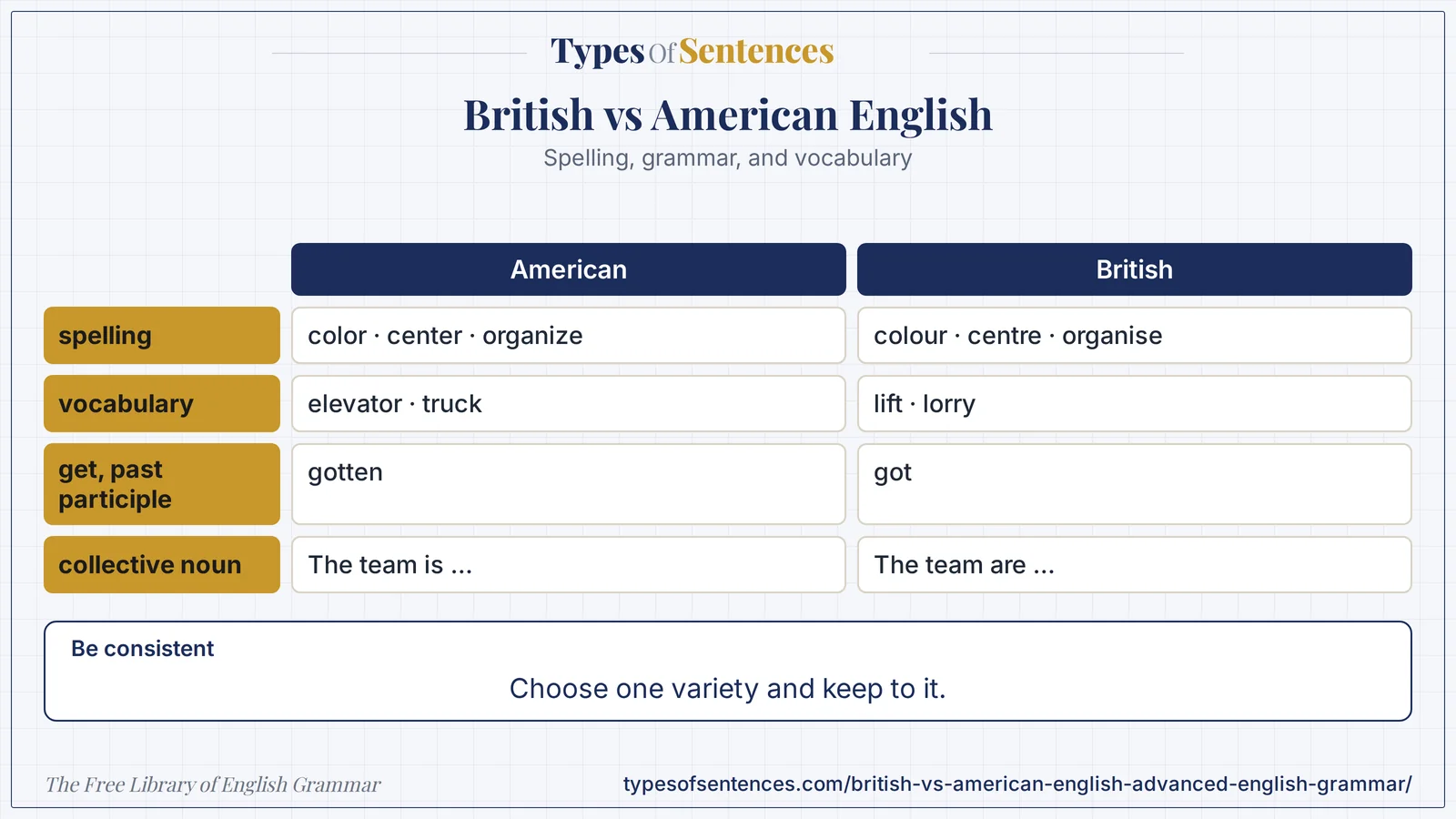
American English and British English are two standard forms of the same language. A word spelled one way in a New York newspaper may be spelled another way in a London one, and both are correct in their own place.
Why it matters: The practical rule is simple: choose the variety your reader expects, and use it everywhere in the document: spelling, vocabulary, punctuation, and dates.
Summary: The two varieties differ in spelling (-or/-our, -er/-re, -ize/-ise, single or double l), in grammar (collective nouns, the present perfect, have got, gotten, prepositions, the subjunctive), in vocabulary (elevator/lift, truck/lorry), in punctuation (double versus single quotation marks, placement of periods and commas, periods after titles, date order), and in pronunciation. The differences are conventions, not errors. Other varieties (Canadian, Australian, Indian) mix features of both. Choose one variety for each document or site, apply it to spelling, vocabulary, punctuation, and dates, and check with the dictionary and a style sheet.
- Spelling: American color, center, organize.
- Grammar: collective nouns, present perfect, gotten.
- Vocabulary: elevator/lift, truck/lorry.
- Be consistent with your variety!
What You’ll Learn
- 1. British vs American English: Spelling Differences
- 2. British American Grammar: Differences in Structure
- 3. Usage Differences: Vocabulary
- 4. Punctuation, Dates, and Numbers
- 5. Pronunciation Differences
- 6. Formal and Informal Differences: Register and Politeness
- 7. Other Varieties: Canadian, Australian, Indian, and More
- 8. Choosing a Variety: Consistency and Audience
- 9. Common Errors and Confusions
- 10. Exercises
- 11. Test Your Knowledge
- 12. Frequently Asked Questions
- 13. Conclusion
1. British vs American English: Spelling Differences
Most spelling differences follow a few patterns. Many were set by the American lexicographer Noah Webster, whose dictionaries of the early nineteenth century promoted simplified forms, while British spelling kept many forms from French and Latin. The patterns are regular, so learning them covers most of the words.
| Pattern | American | British | More examples |
|---|---|---|---|
| -or / -our | color | colour | favor/favour, honor/honour, humor/humour, labor/labour, neighbor/neighbour, behavior/behaviour, flavor/flavour, harbor/harbour, rumor/rumour, vapor/vapour, odor/odour, savior/saviour |
| -er / -re | center | centre | theater/theatre, meter/metre (unit), liter/litre, fiber/fibre, caliber/calibre, somber/sombre, meager/meagre, specter/spectre, saber/sabre |
| -ize / -ise | organize | organise | realize/realise, recognize/recognise, apologize/apologise, criticize/criticise, emphasize/emphasise, summarize/summarise, authorize/authorise, civilize/civilise |
| -yze / -yse | analyze | analyse | paralyze/paralyse, catalyze/catalyse |
| -ense / -ence | defense | defence | offense/offence, pretense/pretence, license (noun)/licence |
| -og / -ogue | catalog | catalogue | dialog/dialogue (both used in American English), analog/analogue, monolog/monologue |
| single or double l | traveling | travelling | canceled/cancelled, modeled/modelled, labeled/labelled, jewelry/jewellery, signaled/signalled, leveled/levelled |
| -ll / -l | fulfill | fulfil | enroll/enrol, skillful/skilful, installment/instalment, willful/wilful |
| ae / oe → e | anemia | anaemia | fetus/foetus, maneuver/manoeuvre, estrogen/oestrogen, encyclopedia/encyclopaedia, pediatric/paediatric, medieval/mediaeval |
| -ment | judgment | judgement | acknowledgment/acknowledgement (both forms occur in British English) |
| -ed / -t (past forms) | learned | learnt | spelled/spelt, burned/burnt, dreamed/dreamt, leaped/leapt, spilled/spilt (both forms occur in British English; American prefers -ed) |
| American | British | Note |
|---|---|---|
| gray | grey | both are listed in American dictionaries; gray is the American norm |
| program | programme | British program for software |
| check (bank) | cheque | check in American English for all senses |
| tire | tyre | the wheel part |
| curb | kerb | the edge of a pavement |
| plow | plough | — |
| mold | mould | — |
| draft | draught | British draught for air and beer; draft for a text |
| pajamas | pyjamas | — |
| skeptic | sceptic | — |
| sulfur | sulphur | international chemistry uses sulfur |
| aluminum | aluminium | — |
| artifact | artefact | — |
| cozy | cosy | — |
| donut | doughnut | donut informal |
| practice (verb) | practise | American practice for noun and verb |
| mustache | moustache | — |
| story (of a building) | storey | — |
| aging | ageing | — |
| sizable | sizeable | — |
| esthetic | aesthetic | aesthetic is common in American English too |
| vise (tool) | vice | — |
| mom | mum | vocabulary and spelling |
| tidbit | titbit | — |
| airplane | aeroplane | — |
| ax | axe | — |
| smolder | smoulder | — |
| specialty | speciality | — |
| rigor | rigour | — |
| pretense | pretence | — |
| carburetor | carburettor | — |
| How to remember | Tip |
|---|---|
| -our / -or | American drops the u in most words |
| -re / -er | American puts er in most words (but not acre or mediocre) |
| -ize | Oxford spelling (a style used by some British publishers) uses -ize too, but not in advertise, surprise, exercise, revise |
| double l | American doubles l only before a stressed syllable (compel, rebel) |
| no ae/oe | American simplifies to e |
Spelling is the most visible difference and is the easiest to control with a spell-checker set to the right variety. Choose the variety first, then check the document against that dictionary. For consistency and style sheets, see the chapter on editing and proofreading.
2. British American Grammar: Differences in Structure
| Feature | American | British | Comment |
|---|---|---|---|
| collective nouns | The team is winning. | The team are winning. (also is) | American takes a singular verb; British often allows a plural verb when the members are in mind |
| present perfect with just, already, yet | I just ate. / Did you eat yet? | I’ve just eaten. / Have you eaten yet? | American uses the simple past more; both varieties accept both |
| possession | Do you have a pen? | Have you got a pen? | have got is more common in British English |
| past participle of get | gotten (He has gotten better) | got (He has got better) | British got also for possession |
| subjunctive after suggest, insist | I suggest that he go. | I suggest that he should go. | the mandative subjunctive also appears in British writing |
| shall | rare | Shall we go? | more common in British English |
| needn’t versus don’t need to | You don’t need to go. | You needn’t go. | both occur |
| dare | I wouldn’t dare to ask. | I daren’t ask. | — |
| light verbs | take a shower, take a walk | have a shower, have a walk | — |
| past forms | learned, spelled, dreamed | learnt, spelt, dreamt (also -ed) | — |
| proved / proven | has proven | has proved | American uses proven more |
| dived / dove | dove (informal) / dived | dived | — |
| fit | The suit fit him. | The suit fitted him. | — |
| quite | quite good (very good) | quite good (moderately good) | different strength |
| whilst, amongst | while, among | whilst, amongst (formal or literary) | — |
| adjectives for adverbs (informal) | He ran real fast. | He ran really fast. | informal American |
| maths | math | maths | — |
| half an hour | a half hour / half an hour | half an hour | — |
| do as a substitute verb | — | I might do. / He hasn’t, but she has done. | British often keeps do after an auxiliary |
| negative questions | Don’t you have one? | Haven’t you got one? | — |
| Prepositions and function words | American | British |
|---|---|---|
| at the weekend | on the weekend | at the weekend |
| Monday to Friday | Monday through Friday | Monday to Friday |
| different | different from / different than | different from / different to |
| write to someone | write me | write to me |
| hospital | in the hospital | in hospital |
| school (as an institution) | in school | at school |
| team | on the team | in the team |
| street | on the street | in the street |
| window | out the window | out of the window |
| time | a quarter of five / after five | a quarter to five / past five |
| university | go to the university (a place) | go to university (an activity) |
| Monday | I’ll see you Monday. | I’ll see you on Monday. |
| talking | talk with | talk to / talk with |
| Additional grammar points | American | British |
|---|---|---|
| agreement with government, committee | singular | singular or plural |
| question tag | Isn’t it? | Isn’t it? (informal: innit?) |
| like as a conjunction | He looks like he’s tired. | He looks as if he’s tired. |
| adverbs without -ly (informal) | Drive slow. | Drive slowly. |
| generic one (formal) | rare | more common |
| ought to in questions | Should we? | Ought we to? / Oughtn’t we? |
Many of these differences are tendencies and not rules. Speakers of each variety understand the other’s forms, and the differences are shrinking as people read and watch material from both. For the underlying grammar, see the chapters on tense and aspect and on the controversies in the previous chapter. The collective-noun difference is a matter of agreement by form or by meaning (notional agreement).
3. Usage Differences: Vocabulary
| Everyday American | British | Everyday American | British |
|---|---|---|---|
| elevator | lift | trunk (car) | boot |
| hood (car) | bonnet | truck | lorry |
| sidewalk | pavement | apartment | flat |
| cookie | biscuit | chips (potato) | crisps |
| french fries | chips | candy | sweets |
| diaper | nappy | pacifier | dummy |
| gas (gasoline) | petrol | subway | underground / tube |
| vacation | holiday | faucet | tap |
| flashlight | torch | cell phone | mobile phone |
| soccer | football | pants | trousers |
| underwear | pants | sweater | jumper |
| sneakers | trainers | vest | waistcoat |
| suspenders | braces | garbage / trash | rubbish |
| trash can | dustbin / bin | mailbox | postbox / letterbox |
| post | zip code | postcode | |
| line (of people) | queue | eraser | rubber |
| Band-Aid | plaster | drugstore | chemist |
| restroom | toilet | stove | cooker |
| closet | wardrobe | drapes | curtains |
| yard | garden | parking lot | car park |
| highway | motorway | overpass | flyover |
| railroad | railway | trailer | caravan |
| gas station | petrol station | license plate | number plate |
| windshield | windscreen | turn signal | indicator |
| stick shift | gear stick | detour | diversion |
| crosswalk | zebra crossing | round trip | return ticket |
| check (restaurant) | bill | appetizer | starter |
| entrée | main course | dessert | pudding / sweet |
| eggplant | aubergine | zucchini | courgette |
| cilantro | coriander | arugula | rocket |
| scallion | spring onion | rutabaga | swede |
| powdered sugar | icing sugar | cotton candy | candy floss |
| ground beef | mince | takeout | takeaway |
| first floor | ground floor | second floor | first floor |
| attic | loft | realtor | estate agent |
| attorney / lawyer | solicitor / barrister | principal (school) | headmaster / head teacher |
| grade (year) | year | semester | term |
| public school (state) | state school | resume | CV |
| fall | autumn | Mom | Mum |
| bangs | fringe | pitcher | jug |
| dumpster | skip | tuxedo | dinner jacket |
| bathrobe | dressing gown | stroller | pushchair |
| wrench | spanner | pantyhose | tights |
| comforter (bedding) | duvet | movie | film |
| mall | shopping centre | billboard | hoarding |
| ladybug | ladybird | sweatpants | tracksuit bottoms |
| checkers (game) | draughts | jump rope | skipping rope |
| cotton swab | cotton bud | tic-tac-toe | noughts and crosses |
| thumbtack | drawing pin | Scotch tape | sticky tape |
| semi (truck) | articulated lorry | broil | grill |
| crib | cot | dollar bill | banknote |
| freshman | first-year student | college (undergraduate) | university |
| Word | American meaning | British meaning | Risk |
|---|---|---|---|
| pants | trousers | underwear | confusion |
| football | American football | soccer | confusion |
| biscuit | a soft bread roll | a cookie | confusion |
| chips | potato crisps | fried potato sticks | confusion |
| jelly | a fruit spread (jelly/jam) | a gelatin dessert | confusion |
| homely | plain, unattractive | welcoming, comfortable | confusion |
| table (a motion) | postpone | bring forward for discussion | reversed meaning |
| quite | very | moderately | confusion |
| mad | angry | insane (also informal) | minor |
| public school | a state school | a private fee-paying school (in England) | confusion |
| first floor | the ground-level floor | the floor above the ground floor | confusion in directions |
| pavement | the road surface | the sidewalk | confusion |
| tube | a TV (old slang) | the London Underground | minor |
| bill | a banknote | a restaurant check | confusion |
Vocabulary differences are the part that readers usually notice and the part that spell-checkers do not catch. When writing for an international audience, choose the term that your readers know, or use a neutral word (to go back instead of to revert in some contexts; to reply for to revert in Indian English; see the chapter on diction). Idioms differ too (see the chapter on idiomatic expressions): to knock on wood is American, to touch wood British; a ballpark figure is American, a rough figure more general.
4. Punctuation, Dates, and Numbers
| Feature | American | British | Example |
|---|---|---|---|
| quotation marks | double (“ ”), with single inside | single (‘ ’), with double inside (common) | American: “She said ‘go.’” / British: ‘She said “go”.’ |
| periods and commas with quotation marks | inside the closing mark | inside if part of the quotation; otherwise outside (“logical” style) | American: “go,” she said. / British: ‘go’, she said. |
| colons and semicolons | outside | outside | — |
| question and exclamation marks | inside only if part of the quotation | same | — |
| period after titles | Mr., Mrs., Dr. | Mr, Mrs, Dr (no period if the abbreviation ends with the last letter) | — |
| period | period | full stop | — |
| parentheses | parentheses | brackets (round brackets); [ ] are “square brackets” | — |
| serial comma | common in many styles | less common (the “Oxford comma” is a choice) | red, white, and blue / red, white and blue |
| dashes | closed em dash (word—word) | spaced en dash (word – word) | — |
| date order | month/day/year | day/month/year | 3/4/2024 = March 4 (American) or 3 April (British) |
| long date | March 4, 2024 | 4 March 2024 | — |
| time | 3:30 p.m. | 3.30 pm or 15:30 | — |
| “and” in numbers | one hundred one | one hundred and one | — |
| decimal and thousands | 3.14; 1,000 | 3.14; 1,000 (also 1 000 in some styles) | — |
| ordinals in dates | March 4 | 4th March (older style) | — |
| hyphenation of prefixes | coworker | co-worker | — |
| Ambiguous date | American reading | British reading |
|---|---|---|
| 03/04/2024 | March 4, 2024 | 3 April 2024 |
| 01/02/2023 | January 2, 2023 | 1 February 2023 |
| 12/11/2022 | December 11, 2022 | 12 November 2022 |
| 05/06/2021 | May 6, 2021 | 5 June 2021 |
Because numeric dates are ambiguous across the two systems, international documents should write the month in words (4 March 2024 or March 4, 2024) or use the ISO form (2024-03-04). The details of quotation marks and the other punctuation marks are treated in the earlier chapters on punctuation; the rule here is consistency within a document.
5. Pronunciation Differences
| Word | American (respelling) | British (respelling) |
|---|---|---|
| schedule | SKED-yool | SHED-yool |
| tomato | tuh-MAY-toe | tuh-MAH-toe |
| advertisement | AD-ver-TYZE-ment | ad-VER-tis-ment |
| garage | guh-RAHZH | GAR-ij / GAR-ahzh |
| herb | urb (the h is silent) | herb |
| vitamin | VY-tuh-min | VIT-uh-min |
| laboratory | LAB-ruh-tor-ee | luh-BOR-uh-tree |
| either / neither | EE-ther / NEE-ther | EYE-ther / NYE-ther (also EE-) |
| route | root / rowt | root |
| leisure | LEE-zher | LEZH-er |
| lieutenant | loo-TEN-ant | lef-TEN-ant |
| zebra | ZEE-bruh | ZEB-ruh |
| missile | MISS-ul | MISS-eyel |
| fertile | FUR-tul | FUR-tyle |
| mobile | MOH-bul | MOH-byle |
| privacy | PRY-vuh-see | PRIV-uh-see |
| process | PRAH-sess | PROH-sess |
| progress (noun) | PRAH-gress | PROH-gress |
| clerk | klurk | klark |
| ate (past of eat) | eyt | et or eyt |
| often | OFF-en (also OFF-ten) | OFF-en |
| been | bin | been or bin |
| dance, class, path | vowel as in cat | vowel as in father (southern British) |
| water | WAW-der (with a flap) | WAW-tuh |
| aluminum / aluminium | uh-LOO-mi-num | al-yoo-MIN-ee-um |
| Pattern | American | British (Received Pronunciation) |
|---|---|---|
| the r after a vowel (car, hard) | pronounced (rhotic) | usually silent (non-rhotic), but pronounced in some accents |
| the t between vowels (water, butter) | often a quick flap, like a soft d | a clear t (or a glottal stop in some accents) |
| tune, news, student | usually “toon”, “nooz” | “tyoon”, “nyooz” |
| stress in some French-derived words | ballet: ba-LAY; garage: guh-RAHZH | ballet: BAL-ay; garage: GAR-ij |
| -ary, -ory, -ery endings | fuller vowels (secretary: SEK-ruh-TAIR-ee) | weakened (secretary: SEK-ruh-tree) |
| -ile endings | weak vowel (fertile: FUR-tul) | long vowel (fertile: FUR-tyle) |
Within each country there is great variety: speakers in Scotland, Wales, Ireland, Australia, India, and the American South and Midwest all have accents of their own. The two labels “American” and “British” are conveniences. Pronunciation is mainly a matter of listening and imitation, and in writing it affects spelling mainly through the choice of a versus an (an herb in American English; a herb in British English).
6. Formal and Informal Differences: Register and Politeness
| Context | American | British |
|---|---|---|
| formal letter (unknown reader) | Dear Sir or Madam / To whom it may concern; Sincerely | Dear Sir or Madam; Yours faithfully |
| formal letter (named reader) | Dear Dr. Rao; Sincerely | Dear Dr Rao; Yours sincerely |
| business email close | Best regards; Regards; Thanks | Kind regards; Best wishes; Regards |
| informal greeting | Hi; Hey | Hello; Hi |
| informal thanks | Thanks; Thank you | Cheers (informal); Thanks |
| informal address | buddy, man (informal) | mate (informal) |
| apology | I’m sorry | Sorry (very frequent, also to get attention) |
| polite request | Could you …? / Would you mind …? | Could you possibly …? / Would you mind …? |
| softening | tends to be direct, with enthusiasm | often indirect, with understatement (not bad = good; quite good = fairly good) |
| phone and mail | Is this Priya? / mail | Is that Priya speaking? / post |
| Typical register markers | American | British |
|---|---|---|
| informal “yes” | yeah; uh-huh | yeah; yep |
| informal intensifier | pretty good, really good, awesome | really good, brilliant, lovely |
| approval | great, awesome, cool | brilliant, lovely, smashing (dated) |
| expressing surprise | Wow! Really? | Blimey (dated); Really? |
| farewell | Take care; See you | Cheers; Bye |
| stereotype to avoid | assuming all Americans are loud or direct | assuming all Britons are understated or formal |
Differences of politeness, directness, and understatement are tendencies in communication styles, not rules, and they vary by region, class, and generation. The study of how meaning depends on context is the subject of the chapter on pragmatics. In business writing, the choice of salutation and close follows the conventions of the reader (see the chapter on business writing): Yours faithfully and Yours sincerely are conventional in British letters, and Sincerely or Best regards in American ones.
7. Other Varieties: Canadian, Australian, Indian, and More
| Variety | Spelling | Vocabulary and grammar | Note |
|---|---|---|---|
| Canadian English | a blend: colour, centre, and -ize, but analyze, tire, and curb | a mix of American and British vocabulary | spelling is a blend |
| Australian English | mostly British (colour, -ise common) | its own vocabulary (arvo, ute); both American and British influences | — |
| Indian English | mostly British spelling (colour, centre, -ise common; -ize also used) | its own vocabulary (prepone, out of station, lakh and crore), and features such as only for emphasis | a major variety with a long written tradition |
| Irish English | British spelling | features from Irish (I’m after eating) | — |
| New Zealand, South African English | British-based spelling | own vocabulary and accents | — |
| Singapore and Malaysian English | British-based spelling | blend of English and local languages in informal registers | — |
| Nigerian and other West African Englishes | British-based spelling | own vocabulary and idiom | — |
| Caribbean Englishes | British-based spelling | own varieties and creoles | — |
| International or global English | neutral choices | avoid idioms and local terms | for mixed audiences |
Varieties differ, and within a country there are standards and accents; none is “more correct”. The most useful habit is to check which one a particular reader or institution expects. In India, for example, official, educational, and newspaper writing generally follow British spelling conventions, and a writer for an Indian audience may choose British spelling for that reason even though this site uses American.
8. Choosing a Variety: Consistency and Audience
| Situation | Choice | Reason |
|---|---|---|
| writing for a United States audience, for an American publisher, or for tests such as the SAT, ACT, or TOEFL | American | the reader’s expectation |
| writing for a British or most Commonwealth readers, or for an institution that follows British style | British | the reader’s expectation |
| an international audience | either, consistently (with plain vocabulary) | clarity |
| a document with a client’s style guide | the guide’s variety | requirement |
| an examination (such as IELTS) | either is accepted, consistently | consistency |
| a website | one variety, stated in the style guide | brand and consistency |
| a thesis | the variety of the institution | requirement |
- Decide the variety at the start, from the reader and the publisher.
- Set the language of the word processor to that variety (for example “English (United States)” or “English (United Kingdom)”).
- Make a style sheet that records spelling (-ize/-ise), punctuation (quotation marks, serial comma), date format, and vocabulary choices.
- Check vocabulary that the spell-checker will not flag (sidewalk/pavement).
- Check punctuation and dates for consistency.
- Do not mix. If you have a quotation in the other variety, keep its original spelling and mark it.
- Proofread with the target variety in mind (see the chapter on editing and proofreading).
| Mixed text (inconsistent) | Consistent American | Consistent British |
|---|---|---|
| I realise that the color of the center is gray, and the meeting is on 4/3/2024. | I realize that the color of the center is gray, and the meeting is on March 4, 2024. | I realise that the colour of the centre is grey, and the meeting is on 4 March 2024. |
| She traveled to the theatre by lorry. | She traveled to the theater by truck. | She travelled to the theatre by lorry. |
| ‘Go,’ he said. The programme was “good”. | “Go,” he said. The program was “good.” | ‘Go’, he said. The programme was ‘good’. |
The most important point is not which variety to choose but that you choose, and that you hold to it. Readers will forgive an unfamiliar word more easily than they forgive a text that seems unsure of its own conventions.
9. Common Errors and Confusions
| Error | Example | Fix |
|---|---|---|
| mixed spelling | color … organise | color … organize (or colour … organise) |
| mixed vocabulary | the lift in the apartment | the elevator in the apartment / the lift in the flat |
| mixed punctuation | ‘Go,’ he said. (in an otherwise American text) | “Go,” he said. |
| ambiguous numeric date | 03/04/2024 | 4 March 2024 / March 4, 2024 |
| using a regional word for an international reader | prepone, out of station, lorry | a neutral word: reschedule earlier, away, truck (as readers expect) |
| assuming one variety is “wrong” | “Colour is a mistake.” | It is the British spelling. |
| false equivalence in a collective noun | The committee are … (in an American text) | The committee is … |
| confusion of football | — | define it |
| unmarked quotation in another variety | changing the spelling inside a quotation | keep the original and mark it |
| mixing -ize and -ise in a British text | realise … organize | one pattern (usually -ise, or Oxford -ize) |
| wrong a/an before herb | a herb (American) | an herb |
| inconsistent time format | 3:30 p.m. … 15.30 | one format |
| periods after titles | Mr Rao (in an American text) | Mr. Rao |
| spelling inside a proper name | changing the spelling of an institution | keep the proper name as it is |
| translating idioms literally | touch wood in an American text | knock on wood |
Edit to consistent American English: The colour of the theatre was grey, and she travelled by lorry to the programme on 3/4/2024, where she realised that the lift was out of order and the jumper in her boot was wet, so she ‘took the pavement’, saying ‘go’, and he said, ‘ok.’
- colour: color.
- theatre: theater.
- grey: gray.
- travelled: traveled.
- lorry: truck.
- programme: program.
- 3/4/2024: ambiguous: March 4, 2024.
- realised: realized.
- lift: elevator.
- jumper in her boot: sweater in her trunk.
- pavement: sidewalk.
- ‘go’: “go”; punctuation inside: “Go,” she said.
- Result: The color of the theater was gray, and she traveled by truck to the program on March 4, 2024, where she realized that the elevator was out of order and the sweater in her trunk was wet, so she took the sidewalk, saying “go,” and he said, “OK.” (the passage is invented)
Recap in 12 seconds
Watch the lesson build itself: American and British English differ in spelling, grammar, and vocabulary; choose one and be consistent. The video has no sound.
Exercises
Part A: Spelling (Exercises 1–8)
Exercise 1: American spelling of colour:
Show Answer
Answer: color.
Exercise 2: American spelling of centre:
Show Answer
Answer: center.
Exercise 3: American spelling of organise:
Show Answer
Answer: organize.
Exercise 4: American spelling of analyse:
Show Answer
Answer: analyze.
Exercise 5: American spelling of defence:
Show Answer
Answer: defense.
Exercise 6: American spelling of travelling:
Show Answer
Answer: traveling.
Exercise 7: British spelling of catalog:
Show Answer
Answer: catalogue.
Exercise 8: British spelling of gray:
Show Answer
Answer: grey.
Part B: Grammar (Exercises 9–14)
Exercise 9: Which variety typically says The team are winning?
Show Answer
Answer: British (also allows is).
Exercise 10: Which says Have you got a pen?
Show Answer
Answer: British (more common).
Exercise 11: Past participle of get in American English:
Show Answer
Answer: gotten.
Exercise 12: Which says on the weekend?
Show Answer
Answer: American.
Exercise 13: Which says in hospital?
Show Answer
Answer: British.
Exercise 14: Which says Monday through Friday?
Show Answer
Answer: American.
Part C: Vocabulary (Exercises 15–21)
Exercise 15: British for elevator:
Show Answer
Answer: lift.
Exercise 16: British for truck:
Show Answer
Answer: lorry.
Exercise 17: American for pavement (sidewalk):
Show Answer
Answer: sidewalk.
Exercise 18: British for cookie:
Show Answer
Answer: biscuit.
Exercise 19: American for petrol:
Show Answer
Answer: gas (gasoline).
Exercise 20: American for flat (home):
Show Answer
Answer: apartment.
Exercise 21: British for fall (season):
Show Answer
Answer: autumn.
Part D: Punctuation and Pronunciation (Exercises 22–27)
Exercise 22: Which uses single quotation marks as the default?
Show Answer
Answer: British.
Exercise 23: Where does American English place a period relative to the closing quotation mark?
Show Answer
Answer: Inside.
Exercise 24: Read 03/04/2024 as American:
Show Answer
Answer: March 4, 2024.
Exercise 25: Read 03/04/2024 as British:
Show Answer
Answer: 3 April 2024.
Exercise 26: Pronounce schedule (American):
Show Answer
Answer: SKED-yool.
Exercise 27: Pronounce tomato (British):
Show Answer
Answer: tuh-MAH-toe.
Part E: Choosing and Consistency (Exercises 28–30)
Exercise 28: Name the first step in choosing a variety.
Show Answer
Answer: Decide from the reader and the publisher.
Exercise 29: Fix: I realise that the color is gray. (American)
Show Answer
Answer: I realize that the color is gray.
Exercise 30: Why avoid numeric dates in international documents?
Show Answer
Answer: They are ambiguous.
Test Your Knowledge
Ready to check what you learned? Answer all 10 questions, then submit. You need 80% (8 of 10) to pass. Your answers are not stored.
View correct answers and explanations
Question 1: Which is the American spelling?
✓ Correct Answer: A – color
American drops the u.
Question 2: Which is the British spelling of center?
✓ Correct Answer: B – centre
The -re pattern.
Question 3: Which describes American quotation conventions?
✓ Correct Answer: C – double marks, periods and commas inside
Double marks and punctuation inside.
Question 4: What does 03/04/2024 mean in American usage?
✓ Correct Answer: D – March 4, 2024
Month/day/year.
Question 5: Which is the American word for lift?
✓ Correct Answer: C – elevator
Elevator.
Question 6: Which collective-noun usage is typical of American English?
✓ Correct Answer: A – The team is winning.
A singular verb.
Question 7: Which form is typical of British English?
✓ Correct Answer: D – learnt
Learnt (also learned).
Question 8: What is the American word for petrol?
✓ Correct Answer: C – gas (gasoline)
Gas.
Question 9: What is the key advice on choosing a variety?
✓ Correct Answer: B – be consistent
Consistency.
Question 10: Which verb ending is typical of American spelling?
✓ Correct Answer: B – -ize
organize.
Frequently Asked Questions
What are the main differences between British and American English?
The main differences are in spelling (color/colour), vocabulary (elevator/lift), some grammar (collective nouns, the present perfect), punctuation (quotation marks, dates), and pronunciation. British vs American English differ, but both are standard.
What are UK US English differences in spelling?
The common patterns are -or/-our, -er/-re, -ize/-ise, -yze/-yse, -ense/-ence, and single or double l. These UK US English differences are regular and can be checked with a spell-checker set to the right variety.
What are the British American grammar differences?
British American grammar differs in collective nouns, the use of the present perfect with just and already, have got versus have, got versus gotten, some prepositions, and the subjunctive.
What are some spelling differences to remember?
Spelling differences to remember include color/colour, center/centre, organize/organise, analyze/analyse, defense/defence, traveling/travelling, and gray/grey.
Which usage differences cause confusion?
Usage differences that confuse include pants, football, biscuit, chips, first floor, quite, and numeric dates such as 03/04/2024.
Which variety should I use?
Use the variety your reader or publisher expects, and keep it consistent in spelling, vocabulary, punctuation, and dates. This site uses American English.
Is one variety more correct than the other?
No. Both are standard varieties. What matters is consistency and the reader’s expectation.
Conclusion
You now have a systematic comparison of British and American English: spelling patterns, grammar differences, vocabulary, punctuation and dates, pronunciation, register, other varieties, and the advice on choosing a variety. You can write for a given reader and keep to one variety.
When you write, decide the variety first and apply it everywhere. Next, you will study the history of English grammar.
- Algeo, John. British or American English? A Handbook of Word and Grammar Patterns. Cambridge University Press, 2006.: a systematic comparison of grammar and vocabulary.
- Trudgill, Peter, and Jean Hannah. International English: A Guide to Varieties of English around the World. 5th ed. Routledge, 2013.: grammar and pronunciation of the standard varieties.
- Garner, Bryan A. Garner’s Modern English Usage. 5th ed. Oxford University Press, 2022.: entries on American and British usage.
- Swan, Michael. Practical English Usage. 4th ed. Oxford University Press, 2016.: British and American differences within entries.
- Merriam-Webster Dictionary: American: the dictionary entry.
Last reviewed: October 29, 2026. How it was made: drafted with AI assistance, then checked with automated tests (structure, links, answer keys, spelling) and against the sources above. A person has not yet read this chapter line by line. Found a mistake? Report it.