Essay structure is the plan that holds an essay together. Every essay has three main parts: an introduction that presents the topic and the thesis, body paragraphs that develop the argument, and a conclusion that closes it. This three-part structure applies to a short school essay and a long academic paper alike, and it is the basis of all essay writing.
This chapter shows how to build each part. You will learn how to write an introduction with a hook and a thesis statement, how to build body paragraphs with evidence, how to write a conclusion that answers the question so what?, how to use the five-paragraph essay as a model, how essay organization patterns work, how to move between paragraphs, and what the main types of essays are. A process for writing essays ends the chapter. Thirty exercises and a quiz follow.
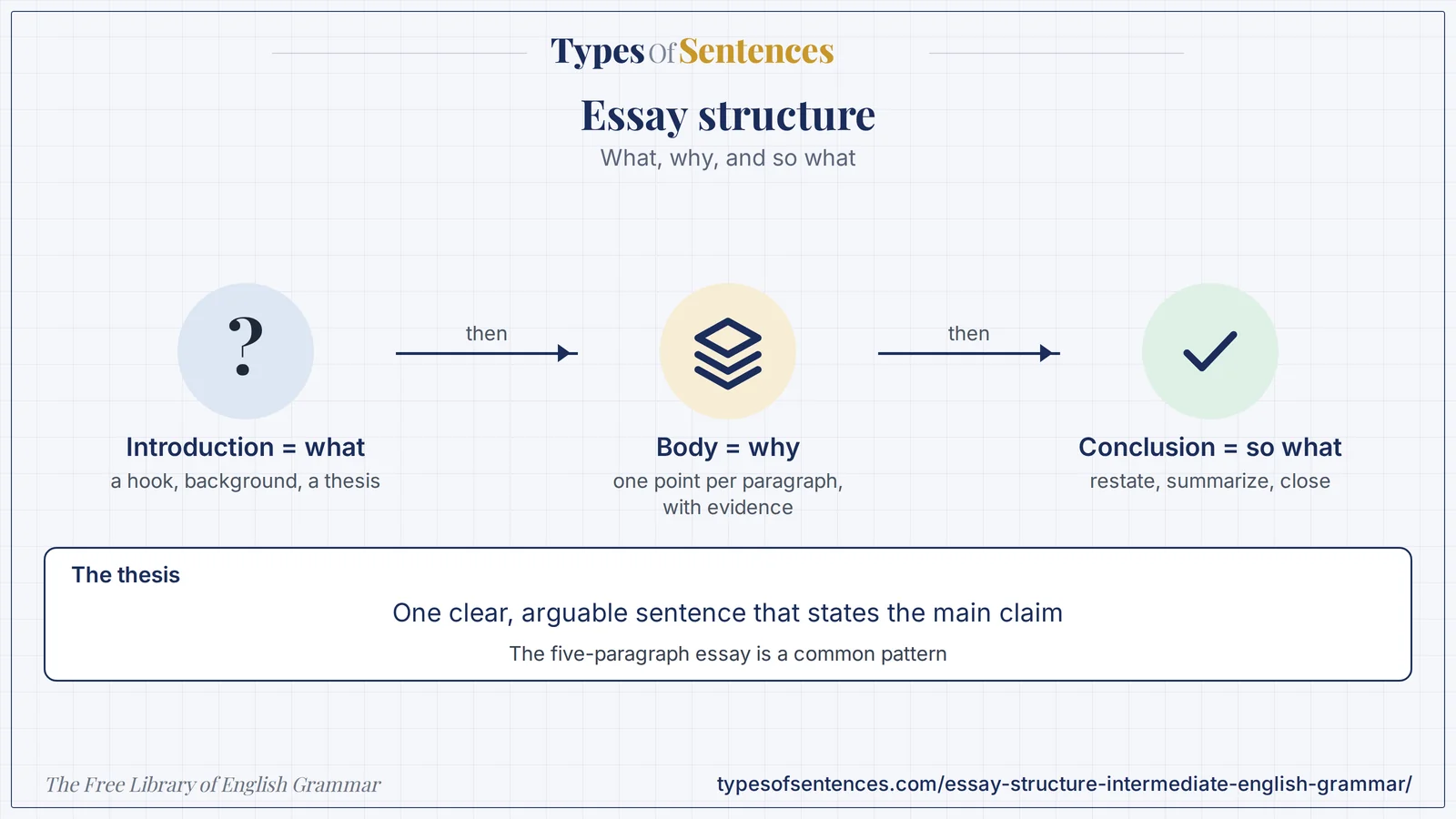
An essay answers a question or makes a point. The introduction tells the reader what the point is, the body proves it, and the conclusion explains why it matters.
Why it matters: If you plan the structure before you write, the essay almost writes itself: each body paragraph supports one part of the thesis.
Summary: An essay has an introduction (a hook, background, and a thesis statement), body paragraphs (each with a topic sentence, evidence, and explanation), and a conclusion (the thesis in new words, a summary, and a closing thought). The five-paragraph essay is the standard model: one introduction, three body paragraphs, one conclusion. Longer essays use the same parts with more body paragraphs.
- Introduction = what: hook, background, thesis.
- Body = why: one point per paragraph, with evidence.
- Conclusion = so what: restate, summarize, close.
- A thesis states the main claim in one clear, arguable sentence.
What You’ll Learn
- 1. Essay Structure: What Is an Essay?
- 2. The Basic Essay Structure
- 3. The Introduction
- 4. Thesis Statements
- 5. Body Paragraphs
- 6. The Conclusion
- 7. Essay Organization Patterns
- 8. Transitions Between Paragraphs
- 9. The Five-Paragraph Essay
- 10. Types of Essays
- 11. The Essay Writing Process
- 12. Common Essay Errors
- 13. Exercises
- 14. Test Your Knowledge
- 15. Frequently Asked Questions
- 16. Conclusion
1. Essay Structure: What Is an Essay?
An essay is a short piece of nonfiction writing on one topic, built around a central idea. In school, essays develop a thesis with reasons and evidence. The structure is a larger version of the paragraph described in the previous chapter on paragraph writing.
| Part | Job | Paragraph model |
|---|---|---|
| introduction | presents the topic and the thesis | topic sentence |
| body paragraphs | develop the thesis point by point | supporting sentences |
| conclusion | closes the essay and answers so what? | concluding sentence |
- A paragraph develops one idea; an essay develops one central idea through several paragraphs.
- Each body paragraph has its own topic sentence, which supports the thesis.
- An essay has a title, which names the topic and often hints at the thesis.
2. The Basic Essay Structure
| Part | Typical content | Approximate share |
|---|---|---|
| title | a short, specific phrase | — |
| introduction | hook, background, thesis statement | 10 to 15 percent |
| body paragraph 1 | topic sentence, evidence, explanation | 25 to 30 percent |
| body paragraph 2 | topic sentence, evidence, explanation | 25 to 30 percent |
| body paragraph 3 | topic sentence, evidence, explanation | 25 to 30 percent |
| conclusion | restated thesis, summary, closing thought | 10 to 15 percent |
The percentages are only a guide. Longer essays add body paragraphs or divide a point into two; shorter essays may have two body paragraphs.
3. The Introduction
The introduction has three jobs: to catch the reader’s interest, to give the background, and to state the thesis. Think of it as a funnel that moves from general to specific.
| Part | Job | Example |
|---|---|---|
| hook | catches interest | Every year, millions of students sit down to write an essay, and most wish they had a plan. |
| background | gives context | Writing a clear essay is a skill that schools teach from an early age. |
| thesis statement | states the main claim | A clear essay needs a strong thesis, well-organized paragraphs, and a purposeful conclusion. |
| Kind of hook | Example |
|---|---|
| a question | What would you do if you could change one thing about your school? |
| a surprising fact | More than half of the world’s population now lives in cities. |
| a short story or anecdote | Last summer, I missed the last bus home. |
| a quotation | “The only way to do great work is to love what you do.” |
| a bold statement | Homework should be abolished. |
4. Thesis Statements
A thesis statement is one sentence, usually at the end of the introduction, that states the main claim of the essay and often previews the points. It is the answer to the question your essay asks.
| Weak thesis | Strong thesis |
|---|---|
| Pollution is bad. (too broad; no one disagrees) | Cities should ban private cars from their centers because cars cause most urban air pollution, noise, and traffic deaths. |
| This essay is about school uniforms. (an announcement) | School uniforms should be required because they reduce bullying, save money, and improve focus. |
| Social media has good and bad points. (vague) | Social media harms teenagers’ sleep and self-esteem more than it helps their friendships. |
| I like soccer. (a preference) | Soccer is the best team sport for children because it teaches cooperation, builds fitness, and costs little. |
- A good thesis is specific, arguable (a reasonable person could disagree), and focused (one main claim).
- A formula: Topic + position + because + two or three reasons.
- The thesis may use a complex sentence; see the chapter on complex sentences, with the reason introduced by because.
- A thesis answers a question. If you cannot write the question, you probably do not yet have a thesis.
5. Body Paragraphs
Each body paragraph develops one reason or point that supports the thesis. The paragraph follows the structure in the previous chapter: a topic sentence, supporting evidence, explanation, and a closing or linking sentence.
| Part | Job | Example (thesis: school uniforms should be required) |
|---|---|---|
| topic sentence | states the point that supports the thesis | First, uniforms reduce bullying. |
| evidence | a fact, example, or quotation | A 2018 survey of three schools found that teasing about clothes dropped after uniforms were introduced. |
| explanation | shows how the evidence supports the point | When everyone dresses alike, students have less reason to judge each other’s clothes. |
| link or closing sentence | ties back to the thesis or leads to the next point | Therefore, uniforms create a more inclusive school. |
A useful memory aid is TEEL: Topic sentence, Evidence, Explanation, Link. Each body paragraph should stay on one point, as in the guide to the topic sentence. If a paragraph has two points, split it into two paragraphs.
6. The Conclusion
The conclusion answers the question so what?. It reminds the reader of the main claim and leaves a final impression.
| Part | Job | Example |
|---|---|---|
| restated thesis | the thesis in new words | In short, school uniforms help students feel equal, save families money, and keep attention on learning. |
| summary of points | the three reasons, briefly | Fewer arguments about clothes, lower costs, and a more focused classroom make uniforms worthwhile. |
| closing thought | a final idea, a recommendation, or a call to action | Schools that want a calmer, fairer atmosphere should consider adopting a uniform policy. |
A conclusion should not introduce a new point or apologize. It should restate the thesis in new words and end firmly.
7. Essay Organization Patterns
| Pattern | Use | How the body paragraphs are ordered |
|---|---|---|
| order of importance | arguments | from the least to the most important reason (or the reverse) |
| chronological | history, processes, narratives | in time order |
| spatial | descriptions of places | from near to far, left to right |
| compare and contrast (block) | two subjects | all about A, then all about B |
| compare and contrast (point by point) | two subjects | price (A, B), quality (A, B), service (A, B) |
| cause and effect | explanations | causes first, then effects (or the reverse) |
| problem and solution | proposals | the problem, its causes, then the solution |
Choose the pattern that fits your purpose, and make it visible with transitions. A short outline helps: write the thesis, then the topic sentence of each body paragraph, then the evidence for each.
8. Transitions Between Paragraphs
| Move | Transition | Example |
|---|---|---|
| to the next point | In addition, Moreover, Furthermore, Another reason | Another reason for uniforms is cost. |
| to a contrast | However, On the other hand, In contrast | However, critics argue that uniforms limit self-expression. |
| to a result | As a result, Therefore, Consequently | Consequently, schools save time each morning. |
| to the conclusion | In conclusion, In short, Overall, Finally | Overall, the benefits outweigh the costs. |
Transitions can come at the end of one paragraph (to lead into the next) or at the start of the next. They are studied in the next chapter on cohesion in writing. A phrase that repeats a key word from the previous paragraph also works as a bridge: This focus on cost leads to a second benefit.
9. The Five-Paragraph Essay
The five-paragraph essay is a standard school model, with one introduction, three body paragraphs, and one conclusion. It teaches the structure that other essays also use.
| Paragraph | Content |
|---|---|
| 1: introduction | hook, background, thesis with three reasons |
| 2: body (reason 1) | topic sentence, evidence, explanation |
| 3: body (reason 2) | topic sentence, evidence, explanation |
| 4: body (reason 3) | topic sentence, evidence, explanation |
| 5: conclusion | restated thesis, summary, closing thought |
Many teachers use the five-paragraph form as training, and many writers move beyond it. A longer essay may have more points, and a shorter argument may need only two. Use the model to learn the parts, and adapt it to the question and the length that the task requires.
10. Types of Essays
| Type | Purpose | Example topic | Studied in |
|---|---|---|---|
| narrative | tells a story | A day I will never forget | the chapter on narrative writing techniques |
| descriptive | describes a person, place, or thing | My grandmother’s kitchen | the chapter on descriptive writing techniques |
| expository | explains or informs | How vaccines work | the chapter on expository writing |
| persuasive (argumentative) | argues for a position | Why schools should start later | the chapter on persuasive writing |
| compare and contrast | shows similarities and differences | Cities and villages | — |
| cause and effect | explains reasons and results | Why prices rise | — |
| process | explains how to do something | How to bake bread | — |
The next chapters in this part cover each of the main types: descriptive and narrative writing, then expository writing and persuasive writing. The structure above applies to all of them, with changes in the body paragraphs.
11. The Essay Writing Process
- Understand the task. Read the question, note the length, the type, and the deadline.
- Prewrite. Brainstorm ideas, list reasons, and choose a focus.
- Write a thesis. State your main claim in one clear sentence.
- Outline. List the introduction, the topic sentence and evidence for each body paragraph, and the conclusion.
- Draft. Write the essay without stopping to fix every mistake.
- Revise. Check the thesis, unity, order, and evidence.
- Edit and proofread. Check grammar, punctuation, capitalization, and spelling.
Outline an essay: Should students wear uniforms?
- Thesis: School uniforms should be required because they reduce bullying, save money, and improve focus.
- Body 1: Uniforms reduce bullying (a survey; reduced teasing about clothes).
- Body 2: Uniforms save families money (the cost of fashion clothing versus two uniforms).
- Body 3: Uniforms improve focus (less time choosing clothes; fewer distractions).
- Conclusion: Restate the thesis, summarize, and recommend that schools consider a uniform policy.
12. Common Essay Errors
| Error | Fix |
|---|---|
| no thesis, or a thesis that only announces the topic | write a specific, arguable claim |
| body paragraphs that do not match the thesis | make each topic sentence support the thesis |
| a body paragraph with several ideas | split it, one point per paragraph |
| evidence with no explanation | explain how the evidence supports the point |
| a conclusion that adds a new point | restate the thesis and close |
| no transitions between paragraphs | link the paragraphs with words or phrases |
| a title that is missing or vague | write a specific title |
| a weak opening (In this essay …) | use a hook |
| a very short essay with underdeveloped points | add examples and explanation |
| skipping revision | revise for structure, then edit for grammar |
Recap in 12 seconds
Watch the lesson build itself: An essay has an introduction with a thesis, body paragraphs with evidence, and a conclusion. The video has no sound.
Exercises
Part A: Parts of an Essay (Exercises 1–5)
Exercise 1: Name the three main parts of an essay.
Show Answer
Answer: Introduction, body, conclusion.
Exercise 2: Which part presents the thesis?
Show Answer
Answer: The introduction.
Exercise 3: Which part answers “so what?”
Show Answer
Answer: The conclusion.
Exercise 4: How many paragraphs are in a five-paragraph essay?
Show Answer
Answer: Five.
Exercise 5: Match: introduction = ___, body = ___, conclusion = ___.
Show Answer
Answer: what; why; so what.
Part B: Introductions and Hooks (Exercises 6–10)
Exercise 6: Name three kinds of hook.
Show Answer
Answer: A question, a surprising fact, an anecdote (also a quotation or a bold statement).
Exercise 7: Which is a weak opening: In this essay, I will talk about uniforms or What if every student wore the same clothes?
Show Answer
Answer: The first.
Exercise 8: Which part of the introduction gives context?
Show Answer
Answer: The background.
Exercise 9: Where does the thesis usually go?
Show Answer
Answer: At the end of the introduction.
Exercise 10: The introduction moves from ___ to ___.
Show Answer
Answer: general to specific.
Part C: Thesis Statements (Exercises 11–16)
Exercise 11: Weak or strong: Pollution is bad.
Show Answer
Answer: Weak (too broad).
Exercise 12: Weak or strong: This essay is about school uniforms.
Show Answer
Answer: Weak (an announcement).
Exercise 13: Improve: Social media has good and bad points.
Show Answer
Answer: Sample: Social media harms teenagers’ sleep and self-esteem more than it helps their friendships.
Exercise 14: Name two qualities of a good thesis.
Show Answer
Answer: Specific and arguable (also focused).
Exercise 15: Write a thesis formula.
Show Answer
Answer: Topic + position + because + reasons.
Exercise 16: What question does a thesis answer?
Show Answer
Answer: The question the essay asks.
Part D: Body Paragraphs and Conclusions (Exercises 17–22)
Exercise 17: What does TEEL stand for?
Show Answer
Answer: Topic sentence, evidence, explanation, link.
Exercise 18: Should each body paragraph have one point or several?
Show Answer
Answer: One.
Exercise 19: What does the explanation do?
Show Answer
Answer: Shows how the evidence supports the point.
Exercise 20: Name the three parts of a conclusion.
Show Answer
Answer: Restated thesis, summary, closing thought.
Exercise 21: Should a conclusion add a new point?
Show Answer
Answer: No.
Exercise 22: Which is better: In conclusion, I have shown that … or In short, …?
Show Answer
Answer: Either is acceptable; avoid long, formulaic announcements.
Part E: Organization and Transitions (Exercises 23–27)
Exercise 23: Which pattern builds from least to most important?
Show Answer
Answer: Order of importance.
Exercise 24: Which pattern suits a historical account?
Show Answer
Answer: Chronological.
Exercise 25: Name two compare-and-contrast arrangements.
Show Answer
Answer: Block and point by point.
Exercise 26: Choose a transition to a contrast: ___, critics argue otherwise.
Show Answer
Answer: However.
Exercise 27: Choose a transition to the conclusion: ___, the benefits outweigh the costs.
Show Answer
Answer: Overall (or In short).
Part F: Types and Process (Exercises 28–30)
Exercise 28: Which type of essay argues for a position?
Show Answer
Answer: Persuasive (argumentative).
Exercise 29: Which type tells a story?
Show Answer
Answer: Narrative.
Exercise 30: Name the step after the first draft.
Show Answer
Answer: Revise.
Test Your Knowledge
Ready to check what you learned? Answer all 10 questions, then submit. You need 80% (8 of 10) to pass. Your answers are not stored.
View correct answers and explanations
Question 1: What are the three main parts of an essay?
✓ Correct Answer: D – Introduction, body, conclusion
The basic structure has an introduction, body, and conclusion.
Question 2: Where does the thesis statement usually go?
✓ Correct Answer: B – At the end of the introduction
The thesis ends the introduction.
Question 3: Which is a strong thesis?
✓ Correct Answer: C – School uniforms should be required because they reduce bullying, save money, and improve focus.
It is specific and arguable.
Question 4: What does a body paragraph need?
✓ Correct Answer: B – A topic sentence and evidence
Each body paragraph has a topic sentence and evidence.
Question 5: What does TEEL stand for?
✓ Correct Answer: D – Topic, evidence, explanation, link
Topic sentence, evidence, explanation, link.
Question 6: Which belongs in a conclusion?
✓ Correct Answer: B – The thesis in new words
Restate the thesis in new words.
Question 7: Which is a hook?
✓ Correct Answer: C – What if every student wore the same clothes?
A question can be a hook.
Question 8: How many paragraphs are in a five-paragraph essay?
✓ Correct Answer: C – Five
Five.
Question 9: Which pattern fits a story?
✓ Correct Answer: A – Chronological
Chronological order fits narratives.
Question 10: What is the first step of the writing process?
✓ Correct Answer: A – Understand the task
Understand the task first.
Frequently Asked Questions
What is essay structure?
Essay structure is the plan of an essay: an introduction with a hook and a thesis statement, body paragraphs that develop the argument, and a conclusion that restates the thesis and closes.
What is essay writing?
Essay writing is the process of building a short piece of nonfiction around a central idea, using a thesis, organized paragraphs, evidence, and a conclusion.
How do I start writing essays?
Start by understanding the task, then brainstorm and write a thesis. Outline the body paragraphs, write a draft, revise for structure and evidence, and edit for grammar. For writing essays well, plan before you write.
What is a five-paragraph essay?
The five-paragraph essay is a model with one introduction, three body paragraphs, and one conclusion. It teaches the basic parts of an essay and is a starting point, not a rule.
What is essay organization?
Essay organization is the order of the body paragraphs: by importance, time, place, comparison, cause and effect, or problem and solution. The order should suit the purpose.
What makes a good thesis statement?
A good thesis is one sentence that is specific, arguable, and focused. It states the main claim and often previews the reasons: School uniforms should be required because they reduce bullying, save money, and improve focus.
How long should an essay be?
It depends on the task. A school essay is often 300 to 800 words, with five paragraphs. Follow the length that the assignment sets, and develop each point enough to prove it.
Conclusion
You now have a guide to essay structure: the introduction with a hook and a thesis, body paragraphs built with TEEL, the conclusion that answers so what, the five-paragraph model, organization patterns, transitions, the main types of essays, and the writing process.
Plan your next essay with a thesis and an outline before you start to write. Next, you will study cohesion, the grammar that links ideas.
- Purdue Online Writing Lab: Essay Writing: reference pages on essay structure, thesis statements, and introductions and conclusions.
- Purdue Online Writing Lab: General Writing: reference pages on writing processes.
- Strunk, William, Jr., and E. B. White. The Elements of Style. 4th ed. Longman, 2000.: principles of composition and revision.
- Quirk, Randolph, et al. A Comprehensive Grammar of the English Language. Longman, 1985.: connection and organization in text.
Last reviewed: October 29, 2026. How it was made: drafted with AI assistance, then checked with automated tests (structure, links, answer keys, spelling) and against the sources above. A person has not yet read this chapter line by line. Found a mistake? Report it.