Descriptive writing techniques help you make readers see, hear, smell, taste, and feel what you describe. A weak description tells (The room was messy); a strong one shows (Socks hung from the lamp, and a pizza box leaned against the door). The aim of description is to create a picture in the reader’s mind with sensory details, precise words, and carefully chosen figurative language.
This chapter covers the main descriptive techniques. You will review the five senses and sensory details, then study showing, not telling, descriptive language that uses figures of speech, precise word choice, creating atmosphere and mood, describing people and places in more depth, the sentence structures that carry description, and avoiding clichés. Thirty exercises and a quiz follow.
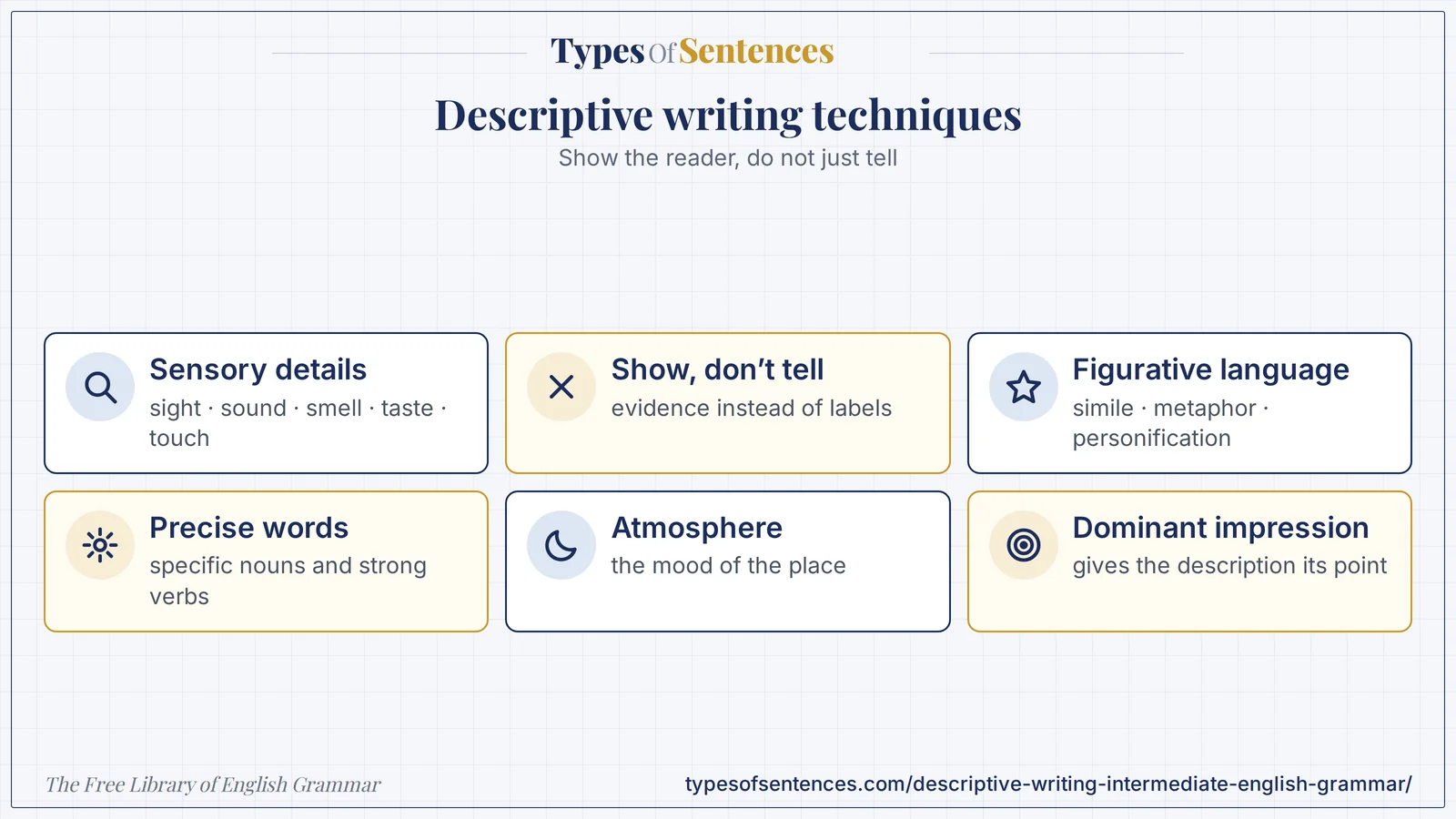
Description is not a list of adjectives. It is a small set of exact details that let the reader fill in the rest. One surprising detail does more than ten general ones.
Why it matters: The golden rule is “show, don’t tell”: instead of naming a feeling or a quality, give the evidence that makes the reader feel it.
Summary: Use the five senses to give sensory details; show, don’t tell, by giving evidence (actions, details, dialogue) instead of labels; use figurative language (simile, metaphor, personification) with care; choose precise nouns and strong verbs; build atmosphere with details that carry a mood; and avoid clichés. Organize a description by a clear order (near to far, top to bottom) around a dominant impression.
- Sensory details: sight, sound, smell, taste, touch.
- Show with evidence; do not label with adjectives.
- Specific nouns and strong verbs beat piles of adjectives.
- A dominant impression gives the description its point.
What You’ll Learn
- 1. Descriptive Writing Techniques: Using the Five Senses
- 2. Showing, Not Telling
- 3. Descriptive Language: Figurative Language
- 4. Precise Word Choice
- 5. Creating Atmosphere and Mood
- 6. Describing People: Advanced
- 7. Describing Places: Advanced
- 8. Avoiding Clichés
- 9. A Descriptive Paragraph: Before and After
- 10. Common Errors in Descriptive Writing
- 11. Exercises
- 12. Test Your Knowledge
- 13. Frequently Asked Questions
- 14. Conclusion
1. Descriptive Writing Techniques: Using the Five Senses
Sensory details are details that appeal to the five senses. Of all the descriptive techniques, sensory detail is the most basic. Most writers rely too much on sight. Adding sound, smell, taste, and touch makes a scene real.
| Sense | Question to ask | Example |
|---|---|---|
| sight | What colors, shapes, and movements are there? | Sunlight slanted through the dusty window onto a torn red couch. |
| sound | What can I hear, loud or quiet? | Rain drummed on the tin roof; somewhere a dog barked twice and stopped. |
| smell | What does it smell like? | The kitchen smelled of cardamom and scorched toast. |
| taste | What does it taste like? | The tea was bitter and metallic, like an old coin. |
| touch | What does it feel like? | The rope was rough and wet, and it burned her palms. |
| movement and body feeling | What do I feel inside? | His heart pounded, and his knees felt weak. |
Choose details that serve a single dominant impression, such as cozy, abandoned, or crowded. If the impression is “abandoned,” details of silence, dust, and rust fit, and details of cheerful bustle do not.
2. Showing, Not Telling
Telling states a fact or a feeling. Showing gives the evidence from which the reader draws the conclusion. Showing, not telling, is the core of descriptive writing.
| Telling | Showing |
|---|---|
| She was nervous. | Her hands trembled as she folded the note into smaller and smaller squares. |
| The room was messy. | Socks hung from the lamp, and a pizza box leaned against the door. |
| He was angry. | He slammed the door so hard that the picture frames rattled. |
| The old man was kind. | The old man slipped a coin into the beggar’s cup and tipped his hat. |
| It was a hot day. | The pavement shimmered, and even the dogs lay flat in the shade. |
| The food was delicious. | The curry was so rich that she mopped the plate with the last piece of bread. |
| Technique | How it shows | Example |
|---|---|---|
| action | what the person does | He drummed his fingers on the table. |
| body language and expression | what the body reveals | Her smile did not reach her eyes. |
| dialogue | what the person says and how | “Fine,” she snapped. “Do what you want.” |
| concrete detail | the object that tells the story | A single wilted rose lay on the floor. |
| setting and weather | the surroundings that echo a mood | Clouds pressed low over the empty street. |
3. Descriptive Language: Figurative Language
Figurative language uses comparison and imagination to make a description vivid. The main figures are listed below.
| Figure | What it does | Example |
|---|---|---|
| simile | compares with like or as | The moon was like a silver coin. |
| metaphor | says one thing is another | The city was a beehive. |
| personification | gives human qualities to a non-human thing | The wind whispered through the trees. |
| hyperbole | exaggerates for effect | I have told you a million times. |
| imagery | creates a mental picture with sensory words | the sharp scent of pine after rain |
| alliteration | repeats an initial sound | the soft, silky sand |
| onomatopoeia | a word that sounds like its meaning | buzz, crash, sizzle |
| symbolism | an object stands for an idea | a locked door that stands for a secret |
- Keep the comparison fresh and fitting. A simile that surprises (The silence sat in the room like a stranger) is better than a stale one (as quiet as a mouse).
- Avoid mixed metaphors: The ship of state is on thin ice mixes two images.
- Use figures sparingly. A page full of them tires the reader.
4. Precise Word Choice
| General | Precise |
|---|---|
| walk | stroll, stride, trudge, limp, march, shuffle |
| said | whispered, muttered, declared, snapped, murmured |
| look | glance, stare, peer, glimpse, squint |
| big house | mansion, estate, sprawling villa |
| a bird | a sparrow, a crow, a hawk |
| nice | generous, charming, welcoming, sweet-natured |
| very tired | exhausted, drained, worn out |
- Prefer specific nouns to general ones (oak to tree).
- Prefer strong verbs to a verb plus an adverb (trudged to walked slowly).
- Prefer one exact adjective to two weak ones. See the chapters on adjective types and types of adverbs.
- Watch connotation, the feeling that a word carries: thrifty is positive, stingy negative, cheap in between. Diction is studied further at the Advanced level.
Piling intensifiers and general adjectives weakens a description. Replace them with specific nouns and strong details.
5. Creating Atmosphere and Mood
Atmosphere (mood) is the feeling that a description creates. It comes from the details that you choose and the words and rhythm that you use.
| Mood | Details | Word choice and rhythm |
|---|---|---|
| eerie, tense | fog, creaking, silence, shadows, cold | short sentences, hard sounds, words like lurked, hollow |
| peaceful, calm | warm light, soft sounds, slow water | long, flowing sentences, soft sounds, words like drifted, hush |
| joyful, lively | bright colors, laughter, music, movement | quick rhythm, active verbs, words like burst, dance |
| sad, lonely | empty rooms, rain, gray light, single objects | slow rhythm, words like faded, alone |
| hot, oppressive | glare, sweat, stillness, buzzing | heavy, slow words, words like sweltering, suffocating |
- Eerie: The fog crept up the lane. Somewhere a gate creaked. Nothing moved.
- Peaceful: The river slid by in the warm light, slow and green, while the reeds nodded in the breeze.
- Lively: Drums burst from the doorway, and children spun through the square, scattering pigeons and laughter.
6. Describing People: Advanced
A good description of a person does more than list height and hair color. It chooses details that reveal character.
| Aspect | What to include | Example |
|---|---|---|
| appearance | one or two distinctive features | a stooped man with ink-stained fingers |
| clothing and objects | what they wear and carry | a coat patched at both elbows |
| movement and gesture | how they move | she tapped her pen against her teeth when thinking |
| voice and speech | how they sound | a voice like gravel in a tin cup |
| behavior | what they do habitually | he straightened every picture he passed |
| background clues | what the details suggest | a faded army cap on the hook |
Use indirect characterization: let the reader infer the person’s character from what they do and say. He returned the extra change to the cashier shows honesty without saying he was honest. Appositives and participial phrases, described in the chapters on appositive phrases and participial phrases, pack several details into one sentence: Mr. Rao, a retired teacher with a gentle smile, shuffled in, clutching a battered briefcase.
7. Describing Places: Advanced
| Order | How it works | Example |
|---|---|---|
| near to far (or far to near) | the eye moves in depth | A cracked path, then a garden gone to seed, then a house, and beyond it the hills. |
| top to bottom (or bottom to top) | the eye moves vertically | Tall steel towers, balconies, shops, and at street level a crowd of cyclists. |
| left to right | the eye sweeps across a scene | On the left a tea stall, in the middle a banyan tree, on the right the old school. |
| general to specific | from the whole to a detail | A busy market; at its center, an old man selling kites. |
| by a moving viewpoint | the narrator walks through | Enter the gate, pass the well, then climb the steps to the porch. |
Choose a vantage point (where the observer stands) and keep it consistent, and move the reader through the place in an order. Then select the details that support your dominant impression and leave out the rest. The grammar of description often uses prepositional phrases of place, as in the chapter on prepositions, and absolute phrases (Rain falling softly, the street was empty), as in the chapter on absolute phrases.
8. Avoiding Clichés
A cliché is a phrase that has been used so often that it has lost its force. Clichés signal that the writer has not looked closely at the subject.
| Cliché | Why it fails | Fresh approach |
|---|---|---|
| as white as snow | everyone has read it | as white as a freshly washed sheet in strong sunlight |
| cold as ice | stale comparison | so cold that her breath froze on her scarf |
| quiet as a mouse | overused | so quiet that he could hear the clock’s tick |
| crystal clear | stock phrase | clear enough to count the pebbles on the bottom |
| a heart of gold | general label | she gave away her lunch to the new boy |
| it was raining cats and dogs | a dead idiom | rain hammered the roof and ran down the street in brown rivers |
9. A Descriptive Paragraph: Before and After
Revise: The market was busy and noisy. There were many people and a lot of things for sale. It smelled nice. It was a hot day, and everyone was tired.
- Problem: telling words (busy, noisy, nice, hot, tired) and vague nouns (things).
- Choose a dominant impression: crowded and sweltering.
- Add sensory details: sounds, smells, touch.
- Use specific nouns, strong verbs, and one fresh comparison.
- Result: Shoppers jostled between stalls stacked with mangoes, brass lamps, and plastic toys. Vendors bellowed prices over the clatter of scales, and the smell of frying samosas drifted through the heat. By noon the tarmac shimmered, and the crowd moved like a slow river, damp shirts clinging to backs.
- Decide the dominant impression.
- Gather sensory details that support it.
- Choose an order (near to far, top to bottom).
- Show instead of telling.
- Use precise words and one or two fresh comparisons.
- Cut clichés and weak intensifiers.
- Read aloud for rhythm.
10. Common Errors in Descriptive Writing
| Error | Fix |
|---|---|
| listing adjectives (a big, old, dark, scary house) | choose one or two exact details |
| telling instead of showing | give the evidence: action, detail, dialogue |
| only sight details | add sound, smell, taste, and touch |
| clichés | look closely and write a fresh image |
| mixed metaphors | keep one image per comparison |
| too many figures of speech | use them sparingly |
| details that do not fit the mood | keep the dominant impression |
| no order (jumping around the scene) | use spatial order and a clear viewpoint |
| piling up intensifiers (very, really) | use a stronger word |
| over-writing (every noun has two adjectives) | prune; trust strong nouns and verbs |
Recap in 12 seconds
Watch the lesson build itself: Techniques for descriptive writing: sensory detail, showing, figurative language, precise words, atmosphere, and a dominant impression. The video has no sound.
Exercises
Part A: Five Senses (Exercises 1–5)
Exercise 1: Name the five senses.
Show Answer
Answer: Sight, sound, smell, taste, touch.
Exercise 2: Add a smell detail to The kitchen was warm.
Show Answer
Answer: Sample: The kitchen was warm and smelled of cardamom.
Exercise 3: Add a sound detail to The street was quiet.
Show Answer
Answer: Sample: The street was so quiet that a distant dog’s bark echoed.
Exercise 4: What is a dominant impression?
Show Answer
Answer: The main feeling or idea that the details create.
Exercise 5: Which detail fits an abandoned house: dust and silence or laughter and music?
Show Answer
Answer: Dust and silence.
Part B: Show, Don’t Tell (Exercises 6–12)
Exercise 6: Show: She was nervous.
Show Answer
Answer: Sample: Her hands trembled as she folded the note into smaller squares.
Exercise 7: Show: The room was messy.
Show Answer
Answer: Sample: Socks hung from the lamp, and a pizza box leaned against the door.
Exercise 8: Show: He was angry.
Show Answer
Answer: Sample: He slammed the door so hard that the frames rattled.
Exercise 9: Show: It was a hot day.
Show Answer
Answer: Sample: The pavement shimmered, and the dogs lay flat in the shade.
Exercise 10: Name two techniques for showing.
Show Answer
Answer: Action and dialogue (also body language, concrete detail, setting).
Exercise 11: Is telling ever acceptable?
Show Answer
Answer: Yes, for quick facts and transitions.
Exercise 12: Which shows: He was kind or He slipped a coin into the beggar’s cup?
Show Answer
Answer: The second.
Part C: Figurative Language (Exercises 13–18)
Exercise 13: Name the figure: The moon was like a silver coin.
Show Answer
Answer: Simile.
Exercise 14: Name the figure: The city was a beehive.
Show Answer
Answer: Metaphor.
Exercise 15: Name the figure: The wind whispered.
Show Answer
Answer: Personification.
Exercise 16: Name the figure: I have told you a million times.
Show Answer
Answer: Hyperbole.
Exercise 17: Name the figure: buzz, crash, sizzle
Show Answer
Answer: Onomatopoeia.
Exercise 18: What is a mixed metaphor?
Show Answer
Answer: Two images that clash in one expression.
Part D: Precise Words and Atmosphere (Exercises 19–24)
Exercise 19: Replace walked slowly with one strong verb.
Show Answer
Answer: trudged (or strolled, shuffled).
Exercise 20: Replace said quietly with one verb.
Show Answer
Answer: whispered (or murmured).
Exercise 21: Replace very tired.
Show Answer
Answer: exhausted.
Exercise 22: Which has a negative connotation: thrifty or stingy?
Show Answer
Answer: stingy.
Exercise 23: Which words suit an eerie mood: lurked, hollow or burst, dance?
Show Answer
Answer: lurked, hollow.
Exercise 24: Which rhythm suits a tense scene: short or long sentences?
Show Answer
Answer: Short.
Part E: People, Places, Clichés (Exercises 25–30)
Exercise 25: What is indirect characterization?
Show Answer
Answer: Showing character through actions and details.
Exercise 26: Name two aspects to describe in a person.
Show Answer
Answer: Appearance and behavior (also voice, clothing, gesture).
Exercise 27: Name a spatial order for a place.
Show Answer
Answer: Near to far (or top to bottom, left to right).
Exercise 28: Why keep a vantage point consistent?
Show Answer
Answer: So the reader can follow the scene.
Exercise 29: Name a cliché: as white as ___.
Show Answer
Answer: snow.
Exercise 30: Replace a cliché: cold as ice.
Show Answer
Answer: Sample: so cold that her breath froze on her scarf.
Test Your Knowledge
Ready to check what you learned? Answer all 10 questions, then submit. You need 80% (8 of 10) to pass. Your answers are not stored.
View correct answers and explanations
Question 1: What does “show, don’t tell” mean?
✓ Correct Answer: C – Give evidence instead of naming a feeling
Show with evidence, not labels.
Question 2: Which is showing?
✓ Correct Answer: B – He slammed the door so hard that the frames rattled.
It gives the evidence of anger.
Question 3: Which is a simile?
✓ Correct Answer: B – The moon was like a silver coin.
A simile uses like or as.
Question 4: Which is a metaphor?
✓ Correct Answer: D – The city was a beehive.
A metaphor says one thing is another.
Question 5: Which is personification?
✓ Correct Answer: C – The wind whispered.
The wind is given a human action.
Question 6: Which is a cliché?
✓ Correct Answer: D – as white as snow
As white as snow is overused.
Question 7: Which word is the most precise?
✓ Correct Answer: C – trudge
Trudge says how.
Question 8: What is a dominant impression?
✓ Correct Answer: A – The main feeling the details create
The details should serve one main feeling.
Question 9: Which suits an eerie mood?
✓ Correct Answer: B – fog and creaking
Fog and creaking build tension.
Question 10: Which is a mixed metaphor?
✓ Correct Answer: A – The ship of state is on thin ice.
Two clashing images.
Frequently Asked Questions
What are descriptive writing techniques?
Descriptive writing techniques include sensory details, showing, not telling, figurative language, precise word choice, creating atmosphere, a clear order, and a dominant impression. They help the reader see and feel what you describe.
What are descriptive techniques for beginners?
The easiest descriptive techniques are to use all five senses, to give one exact detail instead of several general ones, and to replace telling words (nervous, messy) with the evidence for them.
What are sensory details?
Sensory details are details that appeal to the five senses: sight, sound, smell, taste, and touch. They make a scene real, and a good description uses more than sight.
What is showing, not telling?
Showing, not telling means giving the evidence from which the reader draws the conclusion, instead of naming it. Her hands trembled shows nervousness; She was nervous tells it.
What is descriptive language?
Descriptive language is the words that create pictures: specific nouns, strong verbs, exact adjectives, and figures of speech such as similes and metaphors. Choose it with care.
How do I avoid clichés?
Notice phrases that you have heard many times (cold as ice) and ask what you actually see, hear, or feel. Write that specific observation in your own words.
How many adjectives should a description have?
Few. Strong nouns and verbs and one exact adjective usually do more than a pile of adjectives. Every word should add a detail that the reader needs.
Conclusion
You now know the main descriptive writing techniques: sensory details, showing, not telling, figurative language, precise word choice, atmosphere and mood, describing people and places in depth, and avoiding clichés. You can build a description around a dominant impression.
Look at a place for five minutes and write down one detail for each sense; then write a paragraph from the notes. Next, you will study narrative writing techniques.
- Purdue Online Writing Lab: Descriptive Essays: reference page on descriptive writing.
- Purdue Online Writing Lab: General Writing: reference pages on writing processes.
- Strunk, William, Jr., and E. B. White. The Elements of Style. 4th ed. Longman, 2000.: the advice to prefer the specific and concrete.
- Quirk, Randolph, et al. A Comprehensive Grammar of the English Language. Longman, 1985.: adjectives, adverbs, and modification.
Last reviewed: October 29, 2026. How it was made: drafted with AI assistance, then checked with automated tests (structure, links, answer keys, spelling) and against the sources above. A person has not yet read this chapter line by line. Found a mistake? Report it.