What are collective nouns? A collective noun is a singular word that names a group of people, animals, or things: team, flock, bunch. In The team wins most games, team names a group of players but is grammatically one thing. This collective nouns list gives 150 examples, grouped as collective nouns for people, collective nouns for animals, and collective nouns for things.
Each table of collective noun examples shows the term, the members of the group, and a sentence. After the lists, the page explains the rule that causes most mistakes: whether a collective noun takes a singular or a plural verb. It ends with the common mistakes, 30 exercises, and a 10-question quiz. The sentences are my own; the traditional animal terms are listed as terms of art, because many of them are rarely used in ordinary speech.
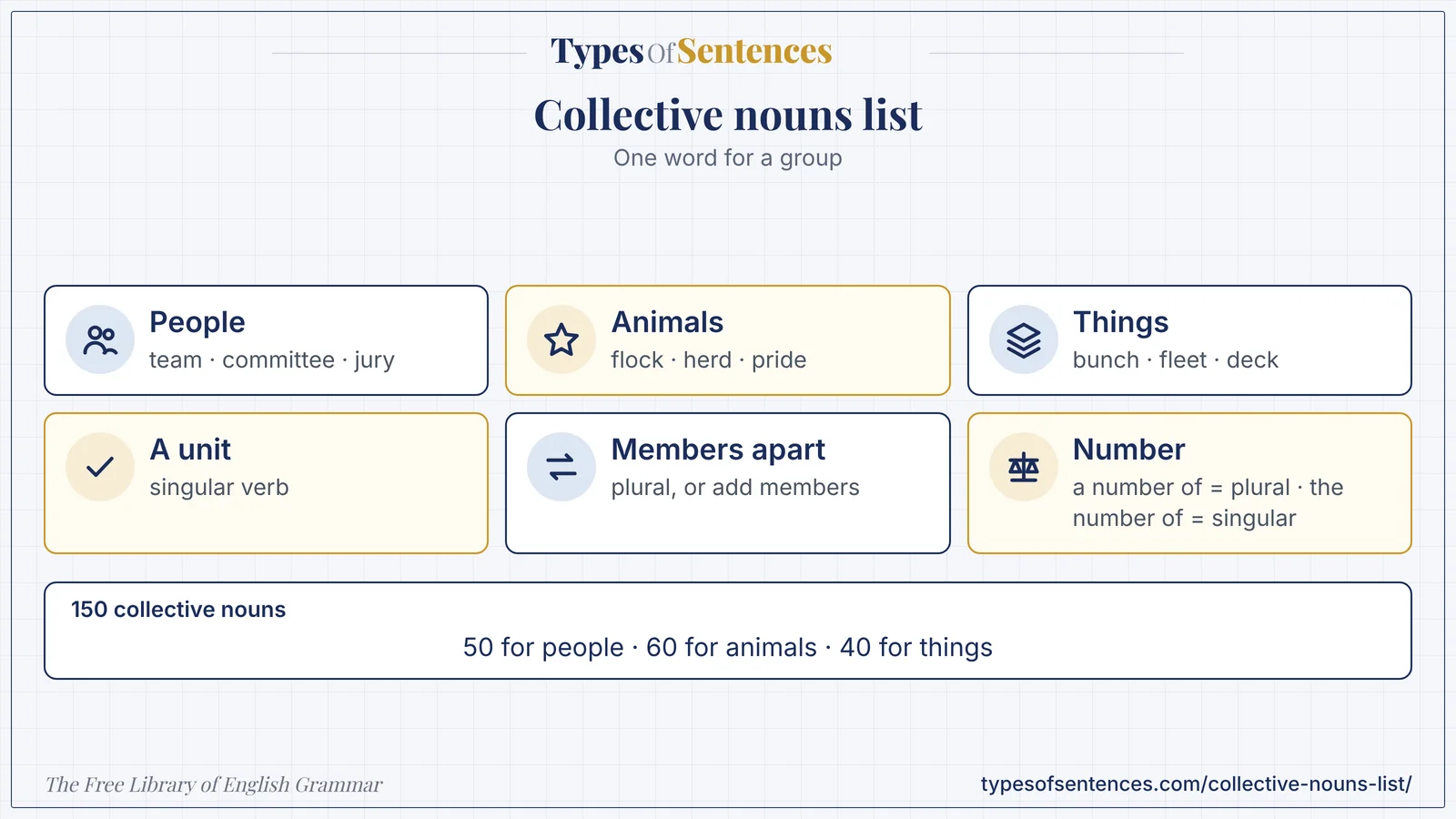
A collective noun is one word for many. A flock is one flock even though it holds many birds.
Why it matters: Most of the time, treat the group as one thing and use a singular verb: The team is ready.
Summary: A collective noun names a group as a single unit: team, committee, flock, bunch. In American English, a collective noun usually takes a singular verb and a singular pronoun when the group acts as one (The team is ready; it will start soon). If the members act separately, the verb may be plural, or the writer adds members (The team members are arguing). British English more often uses a plural verb. A number of takes a plural verb; the number of takes a singular verb. The police and the clergy are always plural. Traditional terms for animals (a murder of crows) are mostly names of fashion, not everyday vocabulary.
- One word for a group.
- Group as a unit: singular verb.
- Members apart: plural, or add members.
- A number of = plural; the number of = singular.
What You’ll Learn
- 1. Collective Nouns List: The Short Answer
- 2. Collective Nouns for People: 50 Examples
- 3. Collective Nouns for Animals: 60 Examples
- 4. Collective Nouns for Things: 40 Examples
- 5. Collective Nouns and Agreement: Singular or Plural?
- 6. Common Mistakes With Collective Nouns
- 7. Exercises
- 8. Test Your Knowledge
- 9. Frequently Asked Questions
- 10. Conclusion
1. Collective Nouns List: The Short Answer
| Kind | Examples | Example sentence |
|---|---|---|
| collective nouns for people | team, committee, family, jury, crowd | The jury has reached a verdict. |
| collective nouns for animals | flock, herd, pack, pride, school, swarm | A pride of lions rested. |
| collective nouns for things | bunch, stack, fleet, deck, bouquet | A fleet of ships sailed. |
This collective nouns list has 150 terms: 50 for people, 60 for animals, and 40 for things. It is not a complete list, because English has hundreds of such terms, and many traditional ones are listed in word books rather than used in everyday speech. When a term is only traditional, the example sentence says so.
2. Collective Nouns for People: 50 Examples
These collective nouns for people and organizations name groups of people. Many take either a singular or a plural verb, depending on the meaning (see the agreement section below).
| Collective noun | Members | Example sentence |
|---|---|---|
| audience | listeners or viewers | The audience was moved by the final song. |
| band | musicians | The band plays every Friday. |
| board | directors | The board meets on Monday. |
| cabinet | ministers or advisers | The cabinet approved the budget. |
| cast | actors | The cast takes a bow. |
| choir | singers | The choir sings in the church. |
| chorus | singers or dancers | The chorus rehearses at noon. |
| clan | relatives | The clan gathers once a year. |
| class | students | The class is quiet today. |
| committee | members | The committee has chosen a chairman. |
| company | actors, soldiers, or guests | The company performs on a small stage. |
| congregation | worshippers | The congregation rose to sing. |
| council | advisers or officials | The council votes on Tuesday. |
| crew | sailors or workers | The crew was ready to sail. |
| crowd | spectators | The crowd cheered the winners. |
| delegation | representatives | The delegation arrived this morning. |
| ensemble | musicians | The ensemble tunes its instruments. |
| faculty | teachers | The faculty meets in the main hall. |
| family | relatives | Our family lives in Pune. |
| gang | friends or workers | A gang of workers repaired the road. |
| jury | citizens who judge a case | The jury has reached a verdict. |
| league | teams or clubs | The league starts in March. |
| brigade | soldiers or firefighters | The brigade arrived within minutes. |
| orchestra | musicians | The orchestra tunes up at seven. |
| panel | experts | The panel answers questions after the talk. |
| party | travelers or guests | The party set out at dawn. |
| patrol | guards or police officers | The patrol checks the gate each hour. |
| platoon | soldiers | The platoon crossed the river. |
| regiment | soldiers | The regiment marched home. |
| senate | senators | The senate debates the bill. |
| squad | players or officers | The squad trains every morning. |
| staff | employees | The staff is small but skilled. |
| team | players | The team wins most games. |
| tribe | people who share a culture | The tribe lives by the river. |
| cohort | people who share a trait or start | The cohort graduates in June. |
| troupe | performers | The troupe tours in winter. |
| union | workers | The union demands better pay. |
| unit | soldiers or workers | The unit works at night. |
| syndicate | investors or businesspeople | The syndicate bought the building. |
| generation | people born in the same period | Each generation learns from the last. |
| legion | soldiers | The legion camped beside the river. |
| assembly | delegates or students | The assembly votes at noon. |
| bench | judges or magistrates | The bench retired to consider the case. |
| bloc | countries or voters | The bloc voted as one. |
| commission | appointed members | The commission publishes its report in May. |
| contingent | troops or delegates | The contingent arrived by train. |
| corps | trained members of a service | The press corps waited outside. |
| gathering | friends or guests | The gathering lasted until midnight. |
| household | people who live together | The household wakes at six. |
| society | members of a club | The society meets once a month. |
3. Collective Nouns for Animals: 60 Examples
These collective nouns for animals include everyday terms (flock, herd, pack, school) and traditional or humorous ones (murder of crows, parliament of owls, unkindness of ravens). The traditional terms come from old hunting and word books, and writers use them for color; in science writing, simpler terms are normal. Several are given in more than one form in the sources, so a different book may use a different term for the same animal.
| Collective noun | Members | Example sentence |
|---|---|---|
| flock | birds or sheep | A flock of sheep crossed the road. |
| herd | cattle, elephants, deer, or horses | A herd of elephants drank at the river. |
| pack | wolves or dogs | A pack of wolves howled at the moon. |
| pride | lions | A pride of lions rested in the shade. |
| school | fish | A school of fish swam past the diver. |
| shoal | fish | A shoal of herring shimmered below. |
| swarm | bees or insects | A swarm of bees settled on the branch. |
| colony | ants, bats, or penguins | A colony of ants crossed the path. |
| pod | whales or dolphins | A pod of dolphins leaped beside the boat. |
| gaggle | geese on the ground | A gaggle of geese blocked the lane. |
| skein | geese in flight | A skein of geese flew south. |
| murder | crows | A murder of crows gathered in the field. |
| parliament | owls | A parliament of owls watched from the tree. |
| litter | puppies, kittens, or piglets | A litter of kittens slept in the box. |
| brood | chicks | A brood of chicks followed the hen. |
| troop | monkeys or baboons | A troop of monkeys raided the camp. |
| clowder | cats | A clowder of cats lived in the barn. |
| covey | quail or partridges | A covey of quail rose from the grass. |
| exaltation | larks | An exaltation of larks sang over the meadow. |
| murmuration | starlings | A murmuration of starlings twisted in the sky. |
| unkindness | ravens | An unkindness of ravens sat on the wall. |
| skulk | foxes | A skulk of foxes slipped through the trees. |
| sloth | bears | A sloth of bears fished in the stream. |
| crash | rhinoceroses | A crash of rhinoceroses grazed on the plain. |
| tower | giraffes | A tower of giraffes walked across the savanna. |
| dazzle | zebras | A dazzle of zebras stood at the water hole. |
| business | ferrets | A business of ferrets raced across the yard. |
| mob | kangaroos | A mob of kangaroos bounded over the hill. |
| shrewdness | apes | A shrewdness of apes played in the trees. |
| flamboyance | flamingos | A flamboyance of flamingos stood in the lake. |
| kettle | hawks in flight | A kettle of hawks rose on the warm air. |
| convocation | eagles | A convocation of eagles perched on the cliff. |
| charm | finches | A charm of finches sang in the hedge. |
| raft | ducks on water | A raft of ducks floated on the pond. |
| army | frogs | An army of frogs croaked after the rain. |
| knot | toads | A knot of toads sat under the log. |
| nest | vipers or snakes | A nest of vipers lay under the rock. |
| romp | otters | A romp of otters slid down the bank. |
| plague | locusts | A plague of locusts stripped the fields. |
| cloud | gnats or flies | A cloud of gnats hung over the water. |
| drove | cattle or pigs | A drove of cattle moved down the lane. |
| rookery | rooks or penguins | A rookery of rooks nested in the elms. |
| bevy | quail or swans | A bevy of swans glided across the lake. |
| wake | vultures | A wake of vultures circled overhead. |
| ambush | tigers | An ambush of tigers is a traditional term. |
| leap | leopards | A leap of leopards is a traditional term. |
| bask | crocodiles | A bask of crocodiles lay on the sandbank. |
| descent | woodpeckers | A descent of woodpeckers is a traditional term. |
| labor | moles | A labor of moles is a traditional term. |
| mischief | mice | A mischief of mice lived in the barn. |
| tiding | magpies | A tiding of magpies sat on the fence. |
| prickle | porcupines | A prickle of porcupines crossed the road. |
| bloat | hippopotamuses | A bloat of hippopotamuses rested in the river. |
| cete | badgers | A cete of badgers is a traditional term. |
| sounder | boars or wild pigs | A sounder of boars rooted in the wood. |
| conspiracy | lemurs | A conspiracy of lemurs is a traditional term. |
| caravan | camels | A caravan of camels crossed the dunes. |
| bloom | jellyfish | A bloom of jellyfish drifted into the bay. |
| host | sparrows | A host of sparrows chirped in the hedge. |
| siege | herons | A siege of herons stood in the marsh. |
4. Collective Nouns for Things: 40 Examples
These terms name groups of objects. Some are everyday measures (bunch, stack, set); others are more formal (armada, constellation, arsenal). Each is followed by of and the name of the things.
| Collective noun | Members | Example sentence |
|---|---|---|
| bunch | grapes, bananas, flowers, or keys | She carried a bunch of keys. |
| bouquet | flowers | He gave her a bouquet of roses. |
| bundle | sticks or letters | A bundle of letters lay on the desk. |
| stack | papers or bricks | A stack of papers covered the desk. |
| pile | clothes or leaves | A pile of leaves filled the yard. |
| set | tools or dishes | He bought a set of tools. |
| fleet | ships, cars, or trucks | A fleet of trucks left the depot. |
| deck | playing cards | He shuffled a deck of cards. |
| collection | stamps or coins | She has a collection of stamps. |
| cluster | stars or grapes | A cluster of stars shone overhead. |
| constellation | stars | A constellation of stars lit the night. |
| range | mountains | A range of mountains rose in the north. |
| chain | islands or mountains | A chain of islands lies off the coast. |
| grove | trees | A grove of lemon trees stood by the house. |
| orchard | fruit trees | An orchard of apple trees covers the hill. |
| stand | trees | A stand of pines grew near the lake. |
| string | pearls or lights | She wore a string of pearls. |
| flight | stairs | We climbed a flight of stairs. |
| ream | paper | The printer needs a ream of paper. |
| quiver | arrows | He carried a quiver of arrows. |
| batch | cookies or letters | She baked a batch of cookies. |
| bale | hay or cotton | A bale of hay lay in the barn. |
| suite | rooms or furniture | The hotel has a suite of rooms. |
| series | events or books | A series of storms hit the coast. |
| album | photographs | An album of photographs sat on the shelf. |
| anthology | poems or stories | An anthology of poems is on the table. |
| wardrobe | clothes | Her wardrobe of winter clothes is large. |
| sheaf | papers or grain | He held a sheaf of papers. |
| clutch | eggs | A clutch of eggs lay in the nest. |
| convoy | trucks or ships | A convoy of trucks crossed the border. |
| armada | ships | An armada of ships sailed at dawn. |
| flotilla | small boats | A flotilla of boats crossed the bay. |
| volley | arrows or questions | A volley of arrows flew over the wall. |
| barrage | questions or attacks | A barrage of questions followed. |
| wave | protests or attacks | A wave of protests spread across the city. |
| array | solar panels or instruments | An array of solar panels covers the roof. |
| arsenal | weapons | The army has a large arsenal of weapons. |
| heap | sand or rubbish | A heap of sand stood by the road. |
| tuft | grass or hair | A tuft of grass grew from the wall. |
| patch | flowers or ice | A patch of flowers bloomed by the gate. |
A collective noun can have a possessive form, as in the team’s coach and the flock’s shepherd; the rules are in the guide to possessive nouns.
5. Collective Nouns and Agreement: Singular or Plural?
| Situation | Verb | Example | Comment |
|---|---|---|---|
| the group acts as one unit | singular verb | The team is ready. The committee has decided. | the usual choice in American English |
| the members act separately | plural verb (or add members) | The team are arguing among themselves. / The team members are arguing. | plural verbs are more common in British English; American writers often add members |
| a number of | plural verb | A number of students were absent. | means “several” |
| the number of | singular verb | The number of students is rising. | number is the subject |
| a pair of + plural noun | singular verb | A pair of shoes is on the floor. | pair is the subject |
| a flock of + plural noun | singular verb | A flock of birds is circling. | the head noun is flock |
| the police, the clergy | plural verb | The police are here. | these words are always plural |
| staff, family, class | singular or plural by meaning | The staff is small. / The staff are on vacation. | American English prefers singular |
The basic rule of agreement is in the Basic chapter on subject-verb agreement, and the traps that the SAT sets are in the guide to SAT subject-verb agreement. Whichever verb you choose, keep the pronoun consistent: The committee has made its decision (singular), not The committee has made their decision in the same sentence as a singular verb. Pronoun agreement is covered in the guide to SAT pronoun questions.
| Collective noun and pronoun | Correct (American) | Mixed (avoid) |
|---|---|---|
| unit | The team is ready, and it will start soon. | *The team is ready, and they will start soon. |
| separate members | The team members are ready, and they will start soon. | *The team is ready, and they argue. |
| an organization | The company announced its profits. | *The company announced their profits. |
| a family | The family is moving to Pune; it will arrive in May. | *The family is moving, and they will arrive in May. |
In British English, The team are ready and The company announced their profits are common and accepted, so a mixed sentence that looks wrong to an American editor may be normal in British writing. Follow one style consistently, and follow the style that your teacher, exam, or publisher requires.
6. Common Mistakes With Collective Nouns
| Mistake | Example | Correction |
|---|---|---|
| plural verb with a unit group (American style) | *The committee are deciding today. | The committee is deciding today. |
| singular verb with a number of | *A number of students is absent. | A number of students are absent. |
| plural verb with the number of | *The number of students are rising. | The number of students is rising. |
| mixed singular and plural in one sentence | *The jury is out, and they have not decided. | The jury is out, and it has not decided. |
| the police is | *The police is here. | The police are here. |
| wrong term for the animal | *A pride of crows | A murder of crows |
| of missing | *a flock birds | a flock of birds |
| wrong possessive | *the teams coach | the team’s coach |
| verb that follows the nearest noun | *A flock of birds are circling. | A flock of birds is circling. |
Fix: The committee are meeting today, and a number of its members is late, but the number of absentees are small, so they will start soon.
- The committee are meeting: a group acting as one, so The committee is meeting (American style).
- a number of its members is late: a number of is plural, so are late.
- the number of absentees are small: the number is singular, so is small.
- so they will start: keep one pronoun for the unit, so so it will start.
- Result: The committee is meeting today, and a number of its members are late, but the number of absentees is small, so it will start soon. (the sentence is invented)
Recap in 12 seconds
Watch the lesson build itself: A list of 150 collective nouns for people, animals, and things, with the rule that a group acting as a unit takes a singular verb. The video has no sound.
Exercises
Part A: Match the Collective Noun (Exercises 1–10)
Exercise 1: a ___ of lions
Show Answer
Answer: pride.
Exercise 2: a ___ of wolves
Show Answer
Answer: pack.
Exercise 3: a ___ of fish
Show Answer
Answer: school (or shoal).
Exercise 4: a ___ of bees
Show Answer
Answer: swarm.
Exercise 5: a ___ of cattle
Show Answer
Answer: herd.
Exercise 6: a ___ of keys
Show Answer
Answer: bunch.
Exercise 7: a ___ of cards
Show Answer
Answer: deck.
Exercise 8: a ___ of ships
Show Answer
Answer: fleet.
Exercise 9: a ___ of players
Show Answer
Answer: team.
Exercise 10: a ___ of crows
Show Answer
Answer: murder (a traditional term).
Part B: Choose the Verb (Exercises 11–20)
Exercise 11: The team (is / are) ready to start. (American style, a unit)
Show Answer
Answer: is.
Exercise 12: The committee (has / have) decided. (American style)
Show Answer
Answer: has.
Exercise 13: A number of students (was / were) absent.
Show Answer
Answer: were.
Exercise 14: The number of students (is / are) rising.
Show Answer
Answer: is.
Exercise 15: The police (is / are) at the door.
Show Answer
Answer: are.
Exercise 16: A flock of birds (is / are) circling.
Show Answer
Answer: is.
Exercise 17: The family (lives / live) in Pune. (American style)
Show Answer
Answer: lives.
Exercise 18: The jury (has / have) reached a verdict. (American style)
Show Answer
Answer: has.
Exercise 19: A bunch of keys (was / were) on the table.
Show Answer
Answer: was.
Exercise 20: The staff (is / are) small. (American style)
Show Answer
Answer: is.
Part C: Choose the Pronoun (Exercises 21–25)
Exercise 21: The company announced (its / their) profits. (American style)
Show Answer
Answer: its.
Exercise 22: The team is ready, and (it / they) will start soon. (American style)
Show Answer
Answer: it.
Exercise 23: The jury is out; (it / they) has not decided. (American style)
Show Answer
Answer: it.
Exercise 24: The committee made (its / their) decision. (American style)
Show Answer
Answer: its.
Exercise 25: The class finished (its / their) test. (American style)
Show Answer
Answer: its.
Part D: Correct the Errors (Exercises 26–30)
Exercise 26: Correct: *A number of students is absent.
Show Answer
Answer: A number of students are absent.
Exercise 27: Correct: *The number of students are rising.
Show Answer
Answer: The number of students is rising.
Exercise 28: Correct: *The police is here.
Show Answer
Answer: The police are here.
Exercise 29: Correct: *a flock birds
Show Answer
Answer: a flock of birds
Exercise 30: Correct: *the teams coach
Show Answer
Answer: the team’s coach
Test Your Knowledge
Ready to check what you learned? Answer all 10 questions, then submit. You need 80% (8 of 10) to pass. Your answers are not stored.
View correct answers and explanations
Question 1: A collective noun names
✓ Correct Answer: D – a group as one unit
A group.
Question 2: Which is a collective noun?
✓ Correct Answer: A – flock
Flock.
Question 3: A group of lions is called a
✓ Correct Answer: B – pride
Pride.
Question 4: A group of fish is called a
✓ Correct Answer: C – school
School.
Question 5: In American English, The team ___ ready.
✓ Correct Answer: D – is
Unit, singular.
Question 6: A number of students ___ absent.
✓ Correct Answer: A – are
Plural.
Question 7: The number of students ___ rising.
✓ Correct Answer: B – is
Singular.
Question 8: The police ___ here.
✓ Correct Answer: C – are
Always plural.
Question 9: A group of crows is traditionally called a
✓ Correct Answer: D – murder
Murder.
Question 10: The pronoun for The company announced ___ profits in American English is
✓ Correct Answer: A – its
Singular unit.
Frequently Asked Questions
What are collective nouns?
Collective nouns are singular words that name a group of people, animals, or things, such as team, flock, and bunch.
Do collective nouns take a singular or plural verb?
In American English, usually singular when the group acts as a unit (The team is ready). When the members act separately, a plural verb is possible, or writers add members. British English often uses a plural verb.
What are some collective noun examples for animals?
Common ones are a flock of birds, a herd of cattle, a pack of wolves, a pride of lions, a school of fish, and a swarm of bees. Traditional ones include a murder of crows and a parliament of owls.
What are collective nouns for people?
Examples are team, committee, family, jury, crowd, class, staff, band, board, and audience.
Is “police” a collective noun?
Yes, and it always takes a plural verb: The police are here.
Is “a number of” singular or plural?
A number of takes a plural verb (A number of students are absent), while the number of takes a singular verb (The number of students is rising).
Are the traditional animal terms real English?
They are real terms in word books and are used for effect, but most are rare in everyday speech. Many sources give different terms for the same animal, so treat them as traditional, not required.
Conclusion
You now have a collective nouns list of 150 terms, with collective noun examples for each group, for people, animals, and things, and you know the rule for agreement: a singular verb when the group acts as a unit, a plural verb or the word members when it acts as individuals.
Choose a verb and a pronoun and keep them consistent in the sentence. Next, study the other lists in this series, such as the pronouns and the verb lists.
- Garner, Bryan A. Garner’s Modern English Usage. 5th ed. Oxford University Press, 2022.: the entries on collective nouns.
- Swan, Michael. Practical English Usage. 4th ed. Oxford University Press, 2016.: the entries on singular and plural with group words.
- Quirk, Randolph, et al. A Comprehensive Grammar of the English Language. Longman, 1985.: the discussion of collective nouns and agreement.
- Merriam-Webster Dictionary: collective noun: the dictionary entry (not opened when this page was written). The traditional animal terms were written from general knowledge of word-book usage and were not checked against a single source.
Last reviewed: October 29, 2026. How it was made: drafted with AI assistance, then checked with automated tests (structure, links, answer keys, spelling) and against the sources above. A person has not yet read this chapter line by line. Found a mistake? Report it.