What is SAT subject verb agreement? Subject verb agreement is the rule that a verb must match its subject in number: a singular subject takes a singular verb (The dog barks), and a plural subject takes a plural verb (The dogs bark). On the digital SAT these questions belong to the Form, Structure, and Sense skill of the Standard English Conventions domain, which the College Board describes as about 26 percent of the Reading and Writing section (11 to 15 of its 54 questions). The choices show verb forms such as is, are, was, and were, and you must pick the one that agrees with the real subject.
This page explains the method for every SAT agreement question and lists the subject verb agreement rules and traps with correct and incorrect examples: subject verb agreement with prepositional phrases and other interrupters, inverted sentences, compound subjects, or and nor, indefinite pronouns, collective nouns, and relative clauses. It gives 30 original practice items (not taken from the College Board) and a 10-question quiz. It also covers the neighboring digital SAT subject verb agreement traps that involve verb form and tense.
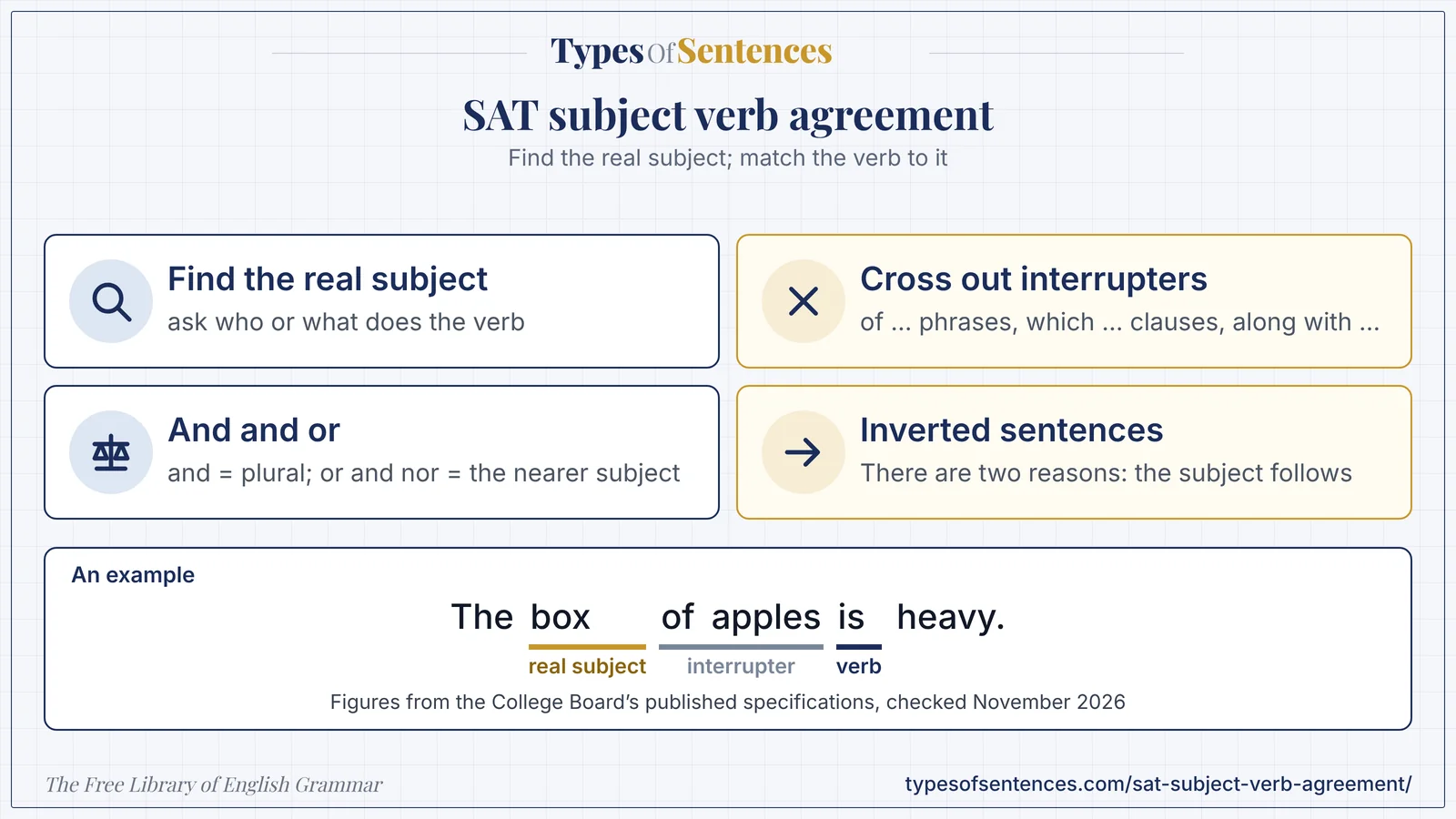
The subject is the person or thing that does the verb’s action or is described by it. The verb has to agree with that word, not with the nearest word. Test writers hide the subject by putting other nouns between it and the verb.
Why it matters: The method is always the same: find the verb, ask who or what does it, cross out the interrupting phrases, and match the number.
Summary: On the digital SAT, subject verb agreement is tested with verb-form choices (is, are, was, were, has, have). The method is to find the real subject by crossing out interrupters (prepositional phrases, appositives, relative clauses, and phrases with along with or as well as) and then to match the verb to it. Compound subjects with and take a plural verb; with or or nor the verb agrees with the nearer subject. Singular indefinite pronouns (each, everyone, neither) take singular verbs; both, few, many, and several take plural verbs. In inverted sentences (There are two reasons), the subject follows the verb. A relative pronoun takes the number of its antecedent.
- Find the real subject.
- Cross out interrupters.
- And = plural; or/nor = nearer subject.
- Inverted: subject after the verb.
What You’ll Learn
- 1. SAT Subject Verb Agreement: The Short Answer
- 2. Subject Verb Agreement With Prepositional Phrases and Other Interrupters
- 3. Subject Verb Agreement Rules: The Complete Table
- 4. And, Or, and Nor: Compound Subjects on the SAT
- 5. Verb Form and Tense Traps Near Agreement Questions
- 6. Common Mistakes on SAT Agreement Questions
- 7. Exercises
- 8. Test Your Knowledge
- 9. Frequently Asked Questions
- 10. Conclusion
1. SAT Subject Verb Agreement: The Short Answer
| Fact | Detail |
|---|---|
| where | the Standard English Conventions domain of the digital SAT Reading and Writing section |
| skill | Form, Structure, and Sense (agreement, verb forms, pronouns, modifiers, possessives, parallelism) |
| share | Standard English Conventions is about 26 percent of the section, or 11 to 15 of 54 questions |
| format | a short text with a blank, and four choices that are verb forms |
| clue | the choices differ in number or tense (is, are, was, were) |
| official practice | the College Board’s Bluebook app and Student Question Bank |
| Step | Do this | Example |
|---|---|---|
| 1 find the verb | locate the verb that the blank belongs to | The list of names ___ long. → the verb is the blank |
| 2 ask who or what | ask “who or what is long?” | the list |
| 3 cross out interrupters | delete prepositional phrases and other extras | The list ___ long. |
| 4 match the number | a singular subject takes a singular verb | The list is long. |
| 5 check | read the sentence with your choice in place | The list of names is long. |
The College Board figures were taken from its published specifications and checked in November 2026; the College Board can change the test, so check satsuite.collegeboard.org before you rely on them. The other rules in the domain are covered in the companion guides in this series.
2. Subject Verb Agreement With Prepositional Phrases and Other Interrupters
The most common SAT agreement trap is an interrupter: a phrase between the subject and the verb that contains a noun of a different number. The subject is never inside a prepositional phrase.
| Interrupter | Example | Real subject | Verb |
|---|---|---|---|
| prepositional phrase | The box of apples ___ heavy. | box (singular) | is |
| prepositional phrase (plural subject) | The apples in the box ___ ripe. | apples (plural) | are |
| appositive | My sister, a teacher at two schools, ___ busy. | sister | is |
| relative clause | The books that I borrowed from the library ___ overdue. | books | are |
| participial phrase | The students waiting in the hall ___ nervous. | students | are |
| along with, as well as, in addition to | The captain, along with his crew, ___ ready. | captain | is |
| together with, accompanied by | The teacher, accompanied by two parents, ___ here. | teacher | is |
These are the subject verb agreement with prepositional phrases patterns that appear most often. The phrases themselves are described in the Intermediate chapter on prepositional phrases.
3. Subject Verb Agreement Rules: The Complete Table
| Rule | Correct example | Error |
|---|---|---|
| a singular subject takes a singular verb | The dog barks. | *The dog bark. |
| a plural subject takes a plural verb | The dogs bark. | *The dogs barks. |
| inverted sentences: the subject follows the verb | There are two reasons. · Here comes the bus. | *There is two reasons. |
| compound subjects with and are plural | Tom and Maria are here. | *Tom and Maria is here. |
| and joining one thing: singular | Bread and butter is a classic pair. | *Bread and butter are a classic pair. |
| each or every before a compound: singular | Every boy and girl has a seat. | *Every boy and girl have a seat. |
| or and nor: the nearer subject decides | Neither the teacher nor the students were late. | *Neither the teacher nor the students was late. |
| singular indefinite pronouns: singular verbs | Everyone is here. · Each of the girls has a ticket. | *Everyone are here. |
| plural indefinite pronouns: plural verbs | Both are ready. · Few were left. | *Both is ready. |
| all, some, most, any: the noun decides | Some of the water is gone. · Some of the books are gone. | *Some of the books is gone. |
| collective nouns as one unit: singular | The team is ready. | *The team are ready. (unless the members act separately) |
| one of the + plural noun: singular | One of the students is absent. | *One of the students are absent. |
| relative pronouns take the number of the antecedent | She is one of those teachers who care. | *She is one of those teachers who cares. |
| amounts, time, money, distance: singular | Ten dollars is a fair price. | *Ten dollars are a fair price. |
| titles and gerunds: singular | Gulliver’s Travels is long. · Swimming is fun. | *Swimming are fun. |
| a number of is plural; the number of is singular | A number of students are absent. · The number of students is large. | *The number of students are large. |
The indefinite pronouns are listed with their agreement in the pronouns list, and the inverted pattern is described in the advanced chapter on existential there. The types of pronoun are set out in the chapter on pronouns.
4. And, Or, and Nor: Compound Subjects on the SAT
| Pattern | Rule | Example |
|---|---|---|
| A and B | plural verb | The captain and the pilot are ready. |
| A or B | verb agrees with B (the nearer) | The captain or the pilots are ready. |
| either A or B | verb agrees with B | Either the pilots or the captain is ready. |
| neither A nor B | verb agrees with B | Neither the captain nor the pilots are ready. |
| not only A but also B | verb agrees with B | Not only the captain but also the pilots were late. |
| A as well as B | verb agrees with A (an interrupter, not a conjunction) | The captain as well as the pilots is ready. |
The same logic applies to every digital SAT subject verb agreement question: find the real subject first, and only then look at the verb choices.
5. Verb Form and Tense Traps Near Agreement Questions
| Trap | Example | Correct |
|---|---|---|
| a participle is not a finite verb | *The dogs barking loudly. | The dogs bark loudly. |
| past participle after have | *She has went home. | She has gone home. |
| past perfect for the earlier past | By the time we arrived, the film started. → had started | By the time we arrived, the film had started. |
| tense shift | *She opened the door and walks in. | She opened the door and walked in. |
| conditional forms | *If I would have known, I would have called. | If I had known, I would have called. |
| being or an infinitive | *The data being clear. | The data are clear. or The data is clear. (follow the passage) |
Verb forms and tenses are explained in the Basic chapter on the past tense and the Intermediate chapter on the past tenses.
6. Common Mistakes on SAT Agreement Questions
| Mistake | What happens | Better habit |
|---|---|---|
| matching the verb to the nearest noun | The box of apples are heavy is chosen | cross out the prepositional phrase |
| ignoring the inverted order | There is two reasons is chosen | find the subject after the verb |
| treating along with as and | a plural verb is chosen for a singular subject | treat it as an interrupter |
| reading each or every as plural | Each of the girls have is chosen | each is always singular |
| forgetting or and nor | the farther subject is chosen | the nearer subject decides |
| forgetting one of the | a plural verb is chosen | the subject is one |
| ignoring a relative pronoun | one of the teachers who cares | who takes the number of teachers |
| reading too fast | a verb-form choice is guessed | read the whole sentence aloud in your head |
Which choice is correct? The collection of rare maps, which are kept in a climate-controlled vault, ___ displayed once a year. (A) are (B) is (C) were (D) have been
- Find the verb: the blank is the main verb of the sentence.
- Find the real subject: collection. Of rare maps is a prepositional phrase, and which are kept in a climate-controlled vault is a relative clause; both are interrupters.
- Cross them out: The collection ___ displayed once a year. A singular subject takes a singular verb, and the present-time meaning (once a year) rules out were and have been.
- Answer: (B) is. (The item is an original practice item, not taken from the College Board.)
Recap in 12 seconds
Watch the lesson build itself: SAT subject verb agreement: find the real subject by crossing out interrupters, then match the verb; and means plural, or and nor use the nearer subject, and inverted sentences put the subject after the verb. The video has no sound.
Exercises
Part A: Interrupters (Exercises 1–10)
Exercise 1: Choose: The box of apples (is/are) heavy.
Show Answer
Answer: is (the subject is box).
Exercise 2: Choose: The apples in the box (is/are) ripe.
Show Answer
Answer: are.
Exercise 3: Choose: My sister, a teacher at two schools, (is/are) busy.
Show Answer
Answer: is.
Exercise 4: Choose: The books that I borrowed (was/were) overdue.
Show Answer
Answer: were.
Exercise 5: Choose: The captain, along with his crew, (is/are) ready.
Show Answer
Answer: is.
Exercise 6: Choose: The list of names (is/are) long.
Show Answer
Answer: is.
Exercise 7: Choose: The students waiting in the hall (is/are) nervous.
Show Answer
Answer: are.
Exercise 8: Choose: The price of the tickets (has/have) risen.
Show Answer
Answer: has.
Exercise 9: Choose: The teacher, accompanied by two parents, (is/are) here.
Show Answer
Answer: is.
Exercise 10: Choose: A box of old photographs (was/were) found.
Show Answer
Answer: was.
Part B: Inverted and Compound Subjects (Exercises 11–18)
Exercise 11: Choose: There (is/are) two reasons.
Show Answer
Answer: are.
Exercise 12: Choose: Here (comes/come) the bus.
Show Answer
Answer: comes.
Exercise 13: Choose: Behind the door (stands/stand) two chairs.
Show Answer
Answer: stand.
Exercise 14: Choose: Tom and Maria (is/are) here.
Show Answer
Answer: are.
Exercise 15: Choose: Neither the teacher nor the students (was/were) late.
Show Answer
Answer: were.
Exercise 16: Choose: Either the students or the teacher (is/are) coming.
Show Answer
Answer: is.
Exercise 17: Choose: Every boy and girl (has/have) a seat.
Show Answer
Answer: has.
Exercise 18: Choose: Bread and butter (is/are) a classic pair.
Show Answer
Answer: is (one unit).
Part C: Pronouns, Collectives, and Relatives (Exercises 19–25)
Exercise 19: Choose: Everyone (is/are) here.
Show Answer
Answer: is.
Exercise 20: Choose: Both (is/are) ready.
Show Answer
Answer: are.
Exercise 21: Choose: Some of the water (is/are) gone.
Show Answer
Answer: is.
Exercise 22: Choose: The team (is/are) ready.
Show Answer
Answer: is.
Exercise 23: Choose: One of the students (is/are) absent.
Show Answer
Answer: is.
Exercise 24: Choose: She is one of those teachers who (care/cares).
Show Answer
Answer: care (who refers to teachers).
Exercise 25: Choose: The number of students (is/are) large.
Show Answer
Answer: is.
Part D: Correct the Errors (Exercises 26–30)
Exercise 26: Correct: *The box of apples are heavy.
Show Answer
Answer: The box of apples is heavy.
Exercise 27: Correct: *There is two reasons.
Show Answer
Answer: There are two reasons.
Exercise 28: Correct: *Each of the girls have a ticket.
Show Answer
Answer: Each of the girls has a ticket.
Exercise 29: Correct: *Ten dollars are a fair price.
Show Answer
Answer: Ten dollars is a fair price.
Exercise 30: Correct: *A number of students is absent.
Show Answer
Answer: A number of students are absent.
Test Your Knowledge
Ready to check what you learned? Answer all 10 questions, then submit. You need 80% (8 of 10) to pass. Your answers are not stored.
View correct answers and explanations
Question 1: The subject is never inside
✓ Correct Answer: A – a prepositional phrase
An interrupter.
Question 2: The list of names ___ long.
✓ Correct Answer: B – is
The subject is list.
Question 3: Neither the teacher nor the students ___ late.
✓ Correct Answer: C – were
The nearer subject.
Question 4: Each of the girls ___ a ticket.
✓ Correct Answer: D – has
Each is singular.
Question 5: There ___ two reasons.
✓ Correct Answer: A – are
The subject follows.
Question 6: Tom and Maria ___ here.
✓ Correct Answer: B – are
A compound with and.
Question 7: A number of students ___ absent.
✓ Correct Answer: C – are
A number of is plural.
Question 8: The captain, along with his crew, ___ ready.
✓ Correct Answer: D – is
Along with is an interrupter.
Question 9: Subject verb agreement on the SAT is part of
✓ Correct Answer: A – Form, Structure, and Sense
The conventions domain.
Question 10: Official digital SAT practice is available in
✓ Correct Answer: B – the Bluebook app
College Board’s app.
Frequently Asked Questions
What is SAT subject verb agreement?
It is the rule that a verb must agree in number with its subject, tested on the digital SAT with verb-form choices such as is and are. The skill belongs to Form, Structure, and Sense in the Standard English Conventions domain.
What are SAT agreement questions like?
SAT agreement questions show a short text with a blank and four verb forms. The real subject is often hidden behind a prepositional phrase or another interrupter, so the task is to find the subject and match the number.
What is subject verb agreement with prepositional phrases?
A prepositional phrase between the subject and the verb does not change the number of the verb. In The box of apples is heavy, the subject is box, not apples.
What are the subject verb agreement rules for or and nor?
With or, nor, either … or, and neither … nor, the verb agrees with the nearer subject: Neither the teacher nor the students were late.
Is each singular or plural?
Each is singular: Each of the girls has a ticket. Everyone, nobody, either, and neither are also singular; both, few, many, and several are plural.
How do I prepare for digital SAT subject verb agreement?
Practice finding the real subject by crossing out interrupters, then check the verb. Use the College Board’s Bluebook app and Student Question Bank for official practice, and the original items on this page for extra work.
Are the practice items on this page from the College Board?
No. They are original items written for this page and are not taken from the College Board.
Conclusion
You now know how SAT subject verb agreement is tested: the real-subject method, the interrupters that hide the subject, the rules for inverted sentences, compound subjects, or and nor, indefinite pronouns, collective nouns, and relative clauses, and the verb-form traps nearby. You have also practiced with original items.
Cross out the interrupters, find the subject, and match the number. Next, study the SAT pronoun questions, the other group of Form, Structure, and Sense items.
- College Board. Digital SAT Suite of Assessments: Reading and Writing Content Specifications. satsuite.collegeboard.org.: the domains, the skills, and the question counts (checked November 2026; the College Board can change them).
- College Board. Bluebook app and Student Question Bank. satsuite.collegeboard.org.: official practice for the digital SAT.
- Garner, Bryan A. Garner’s Modern English Usage. 5th ed. Oxford University Press, 2022.: the entries on subject-verb agreement, collective nouns, and indefinite pronouns.
- Swan, Michael. Practical English Usage. 4th ed. Oxford University Press, 2016.: agreement with there, with or and nor, and with indefinite pronouns.
- Huddleston, Rodney, and Geoffrey K. Pullum. The Cambridge Grammar of the English Language. Cambridge University Press, 2002.: agreement (chapter 17).
Last reviewed: October 29, 2026. How it was made: drafted with AI assistance, then checked with automated tests (structure, links, answer keys, spelling) and against the sources above. A person has not yet read this chapter line by line. Found a mistake? Report it.