What are SAT pronoun questions? SAT pronoun questions are the items on the digital SAT whose answer choices differ in the form of a pronoun: its or their, who or whom, I or me, it’s or its. They belong to the Form, Structure, and Sense skill of the Standard English Conventions domain, which the College Board describes as about 26 percent of the Reading and Writing section (11 to 15 of its 54 questions). The rule behind almost every one is pronouns and antecedents: a pronoun must agree with the noun it replaces, take the right case, and refer clearly.
This page explains the three things that SAT pronoun questions test: pronoun agreement (number and person), pronoun case, and reference. It gives noun pronoun agreement examples, the look-alike pairs (its and it’s, their and they’re, your and you’re), a method for every question, the common traps, 30 original practice items (not taken from the College Board), and a 10-question quiz.
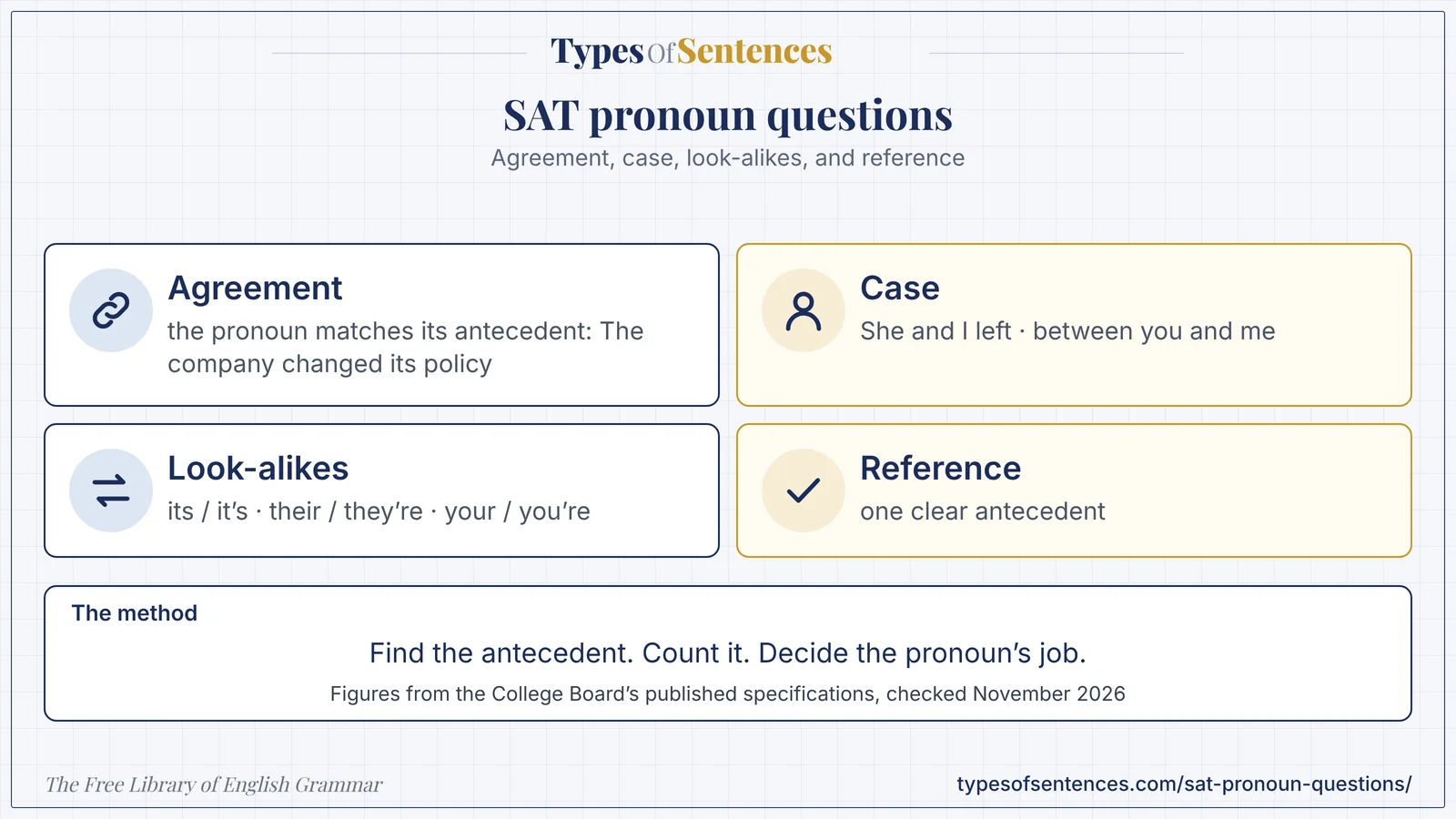
A pronoun stands in for a noun (its antecedent). To choose the right pronoun, find the antecedent, count it (one or many, a person or a thing), and then decide what job the pronoun does in its own clause (subject, object, or owner).
Why it matters: Test writers use the same few traps, and they are easy to learn: a collective noun that looks plural, a pronoun in a pair, a shift from one person to another, and an antecedent that is not clear.
Summary: Digital SAT pronoun questions test three things. Agreement: a pronoun matches its antecedent in number (The company changed its policy) and stays in the same person (do not shift from one to you). Case: use subject forms for subjects (She and I left), object forms for objects and after prepositions (between you and me), who for subjects and whom for objects, and possessive forms for ownership. Reference: every pronoun must have one clear antecedent. Reflexive pronouns (myself) are used only when the subject and object are the same person. The look-alike pairs (its/it’s, their/they’re, your/you’re, whose/who’s) are solved by expanding the contraction.
- Find the antecedent; count it.
- Decide the pronoun’s job: subject, object, owner.
- Expand contractions to test them.
- Every pronoun needs one clear antecedent.
What You’ll Learn
- 1. SAT Pronoun Questions: The Short Answer
- 2. Pronouns and Antecedents: Agreement in Number and Person
- 3. SAT Pronoun Case: Subject, Object, Possessive, Who and Whom
- 4. Look-Alike Pairs: Its, Their, Your, Whose, and Their Contractions
- 5. Reflexive, Intensive, and Relative Pronouns
- 6. A Five-Step Method for SAT Pronoun Questions
- 7. Common Mistakes on SAT Pronoun Questions
- 8. Exercises
- 9. Test Your Knowledge
- 10. Frequently Asked Questions
- 11. Conclusion
1. SAT Pronoun Questions: The Short Answer
| Fact | Detail |
|---|---|
| where | the Standard English Conventions domain of the digital SAT Reading and Writing section |
| skill | Form, Structure, and Sense |
| share | Standard English Conventions is about 26 percent of the section, or 11 to 15 of 54 questions |
| format | a short text with a blank, and four choices that are pronouns or pronoun phrases |
| clue | the choices differ in one pronoun (its / their, who / whom, I / me) |
| official practice | the College Board’s Bluebook app and Student Question Bank |
| Tested point | Rule | Example |
|---|---|---|
| agreement in number | a pronoun matches its antecedent | The company changed its policy. |
| agreement in person | do not shift from one person to another | One should do one’s best. · You should do your best. |
| case | subject, object, or possessive by the pronoun’s job | She and I left. Between you and me. |
| who and whom | who for subjects, whom for objects | the person to whom I spoke |
| reflexive | only when the subject and object are the same | I saw myself. |
| look-alikes | expand the contraction | its / it’s, their / they’re |
| reference | one clear antecedent | Ana smiled when she met Maria. |
The College Board figures were taken from its published specifications and checked in November 2026; the College Board can change the test, so check satsuite.collegeboard.org before you rely on them. The full set of pronoun forms is in the pronouns list, and the types are described in the chapter on pronouns.
2. Pronouns and Antecedents: Agreement in Number and Person
The antecedent is the noun that the pronoun replaces. A pronoun must match it in number. Here are noun pronoun agreement examples, correct and incorrect.
| Antecedent | Correct pronoun | Error | Why |
|---|---|---|---|
| a singular noun | The student lost her book. | *The student lost their books. (formal) | one student, one owner |
| a plural noun | The students lost their books. | *The students lost his book. | many students |
| a collective noun as one unit | The committee reached its decision. | *The committee reached their decision. (as a unit) | a committee acting as one |
| a company, a school, a city | The company changed its policy. | *The company changed their policy. | an organization is singular |
| two nouns joined by and | Tom and Maria lost their keys. | *Tom and Maria lost her keys. | a compound is plural |
| two nouns joined by or | Neither Tom nor Maria lost her keys. | *Neither Tom nor Maria lost their keys. (when the nearer noun is singular) | the nearer noun decides |
| an indefinite pronoun (everyone, each) | Each of the girls brought her lunch. | *Each of the girls brought their lunches. (check style) | each is singular |
| a noun far from its pronoun | The report, which was long, lost its focus. | *The report, which was long, lost their focus. | find the real antecedent |
| Shift in person | Error | Correct |
|---|---|---|
| one to you | *If one studies, you will pass. | If one studies, one will pass. or If you study, you will pass. |
| we to they | *We went to the museum, and they saw the exhibit. | We went to the museum, and we saw the exhibit. |
| I to you | *I like hiking because you can see the view. | I like hiking because I can see the view. |
The use of they and their for a single person is accepted in much standard English today and is discussed in the advanced chapter on gender-inclusive language. I have not checked whether the College Board has published guidance on it, so rely on the antecedent in the passage and avoid depending on this point alone.
3. SAT Pronoun Case: Subject, Object, Possessive, Who and Whom
| Job of the pronoun | Forms | Correct example | Error |
|---|---|---|---|
| subject | I, you, he, she, it, we, they, who | She and I left. | *Her and me left. |
| object of a verb | me, you, him, her, it, us, them, whom | The teacher thanked her and me. | *The teacher thanked she and I. |
| object of a preposition | me, you, him, her, it, us, them, whom | between you and me · to whom | *between you and I |
| possessive (before a noun) | my, your, his, her, its, our, their, whose | Is this your bag? | *Is this you’re bag? |
| possessive (alone) | mine, yours, his, hers, ours, theirs | The choice is yours. | *The choice is your’s. |
| after than or as | the subject form if a verb is understood | She is taller than I (am). | *She is taller than me. (formal) |
| before a gerund | the possessive form (formal) | We appreciate his helping. | *We appreciate him helping. (formal) |
| Who or whom? | Test | Example |
|---|---|---|
| who | replace with he or she; if it fits, use who | Who wrote this? → He wrote this. |
| whom | replace with him or her; if it fits, use whom | To whom did you speak? → You spoke to him. |
| relative clause | look inside the clause for its own subject and verb | The person who called is here. · The person whom I called is here. |
Pronoun case is described in the advanced chapter on pronoun concepts, and the possessive forms in the chapter on determiners.
4. Look-Alike Pairs: Its, Their, Your, Whose, and Their Contractions
| Possessive | Contraction | Test | Example |
|---|---|---|---|
| its | it’s (it is, it has) | expand the contraction | The dog wagged its tail. · It’s late. |
| their | they’re (they are) | expand the contraction | Their car is red. · They’re late. |
| your | you’re (you are) | expand the contraction | Your idea is good. · You’re right. |
| whose | who’s (who is, who has) | expand the contraction | Whose coat is this? · Who’s there? |
| theirs, hers, yours, ours | — | never an apostrophe | The idea is theirs. |
| there | there’s (there is) | a place or existence | There’s a bus at six. |
These pairs have their own guides: its vs it’s, their, there, they’re, and your vs you’re.
5. Reflexive, Intensive, and Relative Pronouns
| Type | Rule | Correct | Error |
|---|---|---|---|
| reflexive | refers back to the subject of the same clause | I taught myself. | *The manager gave the report to myself. |
| intensive | adds emphasis; can be removed | The mayor herself attended. | *Herself attended the mayor. |
| who (people) | people | the teacher who helped me | *the teacher which helped me |
| which (things) | things; nonessential with commas | The book, which was long, won. | *The book who was long won. |
| that | things or people in a restrictive clause, no comma | The book that I read was long. | *The book, that I read, was long. |
| whose | possession for people or things | the writer whose book won | *the writer who’s book won |
| avoiding vague this and it | name the noun | This policy changed the outcome. | *This changed the outcome. (unclear) |
6. A Five-Step Method for SAT Pronoun Questions
| Step | Do this | Why |
|---|---|---|
| 1 find the pronoun | locate the pronoun that the blank belongs to | the choices differ in form |
| 2 find the antecedent | find the noun the pronoun replaces, if any | agreement depends on it |
| 3 count | is the antecedent one or many? a person or a thing? an organization? | number and person decide the form |
| 4 job | what job does the pronoun do in its own clause: subject, object, owner? | case decides the form |
| 5 test | expand contractions, replace who/whom with he/him, and read the sentence aloud | the test catches the look-alikes |
Which choice is correct? The company announced ___ new policy yesterday, and the employees who read ___ were relieved. (A) its … it (B) their … them (C) it’s … it (D) its … them
- First blank: the antecedent is company, a singular organization, and the pronoun comes before a noun, so it needs the possessive its.
- Second blank: the pronoun refers to the policy (a singular thing) and is the object of read, so it needs it.
- Check the choices: (B) uses plural pronouns; (C) uses it’s (it is), which does not fit before a noun; (D) uses them, which is plural.
- Answer: (A) its … it. (The item is an original practice item, not taken from the College Board.)
7. Common Mistakes on SAT Pronoun Questions
| Mistake | What happens | Better habit |
|---|---|---|
| matching the pronoun to the nearest noun | a plural noun near the pronoun is chosen | find the real antecedent |
| treating a company as plural | their is chosen for the company | an organization is singular |
| “between you and I” | a subject form is used after a preposition | object forms after prepositions |
| choosing whom everywhere | whom is used for a subject | replace with he or him |
| confusing a contraction with a possessive | it’s before a noun | expand the contraction |
| shifting person | one then you | keep one person |
| using myself as a polite me | send it to myself | reflexive only if the subject is the same |
| leaving the antecedent unclear | They said it was unfair. | name the noun |
Recap in 12 seconds
Watch the lesson build itself: SAT pronoun questions test agreement with the antecedent, pronoun case, the look-alike pairs, and clear reference. The video has no sound.
Exercises
Part A: Agreement (Exercises 1–10)
Exercise 1: Choose: The company changed (its/their) policy.
Show Answer
Answer: its.
Exercise 2: Choose: The students lost (his/their) books.
Show Answer
Answer: their.
Exercise 3: Choose: The committee reached (its/their) decision.
Show Answer
Answer: its (one unit).
Exercise 4: Choose: Tom and Maria lost (her/their) keys.
Show Answer
Answer: their.
Exercise 5: Choose: Neither Tom nor Maria lost (her/their) keys.
Show Answer
Answer: her (the nearer noun is singular).
Exercise 6: Choose: The report, which was long, lost (its/their) focus.
Show Answer
Answer: its.
Exercise 7: Choose: The team celebrated (its/their) victory.
Show Answer
Answer: its.
Exercise 8: Choose: The city raised (its/their) taxes.
Show Answer
Answer: its.
Exercise 9: Fix the shift: If one studies, you will pass.
Show Answer
Answer: If one studies, one will pass. (or If you study, you will pass.)
Exercise 10: Fix the shift: I like hiking because you can see the view.
Show Answer
Answer: I like hiking because I can see the view.
Part B: Case (Exercises 11–18)
Exercise 11: Choose: (She/Her) and (I/me) left.
Show Answer
Answer: She and I.
Exercise 12: Choose: Between you and (I/me), it is fine.
Show Answer
Answer: me.
Exercise 13: Choose: The teacher thanked (she/her) and (I/me).
Show Answer
Answer: her and me.
Exercise 14: Choose: (Who/Whom) wrote this?
Show Answer
Answer: Who.
Exercise 15: Choose: To (who/whom) did you speak?
Show Answer
Answer: whom.
Exercise 16: Choose: She is taller than (I/me).
Show Answer
Answer: I (than I am).
Exercise 17: Choose: The choice is (your/yours).
Show Answer
Answer: yours.
Exercise 18: Choose: We appreciate (his/him) helping.
Show Answer
Answer: his (formal).
Part C: Look-Alikes and Reflexives (Exercises 19–25)
Exercise 19: Choose: The dog wagged (its/it’s) tail.
Show Answer
Answer: its.
Exercise 20: Choose: (Their/They’re) late.
Show Answer
Answer: They’re.
Exercise 21: Choose: Is this (your/you’re) bag?
Show Answer
Answer: your.
Exercise 22: Choose: (Whose/Who’s) coat is this?
Show Answer
Answer: Whose.
Exercise 23: Choose: I taught (me/myself) to swim.
Show Answer
Answer: myself.
Exercise 24: Choose: Please send it to (me/myself).
Show Answer
Answer: me (the subject is not the same person).
Exercise 25: Choose: The mayor (her/herself) attended.
Show Answer
Answer: herself (intensive).
Part D: Correct the Errors (Exercises 26–30)
Exercise 26: Correct: *The company changed their policy.
Show Answer
Answer: The company changed its policy.
Exercise 27: Correct: *Between you and I, it is fine.
Show Answer
Answer: Between you and me, it is fine.
Exercise 28: Correct: *The dog wagged it’s tail.
Show Answer
Answer: The dog wagged its tail.
Exercise 29: Correct: *The teacher which helped me is kind.
Show Answer
Answer: The teacher who helped me is kind.
Exercise 30: Correct: *Whom is calling?
Show Answer
Answer: Who is calling?
Test Your Knowledge
Ready to check what you learned? Answer all 10 questions, then submit. You need 80% (8 of 10) to pass. Your answers are not stored.
View correct answers and explanations
Question 1: A pronoun must agree with its
✓ Correct Answer: A – antecedent
The noun it replaces.
Question 2: The company changed ___ policy.
✓ Correct Answer: B – its
An organization is singular.
Question 3: Between you and ___, it is fine.
✓ Correct Answer: C – me
Object after a preposition.
Question 4: Which test works for who and whom?
✓ Correct Answer: D – replace with he or him
The he/him test.
Question 5: The dog wagged ___ tail.
✓ Correct Answer: A – its
Possessive.
Question 6: Reflexive pronouns are used when the subject and object are
✓ Correct Answer: B – the same person
Same person.
Question 7: Which is correct?
✓ Correct Answer: C – She and I left.
Subject forms.
Question 8: The person ___ called is here.
✓ Correct Answer: D – who
A subject.
Question 9: SAT pronoun questions belong to
✓ Correct Answer: A – Form, Structure, and Sense
The conventions domain.
Question 10: Official digital SAT practice is available in
✓ Correct Answer: B – the Bluebook app
College Board’s app.
Frequently Asked Questions
What are SAT pronoun questions?
They are the digital SAT items whose answer choices differ in the form of a pronoun, such as its and their, who and whom, or I and me. They test agreement, case, and reference, and belong to Form, Structure, and Sense.
What are pronouns and antecedents?
The antecedent is the noun that a pronoun replaces. Pronouns and antecedents must agree in number and person, and every pronoun should have one clear antecedent.
What is SAT pronoun agreement?
It is the rule that a pronoun matches its antecedent: The company changed its policy (singular), The students lost their books (plural). SAT pronoun agreement also covers shifts from one person to another.
What is SAT pronoun case?
Pronoun case is the choice of the subject, object, or possessive form: She and I left, between you and me, Is this your bag? SAT pronoun case questions also include who and whom.
Does the SAT test singular they?
I have not checked whether the College Board has published guidance on singular they. Standard English today widely accepts it for a single person of unspecified gender, but the best approach is to rely on the number of the antecedent and other clear clues in the passage.
Should I use who or whom?
Use who for the subject and whom for the object. Test by replacing the word with he or him: if he fits, use who; if him fits, use whom.
Are the practice items on this page from the College Board?
No. They are original items written for this page and are not taken from the College Board.
Conclusion
You now know how SAT pronoun questions are built: agreement in number and person, case (including who and whom), the look-alike pairs, reflexive and relative pronouns, and clear reference. You have also seen the method and the traps, and practiced with original items.
Find the antecedent, count it, decide the pronoun’s job, and expand any contraction. You have now seen the main rules of the SAT’s conventions questions in this series; the ACT guide covers a similar set in a different format.
- College Board. Digital SAT Suite of Assessments: Reading and Writing Content Specifications. satsuite.collegeboard.org.: the domains, the skills, and the question counts (checked November 2026; the College Board can change them).
- College Board. Bluebook app and Student Question Bank. satsuite.collegeboard.org.: official practice for the digital SAT.
- Garner, Bryan A. Garner’s Modern English Usage. 5th ed. Oxford University Press, 2022.: the entries on pronoun case, who and whom, and reflexive pronouns.
- Swan, Michael. Practical English Usage. 4th ed. Oxford University Press, 2016.: pronouns, reflexives, and who and whom.
- Huddleston, Rodney, and Geoffrey K. Pullum. The Cambridge Grammar of the English Language. Cambridge University Press, 2002.: case and the pronoun system (chapter 5).
Last reviewed: October 29, 2026. How it was made: drafted with AI assistance, then checked with automated tests (structure, links, answer keys, spelling) and against the sources above. A person has not yet read this chapter line by line. Found a mistake? Report it.