The four past tenses let you tell what happened, what was in progress, what had already happened before something else, and how long an earlier action had lasted: the simple past (I worked), the past continuous (I was working), the past perfect (I had worked), and the past perfect continuous (I had been working). Used together, they let you build a clear story with a foreground and a background.
This chapter studies the four past tenses one at a time and then together. You will see the forms, the uses, the time expressions, the comparing of the simple past, continuous, and the perfect tenses, and how to use the tenses in a narrative. It ends with the common errors. Thirty exercises and a quiz follow.
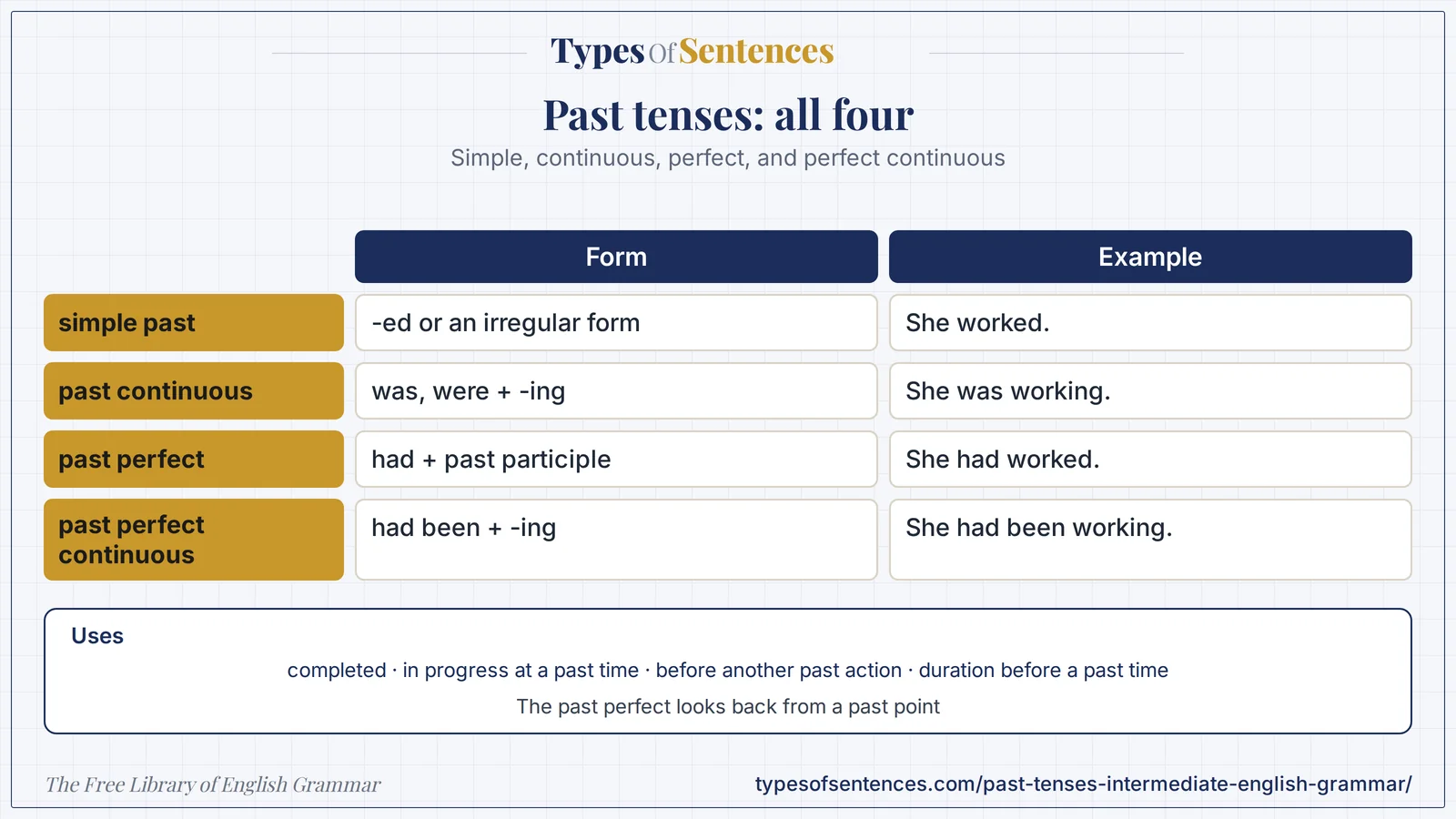
The simple past reports the main events of a story. The past continuous sets the scene around them. The past perfect goes back one step further. The past perfect continuous says how long that earlier action had lasted.
Why it matters: If you picture the story as a timeline with a “then” point, the tenses fall into place: the past perfect is before “then,” the continuous surrounds it, and the simple past is at it.
Summary: Simple past: completed actions (She worked). Past continuous: an action in progress at a past time (She was working). Past perfect: an action completed before another past action (She had worked). Past perfect continuous: duration up to a past point (She had been working). The past perfect is the “further back” tense.
- Simple past: -ed or an irregular form.
- Past continuous: was/were + -ing.
- Past perfect: had + past participle.
- Past perfect continuous: had been + -ing.
What You’ll Learn
- 1. Past Tenses: The Simple Past
- 2. Past Continuous
- 3. Past Perfect
- 4. Past Perfect Continuous
- 5. Comparing the Four: Simple Past, Continuous, and Perfect
- 6. Time Expressions with the Past Tenses
- 7. Past Tense Narrative
- 8. Common Errors with the Past Tenses
- 9. Exercises
- 10. Test Your Knowledge
- 11. Frequently Asked Questions
- 12. Conclusion
1. Past Tenses: The Simple Past
The simple past is formed with -ed for regular verbs and an irregular form for many common verbs; see the guide to irregular verbs. The form is the same for all persons, except be (was, were).
| Form | Example |
|---|---|
| regular | work → worked; live → lived; study → studied; stop → stopped |
| irregular | go → went; see → saw; write → wrote; have → had |
| negative | She did not (didn’t) work. |
| question | Did she work? / Where did she go? |
| be | I was; you were; she was; negative: was not (wasn’t); question: Was she? |
| Use | Example |
|---|---|
| completed action at a finished time | She left an hour ago. I visited Paris in 2019. |
| a series of events (narrative) | He opened the door, walked in, and sat down. |
| past habits and states | We lived in Texas when I was young. |
| past habit with used to | I used to play soccer. |
| past habit with would (actions only) | Every summer we would visit my grandparents. |
Typical time words are yesterday, last week, in 2019, ago, and then. The simple past is the tense of a finished time. Compare used to (a past state or habit that has stopped, for actions and states) and would (a past habit, for actions only): I used to be shy, not I would be shy.
2. Past Continuous
The past continuous uses was or were plus the -ing form.
| Form | Example |
|---|---|
| affirmative | I was working. / They were working. |
| negative | She was not (wasn’t) working. |
| question | Was she working? / What were you doing? |
| Use | Example |
|---|---|
| an action in progress at a past moment | At six o’clock, I was cooking dinner. |
| an action interrupted by another | I was cooking when the phone rang. |
| two actions in progress at the same time | While I was cooking, he was reading. |
| background in a narrative | The sun was setting, and the birds were singing. |
| polite or tentative requests | I was wondering if you could help me. |
| repeated annoying habit (with always) | She was always complaining. |
3. Past Perfect
The past perfect uses had plus the past participle. It has the same form for all persons.
| Form | Example |
|---|---|
| affirmative | I had worked. / She had left. |
| negative | She had not (hadn’t) left. |
| question | Had she left? / What had happened? |
| Use | Example |
|---|---|
| an action completed before another past action | She had left before I arrived. |
| an action completed before a past time | By six, I had finished the report. |
| the earlier of two events in a narrative | When we got to the station, the train had gone. |
| reported speech (backshift) | She said that she had seen him. |
| the third conditional | If I had known, I would have called. |
| unfulfilled wishes in the past | I wish I had studied harder. |
Typical words are before, after, by the time, already, just, never, and when. The past perfect is used with the simple past to show which event came first: When I arrived, she had left (she left first) versus When I arrived, she left (she left after I arrived).
4. Past Perfect Continuous
The past perfect continuous uses had been plus the -ing form.
| Form | Example |
|---|---|
| affirmative | I had been waiting. / She had been working. |
| negative | She had not (hadn’t) been working. |
| question | Had she been working? / How long had you been waiting? |
| Use | Example |
|---|---|
| duration up to a past point | I had been waiting for an hour when the bus arrived. |
| the cause of a past situation | She was tired because she had been working all night. |
| an activity that stopped just before a past time | The ground was wet; it had been raining. |
Compare the two past perfect tenses, just as with the present perfect: the past perfect stresses the completed result (She had written three reports), and the past perfect continuous stresses the duration or the activity (She had been writing reports all day).
5. Comparing the Four: Simple Past, Continuous, and Perfect
| Question | Tense | Example |
|---|---|---|
| What happened at a finished time? | simple past | She left at six. |
| What was in progress then? | past continuous | She was leaving when I called. |
| What was complete before then? | past perfect | She had left before I called. |
| How long had it lasted before then? | past perfect continuous | She had been leaving things behind for weeks. |
| Simple past | Past continuous | Past perfect | Past perfect continuous |
|---|---|---|---|
| I read the book. | I was reading the book. | I had read the book. | I had been reading the book. |
| finished action | in progress | completed earlier | duration before |
Choose the tenses: When I (arrive), she (cook) dinner, and she (already, set) the table.
- When I arrived: a completed event at a point in time: arrived.
- she was cooking: in progress at that time: was cooking.
- had already set: completed before that time: had already set.
- Result: When I arrived, she was cooking dinner, and she had already set the table.
6. Time Expressions with the Past Tenses
| Tense | Time expressions | Example |
|---|---|---|
| simple past | yesterday, last week, in 2019, ago, then, when, finally | She left an hour ago. |
| past continuous | while, when, as, at six yesterday, all evening | I was cooking while he was reading. |
| past perfect | before, after, by the time, already, just, until then, never before | By the time we arrived, she had left. |
| past perfect continuous | for, since, all day, how long, before | He had been waiting for an hour when I came. |
- When can go with all four: When she came, I left (after); When she came, I was leaving (during); When she came, I had left (before).
- While is usually followed by the past continuous: While I was walking, I saw an accident.
- By the time is followed by a simple past, and the main clause often takes the past perfect.
7. Past Tense Narrative
A story usually uses the tenses together: the simple past for the main events (the foreground), the past continuous for the scene and the actions in progress (the background), and the past perfect for what happened earlier.
| Part of the story | Tense | Example |
|---|---|---|
| scene setting | past continuous | It was raining, and the streets were empty. |
| main events | simple past | Maria opened the door and stepped out. |
| earlier events | past perfect | She had forgotten her umbrella. |
| earlier activity and its cause | past perfect continuous | She had been waiting inside for an hour. |
| reaction | simple past | She laughed and walked on. |
Read the passage and name each tense: It was late. Tom was sitting alone in the empty hall. He had been waiting for hours, and he had finally decided to leave. He stood up and walked out.
- was sitting: past continuous (scene).
- had been waiting: past perfect continuous (duration before).
- had decided: past perfect (completed earlier).
- stood up, walked out: simple past (main events).
The sequence of tenses between clauses is covered in the chapter on reported speech and in the chapter on conditional sentences. The verb phrases that make these tenses are in the chapter on verb phrases.
8. Common Errors with the Past Tenses
| Error | Correction | Rule |
|---|---|---|
| Yesterday I have seen him. | Yesterday I saw him. | simple past with a finished time |
| She goed home. | She went home. | irregular past |
| I was knowing the answer. | I knew the answer. | stative verb |
| When I had arrived, she left. (she left later) | When I arrived, she left. | past perfect only for the earlier event |
| I did not went. | I did not go. | after did, use the base form |
| Did you saw it? | Did you see it? | after did, use the base form |
| She had went home. | She had gone home. | past perfect uses the past participle |
| After I have finished, I went home. | After I had finished, I went home. | past perfect in the earlier clause |
| I used to being shy. | I used to be shy. | used to + base form |
Fix: When I was arriving, the film already started, and everyone watched it since an hour.
- was arriving: a completed point: arrived.
- already started: earlier than arrival: had already started.
- watched it since an hour: a duration before that point: had been watching it for an hour.
- Result: When I arrived, the film had already started, and everyone had been watching it for an hour.
Recap in 12 seconds
Watch the lesson build itself: The four past tenses with their forms, examples, and uses. The video has no sound.
Exercises
Part A: Simple Past (Exercises 1–6)
Exercise 1: Past of go:
Show Answer
Answer: went.
Exercise 2: Past of stop:
Show Answer
Answer: stopped.
Exercise 3: Negative: She left.
Show Answer
Answer: She did not leave.
Exercise 4: Question: She left at six.
Show Answer
Answer: Did she leave at six?
Exercise 5: Fix it: She goed home.
Show Answer
Answer: She went home.
Exercise 6: Fix it: Did you saw it?
Show Answer
Answer: Did you see it?
Part B: Past Continuous (Exercises 7–12)
Exercise 7: Complete: At six o’clock, I (cook) dinner.
Show Answer
Answer: was cooking.
Exercise 8: Complete: I (walk) home when it started to rain.
Show Answer
Answer: was walking.
Exercise 9: Complete: While I (cook), he (read).
Show Answer
Answer: was cooking; was reading.
Exercise 10: Question: They were working.
Show Answer
Answer: Were they working?
Exercise 11: Fix it: I was knowing the answer.
Show Answer
Answer: I knew the answer.
Exercise 12: Which is the background action: I was cooking when the phone rang.
Show Answer
Answer: was cooking.
Part C: Past Perfect (Exercises 13–18)
Exercise 13: Complete: She (leave) before I arrived.
Show Answer
Answer: had left.
Exercise 14: Complete: When we got to the station, the train (go).
Show Answer
Answer: had gone.
Exercise 15: Explain: When I arrived, she had left. vs When I arrived, she left.
Show Answer
Answer: In the first she left before I arrived; in the second she left after I arrived.
Exercise 16: Complete (third conditional): If I (know), I would have called.
Show Answer
Answer: had known.
Exercise 17: Fix it: She had went home.
Show Answer
Answer: She had gone home.
Exercise 18: Fix it: After I have finished, I went home.
Show Answer
Answer: After I had finished, I went home.
Part D: Past Perfect Continuous (Exercises 19–23)
Exercise 19: Complete: I (wait) for an hour when the bus arrived.
Show Answer
Answer: had been waiting.
Exercise 20: Complete: She was tired because she (work) all night.
Show Answer
Answer: had been working.
Exercise 21: Question: You had been waiting. (how long)
Show Answer
Answer: How long had you been waiting?
Exercise 22: Choose: She had (written/been writing) three reports. (result)
Show Answer
Answer: written.
Exercise 23: Choose: She had (written/been writing) reports all day. (duration)
Show Answer
Answer: been writing.
Part E: Narrative and Choosing (Exercises 24–28)
Exercise 24: Tense for the scene: It (rain) and the streets (be) empty.
Show Answer
Answer: was raining; were.
Exercise 25: Tense for the main events: Maria (open) the door and (step) out.
Show Answer
Answer: opened; stepped.
Exercise 26: Tense for the earlier event: She (forget) her umbrella.
Show Answer
Answer: had forgotten.
Exercise 27: Name the tense: He had been waiting for hours.
Show Answer
Answer: Past perfect continuous.
Exercise 28: Which is more correct for a habit: I used to be shy or I would be shy?
Show Answer
Answer: I used to be shy (a state).
Part F: Errors (Exercises 29–30)
Exercise 29: Fix it: Yesterday I have seen him.
Show Answer
Answer: Yesterday I saw him.
Exercise 30: Fix it: I used to being shy.
Show Answer
Answer: I used to be shy.
Test Your Knowledge
Ready to check what you learned? Answer all 10 questions, then submit. You need 80% (8 of 10) to pass. Your answers are not stored.
View correct answers and explanations
Question 1: Which is the simple past of write?
✓ Correct Answer: B – wrote
Write is irregular: wrote.
Question 2: Which is the past continuous?
✓ Correct Answer: C – She was working.
Was or were plus -ing.
Question 3: Which is correct?
✓ Correct Answer: A – I was cooking when the phone rang.
The longer action is in the past continuous.
Question 4: Which is the past perfect?
✓ Correct Answer: D – She had left.
Had plus the past participle.
Question 5: What does When I arrived, she had left mean?
✓ Correct Answer: B – She left before I arrived
The past perfect shows the earlier event.
Question 6: Which is correct?
✓ Correct Answer: D – She had gone home.
The past perfect uses the past participle.
Question 7: Which stresses duration before a past point?
✓ Correct Answer: A – Past perfect continuous
Had been plus -ing.
Question 8: Which is correct?
✓ Correct Answer: C – Did you see it?
After did, use the base form.
Question 9: Which is correct?
✓ Correct Answer: B – I used to be shy.
Used to plus the base form.
Question 10: Which tense gives the background in a story?
✓ Correct Answer: C – Past continuous
The past continuous sets the scene.
Frequently Asked Questions
What are the four past tenses?
The four past tenses are the simple past (I worked), past continuous (I was working), past perfect (I had worked), and past perfect continuous (I had been working).
What is the simple past continuous contrast?
The simple past reports a completed action (I cooked dinner), while the continuous shows an action in progress (I was cooking dinner). In one sentence, the continuous is the background and the simple past is the interruption.
What is the past perfect?
The past perfect uses had plus the past participle. It shows an action completed before another past action or time: She had left before I arrived.
What is the past perfect continuous?
The past perfect continuous uses had been plus -ing. It shows an action in progress for some time up to a past point, or the cause of a past situation: She was tired because she had been working.
How do the four past tenses work together?
In a story, the simple past gives the main events, the past continuous gives the scene, the past perfect gives earlier events, and the past perfect continuous gives earlier duration. Learning the four past tenses together makes narrative clear.
When should I use the past perfect?
Use it when you need to show that one past action happened before another, or before a past time. If words such as before and after make the order clear, the simple past is often enough.
What is the difference between used to and would?
Used to describes past habits and states: I used to be shy. Would describes repeated past actions only: We would visit them every summer.
Conclusion
You now know the four past tenses: the simple past for finished actions, the past continuous for actions in progress, the past perfect for earlier actions, and the past perfect continuous for earlier duration. You can use them together in a narrative, choose the right time expressions, and avoid the common errors.
Try rewriting a short story using all four tenses. Next, you will study the four future tenses.
- Merriam-Webster Dictionary: past tense: the dictionary definition of the past tense.
- Purdue Online Writing Lab: Grammar: reference section on verb tenses.
- Quirk, Randolph, et al. A Comprehensive Grammar of the English Language. Longman, 1985.: the past, the past perfect, and the progressive.
- Huddleston, Rodney, and Geoffrey K. Pullum. The Cambridge Grammar of the English Language. Cambridge University Press, 2002.: the preterite and the perfect.
Last reviewed: October 29, 2026. How it was made: drafted with AI assistance, then checked with automated tests (structure, links, answer keys, spelling) and against the sources above. A person has not yet read this chapter line by line. Found a mistake? Report it.