Reported speech tells what someone said without quoting the exact words. Direct speech repeats the words and puts them in quotation marks: She said, “I am tired.” Indirect speech, also called reported speech, gives the meaning in the reporter’s own words: She said that she was tired. The change from direct to indirect affects the tense, the pronouns, and the time and place words.
This chapter explains direct and indirect speech, with direct speech rules for punctuation and indirect speech rules for the changes. You will study the changes in pronouns, time words, and place words, the tense changes (backshift) and the situations with no backshift, reporting statements, questions, and commands, and the reporting verbs, with examples of reported speech for each. Thirty exercises and a quiz follow.
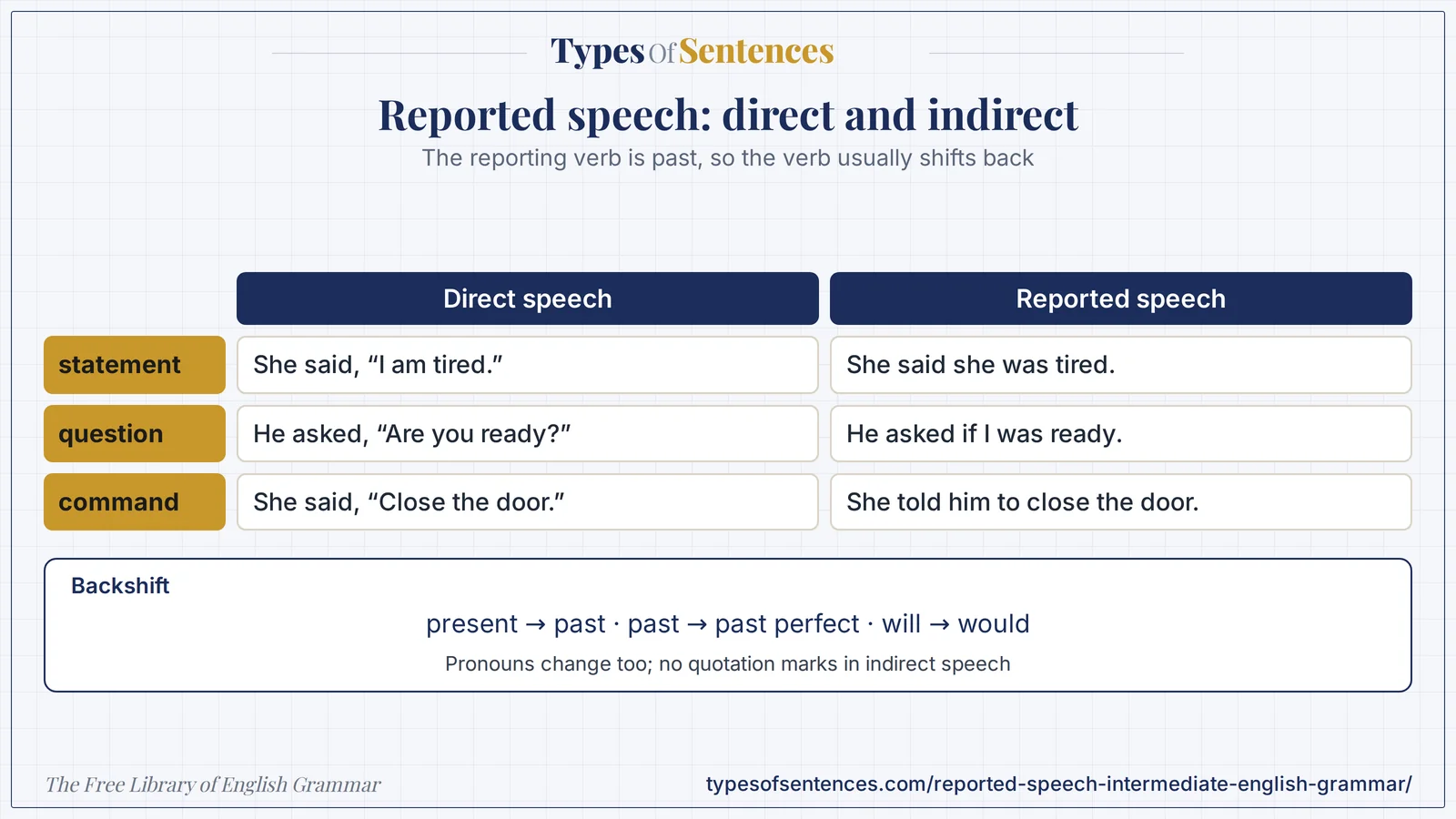
When you tell someone what a third person said, you usually do not repeat the exact words. You retell them from your own point of view, a little later in time, and often in a different place.
Why it matters: That change of viewpoint explains every rule: I becomes she, now becomes then, and the verb usually moves one step back in time.
Summary: Direct speech quotes the exact words in quotation marks. Indirect (reported) speech reports the meaning with no quotation marks. When the reporting verb is in the past, the verb in the reported clause usually shifts back (backshift), pronouns change to fit the reporter’s viewpoint, and time and place words change (now → then, here → there). Questions become statements in order; commands become infinitives.
- Direct: She said, “I am tired.” Indirect: She said (that) she was tired.
- Backshift: present → past, past → past perfect, will → would, can → could.
- Questions: asked if/whether or asked + wh-word, statement order.
- Commands: told/asked him (not) to + base verb.
What You’ll Learn
- 1. Reported Speech: What Is Direct Speech?
- 2. What Is Indirect Speech?
- 3. Changes in Pronouns
- 4. Changes in Time and Place Words
- 5. Tense Changes (Backshift)
- 6. No Backshift Situations
- 7. Reporting Statements
- 8. Reporting Questions
- 9. Reporting Commands, Requests, and Suggestions
- 10. Reporting Verbs
- 11. Common Errors in Reported Speech
- 12. Exercises
- 13. Test Your Knowledge
- 14. Frequently Asked Questions
- 15. Conclusion
1. Reported Speech: What Is Direct Speech?
Direct speech reports the exact words that a speaker used. In writing, the words are placed in quotation marks, with a reporting clause (she said).
| Direct speech rule | Example |
|---|---|
| put the spoken words in quotation marks | She said, “I am tired.” |
| separate the reporting clause with a comma | He said, “Come in.” |
| begin the quotation with a capital letter | She said, “We are leaving.” |
| put the end punctuation inside the closing quotation mark | “Where are you going?” she asked. |
| reporting clause in the middle | “I am tired,” she said, “and I want to go home.” |
| start a new paragraph for each new speaker | (in dialogue) |
The marks are explained in the Basic chapter on quotation marks. The direct speech rules are about punctuation: the words themselves are unchanged.
2. What Is Indirect Speech?
Indirect speech (reported speech) gives the content of what was said in the reporter’s words. There are no quotation marks, and the reported words usually form a noun clause after the reporting verb; see the chapter on noun clauses.
| Direct | Indirect |
|---|---|
| She said, “I am tired.” | She said that she was tired. |
| He said, “I will call you.” | He said that he would call me. |
| They said, “We live in Dallas.” | They said that they lived in Dallas. |
| She said, “I have finished.” | She said that she had finished. |
The word that is optional after say and tell: She said she was tired. These indirect speech rules are the subject of the next sections. Four things can change: pronouns, time words, place words, and tenses.
3. Changes in Pronouns
Pronouns change to match the viewpoint of the reporter. The question to ask is who is now speaking and who is being spoken about.
| Direct | Indirect | Why |
|---|---|---|
| Tom said, “I am tired.” | Tom said that he was tired. | Tom is now he |
| She said to me, “I love you.” | She told me that she loved me. | you is now me |
| They said, “We are leaving.” | They said that they were leaving. | we is now they |
| I said to him, “My car is new.” | I told him that my car was new. | the reporter is the speaker, so my stays |
| She said, “My car is new.” | She said that her car was new. | my is now her |
4. Changes in Time and Place Words
Time and place words change because the reporting happens at a different time and often in a different place. Pronouns are covered above; the common changes are these.
| Direct | Indirect |
|---|---|
| now | then / at that time |
| today | that day |
| tonight | that night |
| yesterday | the day before / the previous day |
| tomorrow | the next day / the following day |
| last week / month / year | the week / month / year before; the previous week |
| next week / month / year | the following week / month / year |
| ago | before |
| this (adjective) | that |
| these | those |
| here | there |
| come | go (depending on the position) |
- He said, “I will come tomorrow.” He said that he would come the next day.
- She said, “I saw him yesterday.” She said that she had seen him the day before.
- I said, “I live here.” I said that I lived there.
If you report the statement on the same day and in the same place, the words need not change: She said she will come tomorrow (said today) is fine. Change them when time or place has shifted.
5. Tense Changes (Backshift)
When the reporting verb is in the past (said, told, asked), the verb in the reported clause usually moves one step back in time. This is called backshift. It follows the sequence of tenses described in the chapter on tense consistency and sequence.
| Direct speech | Reported speech |
|---|---|
| simple present: “I work here.” | simple past: She said she worked there. |
| present continuous: “I am working.” | past continuous: She said she was working. |
| present perfect: “I have worked.” | past perfect: She said she had worked. |
| present perfect continuous: “I have been working.” | past perfect continuous: She said she had been working. |
| simple past: “I worked.” | past perfect: She said she had worked. |
| past continuous: “I was working.” | past perfect continuous (or stays): She said she had been working. |
| will: “I will work.” | would: She said she would work. |
| can: “I can work.” | could: She said she could work. |
| may: “I may work.” | might: She said she might work. |
| must: “I must work.” | had to (or must): She said she had to work. |
The verb phrases are in the chapter on verb tenses. The modals could, would, should, might, and ought to do not change, and the past perfect stays the same: “I had left” → She said she had left. See the chapter on modal verbs.
6. No Backshift Situations
| Situation | Example | Why |
|---|---|---|
| the reporting verb is in the present | She says that she is tired. She has said that she will come. | the report is still current |
| the statement is still true or a general truth | He told me that the Earth moves around the sun. She said that she is a nurse. (she still is) | the fact has not changed |
| the speaker reports it soon after, in the same time frame | “I’m hungry.” She just said she’s hungry. | the time has not changed |
| a modal that has no past form | She said that I should leave. He said that she might come. | would, could, should, might, ought to |
| the past perfect | “I had left.” She said she had left. | it cannot go further back |
| a hypothetical (if) statement | She said that if she had money, she would buy it. | unreal conditionals do not shift |
| a statement with a past time word | “I met him in 2019.” She said that she met him in 2019. | the past time is clear (backshift is optional) |
Grammars differ on whether backshift is optional when the statement is still true. Many say that both She said she is a nurse and She said she was a nurse are correct. Formal writing and exams usually require backshift unless the statement is a general truth. Choose by the style of the context.
7. Reporting Statements
| Reporting verb | Pattern | Example |
|---|---|---|
| say | say (that) + clause (no person) | She said that she was tired. |
| tell | tell + person + (that) + clause | She told me that she was tired. |
| explain, answer, reply, add | verb (+ to + person) + that-clause | He explained that the shop was closed. |
| admit, deny, suggest, recommend | verb + -ing, or that-clause | He admitted taking the money. She suggested going out. |
| promise, threaten, offer, refuse, agree | verb + to + base | He promised to call. She refused to leave. |
| complain, warn, insist | verb + that-clause (or about) | She complained that the room was cold. |
Say does not take a person directly (say to him); tell does (tell him).
8. Reporting Questions
In reported questions, the word order returns to a statement, there is no question mark, and there is no do auxiliary. Yes/no questions use if or whether; wh-questions keep the question word.
| Direct question | Reported question |
|---|---|
| “Are you tired?” | She asked if (whether) I was tired. |
| “Do you live here?” | He asked if I lived there. |
| “Where do you live?” | She asked where I lived. |
| “What are you doing?” | He asked what I was doing. |
| “Have you finished?” | She asked whether I had finished. |
| “Can you help me?” | He asked if I could help him. |
9. Reporting Commands, Requests, and Suggestions
| Direct | Reported |
|---|---|
| “Close the door.” | He told me to close the door. |
| “Please sit down.” | She asked me to sit down. |
| “Don’t touch it.” | He told me not to touch it. |
| “Could you help me?” | She asked me to help her. / She asked if I could help her. |
| “Let’s go.” | He suggested going. / He suggested that we go. |
| “Shall I open the window?” | He offered to open the window. |
| “You should rest.” | He advised me to rest. |
For commands and requests, use a reporting verb (tell, ask, order, advise, warn) with an object and an infinitive (not to in the negative); see the chapter on infinitives. The tone shows in the choice of verb: told is a command, asked a request.
10. Reporting Verbs
| Verb | Pattern | Example |
|---|---|---|
| say, tell, explain, announce | that-clause | She announced that the meeting was canceled. |
| ask, wonder, want to know | if / whether / wh-word | He wondered whether it was true. |
| advise, warn, remind, order, tell, invite | object + (not) to + base | She warned me not to go. |
| promise, offer, refuse, agree, threaten | to + base | He agreed to help. |
| suggest, recommend, admit, deny, apologize | -ing form (or that-clause) | She apologized for being late. He denied taking it. |
| accuse, blame, congratulate, thank | object + for/of + -ing | She thanked him for helping. |
| exclaim, shout, whisper, mutter | that-clause or direct quote | He shouted that the house was on fire. |
11. Common Errors in Reported Speech
| Error | Correction | Rule |
|---|---|---|
| She said me that she was tired. | She told me that she was tired. | tell takes a person; say does not |
| He asked where did I live. | He asked where I lived. | statement order in reported questions |
| She asked me if was I tired. | She asked me if I was tired. | statement order |
| He told that he was tired. | He said that he was tired. / He told me that he was tired. | tell needs a person |
| She said me to go. | She told me to go. | tell + person + to |
| He said, that he was tired. | He said that he was tired. | no comma before that |
| She said that she is tired yesterday. | She said that she had been tired the day before. | backshift and time words |
| He asked me close the door. | He asked me to close the door. | to + base verb |
| He said to leave. | He told me to leave. | report a command with tell + person |
| She asked was I tired? | She asked if I was tired. | no question mark in a reported question |
Fix: She said me that she is tired yesterday, and she asked where did I live, and she told close the door.
- said me: told me.
- she is tired yesterday: backshift and the time word: she had been tired the day before.
- where did I live: where I lived.
- she told close the door: she told me to close the door.
- Result: She told me that she had been tired the day before, and she asked where I lived, and she told me to close the door.
Recap in 12 seconds
Watch the lesson build itself: Direct speech quotes exact words; reported speech backshifts the verb and changes pronouns, with set patterns for questions and commands. The video has no sound.
Exercises
Part A: Direct Speech (Exercises 1–5)
Exercise 1: Punctuate: She said I am tired
Show Answer
Answer: She said, “I am tired.”
Exercise 2: Punctuate: Where are you going she asked
Show Answer
Answer: “Where are you going?” she asked.
Exercise 3: Punctuate: I am tired she said and I want to go home
Show Answer
Answer: “I am tired,” she said, “and I want to go home.”
Exercise 4: Where does the end punctuation go: inside or outside the quotation mark?
Show Answer
Answer: Inside (in American English).
Exercise 5: Is She said that she was tired direct speech?
Show Answer
Answer: No. It is indirect (reported) speech.
Part B: Pronouns and Time Words (Exercises 6–12)
Exercise 6: Report: Tom said, “I am tired.”
Show Answer
Answer: Tom said that he was tired.
Exercise 7: Report: She said to me, “I love you.”
Show Answer
Answer: She told me that she loved me.
Exercise 8: Change: tomorrow
Show Answer
Answer: the next day / the following day.
Exercise 9: Change: yesterday
Show Answer
Answer: the day before.
Exercise 10: Change: here
Show Answer
Answer: there.
Exercise 11: Change: now
Show Answer
Answer: then.
Exercise 12: Change: last week
Show Answer
Answer: the week before / the previous week.
Part C: Backshift (Exercises 13–20)
Exercise 13: Report: “I work here.” (She said …)
Show Answer
Answer: She said she worked there.
Exercise 14: Report: “I am working.”
Show Answer
Answer: She said she was working.
Exercise 15: Report: “I have finished.”
Show Answer
Answer: She said she had finished.
Exercise 16: Report: “I finished.”
Show Answer
Answer: She said she had finished.
Exercise 17: Report: “I will call.”
Show Answer
Answer: She said she would call.
Exercise 18: Report: “I can swim.”
Show Answer
Answer: She said she could swim.
Exercise 19: Report: “I must go.”
Show Answer
Answer: She said she had to go.
Exercise 20: Report with the present reporting verb: “I am tired.” (She says …)
Show Answer
Answer: She says she is tired. (no backshift)
Part D: Questions and Commands (Exercises 21–27)
Exercise 21: Report: “Are you tired?”
Show Answer
Answer: She asked if I was tired.
Exercise 22: Report: “Where do you live?”
Show Answer
Answer: She asked where I lived.
Exercise 23: Report: “What are you doing?”
Show Answer
Answer: He asked what I was doing.
Exercise 24: Report: “Close the door.”
Show Answer
Answer: He told me to close the door.
Exercise 25: Report: “Don’t touch it.”
Show Answer
Answer: He told me not to touch it.
Exercise 26: Report: “Please sit down.”
Show Answer
Answer: She asked me to sit down.
Exercise 27: Report: “Let’s go.”
Show Answer
Answer: He suggested going.
Part E: Errors (Exercises 28–30)
Exercise 28: Fix it: She said me that she was tired.
Show Answer
Answer: She told me that she was tired.
Exercise 29: Fix it: He asked where did I live.
Show Answer
Answer: He asked where I lived.
Exercise 30: Fix it: He asked me close the door.
Show Answer
Answer: He asked me to close the door.
Test Your Knowledge
Ready to check what you learned? Answer all 10 questions, then submit. You need 80% (8 of 10) to pass. Your answers are not stored.
View correct answers and explanations
Question 1: What does reported speech do?
✓ Correct Answer: A – Tells what someone said without quoting
Reported speech gives the meaning without quoting.
Question 2: Which is direct speech?
✓ Correct Answer: B – She said, “I am tired.”
Direct speech uses quotation marks.
Question 3: What is the reported form of “I will call”?
✓ Correct Answer: C – She said she would call.
Will becomes would.
Question 4: What is the reported form of “I have finished”?
✓ Correct Answer: D – She said she had finished.
Present perfect becomes past perfect.
Question 5: What does tomorrow become?
✓ Correct Answer: B – the next day
Tomorrow becomes the next day.
Question 6: Which is correct?
✓ Correct Answer: C – He asked where I lived.
Reported questions use statement order.
Question 7: Which is correct?
✓ Correct Answer: A – She told me to go.
Tell + person + to + base.
Question 8: Which is correct?
✓ Correct Answer: D – She told me that she was tired.
Tell needs a person.
Question 9: Which verb does not change in reported speech?
✓ Correct Answer: C – should
Should does not change.
Question 10: Which word introduces a reported yes/no question?
✓ Correct Answer: B – if
If or whether introduces yes/no questions.
Frequently Asked Questions
What is reported speech?
Reported speech, also called indirect speech, tells what someone said without quoting the exact words. The tense, pronouns, and time and place words usually change.
What is the difference between direct and indirect speech?
Direct speech repeats the exact words in quotation marks (She said, “I am tired.”). Indirect speech reports the meaning in the reporter’s words (She said that she was tired.).
What are some examples of reported speech?
She said that she was tired. He told me to close the door. They asked where I lived. He suggested going out. These are examples of reported speech for statements, commands, questions, and suggestions.
What are the direct speech rules?
Put the spoken words in quotation marks, separate the reporting clause with a comma, begin the quotation with a capital letter, and put the end punctuation inside the closing quotation mark.
What are the indirect speech rules?
Change the pronouns to fit the reporter’s viewpoint, change the time and place words, shift the tense back when the reporting verb is past, use statement order for questions, and use to + base verb for commands.
What is backshift?
Backshift is the shift of tenses one step back in time in reported speech: present to past, past to past perfect, will to would, can to could. It applies when the reporting verb is in the past.
When is there no backshift?
There is no backshift when the reporting verb is in the present, when the statement is a general truth or still true, and with modals such as would, could, and should, and with the past perfect.
Conclusion
You now know how to use reported speech. You can write direct speech correctly, change pronouns, time words, and place words, apply backshift and recognize no-backshift situations, report statements, questions, commands, and suggestions, and choose the right reporting verb.
Practice by reporting a short conversation you have heard. Next, you begin the study of conditional sentences.
- Merriam-Webster Dictionary: indirect speech: the dictionary definition of indirect speech.
- Purdue Online Writing Lab: Grammar: reference section on quotations and reported speech.
- Quirk, Randolph, et al. A Comprehensive Grammar of the English Language. Longman, 1985.: direct and indirect speech and backshift.
- Huddleston, Rodney, and Geoffrey K. Pullum. The Cambridge Grammar of the English Language. Cambridge University Press, 2002.: direct and indirect reported speech.
Last reviewed: October 29, 2026. How it was made: drafted with AI assistance, then checked with automated tests (structure, links, answer keys, spelling) and against the sources above. A person has not yet read this chapter line by line. Found a mistake? Report it.