Grammar teaching methods have changed more often than grammar itself. For most of the nineteenth century, grammar was taught as rules to be memorized and applied in translation. In the mid-twentieth century it was taught as habits formed by pattern drills. From the 1970s the emphasis moved to communication, and some teachers concluded that grammar should not be taught at all; later research showed that learners who receive some attention to form generally do better than learners who do not, provided that the teaching is connected to meaning. The question for a modern teacher is therefore not whether to teach grammar but how: when to give a rule, when to let learners discover it, how to connect form to meaning and use, and how to respond to errors.
This chapter surveys the main approaches to teaching grammar and the research behind them. You will study deductive and inductive teaching, communicative grammar teaching, task-based learning, focus on form, grammar consciousness-raising, error correction approaches, and the principle of teaching grammar in context. These are the main teaching approaches in the field of grammar pedagogy, and the practical choices of grammar instruction depend on the learners, the goals, and the setting. The chapter ends with a method for planning a lesson and with the misconceptions that most often mislead teachers. It is written for teachers, trainee teachers, and self-learners who wish to understand the options. Thirty exercises and a quiz follow.
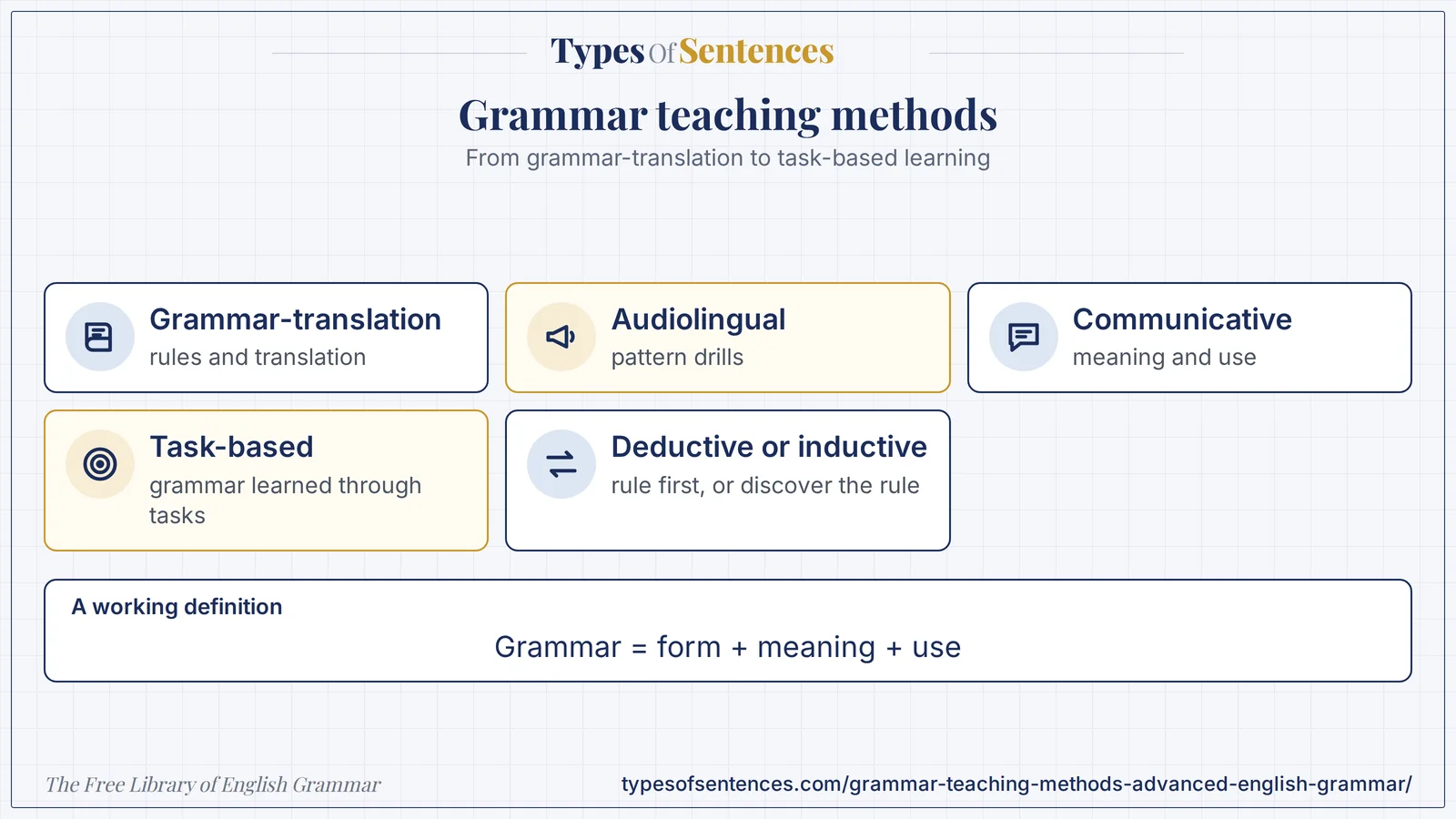
There is no single best way to teach grammar. Some learners like to see the rule first; others learn better by noticing patterns in examples. Some structures are best taught through a communication task; others need explicit explanation and practice.
Why it matters: What the research does support is this: grammar teaching works best when learners understand the meaning and use of a form as well as its shape, when they have chances to use it, and when they receive feedback. Teach grammar in meaningful context.
Summary: Approaches have included grammar-translation (rules and translation), the audiolingual method (pattern drills), communicative language teaching (meaning and use), task-based learning (grammar learned through tasks with outcomes), the lexical approach (chunks), and focus on form (attention to form within meaning-focused activity). Deductive teaching presents the rule first; inductive teaching lets learners discover it from examples. Consciousness-raising and noticing help learners to see patterns. PPP (presentation, practice, production) remains common. Meta-analyses find that explicit instruction is generally effective, especially when combined with practice and feedback. Grammar has three dimensions: form, meaning, and use. Feedback includes recasts and metalinguistic comments. Good practice is to teach grammar in context, from texts and tasks, with attention to the learners’ first language, level, and goals.
- Grammar = form + meaning + use.
- Deductive: rule first; inductive: discover the rule.
- Task-based and focus on form connect meaning and accuracy.
- Teach grammar in meaningful context.
What You’ll Learn
- 1. Grammar Teaching Methods: A Brief History of Approaches
- 2. Deductive vs Inductive Teaching: Rule-First vs Examples-First
- 3. Communicative Grammar Teaching: Focus on Meaning and Use
- 4. Task-Based Learning: Grammar Through Tasks
- 5. Focus on Form: Balancing Meaning and Accuracy
- 6. Grammar Consciousness-Raising: Noticing Patterns
- 7. Error Correction Approaches: When and How
- 8. Grammar in Context: Not Isolated Rules
- 9. Teaching Different Learners and Settings
- 10. Common Misconceptions About Teaching Grammar
- 11. Exercises
- 12. Test Your Knowledge
- 13. Frequently Asked Questions
- 14. Conclusion
1. Grammar Teaching Methods: A Brief History of Approaches
| Approach | Period | Idea | Role of grammar | Typical activity |
|---|---|---|---|---|
| grammar-translation | nineteenth century to the present in many places | the language is learned through rules and translation | central; rules and paradigms | translate sentences; memorize rules |
| direct method | late nineteenth century | teach in the target language, without translation | taught inductively through use | question and answer; demonstration |
| audiolingual method | 1940s to 1960s | language is habit formation (behaviorism); learn by drills | patterns practiced to automaticity | repetition and substitution drills |
| cognitive code | 1960s | learners form rules; understanding precedes practice | explicit rules and meaningful practice | explanation then use |
| communicative language teaching (CLT) | 1970s onward | the aim is communicative competence (Hymes, 1972; Canale and Swain, 1980) | grammar as a resource for meaning; sometimes neglected | information gaps; role plays |
| task-based learning (TBLT) | 1980s onward | learners learn by doing tasks with outcomes (Prabhu, 1987; Willis, 1996; Ellis, 2003) | emerges from the task; language focus after it | a planning task; a survey |
| lexical approach | 1990s | language is chunks of lexis and collocation (Lewis, 1993) | grammar emerges from chunks | noticing collocations and phrases |
| focus on form | 1990s onward | attention to form within meaning-focused activity (Long, 1991) | brief, in context | recasts; textual enhancement |
| content-based and CLIL | 1990s onward | learn language through subject content | incidental and planned | science lessons in English |
| post-method | 1990s onward | teachers choose and adapt principles for their setting (Kumaravadivelu, 1994) | as needed | — |
| Idea or theory | Claim | Source (and comment) |
|---|---|---|
| communicative competence | knowing a language includes knowing how to use it appropriately, not only its rules | Dell Hymes, 1972; Canale and Swain, 1980 |
| input hypothesis | acquisition occurs when learners understand input slightly above their level | Stephen Krashen, 1982 (influential; criticized for ignoring practice and form) |
| noticing hypothesis | learners must consciously notice a form to learn it | Richard Schmidt, 1990 |
| output hypothesis | producing language makes learners notice gaps | Merrill Swain, 1985 |
| interaction hypothesis | negotiating meaning in conversation helps learning | Michael Long, 1996 |
| skill acquisition | explicit knowledge becomes automatic through practice | Robert DeKeyser |
| processing instruction | teaching learners to process input correctly | Bill VanPatten |
| teachability hypothesis | learners acquire structures in a fixed developmental order | Manfred Pienemann |
| form–meaning–use | grammar has three dimensions; teach all | Diane Larsen-Freeman, 2003 |
The Bangalore Project (Prabhu and colleagues, in schools in southern India in the early 1980s) was an early experiment in task-based teaching: pupils learned English through problem-solving tasks with no explicit grammar syllabus. It influenced the later development of task-based learning, and shows that questions about grammar teaching are not confined to any one country. The related research on how learners acquire grammar is mentioned in the chapters on error analysis and on grammar learning strategies.
2. Deductive vs Inductive Teaching: Rule-First vs Examples-First
| Feature | Deductive | Inductive |
|---|---|---|
| sequence | rule → examples → practice | examples → discovery of the rule → practice |
| teacher’s role | explains the rule | guides the discovery |
| learner’s role | applies the rule | notices and formulates the rule |
| speed | fast | slower |
| strengths | clear; efficient; suits adults and exam preparation; good for complex rules | active; memorable; develops noticing; suits patterns that are easy to see |
| weaknesses | passive; may not link to use | may take time; learners may form wrong rules; some rules are hard to see |
| suits | analytical learners; exam courses; complex or abstract rules | curious learners; frequent patterns; small groups |
| research | explicit instruction is generally effective (Norris and Ortega, 2000; Spada and Tomita, 2010); no strong advantage for either direction overall | — |
| Same lesson, two ways: the present perfect with for and since | Deductive version | Inductive version |
|---|---|---|
| step 1 | The teacher writes: have/has + past participle; explains that since + a point in time and for + a length of time go with the present perfect. | The teacher gives eight sentences (I have lived here since 2015; She has worked here for three years; I lived here in 2015). |
| step 2 | Learners study the rule and examples. | Learners sort the sentences into two groups and say what each group has in common. |
| step 3 | Learners do a gap-fill (for/since). | Learners write the rule in their own words; the teacher confirms and refines it. |
| step 4 | Learners write sentences about themselves. | Learners write sentences about themselves. |
| step 5 | The teacher corrects errors. | The teacher corrects errors. |
| Guided discovery (a middle path) | Description |
|---|---|
| examples with a guiding question | What do you notice about the verb in sentences A and B? |
| rule completion | the learners fill in a partly written rule |
| rule checking | learners compare their rule with the grammar reference |
| feedback | the teacher confirms and corrects |
| practice | meaningful use |
- Use deductive teaching when the rule is complex, when time is short, when the learners prefer it, or when they are adults who benefit from metalanguage.
- Use inductive teaching when the pattern is easy to see, when the learners are curious, and when you want them to notice.
- Combine: many lessons begin with an example, move to a brief explicit statement, and end with practice.
- Check the rule that learners formulate. Inductive teaching needs a confirming step.
- Do not equate “inductive” with “no explanation.” Explicit knowledge still has a role.
Studies in the field, including meta-analyses, generally find that explicit instruction (deductive or inductive) is effective for learning grammar, and that the effects are stronger when it is combined with opportunities to use the form. The corpus-based version of discovery learning, in which learners study concordance lines, is described in the chapter on corpus linguistics.
3. Communicative Grammar Teaching: Focus on Meaning and Use
| Principle | Meaning | Example |
|---|---|---|
| grammar serves communication | forms are taught for what they let learners do | the present perfect for talking about experience |
| form, meaning, and use | teach what the form looks like, what it means, and when it is used | have been to (form); visited and returned (meaning); asking about experiences (use) |
| use authentic or realistic language | examples from real situations | a news report, an email |
| information gaps | learners need to exchange information to complete a task | pair work: each has half of a timetable |
| meaningful practice | practice involves choice and real or realistic meaning | survey: Have you ever …? |
| fluency and accuracy | both matter; some activities focus on each | a free discussion, then a language focus |
| learner-centered | activities require learners’ own ideas | interview a partner |
| integration of skills | listening, speaking, reading, and writing combined | — |
| functions and notions | organize by purposes (requesting, advising) | should for advice |
| grammaring | grammar as a skill of using form meaningfully (Larsen-Freeman) | — |
| Communicative activity | Grammar focus | How it works |
|---|---|---|
| information gap | questions, present tenses | each partner has different information |
| role play | modals, politeness | a customer and a clerk |
| survey | present perfect, questions | learners ask others and report |
| problem solving | conditionals, modals of advice | groups solve a problem |
| opinion gap | comparatives, should, I think | learners discuss a controversial statement |
| story-building | past tenses, narrative linking words | each learner adds a sentence |
| picture description | present progressive, prepositions of place | describe and draw |
| find the difference | comparatives, present tenses | compare two pictures |
| guessing game | questions, modals of possibility | twenty questions |
| dictogloss | all structures in a text | listen and rewrite |
| interviews | past simple and perfect | ask about a partner’s experience |
| planning a trip | future forms, modals | agree an itinerary |
| giving instructions | imperatives, sequence words | explain how to make a recipe |
| news report | past tenses, reported speech | report an event |
| debate | conditionals, modals, linking words | argue for or against |
| email exchange | politeness, requests | write and answer a real email |
| presentations | present tenses, discourse markers | talk about a topic |
| project work | mixed | a poster or a short report |
Communicative teaching sometimes neglected grammar, because the focus was on fluency and the hope that grammar would “take care of itself.” Research (and experience) showed that learners benefit from explicit attention to form, especially in areas that are hard to notice in the input. Current practice therefore combines meaningful communication with focused attention to form, as in the approaches described below. The relation of form and meaning is explored in the chapter on grammar and meaning.
4. Task-Based Learning: Grammar Through Tasks
| Feature of a task (Ellis, 2003) | Meaning | Example |
|---|---|---|
| primary focus on meaning | learners are concerned with what is said, not how | plan a weekend trip for the group |
| a gap | a need to convey or obtain information | each learner has part of the information |
| learners use their own resources | no prescribed language | — |
| a clearly defined outcome (non-linguistic) | something produced or decided | a schedule; a list; a decision |
| real-world relationship | tasks resemble activities outside class | making an appointment |
| Stage (Willis, 1996) | Activity | Grammar role |
|---|---|---|
| pre-task | the teacher introduces the topic and task; learners may hear a model | activates relevant language |
| task cycle: task | learners do the task in pairs or groups | use their own language |
| task cycle: planning | learners prepare to report to the class | focus on accuracy for a public report |
| task cycle: report | learners present their results | public use |
| language focus: analysis | learners examine texts or transcripts for forms | noticing and discussion of grammar |
| language focus: practice | the teacher selects forms for practice | targeted practice |
| Type of task | Grammar example | Description |
|---|---|---|
| unfocused task | none specified | any language needed |
| focused task (grammar-targeted) | the simple past | learners tell a story about a crime; the task makes the past tense useful |
| structure-based production task | the conditional | learners discuss what they would do with a large sum of money |
| consciousness-raising task | relative clauses | learners find and discuss examples in a text |
| input-based task | comparatives | learners follow instructions that require interpreting comparatives |
| dictogloss | mixed forms | learners reconstruct a short text |
| picture-sequence task | past and sequencing | learners tell the story |
| decision-making task | modals of advice | learners choose and justify |
| Strengths of task-based learning | Limits |
|---|---|
| meaningful and motivating | needs careful task design |
| practices fluency and strategy | learners may use simple language and avoid difficult forms |
| allows noticing in context | grammar may not be covered systematically |
| learner-centered | large classes and exam syllabi can make it hard to apply |
| suits communicative goals | some learners expect explicit teaching |
| can be combined with a language focus | teachers need training |
A balanced approach uses tasks to create the need for a form and then draws attention to the form afterward. The research literature on task-based teaching is large, and the approach is widely used, though sometimes in a “weak” form (a task as part of a lesson) rather than a “strong” form (the whole syllabus). Its worth is that it connects grammar with purpose.
5. Focus on Form: Balancing Meaning and Accuracy
| Term (Long, 1991, and others) | Meaning | Example |
|---|---|---|
| focus on forms | the traditional teaching of grammar items in isolation, in a sequence | a lesson on the present perfect with drills |
| focus on meaning | communication with no attention to form | a free discussion |
| focus on form | attention to form that arises incidentally in meaning-focused activity | the teacher recasts a learner’s error during a discussion |
| planned focus on form | the teacher plans a task that requires a form | a task that elicits the past tense |
| incidental (reactive) focus on form | the teacher responds to errors or questions as they arise | a quick explanation |
| proactive focus on form | the teacher anticipates and prepares | an input flood of the target form |
| Technique | How it works | Example |
|---|---|---|
| input flood | a text with many instances of the target form | a story with many past perfect verbs |
| textual (input) enhancement | visual highlighting of a form | bold type; underlining; color |
| recast | a corrected reformulation of a learner’s utterance | She go. — She went. |
| clarification request | a request for clarification that signals a problem | Sorry? |
| dictogloss | learners listen to a text and reconstruct it with notes | a team writes out a story |
| processing instruction | activities that force learners to process the form and meaning together | choose the picture that matches The cat was chased by the dog |
| consciousness-raising task | learners analyze examples and formulate a rule | — |
| garden-path technique | learners are led to overgeneralize and then corrected | — |
| output tasks with pre-planning | learners prepare to speak about a topic, then speak | — |
| pushed output | the teacher asks for a more accurate form | Can you say that again? |
| grammar mini-lesson | a short explanation at the point of need | — |
| sentence combining | joining short sentences | — |
| reformulation | a native speaker rewrites the learner’s text; the learner compares | — |
| textual analysis | learners examine a text for grammar and meaning | — |
| peer discussion of form | learners discuss the choice of a form | — |
| think-aloud | learners explain their choices | — |
| cloze with meaning | a text with gaps whose answers require understanding | — |
| jigsaw grammar | each learner studies a part of a rule and teaches it | — |
| Balance between meaning and accuracy | Guideline |
|---|---|
| begin with meaning | a purpose for the language comes first |
| attend to form at the moment of need | brief, in context |
| plan for the forms that matter | frequent, difficult, or global |
| use feedback | recasts and prompts |
| allow time for accuracy work | a planning stage; a writing stage |
| do not interrupt fluency constantly | delayed correction |
| review | recycle forms in later lessons |
Research on focus on form suggests that attention to form in meaning-focused lessons is more effective than leaving form to chance, and that the combination of explicit instruction, practice, and feedback gives the best results. The principle accords with the view of grammar in the chapter on grammar myths: what matters is the use of forms in context, and the teacher should use evidence about what works.
6. Grammar Consciousness-Raising: Noticing Patterns
| Step | Activity | Example |
|---|---|---|
| 1 data | learners receive examples of the structure | eight sentences with the second conditional |
| 2 noticing | learners notice and mark features | underline the verb forms |
| 3 discussion | learners compare and describe the pattern | What tense is used in the if-clause? Is the situation real? |
| 4 rule formulation | learners write the rule | If + past simple, would + base verb |
| 5 checking | learners compare with a reference | a grammar book |
| 6 application | learners use the structure | write three sentences about themselves |
| 7 review | later, learners find the structure in a new text | — |
| Consciousness-raising task (original) | Data | Guiding question |
|---|---|---|
| articles | I saw a dog and a cat. The dog was black. | When do we use a? When the? |
| third-person -s | She works. He plays. They work. | Which subjects take -s? |
| prepositions of time | on Monday; in July; at five o’clock | What kind of time goes with each preposition? |
| reported speech | “I am tired.” → She said she was tired. | What changes? Why? |
| relative clauses | the man who called; the book that I read | When do we use who? that? |
| comparatives | taller, bigger, more careful | Which adjectives take -er? Which take more? |
| modals | You should go. You must go. | What is the difference? |
| word order in questions | You are late. Are you late? | What changes in a question? |
| collocations | make a decision; do homework | Which verbs go with which nouns? |
| passives | The window was broken. | Who broke it? Why is it not stated? |
- Use clear, short data that illustrates one pattern.
- Provide a guiding question so that learners know what to look for.
- Let learners work in pairs to discuss.
- Confirm the rule explicitly; do not leave learners with a wrong generalization.
- Use authentic texts where the pattern occurs naturally.
- Use corpus data for upper-level learners (data-driven learning, associated with Tim Johns).
- Combine with practice. Noticing is a step; use is the goal.
The idea of consciousness-raising was introduced by Rutherford and Sharwood Smith (1985); it builds on the noticing hypothesis, according to which learners learn what they consciously notice. It suits learners who like to analyze, and it provides grammar in the form of a problem to solve, which is often more engaging than a rule to learn.
7. Error Correction Approaches: When and How
| Question | Guidance |
|---|---|
| Which errors to correct? | global, frequent, and stigmatizing errors first; errors in the structure that is the lesson’s focus |
| When to correct in speaking? | immediately in accuracy work; delayed in fluency work |
| When to correct in writing? | on drafts (with a chance to revise); selectively |
| How? | recasts, prompts, metalinguistic comments, codes, reformulation |
| Who corrects? | the teacher, the learner (self-correction), peers, or software |
| How to follow up? | a short exercise, an error log, a rewrite |
| How to protect motivation? | praise success; avoid public embarrassment; limit the amount |
| What if learners ignore the correction? | make the feedback clearer and ask them to rewrite |
The types of error and the methods of correction are described in detail in the previous chapter, on error analysis and correction: here the point is that correction is part of teaching method and has to be planned like any other activity. Teachers should consider the learners’ preferences: some want frequent correction; others find it discouraging.
8. Grammar in Context: Not Isolated Rules
| Approach to context | Description | Example |
|---|---|---|
| text-based teaching | the lesson starts with a whole text, and grammar is taught from it | a news story for the past tenses |
| genre-based teaching | learners study the grammar typical of a genre (recount, report, argument) in a teaching-learning cycle (the Sydney School) | the grammar of a procedure: imperatives and sequencers |
| content-based teaching | grammar arises from subject material | science: passives in lab reports |
| task-based teaching | grammar arises from tasks | — |
| corpus-based teaching | grammar is learned from authentic data | concordance lines |
| literature-based teaching | grammar is explored in stories and poems | the use of tenses in a short story |
| project work | grammar is practiced in extended work | a class newspaper |
| personalization | learners use grammar to talk about their own lives | I have never … |
| spiral curriculum | structures are revisited in new contexts | conditionals at three levels |
| integrated skills | grammar appears across reading, writing, speaking, and listening | — |
| Isolated rule | Rule in context |
|---|---|
| The present perfect is formed with have + the past participle. | Learners read a travel blog and find what the writer has done; then they write about their own experiences. |
| Articles: a before consonants, an before vowels. | Learners read a short description and explain why each noun has a, the, or none. |
| The passive is formed with be + the past participle. | Learners read a description of a process (how paper is made) and rewrite it in the active, discussing the difference. |
| Conditionals: if + past, would + base. | Learners discuss what they would do in an imagined situation. |
| Reported speech: backshift the tense. | Learners report an interview they have conducted. |
| A lesson plan template (grammar in context) | Content |
|---|---|
| aim | what the learners will be able to do (for example, describe past experiences) |
| target form, meaning, and use | form: present perfect; meaning: relevance now; use: experiences |
| context | a short text or situation |
| lead-in | engage with the topic (3 minutes) |
| text and comprehension | read or listen; check meaning (10 minutes) |
| noticing | find examples of the target form; discuss its meaning (10 minutes) |
| clarification | a brief rule or a table (5 minutes) |
| controlled practice | gap-fill; sentence completion (10 minutes) |
| freer practice | a survey or role play (15 minutes) |
| feedback | selective correction; delayed correction (5 minutes) |
| review and homework | a short writing task; an error log entry |
| anticipated problems | since/for; irregular participles; been versus gone |
| assessment | observation; a short quiz next lesson |
Teaching grammar in context does not mean that explicit explanation is excluded; it means that the explanation is connected with a text, a task, or a purpose, and that learners see why the form is used. The principle underlies the integrated approach of this site: examples come from real or realistic texts, and each chapter connects the rule to use.
9. Teaching Different Learners and Settings
| Learners or setting | Considerations |
|---|---|
| young learners | simple, concrete, playful; songs, stories, and games; little metalanguage; implicit learning |
| adolescents | relevance; peer work; some explicit explanation; projects |
| adults | explicit explanation valued; can use metalanguage; need for relevance; time constraints |
| exam-oriented learners | a clear rule and practice; learn exam formats; add communicative use for retention |
| mixed-level classes | tasks with different outcomes; peer teaching; graded materials |
| large classes | pair and group work; whole-class games; written tasks; peer correction |
| multilingual classes in India and elsewhere | use the learners’ languages as a resource; contrastive examples; attention to local varieties; consider the variety of English that learners will use |
| English for academic purposes | genre-specific grammar; nominalization; hedging |
| business English | politeness, modals, email grammar |
| self-study | a grammar reference; corpus and online tools; an error log |
| online learning | interactive exercises; feedback; recordings |
| learners with special needs | multisensory, clear structure, patience; adapt the pace |
| teachers working with textbooks | adapt and supplement; add context and tasks |
| Use of the learners’ first language | Benefit |
|---|---|
| explaining abstract rules briefly | saves time and avoids confusion |
| contrastive examples | helps to notice differences (see the chapter on contrastive analysis) |
| checking understanding | quickly |
| translation as a learning tool | careful comparison can clarify meaning |
| encouraging translanguaging | learners use all their languages as resources |
The teacher’s own knowledge of grammar (pedagogical grammar) and of the learners’ languages affects the quality of explanation. A teacher needs to know the rule, the exceptions, and the common errors, as well as ways of explaining the form, the meaning, and the use. A simple, accurate rule is better than a complicated, complete one for beginners, and the complication can be added as the learners progress.
10. Common Misconceptions About Teaching Grammar
| Misconception | Reality |
|---|---|
| Grammar teaching is useless. | Research generally supports explicit instruction combined with practice. |
| Grammar should be taught only through rules. | Rules are one tool; use, noticing, and practice matter. |
| Learners learn only what is taught. | Learners acquire in their own order; teaching helps but does not control the order. |
| PPP is outdated and ineffective. | It is widely used and can work if practice is meaningful, but it may not reflect how acquisition occurs. |
| Fluency comes first and accuracy follows naturally. | Without attention to form, some errors fossilize. |
| Drills are always useless. | Meaningful drills can help automatization; mechanical drills alone do not. |
| Correct every error. | Be selective. |
| Inductive teaching is always better. | The evidence is mixed; it depends on the learner and the rule. |
| The first language should be banned in class. | Judicious use can help. |
| Native speakers make the best grammar teachers. | Knowledge of grammar and teaching skill matter more. |
| Grammar is boring. | It can be engaging when connected to meaning and tasks. |
| Testing equals teaching. | Tests assess; teaching develops (see the chapter on testing). |
| A grammar rule is either correct or incorrect. | Many rules are tendencies (see the chapter on grammar myths). |
| One method suits all. | Choose according to learners, goals, and setting. |
Plan a short grammar lesson (invented): target — the present perfect for experience; learners — adult intermediate learners in a mixed-language class; time — 60 minutes.
- Context: a short text, “My travel bucket list,” about places a person has and has not visited.
- Lead-in (5 min): Have you ever been to … ? Learners share in pairs.
- Reading (10 min): learners read and answer comprehension questions.
- Noticing (10 min): underline all verbs of the form have/has been and have/has + participle; discuss: Do we know when? What is the sentence about? (the experience).
- Clarification (5 min): a brief table: form, meaning (experience up to now), use (talking about life experiences); contrast been and gone; I saw it in 2019 (a finished time) versus I have seen it.
- Controlled practice (10 min): a gap-fill with participles; sentence transformation.
- Freer practice (15 min): a survey: learners ask five classmates Have you ever …? and report the most interesting answers.
- Feedback (5 min): delayed correction of errors heard during the survey (*I have seen him yesterday).
- Homework: a short paragraph about three experiences; add an error-log entry.
- Assessment: observation, the paragraph, and a short quiz next lesson.
Recap in 12 seconds
Watch the lesson build itself: Teaching approaches range from grammar-translation and drills to communicative and task-based learning. The video has no sound.
Exercises
Part A: Approaches (Exercises 1–7)
Exercise 1: Name the method based on pattern drills and behaviorism.
Show Answer
Answer: The audiolingual method.
Exercise 2: Name the method based on rules and translation.
Show Answer
Answer: Grammar-translation.
Exercise 3: What is communicative competence?
Show Answer
Answer: Knowing how to use a language appropriately, not only its rules.
Exercise 4: Who proposed the noticing hypothesis?
Show Answer
Answer: Richard Schmidt.
Exercise 5: What does PPP stand for?
Show Answer
Answer: Presentation, practice, production.
Exercise 6: Name Larsen-Freeman’s three dimensions of grammar.
Show Answer
Answer: Form, meaning, use.
Exercise 7: What was the Bangalore Project?
Show Answer
Answer: An early task-based teaching experiment in schools in southern India.
Part B: Deductive and Inductive (Exercises 8–12)
Exercise 8: Define deductive teaching.
Show Answer
Answer: The rule is given first, then examples and practice.
Exercise 9: Define inductive teaching.
Show Answer
Answer: Learners discover the rule from examples.
Exercise 10: Name a strength of deductive teaching.
Show Answer
Answer: Clear and efficient; suits complex rules and adult learners.
Exercise 11: Name a strength of inductive teaching.
Show Answer
Answer: Active; develops noticing.
Exercise 12: What is guided discovery?
Show Answer
Answer: Learners discover the rule with guiding questions and confirmation.
Part C: Communicative and Task-Based (Exercises 13–19)
Exercise 13: Name a communicative activity with an information gap.
Show Answer
Answer: Pair work with half a timetable each.
Exercise 14: Name a feature of a task.
Show Answer
Answer: Primary focus on meaning; a gap; a defined outcome; learners use their own resources.
Exercise 15: Name the stages of Willis’s task cycle.
Show Answer
Answer: Pre-task, task cycle (task, planning, report), language focus.
Exercise 16: What is a focused task?
Show Answer
Answer: A task designed to make a particular form useful.
Exercise 17: Name a limit of task-based learning.
Show Answer
Answer: Learners may avoid difficult forms; coverage is unsystematic.
Exercise 18: Who wrote on task-based language teaching (2003)?
Show Answer
Answer: Rod Ellis.
Exercise 19: What is a dictogloss?
Show Answer
Answer: Learners listen to a text and reconstruct it from notes.
Part D: Focus on Form and Consciousness-Raising (Exercises 20–26)
Exercise 20: Who distinguished focus on form from focus on forms?
Show Answer
Answer: Michael Long.
Exercise 21: Define focus on form.
Show Answer
Answer: Attention to form arising within meaning-focused activity.
Exercise 22: Name a focus-on-form technique.
Show Answer
Answer: Recast, input flood, textual enhancement, dictogloss.
Exercise 23: What is input flood?
Show Answer
Answer: A text with many instances of the target form.
Exercise 24: What is consciousness-raising?
Show Answer
Answer: Activities that help learners notice and discuss patterns.
Exercise 25: Who introduced consciousness-raising (1985)?
Show Answer
Answer: Rutherford and Sharwood Smith.
Exercise 26: Who is associated with data-driven learning?
Show Answer
Answer: Tim Johns.
Part E: Context and Practice (Exercises 27–30)
Exercise 27: Where does teaching grammar in context begin?
Show Answer
Answer: With a meaningful text or task.
Exercise 28: Name two stages of a lesson plan.
Show Answer
Answer: Lead-in, noticing, clarification, controlled practice, freer practice, feedback.
Exercise 29: Name a use of the learners’ first language.
Show Answer
Answer: Explaining abstract rules; contrastive examples; checking understanding.
Exercise 30: Name a misconception about grammar teaching.
Show Answer
Answer: That it is useless; that one method suits all.
Test Your Knowledge
Ready to check what you learned? Answer all 10 questions, then submit. You need 80% (8 of 10) to pass. Your answers are not stored.
View correct answers and explanations
Question 1: Which method relies on pattern drills and behaviorism?
✓ Correct Answer: A – the audiolingual method
Audiolingual.
Question 2: In deductive teaching, the learner is
✓ Correct Answer: B – given the rule first and then practices
Rule first.
Question 3: What are the stages of PPP?
✓ Correct Answer: C – Presentation, Practice, Production
The classic sequence.
Question 4: Who proposed the distinction between focus on form and focus on forms?
✓ Correct Answer: D – Michael Long
Long.
Question 5: Which technique has learners reconstruct a text from notes taken while listening?
✓ Correct Answer: C – dictogloss
Dictogloss.
Question 6: What is the main feature of a task in task-based learning?
✓ Correct Answer: A – primary focus on meaning with a clear outcome
Meaning and outcome.
Question 7: Consciousness-raising aims to
✓ Correct Answer: D – help learners notice patterns
Noticing.
Question 8: Who proposed the noticing hypothesis?
✓ Correct Answer: C – Richard Schmidt
Schmidt.
Question 9: Which are the three dimensions of grammar in Larsen-Freeman’s model?
✓ Correct Answer: B – form, meaning, use
Form, meaning, use.
Question 10: Where does teaching grammar in context begin?
✓ Correct Answer: B – with a meaningful text or task
With context.
Frequently Asked Questions
What are grammar teaching methods?
Grammar teaching methods are the approaches used to teach grammar: deductive and inductive teaching, communicative and task-based approaches, focus on form, and consciousness-raising. Grammar teaching methods differ in the role of rules, meaning, and practice.
What is teaching grammar effectively?
Teaching grammar effectively means connecting form, meaning, and use, giving clear explanation where needed, providing meaningful practice and feedback, and adapting to the learners. Teaching grammar is best done in context.
What is grammar instruction?
Grammar instruction is the deliberate teaching of grammar, which may be explicit (with explanation) or implicit (through exposure and practice). Grammar instruction is generally found to help learning.
What is grammar pedagogy?
Grammar pedagogy is the theory and practice of teaching grammar, including selection of content, sequencing, explanation, practice, and feedback. Grammar pedagogy draws on linguistics and research on second language acquisition.
What are the main teaching approaches?
Grammar-translation, the audiolingual method, communicative language teaching, task-based learning, the lexical approach, and focus on form. Modern teaching approaches usually combine several.
Should I teach rules first or let learners discover them?
Both work. Use the rule first for complex rules and short time; use discovery for patterns that are easy to see. Many lessons combine them in guided discovery.
Is grammar teaching necessary?
Research suggests that learners who receive explicit attention to form, with practice and feedback, generally do better than those who do not, though grammar is only part of language learning.
Conclusion
You now have a survey of grammar teaching methods: the history of approaches, deductive and inductive teaching, communicative and task-based teaching, focus on form, consciousness-raising, correction, grammar in context, teaching different learners, and the misconceptions to avoid. You can plan a grammar lesson and justify your choices.
When you plan a lesson, ask what the learners should be able to do, and how the grammar helps them to do it. Next, you will study grammar learning strategies.
- Ellis, Rod. Task-Based Language Learning and Teaching. Oxford University Press, 2003.: the features and stages of tasks.
- Larsen-Freeman, Diane. Teaching Language: From Grammar to Grammaring. Heinle, 2003.: form, meaning, and use.
- Norris, John M., and Lourdes Ortega. “Effectiveness of L2 Instruction: A Research Synthesis and Quantitative Meta-Analysis.” Language Learning 50 (2000): 417–528.: evidence on explicit instruction.
- Long, Michael H. “Focus on Form: A Design Feature in Language Teaching Methodology.” In Foreign Language Research in Cross-Cultural Perspective. John Benjamins, 1991.: the notion of focus on form.
- Merriam-Webster Dictionary: pedagogy: the dictionary entry.
Last reviewed: October 29, 2026. How it was made: drafted with AI assistance, then checked with automated tests (structure, links, answer keys, spelling) and against the sources above. A person has not yet read this chapter line by line. Found a mistake? Report it.