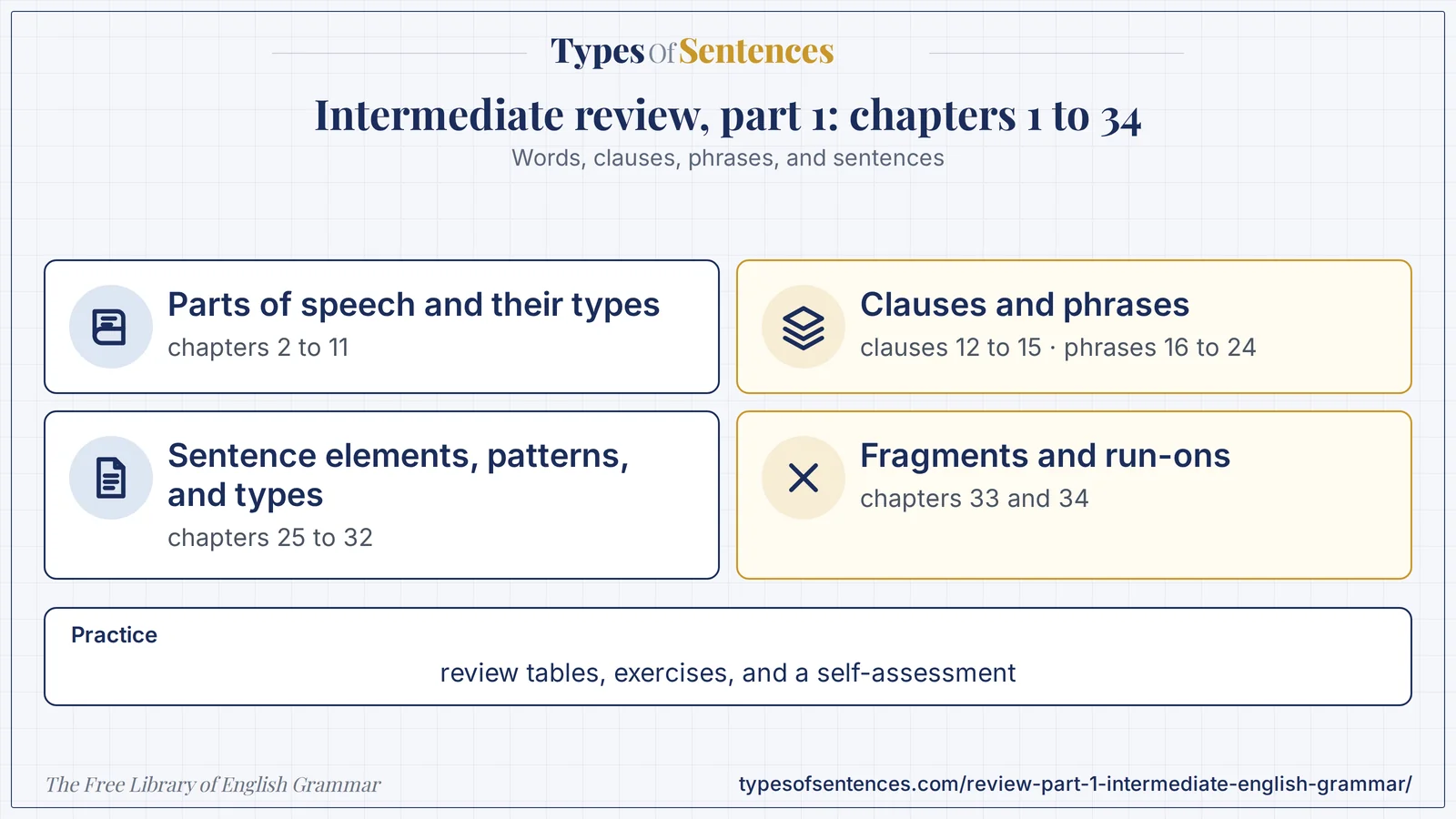
This intermediate grammar review part 1 brings together the first half of the Intermediate level: Chapters 1 to 34. It covers the review and expansion of the basics, the parts of speech in depth, clauses, phrases, and sentence structure, including fragments and run-ons. These are the building blocks of everything that follows: tenses, modals, voice, conditionals, and writing.
This intermediate review part one has four jobs: a comprehensive review of the previous chapters, intermediate grammar exercises (30 of them), a self-assessment, and a summary of key concepts. Use it as an intermediate assessment to find out what you remember and what you should read again before you move on to Part 2.
A review is a check-up for your grammar. You go through each group of topics, ask whether you can explain it and use it, and then fill the gaps.
Why it matters: Reviewing in two parts keeps each session manageable. Part 1 covers the structure of words, phrases, clauses, and sentences; Part 2 covers verbs, voice, conditionals, and writing.
Summary: Chapters 1 to 34 cover the parts of speech and their types, the three kinds of dependent clauses, the main kinds of phrases, the elements and patterns of sentences, the four sentence structures, and the two main sentence-boundary errors (fragments and run-ons). This chapter reviews them with tables, 30 practice exercises, and a self-assessment.
- Parts of speech and their types (Chapters 2 to 11).
- Clauses (12 to 15) and phrases (16 to 24).
- Sentence elements, patterns, and types (25 to 32).
- Fragments and run-ons (33 to 34).
What You’ll Learn
1. Intermediate Grammar Review Part 1: What It Covers
Review Part 1 covers Chapters 1 to 34, in five groups. For each group, ask: Can I explain it? Can I use it? Can I find it in a sentence?
| Group | Chapters | Topics |
|---|---|---|
| Review and expansion | 1 | the bridge from the Basic level; the map of the course |
| Parts of speech | 2 to 11 | nouns, verbs, pronouns, adjectives, adverbs, prepositions, conjunctions, articles, determiners, quantifiers |
| Clauses | 12 to 15 | what a clause is; noun, adjective, and adverb clauses |
| Phrases | 16 to 24 | types of phrases; noun, verb, prepositional, participial, infinitive, gerund, appositive, and absolute phrases |
| Sentence structure | 25 to 34 | elements; seven patterns; objects; complements; simple, compound, complex, and compound-complex sentences; fragments; run-ons |
Part 2, which follows, covers Chapters 35 to 68: tenses, modals, voice and speech, conditionals, non-finite verbs, punctuation, writing skills, and common errors.
2. Comprehensive Review of Previous Chapters
I. Parts of speech (Chapters 2 to 11)
Each part of speech has types, and the types decide how a word behaves in a sentence. The chapter on nouns and the chapters that follow give the details.
| Part | Types to know | One-line rule |
|---|---|---|
| Noun | common, proper, concrete, abstract, collective, compound; countable and uncountable | names; check countable or not before using many/much or a/an |
| Verb | action, linking, helping (auxiliary), modal; transitive and intransitive; stative and dynamic | see types of verbs; only transitive verbs take objects |
| Pronoun | personal, possessive, reflexive, demonstrative, relative, interrogative, indefinite | see types of pronouns; it must agree with its antecedent |
| Adjective | descriptive, limiting, comparative, superlative, participial | see adjective types; order: opinion, size, age, shape, color, origin, material, purpose |
| Adverb | manner, place, time, frequency, degree, sentence adverbs | see types of adverbs; modifies verbs, adjectives, other adverbs |
| Preposition | place, time, direction, and many fixed combinations | see types of prepositions; followed by a noun phrase or gerund |
| Conjunction | coordinating (FANBOYS), subordinating, correlative; conjunctive adverbs | join words, phrases, and clauses |
| Article / determiner / quantifier | a, an, the, zero article; this, my, some, any, much, many, few, little | the choice depends on whether the noun is specific and countable |
| Common choice | Rule | Example |
|---|---|---|
| a or an | by sound, not letter | an hour, a university |
| the or no article | specific or already mentioned: the; general: none | I like music. The music was loud. |
| much or many | much: uncountable; many: countable | much water; many friends |
| few or little | few: countable; little: uncountable (both mean not enough) | few books; little time |
| some or any | some: positive; any: negative and questions | I have some. I don’t have any. |
| good or well | good: adjective; well: adverb | a good singer; she sings well |
| fewer or less | fewer: countable; less: uncountable | fewer cars; less traffic |
II. Clauses (Chapters 12 to 15)
A clause has a subject and a verb. An independent clause can stand alone; a dependent clause cannot. Study the chapter on clauses to see how dependent clauses work as nouns, adjectives, and adverbs.
| Clause | Job | Introduced by | Example |
|---|---|---|---|
| noun clause | subject, object, or complement | that, whether, if, who, what, where, how | I know that she is right. |
| adjective (relative) clause | modifies a noun | who, whom, whose, which, that, where, when | The girl who called is my cousin. |
| adverb clause | modifies a verb (time, reason, condition, contrast, purpose, place) | when, because, if, although, so that, where | Although it rained, we went out. |
- A restrictive adjective clause is needed to identify the noun and takes no commas (The man who called is here). A nonrestrictive clause adds extra information and takes commas (My brother, who lives in Delhi, called).
- An adverb clause that begins a sentence is followed by a comma; one that ends a sentence usually is not.
- In a noun clause, statement word order is used, even for questions: I know where she lives.
III. Phrases (Chapters 16 to 24)
A phrase is a group of words without a subject-verb pair. The types are described in the chapter on types of phrases.
| Phrase | Head word | Example |
|---|---|---|
| noun phrase | a noun | the tall man with the hat |
| verb phrase | a verb with auxiliaries | has been waiting |
| prepositional phrase | a preposition | in the garden |
| participial phrase | a participle (-ing / -ed) | Walking home, she met Tom. |
| infinitive phrase | to + base verb | To win the race, he trained daily. |
| gerund phrase | a gerund (-ing as a noun) | Swimming in the lake is fun. |
| appositive phrase | a noun that renames another | Maria, my sister, lives here. |
| absolute phrase | a noun + a participle, modifies the whole clause | The rain having stopped, we left. |
IV. Sentence structure (Chapters 25 to 34)
A sentence has a subject and a predicate; study the elements in the chapter on the elements of a sentence. The seven patterns are S-V, S-V-O, S-V-IO-DO, S-V-PA, S-V-PN, S-V-O-OC, and S-V-O-A.
| Structure | Clauses | Example |
|---|---|---|
| simple | one independent clause | The dog barked. |
| compound | two or more independent clauses | The dog barked, and the cat ran. |
| complex | one independent + one or more dependent | The dog barked because a stranger came. |
| compound-complex | two independent + one or more dependent | The dog barked because a stranger came, and the cat ran. |
| Error | What is wrong | Fix |
|---|---|---|
| fragment | a piece of a sentence punctuated as a sentence | add the missing subject, verb, or main clause |
| run-on (fused sentence) | two clauses with no punctuation or conjunction | add a period, a semicolon, or a comma and conjunction |
| comma splice | two clauses joined by only a comma | replace with a period, semicolon, or comma and conjunction |
The sentence patterns and their punctuation are connected: a compound sentence needs a comma before the conjunction (see the chapters on simple and compound sentences), and a complex sentence needs a comma after an introductory clause.
3. Key Concepts Summary
| Concept | Remember |
|---|---|
| Countable noun | can be counted; takes a/an and many; has a plural |
| Uncountable noun | cannot be counted; takes much and little; no plural (information, advice) |
| Transitive verb | takes a direct object |
| Linking verb | joins a subject to a complement (be, seem, become) |
| Antecedent | the noun a pronoun replaces |
| Restrictive clause | needed to identify the noun; no commas |
| Nonrestrictive clause | extra information; commas |
| Subordinating conjunction | starts a dependent adverb clause (because, although) |
| Participial phrase | modifies a noun; must be next to the noun it modifies |
| Gerund | an -ing form used as a noun |
| Appositive | a noun phrase that renames the noun before it |
| Direct object | receives the action (kicked the ball) |
| Subject complement | follows a linking verb and renames or describes the subject |
| Independent clause | can stand alone |
| Dependent clause | cannot stand alone; starts with a subordinator or relative word |
| Compound sentence | two independent clauses joined by , + conjunction or ; |
| Complex sentence | an independent clause + a dependent clause |
| Fragment | an incomplete sentence |
| Comma splice | two clauses joined by only a comma |
4. Intermediate Grammar Exercises and Practice
The 30 review exercises below are intermediate grammar practice for Chapters 1 to 34. Try each one before you open the answer. If you miss a question, the answer names the topic to study again.
5. Self-Assessment: Intermediate Assessment
This intermediate assessment has two parts. First, check the I can statements. Then take the quiz at the end and use its score.
| I can… | Chapters |
|---|---|
| tell common from proper nouns and countable from uncountable nouns | 2 |
| name the main types of verbs, and tell transitive from intransitive | 3 |
| choose the right pronoun and make it agree with its antecedent | 4 |
| put adjectives in the right order and choose between adjectives and adverbs | 5, 6 |
| use prepositions, conjunctions, articles, determiners, and quantifiers correctly | 7 to 11 |
| find independent and dependent clauses, and identify noun, adjective, and adverb clauses | 12 to 15 |
| identify the main kinds of phrases | 16 to 24 |
| find the subject, verb, objects, and complements in a sentence | 25 to 28 |
| classify sentences as simple, compound, complex, or compound-complex | 29 to 32 |
| fix fragments, run-ons, and comma splices | 33, 34 |
| Score on the 10-question quiz | What to do |
|---|---|
| 9 or 10 | Excellent. Go on to Part 2. |
| 7 or 8 | Good. Review the topics you missed, then go on. |
| 5 or 6 | Reread the chapters for the missed topics, then retake the quiz. |
| 4 or fewer | Go back through Chapters 2 to 15 slowly, then try again. |
This is a self-check, not an official test. Different learners need different amounts of review, and a low score means you have found what to study, not that you have failed.
Recap in 12 seconds
Watch the lesson build itself: Part 1 of the Intermediate review covers chapters 1 to 34. The video has no sound.
Exercises
Part A: Parts of Speech (Exercises 1–8)
Exercise 1: Plural of child:
Show Answer
Answer: children. (Chapter 2)
Exercise 2: Countable or uncountable: advice
Show Answer
Answer: Uncountable. (Chapter 2)
Exercise 3: Transitive or intransitive: She sleeps.
Show Answer
Answer: Intransitive. (Chapter 3)
Exercise 4: Choose: She gave it to Tom and (I/me).
Show Answer
Answer: me. (Chapter 4)
Exercise 5: Order the adjectives: a (wooden/old/big) table
Show Answer
Answer: a big old wooden table. (Chapter 5)
Exercise 6: Choose: He runs (quick/quickly).
Show Answer
Answer: quickly. (Chapter 6)
Exercise 7: Choose: I have (much/many) friends.
Show Answer
Answer: many. (Chapters 10, 11)
Exercise 8: Choose a, an, or the: I saw ___ elephant. ___ elephant was huge.
Show Answer
Answer: an … The. (Chapter 9)
Part B: Clauses (Exercises 9–14)
Exercise 9: Independent or dependent: because it was late
Show Answer
Answer: Dependent. (Chapter 12)
Exercise 10: Type of clause in I know that she is right: that she is right
Show Answer
Answer: Noun clause. (Chapter 13)
Exercise 11: Type of clause: The girl who called is my cousin. (who called)
Show Answer
Answer: Adjective (relative) clause. (Chapter 14)
Exercise 12: Add commas: My brother who lives in Delhi called.
Show Answer
Answer: My brother, who lives in Delhi, called. (nonrestrictive)
Exercise 13: Type of clause: Although it rained, we went out. (Although it rained)
Show Answer
Answer: Adverb clause (concession). (Chapter 15)
Exercise 14: Fix it: I know where does she live.
Show Answer
Answer: I know where she lives. (Chapter 13)
Part C: Phrases (Exercises 15–21)
Exercise 15: Name the phrase: in the garden
Show Answer
Answer: Prepositional phrase. (Chapter 19)
Exercise 16: Name the phrase: Walking home
Show Answer
Answer: Participial phrase. (Chapter 20)
Exercise 17: Name the phrase: To win the race
Show Answer
Answer: Infinitive phrase. (Chapter 21)
Exercise 18: Name the phrase: Swimming in the lake in Swimming in the lake is fun.
Show Answer
Answer: Gerund phrase. (Chapter 22)
Exercise 19: Name the phrase: my sister in Maria, my sister, lives here.
Show Answer
Answer: Appositive phrase. (Chapter 23)
Exercise 20: Name the phrase: The rain having stopped
Show Answer
Answer: Absolute phrase. (Chapter 24)
Exercise 21: Find the verb phrase: She has been waiting.
Show Answer
Answer: has been waiting. (Chapter 18)
Part D: Sentence Structure (Exercises 22–27)
Exercise 22: Pattern: Tom kicked the ball.
Show Answer
Answer: S-V-O. (Chapter 26)
Exercise 23: Find the indirect object: She gave Maria a book.
Show Answer
Answer: Maria. (Chapter 27)
Exercise 24: Find the subject complement: The soup is hot.
Show Answer
Answer: hot. (Chapter 28)
Exercise 25: Structure: The dog barked, and the cat ran.
Show Answer
Answer: Compound. (Chapter 30)
Exercise 26: Structure: The dog barked because a stranger came.
Show Answer
Answer: Complex. (Chapter 31)
Exercise 27: Structure: Because it rained, we stayed, and the game was canceled.
Show Answer
Answer: Compound-complex. (Chapter 32)
Part E: Fragments and Run-ons (Exercises 28–30)
Exercise 28: Fix the fragment: Because it was late.
Show Answer
Answer: We left because it was late. (Chapter 33)
Exercise 29: Fix the run-on: It was late we left.
Show Answer
Answer: It was late, so we left. (Chapter 34)
Exercise 30: Fix the comma splice: I like tea, however I like coffee more.
Show Answer
Answer: I like tea; however, I like coffee more. (Chapter 34)
Test Your Knowledge
Ready to check what you learned? Answer all 10 questions, then submit. You need 80% (8 of 10) to pass. Your answers are not stored.
View correct answers and explanations
Question 1: Which noun is uncountable?
✓ Correct Answer: A – advice
Advice has no plural.
Question 2: Which is a linking verb?
✓ Correct Answer: D – seem
Seem links a subject to a complement.
Question 3: Which is correct?
✓ Correct Answer: C – She gave it to Tom and me.
Object form after a preposition.
Question 4: Which is an adverb clause?
✓ Correct Answer: C – Although it rained
It begins with a subordinator and modifies the verb.
Question 5: Which phrase has a participle as its head?
✓ Correct Answer: A – Walking home
Walking is a participle.
Question 6: Which is the subject complement in The soup is hot?
✓ Correct Answer: C – hot
Hot describes the subject after a linking verb.
Question 7: Which is a complex sentence?
✓ Correct Answer: D – The dog barked because a stranger came.
One independent clause and one dependent clause.
Question 8: Which is a fragment?
✓ Correct Answer: B – Because it was late.
A dependent clause alone is a fragment.
Question 9: Which is a comma splice?
✓ Correct Answer: B – It was late, we left.
Two clauses with only a comma.
Question 10: Which clause needs commas?
✓ Correct Answer: B – My brother, who lives in Delhi, called.
Nonrestrictive clauses take commas.
Frequently Asked Questions
What is intermediate grammar review part 1?
Intermediate grammar review part 1 is a review of Chapters 1 to 34 of the Intermediate level: the parts of speech and their types, clauses, phrases, sentence structure, fragments, and run-ons.
What does intermediate review part one cover?
It covers the first half of the Intermediate level in five groups: the review and expansion of the basics, parts of speech, clauses, phrases, and sentence structure. Part 2 covers Chapters 35 to 68.
What are intermediate grammar exercises for?
Intermediate grammar exercises show whether you can use what you learned, not just recognize it. The 30 exercises here are mixed, so they also practice recalling a rule you studied weeks ago.
What does intermediate grammar practice include here?
Intermediate grammar practice in this chapter includes a summary of each topic group, a table of key concepts, 30 exercises with explained answers, a self-assessment, and a 10-question quiz.
What is an intermediate assessment?
An intermediate assessment is a self-check of your knowledge at this level. In this chapter it has an I can checklist and a score guide for the quiz, so you can see which topics to review.
What should I do if my score is low?
Go back to the chapters for the topics you missed, redo their exercises, and retake the quiz. A low score tells you where to study next.
How often should I review?
Review a topic a few days after you learn it, then again after a week, then after a month. Spaced review helps you to remember better than one long session.
Conclusion
This intermediate grammar review part 1 summarized Chapters 1 to 34, gave you key concepts and 30 review exercises, and showed you how to assess yourself. You now know which topics are strong and which need another look.
Fix any weak spots now, while the topics are fresh. Next, Part 2 reviews Chapters 35 to 68.
- Purdue Online Writing Lab: Grammar: reference sections for every grammar topic reviewed here.
- Quirk, Randolph, et al. A Comprehensive Grammar of the English Language. Longman, 1985.: reference grammar for parts of speech, clauses, phrases, and sentence structure.
- Huddleston, Rodney, and Geoffrey K. Pullum. The Cambridge Grammar of the English Language. Cambridge University Press, 2002.: reference for clause and phrase structure.
Last reviewed: October 29, 2026. How it was made: drafted with AI assistance, then checked with automated tests (structure, links, answer keys, spelling) and against the sources above. A person has not yet read this chapter line by line. Found a mistake? Report it.