Grammar learning strategies are the things a learner does, on purpose, to learn grammar better: how to read, what to notice, how to practice, when to look something up, how to check one’s own writing, how to learn from a mistake. Learners who use effective strategies learn faster, remember longer, and are less dependent on a teacher. The strategies are not tricks; they follow from what is known about how people learn languages. Meaningful input, attention to form, repeated practice with feedback, and spaced review are the foundations, and the strategies in this chapter are ways of putting those foundations into a daily routine.
This chapter shows how to learn grammar effectively. You will study the principles of effective grammar learning, the strategies that learners use (more than forty of them, by type), input and practice, pattern recognition and noticing, the use of grammar references, self-monitoring, learning from errors, and contextualized learning from real texts. These are the habits of effective grammar study and the means of improving grammar steadily, whether the aim is exams, professional writing, or confident speech. The chapter also treats grammar acquisition, the gradual process by which grammar becomes automatic, and ends with study plans, common problems, and a four-week plan. Thirty exercises and a quiz follow.
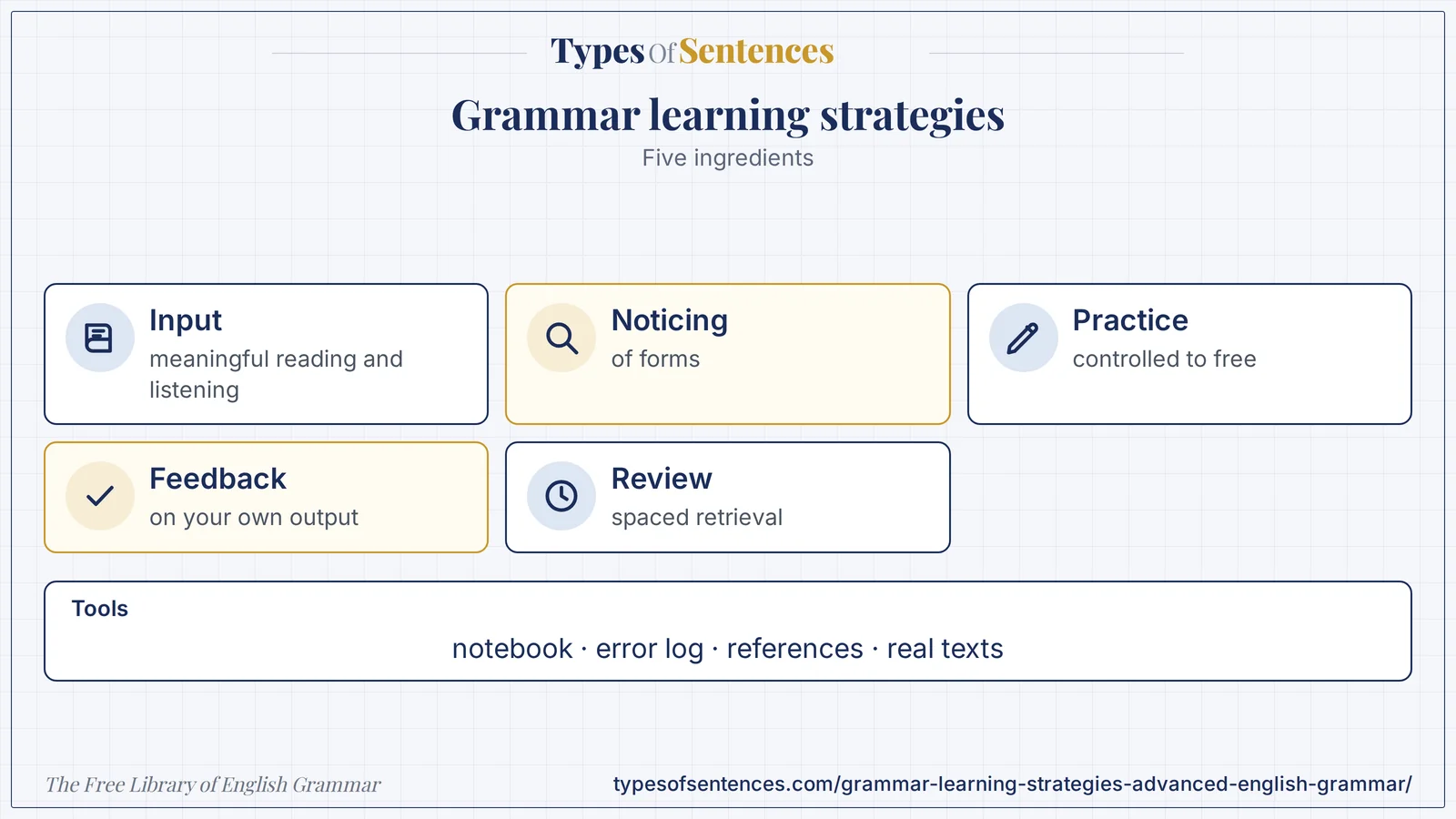
To learn grammar, you need three things: lots of real English to read and hear, a habit of noticing how it is built, and regular practice using it, with some way of checking your accuracy. Rules help, but they are not enough on their own: you learn grammar through use as well as through rules.
Why it matters: The most effective habits are small and regular: a short daily reading with a notebook for patterns, a few sentences of your own writing, a weekly review of your errors, and a reference book that you consult when you are in doubt.
Summary: Effective grammar learning rests on meaningful input (reading and listening), noticing of forms, practice that moves from controlled to free, feedback, and spaced retrieval and review. Learners use memory, cognitive, compensation, metacognitive, affective, and social strategies (Oxford’s taxonomy). Useful strategies include keeping a grammar notebook, highlighting patterns, shadowing, retelling, dictation, writing daily, using flashcards with spaced repetition, consulting references for specific doubts, reading aloud to monitor, keeping an error log, and learning from real texts. A growth mindset treats errors as information. Plans should be matched to level and goal, with realistic time and regular review. Tools such as grammar checkers and AI assistants can help, but their output must be checked.
- Input + noticing + practice + feedback + review.
- Notebook, error log, references, and real texts.
- Monitor your own writing; learn from errors.
- Learn grammar through use, not only rules.
What You’ll Learn
- 1. Grammar Learning Strategies: Principles of Effective Learning
- 2. Input and Practice: Reading, Listening, and Production
- 3. Pattern Recognition: Noticing Grammar
- 4. Using Grammar References: When and How
- 5. Self-Monitoring: Checking Your Own Grammar
- 6. Learning from Errors: A Growth Mindset
- 7. Contextualized Learning: Grammar in Real Texts
- 8. Study Plans by Level and Goal; Tools
- 9. Common Problems and Solutions; a Four-Week Plan
- 10. Common Misconceptions and a Worked Example
- 11. Exercises
- 12. Test Your Knowledge
- 13. Frequently Asked Questions
- 14. Conclusion
1. Grammar Learning Strategies: Principles of Effective Learning
| Principle | Meaning | What to do |
|---|---|---|
| meaningful input | learn from language that you understand and care about | read and listen daily |
| noticing | pay attention to how forms are built and used (Schmidt) | mark and note patterns |
| practice | use the forms yourself | write and speak |
| feedback | know whether you were right | ask a teacher or peer; use references and checkers |
| spaced retrieval | recalling material at increasing intervals strengthens memory (the spacing and testing effects) | review old items regularly |
| interleaving | mixing topics in practice improves discrimination | mix tenses in an exercise |
| elaboration | connect new rules to what you know | write your own examples |
| automatization | repeated use makes grammar fast and automatic (skill acquisition theory) | practice until it feels natural |
| motivation and goals | clear goals sustain effort | decide why you study |
| patience | grammar acquisition is gradual and non-linear | expect plateaus |
| variety | different activities reinforce each other | read, listen, write, speak |
| reflection | think about what works | keep a log |
| Type of strategy (Oxford, 1990) | Purpose | Examples for grammar |
|---|---|---|
| memory | store and retrieve information | flashcards; mnemonic phrases; grouping verbs by pattern |
| cognitive | analyze and use the language | notice patterns; compare with your first language; summarize rules; practice |
| compensation | make up for gaps | guess from context; use a gesture; ask for a repetition |
| metacognitive | plan, monitor, and evaluate learning | set goals; schedule study; check progress |
| affective | manage feelings | reward yourself; reduce anxiety; encourage yourself |
| social | learn with others | ask for correction; practice with a partner; join a group |
| Strategy (a selection of more than forty) | Type | How to use it |
|---|---|---|
| keep a grammar notebook | cognitive / memory | record patterns, rules, and examples |
| collect examples from reading | cognitive | copy sentences that show a pattern |
| highlight a structure in a text | cognitive | mark all examples of one pattern |
| write your own examples | cognitive | three sentences for every new rule |
| compare with your first language | cognitive | note similarities and differences |
| use flashcards (with spaced repetition) | memory | a form on one side, an example on the other |
| learn verbs with their patterns | memory | depend on, enjoy -ing |
| group irregular verbs | memory | sing, sang, sung; ring, rang, rung |
| make mnemonics | memory | a phrase to recall a rule |
| draw a time-line | cognitive | for tenses |
| make a table or diagram | cognitive | for a rule with several parts |
| shadow a speaker | cognitive | repeat immediately after hearing |
| retell a story you read | cognitive | use the same tenses |
| dictate and check | cognitive | write what you hear |
| rewrite a text in another tense or voice | cognitive | transformation practice |
| summarize a rule in your own words | metacognitive | explain it simply |
| set a weekly goal | metacognitive | one structure per week |
| schedule short daily sessions | metacognitive | 15 to 30 minutes |
| review your notebook weekly | metacognitive | revisit examples |
| keep an error log | metacognitive | record, correct, and review |
| read your writing aloud | metacognitive | monitor with the ear |
| use a checklist when proofreading | metacognitive | articles, agreement, tense |
| ask a teacher or friend to check | social | get feedback |
| exchange writing with a partner | social | peer feedback |
| practice conversation with a partner | social | use new forms |
| join a study group | social | share and test |
| talk about your goals | affective | commitment |
| celebrate progress | affective | motivation |
| accept mistakes as part of learning | affective | growth mindset |
| guess meaning from context | compensation | and then check |
| paraphrase when you lack a form | compensation | a temporary strategy |
| use a grammar reference when in doubt | cognitive | look up and check |
| search a corpus for usage | cognitive | see real examples |
| use a learner’s dictionary | cognitive | patterns and examples |
| listen to podcasts with transcripts | cognitive | read while you listen |
| write a daily journal | cognitive | three to five sentences |
| read extensively | cognitive | books and articles at your level |
| read intensively with a grammar focus | cognitive | analyze a short text |
| do timed writing | cognitive | automatization |
| edit your own draft in passes | metacognitive | one problem at a time |
| teach a rule to someone | social / cognitive | explaining deepens understanding |
| use contextual cues | compensation | from the text |
| reflect on what works | metacognitive | adjust the plan |
The classification of learning strategies used here follows Rebecca Oxford’s widely used model (1990). The point is not to use every strategy but to find the ones that suit you, and to combine them. Research on learning also supports the value of spaced and retrieval-based practice (for example the work of Roediger and Karpicke, 2006, on the testing effect) and of noticing (Schmidt, 1990), which the next sections apply to grammar.
2. Input and Practice: Reading, Listening, and Production
| Activity | Skill | How it helps grammar | Time (a guide) |
|---|---|---|---|
| extensive reading (graded readers, novels, articles) | reading | large amounts of grammar in context; implicit learning | 20 to 30 minutes daily |
| intensive reading with a grammar focus | reading | analysis of structures in a short text | 15 minutes, 2 or 3 times a week |
| listening to podcasts, talks, or news | listening | natural grammar in speech | 15 to 30 minutes daily |
| watching films or series with subtitles | listening and reading | speech patterns and discourse | as time allows |
| dictation | listening and writing | links sound and form | 10 minutes, twice a week |
| shadowing | speaking | rhythm and grammar of speech | 5 to 10 minutes daily |
| retelling or summarizing aloud | speaking | use of tenses and linking words | 10 minutes, 3 times a week |
| writing a daily journal | writing | production practice | 10 minutes daily |
| guided writing from a model | writing | imitation of a structure | twice a week |
| transformation exercises | writing | active/passive, direct/reported | 15 minutes weekly |
| sentence combining | writing | complex sentences | 15 minutes weekly |
| gap-fill and cloze | reading and writing | accuracy on target forms | 15 minutes weekly |
| reading your writing aloud | speaking | monitor | while editing |
| language exchange or conversation partner | speaking | use in real time; feedback | 1 or 2 times a week |
| participating in an online community | reading and writing | real communication | regular |
| writing emails to a real person | writing | context and audience | as needed |
| reading aloud to a recording device | speaking | monitor | weekly |
| using a text you like to copy sentence patterns (“copy–change”) | writing | a model with new content | weekly |
| reading with a pen: marking verbs and connectors | reading | awareness | daily |
| From controlled to free practice | Example (for the simple past) |
|---|---|
| recognition | choose the correct form from options |
| controlled production | fill in the verb in brackets |
| guided production | answer questions about last weekend |
| semi-free production | write a paragraph about yesterday using the past tense |
| free production | tell a story to a partner |
| Amount of practice | Guideline |
|---|---|
| regular and short beats long and rare | 15 minutes daily is better than three hours once a week |
| mix reading, listening, writing, speaking | each helps differently |
| review old material | spaced review prevents forgetting |
| increase difficulty slowly | stay in the zone that is challenging but manageable |
| keep a record | a simple log of what you did |
| rest | sleep consolidates memory |
The relation of input to acquisition is the subject of several theories (see the chapter on teaching methods). For the learner the practical point is that grammar becomes usable through many encounters with forms in meaningful contexts, together with attempts to use them. A corpus can supply examples for any structure that you wish to study (see the chapter on corpus linguistics).
3. Pattern Recognition: Noticing Grammar
| Noticing technique | How to do it | Example |
|---|---|---|
| highlight and sort | mark a structure in a text and group the examples | all if-clauses in a news article |
| find the pattern | look for what the examples have in common | verbs followed by -ing: enjoy, avoid, finish |
| compare with your first language | note where English works differently | articles, word order |
| collect collocations | note words that go together | make a decision, do homework |
| collect verb patterns | record the structures that follow verbs | suggest that, want to, enjoy -ing |
| collect sentence frames | record reusable patterns | It is … to …; The reason why … is that … |
| notice lexical bundles | recurring phrases | on the other hand, as a result of |
| notice discourse links | how sentences are connected | however, for example |
| notice tense shifts | why the writer changes tense | present for a general truth; past for a story |
| notice punctuation patterns | commas and clauses | comma after an introductory clause |
| notice what is missing | omitted words (ellipsis) | I think [that] he is right. |
| notice variety differences | American and British forms | gotten, at the weekend |
| notice register | formal and informal | request versus ask for |
| notice word forms | prefixes and suffixes | -tion, -ment |
| notice agreement | subject and verb | The list of items is … |
| use concordance lines | look at many examples of a word | a free online corpus |
| reverse engineering | take a sentence apart and rebuild | a sentence from a favorite author |
| ask questions about forms | why did the writer use the passive here? | — |
| notice repeated structures in speech | listening for patterns | I was going to say … |
| notice common errors in your own writing | a log | — |
| Grammar notebook (layout) | Content |
|---|---|
| date and source | where you found it |
| the sentence | the exact example |
| the pattern | a label (for example, second conditional) |
| the rule in your own words | one line |
| a note on meaning and use | when it is used |
| your own example | a sentence about your life |
| a note on your first language | a comparison, if useful |
| review marks | a tick when you have reviewed it |
The notebook is a personal grammar reference, built from the language you actually meet. Review it regularly; unreviewed notes are soon forgotten. The same material can be turned into flashcards with an app that schedules reviews at increasing intervals.
4. Using Grammar References: When and How
| When to consult a reference | How | Example |
|---|---|---|
| when you are in doubt about a form | look up the topic in the index or contents | Is it “fewer” or “less”? |
| when you are proofreading | check each doubt | — |
| when you meet a structure you do not understand | look up the explanation and examples | had better |
| when you are learning a new structure | read the section, study the examples, do the exercises | the third conditional |
| when you are preparing for an exam | use a reference with exercises | — |
| when you write for a particular reader | check the style guide or the variety | American versus British |
| when you are teaching | prepare an explanation | — |
| when you doubt an online claim | check a reliable reference | a “rule” that you saw on a website |
| Step in looking something up | Action |
|---|---|
| 1 name the problem | what is the form or the question? |
| 2 choose the reference | a learner’s grammar, a usage guide, a dictionary, or a corpus |
| 3 find the section | index, contents, or search |
| 4 read the explanation and the examples | focus on the examples |
| 5 check the variety and register | American or British; formal or informal |
| 6 apply to your sentence | rewrite the sentence |
| 7 note it | add to your notebook |
| 8 check a second source if the answer is disputed | usage guides may disagree |
| Type of reference | Examples (real works) | Use |
|---|---|---|
| learner’s grammar with exercises | English Grammar in Use (Raymond Murphy); Practical English Usage (Michael Swan) | learning and checking |
| comprehensive reference grammar | The Cambridge Grammar of the English Language (Huddleston and Pullum); A Comprehensive Grammar of the English Language (Quirk et al.) | deep detail |
| corpus-based grammar | Longman Grammar of Spoken and Written English (Biber et al.) | real usage and frequency |
| usage guide | Garner’s Modern English Usage | disputed points and style |
| learner’s dictionary | Oxford, Cambridge, Longman, Merriam-Webster learner’s dictionaries | patterns, examples, usage notes |
| style guide | The Chicago Manual of Style; APA; MLA | citation and conventions |
| online resources | university writing centers (for example the Purdue Online Writing Lab); dictionary websites | quick answers |
More on references and how to choose among them is in the next-but-one chapter, on grammar resources. For disputed points, remember that usage guides can disagree, as the chapter on grammar myths explains; in such cases follow the guide that your reader or institution uses.
5. Self-Monitoring: Checking Your Own Grammar
| Method | How it works | When to use |
|---|---|---|
| read aloud | the ear catches missing and wrong forms | after drafting |
| checklist of your frequent errors | check one category at a time | proofreading |
| multiple passes | one pass for articles, one for tenses, and so on | editing |
| wait before checking | a break gives distance | for important writing |
| read backward (sentence by sentence) | you see the form and not the meaning | final proofreading |
| use a grammar checker | a first pass for obvious errors | as an aid, not an authority |
| use text-to-speech | listen to your text | to find awkward sentences |
| compare with a model | see how a good writer handles the same point | — |
| rewrite a sentence in two ways | choose the better | style |
| ask: who is the subject? what is the verb? | check agreement | long sentences |
| mark the time reference | check tenses | narratives |
| check each noun phrase for articles | — | — |
| record yourself speaking | listen for errors | speaking practice |
| ask a partner to listen for one error type | — | — |
| self-assessment against a rubric | — | — |
| Checklist for your own writing | Question |
|---|---|
| sentences | Does each sentence have a subject and a verb? Any run-ons or fragments? |
| agreement | Do subjects and verbs agree? Pronouns and antecedents? |
| tense | Is the tense consistent and appropriate to the time? |
| articles | Is every singular count noun determined? |
| plurals and uncountables | information, advice, furniture |
| prepositions | Verb and adjective collocations |
| word order | Adverbs; questions; indirect questions |
| punctuation | Commas, apostrophes, quotation marks |
| connectors | Do they show the right relation? |
| word choice | Confusable words; formality |
| repetition | Redundant words and ideas |
| reader | Does it say what I mean, in the register my reader expects? |
| Metacognitive routine | Description |
|---|---|
| plan | decide what to practice this week |
| monitor | check as you work |
| evaluate | review what worked |
| adjust | change the plan |
| record | keep an error log and a notebook |
The use of a grammar checker deserves care: such tools find many typing errors and some grammar errors, but they miss errors that need understanding of meaning, and they sometimes suggest incorrect changes. Treat the suggestion as a question to check against a reference. The strategies of professional editing are described in the chapter on editing and proofreading.
6. Learning from Errors: A Growth Mindset
| Attitude | Effect |
|---|---|
| errors as failures | anxiety; avoidance; stopping practice |
| errors as information | analysis; targeted practice; improvement |
| “I am bad at grammar” | a fixed view that reduces effort |
| “I have not learned this yet” | a growth view that supports effort |
| perfectionism | silence; unwillingness to write or speak |
| experimentation | trying new forms and learning from the results |
| Step in an error cycle | Action |
|---|---|
| 1 notice | you or someone finds the error |
| 2 record | add it to the error log |
| 3 analyze | what type? what pattern? what source? (see the chapter on error analysis) |
| 4 correct | write the correct form |
| 5 understand | look up the rule if needed |
| 6 practice | write three new sentences using the correct form |
| 7 review | check the log weekly; mark errors that no longer occur |
| 8 recycle | use the form in new contexts |
- Expect U-shaped learning. A learner may use went correctly, then say goed after learning the regular rule, then use went correctly again. This is a sign of progress.
- Focus on patterns. Do not try to fix every single error at once; work on two or three recurring patterns.
- Collect successes too. Note forms that you now use correctly.
- Do not compare yourself with others. Compare yourself with last month.
- Ask for feedback. Errors that you cannot see need another reader.
- Be kind to yourself. Anxiety interferes with learning.
The idea of a growth mindset (Carol Dweck, 2006) holds that abilities develop through effort and learning from setbacks. Later research on mindset interventions has produced mixed results, so treat it as a useful attitude and not a guarantee. The practical side is clear: errors are information, and an error log turns them into a study plan.
7. Contextualized Learning: Grammar in Real Texts
| Source of real text | What to notice | Task |
|---|---|---|
| news articles | past tenses; reported speech; passives; headlines | find three passives; rewrite as active |
| emails and letters | politeness; modals; requests | list the polite forms |
| stories and novels | narrative tenses; dialogue; reported speech | mark past perfect and explain why |
| academic articles | nominalization; hedging; complex noun phrases | underline hedges |
| instructions and recipes | imperatives; sequencers | rewrite as a paragraph |
| speeches and talks | repetition; questions; we | mark the rhetorical devices |
| advertisements | short sentences; imperatives; fragments | rewrite in formal style |
| blogs and social media | informal grammar; ellipsis; discourse markers | compare with a formal text |
| subtitles and scripts | spoken grammar; contractions | note phrases you can reuse |
| song lyrics (listen and read; do not copy) | informal forms; tenses | note forms and look them up |
| poems | inversion; ellipsis (see the chapter on poetry) | analyze one line |
| legal and official text | long sentences; modals; conditions | simplify one sentence |
| reviews and opinion pieces | evaluation; contrast; concession | list connectors |
| scientific abstracts | tenses; passives | mark tense use |
| interviews | questions; reported speech | report the interview |
| travel guides | present tense; imperatives; adjectives | write your own entry |
| textbooks for other subjects | definitions; passives | write a definition |
| encyclopedia entries | present perfect; passives | — |
| forum posts | questions; advice with modals | write a reply |
| product descriptions | adjective order; compounds | — |
- Choose a text at your level that interests you.
- Read it once for meaning.
- Read it again and mark one grammar pattern (for example, past perfect).
- Ask why the writer used it in each place.
- Note two or three sentences in your notebook.
- Write your own sentences using the pattern.
- Use the pattern in a short piece of your own writing within three days.
- Review after a week.
| Example weekly routine (invented) | Activity |
|---|---|
| Monday | read a news article (15 minutes); mark past tenses; add two sentences to the notebook |
| Tuesday | listen to a podcast with a transcript (20 minutes); shadow one paragraph |
| Wednesday | write a journal entry using the new pattern (10 minutes) |
| Thursday | intensive reading of a short text with a grammar focus (15 minutes); look up one doubt in a reference |
| Friday | review the notebook and the error log (15 minutes) |
| Saturday | a conversation or language exchange; use the pattern |
| Sunday | rest, or free reading for pleasure |
Learning from real texts is the principle of the whole course: the grammar of a text is part of what the text means, as the chapter on readability and the chapters on style show. The goal is to read and listen as a writer and a speaker: to notice how the language is built, and to use what you notice.
8. Study Plans by Level and Goal; Tools
| Level or goal | Focus | Suggested activities |
|---|---|---|
| beginner (basic grammar) | the verb to be, simple tenses, articles, plurals, simple sentences | daily short sentences; simple reading; pattern drills in context; a basic grammar book with exercises |
| intermediate | all tenses, modals, conditionals, passive, relative clauses, reported speech | reading and listening with notebook; writing a paragraph a week; error log |
| advanced | complex sentences, nominalization, hedging, style, nuance | reading academic and literary texts; analyzing style; editing; writing essays with feedback |
| exam preparation | the grammar the exam tests; accuracy under time | practice tests; error log; timed writing; review of common errors |
| academic writing | formal register; nominalization; hedging; citation | model papers; style guides; feedback from a writing center |
| business English | politeness; email grammar; reports | real emails; templates; a conversation partner |
| speaking fluency | spoken grammar; discourse markers | shadowing; recording; conversation practice |
| teaching | pedagogical grammar | study rules and common errors; observe lessons |
| editing and professional writing | style and correctness | style guides; checklists; practice editing |
| Tool | Use | Caution |
|---|---|---|
| grammar notebook | personal reference | review regularly |
| flashcards with spaced repetition (such as Anki) | review forms and examples | make cards from your own examples |
| learner’s grammar book and a usage guide | explanation and exercises | choose one at your level |
| corpus search | real examples | read the lines |
| grammar checker | a first pass | verify; it can be wrong |
| AI chat tools | explanations, examples, practice sentences | they can make mistakes; check against a reference; do not copy their writing as your own where rules forbid |
| dictionary with examples | patterns | — |
| podcasts and videos with transcripts | input | — |
| language exchange or tutor | feedback | — |
| writing center or teacher | feedback and models | — |
| study group | support | — |
| a recording device | self-monitoring | — |
| Progress check | How |
|---|---|
| rewrite an old text | compare errors then and now |
| track the error log | are old errors disappearing? |
| take a practice test | accuracy by category |
| self-assess with a rubric | strengths and weaknesses |
| ask for feedback | a teacher or a reader |
| set the next goal | the next structure or error pattern |
9. Common Problems and Solutions; a Four-Week Plan
| Problem | Cause | Solution |
|---|---|---|
| I know the rules but make mistakes when I speak or write | knowledge is explicit, not yet automatic | more practice under time pressure; monitoring |
| I forget what I learn | no review | spaced retrieval; notebook; flashcards |
| I make the same errors | no analysis | error log; targeted practice |
| I am afraid of mistakes | anxiety; perfectionism | low-stakes practice; a supportive partner; growth mindset |
| I translate from my first language | transfer | notice contrasts; read and write in English more |
| I do not know which rule to use | too many rules; no context | learn from examples and context |
| I use only simple sentences | avoidance | practice sentence combining |
| I plateau | routine; lack of challenge | new materials; higher-level texts; feedback |
| grammar bores me | isolated rules | use texts and topics that interest you |
| I rely on a grammar checker | convenience | learn from its suggestions; check |
| I cannot find time | irregular study | 15 minutes daily; link to a habit |
| I do not get feedback | working alone | a partner, teacher, or writing center |
| I confuse similar forms | no contrast | minimal-pair exercises |
| I do not notice patterns | passive reading | mark and sort examples |
| I study too much at once | cramming | short, regular sessions |
| Four-week plan (invented example: intermediate learner, aim: fewer errors in emails) | Activities |
|---|---|
| Week 1: diagnose | collect five emails you wrote; mark errors; classify (articles, tenses, prepositions); choose two priorities |
| Week 2: study | read two grammar sections on the priorities; collect ten examples from real emails; make a notebook page for each |
| Week 3: practice | write four short emails using the target forms; ask a partner to check; make flashcards from the errors |
| Week 4: consolidate | write two new emails; proofread with a checklist; compare error counts with week 1; set the next goal |
The plan is only an example; adjust it to your needs. The central idea is a cycle: collect, analyze, study, practice, check, and repeat. Over months, the effect is cumulative: forms that you once had to think about become automatic, and your attention is free for what you want to say.
10. Common Misconceptions and a Worked Example
| Misconception | Reality |
|---|---|
| Grammar is learned only by memorizing rules. | Rules help, but use and noticing are essential. |
| Reading alone is enough. | Input is vital, but production and feedback also matter. |
| Practice means doing exercises. | Real use (writing, speaking) matters as much. |
| One long session is as good as short sessions. | Spaced, regular practice is more effective. |
| A grammar checker will fix my grammar. | It is an aid with limits. |
| Mistakes mean I am bad at English. | Mistakes are information. |
| Advanced learners do not need grammar study. | Advanced learners work on nuance, style, and rarely noticed errors. |
| Only a teacher can correct me. | You can self-monitor and use peers and references. |
| Native speakers do not need to study grammar. | Many native writers benefit from study, especially for writing and editing. |
| There is a single best study method. | Choose what works for you and your goals. |
| Grammar is separate from vocabulary. | They are intertwined: verb patterns and collocations. |
| If I understand a rule I can use it. | Understanding is not automatic use. |
Design a one-week routine for a learner (invented): Level — intermediate. Goal — fewer tense and article errors in work emails. Time — 30 minutes a day.
- Diagnose (day 1): collect three recent emails; list tense and article errors; add to the error log.
- Notice (day 2): read a short business email chain; mark past and perfect tenses and articles; add five sentences to the notebook.
- Study (day 3): read a reference section on the present perfect and a short article section; write three examples of your own.
- Practice (day 4): rewrite two of your own emails using the correct forms; read them aloud.
- Feedback (day 5): ask a colleague or tutor to check; add new errors to the log.
- Review (day 6): flashcards from the log; a gap-fill exercise.
- Use (day 7): write a new email using the target forms, then proofread with the checklist.
- Check: count errors in the new email; compare with day 1.
Recap in 12 seconds
Watch the lesson build itself: Effective grammar learning combines input, noticing, practice, feedback, and spaced review. The video has no sound.
Exercises
Part A: Principles (Exercises 1–7)
Exercise 1: Name three principles of effective grammar learning.
Show Answer
Answer: Meaningful input, noticing, practice, feedback, spaced review.
Exercise 2: What is spaced repetition?
Show Answer
Answer: Reviewing material at increasing intervals.
Exercise 3: What does the testing effect say?
Show Answer
Answer: Recalling information strengthens memory.
Exercise 4: Name the six strategy types in Oxford’s model.
Show Answer
Answer: Memory, cognitive, compensation, metacognitive, affective, social.
Exercise 5: Is shadowing a cognitive or social strategy?
Show Answer
Answer: Cognitive.
Exercise 6: What is a metacognitive strategy?
Show Answer
Answer: Planning, monitoring, and evaluating your learning.
Exercise 7: Why is 15 minutes daily better than 3 hours once a week?
Show Answer
Answer: Regular, spaced practice is more effective.
Part B: Input, Practice, and Patterns (Exercises 8–14)
Exercise 8: Name two input activities.
Show Answer
Answer: Extensive reading, listening to podcasts.
Exercise 9: Name a production activity.
Show Answer
Answer: A daily journal; a retelling; sentence combining.
Exercise 10: Name a path from controlled to free practice.
Show Answer
Answer: Recognition → controlled production → guided → free.
Exercise 11: What goes in a grammar notebook?
Show Answer
Answer: Example sentences, the pattern, the rule, your own example, a note on use.
Exercise 12: What is a collocation?
Show Answer
Answer: Words that often go together (make a decision).
Exercise 13: What is shadowing?
Show Answer
Answer: Repeating speech immediately after hearing it.
Exercise 14: Name a way to notice patterns in a text.
Show Answer
Answer: Highlight and sort examples; compare with your first language.
Part C: References and Self-Monitoring (Exercises 15–21)
Exercise 15: When should you consult a reference?
Show Answer
Answer: When in doubt, when proofreading, or when learning a new structure.
Exercise 16: Name a learner’s grammar.
Show Answer
Answer: English Grammar in Use or Practical English Usage.
Exercise 17: Name a usage guide.
Show Answer
Answer: Garner’s Modern English Usage.
Exercise 18: Why read your writing aloud?
Show Answer
Answer: The ear catches missing and wrong forms.
Exercise 19: Name two checklist items.
Show Answer
Answer: Agreement, tense, articles, prepositions, punctuation.
Exercise 20: Is a grammar checker an authority?
Show Answer
Answer: No; an aid to verify.
Exercise 21: Why proofread in passes?
Show Answer
Answer: One problem at a time is easier to see.
Part D: Errors and Context (Exercises 22–26)
Exercise 22: What is an error log?
Show Answer
Answer: A record and analysis of your errors.
Exercise 23: What is U-shaped learning?
Show Answer
Answer: Correct, then an error from overgeneralization, then correct again.
Exercise 24: What does a growth mindset suggest?
Show Answer
Answer: Effort and learning from errors improve ability.
Exercise 25: Name a real text useful for passives.
Show Answer
Answer: News articles; scientific abstracts.
Exercise 26: Name the first step of learning from a real text.
Show Answer
Answer: Choose a text at your level and read for meaning.
Part E: Plans (Exercises 27–30)
Exercise 27: Name a tool for spaced review.
Show Answer
Answer: Flashcards with an app such as Anki.
Exercise 28: Name a problem and a solution.
Show Answer
Answer: Forgetting → spaced retrieval; the same errors → an error log.
Exercise 29: Name a sign of progress.
Show Answer
Answer: Old errors disappearing from the log.
Exercise 30: Why use a partner or teacher?
Show Answer
Answer: To get feedback on errors you cannot see.
Test Your Knowledge
Ready to check what you learned? Answer all 10 questions, then submit. You need 80% (8 of 10) to pass. Your answers are not stored.
View correct answers and explanations
Question 1: What does the testing (retrieval) effect say?
✓ Correct Answer: A – recalling information strengthens memory
Retrieval helps.
Question 2: Which is spaced repetition?
✓ Correct Answer: B – reviewing material at increasing intervals
Increasing intervals.
Question 3: What is the point of a grammar notebook?
✓ Correct Answer: C – collecting examples and patterns you notice
A personal reference.
Question 4: When should a learner consult a grammar reference?
✓ Correct Answer: D – when in doubt, when proofreading, or when learning a new structure
In those cases.
Question 5: Which is a metacognitive strategy?
✓ Correct Answer: C – planning and monitoring your learning
Planning and monitoring.
Question 6: What does an error log help with?
✓ Correct Answer: A – finding patterns and tracking progress
Patterns and progress.
Question 7: Which input helps grammar learning most?
✓ Correct Answer: D – meaningful reading and listening with attention to form
Meaningful input and noticing.
Question 8: What is shadowing?
✓ Correct Answer: C – repeating speech immediately after hearing it
Immediate repetition.
Question 9: What does a growth mindset suggest?
✓ Correct Answer: B – effort and learning from errors improve ability
Effort and learning.
Question 10: Which is a good use of a grammar checker?
✓ Correct Answer: B – as an aid, with verification
An aid, with checking.
Frequently Asked Questions
What are grammar learning strategies?
Grammar learning strategies are the deliberate actions a learner takes to learn grammar: noticing patterns, keeping a notebook, practicing, using references, monitoring, and learning from errors. Grammar learning strategies make study more efficient.
How to learn grammar effectively?
Read and listen daily, notice patterns and note them, practice by writing and speaking, get feedback, review at spaced intervals, and consult references when in doubt. How to learn grammar effectively comes down to regular, meaningful practice.
What is grammar study?
Grammar study is the deliberate study of grammar: reading explanations, analyzing examples, and doing exercises. Grammar study works best when combined with input and use.
What is grammar acquisition?
Grammar acquisition is the gradual process by which learners develop the ability to understand and use grammar, often in a developmental order. Grammar acquisition is helped by input, noticing, practice, and feedback.
How can I go about improving grammar?
Identify your recurring errors, study the relevant patterns, practice them in your own writing, get feedback, and review. Improving grammar is a matter of targeted, regular practice.
Should I memorize rules?
Rules help to understand and check, but memorized rules do not automatically become usable. Combine rules with examples, noticing, and practice.
How long does it take to improve?
It depends on the starting level, the amount of exposure, and the quality of practice. Regular short practice over months shows results; progress is not always steady.
Conclusion
You now have a practical guide to grammar learning strategies: the principles of effective learning, more than forty strategies, input and practice, pattern recognition, references, self-monitoring, learning from errors, learning from real texts, and plans by level and goal. You can design a study routine and keep it going.
When you study grammar, ask what you will notice, what you will practice, and how you will check. Next, you will study grammar testing and assessment.
- Oxford, Rebecca L. Language Learning Strategies: What Every Teacher Should Know. Heinle, 1990.: the classification of learning strategies.
- Schmidt, Richard. “The Role of Consciousness in Second Language Learning.” Applied Linguistics 11 (1990): 129–158.: the noticing hypothesis.
- Roediger, Henry L., and Jeffrey D. Karpicke. “Test-Enhanced Learning.” Psychological Science 17 (2006): 249–255.: the testing effect.
- Dweck, Carol S. Mindset: The New Psychology of Success. Random House, 2006.: the idea of a growth mindset.
- Merriam-Webster Dictionary: strategy: the dictionary entry.
Last reviewed: October 29, 2026. How it was made: drafted with AI assistance, then checked with automated tests (structure, links, answer keys, spelling) and against the sources above. A person has not yet read this chapter line by line. Found a mistake? Report it.