Error analysis is the study of the errors that people actually make, with the aim of understanding why they make them and how to correct them. The shift that gave the method its importance came in the 1960s, when the linguist S. P. Corder argued that a learner’s errors are not merely failures to be eliminated; they are evidence of the system that the learner has built so far, and so are a guide to what the learner needs next. A teacher or a learner who can classify an error, name its likely source, and judge how serious it is can choose a correction that works.
This chapter shows how to analyze and correct grammar errors. You will study the types of errors (including the difference between an error and a mistake), the sources of errors (transfer, developmental, and induced errors), the common errors with articles, tenses, prepositions, and word order, with a correction strategy for each, and the feedback techniques of teachers and editors, including self-correction and peer correction. The chapter gives a procedure for mistake analysis and for finding mistake patterns in grammar, with worked examples, so that error correction becomes systematic and not random. The same skills apply to editing one’s own writing, as in the chapter on editing and proofreading. Thirty editing exercises and a quiz follow.
An error is not just something wrong. It is information. When a learner writes *I have 18 years, the sentence tells us what the learner knows (the structure have + number), what they do not yet know (that English uses be for age), and where the idea may have come from (the first language).
Why it matters: Correcting well means finding the pattern behind an error, choosing the most important patterns to work on first, and giving the learner a way to notice and fix the pattern for themselves.
Summary: Error analysis classifies errors (systematic errors that reflect the learner’s competence versus random mistakes or slips; global errors that impede communication versus local errors that do not; errors of omission, addition, misformation, and misordering), identifies their sources (interlingual transfer from the first language, intralingual developmental processes such as overgeneralization, and induced errors from teaching), and judges their seriousness. Commonest are errors with articles, tense and aspect, prepositions, and word order, each with its correction strategies (rule checks, time-lines, collocation lists, sentence frames). Teachers give feedback by recasts, explicit correction, clarification requests, metalinguistic feedback, elicitation, and repetition; learners and peers can self-correct with checklists and error logs. A good procedure collects a sample, identifies and describes the errors, explains them, evaluates them, and plans targeted practice.
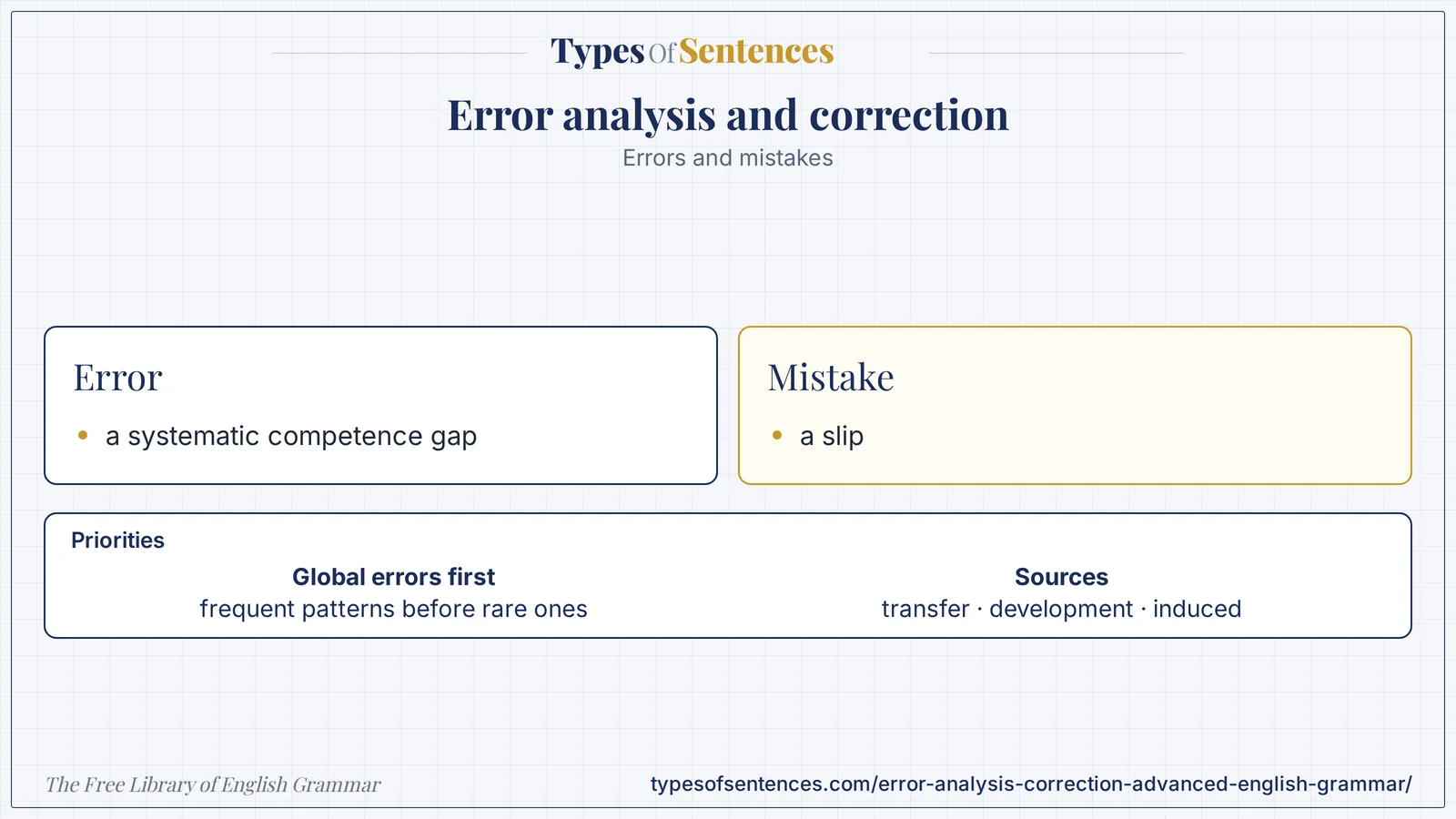
- Error = systematic competence gap; mistake = slip.
- Global errors first; frequent patterns before rare ones.
- Sources: transfer, development, induced.
- Correct by pattern: articles, tenses, prepositions, word order.
What You’ll Learn
- 1. Error Analysis: Types of Errors
- 2. Common L2 Errors: Transfer Errors and Developmental Errors
- 3. Article Errors: Common Mistakes and Correction Strategies
- 4. Tense Errors: Common Mistakes and Correction Strategies
- 5. Preposition Errors: Common Mistakes and Correction Strategies
- 6. Word Order Errors: Common Mistakes and Correction Strategies
- 7. Error Correction Strategies: Feedback, Self-Correction, and Peer Correction
- 8. A Procedure for Error Analysis, with a Worked Example
- 9. Common Misconceptions About Errors and Correction
- 10. Exercises
- 11. Test Your Knowledge
- 12. Frequently Asked Questions
- 13. Conclusion
1. Error Analysis: Types of Errors
| Distinction | Meaning | Example |
|---|---|---|
| error versus mistake (Corder, 1967) | an error is a systematic deviation that reflects the learner’s current knowledge and the learner cannot self-correct; a mistake is a slip of performance that the learner can correct when it is pointed out | *He go home (error, if always) versus a typing slip (mistake) |
| global versus local (Burt and Kiparsky, 1972) | a global error affects the whole sentence and impedes understanding; a local error affects one element and the meaning is still clear | *I have the coffee in the morning at drink (global); *two book (local) |
| systematic versus random | systematic errors recur in a pattern; random errors do not | *She go always (systematic) |
| covert versus overt | a covert error is grammatical in form but wrong in context; an overt error is ungrammatical | I am fine, thank you, and you? (covert: a mismatch of reply) versus *I fine |
| error of omission | a needed element is missing | *She teacher. |
| error of addition | an unnecessary element is added | *She doesn’t knows. |
| error of misformation | the wrong form of a morpheme or structure | *He goed. |
| error of misordering | the wrong order | *I like very much tea. |
| blends (double marking) | two forms are mixed | *He didn’t went. |
| alternating forms | free variation between correct and incorrect | She go / She goes in the same text |
| Source (Richards, 1971; Selinker, 1972) | Description | Example |
|---|---|---|
| interlingual (transfer) | from the first language | *I have 18 years. (Spanish, French, Italian) |
| intralingual (developmental) | from the learner’s partial knowledge of the target language itself | *goed, *foots |
| overgeneralization | a rule is applied beyond its scope | *mans, *He can goes. |
| simplification | a complex rule is replaced by a simpler one | omission of -s, articles |
| ignorance of rule restrictions | a rule is used where an exception applies | *I made him to go. |
| incomplete application of rules | a rule is learned only partly | *You like tea? (question without inversion) |
| false concepts hypothesized | a misunderstanding of a distinction | *He was go (was taken as a past marker) |
| induced error | caused by teaching materials or explanation | a misleading rule such as “use the for specific nouns only” |
| communication strategy | a way around a gap | *the thing for open the can |
| fossilization | persistent errors despite instruction | a stable pronunciation or grammar error |
| Gravity of an error (how serious) | Criterion | Example |
|---|---|---|
| high | impedes communication; global; produces a wrong meaning | *I like to eat my family. |
| medium | affects clarity or credibility but meaning is recoverable | *He go yesterday. |
| low | a local, stigma-free slip | *informations (often understood) |
| stigmatizing (social) | may be judged harshly by readers even if the meaning is clear | *he don’t in a formal letter |
| frequent | recurs; so it deserves attention | article omission |
| context-bound | an error in an exam is more costly than in a chat | — |
Because every learner (and every writer, native or not) makes both errors and mistakes, the first step of analysis is to decide which. The test is simple: can the writer correct it when it is pointed out? If so, it is probably a mistake; if not, it is an error that reflects a gap in knowledge. The causes of transfer errors in particular are discussed in the chapter on contrastive analysis.
2. Common L2 Errors: Transfer Errors and Developmental Errors
| Error (surface) | Category | Source | Correction |
|---|---|---|---|
| *He go to school. | misformation (omitted -s) | simplification; no agreement in some L1s | He goes to school. |
| *She don’t like it. | misformation | overgeneralization of don’t | She doesn’t like it. |
| *I goed home. | misformation | overgeneralization of -ed | I went home. |
| *two childs | misformation | overgeneralization of -s | two children |
| *informations | addition (plural of an uncountable) | L1 or overgeneralization | information |
| *a advice | misformation | L1 countable | a piece of advice / some advice |
| *I am agree. | addition of be | L1 verb of agreement | I agree. |
| *I have 18 years. | misformation | transfer | I am 18 years old. |
| *Is raining. | omission of the subject | transfer from pro-drop languages | It is raining. |
| *Where you are going? | misordering | incomplete application | Where are you going? |
| *Do you can swim? | addition of do | overgeneralization of do-support | Can you swim? |
| *He can goes. | addition of -s | overgeneralization | He can go. |
| *I made him to go. | addition of to | ignorance of restrictions | I made him go. |
| *I enjoy to swim. | misformation (infinitive for gerund) | incomplete application | I enjoy swimming. |
| *She said me. | misformation | transfer or confusion with tell | She told me. |
| *I explained him. | omission of to and the object | transfer | I explained it to him. |
| *The life is hard. | addition of the | transfer | Life is hard. |
| *I like the music. | addition of the | transfer (generic) | I like music. |
| *He is more taller. | addition (double comparison) | overgeneralization | He is taller. |
| *Yesterday I go. | omission of tense | L1 without tense | Yesterday I went. |
| *I live here since 2010. | tense | transfer | I have lived here since 2010. |
| *I didn’t saw him. | blend | double marking of past | I didn’t see him. |
| *She is the best of her class student. | misformation | L1 word order | She is the best student in her class. |
| *Me and him went. | misformation | case | He and I went. |
| *Their is a problem. | spelling (homophone) | mistake or error | There is a problem. |
| *I look forward to see you. | misformation | to as a preposition | I look forward to seeing you. |
| *If I will go, I will call. | tense in a condition | transfer | If I go, I will call. |
| *He suggested me to go. | misformation | analogy with advise | He suggested that I go. |
| *Despite of the rain | addition of of | analogy with in spite of | Despite the rain |
| *many informations, much books | misformation | quantifier errors | much information; many books |
| Developmental process | Evidence | Correction principle |
|---|---|---|
| overgeneralization | regular endings on irregular forms | teach irregular forms as separate items |
| simplification | dropping endings and function words | raise awareness; use sentence frames |
| hypothesis formation | a “rule” guessed from limited data | show contrasting examples |
| U-shaped learning | correct early form (went), then an error (goed), then correct again | do not panic: it signals learning |
| avoidance | not using a structure | offer low-risk practice |
Both kinds of error are normal. Developmental errors appear in learners of every first language and also, in some forms, in children learning English as a first language (goed, mouses). The two kinds can be told apart roughly by asking whether learners from different language backgrounds make the same error. Further analysis of the grammar that learners must master is in the chapters on article usage and tense and aspect.
3. Article Errors: Common Mistakes and Correction Strategies
| Error type | Faulty | Corrected | Rule or reason |
|---|---|---|---|
| omission (singular count noun) | *I bought book. | I bought a book. | a singular count noun needs a determiner |
| omission (definite, known) | *Please close door. | Please close the door. | a specific, known door |
| omission (superlative) | *She is best student. | She is the best student. | the with superlatives |
| omission (unique) | *Sun rises in east. | The sun rises in the east. | unique referents and directions |
| wrong choice (a for the) | *I saw a moon. | I saw the moon. | unique referent |
| wrong choice (the for a) | *I need the pen. | I need a pen. | any pen, not a known one |
| unnecessary article (generic plural) | *The students need motivation. | Students need motivation. | generic plural without article |
| unnecessary article (uncountable general) | *I like the music. | I like music. | general uncountable |
| unnecessary article (proper names) | *The Priya came. | Priya came. | names take no article |
| unnecessary article (meals, languages) | *I had the lunch. *I speak the English. | I had lunch. I speak English. | no article with meals and languages |
| a/an confusion | *an university, *a hour | a university, an hour | sound, not spelling |
| article with an uncountable noun | *a furniture, *an advice | some furniture, a piece of advice | uncountable nouns do not take a |
| first mention versus second mention | *I saw the film. A film was good. | I saw a film. The film was good. | first mention a; later the |
| institutions | *He went to the hospital for treatment (as a patient). | He went to hospital. (British) / He went to the hospital. (American) | variety differences |
| the with geographical names | *the India, *Mount the Everest | India; Mount Everest | names without the; plurals and some regions with the |
| article before a possessive | *the my book | my book | possessive replaces the article |
| article after such/quite/what | *a such good idea | such a good idea | article order |
| the before a unique role | *He is the president of a company. | He is the president of the company (a specific one) / a president of a company | specificity |
| article with a class | *A tiger is endangered. | The tiger is endangered. / Tigers are endangered. | generic reference |
| zero versus the with abstract nouns | *The honesty is the best policy. | Honesty is the best policy. | general abstract noun |
- Is the noun countable or uncountable? Uncountable nouns take no a/an.
- Singular or plural? A singular count noun needs a determiner.
- Specific or general? A specific, identifiable noun takes the; a general plural or uncountable takes none.
- Mentioned before, or shared knowledge? Then the.
- New to the reader? Then a/an.
- Unique or a superlative? Then the.
- Check for another determiner (my, this, some).
- Proper names, meals, languages, and general abstract nouns: usually no article.
- Mark every noun phrase in a paragraph and test it with the questions above.
- Keep a list of fixed expressions (at school, in the morning, go to bed).
- Read published texts with attention to articles.
- Use a corpus to check a particular noun.
- Do not over-explain: article use is largely learned through exposure.
The grammar of articles is set out in full in the chapter on article usage; the point here is the diagnosis of errors. Article errors are among the most frequent errors in the writing of learners whose first languages lack articles, and they seldom cause a breakdown of meaning, but they affect the impression of fluency.
4. Tense Errors: Common Mistakes and Correction Strategies
| Error type | Faulty | Corrected | Reason |
|---|---|---|---|
| present perfect with a finished time | *I have seen him yesterday. | I saw him yesterday. | a finished time takes the simple past |
| simple past with a continuing time | *I lived here for ten years. (still living) | I have lived here for ten years. | continuing to now |
| since/for with the present | *I am here since Monday. | I have been here since Monday. | the perfect with since |
| future in time clauses | *When I will arrive, I will call. | When I arrive, I will call. | present for a future time clause |
| future in conditionals | *If it will rain, we will stay. | If it rains, we will stay. | present in if-clauses |
| tense inconsistency | *She walked in and sees him. | She walked in and saw him. | keep one time frame |
| tense in reported speech | *He said that he is tired. | He said that he was tired. | backshift when needed |
| progressive with a stative verb | *I am knowing the answer. | I know the answer. | states do not take the progressive |
| simple present for a current action | *Look, it rains. | Look, it is raining. | progressive for in progress |
| simple present for a habit expressed with the progressive | *She is going to school every day. | She goes to school every day. | habit |
| past perfect for a simple past | *I had finished it yesterday. | I finished it yesterday. | the perfect needs a second time reference |
| simple past for the past perfect | *When I arrived, he left. (he had left earlier) | When I arrived, he had left. | earlier event |
| present perfect for a past with a clear time | *I have been to Paris in 2019. | I went to Paris in 2019. | time adverbial |
| unreal conditional with would in the if-clause | *If I would have time, I would go. | If I had time, I would go. | past for unreality |
| third conditional errors | *If I would have known, I would have come. | If I had known, I would have come. | past perfect |
| used to with did | *I didn’t used to go. | I didn’t use to go. | base form after did |
| modal plus past | *He must went. | He must have gone. | modal + have + participle |
| double past marking | *She didn’t went. | She didn’t go. | tense on the auxiliary |
| wrong participle | *I have went. *She has wrote. | I have gone. She has written. | irregular participles |
| present for a past narrative in a past text | *Yesterday I go to the market. | Yesterday I went to the market. | time adverb and tense agree |
| was/were confusion | *We was late. | We were late. | agreement |
| gerund for a perfect | *I regret not to have told her. | I regret not having told her. | non-finite perfect |
| will for a present arrangement | *I will meet him at five tomorrow. (arranged) | I am meeting him at five tomorrow. | arrangement |
| simple present for a future plan not scheduled | *I go to the party. | I am going to the party. | plan |
| for and ago | *I came here for five years ago. | I came here five years ago. | ago alone |
| tense after wish | *I wish I can fly. | I wish I could fly. | backshift |
| tense in the sequence of events | *After he arrived, he has eaten. | After he arrived, he ate. | consistent past |
| tense after it is time | *It is time we go. | It is time we went. | past subjunctive |
| said with the present in narrative | *She said, “I am going,” and goes. | She said, “I am going,” and went. | consistency |
| already/yet with the wrong tense | *Did you eat yet? (British usage prefers the perfect) | Have you eaten yet? | variety |
| Strategy for tense | How it works |
|---|---|
| draw a time-line | mark now, then, and the event; see which tense fits |
| look for the time word | yesterday → past; since → perfect; tomorrow → future |
| ask: is the time finished or continuing? | simple past versus present perfect |
| ask: is it a state or an action? | progressive only for actions |
| keep one time frame in a paragraph | change only for a reason |
| check the auxiliary | tense on the first auxiliary only |
| learn irregular verbs in groups | sing, sang, sung; drive, drove, driven |
| read aloud | the ear detects a wrong form |
| use sentence frames | Since + point in time; For + length of time |
Tense is the area of grammar in which errors have the most variety, because tense interacts with aspect, time adverbials, and the speaker’s perspective. The complete system is in the chapter on tense and aspect; the correction approach is to identify the time reference first, and then the form.
5. Preposition Errors: Common Mistakes and Correction Strategies
| Error type | Faulty | Corrected | Pattern |
|---|---|---|---|
| unnecessary preposition after a verb | *discuss about the plan | discuss the plan | discuss takes a direct object |
| unnecessary preposition | *enter into the room | enter the room | enter takes a direct object |
| unnecessary preposition | *reach to the station | reach the station | — |
| unnecessary preposition | *emphasize on the point | emphasize the point | — |
| unnecessary preposition | *marry with her | marry her | marry takes a direct object |
| unnecessary preposition | *return back | return | — |
| missing preposition | *listen the music | listen to the music | listen to |
| missing preposition | *wait the bus | wait for the bus | wait for |
| missing preposition | *look the picture | look at the picture | look at |
| missing preposition | *depend the weather | depend on the weather | depend on |
| wrong preposition | *depend of | depend on | verb + preposition collocation |
| wrong preposition | *different than (formal) | different from | collocation |
| wrong preposition | *interested on | interested in | adjective + preposition |
| wrong preposition | *good in English | good at English | good at |
| wrong preposition | *afraid from | afraid of | afraid of |
| wrong preposition | *married with | married to | married to |
| wrong preposition | *arrive to the city | arrive in the city | arrive in (places) / at (points) |
| wrong preposition | *arrive at India | arrive in India | large places take in |
| wrong preposition (time) | *in Monday, *at morning | on Monday, in the morning | time prepositions |
| wrong preposition (time) | *in the night | at night | fixed phrases |
| wrong preposition (place) | *in the bus stop | at the bus stop | point versus enclosure |
| wrong preposition (place) | *I live at Pune. | I live in Pune. | city |
| wrong preposition (transport) | *by the car | by car | by + transport without article |
| wrong preposition (transport) | *in foot | on foot | — |
| wrong preposition | *since three days | for three days | for with a duration |
| wrong preposition | *discuss on | discuss | — |
| wrong preposition | *pay attention on | pay attention to | — |
| wrong preposition | *congratulate for | congratulate on | — |
| wrong preposition | *responsible of | responsible for | — |
| wrong preposition | *suffer of | suffer from | — |
| wrong preposition | *insist to | insist on | — |
| preposition before a clause | *Despite of the rain | Despite the rain | no of |
| preposition and gerund | *look forward to see | look forward to seeing | to is a preposition |
| preposition omitted before relative | *the house I live | the house I live in | stranded preposition needed |
| Strategy | How it works |
|---|---|
| learn verbs with their prepositions as units | depend on, listen to, wait for |
| group by pattern | verbs that take no preposition (discuss, enter, reach, marry) |
| use a collocation dictionary or a corpus | see the usual preposition |
| group time and place prepositions | at (point), on (surface, day), in (enclosure, month, year) |
| keep an error log of preposition mistakes | find recurring ones |
| notice prepositions when reading | mark and collect |
| translate by meaning, not word for word | L1 prepositions rarely match |
| check phrasal and prepositional verbs | a particle changes meaning |
| practice with gap-fills and sentence completion | — |
Prepositions are among the most idiomatic parts of English, and many errors come from translating the L1 preposition word for word. The best remedy is exposure and collocation learning, as the chapter on collocation suggests for related patterns. A corpus search (see the chapter on corpus linguistics) shows which preposition is usual.
6. Word Order Errors: Common Mistakes and Correction Strategies
| Error type | Faulty | Corrected | Source or pattern |
|---|---|---|---|
| adverb between verb and object | *I like very much tea. | I like tea very much. | transfer from languages that allow it |
| adverb of frequency | *I go always to school. | I always go to school. | frequency adverb before the main verb |
| adverb of manner | *She speaks very well English. | She speaks English very well. | — |
| place before time | *I will go tomorrow to the market. | I will go to the market tomorrow. | place before time is the usual order |
| subject–verb inversion in statements | *Yesterday went I to the cinema. | Yesterday I went to the cinema. | V2 transfer |
| question without inversion | *Where you are going? | Where are you going? | incomplete application |
| indirect question with inversion | *Do you know where is the station? | Do you know where the station is? | statement order in embedded questions |
| negative questions | *Why you don’t come? | Why don’t you come? | auxiliary before the subject |
| adjective after the noun | *a car red | a red car | Romance transfer |
| adjective order | *a wooden big old table | a big old wooden table | opinion, size, age, shape, color, origin, material |
| noun modifiers | *the house of the garden big | the big garden house | — |
| object pronoun placement | *I it saw. | I saw it. | — |
| particle and pronoun | *Pick up it. | Pick it up. | a pronoun object goes between |
| indirect object order | *He gave to me a book. | He gave me a book. | double object order |
| dative alternation | *He explained me the rule. | He explained the rule to me. | explain takes to |
| enough position | *enough big | big enough | after an adjective |
| only, also, even | *I only have two books (meaning only two) | I have only two books. | scope |
| relative clause order | *the man who I saw him | the man whom I saw | no resumptive pronoun |
| comparative structure | *more better than | better than | — |
| conditional clause order and tense | *I would go if I will have time. | I would go if I had time. | — |
| order of auxiliaries | *He has been being | He has been | — |
| subject–verb order in questions with who | *Who did come? | Who came? | no do with a subject question word |
| dependent clause as a sentence | *Because I was late. I ran. | Because I was late, I ran. | fragment |
| adverb at the start with a verb-initial order | *Never I have seen | Never have I seen | inversion after negative adverbs |
| order of years and dates | *of 2024 March 4 | 4 March 2024 | — |
| numerals and nouns | *the books two | the two books | — |
| Strategy | How it works |
|---|---|
| learn the basic order | subject–verb–object–manner–place–time |
| use sentence frames | Where + auxiliary + subject + verb |
| practice transformation | statement → question → indirect question |
| check adverb positions | before the main verb (frequency), at the end (manner), at the start or end (time) |
| mark the verb and its object | keep them close |
| read aloud | the ear detects a strange order |
| compare with the L1 | see where the orders differ |
| use model sentences | copy a pattern with new words |
7. Error Correction Strategies: Feedback, Self-Correction, and Peer Correction
| Feedback type (Lyster and Ranta, 1997) | Description | Example (learner: *He go to school.) |
|---|---|---|
| explicit correction | the correct form is given with a clear signal | No, “He goes to school.” |
| recast | the teacher repeats the sentence correctly without signaling | He goes to school. |
| clarification request | the teacher signals that the sentence was not understood or was wrong | Sorry? What do you mean? |
| metalinguistic feedback | the teacher gives a comment or question about the form | Remember the third person. |
| elicitation | the teacher asks the learner to supply the form | He … to school? |
| repetition | the teacher repeats the error with a rising intonation | He go to school? |
| Approach | How it works | Strength | Limit |
|---|---|---|---|
| direct correction (writing) | the corrected form is written above the error | clear; quick for the learner | the learner may not think about it |
| indirect correction (underline or circle) | the error is marked, not corrected | the learner must work it out | may fail if the learner lacks the knowledge |
| coded feedback | a symbol shows the error type (T tense, WO word order, Art article, Prep preposition, SP spelling, ? unclear) | trains analysis | needs a shared code |
| comments | a note on the pattern | explains | time-consuming |
| reformulation | the teacher rewrites the text correctly, and the learner compares | shows natural phrasing | less attention to specific errors |
| self-correction | the writer finds and fixes the error | builds autonomy | needs strategies and time |
| peer correction | classmates mark and discuss | active; social | accuracy depends on peers |
| delayed correction (spoken) | errors are noted and discussed after an activity | keeps fluency | less immediate |
| immediate correction (spoken) | correction at the moment of the error | good for accuracy | may disrupt fluency |
| selective correction | only some error types are marked | keeps focus | must choose well |
| error log | the learner records and analyzes their errors | tracks progress | needs discipline |
| conferencing | a short discussion of the writing | personal | time |
| automated feedback | software flags errors | instant | may miss or misjudge errors |
| Principle for effective correction | Why |
|---|---|
| correct the most important errors first | global, frequent, and stigmatizing errors |
| be selective | too many corrections discourage |
| correct patterns, not single items | the learner can generalize |
| respond to meaning as well as to form | communication comes first |
| give the learner a chance to self-correct | retrieval helps learning |
| be consistent in the code | clarity |
| follow up | check that the correction was understood and used |
| respect the learner | correction should support and not shame |
| adjust to the learner’s level | a beginner needs different feedback from an advanced learner |
| research is mixed on the value of correction of writing | Truscott (1996) argued that grammar correction is ineffective and may be harmful; Ferris and others found that it can help when it is focused and followed up; use judgment |
| Self-correction checklist | Look for |
|---|---|
| subject–verb agreement | She go; they is |
| tense consistency | shifts without reason |
| articles | missing or extra |
| prepositions | verb and adjective collocations |
| plurals and uncountables | informations |
| word order | adverbs, questions |
| sentence boundaries | run-ons, fragments |
| pronoun reference | unclear it, they |
| spelling and homophones | their/there |
| punctuation | apostrophes, commas |
| word choice | confusable words |
| repetition | repeated words and ideas |
| Error log (template) | Content |
|---|---|
| date and text | where the error appeared |
| the error | the exact words |
| the correction | the target form |
| the category | article, tense, preposition, word order, other |
| the rule or reason | one line |
| the likely source | L1, development, carelessness |
| a new example | a sentence of your own using the correct form |
| review date | to check that the error has gone |
Correction works best when it fits into a cycle: write, receive feedback, analyze, correct, and write again. The learner’s own analysis is the key step, and an error log supports it. For professional editing practice see the chapter on editing and proofreading.
8. A Procedure for Error Analysis, with a Worked Example
- Collect a sample of the learner’s writing or speech (at least a paragraph; preferably several pieces).
- Identify the errors. Mark every deviation from the target form.
- Describe the errors (omission, addition, misformation, misordering) and classify by area (article, tense, preposition, word order).
- Explain the errors: transfer, development, induced, or mistake.
- Evaluate their gravity: global or local, frequent or rare.
- Plan correction: choose two or three priority patterns and the methods.
- Re-test after practice.
| Learner text (invented) | Error | Category | Source (likely) | Gravity | Correction |
|---|---|---|---|---|---|
| Yesterday I go to market for buy a vegetables. | go | tense (misformation) | no tense marking in the L1 (or development) | medium | went |
| (same text) | market | article (omission) | no articles in the L1 | low | the market |
| (same text) | for buy | preposition and infinitive (misformation) | for of purpose in the L1 | medium | to buy |
| (same text) | a vegetables | article and number (addition) | article with plural | low | some vegetables |
| The market is very far from my house, so I am take a bus. | am take | tense (blend) | confusion of progressive and simple | high | took / am taking (an event) → took a bus |
| In the bus I am meeting my friend which she is knowing me from school. | In the bus | preposition | L1 preposition | low | On the bus |
| (same text) | am meeting | tense | habit of the progressive in the L1 | medium | met |
| (same text) | which she is knowing | relative clause and tense | transfer (a relative pronoun plus a resumptive pronoun) and a stative verb in the progressive | high | who knows me from school |
| We talked about many things and the time was passing quick. | passing quick | adverb form (misformation) | no adverb marker | low | passed quickly |
| I will tell you more informations tomorrow. | informations | countability | overgeneralization | low | more information |
| Summary of the analysis | Finding |
|---|---|
| most frequent area | tense and aspect (four errors), articles (three) |
| most serious | the relative clause in sentence 3 and the blend am take |
| likely sources | transfer (articles, prepositions, resumptive pronoun) and development (tense, countability) |
| priority for practice | 1 tense and aspect (the simple past, and the progressive versus the simple); 2 relative clauses; 3 articles |
| method | a time-line, a gap-fill of simple past and progressive, a short written task using relative clauses, and an error log |
This analysis is a sample from a hypothetical learner. In practice, a teacher or learner would collect several texts, and look for errors that recur. The procedure also applies to native writers (comma splices, apostrophes, and agreement), and the “mistake versus error” distinction applies to them as well: a native writer who writes your for you’re may be making a mistake of attention, or an error of knowledge. Both can be improved by a log and by targeted practice, as the chapters on grammar learning strategies and on editing explain.
9. Common Misconceptions About Errors and Correction
| Misconception | Reality |
|---|---|
| All errors come from the first language. | Many are developmental and shared by learners of every background. |
| Every error must be corrected. | Selective correction is more effective. |
| Correction always helps. | The effect depends on the kind, the timing, and the learner’s response. |
| Errors show lack of ability. | They show learning in progress. |
| A native speaker makes no errors. | Native speakers make mistakes, and some errors are regional or social variants. |
| Errors disappear on their own. | Some fossilize without attention. |
| A learner who avoids a structure has mastered it. | Avoidance may hide a difficulty. |
| Writing errors are always carelessness. | Many are gaps in knowledge. |
| Grammar checkers find all errors. | They miss many and flag false alarms. |
| A correct sentence is always good English. | It may be correct and unclear or unnatural. |
| Error analysis is only for teachers. | Learners and writers can analyze their own errors. |
| Correcting a learner in public is fine. | Respect matters; private feedback is often better. |
| “Indian English” or another variety is full of errors. | A variety has its own norms; check whether a feature is regular in the variety before calling it an error. |
Analyze and correct (invented learner paragraph): He suggest me to go in the hospital because I have fever since three days and the doctor tell me that I must to rest, and I am agree with advices.
- He suggest me to go: He suggested that I go (tense: suggest → past; pattern: suggest that + subjunctive, not suggest me to; source: analogy with advise).
- in the hospital: to the hospital (preposition; direction: to).
- I have fever since three days: I have had a fever for three days (article, perfect, and for with a duration).
- the doctor tell me: the doctor told me (tense and agreement).
- I must to rest: I must rest (no to after a modal).
- I am agree: I agree (extra be).
- with advices: with the advice (an uncountable noun; agree with a person, agree to a plan).
- Result: He suggested that I go to the hospital because I have had a fever for three days, and the doctor told me that I must rest, and I agree with the advice. (the paragraph is invented)
- Pattern: verb patterns after suggest and modals, tense forms, and countability; priority: tense and verb patterns.
Recap in 12 seconds
Watch the lesson build itself: Error analysis separates systematic errors from slips, and corrects global and frequent errors first. The video has no sound.
Exercises
Part A: Types and Sources (Exercises 1–7)
Exercise 1: Error or mistake: a learner who always writes *He go.
Show Answer
Answer: Error (systematic).
Exercise 2: Error or mistake: a typing slip in a text the writer can fix.
Show Answer
Answer: Mistake.
Exercise 3: Global or local: *two book
Show Answer
Answer: Local.
Exercise 4: Name the four surface categories.
Show Answer
Answer: Omission, addition, misformation, misordering.
Exercise 5: Name two sources of errors.
Show Answer
Answer: Transfer, development (overgeneralization), induced.
Exercise 6: Give an overgeneralization.
Show Answer
Answer: goed, mans, He can goes.
Exercise 7: Who distinguished errors from mistakes (1967)?
Show Answer
Answer: S. P. Corder.
Part B: Articles and Tenses (Exercises 8–15)
Exercise 8: Correct: *I bought book.
Show Answer
Answer: I bought a book.
Exercise 9: Correct: *The life is hard.
Show Answer
Answer: Life is hard.
Exercise 10: Correct: *an university
Show Answer
Answer: a university.
Exercise 11: Correct: *I have seen him yesterday.
Show Answer
Answer: I saw him yesterday.
Exercise 12: Correct: *When I will arrive, I will call.
Show Answer
Answer: When I arrive, I will call.
Exercise 13: Correct: *I am knowing the answer.
Show Answer
Answer: I know the answer.
Exercise 14: Correct: *She didn’t went.
Show Answer
Answer: She didn’t go.
Exercise 15: Correct: *If I would have time, I would go.
Show Answer
Answer: If I had time, I would go.
Part C: Prepositions and Word Order (Exercises 16–23)
Exercise 16: Correct: *discuss about the plan
Show Answer
Answer: discuss the plan.
Exercise 17: Correct: *depend of
Show Answer
Answer: depend on.
Exercise 18: Correct: *listen the music
Show Answer
Answer: listen to the music.
Exercise 19: Correct: *interested on
Show Answer
Answer: interested in.
Exercise 20: Correct: *I like very much tea.
Show Answer
Answer: I like tea very much.
Exercise 21: Correct: *Where you are going?
Show Answer
Answer: Where are you going?
Exercise 22: Correct: *Do you know where is the station?
Show Answer
Answer: Do you know where the station is?
Exercise 23: Correct: *a car red
Show Answer
Answer: a red car.
Part D: Feedback and Strategies (Exercises 24–28)
Exercise 24: Define a recast.
Show Answer
Answer: Repeating the learner’s sentence correctly without signaling.
Exercise 25: Define metalinguistic feedback.
Show Answer
Answer: A comment or question about the form (Remember the third person.).
Exercise 26: What is coded feedback?
Show Answer
Answer: A symbol showing the type of error.
Exercise 27: Name a principle of correction.
Show Answer
Answer: Correct important errors first; be selective; correct patterns; follow up.
Exercise 28: What is an error log?
Show Answer
Answer: A learner’s record and analysis of their errors.
Part E: Procedure (Exercises 29–30)
Exercise 29: Name the steps of error analysis.
Show Answer
Answer: Collect, identify, describe, explain, evaluate, plan.
Exercise 30: Correct and classify: *She said me the truth.
Show Answer
Answer: She told me the truth (misformation: say/tell).
Test Your Knowledge
Ready to check what you learned? Answer all 10 questions, then submit. You need 80% (8 of 10) to pass. Your answers are not stored.
View correct answers and explanations
Question 1: What is an error in Corder’s sense?
✓ Correct Answer: A – a systematic deviation reflecting current knowledge
A competence error.
Question 2: Which is a global error?
✓ Correct Answer: B – an error that impedes understanding of the whole sentence
Global errors impede understanding.
Question 3: Which is an overgeneralization?
✓ Correct Answer: C – *goed
Regular ending on an irregular verb.
Question 4: Which is an error of misordering?
✓ Correct Answer: D – *I like very much tea.
Wrong word order.
Question 5: Which is correct?
✓ Correct Answer: C – discuss the plan
Discuss takes a direct object.
Question 6: Which is a recast?
✓ Correct Answer: A – The teacher repeats the sentence correctly without signaling
Recast.
Question 7: Which is correct?
✓ Correct Answer: D – Do you know where the station is?
Statement order.
Question 8: Which is a good principle of correction?
✓ Correct Answer: C – correct frequent and global errors first
Prioritize.
Question 9: Which is the first step in error analysis?
✓ Correct Answer: B – collect a sample
Collect data.
Question 10: Which tool helps a learner to track errors?
✓ Correct Answer: B – an error log
Error log.
Frequently Asked Questions
What is error analysis?
Error analysis is the study of the errors that learners or writers actually make, to classify them, explain their causes, judge their seriousness, and plan correction. Error analysis treats errors as evidence of the learner’s developing system.
What are grammar errors?
Grammar errors are deviations from the grammar of the target variety. The commonest involve articles, tenses, prepositions, agreement, and word order. Grammar errors may come from transfer or from development.
How should I handle error correction?
Correct selectively, begin with global, frequent, and serious errors, correct patterns, give learners a chance to self-correct, and follow up. Error correction works best in a cycle of writing, feedback, analysis, and rewriting.
What is mistake analysis?
Mistake analysis is the analysis of slips of performance (as distinct from systematic errors), for example typing and attention slips. Mistake analysis looks for causes such as haste or fatigue.
What are mistake patterns in grammar?
Mistake patterns in grammar are recurring forms of error, such as missing articles, tense shifts, wrong prepositions, and misordered adverbs. Finding mistake patterns in grammar tells you what to practice.
Are errors always caused by the first language?
No. Many are developmental, appearing in learners of every first language; others are induced by teaching or caused by carelessness.
Is correcting every error a good idea?
No. Too much correction discourages learners. Be selective and consistent, and respond to meaning as well as to form.
Conclusion
You now have a study of error analysis and correction: the types and sources of errors, the commonest errors with articles, tenses, prepositions, and word order, the strategies of correction, a procedure for analysis, and the misconceptions to avoid. You can analyze an error and choose a correction that helps.
When you meet an error, ask what pattern it shows and what would help. Next, you will begin Part 9 with grammar teaching methods.
- Corder, S. Pit. “The Significance of Learners’ Errors.” International Review of Applied Linguistics 5 (1967): 161–170.: errors as evidence of the learner’s system.
- Richards, Jack C. “A Non-Contrastive Approach to Error Analysis.” English Language Teaching 25 (1971): 204–219.: interlingual and intralingual errors.
- Lyster, Roy, and Leila Ranta. “Corrective Feedback and Learner Uptake.” Studies in Second Language Acquisition 19 (1997): 37–66.: types of corrective feedback.
- Ellis, Rod. Understanding Second Language Acquisition. 2nd ed. Oxford University Press, 2015.: errors and feedback in second language learning.
- Merriam-Webster Dictionary: error: the dictionary entry.
Last reviewed: October 29, 2026. How it was made: drafted with AI assistance, then checked with automated tests (structure, links, answer keys, spelling) and against the sources above. A person has not yet read this chapter line by line. Found a mistake? Report it.