Corpus linguistics is the study of language through large collections of real texts, called corpora, that are stored in electronic form and analyzed with software. Instead of asking what a native speaker thinks is grammatical, or what a rule book says should be, the corpus linguist asks what speakers and writers actually do, and how often. The answers are sometimes surprising: constructions that rule books condemn turn out to be frequent in good writing, and “rules” that rule books state turn out to hold only in particular kinds of text. For this reason corpus linguistics has become one of the main sources of evidence in modern grammar.
This chapter explains what corpora are and how they are used. You will study the main ideas of corpus linguistics (frequency, concordance, collocation), how corpus grammar describes real usage patterns, the major English corpora (such as the Brown Corpus, the British National Corpus, and the Corpus of Contemporary American English), the discoveries that corpora have produced, and the implications for learning and writing. Data-driven grammar and empirical grammar are the names for approaches that rest on this evidence, and a language corpus is also a practical tool that you can use to check a word, a phrase, or a rule. The chapter ends with the limitations of corpus evidence. Thirty editing exercises and a quiz follow.
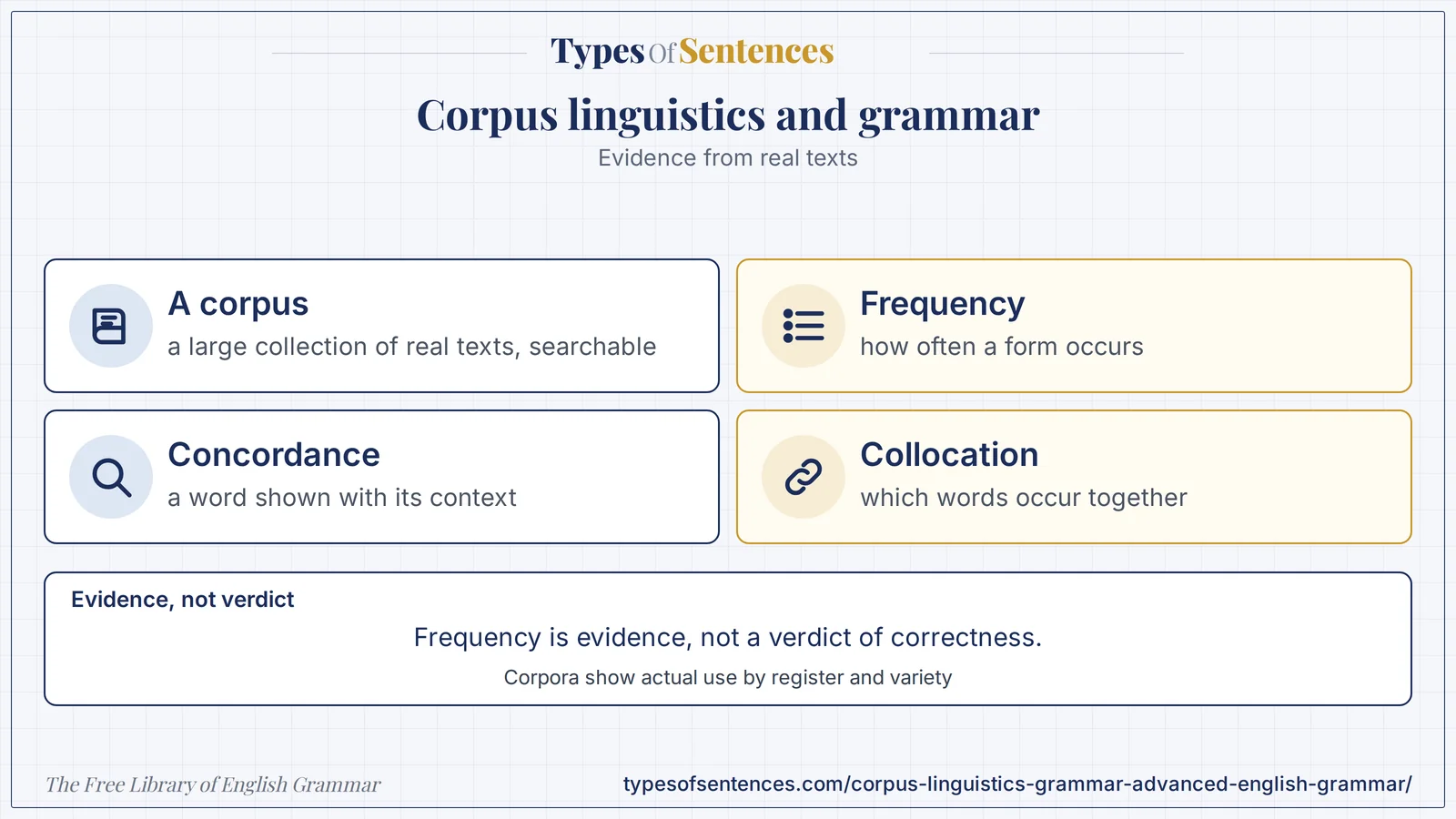
A corpus is a big, organized collection of real writing and speech that a computer can search. With it you can see how a word or a construction is actually used, what words keep company with it, and how its use differs between speech and writing, or between American and British English.
Why it matters: Corpus evidence answers the question “What do people do?” It does not by itself answer “What should they do?” But a writer who knows what people do is better placed to decide.
Summary: A corpus is a large, principled collection of authentic texts in machine-readable form. Corpus linguistics analyzes it with software to find frequencies, concordances (a word shown with its context), and collocations (words that occur together). It supports an empirical approach: grammar is described from evidence of use, by register and variety. Major English corpora include the Brown Corpus (1961, American written), the British National Corpus, the Corpus of Contemporary American English, the International Corpus of English, and historical, spoken, and learner corpora. Findings include differences between registers (passives in academic writing, contractions in conversation), the dependence of grammar on particular words, and the real frequency of constructions that prescriptions condemn. Corpora inform dictionaries, teaching, and style advice. Their limits are representativeness, the absence of negative evidence, and the need for interpretation.
- A corpus = a large collection of real texts, searchable.
- Frequency, concordance, collocation are the basic tools.
- Corpora show actual use by register and variety.
- Frequency is evidence, not a verdict of correctness.
What You’ll Learn
- 1. Corpus Linguistics: What Is It?
- 2. How Corpora Inform Grammar: Usage Patterns and Frequency
- 3. Major English Corpora
- 4. Discoveries from Corpora: Unexpected Patterns and Usage Variation
- 5. Using a Corpus Yourself: A Simple Procedure
- 6. Implications for Learning, Teaching, and Writing
- 7. Limitations and Cautions
- 8. Common Errors About Corpora, and a Worked Example
- 9. Exercises
- 10. Test Your Knowledge
- 11. Frequently Asked Questions
- 12. Conclusion
1. Corpus Linguistics: What Is It?
| Term | Meaning | Example |
|---|---|---|
| corpus (plural: corpora) | a large, principled collection of authentic texts (written, spoken, or both) in electronic form | the British National Corpus |
| token | each running word in a text | “the cat saw the cat” has five tokens |
| type | each distinct word form | the same sentence has three types |
| lemma | a dictionary headword grouping inflected forms | run, runs, ran, running |
| frequency | how often something occurs | can occurs 5,000 times in a sample |
| normalized frequency | frequency per fixed number of words (for example per million) | allows corpora of different sizes to be compared |
| concordance (KWIC) | a display of every occurrence of a word with its context, centered on the keyword | — |
| collocation | the tendency of words to occur together | heavy rain, make a decision |
| colligation | the tendency of a word to occur with a grammatical pattern | suggest + that-clause |
| n-gram (lexical bundle) | a sequence of n words that recurs | on the other hand |
| part-of-speech tagging | automatic labeling of each word with its class | run as noun or verb |
| annotation (markup) | added information about the text (speaker, date, grammar) | — |
| register / genre | the variety of text: conversation, news, fiction, academic | — |
| keyness | words that are unusually frequent in one corpus compared with another | — |
| reference (general) corpus | a balanced sample of a language as a whole | — |
| specialized corpus | a collection from a field or genre | a corpus of medical research articles |
| Approach | Evidence | Strength | Weakness |
|---|---|---|---|
| introspection (the “armchair”) | the linguist’s own intuition about what is grammatical | quick; can test rare constructions; shows what speakers accept | may reflect the linguist’s dialect; may overlook frequency and variation |
| elicitation and experiments | judgments or performance of speakers in a task | controlled; tests hypotheses | artificial; small samples |
| corpus evidence | real usage in large samples | shows frequency, context, and variation; reproducible | shows use, not acceptability; limited to the text collected |
| Date | Milestone |
|---|---|
| 1959 | Randolph Quirk begins the Survey of English Usage at University College London (an early corpus of spoken and written British English) |
| 1961 | the Brown Corpus: one million words of American written English, compiled at Brown University (Francis and Kučera) |
| 1978 | the LOB Corpus: a British counterpart of the Brown Corpus |
| 1980s | the COBUILD project at Birmingham, led by John Sinclair, builds a large corpus for dictionaries |
| 1994 | the British National Corpus (about 100 million words) |
| 2008 | the Corpus of Contemporary American English (Mark Davies) |
| 2010 | the Google Books Ngram Viewer opens to the public |
| today | corpora of many billions of words, web corpora, historical, learner, and parallel corpora |
The term corpus is Latin for “body” (of texts). A corpus is not just any pile of text: it should be collected on principles that make it representative of the variety of language being studied, and it should be documented so that the researcher knows what it contains. The central contribution of corpus linguistics is to replace anecdote with measured evidence about usage. The relationship of this evidence to the “rules” discussed in the chapter on grammar myths is direct: many myths can be tested against corpus data.
2. How Corpora Inform Grammar: Usage Patterns and Frequency
| Question | How a corpus answers it | Example of a finding |
|---|---|---|
| How often is a structure used? | count the structure, normalized per million words | passives are far more frequent in academic prose than in conversation |
| Where is it used? | compare registers (conversation, fiction, news, academic) and varieties (American, British) | gotten is common in American and rare in British English |
| What does a word typically combine with? | list collocates and patterns | strong tea, heavy rain; enjoy + -ing |
| What does a word mean in context? | read concordance lines | run has many senses; most frequent senses are not those in the dictionary’s first entry |
| Is a construction changing? | compare corpora from different dates | shall declining; semi-modals rising |
| Is a prescription followed? | search for the “forbidden” form in good writing | split infinitives occur widely in edited prose |
| What do learners get wrong? | compare learner and native corpora | overuse of some connectors; wrong collocations |
| Register finding (Biber and colleagues, Longman Grammar of Spoken and Written English, 1999) | Typical pattern |
|---|---|
| conversation | more verbs, pronouns, contractions, and short clauses; that often omitted after verbs of thinking and saying; first and second person; the present tense |
| fiction | the past tense; speech reported with said; third person pronouns; descriptive adjectives |
| news | compressed noun phrases; the past tense and attributed speech; many proper nouns |
| academic prose | many nouns, long noun phrases, passives, nominalizations, and the present tense; few contractions and few first and second person pronouns |
| Principle from corpus research | Meaning |
|---|---|
| the idiom principle (John Sinclair) | speakers often use ready-made multi-word chunks, not only free combination of single words |
| the open-choice principle | but they can also choose words freely under grammatical rules |
| lexis and grammar are interdependent | words have their own patterns (pattern grammar; Hunston and Francis, 2000) |
| register matters | a structure’s frequency and function depend on the kind of text |
| frequency is evidence of use and of entrenchment | frequent forms are processed and learned more readily |
| variation is the norm | a corpus shows a range of forms in use |
Corpus grammar, sometimes called data-driven grammar or empirical grammar, treats grammar as a description of patterns in use, as the chapter on idiomatic expressions and the chapter on collocation also do for fixed expressions and for word partnerships. The grammar may still use the traditional categories (noun, verb, clause), but it adds quantities: not only that a structure exists, but when, where, and how often it is used.
3. Major English Corpora
| Corpus | Content and size (approximate) | Use |
|---|---|---|
| Brown Corpus | American written English, 1961; about 1 million words; 500 samples | the first standard corpus; a model for others |
| LOB (Lancaster-Oslo/Bergen) Corpus | British written English, 1961; about 1 million words | comparison with Brown |
| Frown and FLOB | American and British written English, early 1990s; about 1 million words each | change since 1961 |
| Survey of English Usage / ICE-GB | British spoken and written English; the International Corpus of English family includes parallel corpora of about 1 million words for many national varieties | varieties of English |
| British National Corpus (BNC) | British English of the late twentieth century; about 100 million words; mostly written, with about 10 percent spoken | a general reference corpus |
| Corpus of Contemporary American English (COCA) | American English from 1990 onward; more than a billion words; spoken, fiction, magazines, newspapers, academic, and other genres; updated regularly | current American usage |
| Corpus of Historical American English (COHA) | American English from the 1810s to the 2000s; hundreds of millions of words | change over two centuries |
| Corpus of Global Web-Based English (GloWbE) | web texts from about twenty countries; nearly two billion words | world varieties |
| News on the Web (NOW) | online news texts from many countries, updated | recent change in vocabulary |
| Helsinki Corpus of English Texts | Old English to early Modern English | the history of English |
| Santa Barbara Corpus of Spoken American English | transcribed natural conversation; a few hundred thousand words | spoken grammar |
| Longman Spoken and Written English Corpus | about 40 million words, the basis of Biber et al. (1999) | register studies |
| Michigan Corpus of Academic Spoken English (MICASE) | academic speech at a United States university; about 2 million words | academic speaking |
| British Academic Written English (BAWE) | student writing from British universities; about 6 million words | student academic writing |
| International Corpus of Learner English (ICLE) | essays by learners of English from many first-language backgrounds | learner errors and overuse |
| Cambridge Learner Corpus | exam scripts of learners of English | learner language and dictionaries |
| Google Books and the Ngram Viewer | counts of words and phrases in millions of digitized books, over several centuries | long-term trends (to be used with care) |
| web-scale corpora (for example the enTenTen family) | tens of billions of words of web text | rare words and new usage |
| specialized corpora | medicine, law, engineering, and other fields built by researchers | field-specific language |
| Tool | What it is | Use |
|---|---|---|
| AntConc | free concordancing software | search, concordance, collocates, word lists in your own texts |
| Sketch Engine | a commercial corpus platform | word sketches (grammatical and collocational summaries) |
| English-Corpora.org (Mark Davies) | a site that hosts COCA, the BNC, COHA, GloWbE, NOW, and others | a free search with limits, and a paid full access |
| LancsBox (#LancsBox) | free software from Lancaster University | corpus analysis |
| Google Books Ngram Viewer | a free chart of phrase frequency over time | quick trends |
| WordSmith Tools | commercial concordancing software | research |
Sizes, dates, and access conditions change as corpora are updated, and the figures above are approximate. The tools named are real and in wide use; their details change, so check each corpus’s own documentation. Some corpora are free to search online, others require a license.
4. Discoveries from Corpora: Unexpected Patterns and Usage Variation
The table summarizes findings that corpus studies have supported. They are tendencies and not rules, and the strength of each depends on the corpus and the register; the point of the table is to show the kind of evidence that corpora provide.
| Topic | Finding | Implication |
|---|---|---|
| passives | far more frequent in academic and scientific prose than in conversation or fiction | advice to “avoid the passive” does not fit all genres (see the chapter on voice) |
| get-passive | more frequent in conversation than in writing | a spoken-register marker |
| split infinitives | occur regularly in edited published prose, especially with adverbs such as really and fully | not a mark of poor writing |
| stranded prepositions | very common in speech and in relative clauses and questions in writing | the “rule” against them is not followed |
| sentences beginning with and/but | common in published prose | not an error |
| that omission | frequent in conversation (I think he’s late); less so in formal writing | a register difference |
| contractions | very frequent in conversation and fiction; present even in some news and academic writing | tone and formality |
| modal verbs | can, will, and would are among the most frequent; shall is rare | teaching priorities |
| semi-modals | have to, want to, be going to increasing since the 1960s | change in progress (see the chapter on language change) |
| past and present tenses | past dominates fiction and news; present dominates conversation and academic prose | tense choice depends on register |
| noun versus verb density | academic prose has many nouns and complex noun phrases; conversation has more verbs | style of different registers |
| lexical bundles | recurring phrases such as on the other hand, as a result of (academic) and I don’t know if (conversation) | register-specific phraseology |
| singular they | increasing, especially with indefinite pronouns | accepted usage |
| whom | rare in speech; present mainly in formal writing and after prepositions | declining |
| between you and I | occurs in educated speech, though many guides disapprove | hypercorrection or variation |
| different than versus different from | both attested; different than is more American, different to more British | variety differences |
| gotten | frequent in American English, rare in British English | variety difference |
| fewer and less | less before plural nouns occurs, especially in speech and informal writing; fewer is standard in formal writing | a register and style issue |
| hopefully as a sentence adverb | frequent in speech and in many kinds of writing | established |
| literally as an intensifier | attested in speech and informal writing | established in informal use |
| collocations | heavy rain, strong tea, make a decision, take a decision (more British) | natural combinations differ by variety |
| say and said | among the most frequent verbs in news and fiction | reporting verbs follow register conventions |
| verb patterns | enjoy takes -ing; want takes to; suggest takes a that-clause | patterns are lexically specific (pattern grammar) |
| phrasal verbs | frequent in conversation; many have idiomatic meaning; a small set of verbs and particles accounts for many | teach the most frequent |
| discourse markers | well, so, you know, I mean frequent in conversation | speech has its own grammar of interaction |
| hedges and boosters | academic prose uses hedges in characteristic positions, with variation by field (see the chapter on hedging) | genre conventions |
| ellipsis | frequent in conversation (Going out?) | speech has reduced clauses |
| relative clauses | that and zero relatives dominate in speech; which and whom in formal writing | register |
| each other and one another | both used; each other is more frequent | no rule of number |
| amongst and similar -st forms | rare in American English; present in British English, especially formal | variety difference |
| alright | used alongside all right | spelling variation |
| first person pronouns in academic writing | vary by discipline and genre | follow the field |
| word frequency | a small set of words (function words) accounts for a large share of all text | vocabulary teaching can prioritize frequent words |
| learner overuse | learners overuse some connectors (moreover) and underuse others | corpus-informed teaching |
| spelling variants | judgment and judgement, email and e-mail vary by variety and date | style sheets |
The general lesson is that real usage is richer, more varied, and more dependent on context than a list of rules suggests. The study of the findings also changes how the “myths” discussed earlier are evaluated: a construction that appears regularly in the writing of respected authors is hardly an error, although it may still be inappropriate in a particular register.
5. Using a Corpus Yourself: A Simple Procedure
- Formulate a question. For example: “Do careful writers use different than?” or “What verbs follow suggest?”
- Choose a suitable corpus. For American usage, COCA; for British, the BNC; for change over time, COHA or the Ngram Viewer; for your own documents, load them into concordancing software.
- Search. Enter the word or phrase; use part-of-speech filters where available.
- Check the frequency (normalized) and the distribution across genres and dates.
- Read concordance lines. Do not rely on counts alone; read at least a sample of lines to see how the word is used.
- Look at collocates. What words appear next to it? What patterns recur?
- Compare. Compare registers, varieties, or periods.
- Interpret with care. Remember the limits of the corpus and the question you asked.
| Concordance lines (invented illustrations, not from a real corpus) | Observation |
|---|---|
| … the results were different from those of the first study … | different from in academic prose |
| … which was different than what I expected … | different than followed by a clause |
| … she is different to her sister … | different to (British pattern) |
| … we suggest that the policy be changed … | suggest that + subjunctive |
| … I suggest you read it first … | suggest + clause without that |
| Search idea | What it can tell you |
|---|---|
| the word and its frequency by register | where it belongs |
| the two competing forms side by side | which is more frequent and where |
| a word’s collocates | natural combinations |
| a phrase with a wildcard | patterns around it |
| the word by decade | change over time |
| the word in your own writing versus a reference corpus | what is unusual in your style |
| the word in a learner corpus versus a native corpus | typical learner choices |
- Use at least two corpora when the question matters, and check that the corpus matches your reader’s variety and register.
- Read the lines. Counts hide differences in meaning.
- Do not equate frequency with correctness. A common error is still an error in a formal context.
- Report your method if you use a corpus in research: the corpus, the query, and the date.
- Use the corpus with other sources: a usage guide, a dictionary, and a reference grammar.
6. Implications for Learning, Teaching, and Writing
| Area | Implication | Example |
|---|---|---|
| dictionaries | corpora give frequency, collocations, and authentic examples | COBUILD (1987) was the first major dictionary based on a corpus |
| vocabulary teaching | teach the most frequent words and phrases first | the General Service List; the Academic Word List (Coxhead 2000) |
| grammar teaching | teach structures by frequency and register; show real examples | teach have to and want to early |
| data-driven learning (Tim Johns) | learners explore concordances to discover patterns themselves | a lesson on suggest patterns |
| materials writing | examples taken from corpora are authentic | — |
| writing and editing | check collocations and usage before a final decision | is it make a decision or take a decision for this reader? |
| language testing | tests can reflect the frequency of real use | — |
| translation and lexicography | align parallel corpora; find equivalents | — |
| forensic and literary analysis | compare an author’s style with a corpus | keyness; authorship |
| style guides | evidence for usage advice | a usage guide that cites corpus data |
| natural language processing | corpora train language technologies | — |
| Question for a writer | How a corpus helps |
|---|---|
| Which preposition follows different? | compare from, than, to in the reader’s variety |
| Is data singular or plural in this field? | search a corpus of the field |
| Is a phrase natural? | check whether it occurs and with what frequency |
| Is a word formal or informal? | compare its distribution across registers |
| Is a spelling current? | check the date distribution |
| What collocates with this noun? | look at the collocate list |
The effect on advice about grammar and style is large: a recommendation that is not supported by usage is weak, and a recommendation that matches usage in the reader’s register is strong. The evidence does not replace judgment, but it makes judgment better informed, and it supports the evidence-based approach to the debates described in the chapter on hedging (the typical places of hedges in academic writing can themselves be studied with corpora).
7. Limitations and Cautions
| Limitation | Explanation |
|---|---|
| representativeness | a corpus is a sample; it may not represent all speakers, genres, or periods |
| balance and design | the choice of texts affects results; published written texts dominate many corpora |
| spoken data | transcriptions lose prosody and gesture; spoken corpora are smaller and costlier |
| no negative evidence | absence from a corpus does not prove that a form is impossible |
| frequency is not acceptability | a form can be frequent and stigmatized, or rare and acceptable |
| annotation errors | automatic tagging makes mistakes, especially with ambiguous words |
| web noise | web corpora include errors, repeated text, and machine-generated text |
| context is needed | concordance lines must be read, not only counted |
| time and place | corpora are snapshots; usage differs by region and changes |
| ethics and law | copyright, privacy, and consent in collecting texts |
| interpretation | a statistic needs an explanation; the corpus cannot supply it |
| Misuse | Better practice |
|---|---|
| “The corpus shows it is correct.” | The corpus shows that it is used, in these registers, with this frequency. |
| “It appears only twice, so it is wrong.” | Rare is not wrong; check the corpus size and the register. |
| “COCA says so; therefore it holds for British English.” | Use a corpus of the relevant variety. |
| counting without reading | read concordance lines |
| over-generalizing from a small sample | use a larger or second corpus |
| ignoring the reader | choose by the reader’s expectation |
8. Common Errors About Corpora, and a Worked Example
| Error | Example | Better |
|---|---|---|
| equating frequency with correctness | “It is common, so it is right.” | Frequency shows usage; correctness depends on register and reader. |
| equating rarity with error | “It is rare, so it is wrong.” | It may be a formal or specialized form. |
| using one corpus for all questions | using an American corpus for British usage | choose the corpus that matches the question |
| ignoring register | mixing conversation and academic data | compare registers separately |
| reading only the numbers | — | read concordance lines |
| forgetting normalization | comparing raw counts of corpora of different sizes | use frequency per million |
| believing corpora replace grammar books | — | use both |
| treating the web as a neutral sample | — | know what a web corpus contains |
| assuming that a corpus contains all language | — | a corpus is a sample |
| ignoring the date | using a 1961 corpus for current slang | use a recent corpus |
| using a corpus without a question | — | state the question first |
| equating “native speaker” with one variety | — | state the variety |
Worked example (invented data, to show the method): Question: do careful writers use different than or different from? Method: search a reference corpus of American written English for each form; normalize per million words; compare genres; read 30 concordance lines of each.
- Step 1: counts. Suppose different from occurs 120 times per million words and different than 12 times per million words (invented figures). From is about ten times as frequent.
- Step 2: register. In an invented breakdown, different than is relatively more frequent in speech and magazines, and rare in academic prose.
- Step 3: concordance lines. Read the lines: different than often introduces a clause (different than I expected), where different from would need from what I expected.
- Step 4: variety. Check a British corpus: different to appears there.
- Interpretation. Different from is the safer form in formal writing, and different than is established in American usage, especially before a clause. A usage guide, a dictionary, and the style guide of the reader should be consulted before deciding.
- Report: state the corpus, the query, the date, and the limits. (All figures here are invented for illustration.)
Recap in 12 seconds
Watch the lesson build itself: A corpus supports frequency, concordance, and collocation analysis of real language use. The video has no sound.
Exercises
Part A: Basic Ideas (Exercises 1–7)
Exercise 1: Define a corpus.
Show Answer
Answer: A large, principled, electronic collection of authentic texts.
Exercise 2: What is the plural of corpus?
Show Answer
Answer: Corpora.
Exercise 3: What is a token?
Show Answer
Answer: Each running word in a text.
Exercise 4: What is a type?
Show Answer
Answer: Each distinct word form.
Exercise 5: What is a concordance?
Show Answer
Answer: A display of a word with its context.
Exercise 6: What is a collocation?
Show Answer
Answer: A tendency of words to occur together.
Exercise 7: Why normalize frequencies?
Show Answer
Answer: To compare corpora of different sizes.
Part B: Corpora (Exercises 8–14)
Exercise 8: Which was the first standard one-million-word corpus of American written English?
Show Answer
Answer: The Brown Corpus (1961).
Exercise 9: Which corpus has about 100 million words of British English?
Show Answer
Answer: The British National Corpus.
Exercise 10: Which corpus covers American English from 1990 and has more than a billion words?
Show Answer
Answer: COCA.
Exercise 11: Which corpus is historical American English?
Show Answer
Answer: COHA.
Exercise 12: Name a free concordancing program.
Show Answer
Answer: AntConc.
Exercise 13: Which project led by John Sinclair built a corpus for dictionaries?
Show Answer
Answer: COBUILD.
Exercise 14: Name a learner corpus.
Show Answer
Answer: ICLE or the Cambridge Learner Corpus.
Part C: Findings (Exercises 15–21)
Exercise 15: Where are passives most frequent?
Show Answer
Answer: Academic and scientific prose.
Exercise 16: Where is that most often omitted?
Show Answer
Answer: In conversation.
Exercise 17: Which modal is rare now: shall or can?
Show Answer
Answer: shall.
Exercise 18: Do split infinitives occur in edited prose?
Show Answer
Answer: Yes.
Exercise 19: Which variety uses gotten frequently?
Show Answer
Answer: American English.
Exercise 20: Name a register difference in tense.
Show Answer
Answer: Past dominates fiction and news; present dominates conversation and academic prose.
Exercise 21: What is a lexical bundle?
Show Answer
Answer: A recurring multi-word sequence, such as on the other hand.
Part D: Using a Corpus (Exercises 22–26)
Exercise 22: What is the first step in using a corpus?
Show Answer
Answer: Formulate a question.
Exercise 23: Why read concordance lines?
Show Answer
Answer: Counts hide differences in meaning.
Exercise 24: Which corpus would you use for current American usage?
Show Answer
Answer: COCA.
Exercise 25: Which corpus would you use for change over two centuries?
Show Answer
Answer: COHA (or the Ngram Viewer).
Exercise 26: Name a way to compare registers.
Show Answer
Answer: Search each register separately and compare normalized frequencies.
Part E: Implications and Limits (Exercises 27–30)
Exercise 27: Who is associated with data-driven learning?
Show Answer
Answer: Tim Johns.
Exercise 28: Does frequency prove correctness?
Show Answer
Answer: No.
Exercise 29: Does absence from a corpus prove a form is impossible?
Show Answer
Answer: No.
Exercise 30: Name a limitation of web corpora.
Show Answer
Answer: They contain errors, repeated and machine-generated text.
Test Your Knowledge
Ready to check what you learned? Answer all 10 questions, then submit. You need 80% (8 of 10) to pass. Your answers are not stored.
View correct answers and explanations
Question 1: What is a corpus?
✓ Correct Answer: A – a large collection of authentic texts in electronic form
A text collection.
Question 2: Which was an early one-million-word corpus of American written English?
✓ Correct Answer: B – the Brown Corpus
Brown, 1961.
Question 3: What is a concordance?
✓ Correct Answer: C – a display of a word with its context
KWIC lines.
Question 4: What does normalized frequency allow?
✓ Correct Answer: D – comparing corpora of different sizes
Comparison.
Question 5: Which finding is typical of corpus studies?
✓ Correct Answer: C – Passives are much more frequent in academic writing than in conversation.
Register difference.
Question 6: What does frequency show?
✓ Correct Answer: A – how often a form occurs, not whether it is correct
Use, not correctness.
Question 7: Which is a limitation of corpora?
✓ Correct Answer: D – absence does not prove a form is impossible
No negative evidence.
Question 8: Who is associated with data-driven learning?
✓ Correct Answer: C – Tim Johns
Tim Johns.
Question 9: What is a collocate of a word?
✓ Correct Answer: B – a word that frequently occurs near it
A frequent neighbor.
Question 10: Which tool is free concordancing software?
✓ Correct Answer: B – AntConc
AntConc.
Frequently Asked Questions
What is corpus linguistics?
Corpus linguistics is the study of language using large collections of real texts and software. Corpus linguistics measures frequency, context, and collocation.
What is corpus grammar?
Corpus grammar is a description of grammar based on evidence from corpora: which structures are used, how often, in which registers and varieties. Corpus grammar adds quantities to the traditional categories.
What is data-driven grammar?
Data-driven grammar is grammar developed from patterns in large amounts of real usage data, not only from intuition or tradition. Data-driven grammar is also used in teaching, where learners study concordances.
What is a language corpus?
A language corpus is a large, organized, electronic collection of authentic texts, written or spoken, used for study. A language corpus must be designed to be representative.
What is empirical grammar?
Empirical grammar is grammar based on observation of actual use. Empirical grammar tests rules against evidence.
How can I use a corpus to check a usage question?
State the question, choose a corpus that matches your reader’s variety, search the forms, compare normalized frequencies and registers, and read the concordance lines.
Does corpus evidence tell me what is correct?
No. It shows what is used, by whom, and where. Correctness depends on the register, the reader, and the style guide.
Conclusion
You now have a study of corpus linguistics and grammar: what a corpus is, how corpora inform grammar, the major English corpora, the discoveries they have supported, a simple procedure for using a corpus, the implications for teaching and writing, and the limits of the evidence. You can look for evidence of use, and read it with care.
When you meet a usage question, ask what the evidence of use is, and for which readers. Next, you will study contrastive analysis.
- McEnery, Tony, and Andrew Hardie. Corpus Linguistics: Method, Theory and Practice. Cambridge University Press, 2012.: an introduction to the field.
- Biber, Douglas, et al. Longman Grammar of Spoken and Written English. Longman, 1999.: a corpus-based grammar.
- Sinclair, John. Corpus, Concordance, Collocation. Oxford University Press, 1991.: the idiom principle and the open-choice principle.
- Hunston, Susan, and Gill Francis. Pattern Grammar. John Benjamins, 2000.: grammar as lexical patterns.
- English-Corpora.org: a site hosting several large English corpora.
Last reviewed: October 29, 2026. How it was made: drafted with AI assistance, then checked with automated tests (structure, links, answer keys, spelling) and against the sources above. A person has not yet read this chapter line by line. Found a mistake? Report it.