Grammar myths are statements about “correct” English that people repeat with confidence and that the evidence does not support: never split an infinitive, never end a sentence with a preposition, never begin a sentence with and or but. Many were invented by eighteenth- and nineteenth-century writers who wished to make English more like Latin, or simply to record their own tastes, and they were passed down in classrooms as laws. Good writers have always broken them. Other points are real controversies: educated writers and usage guides disagree about them, and the disagreement is itself part of the history of the language.
This chapter separates the myths from the genuine questions. You will meet fifty common grammar rules myths with the evidence against them, the difference between prescriptive and descriptive grammar, the way that language evolves, the main grammar controversies (singular they, the serial comma, which and that, and others), regional variation, and the question of when a rule does matter: in an exam, a style guide, an academic journal, or a job application. The aim is not to abandon rules but to know what kind of rule each one is. Debunking grammar myths helps a writer to choose by evidence and by the needs of the reader, and to avoid language myths about “correctness”. Thirty editing exercises and a quiz follow.
Some grammar “rules” are real: they describe what almost every speaker does, and breaking them makes a sentence ungrammatical (*He go home). Others are myths: they were taught as rules, but careful writers have always ignored them, and following them can make a sentence worse.
Why it matters: A third group are matters of style or convention: an exam, an editor, or a style guide may require a particular choice. The skill is to tell the three apart, and to follow the rule that your reader and your purpose require.
Summary: A grammar myth is a supposed rule that the evidence from usage and from the history of English does not support: for example, that infinitives must not be split, that sentences must not end with prepositions, or that they must not begin with conjunctions. Prescriptive grammar tells people how to use language; descriptive grammar records how they do. Language evolves, and many once-condemned usages are now standard. Genuine controversies remain (singular they, the serial comma, which versus that), and the answer often depends on context, genre, and the house style of the reader. Rules matter most where an audience, a test, or a style guide requires them; elsewhere, clarity and the reader’s expectations are the guide.
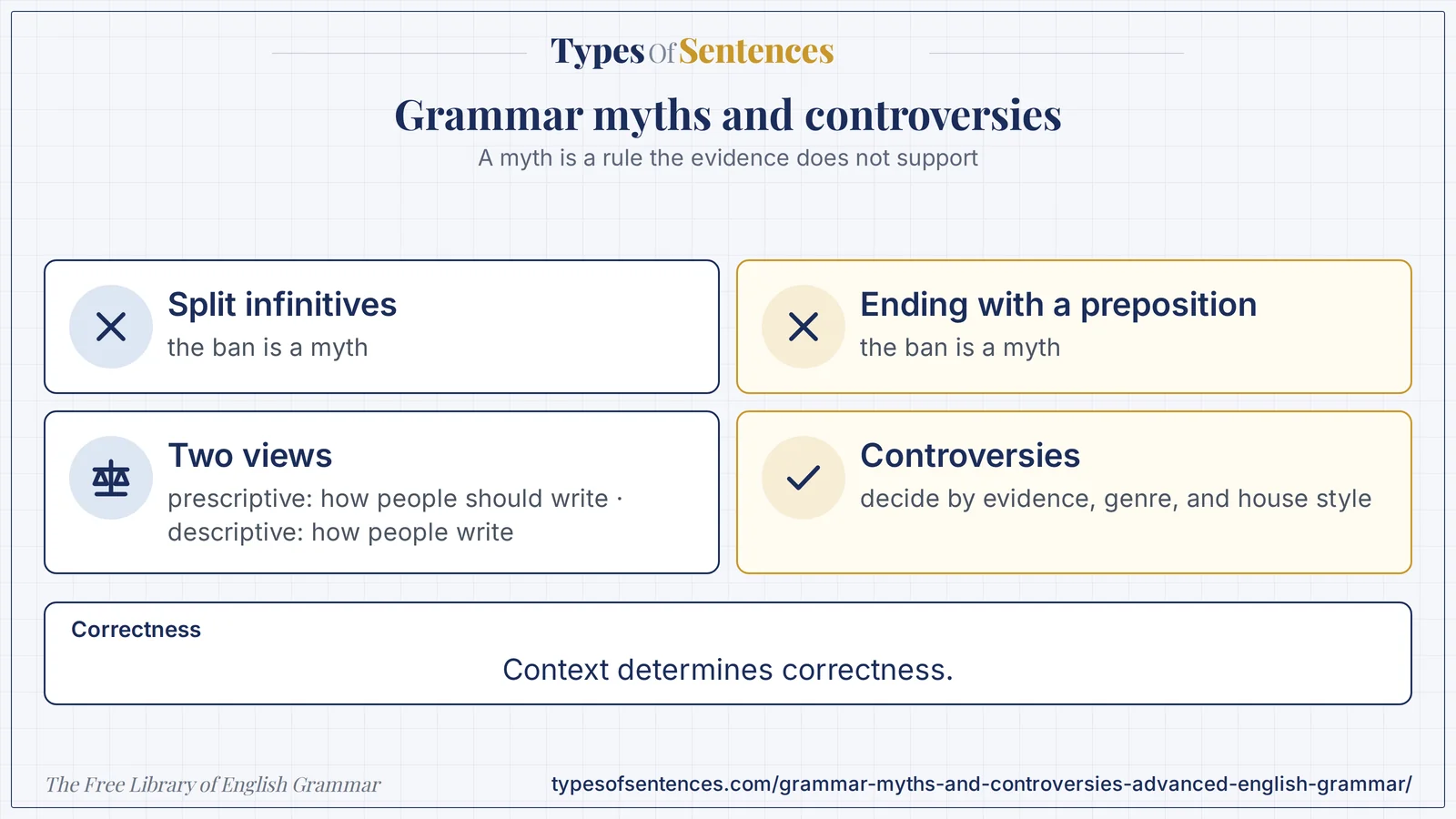
- A myth is a “rule” the evidence does not support.
- Prescriptive = how people should write; descriptive = how people do.
- Controversies: decide by evidence, genre, and house style.
- Context determines correctness.
What You’ll Learn
- 1. Grammar Myths: Fifty “Rules” That Are Not Rules
- 2. Prescriptive vs Descriptive Grammar
- 3. Evolving Language: Usages That Were Once Condemned
- 4. Grammar Controversies: Where Experts Disagree
- 5. Regional and Social Variation
- 6. Formal vs Informal Rules: Context Matters
- 7. When Rules Matter: Academic, Professional, and Test Contexts
- 8. How to Evaluate a Grammar Claim
- 9. Common Errors in Thinking About Grammar
- 10. Exercises
- 11. Test Your Knowledge
- 12. Frequently Asked Questions
- 13. Conclusion
1. Grammar Myths: Fifty “Rules” That Are Not Rules
The statements below are among the most widely repeated claims about English. For each, the table gives the verdict of current usage guides and grammars, with the reason. “Not a rule” means that careful writers use the construction freely; it does not mean that it is always the best choice. A few entries are real preferences in some contexts, and are marked.
| # | The “rule” | Verdict | Why |
|---|---|---|---|
| 1 | Never split an infinitive (to boldly go). | Myth | English infinitives are two words; splitting is natural, and sometimes avoiding it is awkward or changes the meaning. |
| 2 | Never end a sentence with a preposition. | Myth | Stranded prepositions are standard in speech and writing: the book you asked about. |
| 3 | Never begin a sentence with and, but, or because. | Myth | Coordinators and subordinators begin sentences in good writing; avoid a fragment, not the word. |
| 4 | Never use I in academic writing. | Myth (varies by field) | Many fields and style guides accept I and we where the writer’s role matters. |
| 5 | Never use contractions in writing. | Context | Fine in informal and neutral prose; avoid in formal documents. |
| 6 | The passive voice is always bad. | Myth | It is useful when the actor is unknown or unimportant (see the chapter on voice). |
| 7 | A paragraph must have at least three sentences (or five). | Myth | A paragraph needs one main idea, however many sentences develop it. |
| 8 | Never use a one-sentence paragraph. | Myth | Used sparingly for emphasis; common in journalism and fiction. |
| 9 | Never use a fragment. | Myth | Deliberate fragments are standard in creative and informal writing. |
| 10 | Since can only mean time, not reason. | Myth | Both senses have been used since the Middle Ages; avoid it only where ambiguous. |
| 11 | Use that for restrictive clauses and which for non-restrictive ones. | Convention | A widely taught house-style rule that many writers do not follow; see the controversies below. |
| 12 | None must take a singular verb. | Myth | None may take a singular or a plural verb, depending on meaning. |
| 13 | Whom must be used for all objects. | Context | Whom is formal and fading in speech; who is normal in most informal contexts. |
| 14 | Use fewer for countable nouns and less for uncountable ones, without exception. | Context | A useful distinction in formal writing, but less than with quantities (less than 10 miles) has long been standard. |
| 15 | Hopefully must not mean “it is hoped that”. | Myth | A sentence adverb like fortunately; accepted by most modern guides. |
| 16 | Different than is wrong; use different from. | Disputed | Both are used by educated writers; from is safer in formal writing. |
| 17 | Double negatives are always illogical. | Myth | Standard in many dialects and languages for emphasis; and not unlikely is a legitimate litotes. Avoid in formal standard English. |
| 18 | Between is for two, among for more than two. | Myth | Between is also used for relations among several distinct items. |
| 19 | Can asks ability; may asks permission, and can is wrong for permission. | Myth | Can for permission is long established in speech; may is more formal. |
| 20 | Each other is for two, one another for more. | Myth | The two are interchangeable in practice. |
| 21 | Over cannot mean “more than”. | Myth | Common in good writing; some house styles prefer more than. |
| 22 | Data is always plural. | Context | Plural in many scientific styles; singular as a mass noun is standard in general use. |
| 23 | They cannot be singular. | Myth | Singular they has been used since the fourteenth century. |
| 24 | Impact cannot be a verb. | Myth | Verb use is common; some readers dislike it. |
| 25 | Gotten is not good English. | Myth | Standard in American English; not used in the same way in British English. |
| 26 | Irregardless is not a word. | Nonstandard | It is in dictionaries, labeled nonstandard; use regardless. |
| 27 | You must not use they to refer to a company. | Variety | Common in British English; American usage prefers it. |
| 28 | A sentence must have a subject and a verb (so imperatives are wrong). | Myth | Imperatives have an implied subject. |
| 29 | You must not use like as a conjunction. | Disputed | Common in speech; many formal guides prefer as or as if. |
| 30 | Comprise cannot be used in the passive (is comprised of). | Disputed | Widely used; some guides still object. |
| 31 | Literally cannot be used for emphasis. | Disputed | Used for emphasis since the eighteenth century; many guides advise against it in formal writing. |
| 32 | Enormity must mean “wickedness”, never “size”. | Disputed | The size sense is common; the older sense is clearer in formal writing. |
| 33 | Whose cannot refer to things. | Myth | Whose is the standard possessive relative, for things as well as people. |
| 34 | Never use very. | Style | A matter of style, not grammar. |
| 35 | Never use the same word twice in a sentence. | Myth | Repetition is often better than a forced synonym. |
| 36 | Use two spaces after a period. | Convention | A typewriter-era habit; modern style guides prefer one. |
| 37 | A comma goes wherever you pause. | Myth | Commas follow grammar and convention, not breathing. |
| 38 | Never use a comma before and. | Myth | A serial comma is standard in many styles; the comma between independent clauses is required in most. |
| 39 | Never end a sentence with an adverb or a participle. | Myth | There is no such rule. |
| 40 | Everyone is plural, so use their. | Variety | Everyone takes a singular verb; their is accepted as singular. |
| 41 | Never write numerals in prose. | Style | Style guides differ on when to use words and when numerals. |
| 42 | “A lot” is one word. | Myth (spelling) | Two words; the one-word form is a misspelling. |
| 43 | Alright is wrong. | Disputed | Used widely; all right is safer in formal writing. |
| 44 | A sentence cannot begin with a numeral. | Convention | A style rule in some guides; rephrase or spell out. |
| 45 | You must not use so as an intensifier (so tired). | Myth | An ordinary intensifier. |
| 46 | The apostrophe is dying out, so rules do not matter. | Myth | Its use is stable in standard written English. |
| 47 | Adjectives must always precede nouns. | Myth | Postposed adjectives exist (attorney general, something strange). |
| 48 | Prepositions cannot be repeated or dropped in coordination. | Myth | Style choice; see the chapter on parallel structure. |
| 49 | Shall is for the first person and will for others. | Obsolete | An old textbook distinction that most speakers do not make. |
| 50 | English has no future tense because it has no inflected future. | Misleading | English expresses the future in several ways, including will and be going to; the category depends on definitions. |
Several of these items were taught by grammar writers of the eighteenth and nineteenth centuries, who often appealed to Latin or to logic. The best-known early example is the criticism of a preposition at the end of a clause by the poet John Dryden in 1672, and a later influence is Robert Lowth’s A Short Introduction to English Grammar (1762), which has been widely cited as a source of prescriptive rules. The influence of these writers on modern myths is sometimes exaggerated, but the pattern is clear: a rule is stated, repeated in schoolbooks, and taken for a law of the language. See also the chapter on diction for the confusable words that are the other staple of such debates.
2. Prescriptive vs Descriptive Grammar
| Feature | Prescriptive | Descriptive |
|---|---|---|
| aim | to say how language should be used | to record and explain how language is used |
| basis | authority, tradition, taste, logic, Latin | evidence from speech and writing; corpora |
| typical source | style guides, usage dictionaries, school rules | linguistic grammars, corpus studies |
| attitude to variation | prefers one standard form | treats variation as natural data |
| example | “Do not split infinitives.” | “Split infinitives occur in x percent of infinitive constructions in written English.” |
| strength | gives a clear standard; useful for editing and teaching | accurate; explains why people write as they do |
| weakness | may rest on false claims; may treat style as law | may seem to say that anything goes |
| used for | exams, house style, editing | linguistics, dictionaries, language research |
| Kind of statement | Example | Status |
|---|---|---|
| a description of what is grammatical in a variety | She likes tea, not *Likes she tea | descriptive fact |
| a recommendation of style | Prefer the active voice. | prescription (style advice) |
| a requirement of a style guide | Use the serial comma. | prescription (convention) |
| a social judgment | Using ain’t marks a speaker as uneducated. | a claim about prestige, not grammar |
| a claim about history | They cannot be singular. | checkable (and false) |
- Descriptive does not mean “anything goes”. Describing usage includes describing the standard and the penalties for departing from it in particular contexts.
- Prescriptive advice can be good advice. A recommendation to avoid ambiguity or to keep a consistent style is sound; the fault is in presenting preferences as laws.
- Check the claim. Is it a fact about usage, a matter of style, a house rule, or a social prejudice?
- Linguists mostly work descriptively; usage panels and editors mostly work prescriptively. Both have a place.
- Respect the reader’s expectations. Even if a rule is a myth, a reader who believes it may judge you; that is a cost to weigh.
The difference between the two approaches has been debated since the eighteenth century, and it comes up again in the discussion of language change in the next chapters. A balanced view is that grammar can be studied as a science (description) and used as a craft (prescription), and the craft is better when it rests on the science.
3. Evolving Language: Usages That Were Once Condemned
| Usage | Once criticized as | Now |
|---|---|---|
| singular they | ungrammatical | widely accepted; recommended by many major style guides |
| hopefully as a sentence adverb | illogical | standard in informal and general writing |
| is being built (progressive passive) | an incorrect “new” form (c. 1800) | standard |
| contact, impact, text, google as verbs | improper noun-to-verb shifts | verbs in general use |
| who for whom | careless | normal in speech and informal writing |
| like as a conjunction | vulgar | common in speech; formal writing prefers as |
| gotten (American) | an error | standard in American English |
| different than | incorrect | used by educated writers, mostly in American English |
| between you and I | — | a hypercorrection; between you and me is standard |
| fun as an adjective (a fun time) | noun only | accepted |
| decimate for “destroy” | must mean “kill one in ten” | the broad sense is standard; the narrow sense is rare |
| nice (originally “foolish”) | — | the meaning changed over centuries |
| ain’t | illiterate | nonstandard in writing; used in dialects and informal speech for effect |
| split infinitives | a violation of Latin-based “logic” | accepted |
The pattern is consistent: a new use arises in speech, is criticized by some writers, spreads, and often becomes standard, after which the criticism is forgotten or remembered as a curiosity. Not every change succeeds, and the speed varies. These changes are the subject of the following chapters, on the history of English grammar and on language change in modern English, and the way to measure them is described in the chapter on corpus linguistics.
4. Grammar Controversies: Where Experts Disagree
| Issue | Positions | Practical advice |
|---|---|---|
| singular they | accepted as a gender-neutral singular (historic and modern) versus rejected by some formal guides | use it for an unknown person and for a person who uses they; follow your style guide |
| serial (Oxford) comma | AP-style journalism omits it; many academic and book publishers use it | use it consistently; add it when its absence causes ambiguity |
| which versus that (restrictive) | taught as a rule in American style guides; British usage uses which more freely | follow your house style; use commas to mark non-restrictive clauses |
| data singular or plural | plural in formal scientific writing; singular in general use | follow your field |
| who versus whom | whom required in formal writing; who accepted in speech | use whom in formal writing after prepositions |
| split infinitive | accepted by modern guides | split it if the alternative is awkward |
| ending with a preposition | accepted | avoid only if the result is clumsy |
| comprise / compose | is comprised of disputed | use is composed of in formal writing |
| less / fewer | distinction required by some guides | use fewer for count nouns in formal writing |
| over / more than | AP once distinguished; now accepts over | follow your guide |
| since / because | ambiguity of since disliked by some | use because for reason in formal writing |
| whose for inanimate antecedents | accepted | use |
| there is + plural noun | agreement dispute (there’s two reasons) | plural in formal writing |
| I versus me after than and as | taller than I (formal) versus taller than me (common) | either; formal writing prefers the subject form |
| they/their with a singular antecedent | everyone … their | accepted |
| literally as an intensifier | disputed | avoid in formal writing |
| try and versus try to | try and informal | try to in formal writing |
| numerals versus words | style guides differ | follow the guide |
| it’s versus its confusion | a real error, not a controversy | learn the difference |
| hyphens and compounds (email / e-mail) | spelling conventions change | follow the dictionary or the house style |
| e.g. and i.e. with commas | styles differ | follow the guide |
| capitalization of titles and headings | sentence case versus title case | follow the guide |
| American versus British punctuation of quotations | different conventions | follow the variety of your reader (see the chapter on British vs American English) |
When experts disagree, there is rarely a single right answer. The sensible course is to know the options, to know which your reader prefers (or which a style guide requires), and to be consistent. A claim that something is “always wrong” in a disputed area is a reason to doubt the claim.
5. Regional and Social Variation
| Feature | One variety | Another variety | Note |
|---|---|---|---|
| collective nouns (the team …) | The team is winning. (American) | The team are winning. (British) | both standard in their varieties |
| have got for possession | less common: Do you have a pen? | common: Have you got a pen? | different frequency |
| past participle of get | gotten (American) | got (British) | — |
| shall | rare | more common (especially in questions: Shall we go?) | — |
| at the weekend / on the weekend | on the weekend (American) | at the weekend (British) | — |
| subjunctive after suggest | I suggest that he go (American) | I suggest that he should go (British, also goes) | both occur in each variety |
| invariant tag | isn’t it? for any statement (widespread in several Englishes) | the standard tag agrees with the verb | a feature of several varieties |
| stative verbs in the progressive (I am knowing) | nonstandard in most varieties | reported in some second-language and contact varieties | varieties, not errors |
| prepone | unknown in many varieties | used in Indian English for “bring forward” | — |
| only for emphasis | — | used widely in Indian English (He came yesterday only) | — |
| Dimension of variation | Examples |
|---|---|
| region | American, British, Australian, Indian, Nigerian, Singaporean, Caribbean Englishes |
| social class and education | prestige forms versus stigmatized forms (ain’t, double negatives) |
| register | formal versus informal |
| age | generational slang and new constructions (see the chapter on language change) |
| medium | speech versus writing, texting versus formal |
| ethnicity and community | dialects with their own regular grammar |
Each variety has regular grammar of its own, and a feature that is “wrong” in one standard may be normal in another. The major differences between British and American English are the subject of the next chapter, and varieties of English around the world have their own standards and traditions. A writer chooses the variety that suits the reader and keeps it consistent.
6. Formal vs Informal Rules: Context Matters
| Feature | Formal writing | Informal writing |
|---|---|---|
| contractions | avoided | natural |
| sentence-initial and/but | used sparingly | common |
| stranded prepositions | accepted, but a fronted preposition is possible (about which) | natural |
| whom | used after prepositions and as an object | rare |
| I / we | depends on the field | natural |
| fragments | avoided | common |
| passive | common in some fields | less common |
| they as singular | accepted by many guides | natural |
| slang and colloquial vocabulary | avoided | natural |
| can for permission | may preferred | can |
| like as conjunction | as if | common |
| abbreviations and texting forms | avoided | natural |
The same sentence can be correct in one setting and wrong in another. I ain’t got no time is a perfectly regular sentence in a dialect and would be inappropriate in a formal report; The reviewer was unable to ascertain the veracity of the claim is formal and may be out of place in a text message. This is the sense of the memory trick of this chapter: context determines correctness. The choice of register is also discussed in the chapter on register and style.
7. When Rules Matter: Academic, Professional, and Test Contexts
| Context | What matters | Example |
|---|---|---|
| academic writing | the conventions of the field and the journal; formal register; consistent citation (see the chapter on academic writing) | follow APA or MLA; avoid contractions; check whether I is allowed |
| professional and business writing | clarity, courtesy, and the house style of the organization | use the company style guide; keep a consistent tone (see the chapter on business writing) |
| legal and technical documents | precision and consistency; sometimes fixed forms | define terms; use one modal for one meaning |
| standardized tests and exams | the conventions that the test treats as correct (for example subject–verb agreement, punctuation, and idiom) | learn the test’s conventions; they do not test myths such as the split infinitive, but they do test pronoun agreement and fragments |
| editing for a publisher | the house style sheet | serial comma, spelling variety, hyphenation |
| job applications and first impressions | error-free text and an appropriate tone | proofread; avoid typos and wrong words |
| teaching and learning | a clear model of the standard | teach the standard as one variety among many, and explain why |
| Question to ask about any rule | Why |
|---|---|
| Is it a fact of grammar, a style preference, or a house rule? | tells you how binding it is |
| Is there evidence from good writers (a corpus, a usage guide)? | tests the claim |
| Does it serve clarity or help the reader? | the main purpose of a rule |
| Does my reader, editor, or examiner require it? | the practical test |
| What will it cost me to break it? What will it cost to follow it? | weigh the effect on meaning and on the reader’s opinion of you |
| Can I avoid the issue by rewording? | often the simplest solution |
The practical rule is: follow the rule your reader expects, and know why. If a rule is a myth, you may break it where you have a reason; if a rule is a convention you are required to follow, follow it without complaint; and if it is a real rule of grammar, follow it unless you are deliberately using a different variety or a literary effect. The treatment of editing in the chapter on editing and proofreading gives the practical steps.
8. How to Evaluate a Grammar Claim
- State the claim exactly. “You should never split an infinitive” is a claim of a particular strength.
- Look for the source. Who first made the claim, and why? Latin analogy and personal taste are weak grounds.
- Check usage. Do published writers whom you respect use the construction? A corpus (a large collection of real text) can answer this (see the chapter on corpus linguistics).
- Check a modern usage guide or a reference grammar: they report the evidence and the range of opinion.
- Ask what the rule is for. Does it prevent ambiguity, mark a register, or serve a convention?
- Decide in context. The reader, genre, and purpose decide.
| Source | Kind of authority |
|---|---|
| reference grammars (for example Huddleston and Pullum; Quirk et al.; Biber et al.) | descriptive; evidence-based |
| usage guides (for example Garner; Fowler; Merriam-Webster’s usage dictionary) | prescriptive and descriptive, with evidence |
| style guides (AP, Chicago, APA, MLA) | house style conventions |
| dictionaries | record usage and label it (formal, informal, nonstandard) |
| corpora | data on actual frequency |
| school rules and folk wisdom | often myths; test them |
9. Common Errors in Thinking About Grammar
| Error | Example | Better |
|---|---|---|
| treating a style preference as a law | “Never use the passive.” | Use the passive when the actor is unknown or unimportant. |
| treating a real rule as a myth | “Grammar is just opinion, so He go home is fine.” | Standard grammar has real rules; know which are which. |
| over-correcting (hypercorrection) | between you and I; whom for who | between you and me |
| avoiding a natural construction to obey a myth | an awkward rewrite to avoid ending with a preposition | keep the natural sentence |
| “correcting” others in public | — | respect the reader; correct only when asked or needed |
| believing that change is decay | “Language is getting worse.” | Language changes; some changes simplify, some add. |
| believing that anything goes | “There are no rules.” | There are conventions, and they matter in context. |
| mixing varieties | American spelling with British punctuation | choose one variety |
| assuming one authority | “My teacher said so.” | check evidence from several sources |
| ignoring the reader | — | write for the reader’s expectations |
| using a myth in an exam answer without checking the test’s rules | — | learn the test’s conventions |
| quoting a “rule” without a source | — | cite a guide or a grammar |
| confusing formal with correct | Everything formal is right. | Formal is a register, not a standard of truth |
Edit: Never split an infinitive, and never end a sentence with a preposition, and never begin with a conjunction, so “To boldly go” is wrong and the person to whom I gave it, they are a good friend whom I trust, and hopefully irregardless of whom you ask they will say the same, between you and I.
- Never split an infinitive … never end with a preposition … never begin with a conjunction: three myths; none is a rule. (delete the claims)
- “To boldly go” is wrong: a myth; the split infinitive is standard: to boldly go is acceptable.
- the person to whom I gave it, they are a good friend whom I trust: a fronted preposition is correct but formal, and they … a good friend is a mismatch: the person I gave it to is a good friend whom I trust (or a good friend I trust).
- hopefully: accepted by most guides; keep or use I hope in formal writing.
- irregardless: nonstandard: regardless.
- of whom you ask they: of whomever you ask, that person will say the same (formal), or whoever you ask will say the same.
- between you and I: hypercorrection: between you and me.
- Result: The person I gave it to is a good friend I trust, and I hope that, regardless of whom you ask, the answer will be the same, between you and me. (the passage is invented; the fixes keep the natural constructions and remove the only real errors)
Recap in 12 seconds
Watch the lesson build itself: Grammar myths are supposed rules that usage does not support; controversies are decided by evidence, genre, and house style. The video has no sound.
Exercises
Part A: Myths (Exercises 1–7)
Exercise 1: Is “never split an infinitive” a rule or a myth?
Show Answer
Answer: A myth.
Exercise 2: Is “never end a sentence with a preposition” a rule or a myth?
Show Answer
Answer: A myth.
Exercise 3: Is “never begin a sentence with and” a rule or a myth?
Show Answer
Answer: A myth.
Exercise 4: Is “the passive voice is always bad” a rule or a myth?
Show Answer
Answer: A myth.
Exercise 5: Is *He go home grammatical in standard English?
Show Answer
Answer: No (a real rule of agreement).
Exercise 6: Is “use two spaces after a period” a rule?
Show Answer
Answer: A typewriter-era convention; modern guides prefer one space.
Exercise 7: Name one reason that myths arise.
Show Answer
Answer: Latin analogy, taste, schoolbook repetition.
Part B: Prescriptive and Descriptive (Exercises 8–12)
Exercise 8: Define prescriptive grammar.
Show Answer
Answer: Rules for how language should be used.
Exercise 9: Define descriptive grammar.
Show Answer
Answer: An account of how language is actually used.
Exercise 10: Does descriptive mean “anything goes”?
Show Answer
Answer: No.
Exercise 11: Give a source of descriptive evidence.
Show Answer
Answer: A corpus; a reference grammar.
Exercise 12: Is “Prefer the active voice” a fact or a style recommendation?
Show Answer
Answer: A style recommendation.
Part C: Language Change and Controversies (Exercises 13–20)
Exercise 13: Name a usage once criticized and now standard.
Show Answer
Answer: Singular they; hopefully; is being built; verbs such as contact and text.
Exercise 14: Since when has singular they been used?
Show Answer
Answer: Since the fourteenth century.
Exercise 15: Which style typically omits the serial comma?
Show Answer
Answer: Journalistic (AP) style.
Exercise 16: Which is usually taught for restrictive clauses in American style guides: that or which?
Show Answer
Answer: that.
Exercise 17: Correct: between you and I
Show Answer
Answer: between you and me.
Exercise 18: Name a nonstandard word listed in dictionaries.
Show Answer
Answer: irregardless; ain’t.
Exercise 19: Is gotten standard in American English?
Show Answer
Answer: Yes.
Exercise 20: Which is safer in formal writing: different from or different than?
Show Answer
Answer: different from.
Part D: Variation and Context (Exercises 21–26)
Exercise 21: Name a difference between American and British collective nouns.
Show Answer
Answer: The team is (American) / the team are (British).
Exercise 22: Is a feature of another variety an error?
Show Answer
Answer: Not necessarily; it may be standard in that variety.
Exercise 23: Name a formal-writing choice.
Show Answer
Answer: No contractions; whom; avoid fragments.
Exercise 24: Name an informal-writing choice.
Show Answer
Answer: Contractions; sentence-initial and; fragments.
Exercise 25: What is the memory trick of this chapter?
Show Answer
Answer: Context determines correctness.
Exercise 26: Name two contexts where rules matter.
Show Answer
Answer: Exams, academic journals, style guides, professional documents.
Part E: Evaluating Claims (Exercises 27–30)
Exercise 27: Name a first step in evaluating a grammar claim.
Show Answer
Answer: State the claim exactly.
Exercise 28: Name a source of evidence.
Show Answer
Answer: A corpus, a usage guide, or a reference grammar.
Exercise 29: Name a question to ask about a rule.
Show Answer
Answer: Is it a fact, a style preference, or a house rule? Does the reader require it?
Exercise 30: Fix the hypercorrection: He gave it to John and I.
Show Answer
Answer: He gave it to John and me.
Test Your Knowledge
Ready to check what you learned? Answer all 10 questions, then submit. You need 80% (8 of 10) to pass. Your answers are not stored.
View correct answers and explanations
Question 1: What is a grammar myth?
✓ Correct Answer: A – a supposed rule that the evidence does not support
Not supported by usage.
Question 2: Which is a myth?
✓ Correct Answer: B – Never split an infinitive.
Split infinitives are standard.
Question 3: What does prescriptive grammar do?
✓ Correct Answer: C – says how language should be used
Rules for how to use language.
Question 4: What does descriptive grammar do?
✓ Correct Answer: D – records how language is actually used
Describes real usage.
Question 5: Since when has singular they been used?
✓ Correct Answer: C – the fourteenth century
Since the fourteenth century.
Question 6: Which is a hypercorrection?
✓ Correct Answer: A – between you and I
Over-correcting.
Question 7: Which is a controversy rather than a myth?
✓ Correct Answer: D – the serial comma
Style guides differ.
Question 8: Which is standard in American English?
✓ Correct Answer: C – gotten
American standard.
Question 9: Why do context and audience matter?
✓ Correct Answer: B – They decide what is appropriate and correct.
Context determines correctness.
Question 10: What is a good first step in testing a grammar claim?
✓ Correct Answer: B – state it exactly and look for evidence
Check the claim.
Frequently Asked Questions
What are grammar myths?
Grammar myths are supposed rules of English that are widely repeated but not supported by usage or history, such as never splitting infinitives or never ending a sentence with a preposition. Grammar myths are often relics of old prescriptive teaching.
What are grammar rules myths?
Grammar rules myths are the common “rules” that turn out to be preferences, conventions, or inventions, not facts of grammar. Grammar rules myths persist because they were taught as laws in schools.
What are grammar controversies?
Grammar controversies are points on which educated writers, usage guides, and style manuals disagree, such as the serial comma, which versus that, singular they, and data. Grammar controversies are best settled by evidence and by the reader’s needs.
What does debunking grammar mean?
Debunking grammar means testing a claimed rule against evidence from real usage and from history, and showing that it is a myth or a preference. Debunking grammar helps writers choose with confidence.
What are language myths?
Language myths are widely held false beliefs about language, for example that one dialect is more logical than another, that language change is decay, or that texting is ruining English.
Does this mean that grammar rules do not matter?
No. Real rules of grammar exist, and conventions matter in exams, journals, and professional writing. The aim is to know which is which.
How do I decide whether to follow a disputed rule?
Check the style guide your reader or publisher uses, ask whether the rule helps clarity, consider the context, and be consistent.
Conclusion
You now have a clear view of grammar myths and controversies: fifty common “rules” and the verdicts on them, prescriptive and descriptive grammar, how usage evolves, the main disputes, regional and social variation, formal and informal norms, and when rules matter. You can judge a claimed rule by its evidence and its context.
When someone states a grammar rule, ask what it rests on and whom it serves. Next, you will study the differences between British and American English.
- Garner, Bryan A. Garner’s Modern English Usage. 5th ed. Oxford University Press, 2022.: usage guidance with evidence.
- Pullum, Geoffrey K. “The Land of the Free and The Elements of Style.” English Today 26, no. 2 (2010): 34–44.: a critique of some prescriptive rules.
- Huddleston, Rodney, and Geoffrey K. Pullum. The Cambridge Grammar of the English Language. Cambridge University Press, 2002.: descriptive treatment of the disputed constructions.
- Curzan, Anne. Fixing English: Prescriptivism and Language History. Cambridge University Press, 2014.: the history of prescriptive rules.
- Merriam-Webster Dictionary: myth: the dictionary entry.
Last reviewed: October 29, 2026. How it was made: drafted with AI assistance, then checked with automated tests (structure, links, answer keys, spelling) and against the sources above. A person has not yet read this chapter line by line. Found a mistake? Report it.