Grammar resources are the books, dictionaries, guides, and websites that record how English works and how it is best written. Everyone who writes or teaches seriously needs a few of them. No one can remember every rule, every exception, and every disputed point; the skill is to know which reference to consult for which kind of question, how to find the answer quickly, and how to judge whether the answer can be trusted. A learner with a good learner’s grammar and a dictionary can settle most doubts; an editor needs usage guides and a style manual; a researcher needs reference grammars and corpora.
This chapter surveys the main grammar references, from comprehensive scholarly grammars to learner books, usage guides, dictionaries, style guides, and online resources and corpora. It explains how to use them: when to consult, how to look something up, how to read the codes in a dictionary entry, and what to do when sources disagree. It also gives criteria for judging a source, since the quality of online grammar guides varies greatly. The works named are real and well established; their editions change, so check which edition is current, and where this chapter describes the content of a work, it describes its general character and not its exact text. Thirty exercises and a quiz follow.
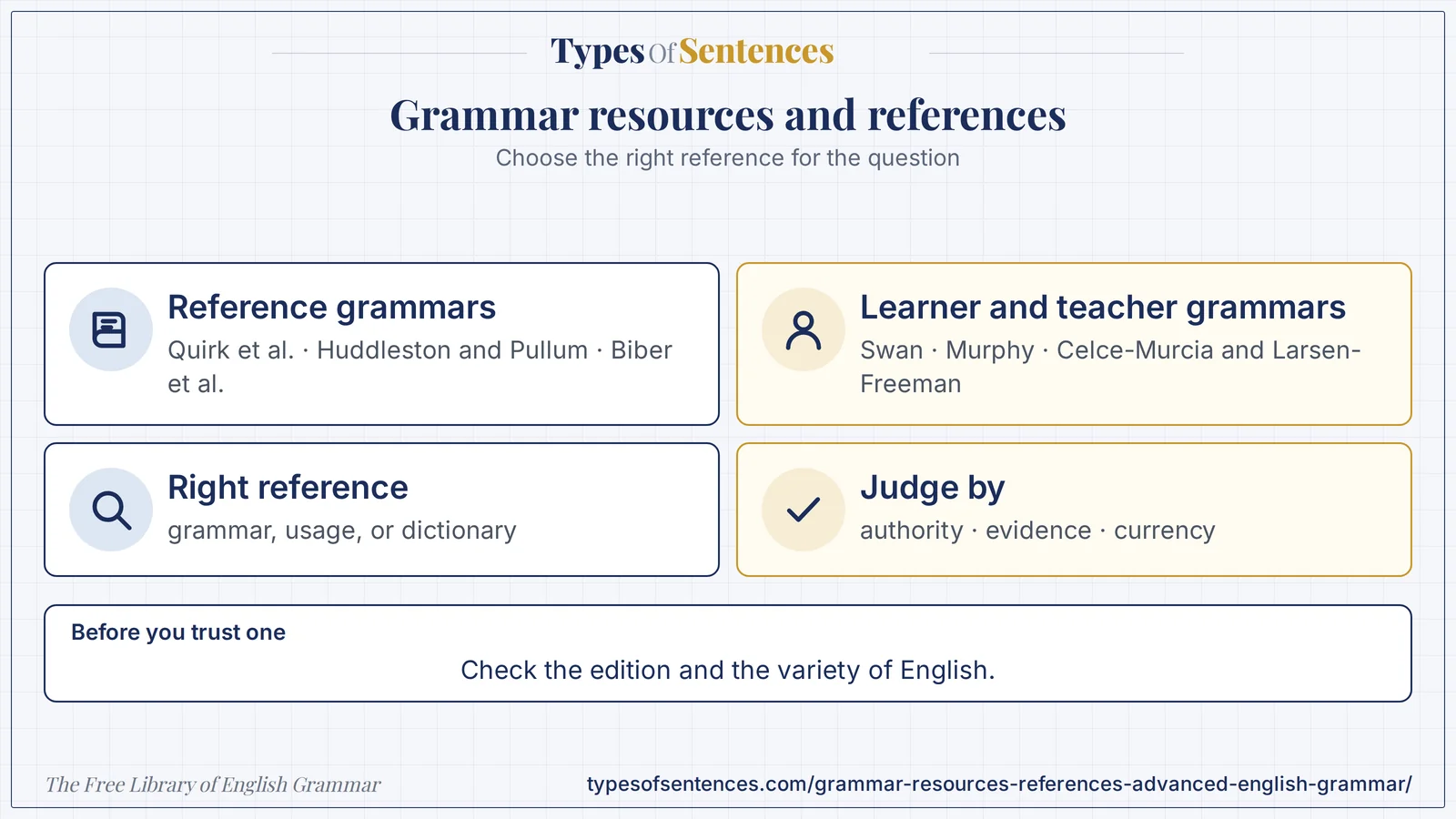
Do not rely on memory or on the first website that appears. For a grammar question, choose the right kind of book: a learner’s grammar for explanations, a reference grammar for detail, a usage guide for disputed points, a dictionary for the word, a style guide for conventions, a corpus for real examples.
Why it matters: Check the edition and the variety (American or British), and when two good references disagree, follow the one that your reader or institution uses.
Summary: Grammar references include comprehensive reference grammars (Quirk et al.; Huddleston and Pullum; Biber et al.), learner and teacher grammars (Swan; Murphy; Celce-Murcia and Larsen-Freeman), functional and university grammars, and school grammars such as Wren and Martin widely used in India. Usage guides (Fowler; Garner; the Merriam-Webster dictionary of usage) advise on disputed points. Learner’s dictionaries (Oxford, Longman, Cambridge, Collins COBUILD, Merriam-Webster) give grammar codes and examples; collocation and phrasal verb dictionaries add patterns. Style guides (Chicago, APA, MLA, AP, New Hart’s Rules) set conventions of citation and form. Online resources include writing centers, learner sites, and corpora (COCA, BNC). To use them, name the problem, choose the reference, find the entry, read the examples, check edition and variety, and note the answer. Judge sources by authority, evidence, currency, and balance.
- Right reference for the question: grammar, usage, dictionary, style, corpus.
- Check edition and variety.
- Judge by authority, evidence, currency.
- When guides disagree, follow your reader’s guide.
What You’ll Learn
- 1. Grammar Resources: Major Grammar References
- 2. Usage Guides: Fowler’s, Garner’s, and Others
- 3. Online Resources: Reputable Websites and Corpora
- 4. Grammar Dictionaries and Dictionaries That Show Grammar
- 5. Style Guides: Chicago, APA, MLA, and Others
- 6. How to Use References: When to Consult and How to Look Things Up
- 7. Building a Personal Reference Shelf
- 8. Common Mistakes in Using References, and a Worked Example
- 9. Exercises
- 10. Test Your Knowledge
- 11. Frequently Asked Questions
- 12. Conclusion
1. Grammar Resources: Major Grammar References
| Work (author, first publication) | Type | Best for |
|---|---|---|
| A Comprehensive Grammar of the English Language (Quirk, Greenbaum, Leech, and Svartvik, 1985) | comprehensive reference grammar | detailed description of nearly every structure; classic |
| The Cambridge Grammar of the English Language (Huddleston and Pullum, 2002) | comprehensive reference grammar | a modern, rigorous description with new terminology |
| A Student’s Introduction to English Grammar (Huddleston and Pullum, 2005) | shorter version of the above | students who want the modern approach |
| Longman Grammar of Spoken and Written English (Biber, Johansson, Leech, Conrad, and Finegan, 1999) | corpus-based reference grammar | frequency and use across registers |
| Longman Student Grammar of Spoken and Written English (Biber, Conrad, and Leech, 2002) | shorter corpus-based grammar | students |
| Cambridge Grammar of English (Carter and McCarthy, 2006) | corpus-based reference grammar | spoken and written grammar for advanced learners and teachers |
| Oxford Modern English Grammar (Bas Aarts, 2011) | modern descriptive grammar | a clear scholarly description |
| An Introduction to English Grammar (Greenbaum and Nelson) | university textbook | a student-friendly introduction |
| Oxford English Grammar (Sidney Greenbaum, 1996) | general reference | a readable overview |
| A University Course in English Grammar (Downing and Locke) | university textbook with a functional orientation | students of linguistics |
| An Introduction to Functional Grammar (Halliday and Matthiessen, 4th ed. 2014) | functional grammar | grammar as a resource for meaning |
| Introducing English Grammar (Börjars and Burridge) | introductory textbook | beginners in linguistics |
| A Modern English Grammar on Historical Principles (Otto Jespersen, 1909–1949) | historical reference grammar | the history of structures |
| A Comprehensive Descriptive Grammar of English (Renaat Declerck, 1991) | reference grammar | detailed tense and aspect description |
| Practical English Usage (Michael Swan, 4th ed. 2016) | learner and teacher reference | quick, practical answers to common questions |
| English Grammar in Use (Raymond Murphy; recent editions with additional authors) | learner grammar with exercises | self-study at elementary to upper-intermediate level |
| Advanced Grammar in Use (Martin Hewings) | learner grammar with exercises | advanced self-study |
| Understanding and Using English Grammar (Betty Azar and Stacy Hagen) | learner grammar with exercises | learners and teachers |
| A Communicative Grammar of English (Leech and Svartvik, 3rd ed. 2002) | communicative reference | grammar by function |
| The Grammar Book (Celce-Murcia and Larsen-Freeman, 2nd ed. 1999) | teacher’s reference | form, meaning, and use for teachers |
| Grammar for English Language Teachers (Martin Parrott) | teacher’s reference | language awareness for teachers |
| Oxford Guide to English Grammar (John Eastwood, 1994) | learner reference | intermediate to advanced learners |
| A Practical English Grammar (Thomson and Martinet) | older learner reference | traditional presentation |
| Advanced English Grammar (Depraetere and Langford, 2012) | university textbook | students of English language |
| Collins COBUILD English Grammar | learner reference based on a corpus | examples from real usage |
| High School English Grammar and Composition (Wren and Martin) | traditional school grammar, widely used in India | school exams and basic rules; check disputed points against a modern reference |
| Type of grammar | Description | Typical user |
|---|---|---|
| reference (descriptive) grammar | a systematic, evidence-based account of the language | linguists, advanced students, editors |
| pedagogical (learner) grammar | explanations and exercises designed for learners | learners and teachers |
| school (traditional) grammar | simplified rules in a traditional framework | school students; exam preparation |
| functional grammar | organizes by meaning and function | analysts of text and style |
| corpus-based grammar | describes frequency and use from corpora | researchers; material writers |
| historical grammar | explains forms through history | historians of the language |
| specialized grammar | for a field (for example academic English, legal English) | professionals |
Editions change: a classic grammar may exist in several editions with different content, and online versions and translations vary. Before buying or citing a work, check which edition is current, and check whether it describes the variety of English (American, British, or other) that you need. The comprehensive grammars are large and expensive, and most learners and writers need only a good learner’s grammar and a usage guide; a library may supply the larger works. A school grammar such as Wren and Martin remains useful in the Indian school system, and the rules it states should be read together with a modern reference where the matter is disputed (see the chapter on grammar myths and controversies).
2. Usage Guides: Fowler’s, Garner’s, and Others
| Guide (author, first publication) | Character | Use |
|---|---|---|
| A Dictionary of Modern English Usage (H. W. Fowler, 1926); later editions by Gowers, Burchfield, and Butterfield (4th ed., 2015) | the classic British guide; opinionated in early editions, more evidence-based later | disputed points, style, British usage |
| Garner’s Modern English Usage (Bryan A. Garner, 5th ed., 2022; earlier titled A Dictionary of Modern American Usage and Garner’s Modern American Usage) | a detailed guide with a ranking of “stages” of acceptance of disputed usages | American usage and general advice |
| Merriam-Webster’s Dictionary of English Usage (1994) | a descriptive guide, based on citations from real writing | evidence on disputed points |
| The New Fowler’s Modern English Usage (R. W. Burchfield, 1996) | a revision of Fowler with more attention to usage evidence | British usage |
| The Cambridge Guide to English Usage (Pam Peters, 2004) | an international, evidence-based guide | varieties of English |
| The American Heritage Guide to Contemporary Usage and Style (2005) | usage with panel opinion | American usage |
| Oxford A–Z of Grammar and Punctuation (John Seely) | a short practical guide | quick answers |
| Oxford Guide to Plain English (Martin Cutts) | guidance on clear writing | plain writing |
| The Elements of Style (Strunk and White, 4th ed., 2000) | a short style guide of advice, widely read | concise style; read with care, since some of its rules are disputed |
| Troublesome Words (Bill Bryson) | a short guide to commonly confused words | word choice |
| The Economist Style Guide | a house style guide | plain journalistic style |
| The Guardian and Observer Style Guide (online) | a house guide | British journalistic style |
| The Chicago Manual of Style (grammar and usage chapters) | a style manual with a grammar section | American publishing style |
| popular books on grammar and punctuation | light and sometimes witty guides | enjoyment; verify claims against a reference |
| How to read a usage guide | Advice |
|---|---|
| look at the ranking or label | many guides mark a usage as standard, disputed, nonstandard, or avoided |
| read the evidence | good guides cite examples from writers and corpora |
| note the variety | American and British guides differ |
| note the date | usage changes; newer editions record change |
| distinguish description from advice | a guide may say that a form is common but advise against it in formal writing |
| compare two guides | where they disagree, the point is disputed |
| check the genre | advice for journalism may differ from advice for academic writing |
| do not treat a guide as law | guides express judgments |
Usage guides are useful for the questions that grammars do not settle: whether to say different from or different than, whether to accept hopefully as a sentence adverb. They differ in approach, from the prescriptive to the descriptive, as the chapter on grammar myths explains, so it helps to use at least two and to know which philosophy each follows.
3. Online Resources: Reputable Websites and Corpora
| Resource (type) | Description | Use |
|---|---|---|
| Purdue Online Writing Lab (writing center) | extensive handouts on grammar, punctuation, style, and citation | grammar and writing questions; citation formats |
| British Council LearnEnglish (learner site) | grammar explanations and exercises | learners |
| Cambridge Dictionary (dictionary and grammar) | dictionary with a grammar section and examples | learners and teachers |
| Oxford Learner’s Dictionaries (dictionary) | definitions, grammar codes, examples, audio | learners |
| Merriam-Webster (dictionary and usage notes) | American English dictionary with usage notes | American usage |
| Collins Dictionary (dictionary and grammar pages) | British and American entries; grammar notes | general use |
| Longman Dictionary of Contemporary English online (dictionary) | grammar codes, collocations, examples | learners |
| BBC Learning English (learner site) | lessons and grammar series | learners |
| University writing centers (for example UNC Chapel Hill; University of Toronto) | handouts on grammar, punctuation, and writing | students and writers |
| Khan Academy grammar (learner site) | free lessons and exercises | school students |
| The Chicago Manual of Style Online (style manual) | the manual with a Q&A | editors and writers |
| APA Style website (style guide) | official guidance for APA format | students and researchers |
| MLA Style Center (style guide) | official guidance for MLA format | students |
| Grammar Girl (Quick and Dirty Tips) (podcast and site) | short episodes on usage | general readers |
| English-Corpora.org (corpora) | COCA, BNC, COHA, and others | real usage and frequency |
| Google Books Ngram Viewer (corpus tool) | phrase frequency over time | historical trends |
| AntConc (software) | free concordancer for your own texts | analysis |
| Sketch Engine (commercial corpus tool) | word sketches and corpora | advanced users |
| Lextutor (tools) | vocabulary and text analysis tools | teachers and researchers |
| Wiktionary (community dictionary) | free, community-edited; includes etymology and inflection tables | quick look-up; verify |
| Stack Exchange: English Language and Usage (community Q&A) | questions and answers from enthusiasts and experts | explanations; quality varies |
| Plain Language guidelines (government sites) | guidance for clear writing | public documents |
| Microsoft and Apple style guides (corporate) | style for technical writing | technical writers |
| library databases and Open Access journals (research) | articles on grammar and linguistics | researchers |
| Criterion for judging a source | Question |
|---|---|
| authority | Who wrote it? What are their qualifications? |
| evidence | Does it cite examples, corpora, or research? |
| currency | When was it written or updated? |
| variety | Does it say which variety of English it describes? |
| balance | Does it acknowledge disputed points? |
| purpose and bias | Is it trying to sell something? Is it promoting a view? |
| transparency | Does it explain its method? |
| clarity | Are the explanations accurate and clear? |
| consistency | Does it agree with reputable references? |
| usability | Is it easy to search and read? |
| Red flag in an online grammar “rule” | Why |
|---|---|
| uses “always” or “never” without evidence | many rules have exceptions or are myths |
| no author, date, or sources | cannot be checked |
| contradicts several good references | probably wrong |
| claims that “real” English is the only correct form | a prejudice, not a fact |
| mocks writers who disagree | an opinion, not evidence |
| is full of advertisements and promises | commercial motives |
| has errors of its own | reduces trust |
| confuses a style preference with a grammar rule | see the chapter on grammar myths |
Online resources are convenient, but quality varies. A good habit is to check an online answer against a second source, preferably a book or a dictionary. For questions about what people actually write, consult a corpus (see the chapter on corpus linguistics); for citation and format questions, consult the style guide itself and not a summary of it. AI chat tools can explain a rule and give examples, but they can also make confident mistakes; treat their output as a first draft and verify it against a reference.
4. Grammar Dictionaries and Dictionaries That Show Grammar
| Dictionary or work | What it shows | Use |
|---|---|---|
| Longman Dictionary of Contemporary English | grammar codes, example sentences, collocations, and usage notes | learners |
| Oxford Advanced Learner’s Dictionary | verb patterns, countable and uncountable marking, examples, and usage notes | learners |
| Cambridge Advanced Learner’s Dictionary | grammar labels, examples, a corpus-based “common learner error” note | learners |
| Collins COBUILD Advanced Learner’s Dictionary | full-sentence definitions showing how a word is used | learners |
| Merriam-Webster’s Learner’s Dictionary and Collegiate Dictionary | American usage, labels, and usage notes | American usage |
| Oxford Dictionary of English | British usage with labels | general use |
| The Oxford English Dictionary | the historical dictionary with dated quotations | history of words and senses |
| Oxford Collocations Dictionary for Students of English | typical word partnerships | writers and learners |
| Cambridge Phrasal Verbs Dictionary and Oxford Phrasal Verbs Dictionary | meanings and patterns of phrasal verbs | learners |
| Longman Dictionary of Common Errors (Turton and Heaton) | typical errors and corrections | learners and teachers |
| A Dictionary of English Grammar and similar glossaries (for example Leech, Cruickshank, and Ivanič) | grammatical terms and usage | students |
| A Dictionary of Linguistics and Phonetics (David Crystal) | linguistic terms | students |
| Merriam-Webster’s Dictionary of English Usage | usage evidence | disputed points |
| a thesaurus (Roget’s; Oxford Thesaurus) | related words | word choice; check the dictionary entry |
| a rhyming and pronunciation dictionary | sounds | pronunciation |
| Code or label in a learner’s dictionary | Meaning |
|---|---|
| [C], countable | a noun that can be counted and has a plural (book) |
| [U], uncountable | a noun that is not counted (information) |
| [T], transitive | a verb that takes an object |
| [I], intransitive | a verb that does not take an object |
| + to-infinitive, + -ing, + that | the structures that follow the word |
| usually plural, singular | number restrictions |
| formal, informal, slang, literary | register |
| American English, British English | variety |
| old-fashioned, dated | currency |
| disapproving, approving | attitude |
| phrasal verb, idiom | multi-word units |
| often passive | typical voice |
| not usually progressive | stative verbs |
| no object | intransitive use |
| common learner error note | typical mistakes with this word |
| Reading a dictionary entry (an example) | What to notice |
|---|---|
| headword and part of speech | which class? |
| pronunciation | stress and sound |
| grammar code | countable or uncountable; transitive or intransitive |
| definitions numbered by sense | the most frequent sense first (in many learner dictionaries) |
| examples | how the word is used in sentences |
| collocations and patterns | typical partners |
| usage notes | differences from similar words; variety; register |
| related words and phrases | derivatives; phrasal verbs; idioms |
A learner’s dictionary is the most useful grammar tool for individual words, because it shows which structures a word takes: whether a noun is countable, whether a verb takes a that-clause, which preposition follows an adjective. Many errors in the chapter on error analysis (discuss about, informations) can be avoided by a quick dictionary check.
5. Style Guides: Chicago, APA, MLA, and Others
| Style guide (edition note) | Field or use | Covers |
|---|---|---|
| The Chicago Manual of Style (17th ed., 2017; a newer edition has been published, so check the current one) | publishing, humanities, social sciences | grammar and usage, punctuation, citation (notes-bibliography and author–date) |
| Publication Manual of the American Psychological Association (7th ed., 2020) | psychology, education, social sciences | paper format, writing style, citation |
| MLA Handbook (9th ed., 2021) | literature, languages, humanities | citation and writing |
| The Associated Press Stylebook (updated regularly) | journalism | news style, usage, numerals |
| New Hart’s Rules and The Oxford Style Manual | British publishing | punctuation, spelling, citation |
| A Manual for Writers of Research Papers, Theses, and Dissertations (Kate Turabian, 9th ed., 2018) | students | a Chicago-based student manual |
| Harvard referencing (varies by institution) | sciences and social sciences | author–date citation |
| IEEE style | engineering | numbered citation |
| Vancouver or ICMJE style | medicine | numbered citation |
| Scientific Style and Format (Council of Science Editors) | sciences | units, names, references |
| The Economist Style Guide | journalism | plain style |
| Microsoft Writing Style Guide and Apple Style Guide | technology | technical and interface writing |
| Google developer documentation style guide | software documentation | technical writing |
| Gov.uk style guide and plainlanguage.gov | government writing | plain language |
| house style guides of publishers and institutions | specific organizations | their own conventions |
| When to use a style guide | Example |
|---|---|
| to follow a required format | a thesis in APA |
| to settle a convention (serial comma, numerals, capitalization) | Chicago says … |
| to cite sources correctly | MLA 9 works cited |
| to work for a publisher or an organization | the house style sheet |
| to resolve a disputed usage in a particular field | the AP Stylebook |
| to write consistently | a project style sheet |
A style guide gives conventions, not grammar rules: it tells you what to do in a particular publication or field, and it may differ from another style guide on the same point. The citation formats are treated in the chapter on citing sources, and the use of style sheets in the chapter on editing and proofreading.
6. How to Use References: When to Consult and How to Look Things Up
| Question or need | Best resource | How |
|---|---|---|
| Is this sentence grammatical? | a learner’s grammar or reference grammar | look up the structure |
| Which preposition follows this verb or adjective? | a learner’s dictionary | check the entry and examples |
| Is this noun countable? | a learner’s dictionary | check [C] or [U] |
| How is this tense used? | a learner’s grammar (English Grammar in Use, Practical English Usage) | read the section and do the exercises |
| Is different than acceptable? | a usage guide | check the entry and the ranking |
| Is data singular or plural? | a usage guide and a corpus in your field | compare |
| How do I cite a website in APA? | the APA Style website or manual | follow the model |
| Should I use the serial comma? | your style guide | follow the guide |
| What does this term mean (appositive, gerund)? | a glossary or dictionary of linguistics | look up |
| How often is this form used? | a corpus | search and compare frequencies |
| What are the collocations of decision? | a collocations dictionary | look up the noun |
| What does this phrasal verb mean? | a phrasal verb dictionary | look up the verb and the particle |
| How did this form develop? | a historical dictionary or grammar | check etymology |
| What is the American form? | an American dictionary and style guide | check the label |
| What is the British form? | a British dictionary and style guide | check the label |
| Is this the standard form in my field? | a style guide of the field and articles in a journal | compare |
| How do I explain this rule to a learner? | a teacher’s grammar (The Grammar Book) | read the form, meaning, and use |
| What is the difference between two similar words? | a usage guide or a learner’s dictionary note | read the notes |
| Is this a common error? | a dictionary of common errors | look up |
| How is this punctuated? | a style guide and a grammar chapter | check |
| What is the plural of …? | a dictionary | check the entry |
| What is the past participle of …? | a dictionary | check the verb forms |
| How do I write dates and numbers? | a style guide | check the section on numerals |
| How do I write for a general audience? | plain-language guidelines | follow the guidance |
| How do I use a hyphen? | a dictionary and a style guide | check both |
| Which word order is correct in this question? | a learner’s grammar | look up questions |
| How do I write a formal email? | a business writing guide | follow a model |
| What is the correct title format? | a style guide | capitalization rules |
| Is there a corpus example of this phrase? | English-Corpora.org | search |
| What do experts say about this disputed point? | two usage guides | compare |
- Name the problem exactly. A specific question gets a specific answer.
- Choose the kind of reference (grammar, dictionary, usage guide, style guide, corpus).
- Find the entry (index, contents, search).
- Read the explanation and the examples.
- Check the variety and the register (American or British; formal or informal).
- Check the edition and the date.
- Apply the answer to your sentence and rewrite it.
- If the issue is disputed, consult a second reference.
- Note the answer in your notebook or style sheet.
| When references disagree | What to do |
|---|---|
| two usage guides give different advice | the point is disputed; use the guide that your reader or institution uses |
| a grammar and a dictionary differ | prefer the more specific and recent source; check a corpus |
| an online source and a book differ | check the author and the evidence; trust the better-documented source |
| a style guide differs from a grammar | for conventions, follow the style guide; for grammar, follow the grammar |
| a school grammar and a modern grammar differ | consider whether the school rule is a convention or a myth |
| American and British sources differ | choose the variety for your reader and keep it consistent |
| no source covers it | search a corpus; write around the problem; ask an expert |
The habit of looking things up is the mark of a careful writer; professional editors consult references constantly. The consultation of references is part of the self-monitoring described in the chapter on grammar learning strategies, and of the editing process described in the chapter on editing and proofreading.
7. Building a Personal Reference Shelf
| User | Suggested core resources | Additional resources |
|---|---|---|
| learner (elementary to intermediate) | a learner’s grammar with exercises; a learner’s dictionary | a collocations dictionary; graded readers |
| learner (upper-intermediate to advanced) | a learner’s grammar at that level; a learner’s dictionary; Practical English Usage | a usage guide; a corpus; a phrasal verb dictionary |
| school student (India and elsewhere) | the school grammar of the syllabus; a learner’s dictionary | a modern learner’s grammar for disputed points |
| university student | a style guide for the field; a learner’s or college dictionary; a writing-center website | a reference grammar from the library |
| teacher | a teacher’s grammar; a learner’s grammar; a dictionary of common errors | a reference grammar; journals on teaching |
| writer or editor | a usage guide; a style manual; a collegiate dictionary | a reference grammar; a corpus |
| researcher in linguistics | reference grammars; corpora; journals | the OED; specialized dictionaries |
| business writer | a business writing guide; a style guide of the organization | a usage guide; plain-language guidelines |
| technical writer | a technical style guide; the organization’s style sheet | a usage guide; a terminology database |
| self-learner on a budget | free dictionaries online; a library loan of a grammar; free writing-center handouts | a secondhand learner’s grammar |
- Start small: one learner’s grammar and one dictionary are enough for most purposes.
- Choose the right level. A book that is too hard is not used.
- Prefer recent editions for usage and style; older editions are fine for stable grammar.
- Use the library. Large reference grammars are often available there.
- Combine print and digital. A dictionary app is convenient; a book may be better for study.
- Keep your own notebook of rules and decisions (a personal reference).
- Share resources in a study group.
- Check licenses and prices yourself; availability and cost change.
8. Common Mistakes in Using References, and a Worked Example
| Mistake | Better |
|---|---|
| using the first website that appears | check a reputable source and a second source |
| trusting an unnamed “grammar expert” | look for authority and evidence |
| using an old edition for current usage | check the edition |
| using an American source for British conventions (or the reverse) | match the variety |
| treating a usage guide as law | read it as advice |
| treating a school grammar as the last word | compare with a modern reference on disputed points |
| reading only the rule and not the examples | study the examples |
| ignoring dictionary grammar codes | read the codes and the examples |
| not noting the answer | record it in a notebook or style sheet |
| using a thesaurus without checking the dictionary | check the meaning, register, and collocations |
| relying on a grammar checker alone | check against a reference |
| asking the wrong question | state the problem exactly |
| using only one reference for a disputed point | consult two |
| looking up a rule and not applying it | rewrite the sentence |
| neglecting corpora | check real usage |
Resolve three doubts (the procedure, with the kind of answer to expect).
- Doubt 1: “Is I suggest that he goes or go?” Problem: the verb form after suggest that. Resource: a usage guide or a reference grammar (the entry on the mandative subjunctive). Expect: a statement that the base form (go) is the formal norm, especially in American usage, and that other forms occur. Check the variety. Apply: I suggest that he go (formal). Note it.
- Doubt 2: “Is information countable?” Problem: countability. Resource: a learner’s dictionary. Expect: the label [U] (uncountable) and the example a piece of information. Apply: some information, not an information.
- Doubt 3: “How do I cite a journal article in APA?” Problem: format. Resource: the current APA manual or the APA Style website. Expect: a model reference (author, year, title, journal, volume, pages, DOI). Apply: follow the model exactly, and check the in-text form. Note it in the style sheet.
- Check: in each case the question is named, the right kind of reference is chosen, the answer is applied to the sentence, and the answer is recorded. (The expected content is described in general terms; read the actual entry in your own copy of the reference.)
Recap in 12 seconds
Watch the lesson build itself: Grammar references include reference grammars and learner and teacher grammars, judged by authority, evidence, and currency. The video has no sound.
Exercises
Part A: Major References (Exercises 1–7)
Exercise 1: Name a comprehensive reference grammar.
Show Answer
Answer: A Comprehensive Grammar of the English Language (Quirk et al.) or The Cambridge Grammar of the English Language (Huddleston and Pullum).
Exercise 2: Name a corpus-based grammar.
Show Answer
Answer: Longman Grammar of Spoken and Written English (Biber et al.).
Exercise 3: Name a learner’s grammar with exercises.
Show Answer
Answer: English Grammar in Use (Murphy).
Exercise 4: Name a teacher’s reference grammar.
Show Answer
Answer: The Grammar Book (Celce-Murcia and Larsen-Freeman).
Exercise 5: Name a functional grammar.
Show Answer
Answer: An Introduction to Functional Grammar (Halliday and Matthiessen).
Exercise 6: Which traditional school grammar is widely used in India?
Show Answer
Answer: Wren and Martin, High School English Grammar and Composition.
Exercise 7: Why check the edition?
Show Answer
Answer: Content, and usage, change between editions.
Part B: Usage Guides and Style Guides (Exercises 8–14)
Exercise 8: Name a classic usage guide.
Show Answer
Answer: Fowler’s (A Dictionary of Modern English Usage).
Exercise 9: Name an American usage guide.
Show Answer
Answer: Garner’s Modern English Usage.
Exercise 10: What is a usage guide for?
Show Answer
Answer: Advice on disputed or confusable points.
Exercise 11: Name a style guide for the humanities.
Show Answer
Answer: MLA Handbook (or Chicago).
Exercise 12: Name a style guide for psychology.
Show Answer
Answer: APA Publication Manual.
Exercise 13: Name a style guide for journalism.
Show Answer
Answer: The AP Stylebook.
Exercise 14: Is a style guide a grammar?
Show Answer
Answer: No; it gives conventions.
Part C: Dictionaries and Online Resources (Exercises 15–21)
Exercise 15: What does [U] mean?
Show Answer
Answer: Uncountable.
Exercise 16: What does [T] mean?
Show Answer
Answer: Transitive verb.
Exercise 17: Name a dictionary of collocations.
Show Answer
Answer: Oxford Collocations Dictionary.
Exercise 18: Name a dictionary of common errors.
Show Answer
Answer: Longman Dictionary of Common Errors.
Exercise 19: Name an online writing lab.
Show Answer
Answer: Purdue OWL.
Exercise 20: Name a corpus website.
Show Answer
Answer: English-Corpora.org.
Exercise 21: Name a red flag in an online grammar rule.
Show Answer
Answer: “Always” or “never” without evidence; no author or sources.
Part D: Using References (Exercises 22–27)
Exercise 22: Name the first step in looking up a doubt.
Show Answer
Answer: Name the problem exactly.
Exercise 23: Which resource for the preposition after a verb?
Show Answer
Answer: A learner’s dictionary.
Exercise 24: Which resource for a disputed usage?
Show Answer
Answer: A usage guide (two, if possible).
Exercise 25: Which resource for real usage?
Show Answer
Answer: A corpus.
Exercise 26: What to do when guides disagree?
Show Answer
Answer: Follow the guide your reader or institution uses.
Exercise 27: What should you check about a reference’s variety?
Show Answer
Answer: Whether it is American or British.
Part E: Shelf and Mistakes (Exercises 28–30)
Exercise 28: Name two items of a starter shelf.
Show Answer
Answer: A learner’s grammar and a learner’s dictionary.
Exercise 29: Name a mistake in using references.
Show Answer
Answer: Using the first website; an old edition; treating a guide as law.
Exercise 30: Why keep your own notebook?
Show Answer
Answer: To record answers and decisions.
Test Your Knowledge
Ready to check what you learned? Answer all 10 questions, then submit. You need 80% (8 of 10) to pass. Your answers are not stored.
View correct answers and explanations
Question 1: Which is a corpus-based reference grammar?
✓ Correct Answer: A – Longman Grammar of Spoken and Written English
Biber et al.
Question 2: What does a usage guide mainly do?
✓ Correct Answer: B – advise on disputed points of usage
Advises on usage.
Question 3: Which is a style guide?
✓ Correct Answer: C – The Chicago Manual of Style
Chicago.
Question 4: What should you check first about a reference?
✓ Correct Answer: D – its edition (date) and variety
Edition and variety.
Question 5: In a learner’s dictionary, [U] marks a noun that is
✓ Correct Answer: C – uncountable
Uncountable.
Question 6: Which resource shows real examples of usage?
✓ Correct Answer: A – a corpus
A corpus.
Question 7: A red flag in an online grammar “rule” is
✓ Correct Answer: D – it says “always” or “never” without evidence
Absolute claims.
Question 8: Which type of dictionary gives collocations?
✓ Correct Answer: C – a collocations dictionary
A collocations dictionary.
Question 9: What should you do when guides disagree?
✓ Correct Answer: B – follow the guide your reader or institution uses
Follow your reader’s guide.
Question 10: What is the first step in looking up a doubt?
✓ Correct Answer: B – name the problem and choose the reference
Name it, then choose.
Frequently Asked Questions
What are grammar resources?
Grammar resources are the books, dictionaries, guides, websites, and corpora used to check and learn grammar: reference grammars, learner grammars, usage guides, dictionaries, and style guides. Grammar resources differ in purpose and quality.
What are grammar references?
Grammar references are works that describe the grammar of a language systematically, such as reference grammars, learner grammars, and teacher’s grammars. Grammar references are best used for looking up specific points.
Which grammar books should I use?
For most learners, one learner’s grammar with exercises (for example English Grammar in Use or Practical English Usage) and a learner’s dictionary. Advanced users add a usage guide and a reference grammar. Check which grammar books suit your level and variety.
What are grammar guides?
Grammar guides include usage guides and style guides, which advise on disputed points and conventions. Grammar guides give judgments, so use two for disputed points.
What are grammar dictionaries?
Grammar dictionaries are dictionaries that show grammatical information: learner’s dictionaries with grammar codes, collocation and phrasal verb dictionaries, and dictionaries of common errors or of grammatical terms.
How do I judge an online grammar source?
Check the author, evidence, date, variety, and balance; avoid absolute “rules” without sources; compare with a reputable reference.
What do I do when two references disagree?
Treat the point as disputed, compare their evidence, check a corpus, and follow the guide that your reader or institution requires.
Conclusion
You now have a guide to grammar resources and references: the major grammars, usage guides, online resources, dictionaries, and style guides, how to use them, how to judge them, and how to build a personal shelf. You can look things up with confidence and verify what you read.
When you have a doubt, name it, choose the right reference, and check the edition. Next, you will begin Part 10 with advanced punctuation.
- Quirk, Randolph, Sidney Greenbaum, Geoffrey Leech, and Jan Svartvik. A Comprehensive Grammar of the English Language. Longman, 1985.: a major reference grammar.
- Huddleston, Rodney, and Geoffrey K. Pullum. The Cambridge Grammar of the English Language. Cambridge University Press, 2002.: a modern reference grammar.
- Garner, Bryan A. Garner’s Modern English Usage. 5th ed. Oxford University Press, 2022.: a major usage guide.
- Swan, Michael. Practical English Usage. 4th ed. Oxford University Press, 2016.: a practical reference for learners and teachers.
- Purdue Online Writing Lab: General Writing: reference pages on grammar and writing.
Last reviewed: October 29, 2026. How it was made: drafted with AI assistance, then checked with automated tests (structure, links, answer keys, spelling) and against the sources above. A person has not yet read this chapter line by line. Found a mistake? Report it.