Grammar and meaning are not two separate subjects. A sentence means what it means partly because of its words and partly because of its grammar: Dog bites man and Man bites dog use the same words and say very different things. Grammar tells us who did what to whom, when, how certainly, and from what point of view. Every grammatical choice (a tense, a determiner, a voice, a modal) adds something to the meaning, even when the difference is small. Learning grammar as a list of rules misses this; learning it as a system for making meaning makes the rules intelligible, and it helps a writer to choose the structure that says exactly what is meant.
This chapter explores the relation between form and meaning. You will study grammar semantics (how forms carry meaning), how tense and aspect convey time, duration, and completion, how voice conveys focus and responsibility, how word order conveys roles and information, how mood and modality convey attitude, and the subtle differences between structures that seem almost alike (stop to smoke and stop smoking; I used to and I would). The study of syntax and semantics together, of grammatical meaning and of how it differs from the meanings of words, will give you tools for analysis and for revision. Thirty editing exercises and a quiz follow.
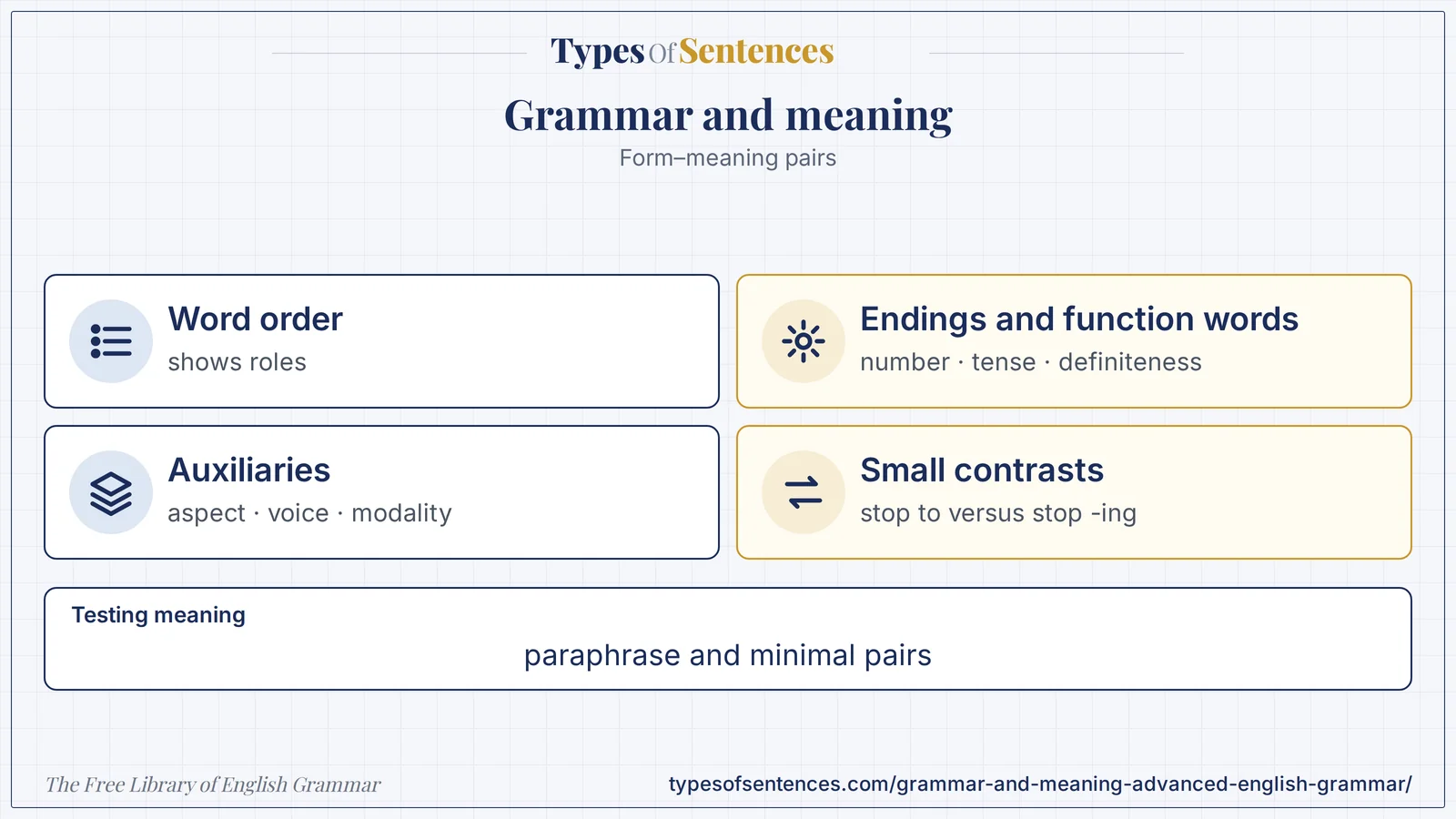
Every grammatical choice means something. A past tense says the event is over, a progressive says it was or is going on, a passive says the focus is on the thing affected, a modal says how sure or how obliged the speaker is.
Why it matters: When two sentences seem to say the same thing, look for the small difference in meaning. It is often there, and it is often what a careful writer is choosing.
Summary: Grammar is a system of form–meaning pairs: word order shows roles; endings and function words show number, tense, and definiteness; auxiliaries show aspect, voice, and modality. Tense and aspect locate and shape events in time (the simple past versus the progressive versus the perfect). Voice selects the topic and may hide the agent. Word order and fronting structure information from known to new. Mood and modality show whether a statement is a fact, a command, a question, a possibility, or an obligation. Many near-equivalent structures differ in meaning (stop to versus stop -ing; used to versus would; a few versus few). Grammatical choices also signal stance and responsibility. Meaning can be tested by paraphrase, substitution, and minimal pairs.
- Form and meaning go together; grammar is not arbitrary.
- Tense/aspect: time and perspective; voice: focus; mood: attitude.
- Small contrasts matter: stop to versus stop -ing.
- Test meaning by paraphrase and minimal pairs.
What You’ll Learn
- 1. Grammar and Meaning: The Form–Meaning Connection
- 2. How Tense and Aspect Convey Meaning
- 3. How Voice Conveys Meaning
- 4. How Word Order and Position Convey Meaning
- 5. How Mood and Modality Convey Meaning
- 6. Subtle Meaning Differences: Nearly Synonymous Structures
- 7. Grammar, Stance, and Ideology
- 8. Tests for Analyzing Meaning
- 9. Common Errors and Misreadings
- 10. Exercises
- 11. Test Your Knowledge
- 12. Frequently Asked Questions
- 13. Conclusion
1. Grammar and Meaning: The Form–Meaning Connection
| Grammatical form | Meaning it carries | Example |
|---|---|---|
| word order (subject before verb before object) | who does what to whom | The dog bit the man. versus The man bit the dog. |
| plural -s | more than one | book versus books |
| a versus the | new versus identifiable | I saw a dog. versus I saw the dog. |
| past tense -ed | a time before now, or remoteness | She walked.; If I had time … |
| progressive be + -ing | in progress, temporary, incomplete | She is reading. |
| perfect have + participle | relevance of a past event to a later time | She has left. |
| passive be + participle | the affected entity is the topic | The window was broken. |
| modal verbs | possibility, obligation, ability, prediction | It may rain.; You must go. |
| negation not | denial of a proposition | She is not here. |
| question word order | a request for information | Is she here? |
| comparative -er, more | a difference of degree | taller, more careful |
| pronoun case (he/him) | role in the clause | He saw him. |
| conjunctions | logical relations | because (cause), although (concession), if (condition) |
| relative clauses | identification or addition | the man who called (restrictive) versus my brother, who called (non-restrictive) |
| quantifiers | amount | some, any, all, few |
| intonation and stress (speech) | focus and attitude | She DID call. |
| punctuation (writing) | structure and emphasis | Let’s eat, Grandma. versus Let’s eat Grandma. |
| Approach | Idea | Source |
|---|---|---|
| functional grammar | a clause carries three kinds of meaning at once: experiential (what is going on), interpersonal (the speaker’s relation to the listener), and textual (how the message is organized) | M. A. K. Halliday |
| construction grammar | a construction (a pattern of form) has a meaning of its own, independent of the words in it | Adele Goldberg and others |
| formal semantics | the meaning of a sentence is built compositionally from the meanings of its parts and the way they combine | Montague and others |
| cognitive grammar | grammar is meaningful throughout, reflecting how we see and construe a scene | Ronald Langacker |
| Semantic role | Meaning | Example (role underlined by context) |
|---|---|---|
| agent | the doer | The chef cooked the meal. |
| patient (theme) | the one affected or moved | The chef cooked the meal. |
| experiencer | one who perceives or feels | She felt cold. |
| instrument | the means | He opened it with a key. |
| recipient | one who receives | She gave him a book. |
| beneficiary | one for whom something is done | She baked a cake for him. |
| location | where | She lives in Pune. |
| source and goal | from and to | He went from Pune to Mumbai. |
| cause | what brings something about | The storm broke the window. |
The same role can appear in different grammatical positions: the patient is the object in The chef cooked the meal and the subject in The meal was cooked. Syntax (the arrangement of words) and semantics (meaning) are therefore related but not identical; the study of their relation is the study of how grammatical structure represents events and relations. Related ideas are treated in the chapter on information structure.
2. How Tense and Aspect Convey Meaning
| Form | Meaning | Example |
|---|---|---|
| simple present | general truth, habit, or a scheduled future | Water boils at 100 degrees.; The train leaves at six. |
| present progressive | in progress now, a temporary situation, or an arranged future | She is working.; We are leaving tomorrow. |
| present perfect | a past event with relevance now, or a state continuing to now | I have lost my keys (I still do not have them); I have lived here for ten years. |
| present perfect progressive | a continuing activity up to now | I have been waiting for an hour. |
| simple past | a completed event or state in the past, usually with a past time | I lost my keys yesterday. |
| past progressive | an action in progress at a past time; background | I was cooking when the phone rang. |
| past perfect | an event before another past event | She had left when I arrived. |
| future with will | prediction, decision at the moment of speaking | It will rain.; I’ll answer it. |
| be going to | a plan or an intention, or a prediction based on present evidence | I’m going to study.; Look at those clouds: it’s going to rain. |
| future perfect | completion before a future time | By Friday I will have finished. |
| historic present | narrative vividness | So he walks in and says … |
| past for politeness or distance | tentative, polite | I wondered if you could help.; Did you want anything? |
| past for unreality | remote or hypothetical | If I had a car, I would drive. |
| Contrast | Meaning difference | Example |
|---|---|---|
| simple past versus present perfect | a finished time versus a connection to now | I saw that film in 2019. versus I have seen that film. |
| gone to versus been to | is there now versus has visited and returned | She has gone to Paris. versus She has been to Paris. |
| simple versus progressive | a whole event versus an activity in progress | She wrote a letter. versus She was writing a letter. |
| progressive with a stative verb | a temporary or changed state | I live in Pune. versus I’m living in Pune (for now). |
| He is being silly versus He is silly | behavior now versus a trait | — |
| I think versus I’m thinking | an opinion versus an activity of thought | — |
| I see versus I’m seeing | understand versus meeting or dating | — |
| used to versus would | states and habits versus habits only | I used to live in Delhi. but not I would live in Delhi (in the same sense) |
| She works here versus She is working here | permanent versus temporary | — |
| It’s the third time I have seen it versus I saw it three times | perfect for a series to now versus a closed past series | — |
| Aspect and event type (Vendler) | Description | Test with the progressive |
|---|---|---|
| state | no change (know, love, be) | usually not progressive: *I am knowing |
| activity | an ongoing action with no natural end (run, swim) | She is running implies She has run |
| accomplishment | an action with a natural end (draw a circle, build a house) | She is drawing a circle does not entail that the circle was completed (the “imperfective paradox”) |
| achievement | an instantaneous change (arrive, win, notice) | She is arriving means “about to arrive” |
The relation between tense and time is not one to one: the present can refer to the future, the past can refer to politeness or unreality. This is treated systematically in the chapter on tense and aspect. A writer chooses a tense for what it conveys about the event’s relation to the moment of writing, not only for when it happened.
3. How Voice Conveys Meaning
| Sentence pair | Same facts, different meaning of emphasis | Effect |
|---|---|---|
| The police arrested the demonstrators. versus The demonstrators were arrested. | the second omits the agent | focus on the affected; the actor is not named |
| The committee rejected the proposal. versus The proposal was rejected by the committee. | the second foregrounds the proposal and puts the agent last | end-focus on the agent |
| Mistakes were made. versus We made mistakes. | the passive avoids responsibility | evasive versus accountable |
| The company laid off 200 workers. versus 200 workers were laid off. | the second hides the company | agency removed |
| The window was broken. (event) versus The window was broken. (state) | dynamic versus stative passive | ambiguous: was broken by someone or was in a broken state |
| He got fired. versus He was fired. | get-passive suggests an adverse or unexpected event, and more speech-like | adversative tone |
| This book reads easily. versus This book is read easily. | middle voice: a property of the subject | — |
| The door opened. versus She opened the door. | the intransitive hides the cause (ergative alternation) | — |
| The teacher made the students laugh. | a causative structure | the causer |
| The ship sank. versus They sank the ship. | an intransitive versus a transitive use of the same verb | — |
| Quantifier scope pair | Possible readings |
|---|---|
| Everyone loves someone. | each person loves a (possibly different) person; or one particular person is loved by everyone |
| Someone is loved by everyone. | more strongly suggests one person loved by all |
| All the students didn’t pass. | not all passed; or none passed (ambiguous) |
Voice shows how grammar can distribute responsibility. Critical discourse analysts note that agentless passives and nominalizations can hide who is responsible (Civilians were killed; the loss of 200 jobs). The active is more direct; the passive has good uses when the agent is unknown or unimportant (see the chapter on voice). A writer or reader should ask: whose action is this, and does the grammar show it?
4. How Word Order and Position Convey Meaning
| Contrast | Meaning difference | Example |
|---|---|---|
| subject versus object | who acts and who is acted on | Dog bites man versus Man bites dog |
| position of only | which element is limited | Only I love you (nobody else does) versus I only love you (love and nothing more) versus I love only you (no one else) |
| position of almost, nearly | what is approximate | She almost drove 200 miles (did not drive) versus She drove almost 200 miles |
| adverb position | scope of the adverb | He quickly said he would leave versus He said he would quickly leave |
| adjective order | natural order and meaning | a big red ball (not a red big ball) |
| a few versus few | positive versus negative quantity | A few came. (some) versus Few came. (hardly any) |
| ditransitive alternation | recipient as affected or goal | She gave the school a book. (the school possesses it) versus She gave a book to the school. |
| fronting (topicalization) | contrast or topic | This I like; that I hate. |
| inversion | emphasis, literary tone | Rarely have I seen such a result. |
| cleft sentences | focus on one element | It was Priya who called. versus What I want is peace. |
| existential there | introducing new referents | There is a problem. |
| end focus | the new information at the end | The decision was made by the board. (focus on the board) |
| placement of a modifier | what the modifier modifies | She saw the man with the telescope (two meanings: with the telescope, the seeing, or the man) |
| order of adverbials | time, place, manner | She sang beautifully in Delhi last night. |
| also and even | scope and focus | Even Priya laughed. versus Priya even laughed. |
| position of the negative | what is negated | All that glitters is not gold. (not everything) versus None of that glitters. |
| Information structure | Meaning |
|---|---|
| given before new | the topic (known) first and the comment (new) last |
| theme and rheme | what the clause is about, and what is said about it |
| focus | the part that carries the main new information, often marked by stress and position |
| contrastive focus | an element is set against alternatives: I wanted TEA, not coffee. |
Word order carries both grammatical roles and discourse functions. The effects of fronting, inversion, clefts, and existential sentences are described in the chapters on fronting and postponement and on information structure; they show that the choice of a construction is a choice of meaning as well as of form.
5. How Mood and Modality Convey Meaning
| Mood or type | Function | Example |
|---|---|---|
| indicative (declarative) | states a fact or a belief | She is here. |
| interrogative | asks a question | Is she here? |
| imperative | commands, requests, invitations, instructions | Come in.; Please sit down. |
| exclamative | expresses feeling | What a day! |
| subjunctive (mandative) | a requirement or recommendation | I insist that he be present. |
| subjunctive (hypothetical) | unreality | If I were you, I would wait. |
| formulaic subjunctive | wishes and fixed phrases | Long live the king.; Be that as it may. |
| conditional (would) | a hypothetical result | I would go if I could. |
| Modal | Epistemic meaning (certainty) | Deontic meaning (obligation, permission) | Dynamic meaning (ability, volition) |
|---|---|---|---|
| must | It must be late. (a strong conclusion) | You must leave. (obligation) | — |
| may | It may rain. (possibility) | You may go. (permission) | — |
| can | It can be cold in May. (general possibility) | You can go. (permission) | She can swim. (ability) |
| could | It could be true. | Could I leave? (polite) | She could swim at five. |
| should | She should be home by now. (expectation) | You should apologize. (advice) | — |
| will | That will be the postman. | — | I will help. (willingness) |
| would | That would be Priya. | — | She would not listen. (willingness in the past) |
| have to | — | I have to go. (external obligation) | — |
| might | It might rain. (weak possibility) | — | — |
| Modal strength (a rough scale) | Examples |
|---|---|
| certain or obligatory | must, will, have to |
| probable or advisable | should, ought to |
| possible | may, could, might |
| Speech act | Form | Example |
|---|---|---|
| request | interrogative with a modal | Can you pass the salt? (not a question about ability) |
| request | declarative | I would like some water. |
| command (polite) | imperative with please | Please close the door. |
| suggestion | Why don’t we …?; Let’s … | Let’s eat. |
| offer | Shall I …?; Would you like …? | Shall I help? |
| warning | imperative or modal | Watch out!; You’d better go. |
| assertion softened | hedge | It seems to be late. |
The meaning of modals depends on whether they express the speaker’s judgment about truth (epistemic) or about what ought to be done (deontic); the same word can do both, and context decides. For the modal system see the chapter on modality, and for the way that a sentence’s form and its use as a request or an offer differ, see the chapter on pragmatics.
6. Subtle Meaning Differences: Nearly Synonymous Structures
| Contrast | Difference | Example |
|---|---|---|
| stop to versus stop -ing | stop in order to do versus cease doing | She stopped to smoke. (paused to smoke) versus She stopped smoking. (quit) |
| remember to versus remember -ing | remember a task versus recall a past event | Remember to lock the door. versus I remember locking the door. |
| forget to versus forget -ing | neglect a task versus lose a memory | I forgot to call. versus I’ll never forget meeting her. |
| try to versus try -ing | attempt versus experiment | Try to open it. versus Try opening it. |
| regret to versus regret -ing | sorry to announce versus sorry about a past act | I regret to say … versus I regret saying that. |
| go on to versus go on -ing | proceed to a new action versus continue | — |
| like to versus like -ing | habit or choice versus enjoyment | I like to rise early. versus I like swimming. |
| used to versus would | past states and habits versus repeated past actions | I used to be shy. (not would be) |
| some versus any | positive/offering versus negative/question | I have some.; I don’t have any.; Would you like some tea? |
| few versus a few; little versus a little | hardly any versus some | I have little time. versus I have a little time. |
| already, yet, still | earlier than expected; not so far; continuing | She has already left.; She hasn’t left yet.; She is still here. |
| each versus every versus all | individual versus general versus the whole | — |
| both versus either versus neither | two together versus one of two versus none of two | — |
| can versus be able to | general ability versus ability on a particular occasion | She can swim. versus She was able to swim across. |
| so versus such | before adjective versus before noun phrase | so tall; such a tall man |
| hardly versus barely | almost not | I could hardly see. |
| although versus though versus even though | concession, with increasing force | — |
| if versus when | possible versus expected | If it rains … versus When it rains … |
| if versus whether | condition versus alternative | I don’t know whether he will come. |
| who versus that | person versus thing or person | — |
| say versus tell versus speak versus talk | report words; inform; language or a monologue; conversation | — |
| learn versus teach | receive versus give knowledge | — |
| the versus no article with generics | the species versus plural generic | The tiger is endangered. versus Tigers are endangered. |
| this versus that | near versus far (in space, time, or discourse) | — |
| between versus among | two or distinct items versus a group | — |
| a versus one | a general noun versus a number | I need a pen. versus I need one pen. |
| do emphatic versus plain | emphasis | I do like it. |
| might have versus could have versus should have | possibility; ability or possibility; criticism | She should have called. |
| I wish I were versus I hope I am | unreal wish versus possible hope | — |
| at versus in versus on | point, enclosure, surface | — |
| since versus for | starting point versus duration | since Monday; for three days |
| affect versus effect | verb versus noun | — |
| other versus another versus others | different or additional | — |
| much versus many versus a lot of | uncountable versus countable versus both | — |
| the more … the more | proportional change | — |
| in case versus if | precaution versus condition | Take an umbrella in case it rains. |
| as versus like | role or manner versus similarity | He works as a teacher. versus He talks like a teacher. |
| expect versus hope versus wait | belief about probability; desire; stay until | — |
| lend versus borrow | give temporarily versus receive temporarily | — |
The test for subtle differences is to ask which situations would make one version true and the other false, or which would make one appropriate and the other odd. The study of near-synonymy is a part of the chapter on diction for words, and of grammar for structures.
7. Grammar, Stance, and Ideology
| Grammatical choice | Stance or effect | Example |
|---|---|---|
| nominalization | turns a process into a thing; hides the agent and time | the termination of 200 jobs |
| agentless passive | hides who acted | Civilians were killed. |
| active with a named agent | shows responsibility | Soldiers killed civilians. |
| pronouns we and they | inclusion and exclusion | We must act versus They should act |
| inclusive versus exclusive we | including or excluding the listener | — |
| modal choice | certainty and obligation | must versus might |
| hedges and boosters | confidence | suggests versus proves |
| evaluative adjectives and adverbs | judgment built into description | unfortunately, admittedly |
| presupposition | assumes a fact as given | Have you stopped cheating?; the failure of the plan |
| negation and contrast | frames expectations | He didn’t fail versus He succeeded |
| tense in reporting | distance from a claim | He said that he was ill versus He says that he is ill |
| reporting verb | the writer’s attitude to a claim | claims versus states versus admits |
| quantifiers | scale of a statement | some versus many versus most |
Because every grammatical choice signals something, careful readers look at how a statement is built as well as what it says: who is the subject, what is nominalized, which agents are named, and what is presupposed. Careful writers do the same in revising. The study of presupposition and implicature belongs to pragmatics (see the chapter on pragmatics), and the effect of hedging and boosting to the chapter on hedging.
8. Tests for Analyzing Meaning
| Test | How it works | Example |
|---|---|---|
| paraphrase | restate in other words; see whether the meaning is the same | She stopped to smoke = She paused in order to smoke |
| substitution | replace a word or structure; see what changes | used to for would |
| minimal pair | two sentences that differ in one feature; the difference in meaning shows the feature’s contribution | She wrote. versus She was writing. |
| entailment | what must be true if the sentence is true | She drew a circle entails that a circle exists; She was drawing a circle does not |
| truth conditions | situations in which the sentence is true or false | — |
| negation | what the negative denies | He didn’t try to leave versus He tried not to leave |
| question test | what the sentence answers | It was Priya who called answers Who called? |
| context test | which context makes the sentence natural | I’m living in Pune implies a temporary situation |
| ambiguity test | are there two readings? | I saw the man with the telescope |
| translation test | how is the difference expressed in another language? | — |
- Ask what the form changes. What differs between two sentences with the same words?
- Name the meaning. Time, duration, completion, focus, responsibility, certainty, obligation?
- Test it with a paraphrase or a minimal pair.
- Check the context. Is the choice natural in the situation?
- Decide what you mean, then choose the form.
- Read the result as a reader would: does it say what you intended?
9. Common Errors and Misreadings
| Error | Example | Better |
|---|---|---|
| treating forms as meaningless variants | “The passive and the active are the same.” | They may differ in focus and responsibility. |
| using a progressive for a state | I am knowing the answer. | I know the answer. |
| present perfect with a finished time | *I have seen him yesterday. | I saw him yesterday. |
| misplaced only | He only died last week. (meaning intended: only last week) | He died only last week. |
| few for a few | I have few friends (meant: some) | I have a few friends. |
| stop smoking for stop to smoke | She stopped smoking to talk. (ambiguous) | She stopped to talk. |
| modal strength mismatch | You might leave now (meant: an order) | You must leave now. |
| agentless passive hiding responsibility | Errors were found. | The auditors found errors. |
| ambiguous modifiers | I saw the man with the telescope. | Using a telescope, I saw the man. |
| wrong aspect for completion | I was writing the report; it is finished. | I wrote the report. |
| future with a present form when not scheduled | I go to the party (plan) | I am going to the party. |
| can for may in formal contexts | Can I leave? in a formal request | May I leave? |
| confusing epistemic and deontic must | You must be careful (obligation) versus You must be tired (conclusion) | know which is meant |
| assuming that two sentences with the same words mean the same | — | compare their truth conditions and focus |
Analyze and edit: Mistakes were made, and I have seen him yesterday, and I am knowing that he stopped smoking to talk, and I only love you, and the committee rejected the plan, and I have few friends, a few of whom might perhaps possibly come.
- Mistakes were made: agentless passive; if responsibility matters: We made mistakes.
- I have seen him yesterday: present perfect with a finished time: I saw him yesterday.
- I am knowing: a stative verb in the progressive: I know.
- he stopped smoking to talk: ambiguous between quitting and pausing: he paused to talk (or he stopped smoking so that he could talk).
- I only love you: ambiguous scope of only: I love only you (if no one else is meant).
- I have few friends, a few of whom might perhaps possibly come: few (almost none) contradicts a few (some); stacked hedges: I have a few friends, some of whom may come.
- Result: We made mistakes. I saw him yesterday. I know that he paused to talk. I love only you. The committee rejected the plan. I have a few friends, some of whom may come. (the sentences are invented to illustrate the contrasts)
Recap in 12 seconds
Watch the lesson build itself: Grammar pairs forms with meanings, and small contrasts change meaning. The video has no sound.
Exercises
Part A: Form and Meaning (Exercises 1–6)
Exercise 1: What does word order show in Dog bites man?
Show Answer
Answer: Who acts and who is acted on.
Exercise 2: What does a versus the signal?
Show Answer
Answer: New versus identifiable.
Exercise 3: Name a semantic role.
Show Answer
Answer: Agent, patient, experiencer, instrument, recipient.
Exercise 4: Who proposed functional grammar’s three kinds of meaning?
Show Answer
Answer: M. A. K. Halliday.
Exercise 5: Does the same semantic role always have the same grammatical position?
Show Answer
Answer: No.
Exercise 6: What changes between Let’s eat, Grandma and Let’s eat Grandma?
Show Answer
Answer: The punctuation changes the structure and meaning.
Part B: Tense and Aspect (Exercises 7–13)
Exercise 7: Which tense says “relevance now”: simple past or present perfect?
Show Answer
Answer: Present perfect.
Exercise 8: Which says “in progress”?
Show Answer
Answer: The progressive.
Exercise 9: Difference: She has gone to Paris versus She has been to Paris?
Show Answer
Answer: Is there now, versus visited and returned.
Exercise 10: Correct: *I have seen him yesterday.
Show Answer
Answer: I saw him yesterday.
Exercise 11: Correct: *I am knowing the answer.
Show Answer
Answer: I know the answer.
Exercise 12: Does She was drawing a circle entail a finished circle?
Show Answer
Answer: No.
Exercise 13: Name a use of the past for politeness.
Show Answer
Answer: I wondered if you could help.
Part C: Voice and Word Order (Exercises 14–19)
Exercise 14: Which version hides the agent: We made mistakes or Mistakes were made?
Show Answer
Answer: Mistakes were made.
Exercise 15: Name the voice: This book reads easily.
Show Answer
Answer: Middle voice.
Exercise 16: Difference: Only I love you and I only love you?
Show Answer
Answer: The scope of only.
Exercise 17: Difference: few and a few?
Show Answer
Answer: Hardly any versus some.
Exercise 18: Name a way to focus an element.
Show Answer
Answer: A cleft, fronting, inversion, or stress.
Exercise 19: Why is I saw the man with the telescope ambiguous?
Show Answer
Answer: The phrase can modify the man or the seeing.
Part D: Mood and Subtle Contrasts (Exercises 20–26)
Exercise 20: Name three moods.
Show Answer
Answer: Indicative, imperative, subjunctive (also interrogative).
Exercise 21: Epistemic or deontic: It must be late.
Show Answer
Answer: Epistemic.
Exercise 22: Epistemic or deontic: You must leave.
Show Answer
Answer: Deontic.
Exercise 23: Difference: stop to smoke and stop smoking?
Show Answer
Answer: Pause in order to smoke, versus quit.
Exercise 24: Difference: remember to lock and remember locking?
Show Answer
Answer: A task to do versus a memory.
Exercise 25: Difference: try to and try -ing?
Show Answer
Answer: Attempt versus experiment.
Exercise 26: Choose: I have ___ time (some): little or a little?
Show Answer
Answer: a little.
Part E: Stance and Tests (Exercises 27–30)
Exercise 27: Name a grammatical way to hide an agent.
Show Answer
Answer: The agentless passive or nominalization.
Exercise 28: Name a test for meaning.
Show Answer
Answer: Paraphrase, substitution, minimal pair, entailment.
Exercise 29: What is a minimal pair?
Show Answer
Answer: Two sentences differing in one feature.
Exercise 30: Is Can you pass the salt? a question about ability?
Show Answer
Answer: No; it is a request.
Test Your Knowledge
Ready to check what you learned? Answer all 10 questions, then submit. You need 80% (8 of 10) to pass. Your answers are not stored.
View correct answers and explanations
Question 1: Which pair shows that word order carries meaning?
✓ Correct Answer: A – Dog bites man / Man bites dog
Roles reverse.
Question 2: Which aspect expresses an ongoing action?
✓ Correct Answer: B – the progressive
Progressive.
Question 3: What does the present perfect often show?
✓ Correct Answer: C – relevance to the present
Present relevance.
Question 4: Which choice typically hides the agent?
✓ Correct Answer: D – the agentless passive
Agentless passive.
Question 5: Which is deontic modality?
✓ Correct Answer: C – You must leave now.
Obligation.
Question 6: In She stopped to smoke, she
✓ Correct Answer: A – stopped in order to smoke
Paused to smoke.
Question 7: Moving only in a sentence can change
✓ Correct Answer: D – the meaning
Scope.
Question 8: Mood includes
✓ Correct Answer: C – indicative, imperative, subjunctive
The moods.
Question 9: Which sentence says that the circle was completed?
✓ Correct Answer: B – She drew a circle.
The simple past.
Question 10: Which is a pragmatic use of grammar?
✓ Correct Answer: B – using Could you pass the salt? as a request
A request.
Frequently Asked Questions
What is the relation between grammar and meaning?
Grammar carries meaning: word order shows roles, tense and aspect show time and perspective, voice shows focus, and modals show attitude. Grammar and meaning cannot be separated in use.
What is grammar semantics?
Grammar semantics is the study of the meanings that grammatical forms carry, such as tense, aspect, voice, mood, determiners, and word order, as distinct from the meanings of individual words.
What is grammatical meaning?
Grammatical meaning is the meaning expressed by grammatical forms and structures (past, plural, passive, definite), as opposed to lexical meaning. Grammatical meaning is usually expressed in small words and endings.
What does syntax semantics mean?
Syntax semantics is the study of how the structure of a sentence (syntax) determines its meaning (semantics), for example how word order or modifier attachment changes what is said.
What is form meaning?
Form meaning is the link between a grammatical form and the meaning it expresses. Form meaning pairs are the basis of construction grammar and functional grammar.
How can I tell when two structures differ in meaning?
Use a paraphrase test, a minimal pair, and a context test: ask what situations make each sentence true or appropriate.
Why does it matter for writing?
Because every grammatical choice signals something, a writer who knows what each form means can choose the one that says exactly what is intended.
Conclusion
You now have a study of the relation between grammar and meaning: form–meaning pairs, how tense and aspect, voice, word order, and mood convey meaning, subtle contrasts between near-synonymous structures, how grammar signals stance, and tests for analyzing meaning. You can choose a structure for what it means, and read others’ structures critically.
When you revise, ask what each grammatical choice adds to the meaning. Next, you will begin the study of syntax and sentence processing.
- Halliday, M. A. K., and Christian M. I. M. Matthiessen. Halliday’s Introduction to Functional Grammar. 4th ed. Routledge, 2014.: grammar as a resource for making meaning.
- Goldberg, Adele E. Constructions: A Construction Grammar Approach to Argument Structure. University of Chicago Press, 1995.: form–meaning pairs.
- Leech, Geoffrey N. Meaning and the English Verb. 3rd ed. Longman, 2004.: the meanings of tense, aspect, and modality.
- Huddleston, Rodney, and Geoffrey K. Pullum. The Cambridge Grammar of the English Language. Cambridge University Press, 2002.: the semantics of grammatical categories.
- Merriam-Webster Dictionary: meaning: the dictionary entry.
Last reviewed: October 29, 2026. How it was made: drafted with AI assistance, then checked with automated tests (structure, links, answer keys, spelling) and against the sources above. A person has not yet read this chapter line by line. Found a mistake? Report it.