Complementation patterns are the sets of elements that a verb requires or permits after it. The verb give takes two objects (give her a book), consider takes an object and a complement (consider him a friend), become takes a complement alone (become a doctor), and put needs a place (put it on the table). Choosing a verb means choosing its pattern, and many errors are errors of pattern: *explain me the rule, *suggest him to go, *make him to laugh.
You will study the main clause patterns and how to recognize them, monotransitive verbs and their object types, ditransitive verbs and the dative alternation, complex transitive verbs with object complements, copular verbs of state and change, the verb-specific patterns of make, let, have, and get, the register differences between formal and informal choices, and a method for learning the verb complements of any verb. This is the foundation of the verb patterns that fluent writers know without thinking. Thirty editing exercises and a quiz follow.
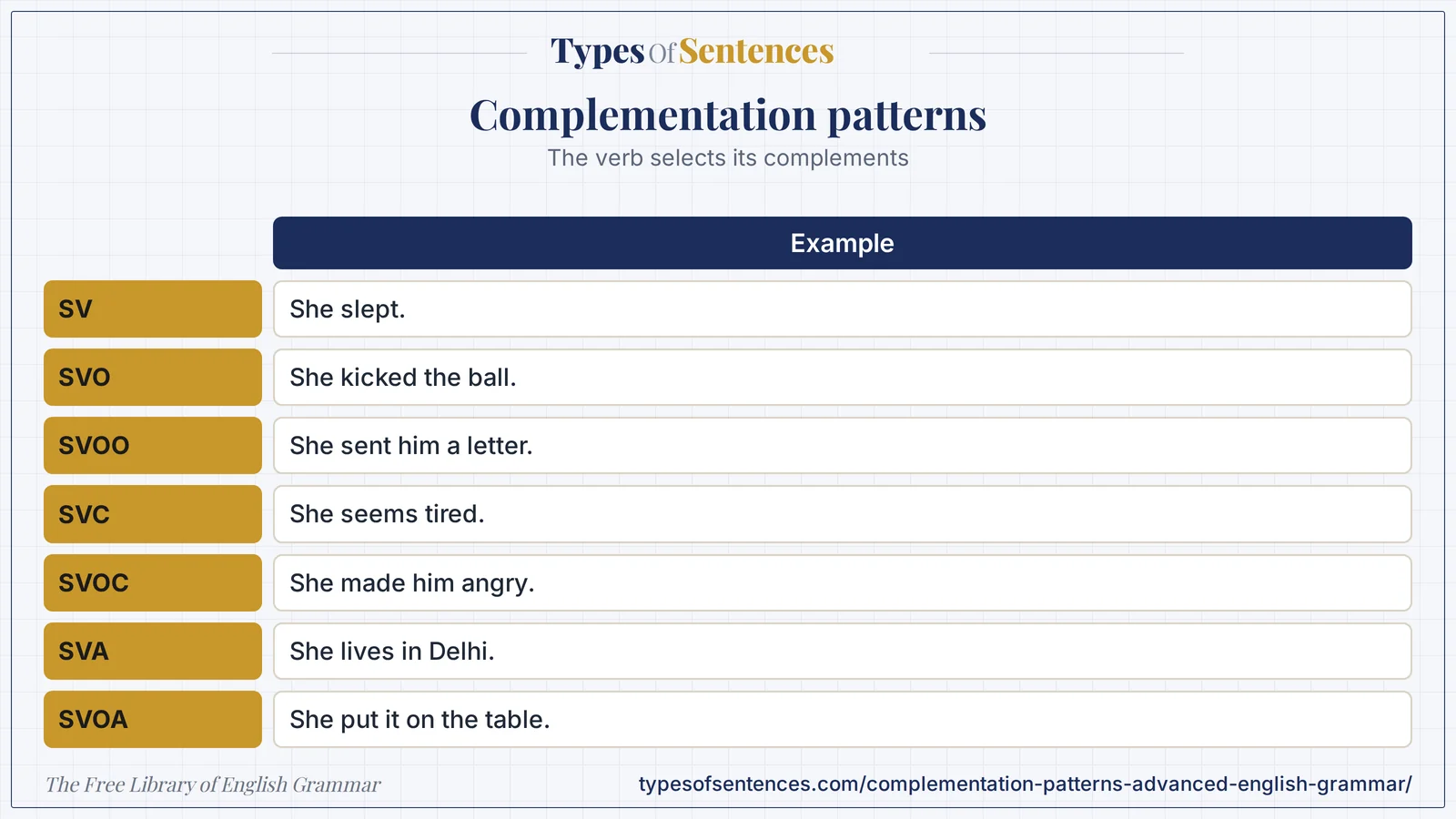
Every verb has a “frame”: the other words it needs. Some verbs need nothing (sleep), some need an object (kick the ball), some need two objects (send him a letter), some need a complement that describes the subject (seem tired), and some need a complement that describes the object (make him angry).
Why it matters: The frame is part of the verb’s meaning. When you learn a new verb, learn its frame together with its definition, and the grammar of the sentence follows.
Summary: The clause patterns are SV (She slept), SVO (She kicked the ball), SVOO (She sent him a letter), SVC (She seems tired), SVOC (She made him angry), SVA (She lives in Delhi), and SVOA (She put it on the table). Verbs select their complements: noun phrases, clauses (that, wh-, to, -ing), adjectives, and prepositional phrases. Many verbs allow more than one pattern, often with a difference of meaning. Ditransitive verbs allow the dative alternation (give the book to Mary / give Mary the book), but not all verbs do.
- Verbs select their complements: pattern is part of the verb’s meaning.
- Patterns: SV, SVO, SVOO, SVC, SVOC, SVA, SVOA.
- Dative alternation: give X to Y / give Y X; not for explain, suggest, donate.
- Causatives: make/let/have + bare infinitive; get/force/allow + to.
What You’ll Learn
- 1. Complementation Patterns: An Overview of Verb Patterns
- 2. Monotransitive Patterns: Verb + Object
- 3. Ditransitive Patterns: Verb + Indirect Object + Direct Object
- 4. Complex Transitive Patterns: Verb + Object + Complement
- 5. Copular Patterns: Linking Verb + Complement
- 6. Verb-Specific Patterns: Make, Let, Have, Get, and Others
- 7. Complementation in Different Registers
- 8. How to Learn the Patterns of a Verb
- 9. Common Errors with Complementation Patterns
- 10. Exercises
- 11. Test Your Knowledge
- 12. Frequently Asked Questions
- 13. Conclusion
1. Complementation Patterns: An Overview of Verb Patterns
A complement is an element that a word requires or licenses; an adjunct is optional. The patterns of verbs are also called verb patterns, and the set of elements a verb takes is its valency. The chapter on advanced verb concepts introduced transitivity; this chapter surveys the patterns systematically.
| Pattern | Structure | Example | Test |
|---|---|---|---|
| SV | subject + verb | She slept. The sun rose. | no complement needed (an adjunct is optional) |
| SVO | subject + verb + object | She kicked the ball. | the object can become the subject of a passive |
| SVOO | subject + verb + indirect object + direct object | She sent him a letter. | to/for paraphrase |
| SVC | subject + linking verb + complement | She seems tired. He became a doctor. | can replace the verb with be |
| SVOC | subject + verb + object + object complement | She made him angry. They elected her president. | him is angry |
| SVA | subject + verb + adverbial complement | She lives in Delhi. He is in the garden. | the adverbial is obligatory |
| SVOA | subject + verb + object + adverbial complement | She put the book on the table. | the adverbial is obligatory |
| Complement type | Examples | Verbs that take it |
|---|---|---|
| noun phrase (object) | kick the ball; read a book | transitive verbs |
| two noun phrases | give her a book | ditransitive verbs |
| adjective phrase | seem tired; make him angry | copular and complex transitive verbs |
| noun phrase (predicative) | become a doctor; elect her president | — |
| prepositional phrase | depend on her; put it on the table | prepositional verbs; verbs of position |
| that-clause | say that it is late | verbs of saying and thinking |
| wh-clause | know where she lives | verbs of knowing |
| to-infinitive | want to leave | catenative and desire verbs |
| -ing clause | enjoy reading | verbs of liking and avoiding |
| bare infinitive | make him wait | causative and perception verbs |
The same verb may have several patterns, often with different meanings: She runs fast (SVA), She runs a company (SVO), She runs a temperature (SVO, idiomatic), The river runs dry (SVC). This is why verb meaning and verb pattern must be learned together. The clausal complements are treated in detail in the chapter on complement clauses.
2. Monotransitive Patterns: Verb + Object
| Object type | Example | Notes |
|---|---|---|
| noun phrase | She kicked the ball. He wrote a letter. | a direct object |
| pronoun | She saw him. | case: object form |
| that-clause | She said that it was late. | verbs of saying and thinking |
| wh-clause | He asked where she lived. | — |
| to-infinitive | She wants to leave. | — |
| -ing form | He enjoys reading. | — |
| reflexive pronoun | She enjoyed herself. He behaved himself. | a reflexive object |
| cognate object | She dreamed a strange dream. He laughed a hearty laugh. | the noun repeats the verb |
| optional object | She reads. She reads novels. | the object can be omitted for some verbs |
| Verb type | Examples | Passive? |
|---|---|---|
| transitive (dynamic) | kick, write, build, break | yes |
| prepositional verb | look at, depend on, rely on, deal with | yes (He was looked after), but check |
| phrasal verb | give up, turn down, put off, carry out | yes (The offer was turned down) |
| stative transitive | have, resemble, fit, suit, lack, cost, weigh, mean | no: *He is resembled by his father |
| measure complements | cost five dollars, weigh ten kilos, last an hour | no: not true objects |
The test for a direct object is the passive: She kicked the ball becomes The ball was kicked. Stative transitive verbs such as resemble and have (possession) cannot be passivized, and measure phrases (The book costs five dollars) are not objects either. The prepositional and phrasal verbs are treated in the chapter on voice.
3. Ditransitive Patterns: Verb + Indirect Object + Direct Object
A ditransitive verb takes two objects: an indirect object (the recipient or beneficiary) and a direct object (the thing). Most can be paraphrased with a prepositional phrase, which is called the dative alternation.
| Double object | Prepositional (to/for) | Group |
|---|---|---|
| She gave him a book. | She gave a book to him. | to-dative: transfer to a recipient |
| He sent me a letter. | He sent a letter to me. | to-dative |
| They offered her a job. | They offered a job to her. | to-dative |
| She bought him a gift. | She bought a gift for him. | for-dative: benefit |
| He made her a cake. | He made a cake for her. | for-dative |
| She found him a seat. | She found a seat for him. | for-dative |
| To-dative verbs | For-dative verbs | Verbs that do not alternate |
|---|---|---|
| give, lend, offer, pay, sell, send, show, teach, tell, throw, write, bring, hand, pass, owe, promise | bake, book, build, buy, cook, find, get, leave, make, order, save, reserve, fetch, choose | explain, say, describe, suggest, announce, donate, introduce, report, mention (to-pattern only) |
| Verb | Double object? | Prepositional? | Example |
|---|---|---|---|
| explain | no | yes | *She explained me the rule. / She explained the rule to me. |
| suggest | no | yes | *He suggested me a plan. / He suggested a plan to me. |
| donate | no | yes | *She donated the library a book. / She donated a book to the library. |
| say | no | yes | *She said me hello. / She said hello to me. |
| tell | yes | — | She told me a story. (tell a story to me is possible but formal) |
| ask | yes | of (formal) | She asked him a question. / She asked a question of him. |
| cost, envy, spare, deny, wish | yes | no | It cost him a lot. She envied him his luck. I wish you luck. |
4. Complex Transitive Patterns: Verb + Object + Complement
A complex transitive verb takes an object and a complement that says something about the object. The relation is a kind of predication: in She made him angry, him is angry.
| Complement type | Example | Verbs |
|---|---|---|
| noun phrase | They elected her president. He called me a fool. We named the baby Maria. | elect, appoint, name, call, make, consider, crown, declare |
| adjective phrase | She made him angry. He painted the door red. I find it hard. | make, find, keep, leave, drive, paint, render, consider, think, hold, prove |
| to-infinitive | I want him to leave. She told him to wait. | want, ask, tell, order, allow, expect, persuade, force |
| bare infinitive | She made him wait. I saw him leave. | make, let, have, see, hear, watch, feel |
| -ing form | I saw him running. She kept him waiting. | see, hear, find, catch, keep, leave, imagine |
| -ed participle | I had my car repaired. She got her hair cut. | have, get, want, see |
| as + noun phrase | He regards her as a friend. They treat him as a child. | regard, see, view, treat, describe, class |
| adverbial complement (SVOA) | She put the book on the table. He placed it carefully. | put, place, set, lay, keep, send |
| Confusing pair | SVOO (ditransitive) | SVOC (complex transitive) |
|---|---|---|
| find | She found him a job. (a job for him) | She found him interesting. (he is interesting) |
| make | She made him a cake. (a cake for him) | She made him angry. (he became angry) |
| call | She called him a taxi. (a taxi for him) | She called him a fool. (he is a fool) |
| leave | She left him a note. (a note for him) | She left him angry. (he was angry) |
The test is whether the second noun phrase is a different entity (a thing for him: SVOO) or describes the first (a description of him: SVOC). I found her a good doctor is ambiguous between I found a good doctor for her and I considered her a good doctor. Adjective complements are discussed in the chapter on advanced adjective concepts.
5. Copular Patterns: Linking Verb + Complement
| Meaning | Verbs | Example |
|---|---|---|
| state | be, seem, appear, look, sound, feel, taste, smell, remain, stay, keep | She seems tired. The soup tastes good. He remained silent. |
| change (become) | become, get, grow, turn, go, come, fall, run, prove | She became a doctor. It got cold. He grew old. The leaves turned red. He went mad. The dream came true. She fell asleep. |
| result of a process | end up, wind up, turn out, prove | She ended up a teacher. It turned out well. |
| Complement type | Example | Notes |
|---|---|---|
| adjective | She is happy. It sounds good. | the commonest |
| noun phrase | She is a doctor. He became president. | identification or class |
| prepositional phrase | She is in Paris. The book is on the table. | locative be (SVA) |
| that-clause | The problem is that nobody knows. | — |
| to-infinitive | Her aim is to win. The plan is to leave. | — |
| -ing clause | My hobby is collecting stamps. | — |
| like + noun phrase or clause | She looks like her mother. It sounds like rain. It feels like I am dreaming. | perception verbs |
| of + noun phrase | It tastes of garlic. It smells of smoke. | — |
| Restriction | Example | Comment |
|---|---|---|
| go and turn with negative changes | go bad, go wrong, go mad, go blind; turn sour, turn nasty | go usually means a change for the worse |
| get with adjectives of a change in state | get tired, get angry, get better, get lost | informal |
| seem/appear with a noun phrase | She seems a nice person. She appears (to be) happy. | to be is often optional |
| become with noun phrases | She became a teacher. (*She became to be a teacher) | no to be |
| sound, look, feel with adjectives, not adverbs | She looks good (not well for appearance). It sounds nice. | adjective after a linking verb |
| be with a locative (not a copular, but SVA) | She is in Paris. The cat is on the mat. | an adverbial complement |
The test for a copular verb is that it can be replaced by be or become without a large change of meaning. A verb such as feel or look can be copular (She feels tired) or transitive and dynamic (She feels the fabric, She looked at him). In the copular use the complement is an adjective, not an adverb: She looks good, not *She looks well (unless she is healthy). The question of such adjectives and adverbs is discussed in the chapter on advanced adverb concepts.
6. Verb-Specific Patterns: Make, Let, Have, Get, and Others
| Verb | Pattern | Example | Notes |
|---|---|---|---|
| make | make + NP | She made a cake. | create |
| make | make + NP + NP | She made him a cake. | ditransitive |
| make | make + O + adjective | It made me happy. | complex transitive |
| make | make + O + NP | They made him captain. | — |
| make | make + O + bare infinitive | She made him wait. | causative; passive: He was made to wait |
| make | make it clear / possible / known + that-clause | He made it clear that he was leaving. | it as dummy object |
| let | let + O + bare infinitive | She let him go. | permission; no passive: He was allowed to go |
| let | let + O + adverbial | Let me in. Let him through. | — |
| have | have + NP | She has a car. | possession (no passive, not in progressive) |
| have | have + O + bare infinitive | I had him check it. | causative |
| have | have + O + -ed | I had my car repaired. | causative (service) or experience: I had my wallet stolen |
| have | have + O + -ing | She had them laughing. | — |
| have | have to + base | I have to go. | obligation (semi-modal) |
| get | get + NP | She got a letter. | obtain, receive |
| get | get + adjective | He got angry. | become |
| get | get + -ed (passive) | He got fired. | get-passive |
| get | get + O + to-infinitive | I got him to help. | causative; persuade |
| get | get + O + -ed | She got her hair cut. | causative (service) |
| get | get + O + -ing | He got the car running. | — |
| get | get to + base | She got to know him. | come to; have the chance |
| help | help + O + (to) + base | She helped him (to) carry it. | to optional |
| keep | keep + O + -ing | She kept him waiting. | — |
| keep | keep + O + adjective | Keep the room clean. | — |
| keep | keep + -ing | She keeps asking. | continuation |
| Causative verb | Complement | Example |
|---|---|---|
| make, let, have | bare infinitive | She made him wait. She let him go. I had him check it. |
| get, force, persuade, allow, enable, cause, permit, order, tell | to-infinitive | She got him to wait. They forced him to leave. The law allows us to park here. |
| help | either | She helped him (to) carry it. |
| see, hear, watch, notice, feel | bare infinitive or -ing | I saw him leave. I saw him leaving. |
Note the shift of to in the passive: the active She made him wait becomes He was made to wait, because the passive of make uses the to-infinitive. The perception verbs do the same: I saw him leave but He was seen to leave. The non-finite forms are treated in the previous chapter.
7. Complementation in Different Registers
| Informal | Formal | Notes |
|---|---|---|
| ask her to attend | request that she attend | mandative subjunctive |
| let him go | allow him to go / permit him to go | formal verbs take to |
| make him do it | cause him to do it / compel him to do it | — |
| start to read | commence reading | — |
| give me it (British) | give it to me | prepositional with a pronoun |
| It’s no use asking. | It is of no use to ask. | — |
| plan on going | plan to go | plan on is informal |
| enough to eat | sufficient to eat | — |
| It needs washed. (regional) | It needs washing / to be washed. | a regional form in Scotland and the American Midwest |
| She’s looking forward to hearing from you. | She awaits your reply. | — |
- Formal verbs often take to-infinitives or that-clauses where informal ones take bare infinitives or -ing.
- Phrasal verbs are informal; single Latinate verbs are formal (put off / postpone).
- Regional patterns (needs washed, might could) are not Standard English, but they are rule-governed.
8. How to Learn the Patterns of a Verb
- Look up the verb in a learner’s dictionary (such as the Oxford Advanced Learner’s, Longman, Cambridge, or Merriam-Webster’s Learner’s). The entries give the pattern codes ([T], [I], V + O + to infinitive) and examples.
- Learn the verb in a phrase: suggest that she go, enjoy reading, explain the rule to me.
- Learn the verbs in groups that share a pattern (verbs of saying, causatives, copulas).
- Note the meaning change when the pattern changes (stop to talk, stop talking).
- Check the passive: it tells you whether the verb is transitive and what the object is.
- Use a corpus (such as COCA or the BNC) to see how the verb is really used.
The idea of verb patterns as a systematic part of English was developed by A. S. Hornby in the guide that led to the learners’ dictionaries, and the idea of “colligation” (the grammatical company a word keeps) is a central theme of corpus linguistics. The dictionary approach is practical, because the patterns are different for each verb.
9. Common Errors with Complementation Patterns
| Error | Correction | Rule |
|---|---|---|
| She explained me the rule. | She explained the rule to me. | no double object for explain |
| He suggested me to go. | He suggested that I go. | suggest patterns |
| She said me hello. | She said hello to me. | say + to |
| He made me to laugh. | He made me laugh. | bare infinitive after make |
| Let him to go. | Let him go. | bare infinitive after let |
| I want that you come. | I want you to come. | object + to |
| She donated the library a book. | She donated a book to the library. | donate + to |
| She became to be a teacher. | She became a teacher. | no to be after become |
| He is resembled by his father. | He resembles his father. | no passive |
| She looks well. (appearance) | She looks good. | adjective after a copular verb |
| He gave to me it. | He gave it to me. | pronoun object |
| I enjoy to read. | I enjoy reading. | -ing after enjoy |
Edit: She explained me the rule, and he suggested me to go, but he made me to laugh, and let him to go, and I want that you come, and she donated the library a book, and she became to be a teacher, and he is resembled by his father.
- explained me the rule: explained the rule to me.
- suggested me to go: suggested that I go.
- made me to laugh: made me laugh.
- let him to go: let him go.
- want that you come: want you to come.
- donated the library a book: donated a book to the library.
- became to be a teacher: became a teacher.
- is resembled by his father: resembles his father.
- Result: She explained the rule to me, and he suggested that I go, but he made me laugh, and let him go, and I want you to come, and she donated a book to the library, and she became a teacher, and he resembles his father.
Recap in 12 seconds
Watch the lesson build itself: The seven clause patterns, SV, SVO, SVOO, SVC, SVOC, SVA, and SVOA, each with an example. The video has no sound.
Exercises
Part A: Recognizing Patterns (Exercises 1–7)
Exercise 1: Name the pattern: She slept.
Show Answer
Answer: SV.
Exercise 2: Name the pattern: She kicked the ball.
Show Answer
Answer: SVO.
Exercise 3: Name the pattern: She sent him a letter.
Show Answer
Answer: SVOO.
Exercise 4: Name the pattern: She seems tired.
Show Answer
Answer: SVC.
Exercise 5: Name the pattern: She made him angry.
Show Answer
Answer: SVOC.
Exercise 6: Name the pattern: She put the book on the table.
Show Answer
Answer: SVOA.
Exercise 7: Name the pattern: She lives in Delhi.
Show Answer
Answer: SVA.
Part B: Monotransitive and Ditransitive (Exercises 8–15)
Exercise 8: Edit: She explained me the rule.
Show Answer
Answer: She explained the rule to me.
Exercise 9: Edit: She said me hello.
Show Answer
Answer: She said hello to me.
Exercise 10: Edit: She donated the library a book.
Show Answer
Answer: She donated a book to the library.
Exercise 11: Edit: He gave to me it.
Show Answer
Answer: He gave it to me.
Exercise 12: Rewrite with a prepositional phrase: She bought him a gift.
Show Answer
Answer: She bought a gift for him.
Exercise 13: Name the group: give versus buy
Show Answer
Answer: To-dative versus for-dative.
Exercise 14: Edit: He is resembled by his father.
Show Answer
Answer: He resembles his father.
Exercise 15: Is five dollars an object in The book costs five dollars?
Show Answer
Answer: No (a measure complement).
Part C: Complex Transitive and Copular (Exercises 16–21)
Exercise 16: SVOO or SVOC: She found him a job.
Show Answer
Answer: SVOO.
Exercise 17: SVOO or SVOC: She found him interesting.
Show Answer
Answer: SVOC.
Exercise 18: Name the complement: They elected her president.
Show Answer
Answer: An object complement (noun phrase).
Exercise 19: Edit: She became to be a teacher.
Show Answer
Answer: She became a teacher.
Exercise 20: Choose: She looks (good/well). (appearance)
Show Answer
Answer: good.
Exercise 21: Name the meaning of go in He went mad.
Show Answer
Answer: A change to a (usually negative) state.
Part D: Verb-Specific Patterns (Exercises 22–27)
Exercise 22: Edit: He made me to laugh.
Show Answer
Answer: He made me laugh.
Exercise 23: Edit: Let him to go.
Show Answer
Answer: Let him go.
Exercise 24: Complete: She got him ___ help.
Show Answer
Answer: to.
Exercise 25: Complete: He was made ___ wait. (passive)
Show Answer
Answer: to.
Exercise 26: Name the pattern: I had my car repaired.
Show Answer
Answer: Causative have + object + -ed.
Exercise 27: Name the pattern: She got fired.
Show Answer
Answer: Get-passive.
Part E: Register and Errors (Exercises 28–30)
Exercise 28: Formal equivalent of ask her to attend:
Show Answer
Answer: request that she attend.
Exercise 29: Edit: I want that you come.
Show Answer
Answer: I want you to come.
Exercise 30: Edit: I enjoy to read.
Show Answer
Answer: I enjoy reading.
Test Your Knowledge
Ready to check what you learned? Answer all 10 questions, then submit. You need 80% (8 of 10) to pass. Your answers are not stored.
View correct answers and explanations
Question 1: Which is the pattern of She made him angry?
✓ Correct Answer: C – SVOC
Subject, verb, object, object complement.
Question 2: Which is correct?
✓ Correct Answer: A – She explained the rule to me.
Explain takes the prepositional form.
Question 3: Which is correct?
✓ Correct Answer: D – He suggested that I go.
Suggest takes a that-clause.
Question 4: Which is correct?
✓ Correct Answer: B – He made me laugh.
Bare infinitive.
Question 5: Which is a for-dative verb?
✓ Correct Answer: C – buy
Buy: buy something for someone.
Question 6: Which is correct?
✓ Correct Answer: B – She became a teacher.
No to be.
Question 7: Which cannot be passivized?
✓ Correct Answer: D – resemble
Resemble is stative.
Question 8: Which is correct?
✓ Correct Answer: C – He gave it to him.
Pronoun direct object.
Question 9: Which is a causative with to?
✓ Correct Answer: A – get
Get him to help.
Question 10: Which is correct?
✓ Correct Answer: B – I want you to come.
Want + object + to.
Frequently Asked Questions
What are complementation patterns?
Complementation patterns are the sets of elements that a verb (or adjective or noun) takes after it: objects, complements, clauses, and prepositional phrases. They are a property of each word.
What are verb complements?
Verb complements are the elements that a verb requires to complete its meaning: a direct object, an indirect object, an object complement, a subject complement, or an obligatory adverbial.
What are complementation structures?
Complementation structures are the grammatical forms of complements: noun phrases, adjective phrases, prepositional phrases, that-clauses, wh-clauses, infinitives, and -ing clauses.
What are verb patterns?
Verb patterns are the typical frames of a verb, such as SVO, SVOO, SVOC, and SVC, and the finer patterns coded in learners’ dictionaries, such as verb + object + to-infinitive.
What are complement types?
Complement types are the categories of complement: object, indirect object, subject complement, object complement, adverbial complement, and clausal complement.
What is the dative alternation?
The dative alternation is the choice between two ways of expressing a ditransitive meaning: give her a book and give a book to her. It does not apply to every verb (not explain me).
How do I learn the patterns of a verb?
Look it up in a learner’s dictionary, learn it in a phrase with its pattern, learn verbs in groups, note meaning changes, check the passive, and read examples in a corpus.
Conclusion
You now have a deep study of complementation patterns: the clause patterns and complement types, monotransitive, ditransitive, complex transitive, and copular patterns, the dative alternation, the verb-specific patterns of make, let, have, and get, register differences, and how to learn the patterns of a verb. You can use verbs with their correct complements.
When you learn a new verb, learn its pattern together with its meaning. Next, you will study negation.
- Huddleston, Rodney, and Geoffrey K. Pullum. The Cambridge Grammar of the English Language. Cambridge University Press, 2002.: the reference analysis of complements, valency, and the dative alternation.
- Quirk, Randolph, et al. A Comprehensive Grammar of the English Language. Longman, 1985.: the classic treatment of clause patterns (SV, SVO, SVOO, SVC, SVOC, SVA, SVOA).
- Biber, Douglas, et al. Longman Grammar of Spoken and Written English. Longman, 1999.: corpus evidence on verb complementation.
- Hornby, A. S. A Guide to Patterns and Usage in English. Oxford University Press, 1954.: the pioneering system of verb patterns.
- Merriam-Webster Dictionary: transitive: the dictionary entry.
Last reviewed: October 29, 2026. How it was made: drafted with AI assistance, then checked with automated tests (structure, links, answer keys, spelling) and against the sources above. A person has not yet read this chapter line by line. Found a mistake? Report it.