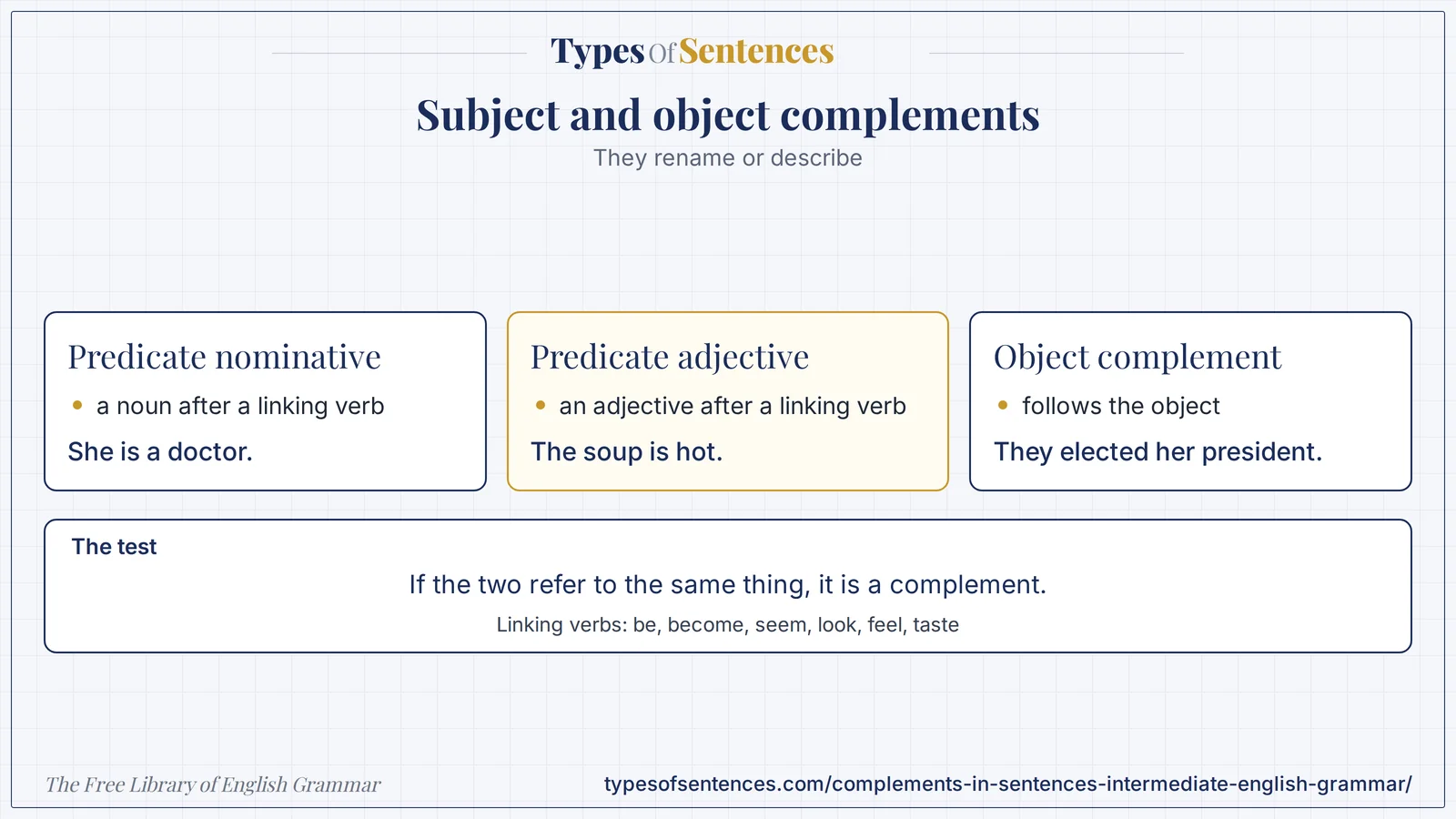
Subject and object complements are the elements that complete the meaning of a clause by describing or renaming the subject or the object. A subject complement follows a linking verb and tells what the subject is or is like: She is a doctor; The soup is hot. An object complement follows a direct object and tells what the object becomes or is called: They elected her president.
This chapter explains what a complement is, then studies the subject complement, its two kinds (the predicate nominative and the predicate adjective), and the object complement. You will learn the tests that separate a complement from an object, the forms a complement can take, the problem of case in It is I, and the common errors. Thirty exercises and a quiz follow.
A complement answers the question What is it? or What is it like?. It does not name a new person or thing; it says more about the one already named, either the subject or the object.
Why it matters: If you can tell a complement from an object, you can choose the right pronoun case, the right word form (adjective or adverb), and the right pattern for the sentence.
Summary: A subject complement follows a linking verb and renames or describes the subject: a noun phrase is a predicate nominative (She is a doctor), and an adjective is a predicate adjective (The soup is hot). An object complement follows a direct object and renames or describes it (They elected her president). A complement refers to the same person or thing as the subject or object.
- Subject complement: after be, become, seem, look, feel, taste.
- Predicate nominative = noun; predicate adjective = adjective.
- Object complement: after verbs such as elect, make, call, find, consider.
- Test: if the two refer to the same thing, it is a complement; if different, an object.
What You’ll Learn
- 1. Subject and Object Complements: What Is a Complement?
- 2. Subject Complements
- 3. Predicate Nominative
- 4. Predicate Adjective
- 5. Object Complements
- 6. Complement vs. Object
- 7. Complement vs. Adverbial
- 8. Punctuation and Style
- 9. Common Errors with Complements
- 10. Exercises
- 11. Test Your Knowledge
- 12. Frequently Asked Questions
- 13. Conclusion
1. Subject and Object Complements: What Is a Complement?
A complement is a clause element that completes the meaning of the verb by describing or renaming the subject or the object. Unlike an object, a complement does not name a new person or thing. It names the same one in another way.
| Kind | Follows | Example | Refers to |
|---|---|---|---|
| Subject complement | a linking verb | She is a doctor. The soup is hot. | the subject |
| Object complement | a direct object | They elected her president. The news made him angry. | the object |
Complements are the fifth element of the clause; see the chapter on elements of a sentence. They complete the patterns S-V-PA, S-V-PN, and S-V-O-OC from the chapter on the seven basic sentence patterns.
2. Subject Complements
A subject complement follows a linking verb. It describes or renames the subject. The linking verb works as an equals sign: She = a doctor, The soup = hot.
| Linking verb | Example |
|---|---|
| be (am, is, are, was, were, been) | She is a doctor. They were late. |
| become, get, grow, turn, go, come | He became angry. The milk turned sour. The food went bad. |
| seem, appear | She seems happy. He appears tired. |
| remain, stay, keep | The shop remained closed. Please stay calm. |
| look, sound, feel, smell, taste | It looks good. That sounds great. I feel tired. |
| Form of the subject complement | Example |
|---|---|
| noun phrase | He is a teacher. |
| pronoun | The winner was she. |
| adjective | The soup is hot. |
| adjective phrase | She is very proud of her work. |
| prepositional phrase | She is in good health. |
| infinitive phrase | His goal is to win. |
| gerund phrase | Her hobby is collecting stamps. |
| noun clause | The problem is that I am late. |
The types of linking verb are in the chapter on types of verbs. To check a verb, replace it with a form of be: The soup is hot works, so tastes is linking in The soup tastes hot.
3. Predicate Nominative
A predicate nominative (also called a predicate noun) is a noun or pronoun that follows a linking verb and renames the subject.
| Sentence | Subject | Predicate nominative |
|---|---|---|
| Tom is a teacher. | Tom | a teacher |
| My sister became a lawyer. | my sister | a lawyer |
| The winner was she. | the winner | she |
| Paris remains the capital of France. | Paris | the capital of France |
I. Case of a pronoun
Traditional grammar says that a pronoun after a linking verb should be in the subject (nominative) form, because it renames the subject: It is I, This is she, The winner was he. In everyday speech and informal writing, the object form is common and accepted: It’s me, That’s him. Use the formal form when the context is formal.
II. Agreement
The verb agrees with the subject, not with the complement.
| Sentence | Subject | Verb |
|---|---|---|
| The problem is the rules. | the problem (singular) | is |
| The rules are the problem. | the rules (plural) | are |
| My hobbies are reading and writing. | my hobbies | are |
| What he wants is patience. | what he wants | is |
The verb agrees with the subject problem, which is singular. If the plural sounds better, make the subject plural.
4. Predicate Adjective
A predicate adjective is an adjective that follows a linking verb and describes the subject.
| Sentence | Subject | Predicate adjective |
|---|---|---|
| The soup is hot. | the soup | hot |
| She seems happy. | she | happy |
| The music sounds beautiful. | the music | beautiful |
| He became angry. | he | angry |
| The milk turned sour. | the milk | sour |
| Linking (adjective) | Action (adverb) |
|---|---|
| The soup tastes good. | She tasted the soup carefully. |
| He looks angry. | He looked at me angrily. |
| I feel bad. | I felt my way slowly. |
| The room smells fresh. | She smelled the flowers happily. |
| The plan sounds good. | The trumpet sounded loudly. |
Two traps are common. I feel bad is correct for a bad mood, and I feel badly suggests that your sense of touch is poor, although many speakers use it. I feel good means happy or healthy, and I feel well means healthy; see the chapter on adjective types.
5. Object Complements
An object complement follows a direct object and describes it or gives it a new name. It occurs with verbs of making, naming, choosing, and thinking.
| Verb type | Examples of verbs | Sentence |
|---|---|---|
| choosing and naming | elect, appoint, name, call, nickname, crown | They elected her president. They named the baby Maria. |
| making and causing | make, render, drive, send | The news made him angry. The noise drove her crazy. |
| thinking and judging | consider, find, think, believe, judge | We consider the plan a success. I found the room cold. |
| keeping and leaving | keep, leave, hold | Please keep the door open. They left the house empty. |
| changing | paint, dye, turn, cut | She painted the door blue. He cut the rope short. |
| Form of object complement | Example |
|---|---|
| noun phrase | They elected her the new president. |
| adjective | The news made him angry. |
| adjective phrase | I found the story very moving. |
| to-infinitive (with some verbs) | We consider him to be a genius. |
| prepositional phrase | I found her in tears. |
Analyze: The committee declared the competition a draw.
- Verb: declared; subject: the committee.
- Object: the competition (declared what?).
- a draw renames the object: an object complement (the competition = a draw).
- Pattern: S-V-O-OC.
In the passive, the object complement becomes a subject complement: She was elected president, He was made angry by the news. The passive is covered in the chapter on passive voice.
6. Complement vs. Object
A complement and an object can both follow a verb, and some sentences allow either reading. Four tests help.
| Test | Complement | Object |
|---|---|---|
| Same referent? | the complement refers to the same thing as the subject or the object | the object refers to a different thing |
| to be insertion | We consider him (to be) a genius. works | She called him (to be) a taxi. does not work |
| Passive | a subject complement cannot become a subject | a direct object can become the subject of a passive |
| Linking verb? | follows a linking verb (S-V-PN/PA) | follows an action verb |
| Complement (same referent) | Object (different referent) |
|---|---|
| She called him a hero. (him = a hero) | She called him a taxi. (him ≠ a taxi: a taxi for him) |
| She made him a manager. (him = a manager) | She made him a cake. (a cake for him) |
| The company named her director. | The company gave her a promotion. |
The objects are the subject of the previous chapter on direct and indirect objects. The first sentence in each pair is S-V-O-OC; the second is S-V-IO-DO.
7. Complement vs. Adverbial
A complement is required by the verb. An adverbial is usually optional. The same word can be either, depending on the verb.
| Sentence | Role of here or the phrase | Why |
|---|---|---|
| She is here. | complement (place) | be needs it; She is is incomplete |
| She works here. | adverbial | She works is complete |
| The meeting is at six. | complement (time) | be needs it |
| The meeting started at six. | adverbial | The meeting started is complete |
| He is in the garden. | complement (place) | required by be |
Some grammars call the required phrase after be a predicative adverbial rather than a complement. In this course, the pattern S-V-A is treated separately from S-V-PN and S-V-PA.
8. Punctuation and Style
- Do not put a comma between a linking verb and its complement: She is a doctor, not She is, a doctor.
- Keep multiple complements parallel: She is smart, kind, and funny, not smart, kind, and a good friend.
- Avoid is when and is where in definitions: A noun is a word that names…, not A noun is when you name something.
- After the reason is, use that, not because: The reason is that it rained.
Some modern grammars do not use the term predicate nominative or predicate adjective. They call all complements after a linking verb subject complements, or predicatives. The traditional names are useful for teaching and remain in many textbooks and exams.
9. Common Errors with Complements
| Error | Correction | Rule |
|---|---|---|
| She looks beautifully. | She looks beautiful. | adjective after a linking verb |
| The soup tastes well. | The soup tastes good. | adjective after a linking verb |
| The problem are the rules. | The problem is the rules. | verb agrees with the subject |
| It is her who called. (formal) | It is she who called. | subject form after be in formal English |
| A noun is when you name something. | A noun is a word that names something. | avoid is when |
| The reason is because it rained. | The reason is that it rained. | that after the reason is |
| They elected she president. | They elected her president. | object form for the object |
| She is, a doctor. | She is a doctor. | no comma after a linking verb |
Fix: The reason is because he feels badly, and the problem are the noise, which makes him looks angrily.
- the reason is because: the reason is that.
- feels badly: after a linking verb use an adjective: feels bad.
- the problem are: the problem is (singular subject).
- makes him looks angrily: makes him look angry (bare infinitive and an adjective complement).
- Result: The reason is that he feels bad, and the problem is the noise, which makes him look angry.
Recap in 12 seconds
Watch the lesson build itself: Subject complements follow linking verbs and object complements follow the object. The video has no sound.
Exercises
Part A: Subject Complements (Exercises 1–6)
Exercise 1: Subject complement: She is a doctor.
Show Answer
Answer: a doctor.
Exercise 2: Subject complement: The soup is hot.
Show Answer
Answer: hot.
Exercise 3: Subject complement: He became angry.
Show Answer
Answer: angry.
Exercise 4: Subject complement: His goal is to win.
Show Answer
Answer: to win (an infinitive phrase).
Exercise 5: Subject complement: The problem is that I am late.
Show Answer
Answer: that I am late (a noun clause).
Exercise 6: Is tastes linking in The soup tastes good?
Show Answer
Answer: Yes. It can be replaced by is.
Part B: Predicate Nominative or Adjective (Exercises 7–12)
Exercise 7: Kind: a teacher in Tom is a teacher.
Show Answer
Answer: Predicate nominative.
Exercise 8: Kind: sour in The milk turned sour.
Show Answer
Answer: Predicate adjective.
Exercise 9: Kind: she in The winner was she.
Show Answer
Answer: Predicate nominative.
Exercise 10: Kind: beautiful in The music sounds beautiful.
Show Answer
Answer: Predicate adjective.
Exercise 11: Choose (formal): It is (I/me).
Show Answer
Answer: I.
Exercise 12: Choose: The problem (is/are) the rules.
Show Answer
Answer: is.
Part C: Adjective or Adverb (Exercises 13–17)
Exercise 13: Choose: She looks (beautiful/beautifully).
Show Answer
Answer: beautiful.
Exercise 14: Choose: The soup tastes (good/well).
Show Answer
Answer: good.
Exercise 15: Choose: She looked (careful/carefully) at the map.
Show Answer
Answer: carefully.
Exercise 16: Choose: He looked (angry/angrily) at me.
Show Answer
Answer: angrily.
Exercise 17: Choose: I feel (bad/badly) about the news.
Show Answer
Answer: bad.
Part D: Object Complements (Exercises 18–23)
Exercise 18: Object complement: They elected her president.
Show Answer
Answer: president.
Exercise 19: Object complement: The news made him angry.
Show Answer
Answer: angry.
Exercise 20: Object complement: She painted the door blue.
Show Answer
Answer: blue.
Exercise 21: Object complement: We consider the plan a success.
Show Answer
Answer: a success.
Exercise 22: Insert to be: We consider him a genius.
Show Answer
Answer: We consider him to be a genius.
Exercise 23: Passive: They elected her president.
Show Answer
Answer: She was elected president.
Part E: Complement or Object? (Exercises 24–27)
Exercise 24: Complement or object: a hero in She called him a hero.
Show Answer
Answer: Complement (him = a hero).
Exercise 25: Complement or object: a taxi in She called him a taxi.
Show Answer
Answer: Direct object (and him is the indirect object).
Exercise 26: Complement or object: a manager in She made him a manager.
Show Answer
Answer: Complement.
Exercise 27: Complement or object: a cake in She made him a cake.
Show Answer
Answer: Direct object.
Part F: Errors (Exercises 28–30)
Exercise 28: Fix it: The reason is because it rained.
Show Answer
Answer: The reason is that it rained.
Exercise 29: Fix it: They elected she president.
Show Answer
Answer: They elected her president.
Exercise 30: Fix it: A noun is when you name something.
Show Answer
Answer: A noun is a word that names something.
Test Your Knowledge
Ready to check what you learned? Answer all 10 questions, then submit. You need 80% (8 of 10) to pass. Your answers are not stored.
View correct answers and explanations
Question 1: What does a subject complement follow?
✓ Correct Answer: C – A linking verb
A subject complement follows a linking verb.
Question 2: What is a predicate nominative?
✓ Correct Answer: B – A noun or pronoun renaming the subject
It is a noun or pronoun that renames the subject.
Question 3: What is a predicate adjective?
✓ Correct Answer: D – An adjective that describes the subject
It describes the subject after a linking verb.
Question 4: Which is correct?
✓ Correct Answer: A – She looks beautiful.
Use an adjective after a linking verb.
Question 5: Which is an object complement in They elected her president?
✓ Correct Answer: C – president
President renames the object her.
Question 6: Which verb agrees: The problem ___ the rules.
✓ Correct Answer: B – is
The subject problem is singular.
Question 7: Which test shows an object complement?
✓ Correct Answer: D – Insert to be
You can insert to be between the object and the complement.
Question 8: Which is formal?
✓ Correct Answer: A – It is I.
Formal English uses the subject form after be.
Question 9: Which is a complement in She is here?
✓ Correct Answer: C – here
Here completes the verb be.
Question 10: Which is a complement, not an object?
✓ Correct Answer: B – a hero in She called him a hero
A hero renames him.
Frequently Asked Questions
What are subject and object complements?
Subject and object complements are the clause elements that describe or rename the subject or the object. A subject complement follows a linking verb, and an object complement follows a direct object.
What is a subject complement?
A subject complement follows a linking verb and describes or renames the subject: She is a doctor; The soup is hot. It can be a noun phrase, an adjective, a phrase, or a clause.
What is an object complement?
An object complement follows a direct object and describes or renames it: They elected her president; The news made him angry. It occurs with verbs of making, naming, choosing, and thinking.
What is a predicate nominative?
A predicate nominative is a noun or pronoun after a linking verb that renames the subject, as in Tom is a teacher. It is one of the two kinds of subject complement.
What is a predicate adjective?
A predicate adjective is an adjective after a linking verb that describes the subject, as in The soup is hot. Use an adjective, not an adverb, after a linking verb.
How do I tell a complement from an object?
A complement refers to the same thing as the subject or the object (She called him a hero: him = a hero). An object refers to something different (She called him a taxi). You can often insert to be before a complement.
Should I say it is I or it is me?
Formal English uses the subject form (It is I) after the verb be. Everyday speech uses It is me, and it is accepted informally. Choose by the formality of the context.
Conclusion
You now understand subject and object complements. You can recognize a subject complement after a linking verb, tell a predicate nominative from a predicate adjective, find an object complement after a direct object, and separate a complement from an object, an adverbial, and a modifier. You can also avoid the common errors.
Practice by finding the complements in what you read and naming the thing each one describes. Next, you begin the study of sentence types with simple sentences.
- Merriam-Webster Dictionary: complement: the dictionary definition of a complement.
- Purdue Online Writing Lab: Grammar: reference section on complements.
- Quirk, Randolph, et al. A Comprehensive Grammar of the English Language. Longman, 1985.: subject and object complements.
- Huddleston, Rodney, and Geoffrey K. Pullum. The Cambridge Grammar of the English Language. Cambridge University Press, 2002.: predicative complements.
Last reviewed: October 29, 2026. How it was made: drafted with AI assistance, then checked with automated tests (structure, links, answer keys, spelling) and against the sources above. A person has not yet read this chapter line by line. Found a mistake? Report it.