This grammar glossary A to C explains the grammar terms starting with A, B, and C in plain language. Each entry gives a short definition, an example, and a link to the lesson on this site where the topic is taught in full. If you want the abstract noun definition, the difference between a clause and a phrase, or the meaning of aspect or case, you will find it here.
The glossary is in six parts, and this is the first. The parts follow the alphabet: A to C, D to G, H to M, N to P, Q to S, and T to Z. A term that has two names, such as copular verb and linking verb, is listed under both. The grammar terms starting with D are in the next part.
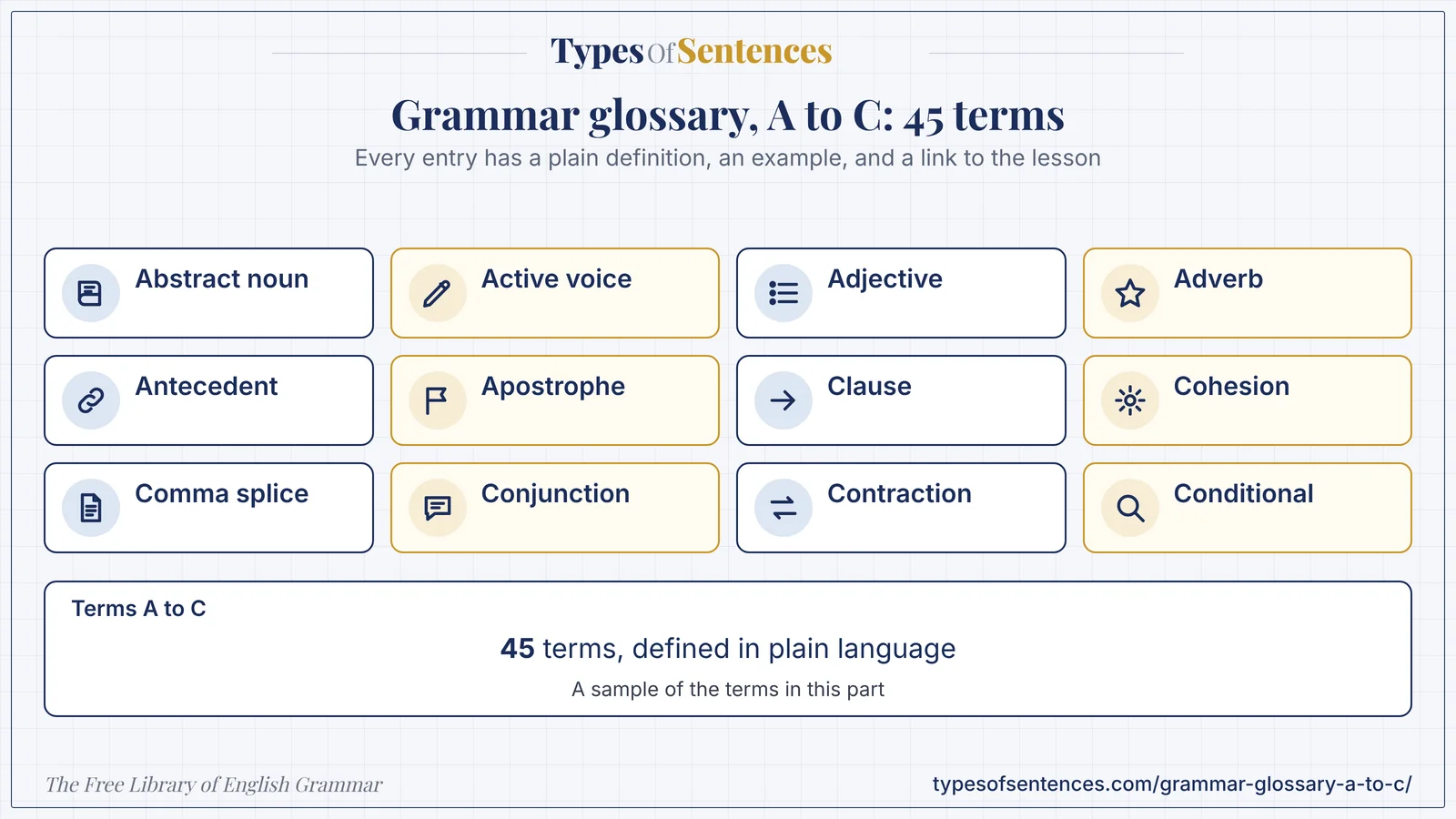
A glossary is a short dictionary of the words that people use to talk about grammar. Use it when a lesson uses a term that you do not know.
Why it matters: Terms such as clause, case, and aspect sound hard, but each describes something simple. A short definition and an example are usually enough to get started.
Summary: This part of the glossary defines 45 grammar terms from abstract noun to countable noun, with an example for each and a link to the full lesson. Terms are in alphabetical order, and the letter list at the top takes you to each section.
- Entries: a definition, an example, and a link to the lesson.
- Terms with two names are listed under both names.
- Next part: D to G.
- Start with the lesson on parts of speech if the terms are new.
Jump to a Letter
A
abstract noun
Definition: A noun that names an idea, quality, feeling, or state that you cannot see or touch. This is the usual abstract noun definition.
Example: Freedom, honesty, and fear are abstract nouns.
Learn more: The Noun – Types of Nouns, A Complete Study
action verb
Definition: A verb that shows physical or mental action. It is also called a dynamic verb.
Example: She runs every morning. He thinks about it.
Learn more: What is a Verb – Action and Being Words
active voice
Definition: A way of building a sentence in which the subject does the action of the verb.
Example: The cat chased the mouse.
Learn more: Passive Voice and Active Voice
adjective
Definition: A word that describes or modifies a noun or pronoun by telling what kind, which one, or how many.
Example: a red car, three books
Learn more: What is an Adjective – Describing Words
adjective clause
Definition: A dependent clause that describes a noun or pronoun. It usually begins with who, whom, whose, which, or that. It is also called a relative clause.
Example: The man who called is my uncle.
Learn more: Adjective Clauses (Relative Clauses)
adjective phrase
Definition: A group of words built around an adjective, which describes a noun.
Example: She is very proud of her son.
Learn more: Types of Phrases
adverb
Definition: A word that describes a verb, an adjective, or another adverb, and tells how, when, where, or to what degree.
Example: She spoke softly. It is very cold.
Learn more: What is an Adverb – Describing Actions
adverb clause
Definition: A dependent clause that works as an adverb. It tells why, when, where, how, or under what condition the main action happens.
Example: Because it rained, we stayed in.
Learn more: Adverb Clauses
adverbial
Definition: Any word, phrase, or clause that works as an adverb in a sentence, most often to add information about time, place, manner, or reason.
Example: We met in the morning.
Learn more: Elements of a Sentence
affix
Definition: A group of letters added to the beginning (prefix) or the end (suffix) of a word to change its meaning or its word class.
Example: unhappy, happiness
Learn more: Prefixes and Suffixes – Word Formation Basics
agreement
Definition: The matching of a verb with its subject (and of a pronoun with its antecedent) in number and person. It is also called concord.
Example: The dogs bark. The dog barks.
Learn more: Subject Verb Agreement
antecedent
Definition: The noun or noun phrase that a pronoun refers to.
Example: Priya said she was late. (Priya is the antecedent of she.)
Learn more: Types of Pronouns – Complete Study
apostrophe
Definition: A punctuation mark (’) that shows possession or marks the place of missing letters.
Example: the dog’s bone, don’t
Learn more: Apostrophe Rules
appositive
Definition: A noun or noun phrase that renames the noun beside it.
Example: My friend Ravi, a chef, cooks well.
Learn more: Appositive Phrases
article
Definition: One of the small words a, an, and the, which come before a noun. Articles are a kind of determiner.
Example: a book, an apple, the sun
Learn more: What is an Article – A, An, The
aspect
Definition: A category of the verb that shows whether an action is complete, in progress, or repeated. English has the simple, progressive (continuous), and perfect aspects.
Example: She has finished. She is finishing.
Learn more: Verb Tenses – Introduction to the 12 Tenses
attributive adjective
Definition: An adjective that comes before the noun it describes. The opposite is a predicative adjective.
Example: a tall tree
Learn more: Adjective Types – Adjectives, A Complete Study
auxiliary verb
Definition: A helping verb used with a main verb to form tenses, questions, negatives, the passive, and modal meanings. The auxiliary verbs are be, do, have, and the modals.
Example: She has gone. Do you know?
Learn more: Auxiliary Verbs (Helping Verbs): Be, Do, Have and Modals
B
base form
Definition: The plain form of a verb, as listed in a dictionary, with no ending. It is the form used after to and after modal verbs.
Example: walk, go, be
Learn more: Types of Verbs – Complete Study
C
capitalization
Definition: The use of capital letters at the beginning of sentences and for proper nouns, titles, and some other words.
Example: Maria lives in Pune.
Learn more: Capitalization Rules
case
Definition: The form of a noun or pronoun that shows its function in the sentence: subjective, objective, or possessive.
Example: he (subjective), him (objective), his (possessive)
Learn more: Types of Pronouns – Complete Study
clause
Definition: A group of words that contains a subject and a predicate. A clause can be independent or dependent.
Example: when she arrived
Learn more: Clause Definition – Introduction to Clauses
cohesion
Definition: The way that words and sentences are linked so that a text reads as one connected whole, through pronouns, connectors, and repetition.
Example: The plan failed. However, it taught us a lesson.
Learn more: Cohesion in Writing – Connecting Ideas in Writing
collective noun
Definition: A noun that names a group of people or things as a single unit.
Example: team, committee, flock
Learn more: The Noun – Types of Nouns, A Complete Study
colon
Definition: A punctuation mark (:) that introduces a list, an explanation, or a quotation after a complete clause.
Example: You need three things: a pen, paper, and time.
Learn more: Punctuation Marks – Complete Study
comma
Definition: A punctuation mark (,) that separates items in a list, joins clauses with a conjunction, and sets off introductory and extra information.
Example: When it rained, we left.
Learn more: Comma Rules
comma splice
Definition: An error in which two independent clauses are joined by only a comma.
Example: It rained, we left. (incorrect)
Learn more: Comma Splice: What It Is and Four Ways to Fix It
common noun
Definition: A noun that names a general person, place, or thing and is not capitalized (unless it begins a sentence).
Example: teacher, city, river
Learn more: What is a Noun – Naming Words
comparative
Definition: The form of an adjective or adverb that compares two things, made with -er or more.
Example: taller, more careful
Learn more: Adjective Types – Adjectives, A Complete Study
complement
Definition: A word or phrase that completes the meaning of a verb, a subject, or an object.
Example: She became a doctor. (a doctor is the subject complement)
Learn more: Subject and Object Complements
complex sentence
Definition: A sentence that has one independent clause and at least one dependent clause.
Example: Although it was late, we kept working.
Learn more: Complex Sentences
compound-complex sentence
Definition: A sentence that has two or more independent clauses and at least one dependent clause.
Example: Although it was late, we kept working, and we finished at midnight.
Learn more: Compound-Complex Sentences
compound sentence
Definition: A sentence that has two or more independent clauses and no dependent clause, usually joined by a coordinating conjunction.
Example: It rained, so we stayed in.
Learn more: Compound Sentences
compound word
Definition: A word made from two or more words. It may be written solid, hyphenated, or open.
Example: toothbrush, mother-in-law, post office
Learn more: What is a Word
concrete noun
Definition: A noun that names something that you can perceive with your senses.
Example: table, rain, bread
Learn more: The Noun – Types of Nouns, A Complete Study
conditional
Definition: A sentence or clause that states a condition and its result, usually with if.
Example: If it rains, we will stay home.
Learn more: Conditional Sentences – Introduction
conjunction
Definition: A word that joins words, phrases, or clauses. The main kinds are coordinating, subordinating, and correlative conjunctions.
Example: and, because, either … or
Learn more: What is a Conjunction – Connecting Words
conjunctive adverb
Definition: An adverb that links two independent clauses and shows the relation between them. It is usually preceded by a semicolon and followed by a comma.
Example: The road was closed; therefore, we turned back.
Learn more: Conjunctive Adverbs: List, Punctuation and Examples
contraction
Definition: A shortened form of a word or words, with an apostrophe in place of the missing letters.
Example: can’t, I’m, they’ve
Learn more: Apostrophe Rules
coordinating conjunction
Definition: One of the seven words for, and, nor, but, or, yet, and so (FANBOYS), which join elements of equal rank.
Example: tea or coffee
Learn more: Coordinating Conjunctions: FANBOYS Rules and Examples
coordination
Definition: The joining of two or more elements of equal grammatical rank, such as words, phrases, or independent clauses.
Example: She sang, and he played.
Learn more: Compound Sentences
copular verb
Definition: A verb that links the subject to a complement that describes or identifies it. It is also called a linking verb. The most common copular verb is be.
Example: She seems tired. He became a pilot.
Learn more: Types of Verbs – Complete Study
correlative conjunctions
Definition: Pairs of words that work together to join equal elements, such as either … or, neither … nor, both … and, and not only … but also.
Example: Either you leave, or I will.
Learn more: Correlative Conjunctions: Pairs, Rules and Examples
count noun
Definition: A noun that names something you can count, so it has a singular and a plural form. See also countable noun.
Example: book, books
Learn more: The Noun – Types of Nouns, A Complete Study
countable noun
Definition: Another name for a count noun: a noun that can be counted and can be used with a or an in the singular and with numbers in the plural. The opposite is an uncountable noun.
Example: one apple, three apples
Learn more: Plural Nouns – Singular and Plural Rules
Recap in 12 seconds
Watch the lesson build itself: A sample of the 45 grammar terms from A to C: abstract noun, active voice, adjective, adverb, antecedent, apostrophe, clause, cohesion, comma splice, conjunction, contraction, conditional. The video has no sound.
Frequently Asked Questions
What is a grammar glossary?
A grammar glossary is an alphabetical list of the terms used to describe grammar, with a short definition and an example for each. A grammar glossary helps you to follow lessons that use technical words.
Which terms are in the grammar glossary A to C?
This part lists the grammar terms starting with A, B, and C, from abstract noun to countable noun, including adjective clause, auxiliary verb, clause, comma splice, and conjunction.
What is the difference between a clause and a phrase?
A clause has a subject and a predicate (when she arrived). A phrase does not have both (in the morning). The glossary entry for clause links to the full lesson.
Where are the other grammar terms?
They are in the other five parts: D to G, H to M, N to P, Q to S, and T to Z. The contents of all six parts are listed on the grammar terms page.
- Huddleston, Rodney, and Geoffrey K. Pullum. A Student’s Introduction to English Grammar. Cambridge University Press, 2005.: standard definitions of grammatical terms.
- Crystal, David. A Dictionary of Linguistics and Phonetics. 6th ed. Blackwell, 2008.: a reference for the terms.
- Quirk, Randolph, Sidney Greenbaum, Geoffrey Leech, and Jan Svartvik. A Comprehensive Grammar of the English Language. Longman, 1985.: a reference grammar.
- Merriam-Webster Dictionary: glossary: the dictionary entry.
Last reviewed: October 29, 2026. How it was made: drafted with AI assistance, then checked with automated tests (structure, links, spelling) and against the sources above. A person has not yet read this glossary line by line. Found a mistake? Report it.