This grammar glossary T to Z explains the grammar terms starting with T, U, V, W, and Z in plain language. Each entry gives a short definition, an example, and a link to the lesson on this site that teaches the topic in full. If you need to know what a transitive verb is, how voice differs from tense, or what a zero article is, you will find it here. The zero article definition appears at the end.
The glossary is in six parts, and this is the last. It continues from Q to S. The grammar terms starting with T and V include the vocabulary of the verb, from tense and transitive verb to verb phrase and voice. There are no entries for X and Y.
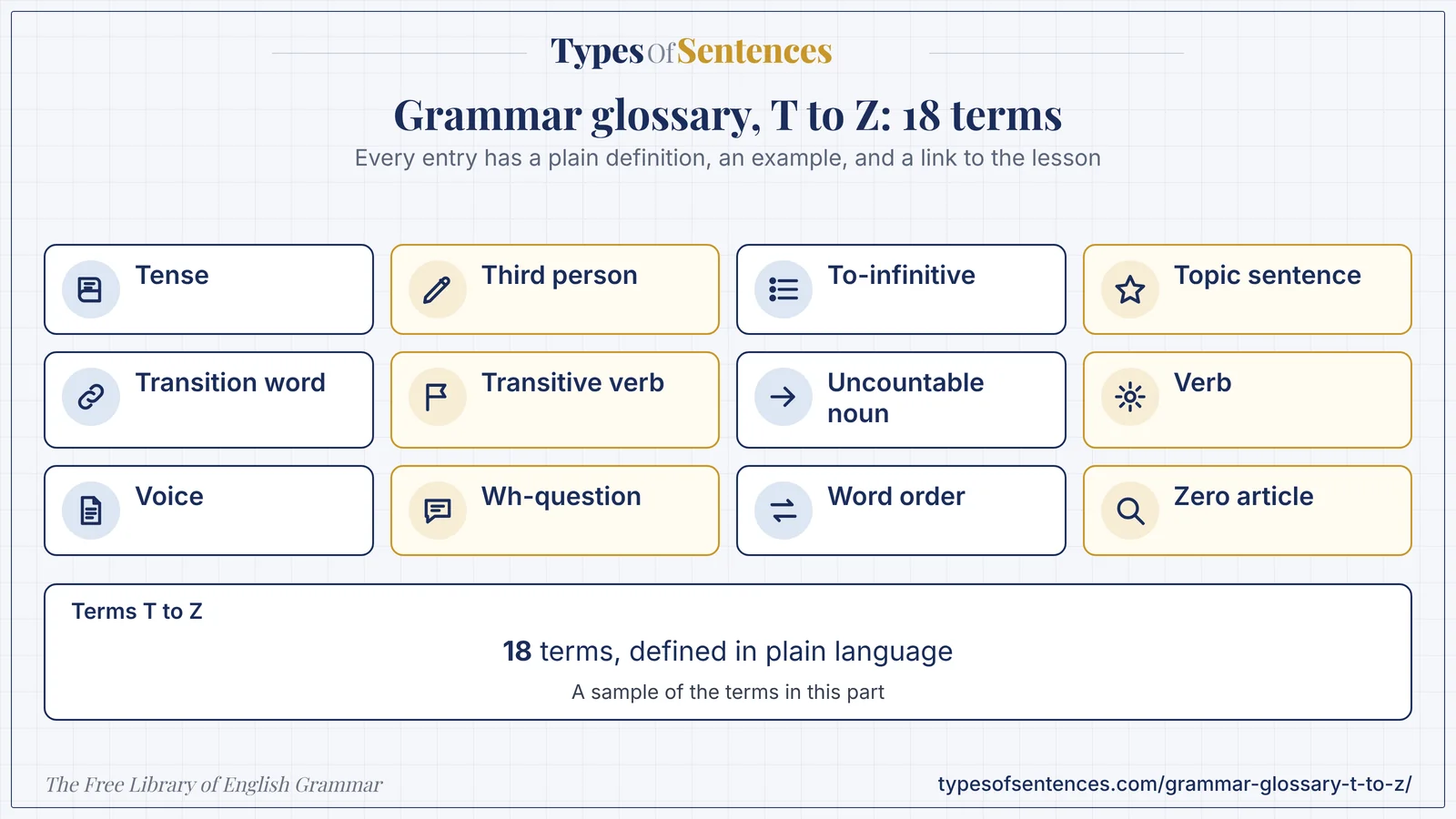
This last part of the glossary covers terms from T to Z. Most of them are about verbs and about how words are put together.
Why it matters: If a term that you need is not here, look in the other five parts, or use the contents on the grammar terms page.
Summary: This part of the glossary defines 18 grammar terms from tense to zero article, with an example for each and a link to the full lesson. Terms are in alphabetical order, and the letter list takes you to each section.
- Entries: a definition, an example, and a link to the lesson.
- Includes the verb terms and the writing terms.
- Previous part: Q to S.
- There are no entries under X and Y.
T
tense
Definition: The form of a verb that shows the time of an action or state: present, past, or future. English has two tense forms in the verb itself (present and past); the future is expressed with other words.
Example: walks (present), walked (past), will walk (future)
Learn more: Verb Tenses – Introduction to the 12 Tenses
third person
Definition: The form of pronouns and verbs used for the person or thing spoken about: he, she, it, they.
Example: She works here.
Learn more: Types of Pronouns – Complete Study
to-infinitive
Definition: The infinitive form with to before the base verb.
Example: She wants to leave.
Learn more: Infinitives – Complete Study
topic sentence
Definition: A sentence, usually the first in a paragraph, that states the main idea of the paragraph.
Example: Regular reading improves writing in three ways.
Learn more: Topic Sentence: Definition, Examples and How to Write One
transition word
Definition: A word or phrase that links ideas between sentences or paragraphs and shows their relation.
Example: however, for example, in addition, therefore
Learn more: Cohesion in Writing – Connecting Ideas in Writing
transitive verb
Definition: A verb that takes a direct object.
Example: She wrote a letter.
Learn more: Direct Object and Indirect Object
U
uncountable noun
Definition: A noun that names something not counted as separate items, so it has no plural and does not take a or an. It is also called a mass noun.
Example: water, advice, furniture
Learn more: The Noun – Types of Nouns, A Complete Study
unreal conditional
Definition: A conditional sentence about a situation that is not true, not likely, or imagined: the second and third conditionals.
Example: If I had wings, I would fly.
Learn more: Second Conditional
V
verb
Definition: A word that expresses an action, an event, or a state. The verb is the main word of the predicate.
Example: run, happen, be
Learn more: What is a Verb – Action and Being Words
verb phrase
Definition: A main verb together with its auxiliary verbs.
Example: has been working, will go
Learn more: Verb Phrases
verbal
Definition: A verb form that works as a noun, an adjective, or an adverb rather than as the verb of a clause: a gerund, an infinitive, or a participle.
Example: swimming, to swim, swum
Learn more: Gerunds – Complete Study
vocative
Definition: A word or phrase that names the person who is spoken to. In writing, it is set off by commas.
Example: Priya, please come here.
Learn more: Comma Rules
voice
Definition: The grammatical category that shows whether the subject does the action (active voice) or receives it (passive voice).
Example: The cat chased the mouse. / The mouse was chased.
Learn more: Passive Voice and Active Voice
W
wh-question
Definition: A question that begins with a question word such as who, what, where, when, why, or how, and that asks for information rather than yes or no.
Example: Where do you live?
Learn more: Question Words
word class
Definition: A group of words that behave in the same way in a sentence, such as noun, verb, or adjective. Word class is another name for part of speech.
Example: noun, verb, adjective
Learn more: Parts of Speech – The 8 Kinds of Words
word formation
Definition: The ways in which new words are made: by adding affixes, joining words, shortening, or changing the word class.
Example: unhappy, toothbrush, to email
Learn more: Prefixes and Suffixes – Word Formation Basics
word order
Definition: The arrangement of words in a sentence. In English, the usual order of a statement is subject, verb, object.
Example: The dog chased the cat.
Learn more: Seven Basic Sentence Patterns
Z
zero article
Definition: The absence of an article before a noun, as with plural and uncountable nouns used in a general sense.
Example: Dogs are loyal. Water is essential.
Learn more: Definite and Indefinite Articles – Complete Study
Recap in 12 seconds
Watch the lesson build itself: A sample of the 18 grammar terms from T to Z: tense, third person, to-infinitive, topic sentence, transition word, transitive verb, uncountable noun, verb, voice, wh-question, word order, zero article. The video has no sound.
Frequently Asked Questions
What is in the grammar glossary T to Z?
This part lists the grammar terms starting with T, U, V, W, and Z, from tense to zero article, including transitive verb, uncountable noun, verb phrase, voice, and word class.
What is a zero article?
A zero article is the absence of a, an, or the before a noun, as with plural and uncountable nouns used in a general sense (Dogs are loyal).
What is the difference between tense and voice?
Tense shows the time of an action (past, present, future). Voice shows whether the subject does the action (active) or receives it (passive).
Where can I find terms that start with other letters?
The other five parts of the glossary cover A to C, D to G, H to M, N to P, and Q to S. All six parts are linked from the grammar terms page.
- Huddleston, Rodney, and Geoffrey K. Pullum. A Student’s Introduction to English Grammar. Cambridge University Press, 2005.: standard definitions of grammatical terms.
- Crystal, David. A Dictionary of Linguistics and Phonetics. 6th ed. Blackwell, 2008.: a reference for the terms.
- Quirk, Randolph, Sidney Greenbaum, Geoffrey Leech, and Jan Svartvik. A Comprehensive Grammar of the English Language. Longman, 1985.: a reference grammar.
- Merriam-Webster Dictionary: tense: the dictionary entry.
Last reviewed: October 29, 2026. How it was made: drafted with AI assistance, then checked with automated tests (structure, links, spelling) and against the sources above. A person has not yet read this glossary line by line. Found a mistake? Report it.