The modals of deduction let us draw a conclusion from evidence: The lights are on, so she must be at home; He has just eaten, so he can’t be hungry. Must expresses a strong positive conclusion, and can’t expresses a strong negative one. We use them when we are almost sure but have not seen the fact itself. A conclusion of this kind is called a logical conclusion.
This chapter covers the modals of deduction: must and can’t for the present, must have and can’t have for the past, couldn’t, and should for expectation. You will see how to place them on a scale of certainty, how deduction differs from obligation, and how to avoid the usual errors. Thirty exercises and a quiz follow.
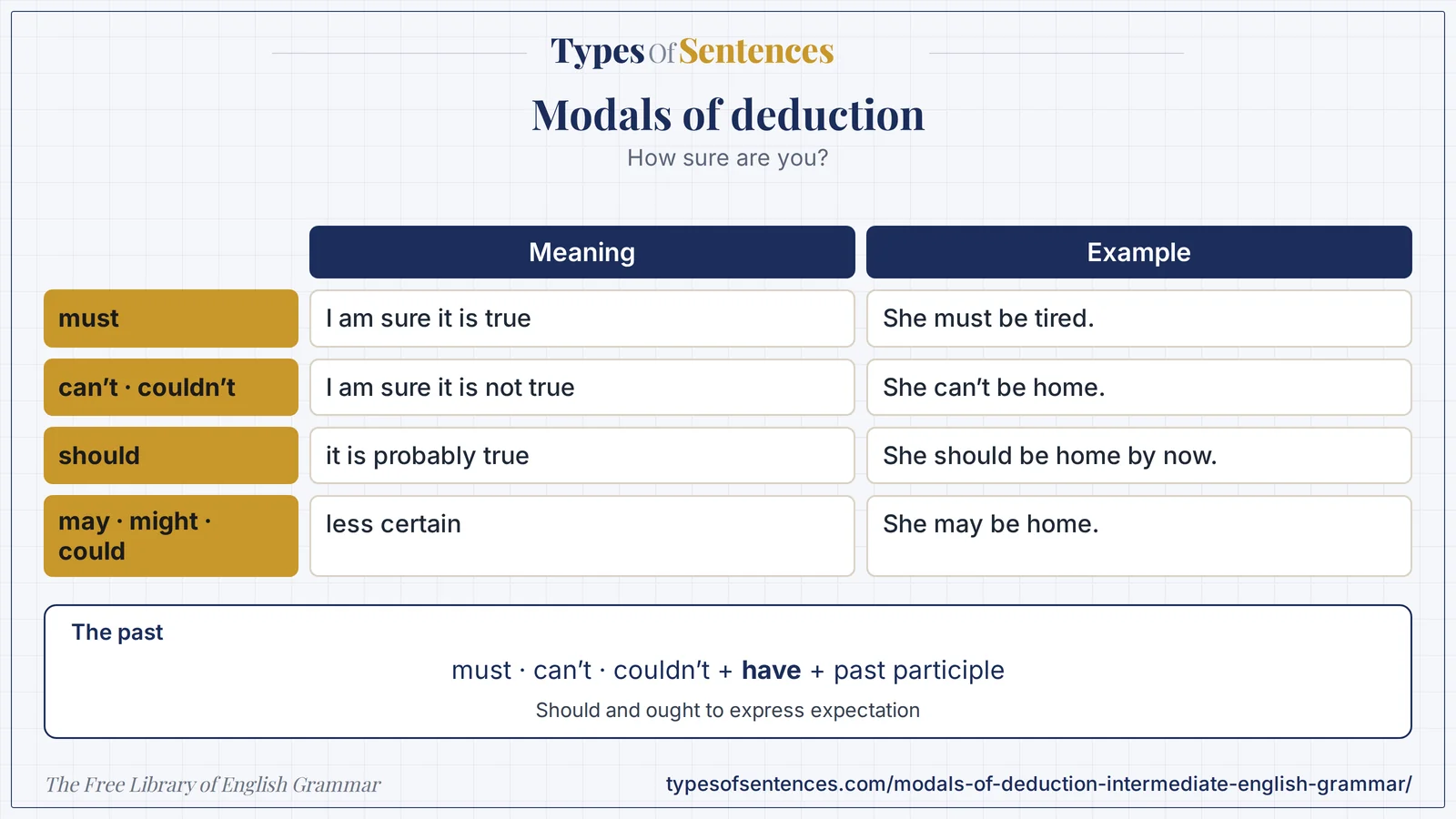
Deduction is detective thinking. You see evidence and you reason to a conclusion: The streets are wet, so it must have rained.
Why it matters: The two key words are must (I am sure it is true) and can’t (I am sure it is not true). The same modal must can also mean obligation, so context matters.
Summary: Must = I am sure it is true (She must be tired). Can’t and couldn’t = I am sure it is not true (She can’t be home). Should = it is probably true (She should be home by now). For the past, use must have, can’t have, and couldn’t have plus the past participle. Do not use mustn’t for deduction.
- Present: must/can’t + be, + be + -ing.
- Past: must/can’t/couldn’t + have + past participle.
- Expectation: should, ought to.
- Possibility (less certain): may, might, could.
What You’ll Learn
- 1. Modals of Deduction: A Logical Conclusion
- 2. Must: A Positive Logical Conclusion
- 3. Can’t and Couldn’t: Impossible
- 4. Should and Ought To: Expectation
- 5. Past Deductions: Must Have and Can’t Have
- 6. Degrees of Certainty
- 7. Questions and Negatives with Deduction Modals
- 8. Common Errors with Modals of Deduction
- 9. Exercises
- 10. Test Your Knowledge
- 11. Frequently Asked Questions
- 12. Conclusion
1. Modals of Deduction: A Logical Conclusion
A deduction is a conclusion based on evidence. The speaker has not seen the fact, but the evidence points to it. The modals of deduction show how sure the speaker is. They are part of the group introduced in the chapter on modal verbs.
| Evidence | Deduction | Modal |
|---|---|---|
| The lights are on and her car is outside. | She is at home. (sure) | She must be at home. |
| She left an hour ago and the trip takes two hours. | She is not home. (sure) | She can’t be home. |
| The streets are wet. | It rained. (sure) | It must have rained. |
| He was with me all evening. | He did not do it. (sure) | He can’t have done it. |
If the speaker is less sure, the modals of possibility are used instead (may, might, could); see the chapter on modals of possibility.
2. Must: A Positive Logical Conclusion
Must expresses a strong positive deduction: the speaker is almost certain that something is true.
| Pattern | Example |
|---|---|
| must + be (state) | She must be tired. He must be at work. |
| must + be + -ing (action in progress) | They must be sleeping. He must be working late. |
| must + base verb (stative verb) | She must know the answer. He must live nearby. |
| must + have + past participle (past) | She must have left. They must have arrived. |
| must + have been + -ing (past, in progress) | He must have been waiting for hours. |
| Deduction | Obligation |
|---|---|
| She must be a doctor. (I conclude) | You must see a doctor. (I require) |
| It must be late. (conclusion) | It must be done today. (requirement) |
In American English, have to and have got to are also used for deduction: He has to be home by now, It’s got to be a mistake. The obligation meaning is in the previous chapter, on modals of obligation.
3. Can’t and Couldn’t: Impossible
Can’t expresses a strong negative deduction: the speaker is almost certain that something is not true. Couldn’t means the same and is slightly more tentative or can refer to the past.
| Pattern | Example |
|---|---|
| can’t + be | She can’t be home. It can’t be true. |
| can’t + be + -ing | He can’t be sleeping. It’s too loud. |
| couldn’t + be | That couldn’t be Tom. He’s in Paris. |
| can’t / couldn’t + have + past participle | She can’t have left. He couldn’t have known. |
The negative of the deduction must is can’t.
Spelling note. In writing, always keep the apostrophe: can’t, couldn’t. Many people type the phrases without it when they search, as in “cant have” or “must cant deduction.” That shortcut is fine for a search box, but in your own writing it is an error, and cant is also a different word meaning insincere talk.
4. Should and Ought To: Expectation
Should and ought to express an expectation: something is probably true or will probably happen, but the speaker is not certain.
| Use | Example |
|---|---|
| present expectation | She should be home by now. The meeting ought to be over. |
| future expectation | The train should arrive at six. It should be easy. |
| negative expectation | It shouldn’t take long. |
| expectation about the past (with have) | The mail should have arrived by now. |
| Modal | Certainty | Example |
|---|---|---|
| must | very sure (positive) | She must be at home. |
| should | probably | She should be at home. |
| may, could | possible | She may be at home. |
| might | less likely | She might be at home. |
| can’t, couldn’t | sure it is not | She can’t be at home. |
Will also expresses an assumption: That will be the postman (I assume it is). Would is used for a polite or hypothetical assumption: That would be Tom.
5. Past Deductions: Must Have and Can’t Have
For a logical conclusion about the past, use the modal plus have and the past participle. The speaker is sure about something that happened, but has not seen it.
| Pattern | Example | Meaning |
|---|---|---|
| must have + past participle | She must have missed the bus. | I am sure she missed it |
| must have been + -ing | They must have been sleeping. | I am sure they were sleeping |
| can’t have + past participle | He can’t have taken it. He was away. | I am sure he did not take it |
| couldn’t have + past participle | She couldn’t have known. | it was impossible for her to know |
| should have + past participle | The mail should have come. | I expected it to come |
| may / might / could have + past participle | She might have forgotten. | possible, not sure |
- The window is broken. Someone must have thrown a stone.
- He can’t have forgotten my birthday. He sent a card.
- You couldn’t have seen him. He was abroad.
- The ground is dry. It can’t have rained.
The perfect forms are described in the chapter on verb phrases. Note that can’t have and couldn’t have both express a strong negative conclusion about the past, but couldn’t have can also express that something was not possible for someone.
6. Degrees of Certainty
| Certainty | Present | Past | Percent (rough) |
|---|---|---|---|
| sure it is true | must be | must have been | 95% |
| probably true | should be, ought to be | should have been | 80% |
| possible | may be, could be | may have been, could have been | 50% |
| less likely | might be | might have been | 30% |
| probably false | shouldn’t be | — | 20% |
| sure it is not true | can’t be, couldn’t be | can’t have been, couldn’t have been | 5% |
Choose the modal: Her coat is here, but I can’t find her. She (be) in the building, but she (not, leave).
- The evidence (the coat) makes it very probable: must be.
- The conclusion that she did not leave is also strong: can’t have left.
- Result: She must be in the building, but she can’t have left.
7. Questions and Negatives with Deduction Modals
| Form | Example | Note |
|---|---|---|
| can in questions | Can he be serious? Who can that be? | questions about deduction use can or could, not must |
| could in questions | Could it have been Tom? | a question about possibility or deduction |
| must in questions | Must it be true? (rare) | more natural: Do you think it is true? |
| negatives with must | — | use can’t or couldn’t instead |
| tag questions | She must be tired, isn’t she? | the tag uses the main verb be |
| short answers | It must be. / It can’t be. | repeat the modal |
Questions about deduction use can or could, or an ordinary question such as Do you think …?
8. Common Errors with Modals of Deduction
| Error | Correction | Rule |
|---|---|---|
| He mustn’t be home. | He can’t be home. | negative deduction uses can’t |
| She must to be tired. | She must be tired. | no to after a modal |
| She must tired. | She must be tired. | be is needed before an adjective |
| She must has left. | She must have left. | have, not has |
| She must of left. | She must have left. | have, not of |
| She can’t has left. | She can’t have left. | have after a modal |
| She must be arrive soon. | She will arrive soon. / She should arrive soon. | a future event needs will or should |
| He must be sleep. | He must be sleeping. | continuous: be + -ing |
| It can not be true. | It can’t be true. / It cannot be true. | cannot is one word |
Fix: He mustn’t be at home because the lights are off, and he must of gone out, so he can’t has been sleep.
- mustn’t be at home: negative deduction: can’t be at home.
- must of gone: must have gone.
- can’t has been sleep: can’t have been sleeping.
- Result: He can’t be at home because the lights are off, and he must have gone out, so he can’t have been sleeping.
Recap in 12 seconds
Watch the lesson build itself: Must, can’t, should, and may express how sure you are, and the past uses have and a past participle. The video has no sound.
Exercises
Part A: Must and Can’t (Exercises 1–8)
Exercise 1: Complete: The lights are on. She (must/can’t) be at home.
Show Answer
Answer: must.
Exercise 2: Complete: She left an hour ago. She (must/can’t) be home yet.
Show Answer
Answer: can’t.
Exercise 3: Complete: He is in Paris. That (must/can’t) be Tom.
Show Answer
Answer: can’t.
Exercise 4: Complete: He looks pale. He (must/can’t) be ill.
Show Answer
Answer: must.
Exercise 5: Fix it: He mustn’t be home.
Show Answer
Answer: He can’t be home.
Exercise 6: Fix it: She must tired.
Show Answer
Answer: She must be tired.
Exercise 7: Add the continuous: They must sleep. (now)
Show Answer
Answer: They must be sleeping.
Exercise 8: Is You must see a doctor a deduction?
Show Answer
Answer: No. It is an obligation or strong advice.
Part B: Past Deductions (Exercises 9–16)
Exercise 9: Past: She must miss the bus.
Show Answer
Answer: She must have missed the bus.
Exercise 10: Past: It can’t rain.
Show Answer
Answer: It can’t have rained.
Exercise 11: Past: He must wait for hours. (continuous)
Show Answer
Answer: He must have been waiting for hours.
Exercise 12: Past: She couldn’t know.
Show Answer
Answer: She couldn’t have known.
Exercise 13: Fix it: She must of left.
Show Answer
Answer: She must have left.
Exercise 14: Fix it: She must has left.
Show Answer
Answer: She must have left.
Exercise 15: Fix it: She can’t has left.
Show Answer
Answer: She can’t have left.
Exercise 16: Evidence: The window is broken. Deduction:
Show Answer
Answer: Someone must have broken it (or thrown a stone).
Part C: Should and Expectation (Exercises 17–21)
Exercise 17: Complete: The train (should/must) arrive at six. (expectation)
Show Answer
Answer: should.
Exercise 18: Complete: She (should/must) be home by now. (probably)
Show Answer
Answer: should.
Exercise 19: Past expectation: The mail should come. (it did not)
Show Answer
Answer: The mail should have come.
Exercise 20: Negative expectation: It shouldn’t take long. means:
Show Answer
Answer: I expect it will not take long.
Exercise 21: Assumption with will: That (be) the postman.
Show Answer
Answer: will be.
Part D: Degrees and Questions (Exercises 22–27)
Exercise 22: Order from most to least certain: might, must, may.
Show Answer
Answer: must, may, might.
Exercise 23: Choose: She (can’t/might not) be home. (impossible)
Show Answer
Answer: can’t.
Exercise 24: Question: Is it possible that he is serious? with can.
Show Answer
Answer: Can he be serious?
Exercise 25: Fix it: Must he be at home?
Show Answer
Answer: Can he be at home? (or Do you think he is at home?)
Exercise 26: Tag: She must be tired, ___?
Show Answer
Answer: isn’t she.
Exercise 27: Short answer to Is it true? (sure it is)
Show Answer
Answer: It must be.
Part E: Errors (Exercises 28–30)
Exercise 28: Fix it: She must to be tired.
Show Answer
Answer: She must be tired.
Exercise 29: Fix it: He must be sleep.
Show Answer
Answer: He must be sleeping.
Exercise 30: Fix it: She must be arrive soon.
Show Answer
Answer: She will arrive soon.
Test Your Knowledge
Ready to check what you learned? Answer all 10 questions, then submit. You need 80% (8 of 10) to pass. Your answers are not stored.
View correct answers and explanations
Question 1: Which expresses a strong positive deduction?
✓ Correct Answer: C – must
Must expresses a strong positive conclusion.
Question 2: Which expresses a strong negative deduction?
✓ Correct Answer: D – can’t
Can’t expresses impossibility.
Question 3: Which is correct?
✓ Correct Answer: A – He can’t be home.
Use can’t for a negative deduction.
Question 4: Which is correct for the past?
✓ Correct Answer: B – She must have missed the bus.
Must have plus the past participle.
Question 5: Which is correct?
✓ Correct Answer: A – She can’t have left.
Can’t have plus the past participle.
Question 6: Which expresses expectation?
✓ Correct Answer: C – should
Should expresses what is probable.
Question 7: Which is correct?
✓ Correct Answer: C – She must be tired.
Be is needed.
Question 8: Which shows the least certainty?
✓ Correct Answer: D – might
Might is the least certain.
Question 9: Which is a deduction?
✓ Correct Answer: B – She must be a doctor.
She must be a doctor is a conclusion.
Question 10: Which is the best question about a deduction?
✓ Correct Answer: B – Can he be at home?
Questions about deduction use can.
Frequently Asked Questions
What are the modals of deduction?
The modals of deduction are must (a positive logical conclusion), can’t and couldn’t (a negative one), and should (expectation). They show how sure the speaker is, based on evidence.
What is a logical conclusion?
A logical conclusion is a conclusion drawn from evidence, as in The lights are on, so she must be at home. The speaker has not seen the fact, but the evidence makes it very probable.
How do I use must have?
Use must have plus the past participle for a strong conclusion about the past: She must have missed the bus. Add been and -ing for an action in progress: He must have been waiting.
How do I use can’t have?
Use can’t have plus the past participle for a strong negative conclusion about the past: He can’t have taken it; he was away. Searches such as “cant have” and “must cant deduction” appear without the apostrophe, but the correct spelling keeps it.
What is the difference between must and can’t in deduction?
Must means I am sure it is true; can’t means I am sure it is not true. They are opposites. Do not use mustn’t for the negative, because mustn’t means forbidden.
How is deduction different from obligation?
Deduction concludes from evidence (She must be tired); obligation requires an action (You must rest). The modal is the same, and context shows the meaning.
Can I use must in the future?
Not for deduction. For a future prediction, use will or should (She will arrive soon). Must about the future would mean an obligation.
Conclusion
You now know the modals of deduction: must for a positive logical conclusion, can’t and couldn’t for a negative one, should for expectation, and the perfect forms must have and can’t have for the past. You can place them on a scale of certainty, tell deduction from obligation, and avoid the common errors.
Look at the evidence and ask how sure you are. Next, you will study other uses of modal verbs.
- Merriam-Webster Dictionary: must: the dictionary entry for the modal must.
- Purdue Online Writing Lab: Grammar: reference section on verbs.
- Quirk, Randolph, et al. A Comprehensive Grammar of the English Language. Longman, 1985.: logical necessity and impossibility.
- Huddleston, Rodney, and Geoffrey K. Pullum. The Cambridge Grammar of the English Language. Cambridge University Press, 2002.: epistemic necessity.
Last reviewed: October 29, 2026. How it was made: drafted with AI assistance, then checked with automated tests (structure, links, answer keys, spelling) and against the sources above. A person has not yet read this chapter line by line. Found a mistake? Report it.