The modals of obligation express what must, should, or need to be done: You must wear a seat belt, I have to work tomorrow, You should rest. They differ in strength and in the source of the obligation. Must and have to express strong obligation, should and ought to express advice, and don’t have to and needn’t express that something is not necessary.
This chapter is about expressing obligation and necessity: the necessity modals and their meanings. You will study must and have to, must vs have to, should and ought to for advice, had better for strong warnings, need, the difference between must not and don’t have to, had to for past obligation, and the common errors. Thirty exercises and a quiz follow.
Obligation is the idea that something is required. The strength can range from a rule you must obey to a piece of friendly advice.
Why it matters: The key choices are between must (the speaker’s own authority) and have to (an outside rule), and between mustn’t (forbidden) and don’t have to (not necessary).
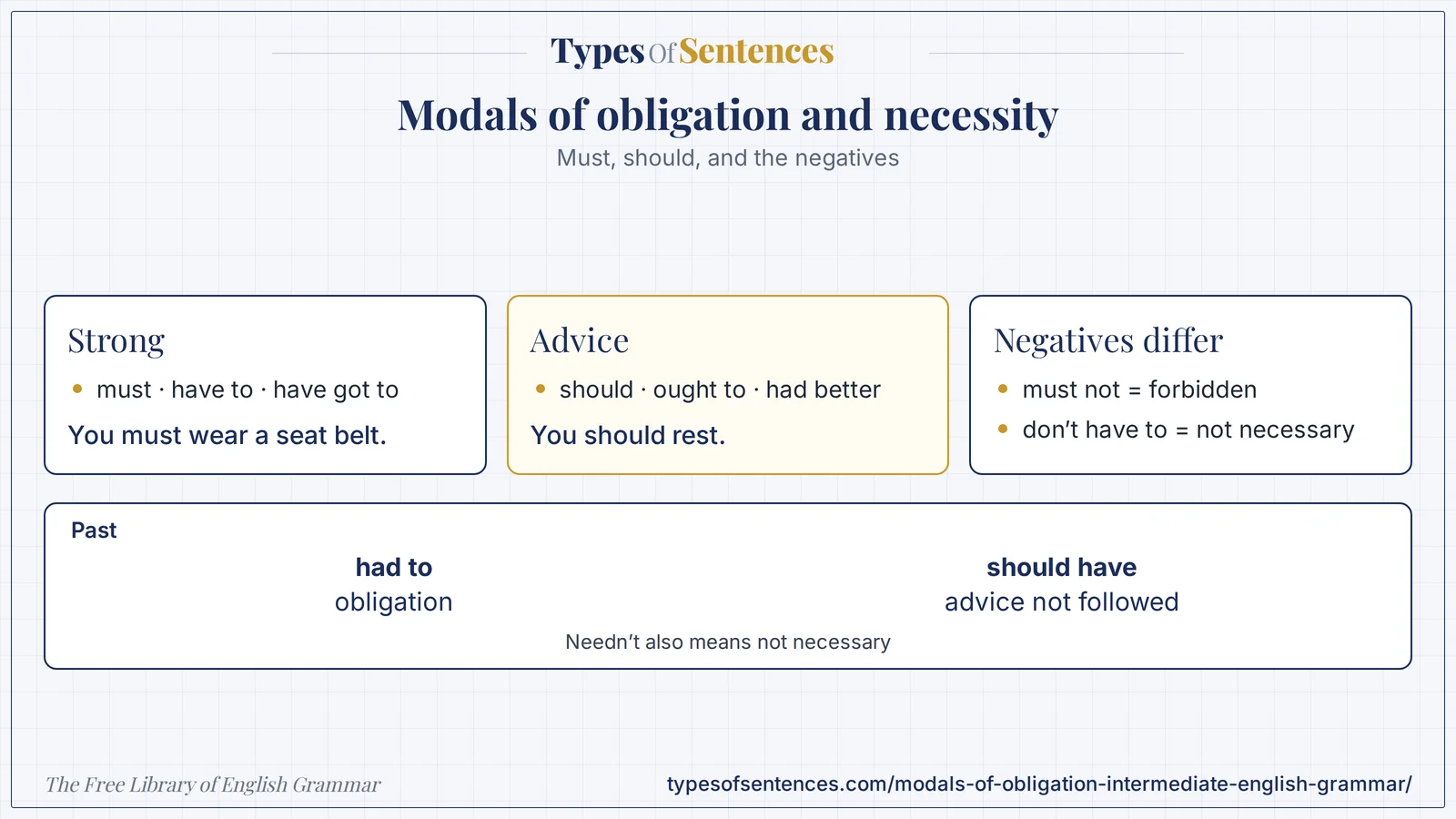
Summary: Must and have to express strong obligation; should and ought to express advice or expectation; had better expresses a strong warning. The negatives differ: must not means forbidden, while don’t have to and needn’t mean not necessary. Must has no past; use had to.
- Strong: must, have to, have got to.
- Advice: should, ought to, had better.
- Forbidden: must not, can’t. Not necessary: don’t have to, needn’t.
- Past: had to (obligation), should have (advice not followed).
What You’ll Learn
- 1. Modals of Obligation: Expressing Obligation and Necessity
- 2. Must, Have To: Strong Obligation
- 3. Must vs. Have To
- 4. Should, Ought To: Advice and Expectation
- 5. Had Better and Need
- 6. Must Not vs. Don’t Have To
- 7. Had To: Past Obligation
- 8. Other Ways of Expressing Obligation
- 9. Common Errors with Modals of Obligation
- 10. Exercises
- 11. Test Your Knowledge
- 12. Frequently Asked Questions
- 13. Conclusion
1. Modals of Obligation: Expressing Obligation and Necessity
Obligation is the idea that someone is required to do something. Necessity is the idea that it is needed. English expresses both with modals and semi-modals, introduced in the chapter on modal verbs.
| Strength | Modals | Example |
|---|---|---|
| required (strong) | must, have to, have got to | You must wear a seat belt. I have to work tomorrow. |
| strongly advised | had better, should, ought to | You had better leave now. You should rest. |
| suggested | could, might | You could ask her. |
| not necessary | don’t have to, needn’t, don’t need to | You don’t have to come. |
| forbidden | must not, can’t, may not | You mustn’t smoke here. |
2. Must, Have To: Strong Obligation
I. Must
Must expresses strong obligation that comes from the speaker or from an official rule. It is used in the present and future only.
| Use | Example |
|---|---|
| the speaker’s own feeling of necessity | I must call my mother. I must remember to pay the bill. |
| the speaker’s authority | You must finish your homework. |
| rules and notices (formal) | Passengers must show their tickets. Visitors must sign in. |
| strong advice or recommendation | You must see this film. It’s wonderful. |
| written instructions | Applicants must be over eighteen. |
II. Have to
Have to expresses an obligation that comes from an outside source: a rule, a law, or circumstances. It has all tenses and forms.
| Form | Example |
|---|---|
| present | I have to work tomorrow. She has to leave early. |
| past | I had to work yesterday. |
| future | We will have to wait. |
| present perfect | I have had to change my plans. |
| infinitive | I don’t want to have to go. |
| negative | I don’t have to work tomorrow. |
| question | Do you have to leave? Does she have to go? |
Have got to is an informal form, especially in speech: I’ve got to go. In American English, have to and gotta are the most common spoken forms.
3. Must vs. Have To
| Must | Have to | |
|---|---|---|
| source | the speaker (internal) or an official rule | an outside source (external) |
| tenses | present and future only | all tenses |
| typical example | I must lose weight. (I feel it) | I have to wear a uniform. (a rule) |
| writing | formal rules and signs | ordinary speech and writing |
| past | had to | had to |
| negative meaning | forbidden: mustn’t | not necessary: don’t have to |
- I must finish this report. (the speaker feels the need)
- I have to finish this report. (the boss demands it)
- You must be home by ten. (the speaker’s rule)
- You have to be home by ten. (a rule from someone else)
The difference between must and have to is often small in everyday speech, and in American English have to is the usual choice. Must sounds formal or emphatic, so many speakers prefer it for rules in writing (Students must register by Friday) and for personal resolutions (I must stop eating sweets).
4. Should, Ought To: Advice and Expectation
Should and ought to express advice, a recommendation, or what is right or expected. They are weaker than must.
| Use | Example |
|---|---|
| advice | You should see a doctor. You ought to rest. |
| a duty or what is right | We should help our neighbors. |
| expectation (it is likely) | The train should arrive at six. She should be home by now. |
| criticism about the past (with have) | You should have called me. She ought to have apologized. |
| Form | Example |
|---|---|
| should negative | You shouldn’t smoke. |
| ought to negative | You ought not to smoke. (formal; oughtn’t to) |
| question with should | Should I call her? What should I do? |
| question with ought to | Ought I to call her? (formal, rare) |
5. Had Better and Need
Had better expresses a strong recommendation with a warning about what will happen if the advice is not taken. It has the form of the past but refers to the present or the future.
| Use | Example |
|---|---|
| strong advice with a warning | You had better leave now, or you will miss the train. |
| contraction | You’d better hurry. |
| negative | You had better not be late. |
| not used for a past meaning | You had better to leave. (incorrect) |
| Form | Example | Meaning |
|---|---|---|
| need to + base verb (ordinary verb) | I need to go. Do you need to leave? | it is necessary |
| don’t need to / needn’t (not necessary) | You don’t need to come. You needn’t come. (British) | not necessary |
| need (modal, mainly British, in negatives and questions) | Need I go? You needn’t worry. | less common in American English |
| didn’t need to | I didn’t need to go, so I stayed. | it was not necessary (and I may not have gone) |
| needn’t have + past participle | I needn’t have gone. (I went, but it was unnecessary) | a past action that was not necessary |
6. Must Not vs. Don’t Have To
| Form | Meaning | Example |
|---|---|---|
| must not (mustn’t) | forbidden | You mustn’t smoke here. (It is against the rules.) |
| don’t have to / doesn’t have to | not necessary (you may if you wish) | You don’t have to come. (It is your choice.) |
| needn’t / don’t need to | not necessary | You needn’t worry. You don’t need to bring anything. |
| can’t | not allowed (informal) | You can’t park here. |
| shouldn’t | advice not to | You shouldn’t eat so fast. |
Do not use do with must. Choose between mustn’t and don’t have to according to the meaning, because they are almost opposite.
The prohibition meaning is also expressed with can’t and may not, as in the chapter on modals of permission.
7. Had To: Past Obligation
Must has no past form. For past obligation use had to. The past of don’t have to is didn’t have to.
| Meaning | Present | Past |
|---|---|---|
| obligation | I must / have to go. | I had to go. |
| no obligation | I don’t have to go. | I didn’t have to go. |
| advice, not followed | You should go. | You should have gone. |
| unnecessary action done | You needn’t go. | You needn’t have gone. |
| obligation in the future | I must / have to go. | I will have to go. |
| Sentence | Meaning |
|---|---|
| I didn’t have to go. | It was not necessary, and I may or may not have gone. |
| I needn’t have gone. | I went, but it was unnecessary. |
| I had to go. | It was necessary, and I went. |
| I should have gone. | I did not go (and it was a mistake). |
The past and future tenses with have to follow the rules in the chapters on the past tenses and the future tenses.
8. Other Ways of Expressing Obligation
| Expression | Use | Example |
|---|---|---|
| be supposed to | expectation or rule (often not followed) | You are supposed to be here at nine. We were supposed to meet. |
| be required to | formal rule | Employees are required to wear badges. |
| be obliged to | formal duty | Citizens are obliged to pay taxes. |
| be to | formal arrangement or order | You are to report at six. |
| have got to | informal necessity | I’ve got to go. |
| it is necessary to | formal necessity | It is necessary to register. |
| need to | general necessity | You need to sign here. |
Be supposed to often shows a gap between what is expected and what happens: He is supposed to be working, but he is playing games.
9. Common Errors with Modals of Obligation
| Error | Correction | Rule |
|---|---|---|
| You must to go. | You must go. | no to after must |
| He musts go. | He must go. / He has to go. | no -s on must |
| I musted go yesterday. | I had to go yesterday. | must has no past |
| You don’t must come. | You mustn’t come. / You don’t have to come. | choose by meaning |
| She have to go. | She has to go. | has to with she |
| Do you must go? | Must you go? / Do you have to go? | inversion with must, do with have to |
| You should to rest. | You should rest. | no to after should |
| You had better to leave. | You had better leave. | base form after had better |
| I should of called. | I should have called. | have, not of |
| You ought go. | You ought to go. | ought needs to |
Fix: Yesterday I must to finish my report because my boss said I don’t must be late, and I should of started earlier, so I had better to hurry now.
- must to finish (past): had to finish.
- don’t must be late: forbidden: mustn’t be late.
- should of started: should have started.
- had better to hurry: had better hurry.
- Result: Yesterday I had to finish my report because my boss said I mustn’t be late, and I should have started earlier, so I had better hurry now.
Recap in 12 seconds
Watch the lesson build itself: Obligation and advice modals, and the difference between forbidden and not necessary. The video has no sound.
Exercises
Part A: Must and Have To (Exercises 1–6)
Exercise 1: Which is the speaker’s own feeling: I must call her or I have to call her?
Show Answer
Answer: I must call her.
Exercise 2: Which is an outside rule: must or have to?
Show Answer
Answer: have to (usually).
Exercise 3: Fix it: He musts go.
Show Answer
Answer: He must go. (or He has to go.)
Exercise 4: Fix it: She have to go.
Show Answer
Answer: She has to go.
Exercise 5: Question with have to: She has to leave.
Show Answer
Answer: Does she have to leave?
Exercise 6: Future of have to: We (wait).
Show Answer
Answer: will have to wait.
Part B: Should, Ought To, Had Better (Exercises 7–12)
Exercise 7: Advice: You (should/must) see a doctor. (a friend’s advice)
Show Answer
Answer: should.
Exercise 8: Expectation: The train (should/must) arrive at six.
Show Answer
Answer: should.
Exercise 9: Criticism of the past: You (should/should have) called me. (you did not)
Show Answer
Answer: should have.
Exercise 10: Fix it: You had better to leave.
Show Answer
Answer: You had better leave.
Exercise 11: Fix it: You ought go.
Show Answer
Answer: You ought to go.
Exercise 12: Fix it: You should to rest.
Show Answer
Answer: You should rest.
Part C: Must Not vs Don’t Have To (Exercises 13–18)
Exercise 13: Choose: You (mustn’t/don’t have to) smoke here. (forbidden)
Show Answer
Answer: mustn’t.
Exercise 14: Choose: You (mustn’t/don’t have to) come. It’s optional.
Show Answer
Answer: don’t have to.
Exercise 15: Explain: You needn’t come.
Show Answer
Answer: It is not necessary to come.
Exercise 16: Fix it: You don’t must come.
Show Answer
Answer: You mustn’t come. (or You don’t have to come.)
Exercise 17: Which is informal: can’t or must not, for a prohibition?
Show Answer
Answer: can’t.
Exercise 18: Need: You (need/needs) to sign here.
Show Answer
Answer: need.
Part D: Past Obligation (Exercises 19–24)
Exercise 19: Past of I must go:
Show Answer
Answer: I had to go.
Exercise 20: Past of I don’t have to go:
Show Answer
Answer: I didn’t have to go.
Exercise 21: Fix it: I musted go yesterday.
Show Answer
Answer: I had to go yesterday.
Exercise 22: Explain: I needn’t have gone.
Show Answer
Answer: I went, but it was unnecessary.
Exercise 23: Explain: I didn’t have to go.
Show Answer
Answer: It was not necessary; I may or may not have gone.
Exercise 24: Past advice not followed: You should go.
Show Answer
Answer: You should have gone.
Part E: Other Expressions (Exercises 25–28)
Exercise 25: Complete: You are ___ to be here at nine. (expected)
Show Answer
Answer: supposed.
Exercise 26: Formal rule: Employees ___ required to wear badges.
Show Answer
Answer: are.
Exercise 27: Informal: I have to go.
Show Answer
Answer: I’ve got to go.
Exercise 28: Order from strongest to weakest: should, must, could.
Show Answer
Answer: must, should, could.
Part F: Errors (Exercises 29–30)
Exercise 29: Fix it: You must to go.
Show Answer
Answer: You must go.
Exercise 30: Fix it: I should of called.
Show Answer
Answer: I should have called.
Test Your Knowledge
Ready to check what you learned? Answer all 10 questions, then submit. You need 80% (8 of 10) to pass. Your answers are not stored.
View correct answers and explanations
Question 1: Which expresses strong obligation?
✓ Correct Answer: A – must
Must expresses strong obligation.
Question 2: Which expresses advice?
✓ Correct Answer: C – should
Should expresses advice.
Question 3: Which is correct for past obligation?
✓ Correct Answer: C – I had to go yesterday.
Must has no past; use had to.
Question 4: Which means forbidden?
✓ Correct Answer: D – You mustn’t come.
Must not means forbidden.
Question 5: Which means not necessary?
✓ Correct Answer: A – You don’t have to come.
Don’t have to means not necessary.
Question 6: Which is correct?
✓ Correct Answer: C – You must go.
A modal is followed by the base form.
Question 7: Which is correct?
✓ Correct Answer: B – You had better leave.
Had better is followed by the base form.
Question 8: Which is correct?
✓ Correct Answer: B – She has to go.
Has to with she.
Question 9: Which means “you went, but it was unnecessary”?
✓ Correct Answer: B – You needn’t have gone.
Needn’t have gone describes an unnecessary past action.
Question 10: Which is the strongest warning?
✓ Correct Answer: D – You had better leave.
Had better is a strong warning.
Frequently Asked Questions
What are the modals of obligation?
The modals of obligation are must, have to, have got to, should, ought to, had better, and need to. They express how strongly something is required or advised.
What is the difference between must, have to?
Must expresses obligation that comes from the speaker or an official rule. Have to expresses obligation from an outside source and works in all tenses. In American English, have to is the usual spoken form.
When do I use should, ought to?
Use should and ought to for advice, a duty, or an expectation: You should rest, The train should arrive at six. Should is more common than ought to.
What is the meaning of expressing obligation in the past?
Expressing obligation in the past uses had to (I had to work), should have for advice not followed (You should have called), and needn’t have for an unnecessary action (I needn’t have gone).
What are necessity modals?
Necessity modals are the modals and semi-modals that show that something is needed: must, have to, need to, and in the negative needn’t and don’t have to.
What is the difference between must not and don’t have to?
Must not means forbidden (You mustn’t smoke), while don’t have to means not necessary (You don’t have to come). They are almost opposites.
Can I use must in the past?
No. Must has no past form. Use had to for past obligation, as in I had to work yesterday.
Conclusion
You now know the modals of obligation and necessity: must and have to for strong obligation, should and ought to for advice, had better for warnings, need for necessity, the contrast between must not and don’t have to, and had to for the past. You can choose by strength and source and avoid the common errors.
Ask who is the source of the obligation, and how strong it is. Next, you will study modals of deduction.
- Merriam-Webster Dictionary: must: the dictionary entry for the modal must.
- Purdue Online Writing Lab: Grammar: reference section on verbs.
- Quirk, Randolph, et al. A Comprehensive Grammar of the English Language. Longman, 1985.: obligation and necessity.
- Huddleston, Rodney, and Geoffrey K. Pullum. The Cambridge Grammar of the English Language. Cambridge University Press, 2002.: deontic modality.
Last reviewed: October 29, 2026. How it was made: drafted with AI assistance, then checked with automated tests (structure, links, answer keys, spelling) and against the sources above. A person has not yet read this chapter line by line. Found a mistake? Report it.