The modals of possibility tell us that something is possible but not certain: It may rain, She might be late, That could be true. They are used when we do not know for sure, and they sit in the middle of the scale between certainty (must, will) and impossibility (can’t). Because they express doubt, they are sometimes called uncertain modals.
This chapter covers the modals of possibility one by one: may and might, could possibility, and can for general possibility. You will see expressing possibility in the present, in the future, and in the past with may have, might have, and could have, the degrees of certainty from strongest to weakest, and the difference between possibility and impossibility. Thirty exercises and a quiz follow.
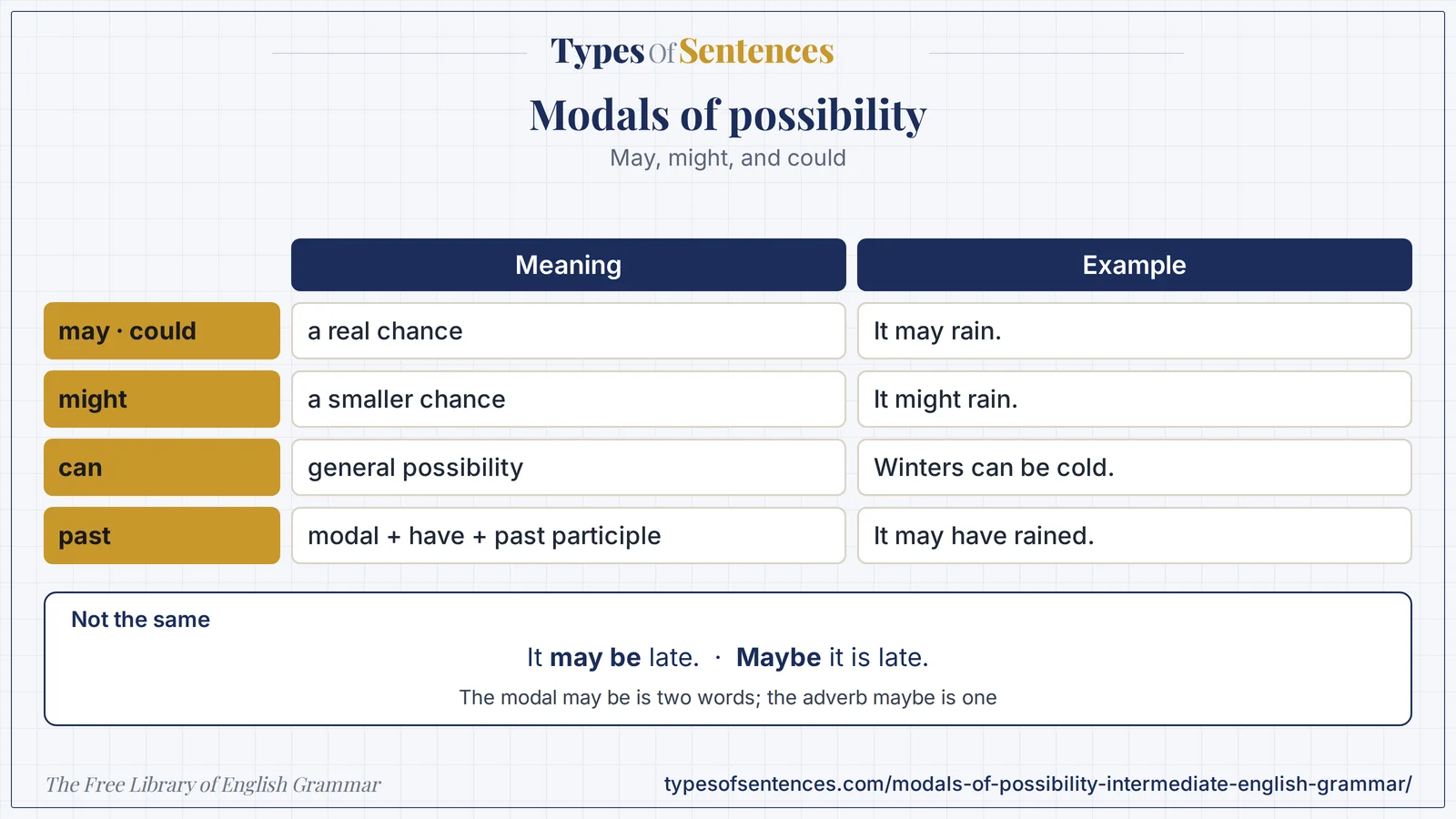
When you do not know whether something is true or will happen, you can say that it may, might, or could be true. These three modals are close in meaning, and each adds a slightly different degree of doubt.
Why it matters: The tense of the main verb decides the time: a base form for the present or future, have plus the past participle for the past.
Summary: May, might, and could express possibility (It may/might/could rain). May and could suggest a real chance; might a smaller one. Can expresses general, theoretical possibility. For the past, use the modal plus have and the past participle (She might have left). For impossibility use can’t or couldn’t.
- Present or future: may, might, could + base form.
- Past: may/might/could + have + past participle.
- Negative possibility: may not, might not (possibly not); impossibility: can’t, couldn’t.
- Do not confuse the modal may be with the adverb maybe.
What You’ll Learn
- 1. Modals of Possibility: What Is Possibility?
- 2. May and Might: Possibility
- 3. Could: Possibility
- 4. Can: General Possibility
- 5. Expressing Possibility in the Present and Future
- 6. May Have and Might Have: Past Possibility
- 7. Degrees of Certainty
- 8. Negatives and Questions with Possibility Modals
- 9. Common Errors with Modals of Possibility
- 10. Exercises
- 11. Test Your Knowledge
- 12. Frequently Asked Questions
- 13. Conclusion
1. Modals of Possibility: What Is Possibility?
Possibility is the idea that something may be true or may happen. The speaker is not sure. Possibility modals are part of the group described in the chapter on modal verbs. They differ from the modals of deduction, which show strong certainty from evidence; see the chapter on modals of deduction.
| Certainty | Modal | Example |
|---|---|---|
| sure it is true | must, will | She must be at home. She will be late. |
| probably true | should, ought to | She should be at home. |
| possible (about 50%) | may, could | She may be at home. She could be at home. |
| less likely (about 30%) | might | She might be at home. |
| sure it is not true | can’t, couldn’t | She can’t be at home. |
The percentages are only a rough guide, and speakers use the modals flexibly. The important contrast is between possible (may, might, could) and certain (must, can’t).
2. May and Might: Possibility
May and might are the two main modals of possibility. They have almost the same meaning, and the may, might possibility contrast is small: might sounds slightly less likely or more tentative.
| Modal | Use | Example |
|---|---|---|
| may | a real possibility | It may rain this afternoon. She may be right. |
| might | a smaller or more tentative possibility | It might rain, but I doubt it. I might go. |
| may / might + be + -ing | a possible action in progress or planned | She may be sleeping. He might be coming tonight. |
| may well / might well | a strong possibility | It may well rain. She might well win. |
| may / might + not | possibly not | It may not rain. She might not come. |
Both are used for the present and the future. In the sentence The report may be ready tomorrow, the possibility refers to the future, and in The report may be ready now to the present. Context and time words show which.
Some older grammars say that may expresses a greater probability than might. In modern usage, speakers often use them interchangeably, and might is common in American English even for ordinary possibilities. Use might when you want to sound more tentative.
3. Could: Possibility
Could expresses possibility, too. Could possibility is a present or future possibility, with no past meaning; it is often a suggestion or a theoretical option.
| Use | Example |
|---|---|
| present or future possibility | It could rain tomorrow. She could be at the station. |
| a possible option (suggestion) | You could ask your teacher. We could eat out tonight. |
| a possible danger | Be careful! You could fall. |
| an unreal or unlikely possibility | If it rained, the match could be canceled. |
| negative: possibility ruled out | That couldn’t be true. (impossible) |
| Statement | Meaning |
|---|---|
| She might not come. | It is possible that she will not come. |
| She couldn’t come. | It is impossible, or she was unable to come. |
| She can’t come. | It is impossible, or she is unable to come. |
4. Can: General Possibility
Can also expresses possibility, but of a general or theoretical kind: what is possible in principle, not what is probable in a particular case.
| Use | Example |
|---|---|
| general possibility | Smoking can cause cancer. Weather in the mountains can change fast. |
| typical behavior | Children can be very noisy. |
| theoretical option | You can take the bus or the train. |
| questions about possibility | Can this be true? How can that happen? |
5. Expressing Possibility in the Present and Future
| Time | Pattern | Example |
|---|---|---|
| present state | may / might / could + be | She may be at home. He might be ill. |
| present action in progress | may / might / could + be + -ing | They could be watching TV. She may be working. |
| future event | may / might / could + base verb | It may snow tomorrow. We might visit them next week. |
| future plan (uncertain) | might + base verb | I might go to the party. |
| possible state of affairs | may / might / could + have (present perfect meaning) | She may have finished by now. |
The words perhaps, maybe, and possibly can replace the modals: Perhaps it will rain, Maybe she is at home. Do not confuse the adverb maybe (one word) with the verb phrase may be (two words): Maybe she is right and She may be right mean the same.
6. May Have and Might Have: Past Possibility
For possibility about the past, use the modal plus have and the past participle. The speaker does not know what happened.
| Pattern | Example | Meaning |
|---|---|---|
| may have + past participle | She may have missed the bus. | perhaps she missed it |
| might have + past participle | He might have forgotten. | perhaps he forgot |
| could have + past participle | They could have taken a taxi. | it was possible that they did |
| may / might / could have been + -ing | She might have been sleeping. | perhaps she was sleeping |
| may / might not have + past participle | She may not have heard. | perhaps she did not hear |
The perfect forms also express a different meaning: an unrealized past possibility. You could have been killed means that the danger existed, but did not happen. She might have won can mean that she lost but had a chance. The verb phrases are in the chapter on verb phrases.
| Meaning | Example |
|---|---|
| uncertain past fact | She might have left already. (I do not know whether she did) |
| unrealized possibility (counterfactual) | You might have been killed. (but you were not) |
| criticism of a past failure | You could have called. (but you did not) |
7. Degrees of Certainty
| Degree | Present or future | Past | Meaning |
|---|---|---|---|
| certain true | must be, will be | must have been | sure |
| probably true | should be | should have been | expected |
| possible | may be, could be | may have been, could have been | 50–50 |
| less likely | might be | might have been | small chance |
| probably false | shouldn’t be | — | unexpected |
| certain false | can’t be, couldn’t be | can’t have been, couldn’t have been | impossible |
- The keys must be in the car. (I am sure.)
- The keys may be in the car. (I am not sure.)
- The keys might be in the car. (Less likely.)
- The keys can’t be in the car. (I checked.)
The strong forms, must and can’t, are in the chapter on modals of deduction. Choose the weaker forms when you do not have good evidence.
8. Negatives and Questions with Possibility Modals
| Form | Example | Note |
|---|---|---|
| may not / might not | It may not rain. She might not come. | a possibility that something is not true |
| can’t / couldn’t | She can’t be home. | impossibility, not possibility |
| question with could | Could it be true? Could she have left? | asks about possibility |
| question with might | Might it rain? (rare, formal) | more natural: Do you think it will rain? |
| question with may | May it rain? (not used) | not used for possibility; use Do you think …? |
May is not used to ask about possibility. In questions, use could or a phrase such as Do you think …?
9. Common Errors with Modals of Possibility
| Error | Correction | Rule |
|---|---|---|
| It may to rain. | It may rain. | no to after a modal |
| She maybe at home. | She may be at home. / Maybe she is at home. | may be (verb) vs maybe (adverb) |
| She might to come. | She might come. | base form after a modal |
| It may rains. | It may rain. | base form after a modal |
| She may has left. | She may have left. | have, not has, after a modal |
| She might of left. | She might have left. | have, not of |
| He could be there yesterday. | He could have been there yesterday. | past possibility needs have |
| It might could rain. | It might rain. / It could rain. | no double modals |
| That mightn’t be right (formal). | That might not be right. | might not is more usual |
Fix: She maybe late because she might of missed the bus, and it may rains, so she could to take a taxi.
- maybe late: the verb phrase may be late.
- might of missed: might have missed.
- may rains: may rain.
- could to take: could take.
- Result: She may be late because she might have missed the bus, and it may rain, so she could take a taxi.
Recap in 12 seconds
Watch the lesson build itself: May, might, and could express possibility with different strengths, and the past uses a modal with have and a past participle. The video has no sound.
Exercises
Part A: May, Might, Could (Exercises 1–6)
Exercise 1: Choose the weaker possibility: may or might?
Show Answer
Answer: might.
Exercise 2: Complete: It (may/must) rain, but I am not sure.
Show Answer
Answer: may.
Exercise 3: Rewrite with might: Perhaps she is late.
Show Answer
Answer: She might be late.
Exercise 4: Rewrite with could: Perhaps it will rain tomorrow.
Show Answer
Answer: It could rain tomorrow.
Exercise 5: Meaning of You could ask your teacher.
Show Answer
Answer: A suggestion (a possible option).
Exercise 6: Meaning of Be careful! You could fall.
Show Answer
Answer: A possible danger.
Part B: Can and General Possibility (Exercises 7–10)
Exercise 7: Choose: Weather in the mountains (can/may) change fast. (general)
Show Answer
Answer: can.
Exercise 8: Choose: It (can/may) rain tomorrow. (a specific day)
Show Answer
Answer: may.
Exercise 9: Meaning of Children can be noisy.
Show Answer
Answer: Typical behavior (general possibility).
Exercise 10: Is Can this be true? a possibility question?
Show Answer
Answer: Yes.
Part C: Present and Future (Exercises 11–16)
Exercise 11: Complete: She may (be/being) at home.
Show Answer
Answer: be.
Exercise 12: Complete: They could (be watching/watching) TV.
Show Answer
Answer: be watching.
Exercise 13: Make negative: It may rain.
Show Answer
Answer: It may not rain.
Exercise 14: Replace with maybe: She may be right.
Show Answer
Answer: Maybe she is right.
Exercise 15: Fix it: She maybe at home.
Show Answer
Answer: She may be at home.
Exercise 16: Fix it: It may to rain.
Show Answer
Answer: It may rain.
Part D: Past Possibility (Exercises 17–22)
Exercise 17: Past possibility: She may miss the bus. (past)
Show Answer
Answer: She may have missed the bus.
Exercise 18: Past possibility: He might forget. (past)
Show Answer
Answer: He might have forgotten.
Exercise 19: Past possibility: They could take a taxi. (past, unrealized)
Show Answer
Answer: They could have taken a taxi.
Exercise 20: Past continuous possibility: She might sleep.
Show Answer
Answer: She might have been sleeping.
Exercise 21: Fix it: She might of left.
Show Answer
Answer: She might have left.
Exercise 22: Explain: You could have been killed.
Show Answer
Answer: The danger existed, but it did not happen.
Part E: Certainty and Impossibility (Exercises 23–27)
Exercise 23: Which expresses impossibility: might not or can’t?
Show Answer
Answer: can’t.
Exercise 24: Order from sure to unlikely: might, must, may.
Show Answer
Answer: must, may, might.
Exercise 25: Choose: The keys (must/might) be in the car. (I am sure)
Show Answer
Answer: must.
Exercise 26: Choose: She (can’t/might not) be home. (impossible)
Show Answer
Answer: can’t.
Exercise 27: Which is a possibility question: May it rain? or Could it rain?
Show Answer
Answer: Could it rain?
Part F: Errors (Exercises 28–30)
Exercise 28: Fix it: It may rains.
Show Answer
Answer: It may rain.
Exercise 29: Fix it: It might could rain.
Show Answer
Answer: It might rain. (or It could rain.)
Exercise 30: Fix it: He could be there yesterday.
Show Answer
Answer: He could have been there yesterday.
Test Your Knowledge
Ready to check what you learned? Answer all 10 questions, then submit. You need 80% (8 of 10) to pass. Your answers are not stored.
View correct answers and explanations
Question 1: Which expresses possibility?
✓ Correct Answer: B – may
May expresses possibility.
Question 2: Which is the weakest possibility?
✓ Correct Answer: C – might
Might is the weakest of the three.
Question 3: Which is correct?
✓ Correct Answer: C – It may rain.
The base form follows a modal.
Question 4: Which is correct for the past?
✓ Correct Answer: D – She might have missed the bus.
Might have plus the past participle.
Question 5: Which is a suggestion?
✓ Correct Answer: A – You could ask her.
Could suggests an option.
Question 6: Which expresses impossibility?
✓ Correct Answer: C – It can’t be true.
Can’t expresses impossibility.
Question 7: Which is correct?
✓ Correct Answer: A – She may be at home.
May be is the verb phrase.
Question 8: Which expresses general possibility?
✓ Correct Answer: A – Smoking can cause cancer.
Can expresses general possibility.
Question 9: Which is not natural?
✓ Correct Answer: B – May it rain tomorrow?
May is not used to ask about possibility.
Question 10: Which is correct?
✓ Correct Answer: D – It might rain.
Avoid double modals.
Frequently Asked Questions
What are the modals of possibility?
The modals of possibility are may, might, and could (for specific cases) and can (for general possibility). They express that something is possible but not certain.
What is the difference between may might possibility?
May suggests a real chance, and might a smaller or more tentative one. In practice the two are often used interchangeably. Both are followed by the base form.
How is could possibility used?
Could expresses a present or future possibility (It could rain) or a possible option (You could ask her). For the past, use could have and the past participle.
What is expressing possibility in the past?
Expressing possibility in the past uses the modal plus have and the past participle: She may have missed the bus, He might have forgotten, They could have taken a taxi.
What are uncertain modals?
Uncertain modals is another name for the modals of possibility (may, might, could), which show that the speaker is not certain. The certain modals are must and can’t.
What is the difference between maybe and may be?
Maybe (one word) is an adverb meaning perhaps: Maybe she is right. May be (two words) is a verb phrase: She may be right.
Is might not the same as can’t?
No. Might not means it is possible that something is not true (She might not come). Can’t means it is impossible (She can’t be home).
Conclusion
You now know the modals of possibility: may, might, and could for particular cases, can for general possibility, and the perfect forms for the past. You can place them on the scale of certainty, tell possibility from impossibility, and avoid the common errors.
Ask how sure you are, and pick the modal that matches. Next, you will study modals of obligation and necessity.
- Merriam-Webster Dictionary: might: the dictionary entry for the modal might.
- Purdue Online Writing Lab: Grammar: reference section on verbs.
- Quirk, Randolph, et al. A Comprehensive Grammar of the English Language. Longman, 1985.: modal meanings (possibility, necessity, volition).
- Huddleston, Rodney, and Geoffrey K. Pullum. The Cambridge Grammar of the English Language. Cambridge University Press, 2002.: epistemic modality.
Last reviewed: October 29, 2026. How it was made: drafted with AI assistance, then checked with automated tests (structure, links, answer keys, spelling) and against the sources above. A person has not yet read this chapter line by line. Found a mistake? Report it.