The modals of permission are the verbs we use to ask for, give, or refuse permission: may, can, could, and might. They differ in formality: may is formal, can is informal, and could is polite when asking. English also uses be allowed to and be permitted to, which work in all tenses.
This chapter shows how to use the modals of permission for asking permission and giving permission, how to refuse politely, how the may, can permission contrast works, why could permission questions are polite but could is not used to give permission, and how to talk about permission in the past. It also covers be allowed to, polite formulas, and the usual errors. Thirty exercises and a quiz follow.
Permission is the right to do something. You can ask for it, give it, or refuse it, and each action has its own set of words.
Why it matters: The choice of modal is mostly a question of politeness. May is formal, can is relaxed, and could is the polite way to ask. The verb that follows is always in the base form.
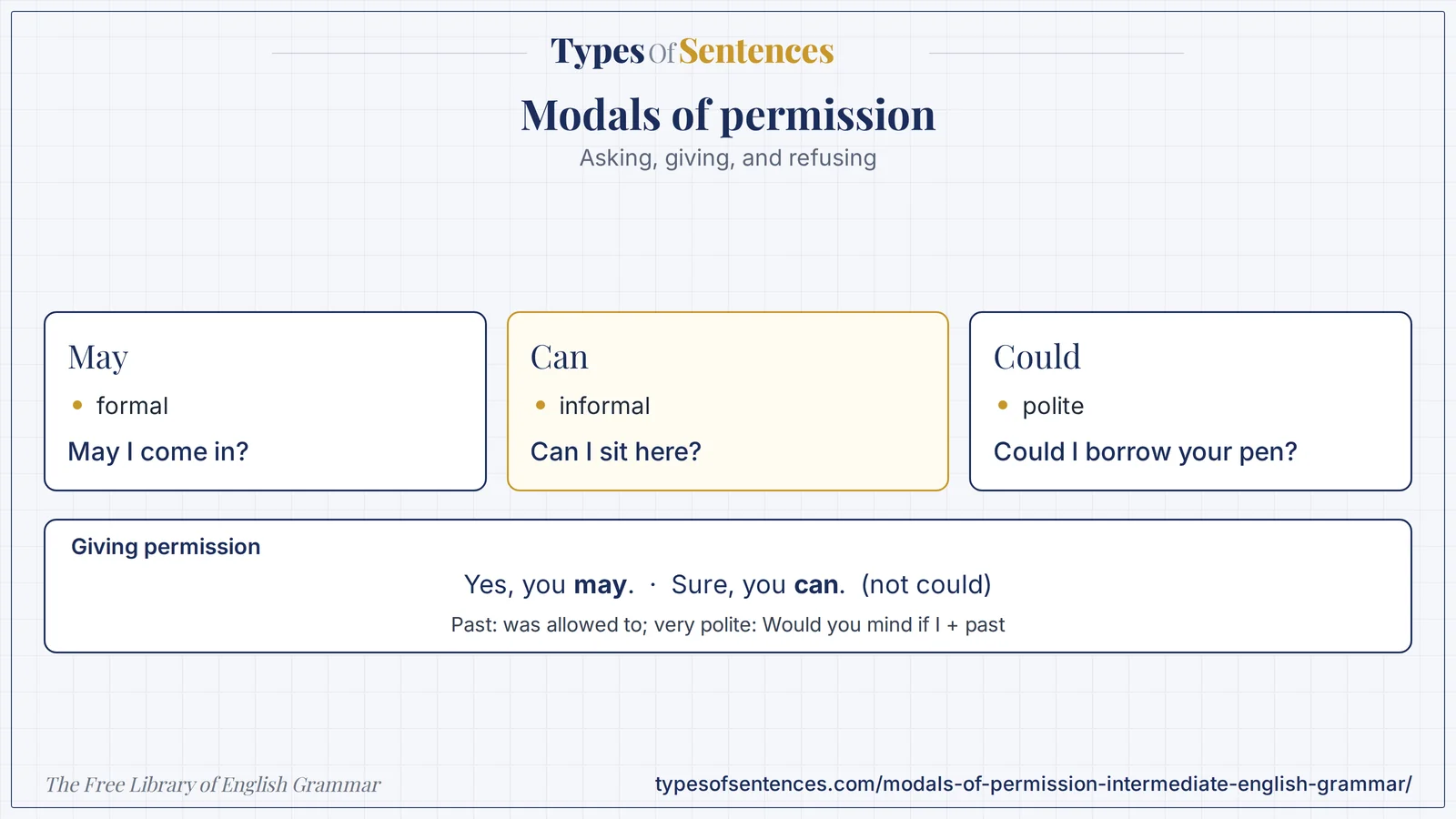
Summary: Ask with may (formal), can (informal), or could (polite): May I come in?, Can I sit here?, Could I borrow your pen? Give permission with may or can (not could): Yes, you may and Sure, you can. Refuse with can’t or may not, softened by I’m afraid. Use be allowed to for other tenses and rules.
- May = formal, can = informal, could = polite (to ask).
- Give permission with may or can; do not use could to give it.
- Past: was allowed to for specific events.
- Use Would you mind if I + past for very polite requests.
What You’ll Learn
- 1. Modals of Permission: Asking, Giving, and Refusing
- 2. May: Formal Permission
- 3. Can: Informal Permission
- 4. Could: Polite Permission
- 5. Might: Very Formal Permission
- 6. Be Allowed To, Be Permitted To, Let
- 7. Giving Permission
- 8. Refusing Permission
- 9. Asking for Permission: Polite Formulas
- 10. Formal vs. Informal Use
- 11. Common Errors with Modals of Permission
- 12. Exercises
- 13. Test Your Knowledge
- 14. Frequently Asked Questions
- 15. Conclusion
1. Modals of Permission: Asking, Giving, and Refusing
Permission has three parts: asking for it, giving it, and refusing it. The modal verbs involved belong to the group introduced in the chapter on modal verbs.
| Action | Formal | Neutral or informal |
|---|---|---|
| asking | May I use your phone? | Can I use your phone? / Could I use your phone? |
| giving | Yes, you may. | Yes, you can. / Sure. / Go ahead. |
| refusing | I’m afraid you may not. | No, you can’t. / Sorry, but no. |
A formality scale helps: might (very formal and tentative), may (formal), could (polite), can (informal).
2. May: Formal Permission
May is the formal modal of permission. It is used in writing, in official rules, and in polite speech to people you do not know well.
| Use | Example |
|---|---|
| asking (formal) | May I come in? May we leave early? |
| giving (formal) | Yes, you may. You may begin now. |
| refusing (formal) | No, you may not. Visitors may not enter after six. |
| rules and notices | Students may borrow up to five books. Passengers may not smoke. |
| very formal tone (with I or we) | May I suggest an alternative? May I have your attention, please? |
A traditional rule says that can means ability and may means permission, so that Can I leave? asks about ability. Usage guides today accept can for permission in ordinary speech and informal writing, and some editors keep may for formal writing. The may, can permission distinction is therefore a question of formality, not of correctness.
3. Can: Informal Permission
Can is the everyday modal for permission, in speech and informal writing.
| Use | Example |
|---|---|
| asking | Can I sit here? Can we go now? |
| giving | Yes, you can. You can use my phone. |
| refusing | No, you can’t. You can’t park here. |
| rules and signs (informal) | You can’t smoke here. |
| permission in general (present) | Children can ride free. |
Can is also the modal of ability (I can swim), as in the previous chapter on modals of ability. Context shows which meaning is intended: You can use my phone gives permission, and You can use a phone could mean that you are able to.
4. Could: Polite Permission
Could is a polite, tentative way to ask for permission. These could permission questions sound more careful than can because the past form creates distance.
| Use | Example |
|---|---|
| asking politely | Could I borrow your pen? Could we sit here? |
| asking very politely | Could I possibly use your phone? |
| past permission (general) | When I was a child, I could stay up late. |
| reported permission | She asked if she could leave early. |
The answer to a permission question is given in the present, with can or may.
5. Might: Very Formal Permission
Might is rare for permission. It is very formal, tentative, and mostly British.
| Example | Note |
|---|---|
| Might I suggest a different approach? | very formal; used by speakers who want to sound very polite |
| Might I ask who is calling? | formal and indirect |
| I wonder if I might leave early. | indirect, polite |
In American English, might is more often used for possibility (It might rain) than for permission. For ordinary polite requests, use could or may.
6. Be Allowed To, Be Permitted To, Let
Be allowed to and be permitted to are the semi-modal forms. They work in every tense, and they are the usual way to talk about rules and past permission for a single event.
| Tense or form | Example |
|---|---|
| present | Students are allowed to use calculators. |
| past (specific or general) | We were allowed to leave early yesterday. |
| future | You will be allowed to enter after six. |
| present perfect | She has been allowed to travel alone. |
| negative | Children are not allowed to swim here. |
| question | Are we allowed to take photos? |
| formal | Visitors are permitted to use the library. |
| Verb | Pattern | Example |
|---|---|---|
| allow | allow + object + to + base | They allow us to park here. |
| permit | permit + object + to + base | The law permits drivers to turn right. |
| let | let + object + base (no to) | My parents let me stay up late. |
| be allowed to | subject + be allowed to + base | I was allowed to stay. |
7. Giving Permission
| Level | Expression | Example |
|---|---|---|
| formal | Yes, you may. / Certainly. / By all means. | Certainly, you may begin. |
| neutral | Yes, you can. / Of course. / Sure. | Of course you can. |
| informal | Go ahead. / Please do. / Feel free (to). / No problem. | Go ahead. Feel free to use my phone. |
| casual | Sure. / Yeah, fine. / Be my guest. | Be my guest. |
- Add warmth with of course or certainly in polite settings.
- Use You’re welcome to for an open invitation: You’re welcome to join us.
- Do not use could to give permission; see the section on could above.
8. Refusing Permission
A refusal can be direct or softened. Because refusing can sound rude, English uses softening expressions.
| Level | Expression | Example |
|---|---|---|
| direct | No, you can’t. / No, you may not. / You must not. | No, you can’t park here. |
| softened | I’m afraid not. / I’m sorry, but … / Sorry, you can’t. | I’m afraid you can’t come in. |
| rule-based | It’s not allowed. / It’s against the rules. / We don’t permit … | Smoking isn’t allowed here. |
| indirect preference | I’d rather you didn’t. / I’d prefer it if you didn’t. | I’d rather you didn’t smoke. |
| prohibition (signs) | No smoking. / You must not … / Do not … | You must not enter. |
You may not is formal and firm. You can’t is informal and sometimes feels blunt. I’d rather you didn’t is polite but clear. A prohibition is stronger and uses must not; see the chapter on modals of obligation.
9. Asking for Permission: Polite Formulas
| Level | Formula | Example |
|---|---|---|
| informal | Can I …? / Is it OK if I …? / Do you mind if I …? | Can I borrow your pen? Do you mind if I sit here? |
| neutral | Could I …? / May I …? | Could I use the phone? May I come in? |
| very polite | Would you mind if I + past …? / I was wondering if I could … | Would you mind if I opened the window? I was wondering if I could leave early. |
| formal | Might I …? / Would it be possible for me to …? | Would it be possible for me to leave early? |
| direct request for action (not permission) | Can you …? / Could you …? / Would you …? | Could you open the window, please? |
May asks for permission for I or we. To ask someone else to do something, use can, could, or would.
10. Formal vs. Informal Use
| Formal | Informal | |
|---|---|---|
| asking | May I …? Might I …? | Can I …? Is it OK if I …? |
| giving | Yes, you may. Certainly. | Yes, you can. Sure. Go ahead. |
| refusing | You may not. I regret that you cannot. | You can’t. No way. |
| rules and notices | Visitors may not enter. | You can’t go in there. |
| writing | Employees are permitted to … | You can … |
| spoken polite | Could I …? | Can I …? |
Other modal uses are in the chapter on uses of modal verbs, and permission in reported speech is in the chapter on reported speech.
Rewrite the request for a formal letter: Can I leave early on Friday?
- A formal letter needs a formal modal and a polite frame.
- Use May for permission, or I would be grateful if I might.
- Result: May I leave early on Friday? or I would be grateful if I might leave early on Friday.
11. Common Errors with Modals of Permission
| Error | Correction | Rule |
|---|---|---|
| May I to go? | May I go? | no to after a modal |
| Can I to sit here? | Can I sit here? | no to after a modal |
| Could I borrow it? Yes, you could. | Could I borrow it? Yes, you can. | give permission with can or may |
| Yesterday I could leave early. | Yesterday I was allowed to leave early. | specific past permission |
| May you open the window? | Could you open the window? | may is for I and we |
| He allowed me going. | He allowed me to go. | allow + object + to + base |
| They let me to go. | They let me go. | let + object + base |
| You don’t may enter. | You may not enter. | no do with a modal |
| Would you mind if I open the window? | Would you mind if I opened the window? | past after would you mind if |
Fix: May you to give me permission to go? Yesterday I could leave early, and the teacher let me to go, so could I go again? She said, “Yes, you could.”
- May you to give me permission: use Could I leave? or May I go?
- Yesterday I could leave early: I was allowed to leave early.
- let me to go: let me go.
- Yes, you could: Yes, you can (giving permission).
- Result: May I go? Yesterday I was allowed to leave early, and the teacher let me go, so could I go again? She said, “Yes, you can.”
Recap in 12 seconds
Watch the lesson build itself: May is formal, can informal, and could polite for asking permission; give permission with may or can, not could. The video has no sound.
Exercises
Part A: Asking (Exercises 1–6)
Exercise 1: Most formal: May I come in?, Can I come in?, or Could I come in?
Show Answer
Answer: May I come in?
Exercise 2: Most informal: May I …? or Can I …?
Show Answer
Answer: Can I …?
Exercise 3: Make polite: Can I borrow your pen?
Show Answer
Answer: Could I borrow your pen?
Exercise 4: Complete: Would you mind if I ___ the window? (open)
Show Answer
Answer: opened.
Exercise 5: Complete: Do you mind if I ___ here? (sit)
Show Answer
Answer: sit.
Exercise 6: Fix it: May I to go?
Show Answer
Answer: May I go?
Part B: Giving (Exercises 7–12)
Exercise 7: Give permission formally: May I begin?
Show Answer
Answer: Yes, you may.
Exercise 8: Give permission informally: Can I use your phone?
Show Answer
Answer: Yes, you can. / Sure. / Go ahead.
Exercise 9: Fix it: Could I borrow it? Yes, you could.
Show Answer
Answer: Yes, you can.
Exercise 10: Is You could leave permission?
Show Answer
Answer: No. It is a suggestion.
Exercise 11: Name two polite phrases for giving permission.
Show Answer
Answer: Of course; certainly; feel free; by all means.
Exercise 12: Complete: You’re ___ to join us.
Show Answer
Answer: welcome.
Part C: Refusing (Exercises 13–18)
Exercise 13: Refuse formally: May I enter?
Show Answer
Answer: No, you may not.
Exercise 14: Refuse softly: Can I park here?
Show Answer
Answer: I’m afraid you can’t.
Exercise 15: Which is a rule-based refusal: You can’t or It’s not allowed?
Show Answer
Answer: It’s not allowed.
Exercise 16: Indirect preference: Don’t smoke. (polite)
Show Answer
Answer: I’d rather you didn’t smoke.
Exercise 17: Stronger than can’t for a prohibition:
Show Answer
Answer: must not.
Exercise 18: Fix it: You don’t may enter.
Show Answer
Answer: You may not enter.
Part D: Be Allowed To and Past (Exercises 19–24)
Exercise 19: Past specific: Yesterday I (could/was allowed to) leave early.
Show Answer
Answer: was allowed to.
Exercise 20: Future: You (can/will be allowed to) enter after six.
Show Answer
Answer: will be allowed to.
Exercise 21: Complete: Children are not ___ swim here.
Show Answer
Answer: allowed to.
Exercise 22: Fix it: He allowed me going.
Show Answer
Answer: He allowed me to go.
Exercise 23: Fix it: They let me to go.
Show Answer
Answer: They let me go.
Exercise 24: Reported: “Can I leave?” → She asked if she ___ leave.
Show Answer
Answer: could.
Part E: Formal vs Informal (Exercises 25–28)
Exercise 25: Formal notice: You can’t smoke.
Show Answer
Answer: Smoking is not permitted. / Visitors may not smoke.
Exercise 26: Informal: May I use your phone?
Show Answer
Answer: Can I use your phone?
Exercise 27: Which is a request for action, not permission: Could you open it? or Could I open it?
Show Answer
Answer: Could you open it?
Exercise 28: Fix it: May you open the window?
Show Answer
Answer: Could you open the window?
Part F: Review (Exercises 29–30)
Exercise 29: Order by formality (most to least): can, may, could, might.
Show Answer
Answer: might, may, could, can.
Exercise 30: Explain the may, can permission contrast.
Show Answer
Answer: May is formal and can is informal; both are accepted for permission today.
Test Your Knowledge
Ready to check what you learned? Answer all 10 questions, then submit. You need 80% (8 of 10) to pass. Your answers are not stored.
View correct answers and explanations
Question 1: Which modal is the most formal for permission?
✓ Correct Answer: B – may
May is the formal modal of permission.
Question 2: Which is the most informal?
✓ Correct Answer: C – Can I?
Can I? is informal.
Question 3: Which is NOT used to give permission?
✓ Correct Answer: C – could
Could is not used to give permission.
Question 4: Which is correct?
✓ Correct Answer: A – May I go?
The base form follows a modal.
Question 5: Which is correct for specific past permission?
✓ Correct Answer: D – I was allowed to leave early yesterday.
Use was allowed to for a single event.
Question 6: Which is correct?
✓ Correct Answer: A – He allowed me to go.
Allow + object + to + base.
Question 7: Which is correct?
✓ Correct Answer: D – They let me go.
Let + object + base.
Question 8: Which is the most polite request?
✓ Correct Answer: B – Would you mind if I opened the window?
Would you mind if I opened … is very polite.
Question 9: Which verb follows Would you mind if I?
✓ Correct Answer: B – past
Use the past tense.
Question 10: Which is a polite refusal?
✓ Correct Answer: C – I’m afraid you can’t.
I’m afraid softens a refusal.
Frequently Asked Questions
What are the modals of permission?
The modals of permission are may (formal), can (informal), could (polite, for asking), and might (very formal). Be allowed to and be permitted to are the semi-modal forms.
How do I use asking permission formulas?
For asking permission, use May I …? (formal), Can I …? (informal), Could I …? (polite), or Would you mind if I …? (very polite, with a past verb).
How do I use giving permission phrases?
For giving permission, use Yes, you may (formal), Yes, you can (neutral), or Of course, Go ahead, and Feel free (informal). Do not use could to give permission.
What is the may, can permission difference?
May is the formal modal for permission, and can is the informal one. The old rule that can means only ability is not observed in ordinary usage today.
Why is could permission polite but not used for giving?
Could sounds careful and tentative when you ask (Could I borrow your pen?), but when you answer, you speak with authority, so you use can or may. You could leave means only that leaving is possible.
How do I refuse permission politely?
Soften the refusal: I’m afraid you can’t, I’m sorry, but …, I’d rather you didn’t. A direct refusal is No, you can’t or No, you may not.
How do I talk about permission in the past?
Use was allowed to for a single event (I was allowed to leave early yesterday) and could for a general past permission (When I was a child, I could stay up late).
Conclusion
You now know the modals of permission: may, can, could, and might for asking and giving permission, the semi-modals be allowed to and be permitted to, the polite formulas, how to refuse politely, and how to talk about past permission. You can choose the right level of formality and avoid the common errors.
Listen for how people ask and give permission, and notice the level of formality. Next, you will study modals of possibility.
- Merriam-Webster Dictionary: may: the dictionary entry for the modal may.
- Purdue Online Writing Lab: Grammar: reference section on verbs.
- Quirk, Randolph, et al. A Comprehensive Grammar of the English Language. Longman, 1985.: permission and the central modals.
- Huddleston, Rodney, and Geoffrey K. Pullum. The Cambridge Grammar of the English Language. Cambridge University Press, 2002.: deontic modality and permission.
Last reviewed: October 29, 2026. How it was made: drafted with AI assistance, then checked with automated tests (structure, links, answer keys, spelling) and against the sources above. A person has not yet read this chapter line by line. Found a mistake? Report it.