The uses of modal verbs go beyond ability, permission, possibility, obligation, and deduction. Modals are also how we make offers (Shall I carry that?), requests (Could you help me?), and suggestions (We could eat out), how we show willingness (I’ll help), describe habits (We would walk every morning), and state preferences (I’d rather stay). Choosing the right modal here is mostly about politeness.
This chapter covers modal offers and requests, modal suggestions, shall, will, and would in their different roles, willingness and refusal, habits with would and will, preferences with would rather and would prefer, and the ladder of polite modals. It ends with the common errors. Thirty exercises and a quiz follow.
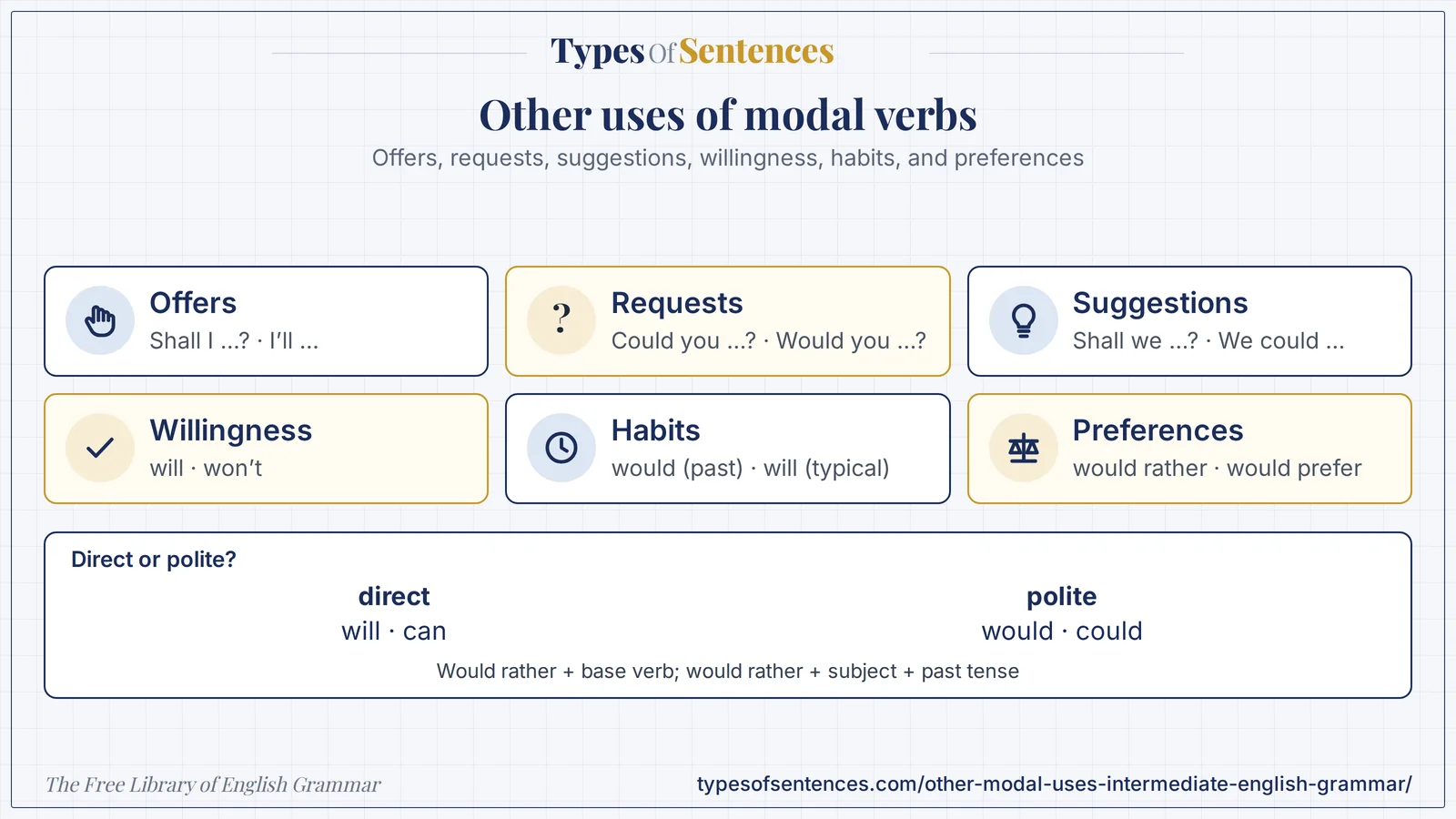
In everyday speech, modals are the tools of politeness. The same request can be direct (Open the window), neutral (Can you open the window?), or very polite (Would you mind opening the window?).
Why it matters: The rule of thumb is that the “past” forms, could and would, sound more polite than can and will, because they put distance between the speaker and the request.
Summary: Offers: Shall I …?, Can I …?, I’ll …. Requests: Can/Could/Will/Would you …? Suggestions: Shall we …?, We could …, You should …. Willingness: will, won’t. Habits: would (past), will (typical). Preferences: would rather, would prefer. Polite forms: could, would, might.
- Direct: will, can. Polite: would, could.
- Shall I/we = offer or suggestion; I’ll = spontaneous offer.
- Would rather + base verb; would rather + subject + past tense.
- Would = past habit (actions), will = typical behavior now.
What You’ll Learn
- 1. Uses of Modal Verbs: Offers
- 2. Requests
- 3. Suggestions
- 4. Shall, Will, Would
- 5. Willingness and Refusal
- 6. Habits: Would and Will
- 7. Preferences: Would Rather, Would Prefer
- 8. The Ladder of Polite Modals
- 9. Common Errors with These Modal Uses
- 10. Exercises
- 11. Test Your Knowledge
- 12. Frequently Asked Questions
- 13. Conclusion
1. Uses of Modal Verbs: Offers
An offer is a proposal to do something for someone. The modals used are shall, can, will, and would, and the choice depends on the formality. These are the modal offers, requests, and suggestions you use every day.
| Form | Example | Note |
|---|---|---|
| Shall I + base verb? | Shall I carry your bag? | polite offer; common in British English |
| Can I + base verb? | Can I help you? | neutral, common in American English |
| Could I + base verb? | Could I get you anything? | very polite |
| I’ll + base verb | I’ll carry that for you. | spontaneous offer |
| Would you like + noun / to + verb? | Would you like some tea? Would you like to sit down? | polite offer of something |
| Let me + base verb | Let me help you. | direct, friendly |
| Do you want me to + base verb? | Do you want me to call a taxi? | informal |
To accept an offer, say Yes, please or Thank you, that would be great. To decline, say No, thank you, I can manage. The modal shall is rare in American English questions except in Shall we …?; Can I …? is the usual form.
2. Requests
A request asks someone to do something. The modals are can, could, will, would, and, for permission, may; see the chapter on modals of permission for the permission forms.
| Level | Request | Example |
|---|---|---|
| direct | Will you …? / Can you …? | Can you open the window? |
| polite | Could you …? / Would you …? | Could you open the window, please? |
| very polite | Would you mind + -ing? / Would you be so kind as to …? | Would you mind opening the window? |
| indirect | I was wondering if you could … / Do you think you could …? | I was wondering if you could open the window. |
| formal | Would you be so kind as to …? / I would be grateful if you would … | I would be grateful if you would open the window. |
| with please | add please to any level | Could you please open the window? |
- Can you give me a lift? (informal)
- Could you give me a lift? (polite)
- Would you mind giving me a lift? (very polite)
- I was wondering if you could give me a lift. (indirect)
3. Suggestions
A suggestion proposes an idea. The modal suggestions below range from tentative to strong.
| Form | Example | Strength |
|---|---|---|
| Shall we + base verb? | Shall we go to the cinema? | invites agreement |
| Let’s + base verb | Let’s go to the cinema. | direct, informal |
| We could + base verb | We could go to the cinema. | tentative |
| Why don’t we + base verb? | Why don’t we go to the cinema? | friendly |
| How about + -ing? | How about going to the cinema? | friendly |
| You could / might + base verb | You could try the new restaurant. You might want to ask her. | tentative advice |
| You should / ought to + base verb | You should see a doctor. | advice |
| You had better + base verb | You had better see a doctor. | strong warning |
Advice and warnings are described further in the chapter on modals of obligation. In a suggestion, could and might are polite because they leave the decision open.
4. Shall, Will, Would
The three modals shall, will, and would are used for the future and for many other meanings.
| Modal | Uses | Example |
|---|---|---|
| shall | offers and suggestions with I and we | Shall I open the window? Shall we dance? |
| shall | formal future (mainly British) | I shall be there at six. |
| shall | rules and legal documents | The tenant shall pay rent monthly. |
| will | prediction | It will be hot tomorrow. |
| will | promise or decision | I will call you. I’ll take the blue one. |
| will | willingness / refusal | Will you help me? The car won’t start. |
| will | assumption | That will be the postman. |
| will | typical behavior | Accidents will happen. She will sit for hours. |
| would | polite request | Would you help me? |
| would | hypothetical situation | I would travel if I had money. |
| would | past habit (actions) | We would walk by the river every Sunday. |
| would | the future in the past | She said that she would come. |
| would | willingness / refusal in the past | He wouldn’t listen. |
The future uses of will are in the chapter on the future tenses. In American English, shall is used mostly for offers and suggestions and in formal writing; elsewhere, will is used.
5. Willingness and Refusal
| Use | Example |
|---|---|
| willingness (present) | I will help you. Will you carry this? |
| refusal (present) | The car won’t start. He won’t listen. |
| willingness (past) | She said she would help. |
| refusal (past) | He wouldn’t answer. |
| insistence (stressed) | He WILL do it his own way. |
| polite willingness | I’d be happy to help. I’d love to. |
The refusal meaning is also used for machines and objects: The door won’t open (it refuses to). The past form is wouldn’t: The door wouldn’t open.
6. Habits: Would and Will
| Form | Use | Example |
|---|---|---|
| would + base verb | a repeated action in the past | Every summer we would visit my grandparents. |
| used to + base verb | a past habit or state | I used to live in Texas. I used to be shy. |
| will + base verb | typical behavior in the present | He will talk for hours if you let him. |
| simple past | a past action, without the habit sense | We visited them every summer. |
7. Preferences: Would Rather, Would Prefer
| Form | Example | Note |
|---|---|---|
| would rather + base verb | I’d rather stay home. | my own preference |
| would rather + base verb + than + base verb | I’d rather walk than drive. | a choice |
| would rather + not + base verb | I’d rather not go. | a negative preference |
| would rather + subject + past tense | I’d rather you stayed. | a preference about another person (present or future) |
| would rather + subject + past perfect | I’d rather you had stayed. | a regret about the past |
| would prefer + to + base verb | I’d prefer to stay home. | formal preference |
| would prefer + noun | I’d prefer tea. | a choice |
| would like + to + base verb | I’d like to stay. | a wish |
Would rather is followed by the base form, with no to. After would prefer, use to.
8. The Ladder of Polite Modals
| More direct | More polite | Very polite or formal |
|---|---|---|
| Can you …? | Could you …? | Would you mind …-ing? |
| Will you …? | Would you …? | I would be grateful if you would … |
| Can I …? | Could I …? / May I …? | Might I …? |
| I want … | I would like … | I would be grateful for … |
| You should … | You might want to … | May I suggest that you …? |
| Shall I …? | Would you like me to …? | Allow me to … |
Politeness also depends on tone, on adding please, and on the situation. Close friends use direct forms; strangers and superiors are addressed with polite ones. In many cultures, indirect forms (I was wondering if …) are the most polite.
Make the request more polite: Give me a lift.
- Direct imperative: Give me a lift.
- Neutral: Can you give me a lift?
- Polite: Could you give me a lift?
- Very polite: Would you mind giving me a lift?
- Indirect: I was wondering if you could give me a lift.
9. Common Errors with These Modal Uses
| Error | Correction | Rule |
|---|---|---|
| May you open the window? | Could you open the window? | may is for I and we |
| I’d rather to stay. | I’d rather stay. | no to after would rather |
| I would be shy as a child. | I used to be shy as a child. | would for actions, not states |
| Would you mind to open the window? | Would you mind opening the window? | mind + gerund |
| Shall you help me? | Will you help me? / Can you help me? | shall only with I and we in questions |
| I would like that you come. | I would like you to come. | verb + object + to |
| Could you to help me? | Could you help me? | no to after a modal |
| I’d prefer stay. | I’d prefer to stay. | prefer takes to |
| Do you can help me? | Can you help me? | no do with a modal |
| I would rather you stay yesterday. | I would rather you had stayed yesterday. | past regret needs the past perfect |
Fix: May you to help me? I would be tired, so I’d rather to rest, and would you mind to open the window?
- May you to help me: a request for action: Could you help me?
- I would be tired (a past state): I used to be tired or simply I was tired.
- I’d rather to rest: I’d rather rest.
- would you mind to open: would you mind opening.
- Result: Could you help me? I was tired, so I’d rather rest, and would you mind opening the window?
Recap in 12 seconds
Watch the lesson build itself: Modal verbs also make offers, requests, suggestions, and statements of willingness, habit, and preference. The video has no sound.
Exercises
Part A: Offers (Exercises 1–5)
Exercise 1: Make an offer with shall: carry your bag.
Show Answer
Answer: Shall I carry your bag?
Exercise 2: Make an offer with can: help you.
Show Answer
Answer: Can I help you?
Exercise 3: Spontaneous offer: I (carry) that for you.
Show Answer
Answer: ’ll carry (I’ll carry that for you.)
Exercise 4: Offer something: Would you ___ some tea?
Show Answer
Answer: like.
Exercise 5: Accept an offer politely:
Show Answer
Answer: Yes, please. / Thank you, that would be great.
Part B: Requests (Exercises 6–11)
Exercise 6: Order from direct to polite: Would you…?, Can you…?, Would you mind…?
Show Answer
Answer: Can you…?, Would you…?, Would you mind…?
Exercise 7: Make polite: Open the window.
Show Answer
Answer: Could you open the window, please?
Exercise 8: Make very polite: Give me a lift.
Show Answer
Answer: Would you mind giving me a lift?
Exercise 9: Fix it: May you open the window?
Show Answer
Answer: Could you open the window?
Exercise 10: Fix it: Would you mind to open the window?
Show Answer
Answer: Would you mind opening the window?
Exercise 11: Indirect request: Help me.
Show Answer
Answer: I was wondering if you could help me.
Part C: Suggestions (Exercises 12–16)
Exercise 12: Suggest with shall: go to the cinema.
Show Answer
Answer: Shall we go to the cinema?
Exercise 13: Suggest with how about: go to the cinema.
Show Answer
Answer: How about going to the cinema?
Exercise 14: Suggest tentatively: We (could) …
Show Answer
Answer: We could go to the cinema.
Exercise 15: Which is a strong warning: You could or You had better?
Show Answer
Answer: You had better.
Exercise 16: Complete: Why ___ we go to the cinema?
Show Answer
Answer: don’t.
Part D: Shall, Will, Would (Exercises 17–22)
Exercise 17: Choose: (Shall/Will) I open the window? (an offer)
Show Answer
Answer: Shall.
Exercise 18: Choose: The car (won’t/shan’t) start.
Show Answer
Answer: won’t.
Exercise 19: Meaning of Accidents will happen.
Show Answer
Answer: Typical behavior.
Exercise 20: Meaning of She said that she would come.
Show Answer
Answer: The future in the past.
Exercise 21: Meaning of He wouldn’t listen.
Show Answer
Answer: Refusal in the past.
Exercise 22: Which is formal and legal: The tenant will pay or The tenant shall pay?
Show Answer
Answer: shall.
Part E: Habits and Preferences (Exercises 23–28)
Exercise 23: Past habit (action): Every summer we (visit) my grandparents.
Show Answer
Answer: would visit.
Exercise 24: Past state: I (be) shy as a child.
Show Answer
Answer: used to be.
Exercise 25: Preference: I’d rather (stay/to stay) home.
Show Answer
Answer: stay.
Exercise 26: Preference about another person: I’d rather you (stay/stayed).
Show Answer
Answer: stayed.
Exercise 27: Regret: I’d rather you (stayed/had stayed). (past)
Show Answer
Answer: had stayed.
Exercise 28: Formal preference: I’d prefer (stay/to stay).
Show Answer
Answer: to stay.
Part F: Errors (Exercises 29–30)
Exercise 29: Fix it: I would be shy as a child.
Show Answer
Answer: I used to be shy as a child.
Exercise 30: Fix it: I’d rather to stay.
Show Answer
Answer: I’d rather stay.
Test Your Knowledge
Ready to check what you learned? Answer all 10 questions, then submit. You need 80% (8 of 10) to pass. Your answers are not stored.
View correct answers and explanations
Question 1: Which is a polite offer?
✓ Correct Answer: A – Shall I carry your bag?
Shall I … is a polite offer.
Question 2: Which is the most polite request?
✓ Correct Answer: C – Would you mind opening the window?
Would you mind … -ing is very polite.
Question 3: Which is correct?
✓ Correct Answer: B – Could you open the window?
May is for I and we.
Question 4: Which is a suggestion?
✓ Correct Answer: A – Shall we go to the cinema?
Shall we is a suggestion.
Question 5: Which is correct?
✓ Correct Answer: C – I’d rather stay.
Would rather takes the base form.
Question 6: Which is correct for a past state?
✓ Correct Answer: D – I used to be shy.
Would is not used for states.
Question 7: What does The car won’t start mean?
✓ Correct Answer: C – The car refuses to start
Won’t expresses refusal.
Question 8: Which expresses typical behavior?
✓ Correct Answer: A – Accidents will happen.
Will can express typical behavior.
Question 9: Which is correct?
✓ Correct Answer: D – I’d rather you had stayed yesterday.
Past regret needs the past perfect.
Question 10: Which is more polite?
✓ Correct Answer: B – Could you help me?
Could is more polite than can.
Frequently Asked Questions
What are the uses of modal verbs?
The uses of modal verbs include ability, permission, possibility, obligation, and deduction, and also offers, requests, suggestions, willingness, habits, and preferences.
What are modal offers requests?
Modal offers include Shall I …?, Can I …?, and I’ll …. Modal requests include Can you …?, Could you …?, Will you …?, and Would you …?, with could and would being more polite.
What is the difference between shall will would?
Shall is used for offers and suggestions with I and we. Will expresses prediction, promise, and willingness. Would is polite, hypothetical, and expresses past habits.
How do I make modal suggestions?
Use Shall we …?, Let’s …, We could …, Why don’t we …?, How about …-ing?, or advice with should. Could and might are tentative.
What are polite modals?
Polite modals are the forms that soften requests, offers, and suggestions: could, would, might, and may. Compare Can you help? with Could you help? and Would you mind helping?
How do I express a preference?
Use would rather plus the base verb (I’d rather stay), would prefer plus to (I’d prefer to stay), or would rather plus a subject and the past tense (I’d rather you stayed).
Should I use would or used to for past habits?
Use would only for repeated actions. For past states, use used to. Used to also works for actions.
Conclusion
You now know the other uses of modal verbs: offers, requests, suggestions, the roles of shall, will, and would, willingness and refusal, habits, preferences, and the ladder of polite modals. You can choose the right level of politeness and avoid the common errors.
Listen for the modal in each polite request you hear. Next, you will study passive voice and active voice.
- Merriam-Webster Dictionary: would: the dictionary entry for the modal would.
- Purdue Online Writing Lab: Grammar: reference section on verbs.
- Quirk, Randolph, et al. A Comprehensive Grammar of the English Language. Longman, 1985.: volition, habit, and politeness.
- Huddleston, Rodney, and Geoffrey K. Pullum. The Cambridge Grammar of the English Language. Cambridge University Press, 2002.: directive and commissive uses of modals.
Last reviewed: October 29, 2026. How it was made: drafted with AI assistance, then checked with automated tests (structure, links, answer keys, spelling) and against the sources above. A person has not yet read this chapter line by line. Found a mistake? Report it.