Object pronouns are the pronouns that stand for the person or thing that receives the action of a verb or follows a preposition: me, you, him, her, it, us, and them. In She called me, the pronoun me is the object of the verb called; in Come with me, it is the object of the preposition with.
This page gives a list of object pronouns (the object pronouns list), the three jobs of an object pronoun, and 30 object pronouns examples. It explains how subject and object pronouns differ, how to choose between them in compound phrases, and the common mistakes. The page ends with 30 exercises and a 10-question quiz.
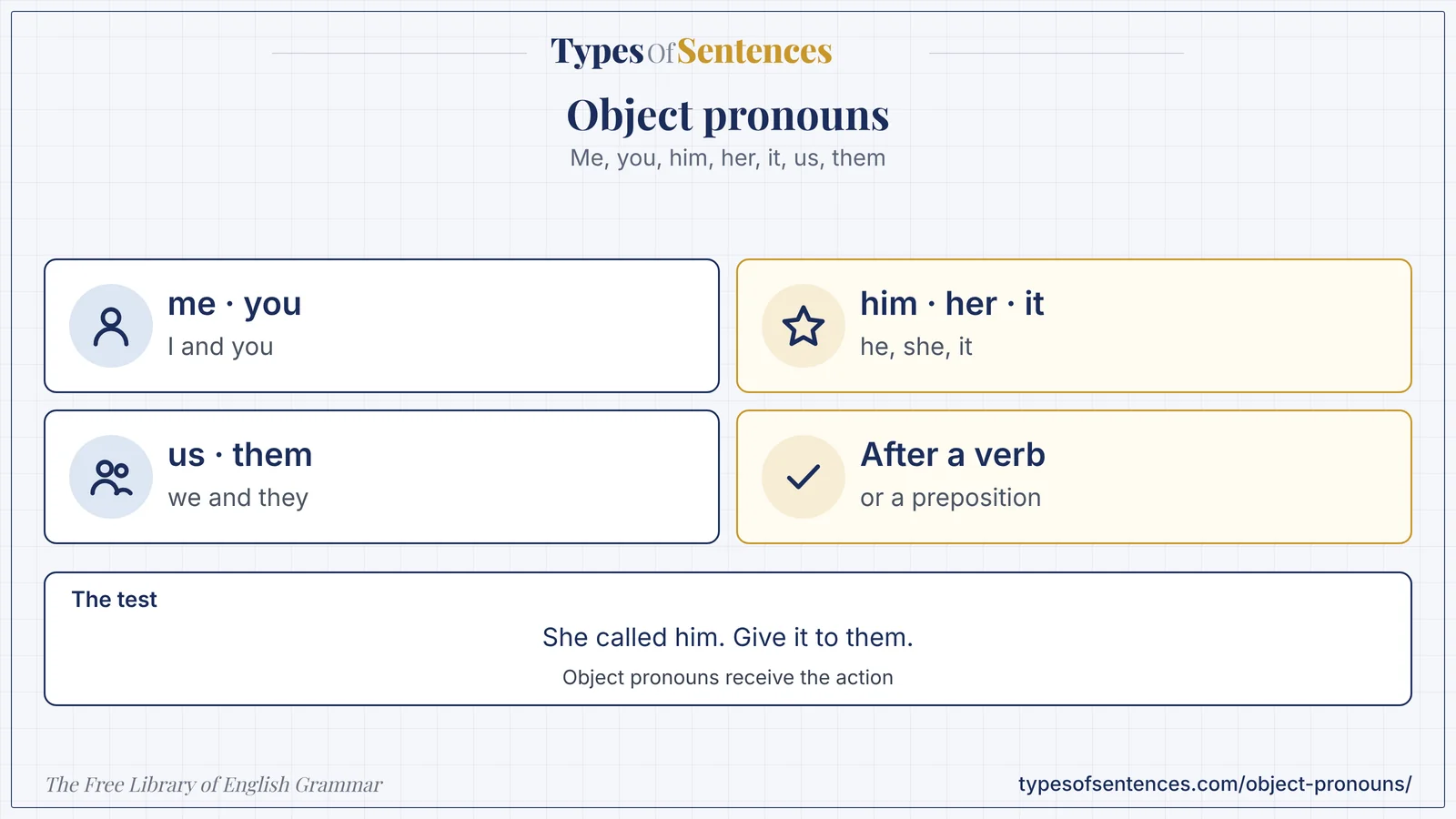
An object pronoun takes the place of a noun that follows a verb or a preposition.
Why it matters: Use I for the doer and me for the receiver: I called her; she called me.
Summary: Object pronouns replace nouns that are the object of a verb or a preposition. The list: me, you, him, her, it, us, them (and whom in formal writing). Subject pronouns (I, you, he, she, it, we, they) do the action; object pronouns receive it. The three jobs: direct object (I saw him), indirect object (She gave me a book), and object of a preposition (for us). In a compound, drop the other person to test: Tom and me went fails because me went is wrong.
- Seven forms: me, you, him, her, it, us, them.
- Receives the action.
- After a verb or a preposition.
- Drop the other person to test.
What You’ll Learn
1. Object Pronouns: The Short Answer
| Person | Subject pronoun | Object pronoun | Example |
|---|---|---|---|
| 1st singular | I | me | She called me. |
| 2nd | you | you | I saw you. |
| 3rd masculine | he | him | We invited him. |
| 3rd feminine | she | her | They thanked her. |
| 3rd neuter | it | it | He dropped it. |
| 1st plural | we | us | The coach picked us. |
| 3rd plural | they | them | I met them. |
| Test | How it works | Example |
|---|---|---|
| the receiver test | the pronoun receives the action | She called me. |
| the preposition test | the pronoun follows a preposition | with me, for us |
| the drop test | drop the other person; the pronoun must still work | Tom and me went → me went ✗ |
Subject pronouns are the other half of the pair. For a deeper look at the different kinds, see the Advanced chapter on advanced pronoun concepts.
2. The Three Jobs of an Object Pronoun
| Job | What it is | Example |
|---|---|---|
| direct object | receives the action of the verb | I saw him. |
| indirect object | tells to whom or for whom the action is done | She gave me a book. |
| object of a preposition | follows a preposition | Come with us. |
Direct and indirect objects are explained in the Intermediate chapter on direct and indirect objects, and prepositions and their objects in the chapter on prepositional phrases. A pronoun after a linking verb (It is I) is a subject complement, which is covered in the chapter on subject and object complements.
3. Object Pronouns Examples: 30 Sentences
| Pronoun | Sentence | Job |
|---|---|---|
| me | She called me last night. | direct object |
| me | He gave me a book. | indirect object |
| me | Come with me. | object of a preposition |
| you | I saw you at the station. | direct object |
| you | She sent you a letter. | indirect object |
| you | This gift is for you. | object of a preposition |
| him | We invited him to dinner. | direct object |
| him | I told him the news. | indirect object |
| him | The teacher spoke to him. | object of a preposition |
| her | They thanked her. | direct object |
| her | He bought her flowers. | indirect object |
| her | I sat next to her. | object of a preposition |
| it | She dropped it. | direct object |
| it | Give it a minute. | indirect object |
| it | He looked at it. | object of a preposition |
| us | The coach picked us. | direct object |
| us | They showed us the way. | indirect object |
| us | Wait for us. | object of a preposition |
| them | I met them yesterday. | direct object |
| them | She made them lunch. | indirect object |
| them | The teacher spoke to them. | object of a preposition |
| me | Please help me. | direct object |
| him | Ask him. | direct object |
| her | Tell her the truth. | indirect object |
| us | Join us for tea. | direct object |
| them | Give them a chance. | indirect object |
| you | I will meet you there. | direct object |
| it | The dog chased it. | direct object |
| me | Between you and me, it is easy. | object of a preposition |
| him | The prize went to him. | object of a preposition |
4. Compound Objects and Comparisons
| Situation | Rule | Example |
|---|---|---|
| two objects joined by and | use object pronouns for each | She invited Tom and me. |
| between | always an object pronoun | between you and me |
| after let | an object pronoun | Let him go. Let us in. |
| after than or as | subject pronoun if a verb is understood | She is taller than I (am) |
| informal speech | than me is common | She is taller than me. |
| after a linking verb | formal: subject pronoun; informal: object | It is I. / It’s me. |
In a comparison, the choice depends on the clause that follows, as described in the guide to independent and dependent clauses. The pair who and whom follows the same logic and is covered in the guide to who and whom.
5. Common Mistakes With Object Pronouns
| Mistake | Example | Correction |
|---|---|---|
| subject pronoun as object | *She called I. | She called me. |
| subject pronoun after a preposition | *between you and I | between you and me |
| object pronoun as subject | *Me and him went. | He and I went. |
| compound object | *She invited Tom and I. | She invited Tom and me. |
| wrong word | *Give it to she. | Give it to her. |
| wrong word | *The prize went to he. | The prize went to him. |
| reflexive instead of object | *She called myself. | She called me. |
| they for them | *I saw they. | I saw them. |
| us as subject | *Us went home. | We went home. |
| double marking | *She gave to me it. | She gave it to me. |
Fix: Between you and I, the teacher gave Tom and I a book, and she told he and she to share it.
- between you and I: the object of between takes an object pronoun, so between you and me.
- gave Tom and I: both are indirect objects, so Tom and me.
- told he and she: both are objects, so him and her.
- Result: Between you and me, the teacher gave Tom and me a book, and she told him and her to share it. (the sentence is invented; the last clause is awkward but correct)
Recap in 12 seconds
Watch the lesson build itself: The object pronouns are me, you, him, her, it, us, and them; they follow a verb or a preposition. The video has no sound.
Exercises
Part A: Choose the Pronoun (Exercises 1–10)
Exercise 1: She called ___. (I)
Show Answer
Answer: me.
Exercise 2: They thanked ___. (she)
Show Answer
Answer: her.
Exercise 3: We invited ___. (he)
Show Answer
Answer: him.
Exercise 4: The coach picked ___. (we)
Show Answer
Answer: us.
Exercise 5: I met ___ yesterday. (they)
Show Answer
Answer: them.
Exercise 6: He gave ___ a book. (I)
Show Answer
Answer: me.
Exercise 7: The gift is for ___. (you)
Show Answer
Answer: you.
Exercise 8: She dropped ___. (it)
Show Answer
Answer: it.
Exercise 9: The teacher spoke to ___. (they)
Show Answer
Answer: them.
Exercise 10: Wait for ___. (we)
Show Answer
Answer: us.
Part B: Name the Job (Exercises 11–20)
Exercise 11: I saw him. (him)
Show Answer
Answer: direct object.
Exercise 12: She gave me a book. (me)
Show Answer
Answer: indirect object.
Exercise 13: Come with us. (us)
Show Answer
Answer: object of a preposition.
Exercise 14: They thanked her. (her)
Show Answer
Answer: direct object.
Exercise 15: He bought her flowers. (her)
Show Answer
Answer: indirect object.
Exercise 16: Look at it. (it)
Show Answer
Answer: object of a preposition.
Exercise 17: I told him the news. (him)
Show Answer
Answer: indirect object.
Exercise 18: Ask him. (him)
Show Answer
Answer: direct object.
Exercise 19: She sent you a letter. (you)
Show Answer
Answer: indirect object.
Exercise 20: This is for them. (them)
Show Answer
Answer: object of a preposition.
Part C: Compound Objects (Exercises 21–25)
Exercise 21: She invited Tom and ___. (I/me)
Show Answer
Answer: me.
Exercise 22: Between you and ___. (I/me)
Show Answer
Answer: me.
Exercise 23: ___ and he went. (I/me)
Show Answer
Answer: I.
Exercise 24: The prize went to him and ___. (she/her)
Show Answer
Answer: her.
Exercise 25: Let ___ go. (he/him)
Show Answer
Answer: him.
Part D: Correct the Errors (Exercises 26–30)
Exercise 26: Correct: *She called I.
Show Answer
Answer: She called me.
Exercise 27: Correct: *Me and him went.
Show Answer
Answer: He and I went.
Exercise 28: Correct: *Give it to she.
Show Answer
Answer: Give it to her.
Exercise 29: Correct: *I saw they.
Show Answer
Answer: I saw them.
Exercise 30: Correct: *She called myself.
Show Answer
Answer: She called me.
Test Your Knowledge
Ready to check what you learned? Answer all 10 questions, then submit. You need 80% (8 of 10) to pass. Your answers are not stored.
View correct answers and explanations
Question 1: Which is an object pronoun?
✓ Correct Answer: D – me
Me.
Question 2: The object pronoun for she is
✓ Correct Answer: A – her
Her.
Question 3: The object pronoun for they is
✓ Correct Answer: B – them
Them.
Question 4: Which is correct?
✓ Correct Answer: C – between you and me
Object of a preposition.
Question 5: She gave me a book. Here me is
✓ Correct Answer: D – an indirect object
Indirect object.
Question 6: Which is correct?
✓ Correct Answer: A – She invited Tom and me.
Object pronoun.
Question 7: Which pronoun has the same subject and object form?
✓ Correct Answer: B – you
You.
Question 8: Which is correct?
✓ Correct Answer: C – He and I went.
Subject pronouns.
Question 9: The object pronoun for we is
✓ Correct Answer: D – us
Us.
Question 10: The drop test means
✓ Correct Answer: A – drop the other person and check
Drop the other person.
Frequently Asked Questions
What are object pronouns?
Object pronouns are the pronouns used as the object of a verb or a preposition: me, you, him, her, it, us, and them.
What is the object pronouns list?
The object pronouns list is me, you, him, her, it, us, them. In formal writing whom is also an object pronoun.
What is the difference between subject and object pronouns?
Subject pronouns (I, you, he, she, it, we, they) do the action. Object pronouns (me, you, him, her, it, us, them) receive it or follow a preposition.
Can you give object pronouns examples?
She called me. They thanked her. Come with us. I met them.
Is it “between you and me” or “between you and I”?
Between you and me is correct, because between is a preposition and takes an object pronoun.
Is it “Tom and me” or “Tom and I”?
Drop the other person: She invited me is correct, so She invited Tom and me. As a subject, Tom and I went.
Why do “you” and “it” have the same form?
They are the same in the subject and object forms. English lost the separate object forms for these words over time.
Conclusion
You now know the list of object pronouns, the three jobs of an object pronoun, and how to choose between subject and object pronouns. You have seen 30 object pronouns examples.
Use the drop test for compound objects, and remember that a pronoun after a preposition is always an object pronoun. Next, study the other lists in this series, such as the common prepositions.
- Quirk, Randolph, et al. A Comprehensive Grammar of the English Language. Longman, 1985.: the account of case in personal pronouns.
- Huddleston, Rodney, and Geoffrey K. Pullum. The Cambridge Grammar of the English Language. Cambridge University Press, 2002.: the chapter on pronouns.
- Garner, Bryan A. Garner’s Modern English Usage. 5th ed. Oxford University Press, 2022.: the entries on case and “between you and me”.
- Merriam-Webster Dictionary: object pronoun: the dictionary entry (not opened when this page was written). All examples and exercises were written for this page.
Last reviewed: October 29, 2026. How it was made: drafted with AI assistance, then checked with automated tests (structure, links, answer keys, spelling) and against the sources above. A person has not yet read this chapter line by line. Found a mistake? Report it.