Possessive adjectives are words that show who owns or is connected with a noun: my, your, his, her, its, our, and their. They come before a noun and answer the question whose?: my book, their house, her idea.
This page gives a possessive adjectives list, the rules for using them, and 30 possessive adjectives examples. It explains the difference between possessive adjectives and pronouns (my and mine), the common confusions (its and it’s, their and there), and the mistakes learners make. The page ends with 30 exercises and a 10-question quiz.
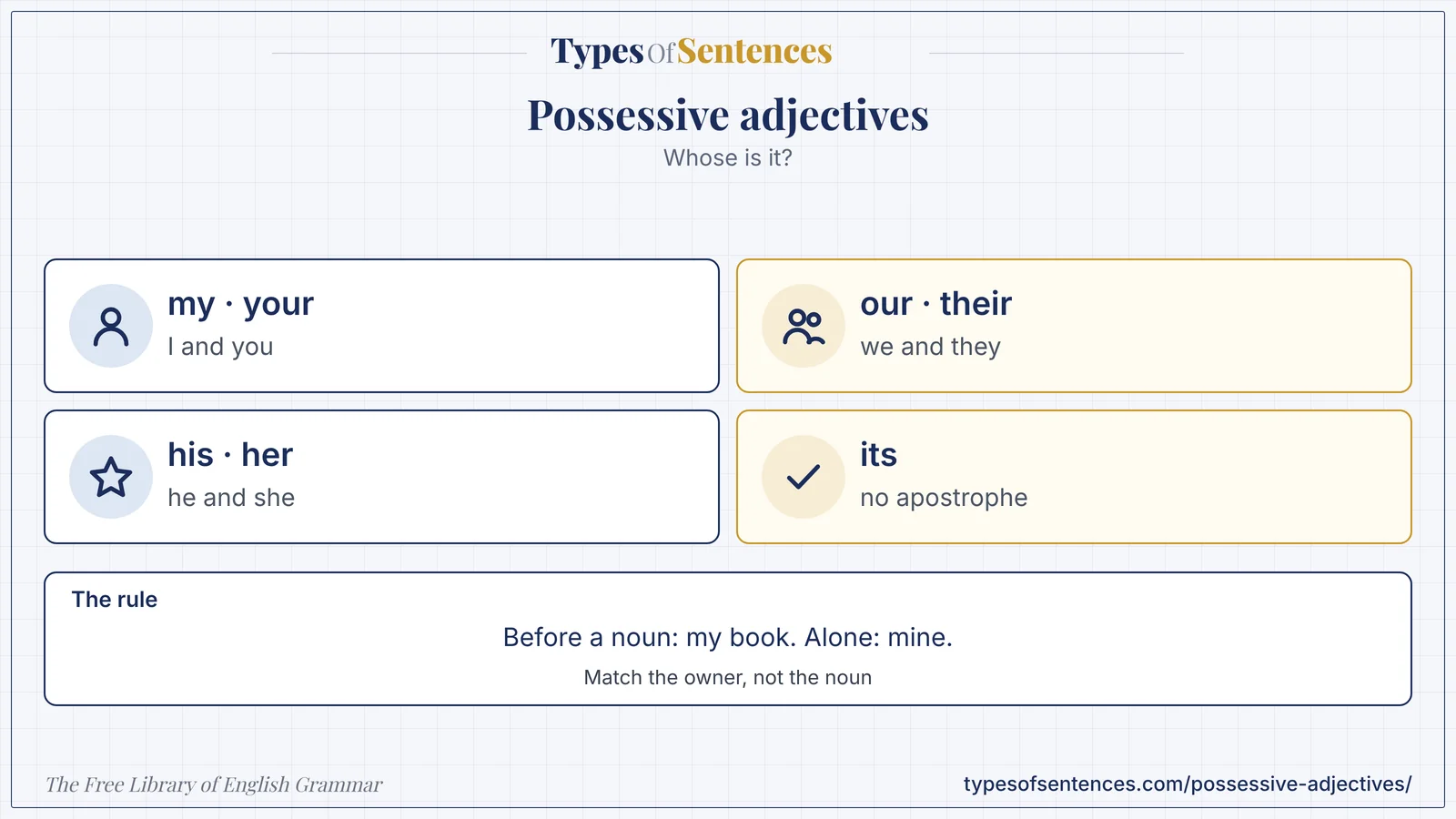
A possessive adjective tells you whose a noun is. It always stands before the noun.
Why it matters: Choose the word that matches the owner: her for a woman, his for a man, their for more than one.
Summary: There are seven possessive adjectives: my, your, his, her, its, our, their. They agree with the owner, not with the thing owned: Anna lost her keys (not his). They come before a noun and never take an article: my book, not the my book. They do not take an apostrophe: its (possessive) and it’s (it is) are different words. The matching pronouns stand alone: mine, yours, his, hers, ours, theirs.
- Seven forms: my, your, his, her, its, our, their.
- Match the owner.
- Before a noun.
- No apostrophe.
What You’ll Learn
- 1. Possessive Adjectives: The Short Answer
- 2. List of Possessive Adjectives With Examples
- 3. The Five Rules
- 4. Possessive Adjectives and Pronouns
- 5. Common Confusions: Its, Their, and Your
- 6. Possessive Adjectives Examples: 30 Sentences
- 7. Common Mistakes With Possessive Adjectives
- 8. Exercises
- 9. Test Your Knowledge
- 10. Frequently Asked Questions
- 11. Conclusion
1. Possessive Adjectives: The Short Answer
| Person | Subject pronoun | Possessive adjective | Possessive pronoun |
|---|---|---|---|
| 1st singular | I | my | mine |
| 2nd singular and plural | you | your | yours |
| 3rd singular masculine | he | his | his |
| 3rd singular feminine | she | her | hers |
| 3rd singular neuter | it | its | (rare) |
| 1st plural | we | our | ours |
| 3rd plural | they | their | theirs |
| Test | How it works | Example |
|---|---|---|
| the whose test | the word answers whose? | Whose bag? My bag. |
| the noun test | a noun follows the word | my book |
| the stand-alone test | if no noun follows, it is a pronoun | The book is mine. |
The types of pronouns are explained in the Intermediate chapter on the types of pronouns, and the types of adjectives in the chapter on adjective types. Possessive adjectives are also a kind of determiner, as shown in the chapter on determiners.
2. List of Possessive Adjectives With Examples
| Possessive adjective | Owner | Example |
|---|---|---|
| my | the speaker | my car |
| your | the person spoken to | your idea |
| his | a male | his phone |
| her | a female | her house |
| its | a thing or an animal | its color |
| our | the speaker and others | our team |
| their | more than one owner | their garden |
The word one’s is a formal possessive adjective for one: One should do one’s best. The possessive adjectives answer the question whose?, so they are close to the possessive nouns in the guide to possessive nouns (Anna’s book = her book).
3. The Five Rules
| Rule | Explanation | Example |
|---|---|---|
| 1. agree with the owner | the word changes with the owner, not with the noun | Anna lost her keys. (not his) |
| 2. stand before a noun | the word is followed by a noun or a noun phrase | my old friend |
| 3. no article | do not use a, an, or the with it | my book, not *the my book |
| 4. no apostrophe | possessive adjectives never take an apostrophe | its, their, your |
| 5. one form for singular and plural nouns | the word does not change with the noun | my book, my books |
| Use | Example | Comment |
|---|---|---|
| body parts | She hurt her arm. | use her, not the, for a person’s own body part |
| clothes | He put on his coat. | the owner is clear |
| family | my mother | not *the my mother |
| with own | my own room | own adds emphasis |
| with of | a friend of mine | a possessive pronoun, not *a friend of my |
4. Possessive Adjectives and Pronouns
| Possessive adjective | Possessive pronoun | Example |
|---|---|---|
| my | mine | This is my book. This book is mine. |
| your | yours | Is that your coat? Is that coat yours? |
| his | his | It is his idea. The idea is his. |
| her | hers | It is her bag. The bag is hers. |
| our | ours | It is our house. The house is ours. |
| their | theirs | It is their car. The car is theirs. |
A possessive adjective is followed by a noun, but a possessive pronoun stands in place of a noun. These possessive adjectives and pronouns are two forms of the same idea, and both avoid repeating the owner’s name.
5. Common Confusions: Its, Their, and Your
| Possessive adjective | Look-alike | Meaning of the look-alike | Example |
|---|---|---|---|
| its | it’s | it is or it has | It’s late, and the cat wants its dinner. |
| their | there | a place | There are their coats over there. |
| their | they’re | they are | They’re putting on their coats. |
| your | you’re | you are | You’re sure it is your key? |
| whose | who’s | who is | Who’s the girl whose bag is red? |
Each pair is covered in its own guide: its and it’s, their, there, and they’re, and your and you’re. The rule is the same in every pair: the possessive adjective has no apostrophe.
6. Possessive Adjectives Examples: 30 Sentences
| Possessive adjective | Sentence |
|---|---|
| my | I lost my keys. |
| my | My brother plays the guitar. |
| my | This is my first day at work. |
| your | Is this your phone? |
| your | Your answer is correct. |
| your | Please wash your hands. |
| his | He ate his lunch at noon. |
| his | His sister lives in Delhi. |
| his | Tom parked his car outside. |
| her | She lost her bag. |
| her | Her teacher praised the essay. |
| her | Maria called her mother. |
| its | The dog wagged its tail. |
| its | The company changed its name. |
| its | The tree lost its leaves. |
| our | We love our new house. |
| our | Our team won the match. |
| our | They joined our class. |
| their | The students did their homework. |
| their | Their house has a red door. |
| their | The birds built their nest. |
| their | Ana and Raj sold their car. |
| my | I brush my teeth twice a day. |
| your | You can bring your friends. |
| his | The boy hurt his knee. |
| her | The girl took her seat. |
| our | We washed our hands. |
| their | The children put on their coats. |
| its | The museum opens its doors at nine. |
| your | What is your name? |
7. Common Mistakes With Possessive Adjectives
| Mistake | Example | Correction |
|---|---|---|
| wrong owner | *Anna lost his keys. | Anna lost her keys. |
| apostrophe | *The dog wagged it’s tail. | The dog wagged its tail. |
| apostrophe | *That is your’s. | That is yours. |
| article | *the my friend | my friend |
| plural form | *their’s | theirs |
| wrong word | *They love there house. | They love their house. |
| wrong word | *You’re book is here. | Your book is here. |
| pronoun for adjective | *This is mine book. | This is my book. |
| adjective for pronoun | *The book is my. | The book is mine. |
| the for a body part | *She hurt the arm. | She hurt her arm. |
Fix: The students lost there books, and Maya hurt the knee, but the teacher said the books were hers and the bag was my.
- there books: the books belong to the students, so their books.
- hurt the knee: a person’s own body part takes the possessive, so her knee.
- the books were hers: this is a pronoun that stands alone, so it is correct if the books are Maya’s.
- the bag was my: a pronoun is needed at the end, so mine.
- Result: The students lost their books, and Maya hurt her knee, but the teacher said the books were hers and the bag was mine. (the sentence is invented)
Recap in 12 seconds
Watch the lesson build itself: The possessive adjectives are my, your, his, her, its, our, and their; they come before a noun and show who owns it. The video has no sound.
Exercises
Part A: Choose the Possessive Adjective (Exercises 1–10)
Exercise 1: I lost ___ keys.
Show Answer
Answer: my.
Exercise 2: She called ___ mother.
Show Answer
Answer: her.
Exercise 3: He parked ___ car.
Show Answer
Answer: his.
Exercise 4: We love ___ new house.
Show Answer
Answer: our.
Exercise 5: They sold ___ car.
Show Answer
Answer: their.
Exercise 6: The dog wagged ___ tail.
Show Answer
Answer: its.
Exercise 7: Is this ___ phone? (to one person)
Show Answer
Answer: your.
Exercise 8: Anna lost ___ bag.
Show Answer
Answer: her.
Exercise 9: The students did ___ homework.
Show Answer
Answer: their.
Exercise 10: The tree lost ___ leaves.
Show Answer
Answer: its.
Part B: Adjective or Pronoun? (Exercises 11–20)
Exercise 11: This book is ___. (I)
Show Answer
Answer: mine.
Exercise 12: This is ___ book. (I)
Show Answer
Answer: my.
Exercise 13: The house is ___. (we)
Show Answer
Answer: ours.
Exercise 14: It is ___ house. (we)
Show Answer
Answer: our.
Exercise 15: The bag is ___. (she)
Show Answer
Answer: hers.
Exercise 16: It is ___ bag. (she)
Show Answer
Answer: her.
Exercise 17: The car is ___. (they)
Show Answer
Answer: theirs.
Exercise 18: It is ___ car. (they)
Show Answer
Answer: their.
Exercise 19: The idea is ___. (he)
Show Answer
Answer: his.
Exercise 20: The coat is ___. (you)
Show Answer
Answer: yours.
Part C: Choose the Right Word (Exercises 21–25)
Exercise 21: The cat licked its/it’s paw.
Show Answer
Answer: its.
Exercise 22: Their/There/They’re books are here.
Show Answer
Answer: Their.
Exercise 23: Your/You’re late.
Show Answer
Answer: You’re.
Exercise 24: I met the girl who’s/whose bag was lost.
Show Answer
Answer: whose.
Exercise 25: It’s/Its raining.
Show Answer
Answer: It’s.
Part D: Correct the Errors (Exercises 26–30)
Exercise 26: Correct: *Anna lost his keys.
Show Answer
Answer: Anna lost her keys.
Exercise 27: Correct: *That is your’s.
Show Answer
Answer: That is yours.
Exercise 28: Correct: *the my friend
Show Answer
Answer: my friend
Exercise 29: Correct: *She hurt the arm.
Show Answer
Answer: She hurt her arm.
Exercise 30: Correct: *They love there house.
Show Answer
Answer: They love their house.
Test Your Knowledge
Ready to check what you learned? Answer all 10 questions, then submit. You need 80% (8 of 10) to pass. Your answers are not stored.
View correct answers and explanations
Question 1: How many possessive adjectives are there in the main list?
✓ Correct Answer: C – 7
my, your, his, her, its, our, their.
Question 2: A possessive adjective is followed by
✓ Correct Answer: A – a noun
A noun.
Question 3: The possessive pronoun for I is
✓ Correct Answer: B – mine
Mine.
Question 4: Its is
✓ Correct Answer: D – possessive
Possessive.
Question 5: Which is correct?
✓ Correct Answer: C – Anna lost her keys.
Match the owner.
Question 6: The possessive adjective for a group is
✓ Correct Answer: A – their
Their.
Question 7: Which takes no apostrophe?
✓ Correct Answer: B – yours
Yours.
Question 8: The book is ___. (I)
✓ Correct Answer: D – mine
Stands alone.
Question 9: A possessive adjective answers the question
✓ Correct Answer: C – whose?
Whose?
Question 10: Which is an article-error?
✓ Correct Answer: A – the my friend
No article.
Frequently Asked Questions
What are possessive adjectives?
Possessive adjectives are the words my, your, his, her, its, our, and their. They come before a noun and show who owns it.
What is the list of possessive adjectives?
The list of possessive adjectives is my, your, his, her, its, our, and their. The formal one’s is also used.
What is the difference between a possessive adjective and a possessive pronoun?
A possessive adjective comes before a noun (my book). A possessive pronoun stands alone (mine).
Can you give possessive adjectives examples?
I lost my keys. She called her mother. They sold their car. The dog wagged its tail.
Do possessive adjectives take an apostrophe?
No. The forms its, your, and their never take an apostrophe. It’s means it is.
Is “their” singular or plural?
Their is used for more than one owner. Many writers also use it for one person of unknown or unspecified gender (Everyone brought their book), though some style guides prefer other wording.
Why do we say “I hurt my arm” and not “I hurt the arm”?
In English the possessive adjective is the normal choice for a person’s own body part or clothes.
Conclusion
You now know the seven possessive adjectives, the five rules, the difference from possessive pronouns, and the common confusions. You have seen 30 possessive adjectives examples.
Use the possessive adjectives list above, match the word to the owner, put it before a noun, and never add an apostrophe. Next, study the other lists in this series, such as the demonstrative pronouns.
- Quirk, Randolph, et al. A Comprehensive Grammar of the English Language. Longman, 1985.: the account of possessive determiners and pronouns.
- Huddleston, Rodney, and Geoffrey K. Pullum. The Cambridge Grammar of the English Language. Cambridge University Press, 2002.: the chapter on pronouns and determiners.
- Garner, Bryan A. Garner’s Modern English Usage. 5th ed. Oxford University Press, 2022.: the entries on possessives and singular they.
- Merriam-Webster Dictionary: possessive adjective: the dictionary entry (not opened when this page was written). All examples and exercises were written for this page.
Last reviewed: October 29, 2026. How it was made: drafted with AI assistance, then checked with automated tests (structure, links, answer keys, spelling) and against the sources above. A person has not yet read this chapter line by line. Found a mistake? Report it.