Sentence variety is the mixing of sentences of different lengths, structures, and openings so that writing reads smoothly and holds the reader’s attention. A paragraph of eight sentences, each of nine words, each starting with The and following the same subject–verb–object pattern, is correct and tiring. The same ideas, given a short sentence for emphasis, a long one for explanation, a question, a sentence that begins with a clause, will read like a person talking. Variety is not decoration: it controls pace, shows which ideas are important, and shapes how the text sounds.
This chapter shows how to vary sentences. You will study why variety matters, how to vary length (short, medium, and long sentences and where to place them), structure (simple, compound, complex, and compound-complex, periodic and cumulative), and beginnings (the many things a sentence can start with other than the subject). You will practice combining choppy sentences and breaking up long ones, and learn how rhythm and flow depend on sound as well as on structure. The aim is interesting writing in which varying sentences serves meaning. These skills of sentence structure variety, rhythm, and length apply to every kind of writing. Thirty editing exercises and a quiz follow.
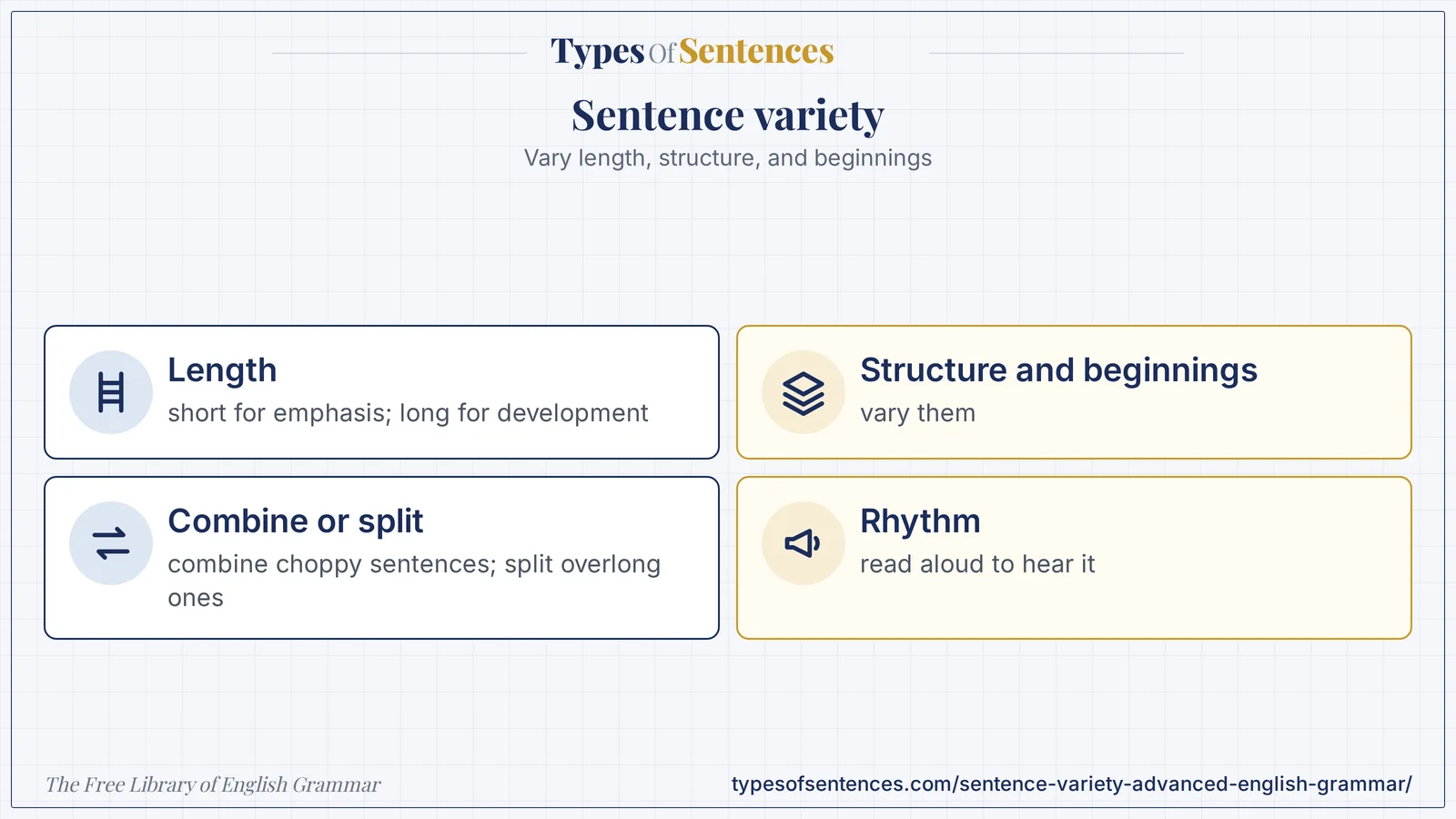
If every sentence in a paragraph has the same length and the same shape, the reader hears a drumbeat and stops listening. Mix short sentences and long ones, start them in different ways, and let the structure follow the importance of the idea.
Why it matters: Do not vary for its own sake. Every choice should do something: a short sentence for emphasis, a long one for a chain of reasoning, a question to engage the reader, an opening clause to show a condition or a contrast.
Summary: Good writing varies sentence length (short for emphasis, long for development), structure (simple, compound, complex, compound-complex; periodic and cumulative), type (statements, questions, commands), and beginnings (subject, adverbial, subordinate clause, participial phrase, infinitive phrase, inversion). Choppy sentences can be combined by coordination, subordination, relative clauses, participles, appositives, and prepositional phrases. Overlong sentences can be split at natural breaks. Rhythm comes from the order of long and short sentences, the position of stressed words, parallelism, and punctuation. Variety should follow the meaning: put the main idea in the main clause and the most important information at the end.
- Vary length: short for emphasis, long for development.
- Vary structure and beginnings.
- Combine choppy sentences; split overlong ones.
- Read aloud to hear the rhythm.
What You’ll Learn
- 1. Sentence Variety: Why Vary Sentences?
- 2. Length Variation: Short, Medium, and Long Sentences
- 3. Structure Variation: Simple, Compound, Complex, and Compound-Complex
- 4. Beginning Variation: Not Always Subject First
- 5. Combining Sentences: Creating Complexity
- 6. Breaking Long Sentences: Creating Clarity
- 7. Rhythm and Flow: Reading Aloud and Natural Cadence
- 8. Sentence Variety in Different Kinds of Writing
- 9. Common Errors and a Revision Checklist
- 10. Exercises
- 11. Test Your Knowledge
- 12. Frequently Asked Questions
- 13. Conclusion
1. Sentence Variety: Why Vary Sentences?
| Monotonous | Varied |
|---|---|
| The city is old. The city has a market. The market is crowded. The market sells spices. The spices come from the hills. I visited the market. I bought some spices. | The old city has a crowded market, where spices from the hills are sold in great heaps. I went there on Sunday. When I left, my bag smelled of cardamom and cloves. |
| The company lost money. It closed three offices. It fired staff. It changed its name. | After losing money, the company closed three offices, dismissed staff, and changed its name. Did it work? Not yet. |
| Reading is useful. It improves vocabulary. It improves writing. It improves thinking. | Reading is useful: it improves vocabulary, writing, and thinking alike. |
| Kind of monotony | Symptom | Cure |
|---|---|---|
| same length | a drumbeat of equal sentences (all short, or all long) | mix short and long |
| same structure | all simple sentences, or all “subject + verb + object” | use compound, complex, and compound-complex sentences |
| same opening | every sentence begins with The, It, or He | open with an adverbial, a clause, a participle |
| same type | all statements | add a question or a command where fitting |
| same connection | every sentence begins with However or Also | vary or omit transitions |
| same rhythm | — | vary the stress pattern and the sentence endings |
| Purpose of variety | How |
|---|---|
| hold attention | change the pattern before the reader tunes out |
| emphasize | a short sentence among longer ones stands out |
| show relationships | subordinate clauses show cause, concession, and condition |
| control pace | short sentences speed up; long ones slow down or build |
| create voice | the sentence habits of a writer are part of the style |
| aid comprehension | move from simple to complex information |
Sentence variety is related to the sentence-combining and rhythm techniques in the chapter on creative writing techniques and to the structure of information in the chapter on information structure. It is a matter of the whole paragraph, not of single sentences: judge variety by reading a paragraph aloud.
2. Length Variation: Short, Medium, and Long Sentences
| Length (guide) | Typical use | Example |
|---|---|---|
| very short (1 to 8 words) | emphasis; a turn; a conclusion; a transition | It failed. / That was the problem. |
| short to medium (9 to 20 words) | the workhorse of most prose; clear statements | The council approved the plan after a two-hour debate. |
| long (21 to 35 words) | development, qualification, chains of reasoning | Although the plan was popular with residents, the council delayed it for a year, because the cost estimates had risen and the funding was still unclear. |
| very long (over 35 words) | used with care: a build-up, a list, a legal or academic argument | — |
| Pattern | Example | Effect |
|---|---|---|
| short after long | The plan was complicated, expensive, and politically dangerous, and the council spent three months arguing about it. It passed. | a punch after a build |
| long after short | It was late. We had walked for hours, through fields and villages, past a river that glittered in the dark, and I no longer remembered why we had set out. | release after a beat |
| short, short, long | Rain. Wind. Then the whole street went dark, window by window, as the power failed along the hill. | a build |
| long, long, short | — | a closing emphasis |
| alternating | — | a lively rhythm |
| Word-count check (a paragraph, original) | Sentence lengths (words) | Comment |
|---|---|---|
| Monotonous | 8, 9, 8, 9, 8, 9, 9, 8 | almost identical lengths |
| Varied | 5, 23, 12, 31, 4, 17 | a real range |
- Count words. Write down the length of each sentence in a paragraph. If the numbers are nearly equal, change the pattern.
- Place the shortest sentence where you want emphasis: at the end of a paragraph, after a long sentence, or at a turn in the argument.
- Fit the length to the reader and the genre. A general reader finds sentences of about 15 to 20 words easy on average; academic and legal prose often runs longer.
- Keep the long sentence clear. Put the main clause where the reader can find it, and use parallel structure and punctuation to organize a long sentence.
- Do not use a string of very short sentences for a complex idea. Combine them to show how the ideas relate.
3. Structure Variation: Simple, Compound, Complex, and Compound-Complex
| Structure | Definition | Example | Use |
|---|---|---|---|
| simple | one independent clause | The train arrived. | clarity, emphasis |
| compound | two or more independent clauses | The train arrived, and the passengers got off. | equal ideas |
| complex | one independent clause and one or more dependent clauses | When the train arrived, the passengers got off. | relations: time, cause, concession, condition |
| compound-complex | two or more independent clauses and at least one dependent clause | When the train arrived, the passengers got off, and the station fell quiet. | a series of related events with a setting |
| fragment (sparingly) | a part of a sentence as a unit | Silence. | deliberate effect |
| Type of sentence by function | Example | Use |
|---|---|---|
| statement (declarative) | The results were clear. | most prose |
| question (interrogative) | What do these results mean? | engages; frames a topic |
| command (imperative) | Consider the results again. | instruction; direct address |
| exclamation | What a result! | rare in formal prose |
| Order of ideas | Description | Example |
|---|---|---|
| cumulative (loose) sentence | the main clause first, then added detail | She walked into the room, her hair wet, her coat dripping, her eyes searching the faces. |
| periodic sentence | the main clause delayed until the end; builds suspense | Dripping with rain, exhausted by the journey, and unsure of her welcome, she walked into the room. |
| balanced sentence | two parts of equal weight and similar structure | To err is human; to forgive, divine. |
| inverted (marked) order | an element placed first for emphasis | Rarely has a plan failed so quickly. |
| Subordination shows the relation | Examples |
|---|---|
| time | When the bell rang, the students left. |
| cause | Because the road was flooded, the bus did not run. |
| concession | Although the road was flooded, the bus ran. |
| condition | If the road floods, the bus will not run. |
| purpose | The bus left early so that it could avoid the flood. |
| contrast | While some students walked, others waited for the bus. |
| relative clause | The students who waited were cold. |
The choice between coordination and subordination affects meaning, not just rhythm: ideas of equal weight are coordinated (and, but), and the less important idea is subordinated, so that the main clause carries the main idea. See the chapter on coordination and subordination. A paragraph in which every idea is joined by and sounds like a child’s story, and a paragraph in which every sentence is complex can sound heavy; mix the structures to match the thought.
4. Beginning Variation: Not Always Subject First
| Opening | Example (same content: the council approved the plan) | Note |
|---|---|---|
| subject | The council approved the plan after a long debate. | the default |
| adverb or adverbial | After a long debate, the council approved the plan. | time, place, manner |
| single adverb | Finally, the council approved the plan. | a transition |
| subordinate clause | After the debate ended, the council approved the plan. | relations |
| concessive clause | Although some members objected, the council approved the plan. | contrast |
| conditional clause | If the vote had failed, the plan would have died. | condition |
| participial phrase (-ing) | Hoping to end the dispute, the council approved the plan. | the subject of the main clause must be the doer |
| participial phrase (-ed) | Pressed by residents, the council approved the plan. | — |
| infinitive phrase | To end the dispute, the council approved the plan. | purpose |
| prepositional phrase | Despite its cost, the plan was approved. | — |
| absolute phrase | The debate over, the council approved the plan. | a noun and a participle, with its own subject |
| adjective phrase | Tired of delay, the council approved the plan. | — |
| appositive | A veteran of many debates, the chairman moved the plan. | — |
| object fronting | The plan the council approved; the budget it deferred. | emphasis; contrast |
| inversion | Never before had the council approved a plan so quickly. | formal, emphatic (see the chapter on inversion) |
| transitional word | However, the council approved the plan. | use sparingly |
| There/It (expletive) | It was the council that approved the plan. | use sparingly (see the chapters on existential there and cleft sentences) |
| question | Did the council approve the plan? It did. | engages the reader |
| Danger | Example | Fix |
|---|---|---|
| dangling participle | Hoping to end the dispute, the plan was approved. | Hoping to end the dispute, the council approved the plan. |
| too many openers in a row | However, … Moreover, … In addition, … | vary or omit connectors |
| an opener that delays the point too long | a long clause before a short main clause every time | balance |
| opening everything with It is or There is | — | use the real subject |
| opening every sentence with a participle | — | mix |
Sentence openings are also a matter of information structure: the beginning of a sentence usually carries what is known or what is being set up, and the end carries the new or important point. Fronting and inversion, treated in the chapters on fronting and postponement and inversion in English, change the order for emphasis and should be used deliberately.
5. Combining Sentences: Creating Complexity
| Technique | Choppy | Combined |
|---|---|---|
| coordination (and, but, or, so) | The road was closed. We took the bypass. | The road was closed, so we took the bypass. |
| subordination (because, although, when) | He was tired. He kept working. | Although he was tired, he kept working. |
| relative clause | The man is my uncle. He is standing at the door. | The man who is standing at the door is my uncle. |
| participial phrase | She opened the box. She found a letter. | Opening the box, she found a letter. |
| appositive | Dr. Rao is the head of the department. She spoke first. | Dr. Rao, head of the department, spoke first. |
| prepositional phrase | The meeting was in the afternoon. It was held in the hall. | The afternoon meeting was held in the hall. |
| compound predicate | He opened the door. He walked in. He sat down. | He opened the door, walked in, and sat down. |
| adjective or adverb moved | The dog was brown. It ran quickly. | The brown dog ran quickly. |
| absolute phrase | The rain had stopped. We went out. | The rain having stopped, we went out. |
| colon or semicolon | The plan has a flaw. It costs too much. | The plan has a flaw: it costs too much. / The plan has a flaw; it costs too much. |
| infinitive phrase | He saved money. He wanted to buy a car. | He saved money to buy a car. |
| Choppy paragraph | Combined paragraph |
|---|---|
| The city has a river. The river is polluted. The pollution comes from factories. The factories dump waste. People get sick. | The city’s river, polluted by waste from the factories along its banks, is making people sick. |
| I woke up. It was early. I made tea. I sat by the window. The sun came up. | I woke early, made tea, and sat by the window as the sun came up. |
- Find the relationship between the short sentences: addition, contrast, cause, time, explanation.
- Choose the structure that shows the relationship: coordination for equal ideas, subordination for dependent ones.
- Put the most important idea in the main clause.
- Check that the result is clear and not too long.
- Read aloud.
Combining is also a way of cutting: it removes repeated subjects and words, as discussed in the chapter on conciseness and wordiness. But do not combine every sentence: a few short sentences are part of the variety.
6. Breaking Long Sentences: Creating Clarity
| Overlong | Split |
|---|---|
| The committee, which had been formed in March to investigate complaints about the new system, which had been introduced without consultation, and which had caused delays in processing applications, published its report on Friday, recommending that the system be replaced. | The committee was formed in March to investigate complaints about the new system. The system had been introduced without consultation and had delayed applications. On Friday, the committee published its report and recommended that the system be replaced. |
| Because the new policy requires all staff to register their vehicles, and because parking is limited, and because the company wants to reduce traffic, staff who live within five kilometers will not receive permits, although exceptions may be made for staff with disabilities. | The new policy requires all staff to register their vehicles. Parking is limited and the company wants to reduce traffic, so staff who live within five kilometers will not receive permits. Exceptions may be made for staff with disabilities. |
| The experiment involved heating the solution to 80 degrees, adding the catalyst, and recording the temperature every minute for 30 minutes, after which the samples were cooled and the results were analyzed with a statistical package, and the findings were compared with the earlier study. | The experiment had four stages. First, the solution was heated to 80 degrees and the catalyst was added. Second, the temperature was recorded every minute for 30 minutes. Third, the samples were cooled and analyzed. Finally, the findings were compared with the earlier study. |
| Technique for splitting | Example |
|---|---|
| split at a coordinating conjunction | …, and the system was replaced. → … . The system was replaced. |
| split at a relative clause | …, which caused delays. → … . This caused delays. |
| use a semicolon between related independent clauses | …; however, … |
| turn a long series into a list | The form requires (a) …, (b) …, and (c) … |
| move a subordinate clause into its own sentence | — (check that it is a full sentence) |
| cut unnecessary words first | see the chapter on conciseness |
| reorder so the main clause comes early | — |
| introduce a sentence break at a change of topic | — |
- Look for signs of overload: more than about 30 to 40 words; several ideas; a reader who must go back to find the main verb; many nested clauses.
- Split at natural joints: where the logic turns, where a new idea begins, at a conjunction.
- Do not split a sentence into fragments. Each new sentence needs a subject and a verb.
- After splitting, add a connector (This, As a result, However) if the link would otherwise be lost.
- Keep long sentences where they are the best form: a legal clause, a long argument, a deliberate build.
7. Rhythm and Flow: Reading Aloud and Natural Cadence
| Factor | How it creates rhythm | Example |
|---|---|---|
| sentence length | the alternation of long and short | — |
| stress and end weight | the important word at the end of the sentence gets the stress | The decision was made by the people who would live with it. |
| parallelism | repeated patterns create a beat | To plan, to build, to finish. |
| punctuation | commas, dashes, and semicolons mark pauses | commas = short pause; periods = long; dashes = sudden pause; semicolons = balanced pause |
| sound repetition | alliteration, assonance, consonance | — |
| word choice | short, strong words quicken; long words slow down | He ran. / He proceeded rapidly. |
| syntax | clauses piling up (accumulation) or breaking (staccato) | — |
| paragraph shape | a build and a release | — |
| Awkward rhythm | Improved rhythm |
|---|---|
| The decision was made by the board that the project would be canceled. | The board decided to cancel the project. |
| Having arrived, having unpacked, having eaten, we slept. | We arrived, unpacked, ate, and slept. |
| She was late and she was tired and she was hungry and she was cross. | She was late, tired, hungry, and cross. |
| It was important to note that the results, which were unexpected, showed a decline. | The results, unexpectedly, showed a decline. |
- Read aloud, or listen to text-to-speech. You will hear a stumble that the eye misses.
- End on the important word. Do not trail off with a weak phrase.
- Avoid accidental rhymes and tongue-twisters (the preacher’s teaching reached each of them).
- Vary punctuation to vary the pause, but only where the meaning calls for it.
- Let the paragraph build: set up, develop, and land.
8. Sentence Variety in Different Kinds of Writing
| Genre | Typical sentence patterns | Variety |
|---|---|---|
| academic writing | medium to long; complex sentences with nominalization; some short sentences for emphasis | avoid a string of long sentences; avoid a string of short simple ones (see the chapter on academic writing) |
| business writing | short to medium; direct; the purpose first | enough variety to avoid a staccato effect; short sentences for the action |
| technical writing | short; consistent; parallel steps | less variety is better: consistency aids use |
| legal writing | long, with conditions; lists | use lists, not very long unbroken sentences |
| journalism | short; one idea each; short paragraphs | vary the lead and the body; use quotations |
| creative writing | full range; rhythm as art | a primary tool (see the chapter on creative writing techniques) |
| speeches | short and long; repetition; parallelism; questions | designed for the ear |
| digital writing | short; scannable | mix lists, short paragraphs, and some longer sentences |
A good writer fits the variety to the genre. Instructions and warnings need consistency; essays and stories reward variety. The principle is always the reader: does the pattern help them follow and enjoy the text? The rule on parallel lists (see the chapter on parallel structure) is not a conflict with variety: parallel items inside a sentence can be part of a varied paragraph.
9. Common Errors and a Revision Checklist
| Error | Example | Fix |
|---|---|---|
| all sentences the same length | a paragraph of nine-word sentences | add short and long sentences |
| all sentences begin with the subject | The …, The …, The … | vary the openings |
| string of simple sentences | He came. He sat. He ate. He left. | He came, sat, ate, and left. |
| string of sentences joined by and | We went and we saw and we came back. | We went, saw, and returned. |
| a heavy chain of subordinate clauses | which … that … because … although … | split into two or three sentences |
| dangling opener | Walking home, the rain started. | As I walked home, the rain started. |
| a run-on or comma splice made by combining | The road was closed, we took the bypass. | The road was closed, so we took the bypass. |
| overuse of However as an opener | However, … However, … | vary or omit |
| a fragment by accident | Because the road was closed. | Because the road was closed, we took the bypass. |
| over-variation (random effects) | a question, a fragment, an exclamation in a technical report | match the genre |
| overlong sentence | a 60-word sentence | split |
| a short sentence that should be combined | The man was old. He was tired. | The old man was tired. |
| weak ending | … and so on and so forth | end with the key point |
| all questions or all commands | — | mix with statements |
- Count and compare the lengths of the sentences in a paragraph.
- Check the first words of each sentence.
- Check the structure of each: simple, compound, complex?
- Combine choppy sets and split overloaded ones.
- Check that each change serves the meaning.
- Read aloud.
Edit: The city is old. The city has a market. The market is crowded. The market sells spices. I visited the market. I bought spices. The spices were cheap. The spices smelled good. I went home. I cooked dinner.
- All ten sentences are short and 4 to 6 words long; nine begin with a subject (the city, the market, I, the spices).
- The city is old. The city has a market. The market is crowded.: combine: The old city has a crowded market.
- The market sells spices. I visited the market.: use a relative clause: I visited the market, which sells spices from the hills. (or an opener)
- I bought spices. The spices were cheap. The spices smelled good.: I bought some cheap, fragrant spices.
- I went home. I cooked dinner.: That evening, I took them home and cooked dinner.
- Add a short sentence for emphasis if needed.
- Result: The old city has a crowded market, which sells spices from the hills. On Sunday I visited it and bought some cheap, fragrant spices. That evening, I took them home and cooked dinner. It was the best meal of the week. (the passage is invented; 10 sentences become 4 of different lengths and openings)
Recap in 12 seconds
Watch the lesson build itself: Good writing varies sentence length, structure, and beginnings. The video has no sound.
Exercises
Part A: Why Vary and Length (Exercises 1–6)
Exercise 1: Name three kinds of monotony.
Show Answer
Answer: Same length, same structure, same opening.
Exercise 2: What does a short sentence among long ones do?
Show Answer
Answer: It emphasizes.
Exercise 3: Name a purpose of variety.
Show Answer
Answer: To hold attention, emphasize, show relationships, control pace.
Exercise 4: How can you check variety?
Show Answer
Answer: Count words per sentence; read aloud.
Exercise 5: Where is a short sentence most effective?
Show Answer
Answer: After a long build; at a turn; at the end of a paragraph.
Exercise 6: Is longer always better?
Show Answer
Answer: No; it must serve the meaning and the reader.
Part B: Structure (Exercises 7–12)
Exercise 7: Name the four sentence structures.
Show Answer
Answer: Simple, compound, complex, compound-complex.
Exercise 8: Classify: When the train arrived, the passengers got off.
Show Answer
Answer: Complex.
Exercise 9: Classify: The train arrived, and the passengers got off.
Show Answer
Answer: Compound.
Exercise 10: Define a periodic sentence.
Show Answer
Answer: The main clause is delayed until the end.
Exercise 11: Define a cumulative sentence.
Show Answer
Answer: The main clause first, with added detail.
Exercise 12: Which structure shows cause?
Show Answer
Answer: A subordinate clause with because.
Part C: Beginnings (Exercises 13–19)
Exercise 13: Rewrite with an adverbial opener: The council approved the plan after a long debate.
Show Answer
Answer: After a long debate, the council approved the plan.
Exercise 14: Rewrite with a participial opener: The council hoped to end the dispute. It approved the plan.
Show Answer
Answer: Hoping to end the dispute, the council approved the plan.
Exercise 15: Rewrite with an infinitive opener:
Show Answer
Answer: To end the dispute, the council approved the plan.
Exercise 16: Fix the dangling participle: Hoping to end the dispute, the plan was approved.
Show Answer
Answer: Hoping to end the dispute, the council approved the plan.
Exercise 17: Rewrite with inversion: The council had never approved a plan so quickly.
Show Answer
Answer: Never had the council approved a plan so quickly.
Exercise 18: Name two other openers.
Show Answer
Answer: A subordinate clause, a prepositional phrase, an absolute phrase, an appositive.
Exercise 19: Why not start every sentence with However?
Show Answer
Answer: It becomes mechanical.
Part D: Combining and Breaking (Exercises 20–26)
Exercise 20: Combine: The road was closed. We took the bypass.
Show Answer
Answer: The road was closed, so we took the bypass.
Exercise 21: Combine: He was tired. He kept working.
Show Answer
Answer: Although he was tired, he kept working.
Exercise 22: Combine: Dr. Rao is the head of the department. She spoke first.
Show Answer
Answer: Dr. Rao, head of the department, spoke first.
Exercise 23: Combine: He opened the door. He walked in. He sat down.
Show Answer
Answer: He opened the door, walked in, and sat down.
Exercise 24: Name a sign of an overlong sentence.
Show Answer
Answer: More than 30 to 40 words; several ideas; the main verb is hard to find.
Exercise 25: Name a way to split a long sentence.
Show Answer
Answer: At a conjunction, a relative clause, or a change of idea; turn a series into a list.
Exercise 26: Why not split into fragments?
Show Answer
Answer: Each sentence needs a subject and a verb.
Part E: Rhythm and Revision (Exercises 27–30)
Exercise 27: How do you hear rhythm problems?
Show Answer
Answer: Read aloud.
Exercise 28: Which word should end a sentence?
Show Answer
Answer: The important one.
Exercise 29: Improve: She was late and she was tired and she was hungry.
Show Answer
Answer: She was late, tired, and hungry.
Exercise 30: In which genre is less variety better?
Show Answer
Answer: Technical instructions.
Test Your Knowledge
Ready to check what you learned? Answer all 10 questions, then submit. You need 80% (8 of 10) to pass. Your answers are not stored.
View correct answers and explanations
Question 1: What is sentence variety?
✓ Correct Answer: A – mixing sentences of different lengths, structures, and openings
Mixing patterns.
Question 2: Which creates emphasis?
✓ Correct Answer: B – a short sentence among long ones
Contrast in length.
Question 3: Which is a complex sentence?
✓ Correct Answer: C – When the train arrived, they left.
One dependent clause.
Question 4: Which is a periodic sentence?
✓ Correct Answer: D – Dripping with rain and unsure of her welcome, she walked in.
The main clause comes last.
Question 5: Which is an absolute phrase?
✓ Correct Answer: C – The debate over
A noun with a participle.
Question 6: Which is a dangling participle?
✓ Correct Answer: A – Hoping to end the dispute, the plan was approved.
The plan cannot hope.
Question 7: Which combines the sentences best? He was tired. He kept working.
✓ Correct Answer: D – Although he was tired, he kept working.
Subordination.
Question 8: Which is a sign of an overlong sentence?
✓ Correct Answer: C – the main verb is hard to find
Overload.
Question 9: Which tool shows rhythm problems?
✓ Correct Answer: B – reading aloud
The ear.
Question 10: Which genre benefits most from consistent sentence patterns?
✓ Correct Answer: B – technical instructions
Consistency aids use.
Frequently Asked Questions
What is sentence variety?
Sentence variety is the use of different lengths, structures, types, and openings of sentences so that writing is smooth, clear, and interesting. Sentence variety also controls emphasis and pace.
How do I vary sentences?
Mix short and long sentences, use simple, compound, and complex structures, start with different elements, combine choppy sentences, split overlong ones, and read aloud. Varying sentences should follow the meaning.
What is sentence structure variety?
Sentence structure variety is the mixing of simple, compound, complex, and compound-complex sentences, and of cumulative and periodic order, so that the structure fits the ideas.
How do I write interesting writing?
Interesting writing combines varied sentences, specific words, strong verbs, concrete details, and a clear voice. Interesting writing also has something to say.
What is sentence rhythm and length?
Sentence rhythm and length describe the pattern of long and short sentences, stress, and pauses in a text. Sentence rhythm and length are controlled by structure, punctuation, and word choice.
Can I use too much variety?
Yes. Random changes in a technical report or a legal clause can confuse the reader. Match the variety to the genre and the purpose.
How do I check variety in my own writing?
Count the words in each sentence of a paragraph, look at the first words, check the structures, and read the paragraph aloud.
Conclusion
You now have a deep study of sentence variety: why it matters, length, structure, beginnings, combining and breaking, rhythm and flow, variety in different kinds of writing, and the common errors. You can vary your sentences so that they hold the reader’s attention and serve your meaning.
When you revise, count and listen. Next, you will study transition words and connectors.
- Williams, Joseph M., and Joseph Bizup. Style: Lessons in Clarity and Grace. 12th ed. Pearson, 2017.: sentence structure, cohesion, and emphasis.
- Lanham, Richard A. Analyzing Prose. 2nd ed. Continuum, 2003.: rhythm and prose style.
- Biber, Douglas, et al. Longman Grammar of Spoken and Written English. Longman, 1999.: sentence length and complexity in registers.
- Strunk, William, Jr., and E. B. White. The Elements of Style. 4th ed. Longman, 2000.: classic advice on sentence construction.
- Merriam-Webster Dictionary: variety: the dictionary entry.
Last reviewed: October 29, 2026. How it was made: drafted with AI assistance, then checked with automated tests (structure, links, answer keys, spelling) and against the sources above. A person has not yet read this chapter line by line. Found a mistake? Report it.