What is a topic sentence? A topic sentence is the sentence that states the main idea of a paragraph. It usually comes first, and every other sentence in the paragraph supports it. Regular reading improves your writing in three ways. A reader who sees that sentence knows what the paragraph will do. A writer who has written it knows what to include and what to leave out. A good one has two parts: a topic (what the paragraph is about) and a controlling idea (what you say about it).
This page explains what a topic sentence is, with many topic sentence examples for paragraphs of different kinds, a worked topic sentence example for essay writing, six steps for writing one, fifty topic sentence starters, the placement of the sentence in the paragraph, how it differs from a thesis statement, and the mistakes to avoid. It ends with 30 exercises and a 10-question quiz.
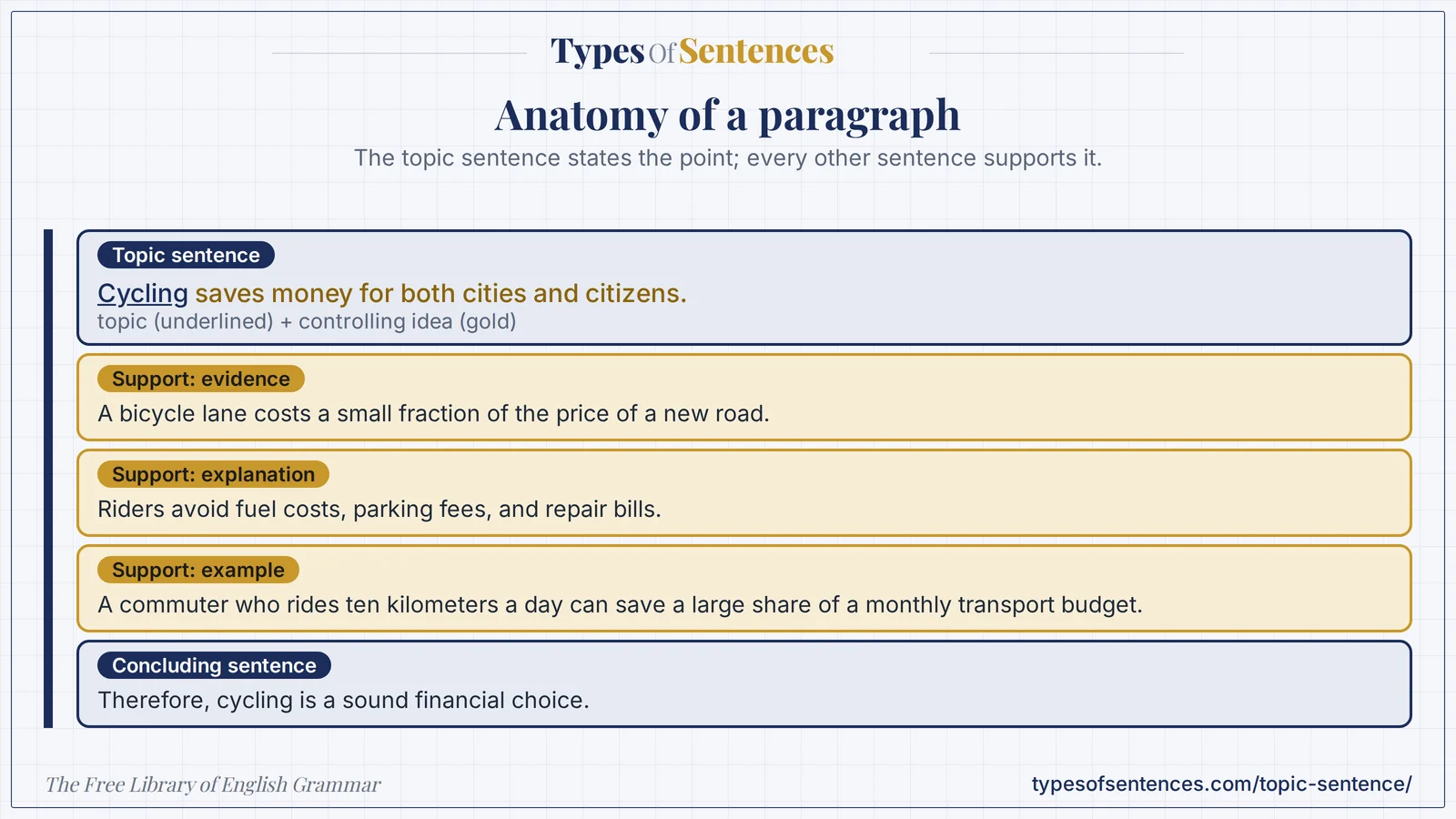
A topic sentence tells the reader the point of the paragraph. Think of it as a signpost: it says where the paragraph is going, and the rest of the paragraph takes you there.
Why it matters: Write it as a complete sentence that makes a claim you can support, not as a fact that needs no support and not as an announcement (This paragraph is about …).
Summary: A topic sentence states the main idea of a paragraph. It has a topic and a controlling idea (Regular reading [topic] improves your writing in three ways [controlling idea]). It is usually the first sentence, but it can come at the end (in an inductive paragraph) or be implied (in narrative). Writing one takes six steps: decide the point; state the topic; add the controlling idea; check that it can be supported; check that it is neither too broad nor too narrow; and check that it links to the thesis. In an essay, each body paragraph opens with a sentence that supports the thesis statement, which is the main idea of the whole essay. Avoid announcements, facts, questions, and sentences that are too broad.
- Topic + controlling idea.
- Usually first; supported by every other sentence.
- Thesis = whole essay; topic sentence = one paragraph.
- Not an announcement, not a bare fact.
What You’ll Learn
- 1. What Is a Topic Sentence? Definition and Parts
- 2. Topic Sentence Examples by Paragraph Type
- 3. A Topic Sentence Example for Essay Writing: Thesis and Body Paragraphs
- 4. How to Write a Topic Sentence: Six Steps
- 5. 50 Topic Sentence Starters
- 6. Where to Put a Topic Sentence
- 7. Common Mistakes With Topic Sentences
- 8. Exercises
- 9. Test Your Knowledge
- 10. Frequently Asked Questions
- 11. Conclusion
1. What Is a Topic Sentence? Definition and Parts
| Part | Meaning | Example |
|---|---|---|
| topic | the subject of the paragraph | Regular reading |
| controlling idea | the point you make about the topic | improves your writing in three ways |
| the whole sentence | a complete sentence that makes a claim | Regular reading improves your writing in three ways. |
| Feature | Explanation |
|---|---|
| purpose | to tell the reader what the paragraph is about |
| position | usually the first sentence of the paragraph |
| scope | broad enough to cover the paragraph, narrow enough to be proved in it |
| form | a complete sentence with a subject and a verb |
| content | a claim, an opinion, or a general statement that needs support |
| link | connects to the thesis of the essay or the topic of the section |
| control | all the other sentences in the paragraph support it |
| Sentence | Is it a topic sentence? | Why |
|---|---|---|
| Cities are noisy. | weak | too general; no controlling idea |
| City life is noisy because of traffic, construction, and crowds. | good | topic + a controlling idea that can be supported |
| The bus came at nine. | no | a fact; there is nothing to support |
| This paragraph is about noise. | no | an announcement |
| Isn’t the city noisy? | no | a question, not a claim |
| Noise in cities harms sleep, concentration, and health. | good | a clear claim with three supports |
This sentence belongs to the paragraph, the unit of writing between the sentence and the essay. The paragraph and its parts are described in the Basic chapter on paragraphs and in cohesion in writing, which explains how sentences within a paragraph are linked.
2. Topic Sentence Examples by Paragraph Type
| Paragraph type | Topic sentence example | Controlling idea |
|---|---|---|
| descriptive | The old market at dawn is a feast for the senses. | a feast for the senses |
| descriptive | My grandmother’s kitchen was the warmest room in the house. | warmest |
| narrative | The day I lost my wallet taught me three lessons about trust. | three lessons |
| narrative | Nothing prepared me for my first day at the new school. | nothing prepared me |
| expository | Solar panels convert sunlight into electricity in three stages. | three stages |
| expository | The monsoon affects India’s economy in several ways. | several ways |
| persuasive | Schools should start later in the morning. | should start later |
| persuasive | Public libraries deserve more funding because they serve everyone. | deserve more funding |
| compare and contrast | Trains and buses differ in cost, speed, and comfort. | differ |
| compare and contrast | Although cats and dogs are both popular pets, they require very different care. | very different care |
| cause and effect | Heavy rain was the main cause of the flood. | the main cause |
| cause and effect | Skipping breakfast can affect a child’s concentration. | affect concentration |
| process | Making tea properly takes five simple steps. | five simple steps |
| definition | A friend is someone who tells you the truth kindly. | tells the truth kindly |
| classification | Readers fall into three types: skimmers, studiers, and scanners. | three types |
| problem and solution | Plastic waste is a serious problem, but communities can reduce it. | a problem and a solution |
| argument against | Banning phones in class will not solve the problem of distraction. | will not solve |
| example | Many animals have remarkable ways of surviving the winter. | remarkable ways |
| introducing a counterargument | Some critics argue that online learning is less effective. | some critics argue |
| conclusion paragraph | In short, small daily habits shape a successful life. | small daily habits |
| Weak topic sentence | Why weak | Improved |
|---|---|---|
| Pollution. | a word, not a sentence | Air pollution harms children’s health in urban areas. |
| I am going to write about dogs. | an announcement | Dogs make loyal and useful companions. |
| Dogs have four legs. | a fact; nothing to argue | Dogs are the most useful of all domestic animals. |
| Everything about technology is important. | too broad | Smartphones have changed how students research. |
| My dog Max ate a red ball on Tuesday. | too narrow | My dog Max is surprisingly clever. |
| Do you like to travel? | a question | Travel teaches us more than books can. |
| There are many reasons. | vague | There are three reasons why cycling is better than driving in a city. |
3. A Topic Sentence Example for Essay Writing: Thesis and Body Paragraphs
| Element of the essay | Example (an invented essay) | Role |
|---|---|---|
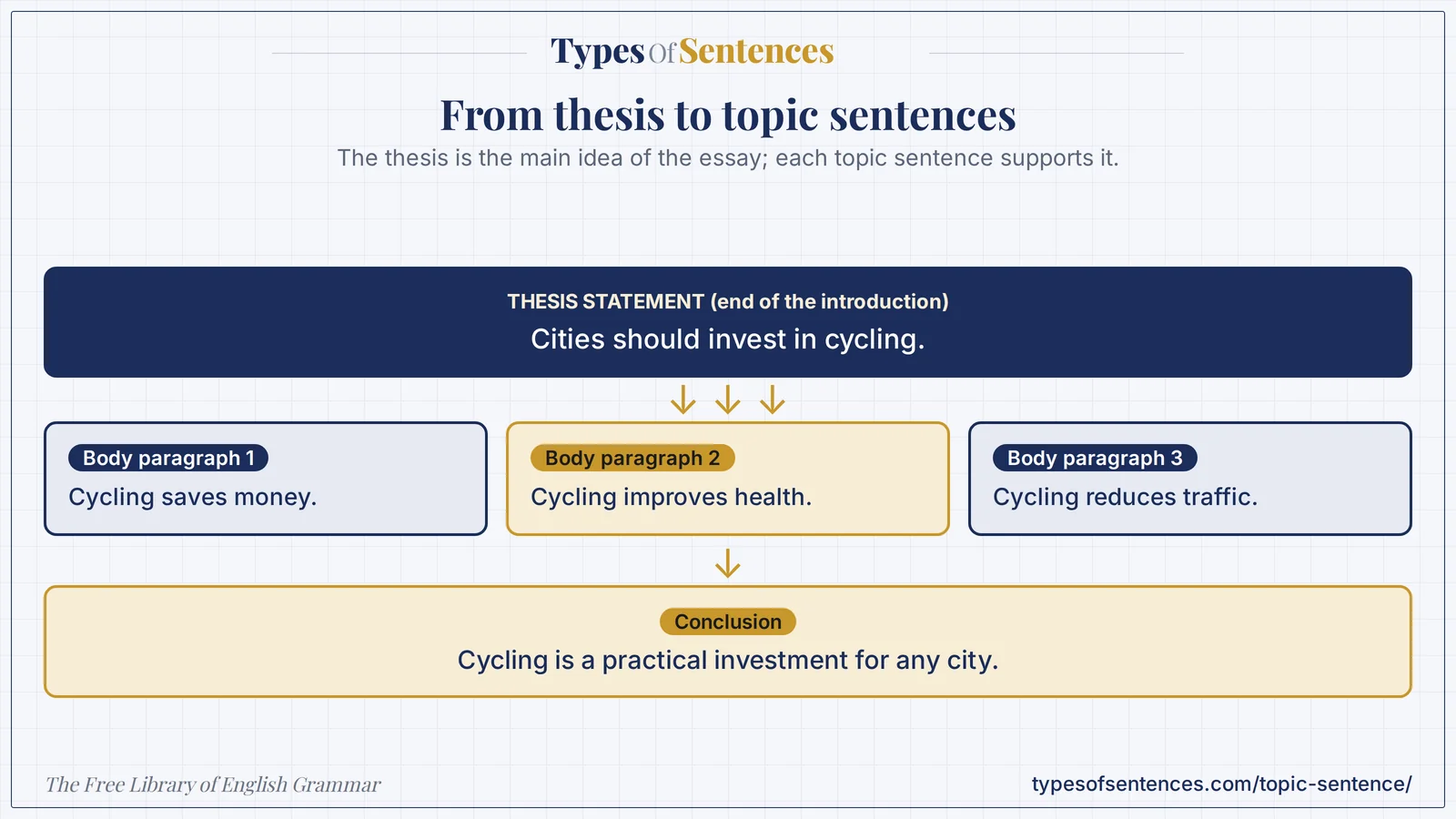
| thesis statement (the introduction) | Cities should invest in cycling because it saves money, improves health, and reduces traffic. | the main claim of the whole essay |
| opening sentence of body paragraph 1 | Cycling saves money for both cities and citizens. | supports the first reason |
| opening sentence of body paragraph 2 | Regular cycling improves the health of riders and reduces the cost of health care. | supports the second reason |
| opening sentence of body paragraph 3 | Cycling reduces traffic by replacing short car trips. | supports the third reason |
| opening sentence of the counterargument paragraph | Critics argue that cycling is unsafe, but protected lanes answer that concern. | answers an objection |
| opening sentence of the conclusion paragraph | In conclusion, cycling is a practical investment for any city. | sums up |
| Topic sentence | Thesis statement |
|---|---|
| the main idea of one paragraph | the main idea of the whole essay |
| supports the thesis | is supported by the opening sentences of the body paragraphs |
| appears in each body paragraph | appears once, usually at the end of the introduction |
| narrower in scope | broader in scope |
| example: Cycling saves money. | example: Cities should invest in cycling. |
| A sample paragraph | Sentence type |
|---|---|
| Cycling saves money for both cities and citizens. | topic sentence |
| A bicycle lane costs a small fraction of the price of a new road. | support (evidence) |
| Citizens who cycle to work avoid fuel costs, parking fees, and repair bills. | support (explanation) |
| For example, a commuter who rides ten kilometers a day can save a large share of a monthly transport budget. | support (example) |
| Therefore, cycling is a sound financial choice. | concluding sentence |
The sample is invented, and a real paragraph would cite evidence. For the structure of the whole essay, see the next chapter, on essay structure, and for the types of essay, the chapters on expository writing and persuasive writing. A full treatment of essay organization at an advanced level is in the related chapter listed at the end, and the basic essay is in the Basic chapter on how to write an essay.
4. How to Write a Topic Sentence: Six Steps
| Step | What to do | Example |
|---|---|---|
| 1 decide the point | what do you want the paragraph to prove or show? | that cycling saves money |
| 2 name the topic | the subject of the paragraph | cycling |
| 3 add the controlling idea | what you claim about it | saves money |
| 4 write a complete sentence | subject + verb + claim | Cycling saves money. |
| 5 sharpen it | be specific; add a number or a scope if useful | Cycling saves money for both cities and citizens. |
| 6 check it | can you support it in one paragraph? does it link to the thesis? is it neither too broad nor too narrow? | yes |
| Checklist | Question |
|---|---|
| complete sentence | does it have a subject and a verb? |
| claim | does it say something that needs support? |
| control | do all the other sentences support it? |
| scope | can it be proved in one paragraph? |
| clarity | is every word necessary and precise? |
| link | does it connect to the thesis and to the paragraph before? |
| no announcement | does it avoid I will write about …? |
| Formula | Pattern | Example |
|---|---|---|
| topic + verb + claim | [Topic] + [verb] + [claim] | Public libraries strengthen communities. |
| topic + number of points | [Topic] + [verb] + [number] + [kinds] | Public libraries serve communities in three ways. |
| concession + claim | Although … , [topic] … | Although e-books are convenient, printed books remain valuable. |
| cause + effect | [Cause] leads to [effect]. | Regular practice leads to fluent speech. |
| comparison | [A] and [B] differ in … | Cities and villages differ in pace and community. |
5. 50 Topic Sentence Starters
| Purpose | Topic sentence starters |
|---|---|
| introducing a main idea | One of the most important …; A key factor in …; The main reason for …; An essential part of …; There are several ways to … |
| adding a point | Another important …; In addition to …; Equally important is …; Moreover, …; A further consideration is … |
| giving a reason | The main reason why … is that …; One cause of … is …; … can be explained by …; Several factors contribute to …; A major reason for … is … |
| showing a result | As a result of …; One consequence of … is …; … leads to …; The effects of … are …; The impact of … on … is … |
| contrasting | In contrast, …; On the other hand, …; However, not everyone agrees that …; Although …, …; Despite …, … |
| comparing | Similarly, …; Like …, …; … and … have much in common.; The difference between … and … is …; … is more … than … |
| giving an example | A good example of … is …; … can be seen in …; Consider the case of …; For instance, …; … is illustrated by … |
| arguing | It is clear that …; … should …; There is strong evidence that …; Critics may argue that …, but …; It can be argued that … |
| showing sequence | The first step in … is …; Next, …; The final stage of … is …; Before …, …; After …, … |
| concluding | In conclusion, …; In short, …; Overall, …; Taken together, …; For these reasons, … |
The starters are scaffolds, not rules. A starter that does not fit the idea makes the sentence sound mechanical, and the best ones are written in the writer’s own words. The words that link one paragraph to the next are treated in the same chapter on cohesion.
6. Where to Put a Topic Sentence
| Position | Description | When to use it | Example |
|---|---|---|---|
| first sentence (the usual place) | the reader knows the point at once | most academic and informational writing | Cycling saves money. A bicycle lane costs … |
| last sentence (inductive) | evidence first, then the point | a persuasive build-up | … All these facts show that cycling saves money. |
| middle | after a short lead-in | a transition from a previous paragraph | Not all costs are visible. Cycling saves money … |
| first and last (a frame) | the point at the start and again at the end | longer paragraphs | an opening claim and a concluding sentence |
| implied (no topic sentence) | the point is clear from the sentences | narrative and descriptive writing | a series of images that build one impression |
| two sentences | a lead-in and a main statement | a complex idea | Many people think of cycling as a hobby. It is also a financial strategy. |
| Transitions between paragraphs | Example |
|---|---|
| to add | In addition to saving money, cycling improves health. |
| to contrast | However, cycling has its critics. |
| to continue a sequence | The second benefit of cycling is health. |
| to conclude | Finally, cycling reduces traffic. |
7. Common Mistakes With Topic Sentences
| Mistake | Example | Correction |
|---|---|---|
| an announcement | *In this paragraph, I will discuss pollution. | Air pollution harms children’s health. |
| a bare fact | *Delhi is in India. | Delhi’s air quality is a serious public health problem. |
| too broad | *Technology is important. | Mobile payments have changed how small shops do business. |
| too narrow | *The phone costs ₹10,000. | Smartphones have become affordable for most households. |
| a question | *Why is sleep important? | Sleep is essential for memory, mood, and health. |
| two ideas in one paragraph | an opening sentence that promises two separate topics | split into two paragraphs |
| no link to the thesis | an opening sentence unrelated to the essay’s claim | revise it or cut the paragraph |
| a vague word | *There are many things about sleep. | Sleep affects three areas of health. |
| not supported by the paragraph | a claim that the sentences do not prove | revise the paragraph or the claim |
| an opening sentence that repeats the thesis | the same words in every paragraph | make it narrower and specific |
Fix: This paragraph is about sports. Sports are good. Many people like them. Cricket is played in India. I play every Sunday and I like it.
- This paragraph is about sports.: an announcement: delete it.
- Sports are good.: too broad and vague: make the claim specific: Playing a team sport such as cricket benefits young people in three ways.
- Many people like them.: vague support; replace it with a reason: First, it builds fitness.
- Cricket is played in India.: a fact, not support; use it in an example: Second, it teaches cooperation, as in the school teams of India.
- I play every Sunday and I like it.: a personal detail that can be an example: Third, it gives a weekly routine; for example, I play every Sunday.
- Result: Playing a team sport such as cricket benefits young people in three ways. First, it builds fitness. Second, it teaches cooperation, as in the school teams of India. Third, it gives a weekly routine; for example, I play every Sunday. (the paragraph is invented)
Recap in 12 seconds
Watch the lesson build itself: A paragraph: a topic sentence, supporting sentences, and a concluding sentence. The example is invented. The video has no sound.
Exercises
Part A: Recognizing Topic Sentences (Exercises 1–8)
Exercise 1: What is a topic sentence?
Show Answer
Answer: The sentence that states the main idea of a paragraph.
Exercise 2: Name the two parts of a topic sentence.
Show Answer
Answer: The topic and the controlling idea.
Exercise 3: Where does a topic sentence usually go?
Show Answer
Answer: At the start of the paragraph.
Exercise 4: Is Dogs have four legs. a good topic sentence?
Show Answer
Answer: No; it is a fact with nothing to support.
Exercise 5: Is I will write about dogs. a good topic sentence?
Show Answer
Answer: No; it is an announcement.
Exercise 6: Is Dogs make loyal companions. a good topic sentence?
Show Answer
Answer: Yes; it makes a claim that can be supported.
Exercise 7: Underline the controlling idea: Regular reading improves your writing.
Show Answer
Answer: improves your writing.
Exercise 8: Underline the topic: Regular reading improves your writing.
Show Answer
Answer: Regular reading.
Part B: Improving Topic Sentences (Exercises 9–16)
Exercise 9: Improve: Pollution.
Show Answer
Answer: Air pollution harms children’s health in cities.
Exercise 10: Improve: Technology is important.
Show Answer
Answer: Smartphones have changed how students research.
Exercise 11: Improve: My phone costs ₹10,000.
Show Answer
Answer: Smartphones have become affordable for most households.
Exercise 12: Improve: Why is sleep important?
Show Answer
Answer: Sleep is essential for memory, mood, and health.
Exercise 13: Improve: In this paragraph, I will discuss exercise.
Show Answer
Answer: Regular exercise improves both body and mind.
Exercise 14: Improve: There are many reasons.
Show Answer
Answer: There are three reasons why cycling is better than driving in a city.
Exercise 15: Make specific: Food is nice.
Show Answer
Answer: Street food shows the variety of Indian cooking.
Exercise 16: Make a claim from the fact: Water is wet.
Show Answer
Answer: Clean water is the basis of public health.
Part C: Writing for Paragraph Types (Exercises 17–22)
Exercise 17: Write a topic sentence for a descriptive paragraph about a market.
Show Answer
Answer: Answers vary: e.g., The old market at dawn is a feast for the senses.
Exercise 18: Write one for a process paragraph about making tea.
Show Answer
Answer: Answers vary: e.g., Making tea properly takes five simple steps.
Exercise 19: Write one for a persuasive paragraph about libraries.
Show Answer
Answer: Answers vary: e.g., Public libraries deserve more funding because they serve everyone.
Exercise 20: Write one for a cause-and-effect paragraph about floods.
Show Answer
Answer: Answers vary: e.g., Heavy rain was the main cause of the flood.
Exercise 21: Write one for a compare-and-contrast paragraph about trains and buses.
Show Answer
Answer: Answers vary: e.g., Trains and buses differ in cost, speed, and comfort.
Exercise 22: Write one for a narrative paragraph about a first day at school.
Show Answer
Answer: Answers vary: e.g., Nothing prepared me for my first day at the new school.
Part D: Essay and Placement (Exercises 23–27)
Exercise 23: What is the difference between a thesis and a topic sentence?
Show Answer
Answer: The thesis is the main idea of the essay; a topic sentence is the main idea of one paragraph.
Exercise 24: Where does the thesis usually appear?
Show Answer
Answer: At the end of the introduction.
Exercise 25: Write a topic sentence for the second body paragraph of an essay on cycling (health).
Show Answer
Answer: Answers vary: e.g., Regular cycling improves the health of riders.
Exercise 26: Name a position for a topic sentence other than the first sentence.
Show Answer
Answer: The last sentence (inductive), or implied.
Exercise 27: What links one paragraph to the next?
Show Answer
Answer: A transition word or phrase, often in the first sentence.
Part E: Starters (Exercises 28–30)
Exercise 28: Use a starter for contrast: … not everyone agrees that homework helps.
Show Answer
Answer: However, not everyone agrees that homework helps.
Exercise 29: Use a starter to add a point: … saving money, cycling improves health.
Show Answer
Answer: In addition to saving money, cycling improves health.
Exercise 30: Use a starter to conclude: … small daily habits shape a successful life.
Show Answer
Answer: In conclusion, small daily habits shape a successful life.
Test Your Knowledge
Ready to check what you learned? Answer all 10 questions, then submit. You need 80% (8 of 10) to pass. Your answers are not stored.
View correct answers and explanations
Question 1: A topic sentence states
✓ Correct Answer: B – the main idea of a paragraph
The main idea.
Question 2: A topic sentence has
✓ Correct Answer: A – a topic and a controlling idea
Topic + controlling idea.
Question 3: Which is the best topic sentence?
✓ Correct Answer: C – Dogs make loyal companions.
A claim that can be supported.
Question 4: Where is a topic sentence usually placed?
✓ Correct Answer: D – at the start
At the start.
Question 5: A thesis statement is the main idea of
✓ Correct Answer: B – the whole essay
The whole essay.
Question 6: Which is an announcement?
✓ Correct Answer: C – In this paragraph, I will discuss pollution.
It announces instead of claiming.
Question 7: Which is too broad?
✓ Correct Answer: A – Technology is important.
Too general.
Question 8: A topic sentence at the end of a paragraph is called
✓ Correct Answer: D – inductive
Inductive order.
Question 9: Every other sentence in the paragraph should
✓ Correct Answer: C – support the main idea
Support it.
Question 10: Which starter shows contrast?
✓ Correct Answer: B – However, …
However.
Frequently Asked Questions
What is a topic sentence?
A topic sentence is the sentence that states the main idea of a paragraph. It usually comes first and has a topic and a controlling idea.
What are topic sentence examples?
Regular reading improves your writing in three ways. Solar panels convert sunlight into electricity in three stages. Schools should start later in the morning. These topic sentence examples each state a claim that a paragraph can support.
What is a topic sentence example for essay writing?
In an essay on cycling with the thesis Cities should invest in cycling, a topic sentence example for essay body paragraphs is Cycling saves money for both cities and citizens.
How do I know what is a topic sentence and what is not?
A good one is a complete sentence that makes a claim and can be supported in one paragraph. A fact, a question, an announcement, or a sentence that is too broad or too narrow is not a good choice.
What are topic sentence starters?
Topic sentence starters are phrases that open the main sentence of a paragraph, such as One of the most important …, In addition to …, However, not everyone agrees that …, and In conclusion, …. Choose topic sentence starters that fit your meaning.
Does every paragraph need a topic sentence?
In academic and informational writing, yes, usually. In narrative and descriptive writing, the main idea may be implied.
How is a topic sentence different from a thesis?
A thesis statement is the main idea of the whole essay; a topic sentence is the main idea of one paragraph and supports the thesis.
Conclusion
You now know what a topic sentence is, its two parts, examples for many paragraph types, a worked essay example, six steps for writing one, fifty starters, where to place it, and the mistakes to avoid.
Before you write a paragraph, write its topic sentence first. Next, you will study how to build a whole essay.
- Williams, Joseph M., and Joseph Bizup. Style: Lessons in Clarity and Grace. 12th ed. Pearson, 2017.: the point of a paragraph and its opening.
- Strunk, William, Jr., and E. B. White. The Elements of Style. 4th ed. Longman, 1999.: the rule on making the paragraph the unit of composition.
- Swales, John M., and Christine B. Feak. Academic Writing for Graduate Students. 3rd ed. University of Michigan Press, 2012.: topic sentences in academic paragraphs.
- Purdue Online Writing Lab. “Paragraphs and Paragraphing.” owl.purdue.edu. (online; check the current page): guidance on topic sentences.
- Merriam-Webster Dictionary: topic sentence: the dictionary entry.
Last reviewed: October 29, 2026. How it was made: drafted with AI assistance, then checked with automated tests (structure, links, answer keys, spelling) and against the sources above. A person has not yet read this chapter line by line. Found a mistake? Report it.