Narrative writing techniques are the tools that turn a series of events into a story. A narrative tells what happened to someone, in an order that builds interest. It needs a plot (what happens), characters (who it happens to), a setting (where and when), a point of view (who tells it), and conflict (what is at stake). Skilled storytellers also control pacing, dialogue, and the order of events.
This chapter covers the main storytelling techniques. You will review story structure, study the plot structure from exposition to resolution, learn character development, setting, point of view, dialogue, and conflict, and see how pacing, showing in narrative, and transitions shape a story. The chapter ends with tense in narrative, beginnings and endings, and a revision checklist. Thirty exercises and a quiz follow.
A story is not just a list of events. It is a chain in which each event causes the next, and in which someone wants something and meets an obstacle.
Why it matters: The simplest test of a story is to ask, “Who wants what, and what stands in the way?” If you can answer, you have the start of a plot.
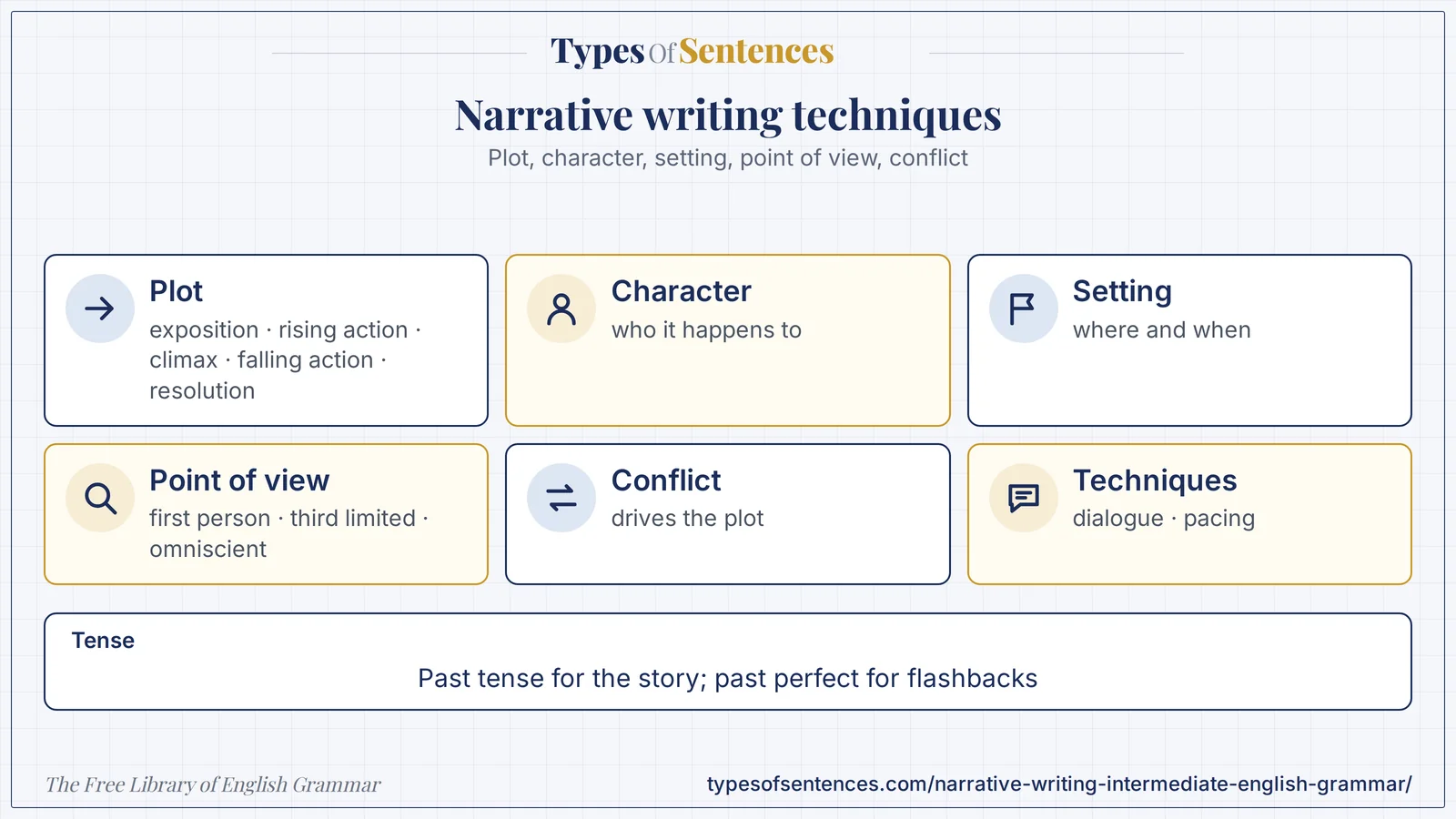
Summary: A narrative has a plot (a sequence of cause-and-effect events), characters, a setting, a point of view, and conflict. The classic plot structure is exposition, rising action, climax, falling action, and resolution. Techniques such as dialogue, pacing, showing (not telling), and well-chosen transitions make the story vivid. Narratives are usually written in the past tense, with the past perfect for events before the main story.
- Plot = what happens; character = who it happens to.
- Conflict drives the plot: someone wants something and meets an obstacle.
- Point of view: first person, third limited, or omniscient.
- Past tense for the story; past perfect for flashbacks.
What You’ll Learn
- 1. Narrative Writing Techniques: Story Structure (Review)
- 2. Narrative Structure: Plot Development
- 3. Character Development
- 4. Setting
- 5. Point of View
- 6. Dialogue
- 7. Conflict
- 8. Pacing
- 9. Show, Don’t Tell in Narrative
- 10. Transitions and Tense in Narrative
- 11. Beginnings and Endings
- 12. Planning and Revising a Narrative
- 13. Common Errors in Narrative Writing
- 14. Exercises
- 15. Test Your Knowledge
- 16. Frequently Asked Questions
- 17. Conclusion
1. Narrative Writing Techniques: Story Structure (Review)
Every story has a beginning, a middle, and an end. In the beginning, we meet the character and the situation. In the middle, a problem grows. In the end, the problem is resolved or changed.
| Element | Question | Example (a short story) |
|---|---|---|
| character | Who is it about? | Mina, a shy new student |
| setting | Where and when? | a crowded school on a rainy Monday |
| conflict | What is the problem? | she has to give a presentation and is terrified |
| plot | What happens? | she freezes, a classmate helps, she tries again |
| theme | What is the larger idea? | courage grows when we accept help |
The way a story is told, the order and the style, is the narrative. These narrative writing techniques are the ones used by novelists and by students writing a personal story.
2. Narrative Structure: Plot Development
Plot is the sequence of events in a story. In a good plot, each event is caused by the one before, so that the story moves forward. The classic plot structure has five parts.
| Part | What happens | Example (Mina’s story) |
|---|---|---|
| exposition | introduces the character, setting, and situation | Mina is new and shy; she dreads speaking in class. |
| inciting incident | the event that starts the conflict | The teacher announces a presentation due on Friday. |
| rising action | complications and growing tension | Mina rehearses alone, loses her notes, and panics. |
| climax | the turning point of greatest tension | In front of the class, her voice fails. |
| falling action | the results of the climax | A classmate smiles; Mina takes a breath and starts again. |
| resolution (denouement) | the final outcome | She finishes, and a new friend waits at the door. |
A well-known remark often credited to E. M. Forster contrasts a story with a plot: “The king died and then the queen died” is a story, while “The king died, and then the queen died of grief” is a plot, because the second shows cause. The point is that a plot connects events by cause and effect.
- Plot is not the same as theme. The plot is what happens; the theme is what it means.
- Plot is driven by conflict. Without a problem or a goal, there is no tension to resolve.
- Not every story follows this order. Some begin in the middle of the action (in medias res), with the exposition woven in later.
3. Character Development
| Term | Meaning | Example |
|---|---|---|
| protagonist | the main character | Mina |
| antagonist | the person or force opposing the protagonist | her own fear; or a mocking classmate |
| round character | complex, with strengths and flaws | Mina is shy but brave in small ways |
| flat character | simple, with one main trait | a cheerful bus driver |
| static character | does not change | the strict teacher |
| dynamic character | changes during the story | Mina learns confidence |
A strong character wants something (a goal), needs something deeper (growth), and has a flaw or fear that stands in the way. The gap between what a character wants and what he or she needs drives the character arc.
| Method | How it works | Example |
|---|---|---|
| direct characterization | the narrator states a trait | Mina was shy. |
| indirect: action | what the character does | Mina rehearsed her speech in the empty corridor. |
| indirect: speech | what the character says and how | “Um … I’m not sure,” she said, looking at the floor. |
| indirect: thoughts | what the character thinks | What if they laugh? |
| indirect: others’ reactions | how other characters respond | The teacher smiled gently and waited. |
4. Setting
Setting is the time and place of the story, together with the social and emotional environment. A good setting does more than name a place. It creates mood, reveals character, and affects the action.
| Aspect | Question | Effect |
|---|---|---|
| place | Where is it? | a lonely lighthouse versus a crowded market |
| time | When is it (era, season, time of day)? | a winter midnight creates a different mood from a summer noon |
| social setting | What customs and conditions surround the characters? | a strict boarding school |
| mood and atmosphere | What feeling does the setting create? | dark and tense, or warm and safe |
Weave the setting into the action instead of describing it in a block. Mina’s shoes squeaked on the wet floor as she hurried past the noisy lockers tells the setting and the action together. The descriptive techniques are in the previous chapter on descriptive writing.
5. Point of View
| Point of view | Pronouns | What the narrator knows | Example |
|---|---|---|---|
| first person | I, we | only what the narrator sees and thinks | I stepped to the front, my knees shaking. |
| second person (rare) | you | addresses the reader or character | You step to the front, your knees shaking. |
| third person limited | he, she, they | one character’s thoughts only | Mina stepped to the front, her knees shaking. She was sure everyone could see. |
| third person omniscient | he, she, they | the thoughts of several characters | Mina was terrified; her teacher, watching, remembered her own first speech. |
| third person objective | he, she, they | only what can be seen and heard | Mina stepped to the front. Her knees shook. |
- Choose one point of view and keep it. Slipping from one character’s thoughts to another’s without a reason confuses the reader.
- First person is intimate but limited; third limited balances closeness and flexibility; omniscient gives scope but less intimacy.
- The narrator can be unreliable, giving a view that the reader doubts.
6. Dialogue
Dialogue is the words that characters speak. It brings characters to life, moves the plot, and reveals information. Good dialogue sounds natural but is more focused than real speech.
| Technique | Example |
|---|---|
| reveals character | “I don’t need help,” Mina said, too quickly. |
| moves the plot | “The presentation is on Friday,” the teacher said. |
| shows emotion through action beats | “Fine.” She slammed the book shut. |
| subtext (meaning beneath the words) | “Oh, I’m fine,” she said, not looking up. |
| simple tags | said, asked, replied (invisible to the reader) |
| varied from description | short lines in conversation, longer lines for description |
- Use quotation marks, and start a new paragraph for each new speaker. The punctuation rules are in the chapter on punctuation marks.
- Use plain tags (said, asked) most of the time. A fancy tag (exclaimed, hissed) every time distracts.
- Avoid dialogue that only gives information (“As you know, Bob, we have been friends for ten years”).
- Do not copy real speech exactly. Cut the um and the small talk; keep the voice.
Dialogue is direct speech. When you summarize a conversation instead, you use reported speech, as in the chapter on reported speech: She told him that she was afraid. Mix the two: dialogue for the key moments and reported speech to move on.
7. Conflict
| Type | Description | Example |
|---|---|---|
| person versus person | a struggle between characters | a rivalry between two students |
| person versus self (internal) | a struggle within the character | Mina’s fear of speaking |
| person versus nature | a struggle against the natural world | a hiker caught in a snowstorm |
| person versus society | a struggle against rules or customs | a girl who wants to study in a village that forbids it |
| person versus technology | a struggle against a machine or system | a pilot fighting a failing autopilot |
| person versus fate | a struggle against destiny | a king trying to avoid a prophecy |
Conflict raises stakes, the consequences of failing. The higher and more personal the stakes, the more the reader cares. A story with no conflict, only events, feels flat.
8. Pacing
Pacing is the speed at which a story moves. A writer speeds up action and slows down important moments by choosing what to include and how to write it.
| To speed up | To slow down |
|---|---|
| short sentences and paragraphs | long, detailed sentences |
| summary (“Weeks passed.”) | scene (moment-by-moment detail) |
| strong verbs, little description | sensory details and thoughts |
| quick dialogue | reflection and inner thoughts |
| cut-away or scene break | a pause before the climax |
- Scene shows an event moment by moment. Summary covers time quickly. Use scene for the important moments and summary for the rest.
- Flashbacks pause the main story to show an earlier event. Use them sparingly, and make the shift clear.
- Cliffhangers end a section at a point of tension to keep the reader reading.
9. Show, Don’t Tell in Narrative
| Telling | Showing |
|---|---|
| Mina was scared. | Mina’s mouth went dry, and the words on her card swam. |
| The teacher was impatient. | The teacher tapped her watch and glanced at the clock. |
| The classroom was tense. | No one coughed. A chair creaked, and the sound echoed. |
| He was happy to see her. | He broke into a grin and waved both arms. |
Show the key moments through action, dialogue, and sensory detail, and tell only to move quickly through the less important parts. The balance is described with the techniques of description in the chapter on descriptive writing.
10. Transitions and Tense in Narrative
| Purpose | Transitions | Example |
|---|---|---|
| time passing | later, soon, the next day, a week later, meanwhile | A week later, the presentation was due. |
| sequence | first, then, next, after that, finally | Then she took a breath. |
| sudden change | suddenly, just then, all at once | Just then, the door opened. |
| place change | back at home, across town, in the next room | Across town, her friend was waiting. |
| scene break | a blank line or a symbol (***) | between scenes |
| flashback | years earlier, as a child, before that | Years earlier, she had failed a speech. |
| Narrative tense | Use | Example |
|---|---|---|
| simple past | the main story | Mina walked to the front. |
| past continuous | a background action in progress | The rain was falling while she spoke. |
| past perfect | events before the main story (flashback) | She had rehearsed all week. |
| present tense (for effect) | immediacy; some modern fiction | Mina walks to the front. Her knees shake. |
11. Beginnings and Endings
| Opening technique | Example |
|---|---|
| action (in medias res) | The alarm shrieked, and Mina ran. |
| a question | What would you do if your voice stopped working? |
| dialogue | “You have to speak first,” the teacher said. |
| a vivid detail or setting | The classroom smelled of chalk and wet umbrellas. |
| a bold statement | Mina had never spoken in class. |
| Ending technique | Effect | Example |
|---|---|---|
| resolved (closed) | the problem is settled | She finished, and the class applauded. |
| open | leaves a question for the reader | She walked to the front. Everyone waited. |
| twist | a surprise that changes meaning | The “classmate” was a new teacher all along. |
| circular | returns to the opening image | The rain was falling again, but now she did not mind. |
12. Planning and Revising a Narrative
- Who is the main character, and what does he or she want?
- What stands in the way (the conflict)?
- Does each event cause the next?
- Is the structure clear: exposition, rising action, climax, resolution?
- Is the point of view consistent?
- Does the dialogue sound natural and do work?
- Are the key moments shown, not told?
- Is the tense consistent, with the past perfect for flashbacks?
- Is the opening engaging, and the ending satisfying?
- Have I proofread for grammar and punctuation?
Plan a short story: A student must give a speech.
- Character: Mina, a shy new student.
- Want: to avoid speaking; need: to find courage.
- Conflict: the presentation due on Friday (internal fear).
- Plot: announcement; rehearsal; loss of notes; freeze in front of the class; help from a classmate; second attempt; success.
- Point of view: third person limited; tense: simple past.
13. Common Errors in Narrative Writing
| Error | Fix |
|---|---|
| a list of events with no cause and effect | link each event to the previous one by cause |
| no conflict or stakes | give the character a goal and an obstacle |
| changing the point of view | choose one and keep it |
| telling every emotion | show the key moments |
| too much dialogue that only informs | make dialogue reveal character or move the plot |
| inconsistent tense | keep the past tense; use the past perfect for flashbacks |
| too much backstory at the start | start with action and weave the background in |
| a rushed ending | give the resolution enough space |
| fancy dialogue tags every time | use said and asked most of the time |
| a flat character | give the character a want, a flaw, and a choice |
Recap in 12 seconds
Watch the lesson build itself: A narrative has a plot, characters, a setting, a point of view, and conflict, told in the past tense. The video has no sound.
Exercises
Part A: Structure and Plot (Exercises 1–7)
Exercise 1: Name five story elements.
Show Answer
Answer: Character, setting, conflict, plot, theme.
Exercise 2: Name the five parts of the classic plot structure.
Show Answer
Answer: Exposition, rising action, climax, falling action, resolution.
Exercise 3: Which part is the turning point of greatest tension?
Show Answer
Answer: The climax.
Exercise 4: Which part introduces the characters and setting?
Show Answer
Answer: The exposition.
Exercise 5: Define plot.
Show Answer
Answer: A sequence of events connected by cause and effect.
Exercise 6: What drives a plot?
Show Answer
Answer: Conflict.
Exercise 7: What does in medias res mean?
Show Answer
Answer: Beginning in the middle of the action.
Part B: Character and Setting (Exercises 8–13)
Exercise 8: Define protagonist.
Show Answer
Answer: The main character.
Exercise 9: Define antagonist.
Show Answer
Answer: The person or force opposing the protagonist.
Exercise 10: Static or dynamic: a character who changes during the story.
Show Answer
Answer: Dynamic.
Exercise 11: Which is indirect characterization: Mina was shy or Mina rehearsed in the empty corridor?
Show Answer
Answer: The second.
Exercise 12: Name two aspects of setting.
Show Answer
Answer: Place and time (also social setting and mood).
Exercise 13: Why weave setting into the action?
Show Answer
Answer: To avoid long blocks of description and to show mood and character.
Part C: Point of View (Exercises 14–18)
Exercise 14: Which point of view uses I?
Show Answer
Answer: First person.
Exercise 15: Which point of view gives one character’s thoughts only?
Show Answer
Answer: Third person limited.
Exercise 16: Which point of view gives several characters’ thoughts?
Show Answer
Answer: Third person omniscient.
Exercise 17: Why keep one point of view?
Show Answer
Answer: To avoid confusing the reader.
Exercise 18: What is an unreliable narrator?
Show Answer
Answer: A narrator whose account the reader doubts.
Part D: Dialogue and Conflict (Exercises 19–24)
Exercise 19: Punctuate: I am ready she said
Show Answer
Answer: “I am ready,” she said.
Exercise 20: Report: “I am afraid,” she said.
Show Answer
Answer: She said that she was afraid.
Exercise 21: Which tag is usually best: said or hissed?
Show Answer
Answer: said.
Exercise 22: Name a type of conflict inside a character.
Show Answer
Answer: Person versus self (internal conflict).
Exercise 23: Name a conflict with the natural world.
Show Answer
Answer: Person versus nature.
Exercise 24: What are stakes?
Show Answer
Answer: The consequences of failing.
Part E: Pacing, Tense, and Endings (Exercises 25–30)
Exercise 25: Which speeds up the pace: short sentences or long detailed ones?
Show Answer
Answer: Short sentences.
Exercise 26: Which tense for events before the main story?
Show Answer
Answer: Past perfect.
Exercise 27: Show: Mina was scared.
Show Answer
Answer: Sample: Mina’s mouth went dry, and the words on her card swam.
Exercise 28: Name a time transition.
Show Answer
Answer: Later (or the next day, meanwhile).
Exercise 29: Name an ending technique.
Show Answer
Answer: Resolved, open, twist, or circular.
Exercise 30: Where should a story begin?
Show Answer
Answer: As late as possible, close to the action.
Test Your Knowledge
Ready to check what you learned? Answer all 10 questions, then submit. You need 80% (8 of 10) to pass. Your answers are not stored.
View correct answers and explanations
Question 1: What is plot?
✓ Correct Answer: D – A sequence of events connected by cause and effect
A plot connects events by cause and effect.
Question 2: Which is the turning point of greatest tension?
✓ Correct Answer: C – Climax
The climax is the peak.
Question 3: Who is the protagonist?
✓ Correct Answer: C – The main character
The protagonist is the main character.
Question 4: Which point of view uses “I”?
✓ Correct Answer: A – First person
First person uses I.
Question 5: What does dialogue do?
✓ Correct Answer: D – Reveals character and moves the plot
Dialogue reveals character and moves the plot.
Question 6: Which tense shows events before the main story?
✓ Correct Answer: B – Past perfect
The past perfect shows an earlier time.
Question 7: Which is a type of internal conflict?
✓ Correct Answer: C – Person versus self
Person versus self is internal.
Question 8: Which is showing?
✓ Correct Answer: B – Mina’s mouth went dry, and the words swam.
It shows the fear through detail.
Question 9: Which tag is usually best?
✓ Correct Answer: A – said
Said is invisible.
Question 10: Where should a story usually begin?
✓ Correct Answer: B – As late as possible, close to the action
Begin close to the action.
Frequently Asked Questions
What are narrative writing techniques?
Narrative writing techniques are the tools used to tell a story well: plot structure, character development, setting, point of view, dialogue, conflict, pacing, showing, transitions, and a controlled use of tense.
What are storytelling techniques for beginners?
Storytelling techniques for beginners are to give the main character a clear goal and an obstacle, make each event cause the next, show key moments, use dialogue, and keep one point of view.
What is narrative structure?
Narrative structure is the way the events of a story are organized. The classic structure has exposition, rising action, climax, falling action, and resolution.
What is plot development?
Plot development is how the events of a story build in tension through conflict and cause and effect, from the inciting incident through the rising action to the climax and resolution.
How do I start writing stories?
For writing stories, start with a character who wants something, add an obstacle, outline the main events, choose a point of view, write the draft in the past tense, and then revise for structure and showing.
What is the difference between plot and story?
A story is a sequence of events. A plot connects the events by cause and effect: not “The king died and then the queen died” but “The king died, and the queen died of grief.”
Which tense should I use in a narrative?
Most narratives use the simple past for the main events and the past perfect for events before them. The present tense can create immediacy, but then it must be used consistently.
Conclusion
You now know the main narrative writing techniques: story and plot structure, character development, setting, point of view, dialogue, conflict, pacing, showing, transitions, tense, and strong beginnings and endings. You can plan and revise a story with a clear goal, obstacle, and resolution.
Write a short story from the plan in this chapter, and revise it with the checklist. Next, you will study expository writing.
- Purdue Online Writing Lab: Narrative Essays: reference page on narrative writing.
- Forster, E. M. Aspects of the Novel. Edward Arnold, 1927.: the distinction between story and plot.
- Freytag, Gustav. Die Technik des Dramas. 1863.: the five-part dramatic structure.
- Quirk, Randolph, et al. A Comprehensive Grammar of the English Language. Longman, 1985.: tense and narrative.
Last reviewed: October 29, 2026. How it was made: drafted with AI assistance, then checked with automated tests (structure, links, answer keys, spelling) and against the sources above. A person has not yet read this chapter line by line. Found a mistake? Report it.