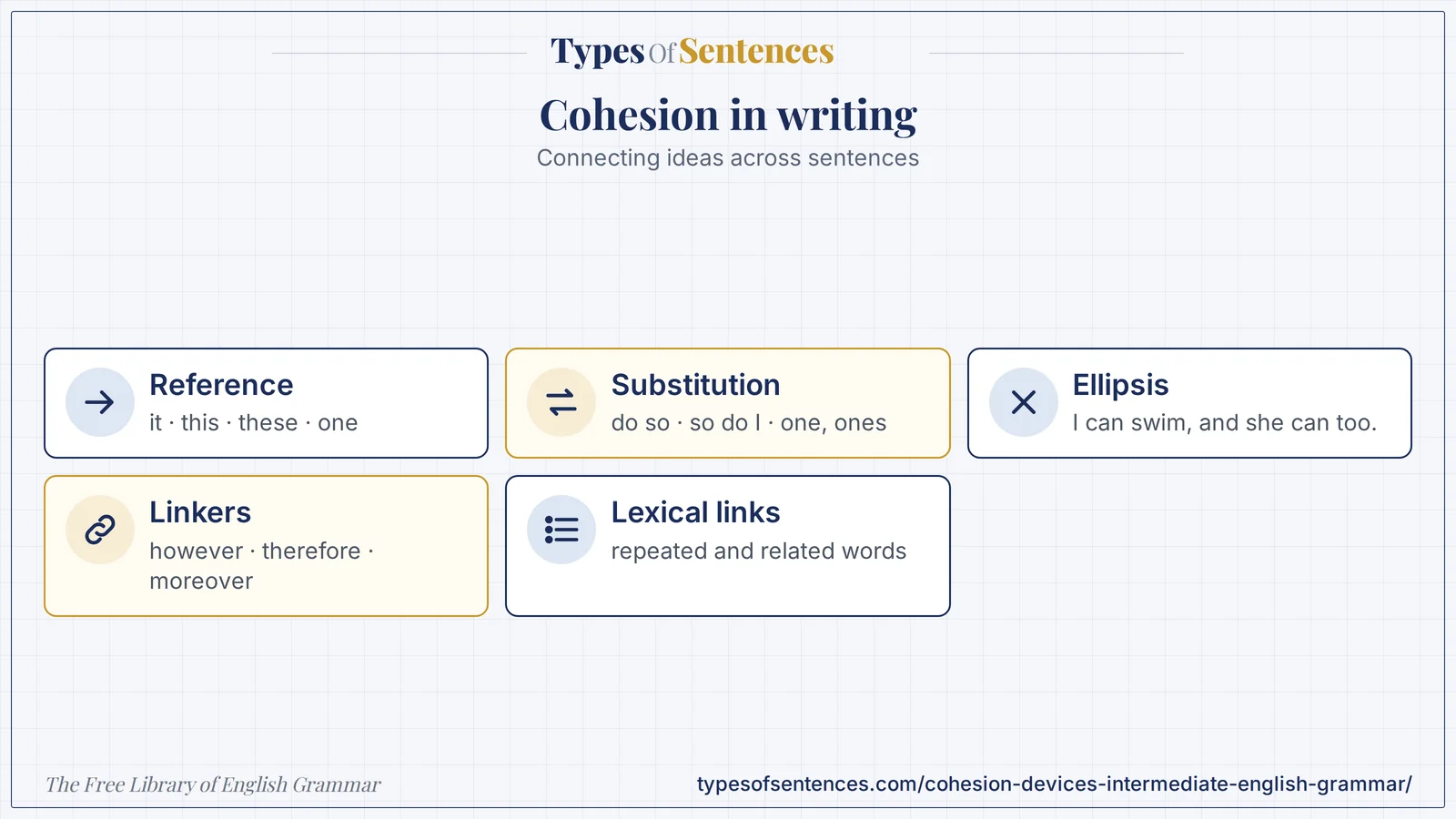
Cohesion in writing is the grammar glue that binds ideas. It is made of the small words and patterns that connect one sentence to the next: pronouns that point back (it, this), words that replace others (do so, one), words that are left out because they are understood (She can swim and he can too), and linkers that show relationships (however, therefore). Without cohesion, a text reads like a list of separate sentences.
This chapter covers the main cohesion devices in writing. You will learn the difference between cohesion and coherence, the reference words and linking patterns (this, that, these, those, one, ones, it), substitution and ellipsis (do so, so do I, neither do we), the conjunctive linkers (however, therefore, moreover, on the other hand), how to improve the flow between sentences, and how cohesion works in a paragraph. Thirty exercises and a quiz follow.
Read two sentences that have nothing linking them: The museum opened in 1990. Tickets are cheap. They are grammatical, but the reader has to guess the link. Add It, however, or also, and the link is clear.
Why it matters: Cohesion is the set of devices in the grammar and the vocabulary that makes the link visible.
Summary: Cohesion is the grammatical and lexical linking of sentences. The main devices are reference (pronouns and demonstratives pointing back or forward), substitution (replacing a word or phrase with one, do so, so), ellipsis (leaving out a repeated word), conjunction (linkers such as however and therefore), and lexical cohesion (repeating or varying key words). Cohesion is about links on the surface; coherence is about sense.
- Reference: it, this, these, one.
- Substitution: do so, so do I, one/ones.
- Ellipsis: I can swim, and she can [swim] too.
- Linkers: however, therefore, moreover, on the other hand.
What You’ll Learn
- 1. Cohesion in Writing: What Is Cohesion?
- 2. Reference Words and Linking: This, That, These, Those, One, Ones, It
- 3. Substitution and Ellipsis: Do So, So Do I, Neither Do We
- 4. Conjunctive Linkers: However, Therefore, Moreover, On the Other Hand
- 5. Lexical Cohesion: Repetition, Synonyms, and Related Words
- 6. Improving Flow Between Sentences
- 7. Cohesion in Paragraph Writing
- 8. Common Errors in Cohesion
- 9. Exercises
- 10. Test Your Knowledge
- 11. Frequently Asked Questions
- 12. Conclusion
1. Cohesion in Writing: What Is Cohesion?
Cohesion is the linking of sentences by grammar and vocabulary, so that the text holds together on the surface. A cohesive text uses devices that tell the reader how each sentence relates to the one before.
| Device | What it does | Example |
|---|---|---|
| reference | points to something already mentioned (or coming) | Maria bought a car. It is red. |
| substitution | replaces a word or phrase | I need a pen. Do you have one? |
| ellipsis | omits a word that is understood | I can swim, and she can [swim] too. |
| conjunction (linkers) | shows a logical relationship | It was cheap; however, it broke. |
| lexical cohesion | repeats or varies key words | the museum … the building … this landmark |
| Cohesion | Coherence | |
|---|---|---|
| what it is | the linking devices in the text | the sense and logic of the whole text |
| where it lives | in the words and grammar | in the ideas and the order |
| example of failure | It is red. She bought. (missing links) | sentences that are linked but make no sense together |
| how to improve | add reference, linkers, and repeated words | organize the ideas, stay on topic |
A text can be cohesive but not coherent: I like tea. Tea comes from leaves. Leaves fall in autumn. Autumn is a book by Smith. Every sentence links to the next, but the whole makes little sense. The difference between coherence and unity in a paragraph is in the chapter on paragraph writing.
2. Reference Words and Linking: This, That, These, Those, One, Ones, It
Reference words point to a person, thing, or idea mentioned elsewhere. The word they point to is the antecedent. Reference that looks back is anaphora; reference that looks forward is cataphora.
| Reference word | Points to | Example |
|---|---|---|
| personal pronouns: he, she, it, they, them | a person or thing | Maria called. She left a message. |
| this, these (near) | something close in time, place, or the text | I have a plan. This will work. |
| that, those (far) | something further or already mentioned | He lied. That surprised me. |
| one, ones | a countable noun already mentioned | I like the blue shirt more than the green one. |
| the same, such, another | a previous item | I will have the same. Such things happen. |
| the + noun (definite article) | something already identified | I bought a dog. The dog is friendly. |
| here, there, then | a place or time | We went to Paris. There we met Tom. |
| Type | Direction | Example |
|---|---|---|
| anaphora (back) | points to an earlier word | Maria arrived. She sat down. |
| cataphora (forward) | points to a later word | When she arrived, Maria sat down. |
| exophora (outside the text) | points to the situation | This is delicious. (pointing at food) |
Demonstratives are determiners and pronouns; see the chapter on determiners. Personal pronouns are described in the chapter on types of pronouns.
A bare this or which can point to several things. Add a noun (this announcement, this decision) to make the reference clear.
3. Substitution and Ellipsis: Do So, So Do I, Neither Do We
Substitution replaces a word or phrase with a short word (one, do, so). Ellipsis leaves the repeated words out altogether. Both avoid repetition.
| Type | Pattern | Example |
|---|---|---|
| nominal substitution | one / ones for a noun | I lost my pen. I will buy a new one. Which shoes? The red ones. |
| verbal substitution | do / do so for a verb phrase | She asked him to leave, and he did so. I thought he would win, and he did. |
| clausal substitution | so / not for a clause | Will it rain? I think so. I hope not. |
| so + auxiliary + subject (agreement) | so do I, so can she | She likes tea, and so do I. |
| neither / nor + auxiliary + subject | neither do we | He doesn’t smoke, and neither do we. |
| too, either (agreement) | too after positive; either after negative | I like it, too. I don’t like it, either. |
| Type of ellipsis | Example (omitted words in brackets) |
|---|---|
| nominal | Tom has two cars, and Maria has three [cars]. |
| verbal | I can’t swim, but she can [swim]. |
| clausal | Who wrote it? Maria [wrote it]. |
| after to | I wanted to go, but I couldn’t [go]. She asked me to come, but I didn’t want to [come]. |
4. Conjunctive Linkers: However, Therefore, Moreover, On the Other Hand
Conjunctive linkers (also called linking adverbials or transition words) show the logical relationship between two sentences or clauses. They are described in the chapter on conjunctions and the guide to conjunctive adverbs.
| Relationship | Linkers | Example |
|---|---|---|
| addition | also, moreover, furthermore, in addition, besides | The phone is cheap. Moreover, it is durable. |
| contrast | however, nevertheless, on the other hand, in contrast, yet | The plan is good. However, it is costly. |
| cause and result | therefore, consequently, as a result, thus, so | It rained. Therefore, we stayed home. |
| sequence | first, then, next, afterward, finally | First, mix the flour. Next, add eggs. |
| example | for example, for instance, such as | Many fruits are sweet, for example, mangoes. |
| concession | although, even so, still, despite this | It was hard. Even so, we finished. |
| summary | in short, in conclusion, overall | In short, the trip was a success. |
| Position | Example | Punctuation |
|---|---|---|
| start of the second sentence | It was cheap. However, it broke. | comma after the linker |
| between clauses | It was cheap; however, it broke. | semicolon before, comma after |
| middle of a clause | It was, however, a poor design. | commas around the linker |
| end of a clause | It broke, however. | comma before |
A comma alone cannot join two sentences with however. This is a comma splice; see the guide to the comma splice.
5. Lexical Cohesion: Repetition, Synonyms, and Related Words
| Device | Example |
|---|---|
| repetition of a key word | The museum opened in 1990. The museum now attracts thousands. |
| synonym or near-synonym | …the museum … the gallery … the institution |
| a general word (hypernym) | …a Honda … the car … the vehicle |
| a related word from the same field | museum, exhibit, curator, collection |
| a pronoun or demonstrative | …the museum … it … this place |
Repeating the key word is not a fault, because it tells the reader that the topic is the same. Replace it with a pronoun or a synonym when the repetition becomes heavy, but avoid an “elegant variation” that changes the word so often that the reader wonders if the topic has changed.
6. Improving Flow Between Sentences
- Old before new. Begin a sentence with information that the reader already knows (the link) and end with the new information: The museum opened in 1990. It now holds 5,000 objects.
- Keep the topic in view. Repeat the key word or a pronoun as the subject of several sentences: The museum … It … The museum.
- Use linkers where the relationship is not obvious. Do not add one to every sentence.
- Vary the sentence openings. Start some sentences with a subject, a prepositional phrase, or a clause, as in the chapters on compound sentences and complex sentences.
- Use parallel structure for related ideas: The first plan was cheap; the second plan was fast.
| Choppy (no cohesion) | Cohesive |
|---|---|
| I have a dog. The dog is brown. I walk the dog. I walk in the morning. | I have a brown dog, which I walk every morning. |
| The exam was hard. Many students failed. The teacher was surprised. | The exam was hard, and many students failed, which surprised the teacher. |
| Libraries are useful. They have books. They have computers. Students use them. | Libraries are useful because they offer books and computers that students use every day. |
7. Cohesion in Paragraph Writing
Improve the cohesion: Cycling is healthy. Cycling is cheap. Cycling is fast in cities. People should cycle more. People get exercise. People save money.
- The sentences are short and repeat the same words, so the paragraph is choppy.
- Combine and link: Cycling is healthy, cheap, and fast in cities.
- Use a reference word: It gives people exercise, and it saves them money.
- Add a linker for the conclusion: Therefore, more people should cycle.
- Result: Cycling is healthy, cheap, and fast in cities. It gives people exercise and saves them money. Therefore, more people should cycle.
| Cohesive device used | In the revised paragraph |
|---|---|
| repetition (key word) | Cycling … it … Cycling |
| reference | it, them |
| substitution/ellipsis | healthy, cheap, and fast (omitted is) |
| linker | Therefore |
The same devices work across paragraphs. A sentence that begins This benefit … or These costs … points back to the previous paragraph and bridges the two, as in the previous chapter on essay structure.
8. Common Errors in Cohesion
| Error | Correction | Rule |
|---|---|---|
| The company announced a policy and a new CEO. This surprised everyone. | …This double announcement surprised everyone. | vague this |
| Maria told Anna that she was late. | Maria told Anna, “You are late.” / Maria told Anna that Anna was late. | ambiguous pronoun |
| I like it, either. | I like it, too. | too after positive |
| He doesn’t smoke, and so do we. | He doesn’t smoke, and neither do we. | negative agreement |
| She is tired, and so does he. | She is tired, and so is he. | matching auxiliary |
| It was cheap, however it broke. | It was cheap; however, it broke. | comma splice |
| I want a red car and she wants a blue car. | I want a red car, and she wants a blue one. | substitution with one |
| Moreover, however, therefore … | (use only the linkers you need) | overuse |
| They saw a movie. The film … the picture … the cinema piece | They saw a movie. The film … | confusing variation |
| The first reason is cost. Second is speed. | The first reason is cost. The second is speed. | keep parallel links |
Fix: My brother lives in Pune. He likes it there. My sister lives in Delhi, however she doesn’t like it, so do my parents.
- however she doesn’t like it: a comma splice: ; however, or a period.
- so do my parents: the first clause is negative: neither do my parents.
- Result: My brother lives in Pune. He likes it there. My sister lives in Delhi; however, she doesn’t like it, and neither do my parents.
Recap in 12 seconds
Watch the lesson build itself: Cohesion links sentences through reference, substitution, ellipsis, linkers, and lexical links. The video has no sound.
Exercises
Part A: Cohesion and Coherence (Exercises 1–5)
Exercise 1: Define cohesion.
Show Answer
Answer: The linking of sentences by grammar and vocabulary.
Exercise 2: Define coherence.
Show Answer
Answer: The sense and logic of the whole text.
Exercise 3: Name three cohesive devices.
Show Answer
Answer: Reference, substitution, ellipsis (also conjunction and lexical cohesion).
Exercise 4: Is a text with many linkers always coherent?
Show Answer
Answer: No. The ideas must also make sense together.
Exercise 5: Which is “grammar glue”: cohesion or coherence?
Show Answer
Answer: Cohesion.
Part B: Reference (Exercises 6–12)
Exercise 6: Find the antecedent: Maria called. She left a message.
Show Answer
Answer: Maria.
Exercise 7: Choose: I like the blue shirt more than the green (one/ones).
Show Answer
Answer: one.
Exercise 8: Choose: Which shoes? The red (one/ones).
Show Answer
Answer: ones.
Exercise 9: Is this anaphora or cataphora: When she arrived, Maria sat down.
Show Answer
Answer: Cataphora (forward).
Exercise 10: Fix the vague this: The firm cut prices and hired staff. This surprised everyone.
Show Answer
Answer: …This double move surprised everyone. (sample)
Exercise 11: Replace with a pronoun: The museum opened in 1990. The museum has 5,000 objects.
Show Answer
Answer: …It has 5,000 objects.
Exercise 12: Fix the ambiguity: Maria told Anna that she was late.
Show Answer
Answer: Maria told Anna, “You are late.” (or name the person)
Part C: Substitution and Ellipsis (Exercises 13–19)
Exercise 13: Complete: She likes tea, and ___ do I.
Show Answer
Answer: so.
Exercise 14: Complete: He doesn’t smoke, and ___ do we.
Show Answer
Answer: neither.
Exercise 15: Complete: She is tired, and so ___ he.
Show Answer
Answer: is.
Exercise 16: Complete: I like it, ___. (too/either)
Show Answer
Answer: too.
Exercise 17: Complete: I don’t like it, ___. (too/either)
Show Answer
Answer: either.
Exercise 18: Replace the repeated verb: She asked him to leave, and he left. (do so)
Show Answer
Answer: …and he did so.
Exercise 19: Show the omitted words: I can’t swim, but she can.
Show Answer
Answer: [swim].
Part D: Linkers (Exercises 20–25)
Exercise 20: Choose a linker for contrast: The plan is good. ___, it is costly.
Show Answer
Answer: However.
Exercise 21: Choose a linker for a result: It rained. ___, we stayed home.
Show Answer
Answer: Therefore.
Exercise 22: Choose a linker for addition: It is cheap. ___, it is durable.
Show Answer
Answer: Moreover.
Exercise 23: Choose a linker for an example: Many fruits are sweet, ___, mangoes.
Show Answer
Answer: for example.
Exercise 24: Fix it: It was cheap, however it broke.
Show Answer
Answer: It was cheap; however, it broke.
Exercise 25: Punctuate: It was however a poor design.
Show Answer
Answer: It was, however, a poor design.
Part E: Flow and Paragraphs (Exercises 26–30)
Exercise 26: Combine: I have a dog. The dog is brown. I walk the dog every morning.
Show Answer
Answer: I have a brown dog, which I walk every morning.
Exercise 27: What is the “old before new” principle?
Show Answer
Answer: Begin with known information and end with new information.
Exercise 28: Name a repetition device that is not a fault.
Show Answer
Answer: Repeating the key word to keep the topic in view.
Exercise 29: Which links paragraphs: This benefit … or Cycling …?
Show Answer
Answer: This benefit … (a reference to the previous paragraph).
Exercise 30: Is it good to add a linker to every sentence?
Show Answer
Answer: No. Use linkers only where the relationship is not obvious.
Test Your Knowledge
Ready to check what you learned? Answer all 10 questions, then submit. You need 80% (8 of 10) to pass. Your answers are not stored.
View correct answers and explanations
Question 1: What is cohesion?
✓ Correct Answer: A – The linking of sentences by grammar and vocabulary
Cohesion is the linking devices.
Question 2: Which is a reference word?
✓ Correct Answer: C – it
It points back to a noun.
Question 3: Which is substitution?
✓ Correct Answer: D – I need a pen. Do you have one?
One replaces the noun.
Question 4: Which is correct?
✓ Correct Answer: C – She likes tea, and so do I.
So do I agrees with a positive verb.
Question 5: Which is correct?
✓ Correct Answer: B – He doesn’t smoke, and neither do we.
Neither do we after a negative.
Question 6: Which linker shows contrast?
✓ Correct Answer: C – however
However shows contrast.
Question 7: Which is correct?
✓ Correct Answer: B – It was cheap; however, it broke.
Semicolon before, comma after.
Question 8: What is anaphora?
✓ Correct Answer: D – Reference to something earlier
Anaphora looks back.
Question 9: What is ellipsis?
✓ Correct Answer: A – Leaving out understood words
Ellipsis omits words.
Question 10: Why is “This surprised everyone” sometimes a problem?
✓ Correct Answer: B – The word this can point to several things
A bare this can be vague.
Frequently Asked Questions
What is cohesion in writing?
Cohesion in writing is the linking of sentences by grammar and vocabulary: reference words, substitution, ellipsis, conjunctive linkers, and repeated key words. It is the grammar glue that binds ideas.
What are cohesion devices in writing?
Cohesion devices in writing are reference (it, this), substitution (one, do so), ellipsis (leaving out understood words), conjunctive linkers (however, therefore), and lexical cohesion (repeated or related words).
What are reference words and linking words?
Reference words and linking words point back or forward in the text (she, this, those, one) or show relationships between sentences (however, moreover). They connect the sentences.
What are reference words?
Reference words are words that point to something mentioned elsewhere, such as personal pronouns (he, it), demonstratives (this, that), and one or ones.
What are ellipsis, substitution, and agreement words?
Ellipsis, substitution patterns avoid repetition. Ellipsis leaves words out (I can swim, and she can too), and substitution replaces them (do so, one, so do I, neither do we).
What is the difference between cohesion and coherence?
Cohesion is the linking on the surface through grammar and vocabulary. Coherence is the logic and sense of the whole text. A text can be cohesive without being coherent.
How can I improve the flow between sentences?
Begin with known information, repeat key words or use pronouns to keep the topic in view, add linkers where the relationship is not obvious, vary the sentence openings, and combine very short sentences.
Conclusion
You now know how cohesion works in writing: what it is and how it differs from coherence, the reference words, substitution and ellipsis, the conjunctive linkers, lexical cohesion, how to improve the flow between sentences, and how to use these devices in a paragraph. You can avoid the common errors.
Read a paragraph you have written and mark each link between sentences; add one where it is missing. Next, you will study descriptive writing techniques.
- Halliday, M. A. K., and Ruqaiya Hasan. Cohesion in English. Longman, 1976.: the foundational study of reference, substitution, ellipsis, conjunction, and lexical cohesion.
- Purdue Online Writing Lab: Transitions and Transitional Devices: reference page on transitions.
- Strunk, William, Jr., and E. B. White. The Elements of Style. 4th ed. Longman, 2000.: principles of clear connection.
- Quirk, Randolph, et al. A Comprehensive Grammar of the English Language. Longman, 1985.: linking adverbials, ellipsis, and substitution.
Last reviewed: October 29, 2026. How it was made: drafted with AI assistance, then checked with automated tests (structure, links, answer keys, spelling) and against the sources above. A person has not yet read this chapter line by line. Found a mistake? Report it.