Advanced reported speech begins where the Intermediate rules of backshift end. At the Intermediate level you learned to change “I am tired” into She said that she was tired. At this level the questions are different: which reporting verb says exactly what you mean (say, claim, admit, insist), which complement pattern each verb takes (He claimed to be innocent, He admitted stealing), how modals change, when backshift is optional, how academic writers attribute ideas without quoting, and how novelists blend the narrator’s voice with a character’s (free indirect speech).
You will study complex reporting verbs and their patterns, reporting with to-infinitives and with -ing forms, advanced reported questions, backshift with modals, optional and absent backshift, reported requests and exclamations, reporting structures in academic writing, and free indirect speech, a literary technique that is part of indirect speech advanced. The control of these reporting verbs advanced writers use is what lets a writer report with precision and fairness. Thirty editing exercises and a quiz follow.
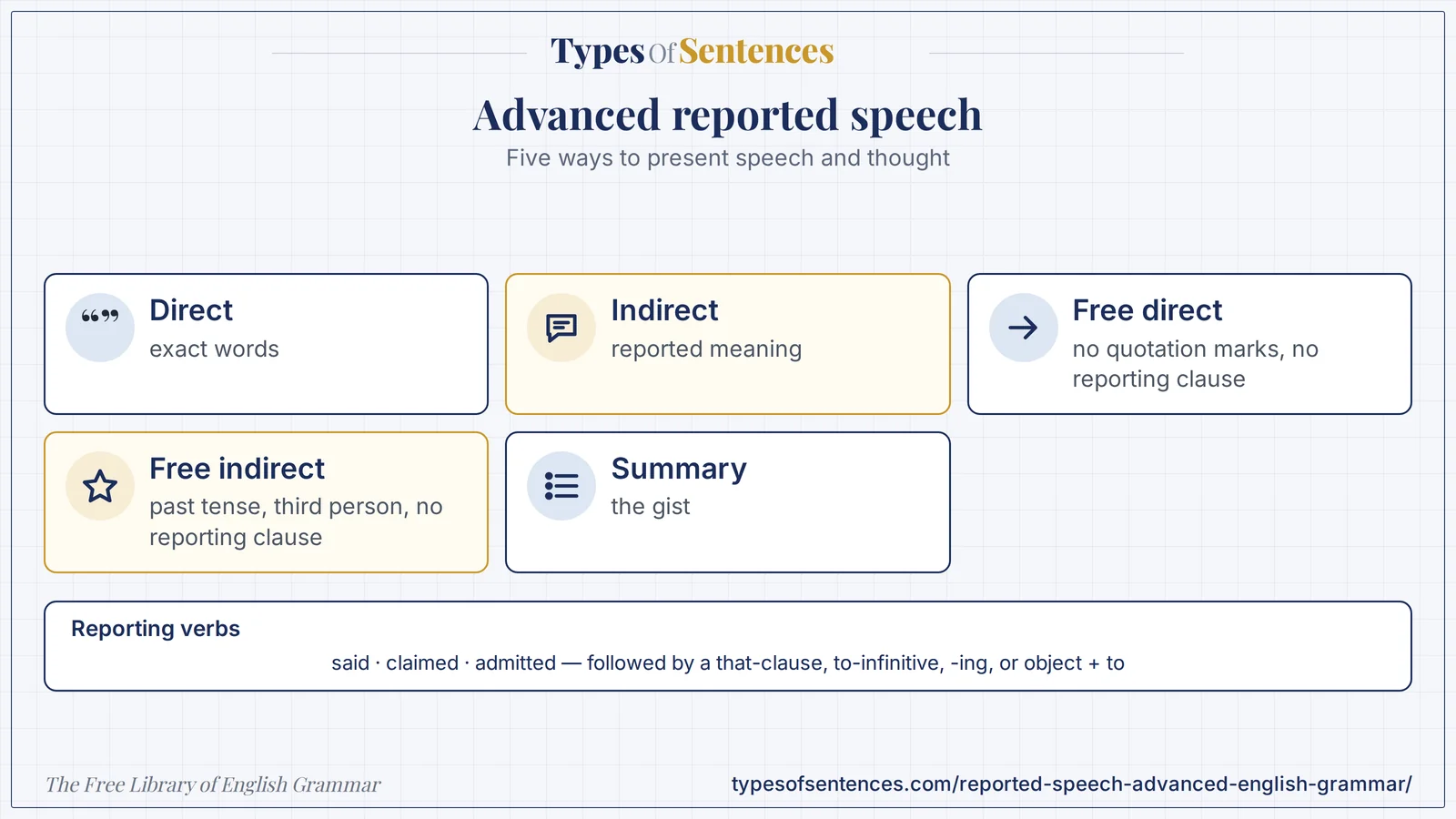
Reporting is never neutral. The verb you choose tells the reader how you rate the words you report: said is neutral, claimed raises doubt, admitted implies fault, pointed out implies that it is true. Choosing the verb is a matter of precision and of fairness.
Why it matters: The grammar follows the verb. Each reporting verb has its own pattern, and a pattern that is right for one verb (suggest that) is wrong for another (*suggest him to). Learning the patterns by group makes them manageable.
Summary: Speech and thought can be presented in direct, indirect, free direct, free indirect, and summary forms. Reporting verbs differ in meaning (neutral, speech act, evaluative, manner) and in the complements they take: a that-clause (say, claim), a to-infinitive (claim, promise, refuse), an -ing form (admit, deny, suggest), or an object plus to (tell, advise, order). Backshift applies to tense and to modals (can → could, must → had to), but it is optional when the report is still true. Academic writing attributes claims with reporting verbs and hedges them. Free indirect speech reports thought or speech without a reporting clause.
- Choose the reporting verb for meaning: said, claimed, admitted, insisted.
- Patterns: that-clause, to-infinitive, -ing, object + to.
- Modals: can → could, will → would, must → had to; would, could, might do not change.
- Free indirect speech: past tense, third person, no reporting clause, character’s voice.
What You’ll Learn
- 1. Advanced Reported Speech: Ways of Presenting Speech and Thought
- 2. Reporting Verbs Advanced: Beyond Said and Told
- 3. Reporting Structures: The Patterns of Reporting Verbs
- 4. Reporting with To-Infinitives and -ing Forms
- 5. Reporting Questions: Advanced Patterns
- 6. Reporting Modal Verbs: Backshift and Exceptions
- 7. When Backshift Is Optional or Absent
- 8. Reporting in Academic Writing: Attribution and Hedging
- 9. Free Indirect Speech
- 10. Common Errors in Reported Speech
- 11. Exercises
- 12. Test Your Knowledge
- 13. Frequently Asked Questions
- 14. Conclusion
1. Advanced Reported Speech: Ways of Presenting Speech and Thought
Direct and indirect speech are two points on a scale. Linguists such as Leech and Short describe several categories of speech presentation, which writers choose between according to how closely they want to follow the original words.
| Category | Example | Features |
|---|---|---|
| direct speech | She said, “I will come tomorrow.” | exact words, quotation marks, reporting clause |
| free direct speech | “I will come tomorrow.” | no reporting clause; the words are given alone |
| indirect speech | She said that she would come the next day. | a subordinate clause; backshift; pronouns and deictics shifted |
| free indirect speech | She would come tomorrow, she thought. | no reporting verb or a minimal one; the character’s deictics are kept |
| narrator’s report of a speech act (summary) | She promised to come the next day. | the act, not the words |
| narrator’s report of speech (minimal) | She spoke at length about her trip. | topic only |
The Intermediate chapter on reported speech covered direct and indirect speech and the basic changes. This chapter covers the finer points of the indirect forms and the free indirect form, which is a standard technique of narrative fiction.
2. Reporting Verbs Advanced: Beyond Said and Told
| Type | Verbs | Meaning and effect |
|---|---|---|
| neutral | say, tell, state, mention, add, remark, note, observe | report without judgment |
| factive (the speaker takes the report to be true) | point out, explain, reveal, show, demonstrate, remind | the writer accepts the content |
| non-factive, distancing | claim, allege, assert, maintain, contend, purport | the writer does not vouch for it |
| admission | admit, concede, confess, acknowledge, own up | the speaker says something damaging or unwelcome |
| denial and refusal | deny, refuse, reject, dispute, contest | — |
| argument and insistence | argue, insist, urge, stress, emphasize, declare, assure | the speaker presses a view |
| speech acts (directive) | ask, request, order, command, tell, advise, warn, remind, invite, urge, beg, forbid | a request or command is reported |
| speech acts (commissive) | promise, offer, threaten, vow, volunteer, refuse, agree | a commitment is reported |
| speech acts (expressive) | thank, apologize, congratulate, complain, boast, protest | a social act |
| manner | whisper, mutter, shout, murmur, snap, stammer, sigh | how it was said |
| Verb pair | Difference |
|---|---|
| say / claim | say is neutral; claim expresses doubt about the truth |
| admit / say | admit implies that the content is damaging to the speaker |
| explain / claim | explain accepts the content as true; claim does not |
| insist / say | insist shows that the speaker pressed the point despite resistance |
| allege / state | allege reports an unproved accusation (important in news and law) |
| suggest / demand | suggest proposes; demand requires |
| complain / mention | complain adds dissatisfaction |
The choice of verb is a choice of attitude. In news writing, replacing said with claimed or admitted shows the writer’s stance and can mislead, so many editors prefer neutral said unless the nuance is intended. In academic writing, the verb choice signals the writer’s evaluation of a source; see the section below.
3. Reporting Structures: The Patterns of Reporting Verbs
| Pattern | Verbs | Example |
|---|---|---|
| that-clause | say, state, claim, explain, announce, add, admit, deny, suggest, insist, mention, argue | She said that she was tired. He claimed that he was innocent. |
| object + that-clause | tell, assure, convince, persuade, remind, warn, inform, notify | She told me that she was tired. He warned them that it was dangerous. |
| to-infinitive (subject control) | claim, promise, threaten, offer, refuse, agree, decline, propose (formal), demand | He claimed to be innocent. She promised to call. They refused to help. |
| object + to-infinitive | tell, ask, order, command, advise, warn, remind, invite, urge, beg, forbid, instruct | She told him to leave. He advised me not to go. They ordered us to stop. |
| -ing form | admit, deny, suggest, recommend, mention, recall, report, propose | He admitted stealing. She denied having seen him. He suggested going. |
| preposition + -ing | insist on, apologize for, accuse … of, blame … for, congratulate … on, complain about, boast about, thank … for | He insisted on paying. She accused him of lying. They thanked her for helping. |
| wh-clause or whether/if | ask, wonder, explain, tell, know, say, inquire, demand to know | She asked where he lived. He wondered whether it was true. |
| direct quotation | say, shout, whisper, ask, reply, add | “Come in,” she said. |
| Verb | Patterns that work | Patterns that do not |
|---|---|---|
| suggest | that + clause (subjunctive or should); -ing | *suggest him to go; *suggest to go |
| insist | that + clause; on + -ing | *insist to go |
| promise | to + infinitive; that + clause; object + that | *promise going |
| admit | that + clause; -ing; to + -ing (formal: admit to stealing) | *admit to steal |
| deny | that + clause; -ing | *deny to have lied |
| explain | that + clause; wh-clause; to + object (explain something to someone) | *explain me; *explain that to |
| tell | object + that / to + inf / wh-; without object only in fixed phrases (tell the truth) | *tell that she left (without an object) |
| claim | that + clause; to-infinitive | *claim to that |
The patterns are grouped by the kind of complement in the chapter on complement clauses, and the noun clauses that follow that and the wh-words are in the chapter on nominal clauses. The mandative subjunctive after suggest and insist is treated there too: She suggested that he leave.
4. Reporting with To-Infinitives and -ing Forms
| Pattern | Example | Notes |
|---|---|---|
| subject + to-infinitive | He claimed to be innocent. She promised to come. | the subject is the understood subject of the infinitive |
| perfect infinitive | He claimed to have been at home. She admitted to having lied. | an earlier event |
| passive infinitive | She claimed to have been misunderstood. | — |
| object + to-infinitive | She told him to wait. He ordered them to leave. | the object is the understood subject |
| negative | She told him not to go. He promised not to tell. | not before to |
| -ing form | He admitted taking the money. She denied seeing him. | the subject is the understood subject |
| perfect -ing | He denied having taken it. She admitted having been wrong. | an earlier event |
| preposition + -ing | She accused him of lying. He insisted on seeing the manager. | — |
The choice between the infinitive and the -ing form is a property of each verb: claim to be but admit being. The understood subject follows the same rules as control in the chapter on complement clauses. Reporting commands and requests uses object + to: “Close the door” → He told me to close the door. The non-finite forms are treated in the chapter on non-finite verbs.
5. Reporting Questions: Advanced Patterns
| Direct | Reported | Notes |
|---|---|---|
| “Where do you live?” | She asked where I lived. | statement order; no do |
| “Are you coming?” | He asked whether (if) I was coming. | whether is more formal |
| “Where should I go?” | She asked where she should go. / She asked where to go. | an infinitive wh-clause when the subject is the same |
| “Can you help me?” | She asked whether I could help her. / She asked me to help her. | a request can be reported as a question or as a request |
| “What are you doing here, and who let you in?” | He demanded to know what I was doing there and who had let me in. | two questions, parallel clauses |
| “How long have you lived here?” | She asked how long I had lived there. | backshift to the past perfect |
| “Why did you do it?” | He wanted to know why I had done it. | want to know, wonder, inquire |
| “Do you mind if I sit here?” | She asked if I minded her sitting there. | — |
6. Reporting Modal Verbs: Backshift and Exceptions
| Direct | Reported | Notes |
|---|---|---|
| “I can swim.” | She said she could swim. | can → could |
| “I may come.” | She said she might come. | may → might |
| “I will help.” | She said she would help. | will → would |
| “I shall return.” | She said she would return. / …should return. (British) | shall → would (or should) |
| “I must go.” (obligation) | She said she had to go. / …she must go. | must → had to (or unchanged) |
| “He must be tired.” (deduction) | She said he must be tired. | epistemic must stays |
| “You needn’t come.” | She said I needn’t come. / …didn’t need to come. | — |
| “You should rest.” | She said I should rest. | no change |
| “It might rain.” | She said it might rain. | no change |
| “You could have called.” | She said I could have called. | no change |
| “I would have helped.” | She said she would have helped. | no change |
The modals would, could, should, might, ought to, and had better do not change because they are already “remote” forms, as explained in the chapter on modality. Must expressing obligation can become had to or stay as it is, depending on whether the obligation is still current. The permission may becomes could or might: “You may leave” → She said I could leave.
7. When Backshift Is Optional or Absent
| Situation | Example | Why |
|---|---|---|
| the reporting verb is in the present or present perfect | She says she is tired. He has said that he will come. | the report is current |
| the statement is still true or a general truth | He said that the Earth moves around the sun. She told me she is a nurse. (she still is) | backshift would not change the truth |
| the report is made soon after | “I’m hungry.” — She just said she’s hungry. | the time has not changed |
| a past reporting verb with a future time that has not arrived | She said she will come tomorrow. (tomorrow has not come) | the future is still future |
| the writer wants to commit to the truth | Galileo said that the Earth moves. | present tense endorses the claim |
| a past perfect or a modal that cannot shift | She said she had left. She said she might come. | already past or remote |
| Deixis | Direct | Reported (when time or place has changed) |
|---|---|---|
| time | now, today, tomorrow, yesterday, last week, ago | then, that day, the next day, the day before, the week before, before |
| place | here, this, come | there, that, go |
| person | I, we, you | he/she, they, I/he/she (by speaker) |
Reports are also made of requests, offers, thanks, and other speech acts, using the speech-act verbs: “Thank you” → She thanked him. “Happy birthday!” → She wished him a happy birthday. “Shall I open the window?” → He offered to open the window. The sequence of tenses in the wider system is treated in the chapter on tense and aspect.
8. Reporting in Academic Writing: Attribution and Hedging
| Function | Reporting verbs | Example |
|---|---|---|
| neutral reporting | state, note, observe, report, mention, describe | Smith (2020) reports that the rate has fallen. |
| positive stance (writer agrees) | show, demonstrate, establish, prove, confirm, point out, reveal | Jones (2019) demonstrates that sleep affects memory. |
| neutral to tentative | suggest, indicate, propose, imply, hypothesize | Lee (2021) suggests that the effect may be small. |
| argumentative | argue, claim, contend, maintain, assert, insist | Brown (2018) argues that policy has failed. |
| negative stance (writer doubts) | claim, allege, purport, fail to, overlook, ignore | Green (2017) claims, without evidence, that … |
| findings | find, discover, conclude, measure, estimate | Smith (2020) found that … |
| Type of citation | Example | Notes |
|---|---|---|
| integral (author in the sentence) | Smith (2020) argues that sleep is vital. | the reporting verb is the main verb |
| non-integral (author in brackets) | Sleep is vital (Smith, 2020). | no reporting verb |
| passive reporting | It has been argued that sleep is vital (Smith, 2020). | the source is in the brackets |
| according to | According to Smith (2020), sleep is vital. | neutral |
| paraphrase with hedging | Smith (2020) appears to suggest that sleep may be vital. | double hedge |
| quotation | Smith (2020) calls sleep “the foundation of learning” (p. 12). | short, exact words |
- Tense: present simple for what a source argues or for established facts (Smith argues); past simple for a specific study (Smith found); present perfect for a body of work (Researchers have shown).
- Hedge the content that is not certain: may, appears to, suggests. Do not hedge the verb of a source that is firmly established.
- Be fair. Claim and allege signal doubt; use them only when you intend to question the source.
- Do not copy. Paraphrase in your own structure and cite the source; the format of citation is treated in the chapter on citing sources.
9. Free Indirect Speech
Free indirect speech (also called free indirect discourse) is a literary technique that reports a character’s words or thoughts without a reporting clause and without quotation marks, blending the narrator’s voice with the character’s. It is typical of third-person narrative in the past tense.
| Feature | Direct | Indirect | Free indirect |
|---|---|---|---|
| reporting clause | She thought, “I will go tomorrow.” | She thought that she would go the next day. | She would go tomorrow. |
| tense | present, future | backshifted | backshifted (past) |
| pronouns | I | she | she |
| deictics (now, tomorrow, here) | kept | shifted | kept: tomorrow, now, here |
| questions | “Will I ever be free?” | She wondered whether she would ever be free. | Would she ever be free? (question order kept) |
| exclamations and emphasis | “What a fool I am!” | She exclaimed that she was a fool. | What a fool she was! |
| quotation marks | yes | no | no |
- Tomorrow was Monday. Would she never be free of this place? Surely someone would come. free indirect: Tomorrow and the question order are the character’s
- She was sure of it now. He had lied, and she would not forgive him. free indirect: now and the emphatic tone
- He looked at the clock. Where was she? She should have been here an hour ago. a character’s thought in the narrator’s past tense
Free indirect speech shows how grammar creates voice: the past tense and the third person belong to the narrator, while the deictic words, the question forms, and the exclamations belong to the character. It occurs in the work of many novelists, and noticing it is a skill of literary analysis, which is developed in the chapter on grammar in literature. When you write it, keep the character’s deictics (now, tomorrow) and avoid a reporting clause.
10. Common Errors in Reported Speech
| Error | Correction | Rule |
|---|---|---|
| She said me that she was late. | She told me that she was late. | tell takes an object |
| He suggested me to go. | He suggested that I go. / He suggested going. | suggest patterns |
| He insisted to go. | He insisted on going. / He insisted that he go. | insist on + -ing |
| He admitted to steal. | He admitted stealing. / He admitted to stealing. | -ing after admit |
| He denied to have lied. | He denied having lied. / He denied that he had lied. | -ing after deny |
| She asked where did I live. | She asked where I lived. | statement order |
| She explained me the rule. | She explained the rule to me. | explain + to |
| He claimed that to be innocent. | He claimed to be innocent. / He claimed that he was innocent. | one pattern |
| She promised going. | She promised to go. | promise + to |
| He said that “I am tired.” | He said, “I am tired.” / He said that he was tired. | do not mix direct and indirect |
| She said that she will come yesterday. | She said that she would come the day before. | backshift and time words |
| He claimed that he was home, which was true. | He said that he was home, which was true. | the wrong verb for a nuance (claimed doubts) |
Edit: She said me that she was late, and he suggested me to go, but he insisted to pay, and he admitted to steal, and she denied to have lied, and she asked where did I live, and she explained me the rule, and he said that “I am tired.”
- said me: told me.
- suggested me to go: suggested that I go.
- insisted to pay: insisted on paying.
- admitted to steal: admitted stealing.
- denied to have lied: denied having lied.
- where did I live: where I lived.
- explained me the rule: explained the rule to me.
- he said that “I am tired”: he said that he was tired.
- Result: She told me that she was late, and he suggested that I go, but he insisted on paying, and he admitted stealing, and she denied having lied, and she asked where I lived, and she explained the rule to me, and he said that he was tired.
Recap in 12 seconds
Watch the lesson build itself: Speech and thought can be direct, indirect, free direct, free indirect, or summarized, with reporting verbs chosen for meaning. The video has no sound.
Exercises
Part A: Reporting Verbs (Exercises 1–7)
Exercise 1: Which verb shows doubt: said or claimed?
Show Answer
Answer: claimed.
Exercise 2: Which verb implies a damaging admission: said or admitted?
Show Answer
Answer: admitted.
Exercise 3: Which is neutral: claim or say?
Show Answer
Answer: say.
Exercise 4: Which verb accepts the content as true: explain or allege?
Show Answer
Answer: explain.
Exercise 5: Name the type: whisper
Show Answer
Answer: A manner verb.
Exercise 6: Name the type: promise
Show Answer
Answer: A commissive speech-act verb.
Exercise 7: Edit: She said me that she was late.
Show Answer
Answer: She told me that she was late.
Part B: Patterns (Exercises 8–14)
Exercise 8: Edit: He suggested me to go.
Show Answer
Answer: He suggested that I go.
Exercise 9: Edit: He insisted to go.
Show Answer
Answer: He insisted on going.
Exercise 10: Edit: He admitted to steal.
Show Answer
Answer: He admitted stealing.
Exercise 11: Edit: She denied to have lied.
Show Answer
Answer: She denied having lied.
Exercise 12: Report: “I will call,” she promised. (to-infinitive)
Show Answer
Answer: She promised to call.
Exercise 13: Report: “Don’t go,” he said to me.
Show Answer
Answer: He told me not to go.
Exercise 14: Report: “You lied,” she said. (accused)
Show Answer
Answer: She accused him of lying.
Part C: Questions and Modals (Exercises 15–21)
Exercise 15: Report: “Where do you live?” she asked.
Show Answer
Answer: She asked where I lived.
Exercise 16: Report with an infinitive: “Where should I go?” she asked.
Show Answer
Answer: She asked where to go.
Exercise 17: Report: “I can swim,” she said.
Show Answer
Answer: She said she could swim.
Exercise 18: Report: “I must go,” she said.
Show Answer
Answer: She said she had to go.
Exercise 19: Report: “You should rest,” she said.
Show Answer
Answer: She said I should rest.
Exercise 20: Report: “You may leave,” he said.
Show Answer
Answer: He said I could leave.
Exercise 21: Edit: She asked where did I live.
Show Answer
Answer: She asked where I lived.
Part D: Backshift and Deixis (Exercises 22–25)
Exercise 22: Is backshift required: He said that the Earth moves around the sun.?
Show Answer
Answer: No (a general truth).
Exercise 23: Backshift the time word: “I will come tomorrow,” she said.
Show Answer
Answer: She said she would come the next day.
Exercise 24: Edit: She said that she will come yesterday.
Show Answer
Answer: She said that she would come the day before.
Exercise 25: Report the speech act: “Thank you,” she said to him.
Show Answer
Answer: She thanked him.
Part E: Academic and Free Indirect (Exercises 26–30)
Exercise 26: Which tense reports what a source argues: present or past?
Show Answer
Answer: Present.
Exercise 27: Which verb shows a positive stance: claim or demonstrate?
Show Answer
Answer: demonstrate.
Exercise 28: Name the technique: Tomorrow was Monday. Would she never be free?
Show Answer
Answer: Free indirect speech.
Exercise 29: Which words show the character’s voice in free indirect speech?
Show Answer
Answer: Deictics (tomorrow, now) and question or exclamation forms.
Exercise 30: Does free indirect speech use quotation marks?
Show Answer
Answer: No.
Test Your Knowledge
Ready to check what you learned? Answer all 10 questions, then submit. You need 80% (8 of 10) to pass. Your answers are not stored.
View correct answers and explanations
Question 1: Which reporting verb shows doubt?
✓ Correct Answer: A – claim
Claim does not vouch for the content.
Question 2: Which is correct?
✓ Correct Answer: C – He suggested that I go.
Suggest takes a that-clause or -ing.
Question 3: Which is correct?
✓ Correct Answer: D – He insisted on going.
Insist on + -ing.
Question 4: Which is correct?
✓ Correct Answer: B – He denied having lied.
Deny + -ing.
Question 5: Which is the reported form of “I can swim”?
✓ Correct Answer: C – She said she could swim.
Can becomes could.
Question 6: Which modal does not change in reported speech?
✓ Correct Answer: C – should
Should is already remote.
Question 7: Is backshift required for a general truth?
✓ Correct Answer: B – no
A true statement may keep the present.
Question 8: Which is free indirect speech?
✓ Correct Answer: A – Tomorrow was Monday. Would she never be free?
No reporting clause; the character’s deictics.
Question 9: Which tense reports what an author argues?
✓ Correct Answer: D – present simple
The academic present.
Question 10: Which verb takes an object before that?
✓ Correct Answer: B – tell
Tell needs an object.
Frequently Asked Questions
What is advanced reported speech?
Advanced reported speech is the finer points of reporting: reporting verbs and their patterns, reported questions and modals, optional backshift, academic attribution, and free indirect speech.
What is complex reporting?
Complex reporting is the reporting of speech with verbs beyond say and tell, with infinitive, -ing, and object patterns, multiple reported questions, and modals.
What is indirect speech advanced?
Indirect speech advanced learners study covers when backshift is optional, how modals change, how speech acts are reported, and how the reporting verb conveys attitude.
What are reporting structures?
Reporting structures are the patterns that follow reporting verbs: that-clauses, to-infinitives, -ing forms, object + to, wh-clauses, and direct quotations.
What are reporting verbs advanced writers use?
Reporting verbs advanced writers use include claim, allege, admit, deny, insist, suggest, and point out. Each one carries a meaning and a complement pattern.
What is free indirect speech?
Free indirect speech reports a character’s words or thoughts without a reporting clause or quotation marks, in the past tense and third person, but with the character’s deictics and question and exclamation forms.
How do I report claims in academic writing?
Use a reporting verb that fits your stance (suggest, argue, demonstrate), the present tense for arguments, the past for a specific study, hedge uncertain content, and cite the source.
Conclusion
You now have a deep study of reported speech: the ways of presenting speech and thought, reporting verbs and their patterns, reporting with infinitives and -ing forms, reported questions, backshift with modals and when it is optional, academic attribution, and free indirect speech. You can report with precision and fairness.
When you report, choose the verb that says exactly what you mean and the pattern that goes with it. Next, you will study advanced conditionals.
- Huddleston, Rodney, and Geoffrey K. Pullum. The Cambridge Grammar of the English Language. Cambridge University Press, 2002.: the reference analysis of direct and indirect reports and the complements of reporting verbs.
- Quirk, Randolph, et al. A Comprehensive Grammar of the English Language. Longman, 1985.: the classic treatment of reported speech.
- Leech, Geoffrey N., and Mick Short. Style in Fiction. 2nd ed. Pearson, 2007.: the categories of speech and thought presentation, including free indirect speech.
- Thompson, Geoff, and Susan Hunston. “Evaluation: An Introduction.” In Evaluation in Text, edited by Susan Hunston and Geoff Thompson. Oxford University Press, 2000.: attribution and stance in reporting.
- Merriam-Webster Dictionary: indirect speech: the dictionary definition.
Last reviewed: October 29, 2026. How it was made: drafted with AI assistance, then checked with automated tests (structure, links, answer keys, spelling) and against the sources above. A person has not yet read this chapter line by line. Found a mistake? Report it.