What is SAT parallel structure? SAT parallel structure is the rule, tested in the Standard English Conventions part of the digital SAT, that items doing the same job in a sentence must have the same grammatical form. In She likes hiking, swimming, and biking, the three items are all -ing forms, so the list is parallel. In *She likes hiking, to swim, and biking, the middle item breaks the pattern. Parallel structure questions usually show one such list or pair with four answer choices, and the task is to pick the choice whose form matches the rest.
This page explains parallelism in grammar from the beginning: lists, pairs, and comparisons. It gives parallel structure examples for each type, shows the traps that the SAT sets, and ends with a five-step method, 30 original practice items (not taken from the College Board), and a 10-question quiz. Test-takers sometimes call this topic SAT parallelism; the idea is the same.
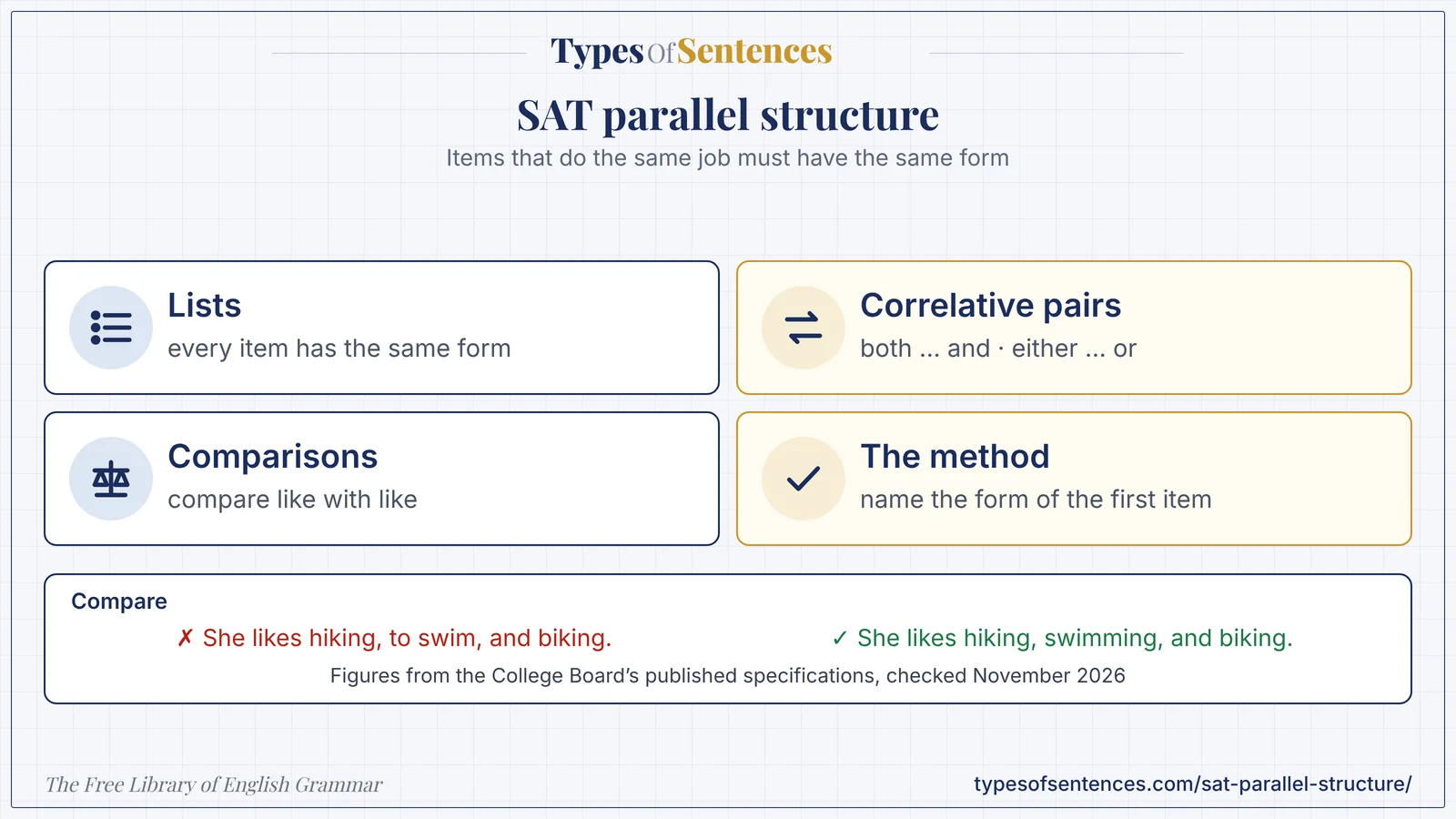
Parallel means “lined up the same way.” If one item in a list is a noun, the others should be nouns. If one is an -ing word, the others should be -ing words.
Why it matters: Read the list aloud. The item that sounds different is usually the broken one. Then rewrite it to match its neighbors.
Summary: Parallel structure means that items in a series, a pair, or a comparison have the same form: nouns with nouns, -ing forms with -ing forms, infinitives with infinitives, clauses with clauses. Faulty parallelism mixes forms (She likes hiking, to swim, and biking). Correlative pairs (both … and, either … or, neither … nor, not only … but also) must join matching forms. Comparisons with than and as compare like with like. The SAT tests this in the Form, Structure, and Sense skill: find the list or pair, name the form of the first item, and choose the answer that matches it.
- Same job, same form.
- List: A, B, and C all match.
- Pairs: both X and Y match.
- Comparison: like with like.
What You’ll Learn
- 1. SAT Parallel Structure: The Short Answer
- 2. What Is Parallel Structure? Parallelism in Grammar
- 3. Faulty Parallelism: Parallel Structure Examples of Errors and Fixes
- 4. Correlative Pairs and Comparisons
- 5. A Five-Step Method for SAT Parallel Structure Questions
- 6. Common Mistakes on SAT Parallel Structure Questions
- 7. Exercises
- 8. Test Your Knowledge
- 9. Frequently Asked Questions
- 10. Conclusion
1. SAT Parallel Structure: The Short Answer
| Fact | Detail |
|---|---|
| where | the Standard English Conventions domain of the digital SAT Reading and Writing section |
| skill | Form, Structure, and Sense (agreement, verb tense and form, pronouns, modifiers, possessives, parallel structure) |
| share | Standard English Conventions is about 26 percent of the section, or 11 to 15 of 54 questions |
| format | a short text with a blank, and four choices; one choice matches the form of the rest of the list or pair |
| how to check | official practice is in the Bluebook app; check satsuite.collegeboard.org for the current format |
| Where it appears | Rule | Example |
|---|---|---|
| a list of three or more | every item has the same form | She likes hiking, swimming, and biking. |
| a pair joined by and, or, but | both items have the same form | He is smart but lazy. |
| a correlative pair | the same form after each part | both a writer and an editor |
| a comparison with than or as | compare like with like | Walking is cheaper than driving. |
| a repeated pattern | repeat the same small words | in the morning, in the evening |
The College Board figures were taken from its published specifications and checked in November 2026; the test can change, so check satsuite.collegeboard.org before you rely on them. For the other conventions on the test, see the complete guide to SAT grammar rules.
2. What Is Parallel Structure? Parallelism in Grammar
Parallelism in grammar means giving equal ideas equal form. A list is easier to read when its items match, because the reader learns the pattern from the first item and expects it to continue. A broken pattern makes the reader stop. The rule applies to words, phrases, and clauses.
| Form | Parallel list (correct) |
|---|---|
| nouns | The kit includes a map, a compass, and a flashlight. |
| adjectives | The room was small, quiet, and cool. |
| -ing forms | She likes hiking, swimming, and biking. |
| infinitives | He wants to learn, to teach, and to lead. |
| verbs in the same tense | She opened the door, looked inside, and smiled. |
| prepositional phrases | over the hill, across the river, and through the woods |
| clauses | She said that she was tired, that she was hungry, and that she was leaving. |
Parallel items need not be identical words; they need the same grammatical form. A long list can also drop a repeated word (to learn, teach, and lead) as long as the list stays consistent. How lists are punctuated is covered in the guide to SAT punctuation rules.
3. Faulty Parallelism: Parallel Structure Examples of Errors and Fixes
Faulty parallelism is a list or pair whose items have different forms. These are typical errors, in the shapes the SAT uses.
| Faulty parallelism (error) | What does not match | Correct version |
|---|---|---|
| *She likes hiking, to swim, and biking. | -ing, to, -ing | She likes hiking, swimming, and biking. |
| *The job requires patience, skill, and being punctual. | noun, noun, -ing phrase | The job requires patience, skill, and punctuality. |
| *He promised to call, to write, and that he would visit. | infinitive, infinitive, clause | He promised to call, to write, and to visit. |
| *The report is clear, concise, and it has a good structure. | adjective, adjective, clause | The report is clear, concise, and well structured. |
| *The study measured heart rate, blood pressure, and how much the patients slept. | noun, noun, clause | The study measured heart rate, blood pressure, and sleep. |
| *She enjoys reading novels and to watch films. | -ing and infinitive | She enjoys reading novels and watching films. |
| *We can take the bus, the train, or going by car. | noun, noun, -ing | We can take the bus, the train, or a car. |
| *The coach was strict but he treated everyone fairly. | adjective and clause | The coach was strict but fair. |
| Two ways to fix faulty parallelism | Example |
|---|---|
| 1 change the odd item to match the others | She likes hiking, swimming, and biking. |
| 2 reword the whole list so that every item is the same kind | The job requires patience, skill, and punctuality. |
In SAT parallelism questions, the test usually offers four choices in which one matches the pattern and three do not. The wrong choices often keep the meaning but change the form, so you cannot answer by meaning alone. The same habit of reading the form helps with the other questions on the test, such as verb tense questions.
4. Correlative Pairs and Comparisons
Correlative conjunctions come in two parts. What follows the first part must match what follows the second part, and the SAT often tests this.
| Pair | Parallel (correct) | Faulty (error) |
|---|---|---|
| both … and | She is both a gifted writer and a careful editor. | *She is both a gifted writer and edits carefully. |
| either … or | You can either pay now or pay later. | *You can either pay now or later you pay. |
| neither … nor | He neither called nor wrote. | *He neither called nor did he write a letter. |
| not only … but also | The plan is not only cheap but also fast. | *The plan is not only cheap but it is also being fast. |
| not … but | She wants not praise but respect. | *She wants not praise but to be respected. |
| whether … or | I wonder whether to stay or to leave. | *I wonder whether to stay or if I should leave. |
| Comparison | Parallel (correct) | Faulty (error) |
|---|---|---|
| than | Walking is cheaper than driving. | *Walking is cheaper than to drive. |
| as … as | Her scores were as high as her brother’s. | *Her scores were as high as her brother. (scores are compared with a person) |
| prefer … to | I prefer reading to watching television. | *I prefer reading to watch television. |
| like comparison | The climate here is like the climate in Spain. | *The climate here is like Spain. |
| more … than | He values honesty more than wealth. | *He values honesty more than being rich. |
The conjunctions themselves, and the way they join equal parts, are explained in the Basic chapter on conjunctions (see Related lessons below).
5. A Five-Step Method for SAT Parallel Structure Questions
| Step | Do this | Why |
|---|---|---|
| 1 find the list or pair | look for commas, and, or, but, than, both, either, not only | parallelism hides in the pattern |
| 2 name the form of the first item | noun, adjective, -ing, infinitive, verb, or clause? | the first item sets the pattern |
| 3 check each choice | does the form of the new item match the others? | three choices break the pattern |
| 4 keep the meaning | make sure the choice is not just parallel but sensible | a parallel choice can still be wrong in meaning |
| 5 read the whole sentence | read the list from the start with your choice | your ear catches a broken pattern |
| Trap | What it looks like | The cure |
|---|---|---|
| the long final item | a clause or a wordy phrase at the end of a short list | shorten it to the same form as the first items |
| the hidden pair | both … and separated by a long phrase | link each part to the same kind of word |
| the shared verb | a list of nouns that share one verb | check that the verb fits every noun |
| the changing tense | a list of verbs that starts in the past and slips into the present | keep one tense in the list |
| the smooth wrong choice | the nonparallel choice sounds natural | trust the pattern, not the ear alone |
Which choice completes the text? The program trains students to analyze data, to write reports, and ___ (A) presenting their findings. (B) to present their findings. (C) how they should present their findings. (D) the presentation of their findings.
- Find the list: to analyze, to write, and a blank.
- Name the form: infinitive (to + verb).
- Check the choices: (A) -ing, (B) infinitive, (C) clause, (D) noun phrase.
- Only (B) matches: to present their findings.
- Read it whole: to analyze data, to write reports, and to present their findings. The question is my own.
6. Common Mistakes on SAT Parallel Structure Questions
| Mistake | What happens | Better habit |
|---|---|---|
| choosing the choice that sounds smoothest | a nonparallel choice is picked | name the form of the first item |
| checking only the last two items | the first item is ignored | read the whole list from the start |
| fixing the first item instead of the last | the list changes without need | match the item that breaks the pattern |
| ignoring correlative pairs | both parts are not matched | compare what follows each part |
| comparing unlike things | the climate here is like Spain | compare like with like (the climate there) |
| changing the meaning | a parallel choice that says something else | keep the original meaning |
Recap in 12 seconds
Watch the lesson build itself: SAT parallel structure questions test that items in a list, a pair, or a comparison have the same grammatical form. The video has no sound.
Exercises
Part A: Choose the Parallel Form (Exercises 1–10)
Exercise 1: She likes hiking, swimming, and ___. (A) to bike (B) biking (C) bike (D) she bikes
Show Answer
Answer: (B) biking.
Exercise 2: He wants to learn, to teach, and ___. (A) leading (B) lead (C) to lead (D) that he leads
Show Answer
Answer: (C) to lead.
Exercise 3: The room was small, quiet, and ___. (A) cool (B) it was cool (C) coolness (D) being cool
Show Answer
Answer: (A) cool.
Exercise 4: The kit includes a map, a compass, and ___. (A) bringing a flashlight (B) a flashlight (C) to have a flashlight (D) that there is a flashlight
Show Answer
Answer: (B) a flashlight.
Exercise 5: He is both a teacher and ___. (A) writes books (B) an author (C) to write (D) writing
Show Answer
Answer: (B) an author.
Exercise 6: You can either call now or ___. (A) call later (B) later you call (C) later calling (D) to call later on
Show Answer
Answer: (A) call later.
Exercise 7: The plan is not only cheap but also ___. (A) it is fast (B) being fast (C) fast (D) speed
Show Answer
Answer: (C) fast.
Exercise 8: I prefer reading to ___. (A) watch television (B) watching television (C) television is watched (D) to watch
Show Answer
Answer: (B) watching television.
Exercise 9: Walking is cheaper than ___. (A) to drive (B) driving (C) drive (D) he drives
Show Answer
Answer: (B) driving.
Exercise 10: She opened the door, looked inside, and ___. (A) smiling (B) she smiled (C) smiled (D) to smile
Show Answer
Answer: (C) smiled.
Part B: Spot the Error (Exercises 11–20)
Exercise 11: She likes hiking, to swim, and biking. Which item breaks the pattern?
Show Answer
Answer: to swim.
Exercise 12: The job requires patience, skill, and being punctual. Which item breaks the pattern?
Show Answer
Answer: being punctual.
Exercise 13: He promised to call, to write, and that he would visit. Which item breaks the pattern?
Show Answer
Answer: that he would visit.
Exercise 14: The coach was strict but he treated everyone fairly. What is the error?
Show Answer
Answer: An adjective (strict) is paired with a clause; use strict but fair.
Exercise 15: She enjoys reading novels and to watch films. What is the error?
Show Answer
Answer: -ing and infinitive; use reading … and watching.
Exercise 16: He neither called nor did he write. What is the error?
Show Answer
Answer: The two parts of the pair do not match; use neither called nor wrote.
Exercise 17: The climate here is like Spain. What is the error?
Show Answer
Answer: A climate is compared with a country; use like the climate in Spain.
Exercise 18: I wonder whether to stay or if I should leave. What is the error?
Show Answer
Answer: The pair does not match; use whether to stay or to leave.
Exercise 19: The study measured heart rate, blood pressure, and how much the patients slept. What is the error?
Show Answer
Answer: Two nouns and a clause; use and sleep.
Exercise 20: We can take the bus, the train, or going by car. What is the error?
Show Answer
Answer: Two nouns and an -ing phrase; use or a car.
Part C: Fix the Sentence (Exercises 21–26)
Exercise 21: Fix: *She is both a gifted writer and edits carefully.
Show Answer
Answer: She is both a gifted writer and a careful editor.
Exercise 22: Fix: *The report is clear, concise, and it has a good structure.
Show Answer
Answer: The report is clear, concise, and well structured.
Exercise 23: Fix: *I prefer reading to watch television.
Show Answer
Answer: I prefer reading to watching television.
Exercise 24: Fix: *He values honesty more than being rich.
Show Answer
Answer: He values honesty more than wealth.
Exercise 25: Fix: *Her scores were as high as her brother.
Show Answer
Answer: Her scores were as high as her brother’s.
Exercise 26: Fix: *She wants not praise but to be respected.
Show Answer
Answer: She wants not praise but respect.
Part D: Explain (Exercises 27–30)
Exercise 27: What does parallel structure mean?
Show Answer
Answer: Items that do the same job have the same grammatical form.
Exercise 28: Name two ways to fix a faulty list.
Show Answer
Answer: Change the odd item to match the others, or reword the whole list.
Exercise 29: What must follow both parts of not only … but also?
Show Answer
Answer: The same kind of word or phrase.
Exercise 30: What is the first thing to do in a parallel structure question?
Show Answer
Answer: Find the list or pair and name the form of the first item.
Test Your Knowledge
Ready to check what you learned? Answer all 10 questions, then submit. You need 80% (8 of 10) to pass. Your answers are not stored.
View correct answers and explanations
Question 1: Parallel structure means that items in a list
✓ Correct Answer: C – have the same form
Same form.
Question 2: Which list is parallel?
✓ Correct Answer: A – hiking, swimming, and biking
Three -ing forms.
Question 3: A correlative pair is
✓ Correct Answer: B – both … and
Both … and.
Question 4: Which is correct?
✓ Correct Answer: D – He neither called nor wrote.
Matching verbs.
Question 5: The first step in a parallel structure question is to
✓ Correct Answer: C – find the list or pair
Find the pattern.
Question 6: A comparison should compare
✓ Correct Answer: A – like with like
Like with like.
Question 7: Which is parallel?
✓ Correct Answer: B – I prefer reading to watching television.
-ing with -ing.
Question 8: The SAT skill that includes parallelism is
✓ Correct Answer: D – Form, Structure, and Sense
The conventions domain.
Question 9: A parallel choice can still be wrong because of
✓ Correct Answer: C – its meaning
Meaning must fit.
Question 10: Official digital SAT practice is available in
✓ Correct Answer: A – the Bluebook app
College Board’s app.
Frequently Asked Questions
What is SAT parallel structure?
It is the rule that items in a list, a pair, or a comparison must have the same grammatical form. The digital SAT tests it in the Form, Structure, and Sense skill of the Standard English Conventions domain.
What is faulty parallelism?
Faulty parallelism is a list or pair whose items have different forms, such as She likes hiking, to swim, and biking. The fix is to make every item the same form.
How do I spot a parallel structure question?
Look for a list with commas and and or or, a correlative pair such as both … and, or a comparison with than. The answer choices usually differ in the form of one item.
Do all items in a list need the same words?
No. They need the same grammatical form. To learn, teach, and lead is parallel even though to appears once.
Are correlative conjunctions tested?
Yes. Both … and, either … or, neither … nor, and not only … but also must join matching forms.
What is the difference between parallelism and agreement?
Parallelism is about the same form for equal items. Agreement is about matching number or person, such as a subject and a verb.
Where can I practice real SAT questions?
The College Board offers official practice in its Bluebook app. The questions on this page are original and are for practice only.
Conclusion
You now know the rule of SAT parallel structure: items that do the same job must have the same form, whether in a list, a correlative pair, or a comparison. You have seen parallelism in grammar, parallel structure examples with their errors, and a five-step method.
Practice naming the form of the first item in every list you read; that habit solves most SAT parallelism items. Next, study the other conventions the SAT tests, such as sentence boundaries and transitions.
- College Board. The Digital SAT Suite of Assessments Specifications.: the content domains and the Standard English Conventions skills (figures checked via web search in November 2026; the official page was not opened).
- Garner, Bryan A. Garner’s Modern English Usage. 5th ed. Oxford University Press, 2022.: the entry on parallelism.
- Strunk, William, Jr., and E. B. White. The Elements of Style. 4th ed. Longman, 1999.: the rule “Express coordinate ideas in similar form.”
- Merriam-Webster Dictionary: parallelism: the dictionary entry (not opened when this page was written).
Last reviewed: October 29, 2026. How it was made: drafted with AI assistance, then checked with automated tests (structure, links, answer keys, spelling) and against the sources above. A person has not yet read this chapter line by line. Found a mistake? Report it.