What are SAT verb tense questions? SAT verb tense questions are the items on the digital SAT whose answer choices differ in the form of a verb: went, had gone, has gone, going, will go. They belong to the Form, Structure, and Sense skill of the Standard English Conventions domain, which the College Board describes as about 26 percent of the Reading and Writing section (11 to 15 of its 54 questions). The task is to choose the tense and the form that fit the time of the passage and the grammar of the sentence.
This page explains digital SAT verb tense and the neighboring SAT verb form questions: the time markers that decide the tense, tense consistency and the shifts that are allowed, the simple and perfect tenses, conditionals, finite and nonfinite verbs, and the subjunctive. It gives a method and the traps, 30 original practice items (not taken from the College Board), and a 10-question quiz. It also shows how SAT tense consistency differs from simple repetition of one tense.
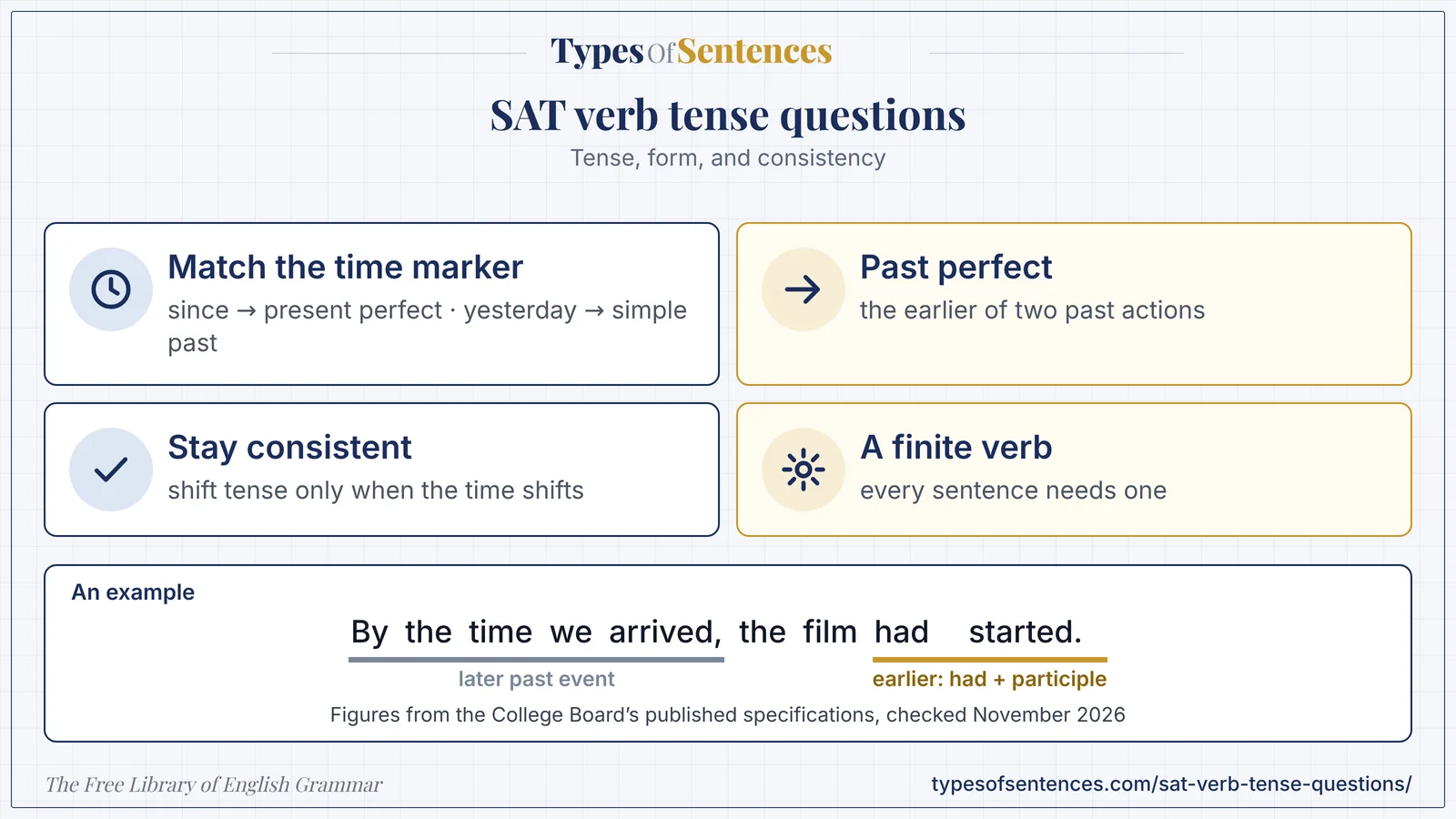
A verb has two jobs: it shows when (tense) and it shows how it is built (form). The SAT tests both. The clues are usually in the sentence: a time word such as yesterday or since, another verb that shows the main time, or an if clause.
Why it matters: Find the time of the passage, find the time marker, and choose the verb that matches. Do not change tense unless the time changes.
Summary: Digital SAT verb tense questions show four forms of one verb. The rules are: use the tense that matches the time marker (yesterday, last year: simple past; since, for: present perfect; by the time: past perfect for the earlier action); keep one tense within a time frame and shift only when the time changes; use the past perfect for an action before another past action; in if clauses use had + participle with would have, and the past with would; every sentence needs a finite verb (a participle or infinitive alone is not enough); and the subjunctive uses the base form after verbs of demand (insist that he go) and were in unreal conditions.
- Match the tense to the time marker.
- Shift tense only when the time changes.
- Past perfect = earlier past.
- A sentence needs a finite verb.
What You’ll Learn
- 1. SAT Verb Tense Questions: The Short Answer
- 2. Time Markers: Which Tense Does the Sentence Need?
- 3. SAT Tense Consistency: When to Shift and When Not To
- 4. Conditionals and the Subjunctive on the SAT
- 5. SAT Verb Form Questions: Finite and Nonfinite Verbs
- 6. A Five-Step Method for SAT Verb Tense Questions
- 7. Common Mistakes on SAT Verb Tense Questions
- 8. Exercises
- 9. Test Your Knowledge
- 10. Frequently Asked Questions
- 11. Conclusion
1. SAT Verb Tense Questions: The Short Answer
| Fact | Detail |
|---|---|
| where | the Standard English Conventions domain of the digital SAT Reading and Writing section |
| skill | Form, Structure, and Sense (agreement, verb tense and form, pronouns, modifiers, possessives, parallelism) |
| share | Standard English Conventions is about 26 percent of the section, or 11 to 15 of 54 questions |
| format | a short text with a blank, and four verb forms |
| clue | the choices are tenses or forms of the same verb |
| official practice | the College Board’s Bluebook app and Student Question Bank |
| Question | What it tests | Example |
|---|---|---|
| which tense? | the time marker or the other verbs | By the time we arrived, the film ___. → had started |
| which form? | finite or nonfinite; participle or base | The dog ___ loudly. (needs a finite verb) |
| consistent? | one tense for one time frame | She opened the door and walked in. |
| conditional? | the pattern of the if clause and the result | If I had known, I would have called. |
The College Board figures were taken from its published specifications and checked in November 2026; the College Board can change the test, so check satsuite.collegeboard.org before you rely on them.
2. Time Markers: Which Tense Does the Sentence Need?
| Time marker | Tense | Example |
|---|---|---|
| yesterday, last year, in 1990, ago | simple past | She moved here in 2010. |
| since, for (up to now), so far, recently | present perfect | She has lived here since 2010. |
| by the time + simple past, before, already (earlier past) | past perfect | By the time we arrived, the film had started. |
| by next year, by then (future) | future perfect | By next year, she will have finished. |
| now, currently, at the moment | present progressive | She is studying now. |
| every day, always, usually, general truths | simple present | Water boils at 100 degrees. |
| tomorrow, next week | future (will or present progressive) | She will arrive tomorrow. |
| while, when (an action in progress) | past progressive | She was cooking when I called. |
| Contrast | Rule | Example |
|---|---|---|
| simple past vs present perfect | simple past for a finished time; present perfect for a link to now | I saw it yesterday. · I have seen it. |
| simple past vs past perfect | past perfect for the earlier of two past actions | She left before I arrived. · She had left before I arrived. |
| present perfect vs present perfect progressive | progressive stresses duration | She has worked here for years. · She has been working all day. |
The tenses are described in the Intermediate chapters on the present tenses and the past tenses, and the pairs of tenses in the chapter on tense consistency.
3. SAT Tense Consistency: When to Shift and When Not To
| Situation | Rule | Example |
|---|---|---|
| one time frame | keep one tense | She opened the door, looked around, and walked in. |
| a new time frame | shift to the new tense | She left in 2010 and lives in Denver now. |
| a general truth | use the simple present, whatever the main tense | The teacher said that water boils at 100 degrees. |
| reporting past statements | the main verb is past; the reported verb is often past or past perfect | She said she was tired. |
| historical present | a writer may narrate the past in the present; stay consistent | Lincoln gives the speech in 1863 and calls for… |
| a shift with no new time | an error | *She opened the door and walks in. |
| Tense error | Example | Correct |
|---|---|---|
| present for past | *Yesterday she goes to the market. | Yesterday she went to the market. |
| past for present fact | *The report states that the sky was blue. (a general truth) | The report states that the sky is blue. |
| past participle for past | *She seen the film. | She saw the film. |
| past for participle | *She has went home. | She has gone home. |
| wrong sequence | *By the time we arrived, the film started. | By the time we arrived, the film had started. |
4. Conditionals and the Subjunctive on the SAT
| Type | If clause | Result clause | Example |
|---|---|---|---|
| real, present or general | simple present | simple present or will | If it rains, we stay home. · If it rains, we will stay home. |
| unreal present | simple past (were for be) | would + base | If I had time, I would help. · If I were you, I would go. |
| unreal past | past perfect (had + participle) | would have + participle | If I had known, I would have called. |
| mixed | past perfect | would + base | If I had studied, I would be a doctor now. |
| Common error | Example | Correct |
|---|---|---|
| would have in the if clause | *If I would have known, I would have called. | If I had known, I would have called. |
| past simple for unreal past | *If I knew, I would have called. | If I had known, I would have called. |
| was for the subjunctive | *If I was you, I would go. | If I were you, I would go. |
| inflected base after demand verbs | *She insisted that he goes. | She insisted that he go. |
The conditional patterns are explained in the Intermediate chapters on the third conditional and the other conditionals.
5. SAT Verb Form Questions: Finite and Nonfinite Verbs
| Rule | Correct example | Error |
|---|---|---|
| a sentence needs a finite verb | The dog barks loudly. | *The dog barking loudly. |
| a participle is not a finite verb | The dogs barking in the yard woke us. (a participle phrase inside a sentence that has a finite verb) | *The dogs barking in the yard. |
| past participle after have | has eaten, had gone | *has ate, *had went |
| infinitive after to | She wants to leave. | *She wants to leaves. |
| base form after a modal | She can swim. | *She can swims. |
| -ing after a preposition | She is good at swimming. | *She is good at swim. |
| parallel verb forms | She likes reading, writing, and drawing. | *She likes reading, writing, and to draw. |
| agreement and tense together | The list of names is long. | *The list of names are long. |
The nonfinite forms are described in the Intermediate chapter on participles, and the past participle in the chapter on the past participle.
6. A Five-Step Method for SAT Verb Tense Questions
| Step | Do this | Why |
|---|---|---|
| 1 read | read the whole sentence and the sentence before it | the time frame may be set earlier |
| 2 name | look at how the choices differ: tense, form, or agreement? | a named rule narrows the choices |
| 3 find | find the time markers and the other verbs | the markers decide the tense |
| 4 test | test each choice: does it fit the time, the form, and the subject? | several choices look natural |
| 5 check | reread the sentence with your answer in place | one wrong form can survive steps 1 to 4 |
| Trap | What it looks like | The cure |
|---|---|---|
| the false shift | a choice in a different tense that “sounds” fine | shift only if the time shifts |
| the perfect that is too early | had + participle with no earlier event | use the past perfect only for an earlier action |
| the nearby verb | a tense copied from a verb in a clause that is not in the same time frame | find the time of this clause |
| the participle as a main verb | The dogs barking | a sentence needs a finite verb |
| the conditional with would twice | If I would have known | had in the if clause |
Which choice is correct? By the time the speaker finally arrived, most of the audience ___ the hall. (A) leaves (B) had left (C) has left (D) leaving
- Name the rule: the choices are verb forms, so this is tense and form.
- Find the marker: By the time the speaker finally arrived sets a past time; the audience’s action happened before that time.
- Test: an earlier past action takes the past perfect. (A) is present; (C) is present perfect; (D) is a participle and has no finite verb.
- Answer: (B) had left. (The item is an original practice item, not taken from the College Board.)
7. Common Mistakes on SAT Verb Tense Questions
| Mistake | What happens | Better habit |
|---|---|---|
| copying the tense of the nearest verb | the wrong time frame is used | find the time marker for this clause |
| ignoring by the time, before, or already | the simple past is chosen for an earlier action | use the past perfect for the earlier event |
| changing tense without a new time | a shift error is chosen | keep one tense in one time frame |
| choosing a participle for a finite verb | a fragment is built | a sentence needs a finite verb |
| would have after if | a conditional error is chosen | had + participle in the if clause |
| confusing has gone and went | a present-perfect error | use the present perfect only with a link to now |
| forgetting general truths | a past tense for a fact | use the simple present for facts |
| reading the blank only | the time marker is missed | read the whole sentence |
Recap in 12 seconds
Watch the lesson build itself: SAT verb tense questions test matching the tense to the time marker, the past perfect for the earlier of two past actions, consistency, and finite verbs. The video has no sound.
Exercises
Part A: Time Markers (Exercises 1–10)
Exercise 1: Choose: Yesterday she (goes/went) to the market.
Show Answer
Answer: went.
Exercise 2: Choose: She (lived/has lived) here since 2010.
Show Answer
Answer: has lived (since).
Exercise 3: Choose: By the time we arrived, the film (started/had started).
Show Answer
Answer: had started.
Exercise 4: Choose: By next year, she (will finish/will have finished).
Show Answer
Answer: will have finished.
Exercise 5: Choose: She (studies/is studying) now.
Show Answer
Answer: is studying.
Exercise 6: Choose: Water (boils/boiled) at 100 degrees.
Show Answer
Answer: boils (a general truth).
Exercise 7: Choose: I (saw/have seen) the film yesterday.
Show Answer
Answer: saw.
Exercise 8: Choose: She (cooked/was cooking) when I called.
Show Answer
Answer: was cooking.
Exercise 9: Choose: She (left/had left) before I arrived.
Show Answer
Answer: had left (the earlier action).
Exercise 10: Choose: She (has worked/worked) here for years and still does.
Show Answer
Answer: has worked.
Part B: Consistency and Conditionals (Exercises 11–20)
Exercise 11: Choose: She opened the door and (walks/walked) in.
Show Answer
Answer: walked.
Exercise 12: Choose: The teacher said that water (boils/boiled) at 100 degrees.
Show Answer
Answer: boils (a general truth).
Exercise 13: Choose: If it rains, we (stay/stayed) home.
Show Answer
Answer: stay.
Exercise 14: Choose: If I had time, I (would help/will help).
Show Answer
Answer: would help.
Exercise 15: Choose: If I (would have known/had known), I would have called.
Show Answer
Answer: had known.
Exercise 16: Choose: If I (was/were) you, I would go.
Show Answer
Answer: were.
Exercise 17: Choose: She insisted that he (goes/go).
Show Answer
Answer: go (the subjunctive).
Exercise 18: Choose: I wish it (was/were) Friday.
Show Answer
Answer: were.
Exercise 19: Choose: If I had studied, I (would be/will be) a doctor now.
Show Answer
Answer: would be (a mixed conditional).
Exercise 20: Choose: She said she (is/was) tired.
Show Answer
Answer: was.
Part C: Verb Forms (Exercises 21–26)
Exercise 21: Choose: She has (went/gone) home.
Show Answer
Answer: gone.
Exercise 22: Choose: She wants to (leave/leaves).
Show Answer
Answer: leave.
Exercise 23: Choose: She can (swim/swims).
Show Answer
Answer: swim.
Exercise 24: Choose: She is good at (swim/swimming).
Show Answer
Answer: swimming.
Exercise 25: Which is a complete sentence? (A) The dog barking loudly. (B) The dog barks loudly.
Show Answer
Answer: (B).
Exercise 26: Choose the parallel form: She likes reading, writing, and (to draw/drawing).
Show Answer
Answer: drawing.
Part D: Correct the Errors (Exercises 27–30)
Exercise 27: Correct: *Yesterday she goes to the market.
Show Answer
Answer: Yesterday she went to the market.
Exercise 28: Correct: *By the time we arrived, the film started.
Show Answer
Answer: By the time we arrived, the film had started.
Exercise 29: Correct: *If I would have known, I would have called.
Show Answer
Answer: If I had known, I would have called.
Exercise 30: Correct: *She seen the film.
Show Answer
Answer: She saw the film.
Test Your Knowledge
Ready to check what you learned? Answer all 10 questions, then submit. You need 80% (8 of 10) to pass. Your answers are not stored.
View correct answers and explanations
Question 1: The past perfect is used for
✓ Correct Answer: A – the earlier of two past actions
The earlier past.
Question 2: She ___ here since 2010.
✓ Correct Answer: B – has lived
Since.
Question 3: If I had known, I would ___ called.
✓ Correct Answer: C – have
Would have.
Question 4: If I ___ you, I would go.
✓ Correct Answer: D – were
Subjunctive.
Question 5: A sentence needs a
✓ Correct Answer: A – finite verb
A finite verb.
Question 6: Water ___ at 100 degrees.
✓ Correct Answer: B – boils
A general truth.
Question 7: She has ___ home.
✓ Correct Answer: C – gone
Past participle.
Question 8: By the time we arrived, the film ___.
✓ Correct Answer: D – had started
Earlier past.
Question 9: SAT verb tense questions belong to
✓ Correct Answer: A – Form, Structure, and Sense
The conventions domain.
Question 10: Official digital SAT practice is available in
✓ Correct Answer: B – the Bluebook app
College Board’s app.
Frequently Asked Questions
What are SAT verb tense questions?
They are the digital SAT items whose answer choices are different tenses or forms of one verb. They belong to Form, Structure, and Sense in the Standard English Conventions domain, and they test whether you choose the tense that fits the time of the sentence.
How do I answer digital SAT verb tense questions?
Find the time marker and the time frame, name the rule (tense, form, or agreement), test each choice, and reread the sentence. Use the past perfect only for an action before another past action.
What are SAT verb form questions?
SAT verb form questions test whether the verb is built correctly: a finite verb in every sentence, the past participle after have, the base form after a modal or to, and the -ing form after a preposition.
What is SAT tense consistency?
Tense consistency means keeping one tense within one time frame and shifting only when the time changes. A shift with no change of time (She opened the door and walks in) is an error.
When do I use the past perfect?
Use the past perfect (had + past participle) for an action that happened before another action in the past: By the time we arrived, the film had started.
Are the practice items on this page from the College Board?
No. They are original items written for this page and are not taken from the College Board. For official practice use the Bluebook app and Student Question Bank.
How much of the SAT is about verbs?
The College Board does not publish a separate count for verb questions. They fall under Standard English Conventions, which is about 26 percent of the Reading and Writing section. Check satsuite.collegeboard.org for current figures.
Conclusion
You now know how SAT verb tense questions are built: the time markers that decide the tense, tense consistency and the allowed shifts, the simple and perfect tenses, conditionals and the subjunctive, and the finite and nonfinite forms. You have also seen the method and the traps, and practiced with original items.
Find the time, match the verb, and keep one tense in one time frame. Next, study the SAT modifier questions, the other large group of Form, Structure, and Sense items.
- College Board. Digital SAT Suite of Assessments: Reading and Writing Content Specifications. satsuite.collegeboard.org.: the domains, the skills, and the question counts (checked November 2026; the College Board can change them).
- College Board. Bluebook app and Student Question Bank. satsuite.collegeboard.org.: official practice for the digital SAT.
- Garner, Bryan A. Garner’s Modern English Usage. 5th ed. Oxford University Press, 2022.: the entries on tense, the subjunctive, and the past perfect.
- Swan, Michael. Practical English Usage. 4th ed. Oxford University Press, 2016.: the tenses, conditionals, and the subjunctive.
- Huddleston, Rodney, and Geoffrey K. Pullum. The Cambridge Grammar of the English Language. Cambridge University Press, 2002.: tense and aspect (chapter 3).
Last reviewed: October 29, 2026. How it was made: drafted with AI assistance, then checked with automated tests (structure, links, answer keys, spelling) and against the sources above. A person has not yet read this chapter line by line. Found a mistake? Report it.