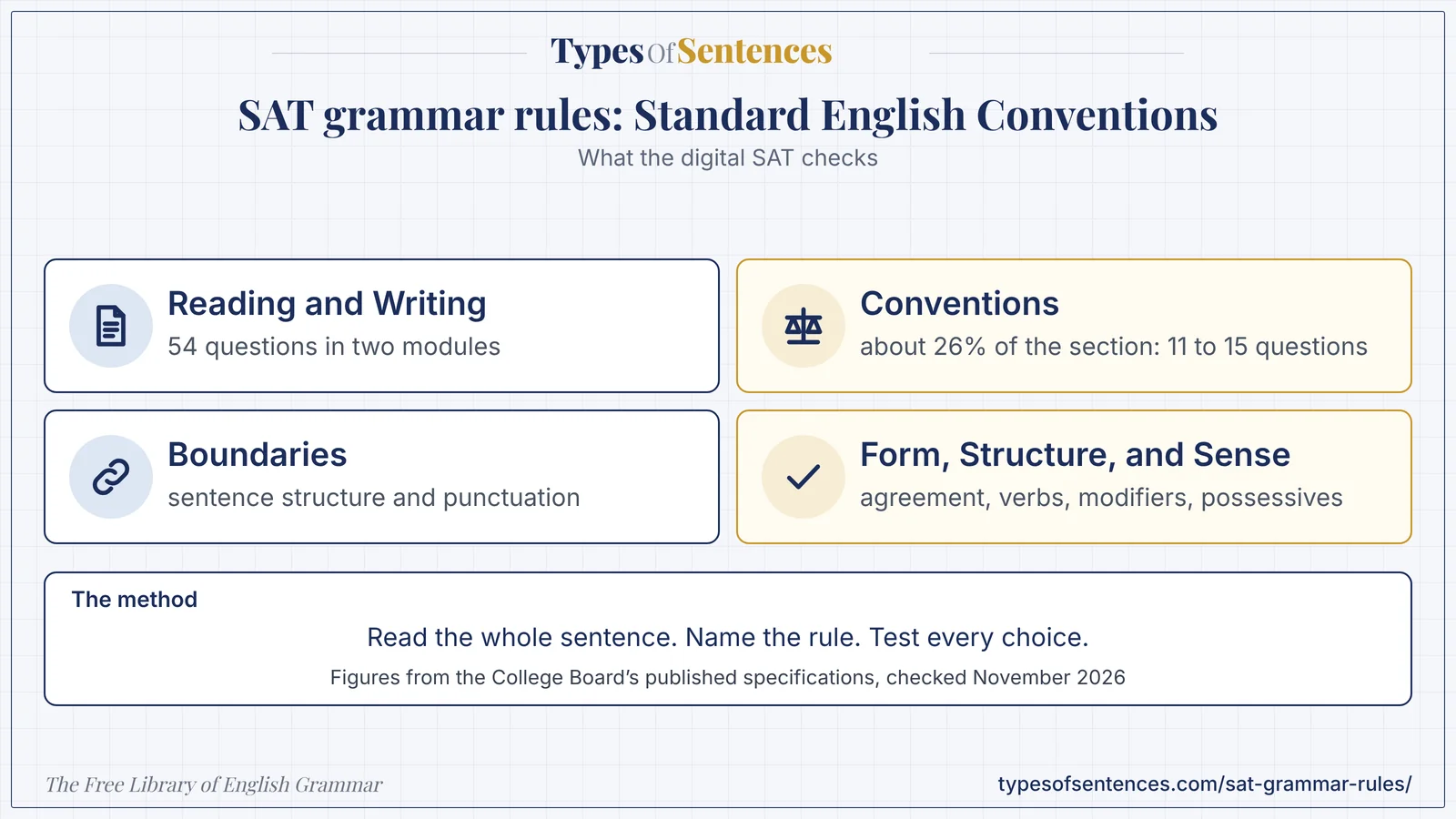
What are the SAT grammar rules? The SAT grammar rules are the conventions of Standard English that the digital SAT checks in its Reading and Writing section. The questions that test them belong to a content domain called Standard English Conventions, which the College Board describes as editing text to conform to the core conventions of Standard English sentence structure, usage, and punctuation. It has two skills: Boundaries (where sentences and clauses begin and end, and how they are joined) and Form, Structure, and Sense (agreement, verb forms, modifiers, possessives, and similar points).
This page explains how the SAT Standard English Conventions questions are built, lists every rule that the test uses with correct and incorrect examples, and gives a method for answering SAT grammar questions quickly. The SAT essential grammar is smaller than most students fear: about a dozen rules explain nearly every question. It ends with 30 original practice items (not taken from the College Board) and a 10-question quiz.
The SAT does not test obscure grammar terms. It shows a short passage with a blank or an underlined part and asks which choice follows the rules of Standard English. The same dozen rules come back again and again.
Why it matters: Learn the rules once, learn the question patterns, and the digital SAT grammar questions become some of the fastest points on the test.
Summary: On the digital SAT, the Reading and Writing section has 54 questions in two 27-question modules, and the Standard English Conventions domain accounts for about 26 percent of them (11 to 15 questions). Its two skills are Boundaries and Form, Structure, and Sense. The rules most often tested are: two complete sentences need a period, a semicolon, a colon, or a comma with a conjunction; never separate a subject from its verb with one comma; make verbs and pronouns agree; use the correct verb tense and form; place modifiers next to the word they describe; distinguish possessives, plurals, and contractions; and keep lists parallel.
- Standard English Conventions: about 26% of Reading and Writing.
- Two skills: Boundaries; Form, Structure, and Sense.
- A dozen rules cover nearly every question.
- Method: read, name the rule, test each choice.
What You’ll Learn
- 1. SAT Grammar Rules: The Short Answer
- 2. How the Digital SAT Grammar Questions Are Built
- 3. Boundaries: The SAT Grammar Rules for Sentence Structure and Punctuation
- 4. Form, Structure, and Sense: Agreement, Verbs, Modifiers, and Possessives
- 5. A Five-Step Method for SAT Grammar Questions
- 6. Beyond Conventions: The Digital SAT Questions on Transitions
- 7. Common Mistakes on SAT Grammar Questions
- 8. Exercises
- 9. Test Your Knowledge
- 10. Frequently Asked Questions
- 11. Conclusion
1. SAT Grammar Rules: The Short Answer
| Fact | Detail |
|---|---|
| test | the digital SAT, a College Board test taken on a computer |
| section | Reading and Writing: 54 questions in two modules of 27 questions, 32 minutes each |
| domain | Standard English Conventions: about 26 percent, or 11 to 15 questions |
| skill 1 | Boundaries: sentence structure and punctuation |
| skill 2 | Form, Structure, and Sense: agreement, verbs, modifiers, possessives, and similar points |
| next domain | Expression of Ideas (about 20 percent): transitions and rhetorical synthesis |
| format | a short text with a blank or an underlined part, and four answer choices |
| adaptive | the second module is easier or harder depending on how you do in the first |
| official practice | the College Board’s Bluebook app and Student Question Bank |
These figures are taken from the College Board’s published specifications for the digital SAT and were checked in November 2026; the College Board can change the test, so check the current specifications at satsuite.collegeboard.org before you rely on them.
2. How the Digital SAT Grammar Questions Are Built
| Part | What you see | What you do |
|---|---|---|
| the text | a passage of 25 to 150 words with one blank or one underlined part | read the whole sentence, not just the blank |
| the stem | “Which choice completes the text so that it conforms to the conventions of Standard English?” | pick the choice that is grammatically correct |
| the choices | four answers that are often the same words with different punctuation or word forms | spot the one thing that changes |
| the pattern | the changing part shows the rule being tested | name the rule before you look at the answers |
| If the choices differ in… | The rule is probably… | Example |
|---|---|---|
| punctuation only (a period, a comma, a semicolon, a colon, a dash) | Boundaries | work, and / work; and / work and |
| verb forms (is, are, were, has been) | agreement or tense | The list of names (is/are) |
| pronouns (who, whom, their, its) | pronoun agreement or case | the company and (its/their) plan |
| the first words of the choice | modifier placement | Walking home, the rain… |
| apostrophes and plurals | possessives and plurals | the dogs’ bowls / the dog’s bowls |
| the order of words in a list | parallel structure | reading, to write, and drawing |
The four-skill structure of the whole section (Craft and Structure, Information and Ideas, Standard English Conventions, and Expression of Ideas) appears in the same order in every module, with the conventions questions third.
3. Boundaries: The SAT Grammar Rules for Sentence Structure and Punctuation
Boundaries questions test whether you can join clauses correctly. An independent clause can stand alone as a sentence; a dependent clause cannot. These are the legal ways to combine them.
| Joining pattern | Punctuation | Correct example |
|---|---|---|
| independent clause + independent clause | a period | The rain stopped. We went outside. |
| independent clause + independent clause (closely related) | a semicolon | The rain stopped; we went outside. |
| independent clause + independent clause | a comma + a coordinating conjunction (for, and, nor, but, or, yet, so) | The rain stopped, and we went outside. |
| independent clause + explanation or list | a colon after a complete clause | She packed three things: a map, a compass, and water. |
| independent clause + independent clause | a semicolon + a conjunctive adverb + a comma | The rain stopped; therefore, we went outside. |
| dependent clause + independent clause | a comma after the dependent clause | When the rain stopped, we went outside. |
| independent clause + dependent clause | no comma (usually) | We went outside when the rain stopped. |
| Boundary error | Example | Why it is wrong | Fix |
|---|---|---|---|
| comma splice | *The rain stopped, we went outside. | a comma alone cannot join two independent clauses | The rain stopped, so we went outside. |
| run-on (fused sentence) | *The rain stopped we went outside. | no punctuation at all | The rain stopped. We went outside. |
| fragment | *Because the rain stopped. | a dependent clause alone is not a sentence | Because the rain stopped, we went outside. |
| colon after an incomplete clause | *She packed: a map and water. | the clause before a colon must be complete | She packed a map and water. |
| semicolon before a dependent clause | *We went outside; when the rain stopped. | a semicolon joins independent clauses only | We went outside when the rain stopped. |
| comma between subject and verb | *The girl in the red coat, won. | one comma cannot separate a subject from its verb | The girl in the red coat won. |
The comma splice is explained in the chapter on the comma splice, and the other punctuation marks that the SAT uses are covered in the chapter on advanced punctuation.
| Nonessential information | Pattern | Example |
|---|---|---|
| extra information set off by commas | a comma before and after | My brother, who lives in Denver, called. |
| extra information set off by dashes | a dash before and after | My brother — who lives in Denver — called. |
| extra information in parentheses | an opening and a closing parenthesis | My brother (who lives in Denver) called. |
| mixed marks | never mix: do not start with a comma and end with a dash | *My brother, who lives in Denver — called. |
4. Form, Structure, and Sense: Agreement, Verbs, Modifiers, and Possessives
| Rule | What the test asks | Correct example | Trap |
|---|---|---|---|
| subject-verb agreement | the verb must match the real subject | The list of names is long. | a noun in a prepositional phrase (of names) sits between subject and verb |
| subject-verb agreement (inverted) | the subject may follow the verb | There are two reasons. | the verb agrees with reasons, not with there |
| compound subjects | and makes a plural; or uses the nearer noun | Tom and Maria are here. · Tom or Maria is here. | the verb after or agrees with the closer subject |
| pronoun-antecedent agreement | the pronoun matches its noun in number | The company changed its policy. | a singular collective noun takes its |
| pronoun case | subject forms before verbs, object forms after | She and I left. · between you and me | a pronoun in a pair |
| verb tense and form | the verb follows the time of the passage | She had finished before he arrived. | a shift in tense without a reason |
| finite and nonfinite verbs | a sentence needs one finite verb | *The dog barking loudly. | a participle is not a finite verb |
| modifier placement | a modifier sits next to what it modifies | Walking home, she saw the rain begin. | *Walking home, the rain began. (dangling) |
| possessives and plurals | a plural has no apostrophe; a possessive has | the dogs’ bowls · two dogs | a plural with an apostrophe |
| parallel structure | items in a list share one form | reading, writing, and drawing | mixed forms: reading, to write, and drawing |
| comparisons | compare like with like | The climate of Maine is cooler than that of Texas. | *cooler than Texas |
| apostrophe or contraction | expand it to test it | its vs it’s | replace it’s with it is |
Several of these rules have their own chapters: parallelism is covered in the advanced chapter on parallel structure, and participial phrases (the source of dangling modifiers) in the chapter on participial phrases. The possessive forms are explained in the guide to possessive nouns.
5. A Five-Step Method for SAT Grammar Questions
| Step | Do this | Why |
|---|---|---|
| 1 read | read the whole sentence, from the start to the end | the problem is often outside the blank |
| 2 name | look at how the choices differ and name the rule (boundary, agreement, tense, modifier, possessive, parallelism) | a named rule narrows the choices |
| 3 find | find the key words: the real subject, the verb, the antecedent, the clauses | traps hide in the words between them |
| 4 test | test each choice by reading it back; cross out the ones that break the rule | more than one choice often looks natural |
| 5 check | reread the sentence with your answer in place | one wrong word can survive steps 1 to 4 |
| Trap | What it looks like | The cure |
|---|---|---|
| the interrupter | a long phrase between subject and verb | cross out the phrase and read the subject and verb together |
| the comma habit | a choice with “one more comma” that sounds natural | ask whether the comma separates a subject from its verb, or joins two clauses |
| the wordy winner | a longer choice that sounds formal | the shortest correct choice is often right when the rules are met |
| the near-twin | two choices that differ by one letter (its, it’s) | expand contractions to test them |
| the plural noun | a plural noun right before the verb | check whether it is the real subject |
Which choice is correct? The collection of rare books, which are kept in the basement, ___ valued at two million dollars. (A) are (B) is (C) were (D) have been
- Name the rule: the choices are verb forms, so this is subject-verb agreement.
- Find the real subject: collection (a singular noun). Of rare books and which are kept in the basement are interrupters.
- Test: The collection … is valued is correct; are, were, and have been do not agree with a singular subject (and were changes the tense).
- Answer: (B) is. (The item is an original practice item, not taken from the College Board.)
6. Beyond Conventions: The Digital SAT Questions on Transitions
| Skill | What it tests | Example |
|---|---|---|
| Transitions (Expression of Ideas) | choosing the word that shows the right relationship | The experiment failed. ___, the team tried again. → Nevertheless |
| Rhetorical synthesis (Expression of Ideas) | using notes to meet a stated goal | a list of facts and a task such as “emphasize the contrast” |
| Words in Context (Craft and Structure) | the most precise word in context | not a grammar rule; a vocabulary and meaning skill |
Transitions are not strictly “grammar”, but the SAT groups them with the writing questions. The relationships are listed in the advanced chapter on transition words and connectors.
7. Common Mistakes on SAT Grammar Questions
| Mistake | What happens | Better habit |
|---|---|---|
| answering from the blank only | a wrong subject or tense is chosen | read the whole sentence |
| adding commas by “sound” | a comma splits a subject from its verb | test the comma by the joining rules |
| ignoring the real subject | the verb matches the nearest noun | cross out interrupting phrases |
| mixing dashes and commas | a nonessential phrase is half-closed | use a pair of the same mark |
| expecting a grammar term | the test never asks for the name of a rule | use the term only to help yourself |
| choosing the longest answer | a formal-sounding choice breaks a rule | test the rule first |
| leaving questions blank | there is no penalty for a wrong answer | answer every question |
| spending too long | a three-minute question costs three easier ones | mark it, move on, return if time allows |
Recap in 12 seconds
Watch the lesson build itself: The digital SAT’s Standard English Conventions domain has two skills, Boundaries and Form, Structure, and Sense, and about 26 percent of the Reading and Writing questions. The video has no sound.
Exercises
Part A: Boundaries (Exercises 1–10)
Exercise 1: Choose the punctuation: The museum opens at nine ___ the line is already long. (A) , (B) ; (C) , and (D) A and B
Show Answer
Answer: (D): a semicolon works, and a comma with and works; the punctuation must join two independent clauses. (original item)
Exercise 2: Which is correct? (A) The test is long, students take breaks. (B) The test is long; students take breaks. (C) The test is long students take breaks.
Show Answer
Answer: (B): a semicolon joins two independent clauses.
Exercise 3: Which is correct? (A) She brought: a pencil and a pen. (B) She brought a pencil and a pen. (C) She brought; a pencil and a pen.
Show Answer
Answer: (B): a colon must follow a complete clause; here no punctuation is needed.
Exercise 4: Which is correct? (A) When the bell rang, the students left. (B) When the bell rang the students, left.
Show Answer
Answer: (A): a comma follows the introductory dependent clause.
Exercise 5: Which is correct? (A) The author, who won the prize, spoke. (B) The author, who won the prize spoke. (C) The author who won the prize, spoke.
Show Answer
Answer: (A): commas must come in pairs around nonessential information.
Exercise 6: Which is correct? (A) The dog barked, because it was scared. (B) The dog barked because it was scared.
Show Answer
Answer: (B): no comma is needed before a dependent clause that follows.
Exercise 7: Which fixes the fragment? Although it rained. (A) Although it rained, we played. (B) Although it rained; we played.
Show Answer
Answer: (A).
Exercise 8: Which is correct? (A) The result was clear: the plan failed. (B) The result was: clear the plan failed.
Show Answer
Answer: (A): a colon after a complete clause.
Exercise 9: Which is correct? (A) The result was clear — the plan failed. (B) The result was clear — the plan failed,
Show Answer
Answer: (A): a dash can join the two clauses; a stray final comma is an error.
Exercise 10: Which is a comma splice? (A) It was late, so we left. (B) It was late, we left. (C) It was late; we left.
Show Answer
Answer: (B).
Part B: Form, Structure, and Sense (Exercises 11–20)
Exercise 11: Choose: The list of names (is/are) long.
Show Answer
Answer: is (the subject is list).
Exercise 12: Choose: There (is/are) two reasons.
Show Answer
Answer: are (the subject is reasons).
Exercise 13: Choose: Tom or his sisters (is/are) coming.
Show Answer
Answer: are (the nearer subject is plural).
Exercise 14: Choose: The company changed (its/their) policy.
Show Answer
Answer: its.
Exercise 15: Choose: Between you and (I/me), it is fine.
Show Answer
Answer: me (object of a preposition).
Exercise 16: Choose: By the time we arrived, the film (started/had started).
Show Answer
Answer: had started (earlier past).
Exercise 17: Choose: Walking home, (the rain began/she felt the rain begin).
Show Answer
Answer: she felt the rain begin (the modifier must attach to a person).
Exercise 18: Choose: The (dogs’/dog’s) bowls are empty. (three dogs)
Show Answer
Answer: dogs’.
Exercise 19: Choose the parallel form: She likes reading, writing, and (to draw/drawing).
Show Answer
Answer: drawing.
Exercise 20: Choose: The climate of Maine is cooler than (Texas/that of Texas).
Show Answer
Answer: that of Texas (compare like with like).
Part C: Name the Rule (Exercises 21–25)
Exercise 21: The choices are is, are, were, and have been. Which skill?
Show Answer
Answer: Form, Structure, and Sense (agreement or tense).
Exercise 22: The choices differ only in a comma, a semicolon, and a period. Which skill?
Show Answer
Answer: Boundaries.
Exercise 23: The choices begin with Walking home,, The rain,, and While walking,. Which rule?
Show Answer
Answer: modifier placement.
Exercise 24: The choices are its and it’s. Which test?
Show Answer
Answer: expand the contraction (it is or it has).
Exercise 25: The choices are reading, to write, and drawing and reading, writing, and drawing. Which rule?
Show Answer
Answer: parallel structure.
Part D: Correct the Errors (Exercises 26–30)
Exercise 26: Correct: *The girl in the red coat, won.
Show Answer
Answer: The girl in the red coat won.
Exercise 27: Correct: *The rain stopped, we went outside.
Show Answer
Answer: The rain stopped, and we went outside. (or use a semicolon or a period)
Exercise 28: Correct: *She packed: a map and water.
Show Answer
Answer: She packed a map and water.
Exercise 29: Correct: *The data was clear, the results were strong.
Show Answer
Answer: The data were clear; the results were strong. (or was if your style accepts it)
Exercise 30: Correct: *Walking home, the rain began.
Show Answer
Answer: Walking home, she felt the rain begin.
Test Your Knowledge
Ready to check what you learned? Answer all 10 questions, then submit. You need 80% (8 of 10) to pass. Your answers are not stored.
View correct answers and explanations
Question 1: The digital SAT Reading and Writing section has
✓ Correct Answer: A – 54 questions in two modules
Two modules of 27.
Question 2: Standard English Conventions is about what share of the section?
✓ Correct Answer: B – 26 percent
About 26 percent.
Question 3: The two skills in this domain are
✓ Correct Answer: C – Boundaries; Form, Structure, and Sense
As published by the College Board.
Question 4: Which can join two independent clauses?
✓ Correct Answer: D – a semicolon
A semicolon.
Question 5: A comma should not separate
✓ Correct Answer: A – a subject from its verb
A basic rule.
Question 6: The list of names ___ long.
✓ Correct Answer: B – is
The subject is list.
Question 7: Which is parallel?
✓ Correct Answer: C – reading, writing, and drawing
Same form.
Question 8: A colon must follow
✓ Correct Answer: D – a complete clause
A complete clause.
Question 9: Which test works for its vs it’s?
✓ Correct Answer: A – expand the contraction
Expand it.
Question 10: Official practice for the digital SAT is available in
✓ Correct Answer: B – the Bluebook app
College Board’s app.
Frequently Asked Questions
What are the SAT grammar rules?
The SAT grammar rules are the conventions of Standard English that the digital SAT tests in its SAT Standard English Conventions questions: sentence boundaries and punctuation (Boundaries) and agreement, verb forms, modifiers, possessives, and parallelism (Form, Structure, and Sense).
How many SAT grammar questions are on the digital SAT?
The College Board describes Standard English Conventions as about 26 percent of the Reading and Writing section, or 11 to 15 of its 54 questions. These are the SAT grammar questions. Check satsuite.collegeboard.org for the current figures.
Is there a Writing section on the digital SAT?
There is no separate Writing section. The digital SAT combines reading and writing into one section called Reading and Writing, and the grammar questions are in the Standard English Conventions domain of that section.
What is SAT essential grammar?
It is the small set of rules that explain nearly every question: joining clauses, never separating a subject from its verb with one comma, agreement, verb tense and form, modifier placement, possessives and plurals, and parallel structure.
Are the digital SAT grammar questions harder than the old ones?
The conventions tested are the same standard rules; what changed is the format (short passages, one question each, on a computer). The College Board’s own practice materials are the best guide to difficulty.
How can I practice for digital SAT grammar?
Use the College Board’s official Bluebook app and Student Question Bank, then work through the rules on this page. Practice items on this page are original and are not taken from the College Board.
Does the SAT test grammar terms?
No. It never asks you to name a rule. It asks which choice follows Standard English, so knowing the rule helps you choose, but the name does not matter.
Conclusion
You now know the SAT grammar rules: how the digital SAT builds its Standard English Conventions questions, the two skills, the rules that come up most often, and a five-step method for answering them. You have also seen the common traps and practiced with original items.
Practice with the official Bluebook app, and name the rule before you look at the answer choices. Next, study the ACT, whose English test checks a similar set of rules in a different format.
- College Board. Digital SAT Suite of Assessments: Reading and Writing Content Specifications. satsuite.collegeboard.org.: the domains, the skills, and the question counts (checked November 2026; the College Board can change them).
- College Board. Bluebook app and Student Question Bank. satsuite.collegeboard.org.: official practice for the digital SAT.
- Garner, Bryan A. Garner’s Modern English Usage. 5th ed. Oxford University Press, 2022.: the rules of agreement, punctuation, and modifiers.
- Strunk, William, Jr., and E. B. White. The Elements of Style. 4th ed. Longman, 1999.: the elementary rules of usage and composition.
Last reviewed: October 29, 2026. How it was made: drafted with AI assistance, then checked with automated tests (structure, links, answer keys, spelling) and against the sources above. A person has not yet read this chapter line by line. Found a mistake? Report it.