Parallel structure means giving equal ideas the same grammatical form. When a sentence lists three activities, it should list them as three nouns, or three gerunds, or three infinitives, not as a noun, a gerund, and a clause. The reader expects the pattern once it begins, and when the pattern holds, the sentence is easy to follow and has balance and rhythm. When it breaks, the sentence lurches, and the reader may have to reread it. Parallelism is therefore a rule of correctness (a matter of grammar) and also a source of style (a matter of effect).
You will study what parallelism is, parallelism in lists and series, with coordinating conjunctions (and, but, or), with correlative conjunctions (both … and, not only … but also, either … or), and in comparisons (than, as). You will see the common forms of faulty parallelism and how to correct them, how to use parallel construction for rhetorical effect, and how to apply it to headings, bullet points, and outlines. This is the grammar of coordination seen from the side of style: grammatical parallelism and its uses. Thirty editing exercises and a quiz follow.
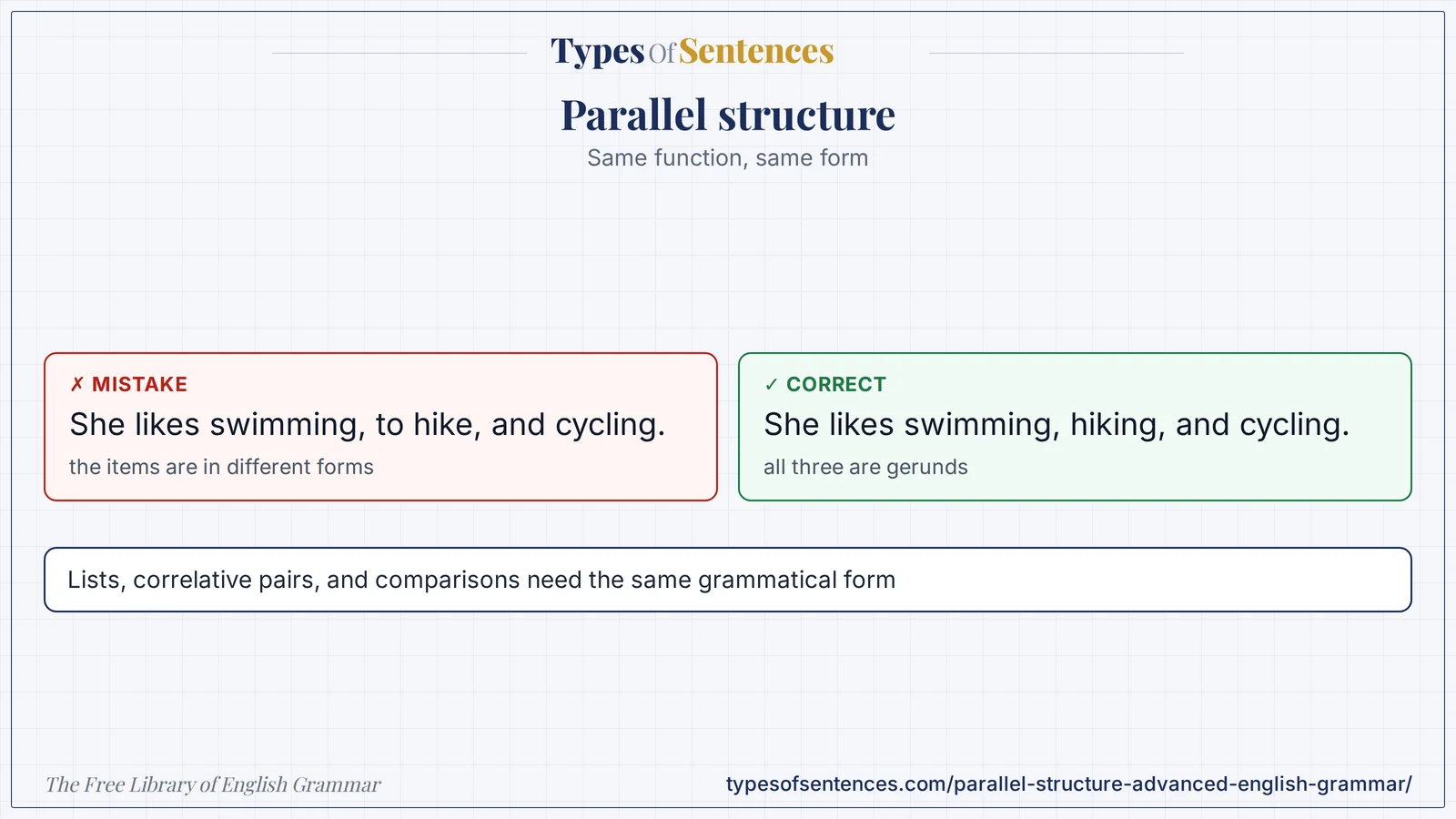
Parallel structure means that items that do the same job in a sentence look alike. If you write a list of verbs, every item is a verb in the same form. If you write not only … but also, what follows each part is the same kind of phrase.
Why it matters: Faulty parallelism is easy to hear when you read aloud and easy to fix: choose one form, then rewrite the odd item to match.
Summary: Parallel structure puts coordinated elements (items in a list, parts joined by and, but, or, correlative pairs, and the two sides of a comparison) in the same grammatical form: noun with noun, gerund with gerund, infinitive with infinitive, clause with clause. Repeat or omit function words (articles, prepositions, to, that) consistently. Place correlative conjunctions so that each introduces the same kind of phrase. Compare like with like. Faulty parallelism mixes forms, misplaces correlatives, or compares unlike things. Deliberate parallelism (anaphora, tricolon, antithesis, isocolon) gives emphasis and rhythm. Bullet points, headings, and outlines should be parallel too.
- Same function → same form.
- Lists: all nouns, all gerunds, all infinitives, all clauses.
- Correlatives: the same form after each part.
- Compare like with like; use parallelism for effect, not by accident.
What You’ll Learn
- 1. Parallel Structure: What Is Parallelism?
- 2. Parallelism in Lists and Series
- 3. Parallelism with Coordinating Conjunctions: And, But, Or
- 4. Parallelism with Correlative Conjunctions
- 5. Parallelism in Comparisons
- 6. Faulty Parallelism: Common Errors and Corrections
- 7. Parallelism for Effect: Rhetorical Impact
- 8. Parallelism in Different Kinds of Writing
- 9. Common Errors and a Checklist
- 10. Exercises
- 11. Test Your Knowledge
- 12. Frequently Asked Questions
- 13. Conclusion
1. Parallel Structure: What Is Parallelism?
| Non-parallel | Parallel | Form |
|---|---|---|
| She likes swimming, to hike, and a bicycle. | She likes swimming, hiking, and cycling. | all gerunds |
| He is tall, dark, and with a handsome face. | He is tall, dark, and handsome. | all adjectives |
| The job requires patience, being organized, and to work hard. | The job requires patience, organization, and hard work. | all nouns |
| We came to learn, practicing, and to share. | We came to learn, to practice, and to share. | all infinitives |
| The report was clear, concise, and it was well organized. | The report was clear, concise, and well organized. | all adjectives |
| Our goals are to reduce costs, improving quality, and customer satisfaction. | Our goals are to reduce costs, improve quality, and increase customer satisfaction. | all infinitive phrases |
| Level | What is parallel | Example |
|---|---|---|
| word | nouns with nouns, verbs with verbs | speed, accuracy, and reliability |
| phrase | gerund phrases, prepositional phrases, infinitive phrases | by reading, by writing, and by speaking |
| clause | finite clauses with finite clauses | He said that he was tired, that he was hungry, and that he wanted to go home. |
| sentence | sentences with a common pattern | He came. He saw. He left. |
| paragraph and text | headings, bullets, and sections with a common pattern | Phase 1: Plan. Phase 2: Build. Phase 3: Test. |
| Benefit | Explanation |
|---|---|
| readability | the reader recognizes the pattern and processes it quickly |
| clarity | shows which elements are equal and which parts are joined |
| balance and rhythm | the sentence has a shape |
| emphasis | repeated form stresses the equal weight of the ideas |
| economy | allows shared words to be omitted without confusion (see the chapter on ellipsis and substitution) |
| memorability | patterns are easy to remember |
The principle is that coordinated elements should be of the same kind: the grammar of coordination, discussed in the chapters on advanced conjunction concepts and coordination and subordination, joins elements that have the same function. Parallelism asks that they also have the same form, wherever possible, so that the reader can see that they are equal.
2. Parallelism in Lists and Series
| Kind of list | Parallel example | Non-parallel (faulty) |
|---|---|---|
| nouns | The kit includes a map, a compass, and a flashlight. | The kit includes a map, a compass, and to carry a flashlight. |
| verbs (same form) | She opened the door, crossed the room, and sat down. | She opened the door, crossing the room, and sat down. |
| gerunds | He enjoys cooking, reading, and traveling. | He enjoys cooking, reading, and to travel. |
| infinitives | They wanted to win, to learn, and to enjoy. | They wanted to win, learning, and enjoyment. |
| adjectives | The room was bright, clean, and quiet. | The room was bright, clean, and had no noise. |
| adverbs | She spoke slowly, clearly, and calmly. | She spoke slowly, clearly, and with calm. |
| prepositional phrases | in the morning, in the evening, and at night | in the morning, evenings, and at night |
| noun clauses | He knew that it was late, that he was tired, and that the train had gone. | He knew that it was late, his tiredness, and that the train had gone. |
| relative clauses | a plan that is simple, that is cheap, and that works | a plan that is simple, cheap, and that works |
| passive and active verbs | The data were collected, analyzed, and reported. | The data were collected, we analyzed them, and reported. |
| Function words | Rule | Example |
|---|---|---|
| articles | repeat the article consistently, or use one for the whole series if the items are a unit | the manager, the clerk, and the cashier / the manager and clerk (one person?) |
| prepositions | repeat the preposition before each item when the relations differ or the series is long | in the house, in the garden, and in the shed |
| to with infinitives | repeat to before each, or use it once before all | to read, to write, and to speak / to read, write, and speak |
| that in clauses | repeat or omit throughout | He said that he was tired, that he was late, and that he would leave. |
| auxiliary verbs | repeat if the forms differ | She has called and has written. (not has called and wrote) |
| possessives | repeat or omit throughout | her book, her pen, and her bag / her book, pen, and bag |
| Bullets, headings, and outlines | Non-parallel | Parallel |
|---|---|---|
| bulleted list in a résumé | • Managed a team; • Responsible for sales; • Training of new staff | • Managed a team; • Led sales; • Trained new staff |
| headings in a report | Introduction; Methods Used; What We Found; The Conclusions | Introduction; Methods; Findings; Conclusions |
| steps in instructions | 1. Open the box. 2. The cable should be connected. 3. Turn it on. | 1. Open the box. 2. Connect the cable. 3. Turn on the device. |
| items in a slide | Fast; saving money; easy to use | Fast; cheap; easy |
| section titles in an outline | I. Causes of the war; II. Effects; III. How to prevent wars | I. Causes of the war; II. Effects of the war; III. Prevention of war |
- Choose one form and keep it. If the first item is a gerund, make the rest gerunds.
- Check every item in a series, not only the first two.
- Make bullet points parallel in grammar, in capitalization, and in punctuation. If the first bullet starts with a verb, they all should.
- Parallel steps and instructions are easier to follow (see the chapter on technical writing).
- Use a list with a lead-in that fits every item: the lead-in plus any bullet must make a grammatical sentence.
3. Parallelism with Coordinating Conjunctions: And, But, Or
| Conjunction | Parallel | Faulty |
|---|---|---|
| and | She is intelligent and hardworking. | She is intelligent and a hard worker. |
| and (clauses) | He opened the window, and she closed the door. | He opened the window, and the door was closed by her. |
| but | He is not rich but generous. | He is not rich but he has generosity. |
| or | You can pay by cash or by card. | You can pay by cash or with a card, or by bank transfer online. |
| nor | He neither called nor wrote. | He neither called nor did he write a letter. (heavy) |
| yet | a simple yet effective plan | a simple yet it is effective plan |
| so and for (clauses) | The road was closed, so we turned back. | — |
| Rule | Example |
|---|---|
| join like with like: noun with noun, phrase with phrase, clause with clause | the speed and the accuracy of the test |
| repeat a word only when it clarifies | She plays the piano and the guitar. |
| keep the verb form the same when verbs share a subject | He opened the door, entered the room, and closed the window. |
| keep voice consistent | The plan was drafted, reviewed, and approved. (all passive) |
| pair elements of the same grammatical function: adjective with adjective, adverbial with adverbial | He spoke clearly and with confidence (two adverbials, accepted) |
| avoid joining a gerund with an infinitive | She likes swimming and to run. → She likes swimming and running. |
Not every mismatch is an error. Grammarians treat coordination as a matter of function as well as of form: two elements of the same function (for example two adverbials) can be joined even if one is an adverb and one is a prepositional phrase: He spoke slowly and with great care. The writer should judge whether the mix is natural or a lurch. A deliberate mismatch can also be a figure of speech called zeugma, in which one word governs two things in different senses: She lost her keys and her temper. The test is the reader’s ease.
4. Parallelism with Correlative Conjunctions
| Correlative pair | Rule | Parallel example |
|---|---|---|
| both … and | the same form after both and after and | The plan is both cheap and effective. |
| not only … but also | the same form after each part; also may be omitted | She is not only intelligent but also kind. |
| either … or | the same form after each | You can either call us or write to us. |
| neither … nor | the same form after each | He neither smokes nor drinks. |
| whether … or | the same form after each | whether to stay or to go |
| not … but | the same form after each | not for money but for pleasure |
| rather than; instead of | parallel forms | He chose to walk rather than to drive. / walking rather than driving |
| as … as | parallel (comparison) | as fast as a bicycle |
| Faulty correlative placement | Why faulty | Corrected |
|---|---|---|
| He not only wrote a novel but also a play. | after not only: a verb phrase; after but also: a noun phrase | He wrote not only a novel but also a play. / He not only wrote a novel but also published a play. |
| She is both a teacher and writes books. | a noun phrase and a verb phrase | She is both a teacher and a writer. |
| The plan will either fail because of cost or the lack of time. | a prepositional phrase (because of) and a noun phrase | The plan will fail because of either cost or lack of time. |
| He neither wants to go nor to stay. | neither before the verb; nor before an infinitive | He wants neither to go nor to stay. |
| You can either pay now or by credit card. | a time adverb and a prepositional phrase | You can pay either now or later. |
| She not only sings but she also dances. | — | She not only sings but also dances. |
| Whether to go or staying is the question. | an infinitive phrase and a gerund | Whether to go or to stay is the question. |
| They are interested in both buying and in renting. | in repeated after and but not after both | They are interested in both buying and renting. |
| Detail | Rule | Example |
|---|---|---|
| verb agreement with either … or and neither … nor | the verb agrees with the nearer subject | Neither the teacher nor the students were ready. |
| inversion after not only at the start of a sentence | auxiliary before the subject | Not only did she sing, but she also danced. |
| both … and cannot join more than two | — | both A and B (not both A, B, and C) |
| not only … but also with different subjects | put the verb to agree with the nearer subject | Not only the manager but also the clerks were late. |
The rule is simple: whatever follows the first part of a correlative pair must be matched by the same kind of element after the second part. If the first part is followed by a noun phrase, the second part must be as well. A quick test is to read the sentence with the first correlative removed: if each half still makes sense in the same way, the sentence is parallel. The relevant coordination structures are also covered in the chapter on conjunction concepts.
5. Parallelism in Comparisons
| Faulty comparison (unlike things) | Corrected (like with like) |
|---|---|
| The population of Delhi is larger than Mumbai. | The population of Delhi is larger than that of Mumbai. |
| Her salary is higher than her colleague. | Her salary is higher than her colleague’s. |
| The climate of Bengaluru is milder than Chennai. | The climate of Bengaluru is milder than that of Chennai. |
| The results of the first test were better than the second. | The results of the first test were better than those of the second. |
| The prices here are lower than the market. | The prices here are lower than those in the market. |
| Writing a report is more difficult than to give a talk. | Writing a report is more difficult than giving a talk. |
| I like him better than her. (ambiguous) | I like him better than I like her. / I like him better than she does. |
| Comparison structure | Parallel form | Example |
|---|---|---|
| than | the same form on both sides | Reading is more enjoyable than watching television. |
| as … as | the same form on both sides | Working alone is as productive as working in a group. |
| more … than (two adjectives) | — | more clever than wise |
| prefer … to | noun/gerund with noun/gerund | She prefers walking to driving. |
| prefer to … rather than | infinitive with bare infinitive | She prefers to walk rather than drive. |
| would rather … than | bare infinitives | I would rather stay than go. |
| the same as; different from | nouns of the same kind | His method is different from hers. |
| the more … the more | parallel clauses | The more you practice, the better you play. |
| between … and | the same type of noun | between a hard place and a rock; between reading and writing |
In a comparison the two things compared must be of the same kind, and the grammar must show it. The most common error is comparing a thing with a place or a person (the population … than Mumbai) instead of with the matching thing (that of Mumbai). The grammar of comparison also depends on ellipsis: the words that are omitted in a comparison must be recoverable and correct.
6. Faulty Parallelism: Common Errors and Corrections
| Error type | Faulty | Corrected |
|---|---|---|
| mixing gerund and infinitive | He likes hiking and to swim. | He likes hiking and swimming. |
| mixing noun and verb phrase | She is a teacher and writes books. | She is a teacher and an author. |
| mixing noun and adjective | The job is difficult, a challenge, and exciting. | The job is difficult, challenging, and exciting. |
| mixing phrase and clause | He is known for his honesty and because he works hard. | He is known for his honesty and his hard work. |
| mixing active and passive | The committee reviewed the plan and the budget was approved. | The committee reviewed the plan and approved the budget. |
| mixing tense in shared-subject verbs | He opened the door, walks in, and sat down. | He opened the door, walked in, and sat down. |
| shared auxiliary with a wrong form | He has finished the report and submitting it. | He has finished and submitted the report. |
| mixing clause types | She said that she was ill and to leave early. | She said that she was ill and that she would leave early. |
| unparallel prepositions | He was interested in art, in music, and loved books. | He was interested in art, music, and books. |
| omitted word that changes the form | The manager and a clerk were chosen. | The manager and the clerk were chosen. (if the same pair) |
| correlative misplacement | He both wrote and has published a book. | He both wrote and published a book. |
| list with unequal items | The park has benches, trees, a lake, and is clean. | The park has benches, trees, and a clean lake. |
| uneven comparison | Her job is better than her sister. | Her job is better than her sister’s. |
| mixed items in a heading list | Introduction; Methods Used; What We Found | Introduction; Methods; Findings |
| mixed bullets | • Lead teams • Responsible for budgets • Training | • Led teams • Managed budgets • Trained staff |
| uneven thesis reasons | Cities should plant trees because of cooling, health, and they are beautiful. | Cities should plant trees for cooling, health, and beauty. |
| mixed it/ they references in a pair | It is useful, and they are cheap. | It is useful and cheap. |
| uneven result clause | The study aimed to measure growth, to compare groups, and the analysis of costs. | The study aimed to measure growth, compare groups, and analyze costs. |
| mixed modal forms | You must submit the form and should to attend. | You must submit the form and should attend. |
| uneven noun phrases | a quick, easy, and with low cost method | a quick, easy, and cheap method |
- Find the coordinated items: look for and, or, but, commas in a series, correlative pairs, and comparisons.
- Name the form of the first item (noun, gerund, infinitive, clause).
- Check that every other item has the same form.
- Rewrite the odd item, or restructure the sentence.
- Check repeated function words (articles, prepositions, to, that).
- Read aloud. A break in rhythm often marks faulty parallelism.
Parallelism errors are some of the most common in student and business writing, and they are checked in the copyediting stage (the economy that parallelism allows is discussed in the previous chapters of this part). Sometimes the faulty parallelism is a sign that the ideas are not really equal; if so, restructure the sentence so that the main ideas and the secondary ideas are in different structures.
7. Parallelism for Effect: Rhetorical Impact
| Device | Description | Example (original unless noted) |
|---|---|---|
| parallelism (general) | balanced structures for equal ideas | We need to listen, to learn, and to lead. |
| tricolon (three parallel parts) | three items; often with climax | safer, stronger, and smarter |
| isocolon | parallel parts of equal length | Easy to learn, easy to use. |
| anaphora | repetition at the beginning of successive clauses | We will plan. We will build. We will finish. |
| epistrophe | repetition at the end of successive clauses | of the people, by the people, for the people (a well-known phrase) |
| antithesis | parallel structures with opposed ideas | Small steps, giant leaps. |
| chiasmus | parallel structure in reverse order (AB–BA) | Do not live to eat; eat to live. |
| climax (auxesis) | parallel items of increasing strength | a mistake, a failure, a disaster |
| asyndeton | parallel items without conjunctions | I came, I saw, I conquered (a famous saying, in translation) |
| polysyndeton | parallel items with repeated conjunctions | and the rain fell and the rivers rose and the roads vanished |
| parallel questions | a series of questions with the same form | What are we doing? What do we want? What will we leave? |
| Plain | Parallel (for effect) |
|---|---|
| The company will make products and it will also train staff and it hopes to give back to society. | We will make better products, train better staff, and build a better community. |
| The speaker said that we should be honest, that we must work hard, and also that being kind matters. | Be honest. Work hard. Be kind. |
| Studying hard is good, and the results of exams matter, and you should also rest. | Study hard, test well, and rest well. |
- Use parallelism where equal ideas deserve equal weight, or where the rhythm will help the reader remember.
- Match the length as well as the form in formal parallelism (isocolon).
- Put the strongest item last in a series (climax).
- Do not force parallelism on ideas that are not parallel. A false symmetry can make an argument look neater than it is.
- Do not overuse it. A text full of triplets and balanced phrases sounds like a speech.
- Check the logic: an antithesis must set opposites against each other, not any two ideas.
The use of parallel patterns to persuade is part of the study of rhetoric (see the chapters on emphasis and focus and rhetorical strategies). In speeches and slogans, parallelism is one of the oldest and most effective devices, because it organizes ideas into patterns that the ear can follow.
8. Parallelism in Different Kinds of Writing
| Context | Use of parallelism | Example |
|---|---|---|
| academic writing | thesis with parallel reasons; parallel topic sentences; parallel methods | The policy failed because of cost, delay, and poor design. |
| business writing | parallel bullets, lists of actions, headings | Plan the work. Assign the tasks. Review the results. |
| technical writing | parallel steps and warnings | 1. Remove the cover. 2. Disconnect the cable. 3. Replace the filter. |
| résumés and applications | parallel bullet points with verbs in the same form | Led a team of five; managed a budget of 2 crore; trained 40 staff |
| legal drafting | parallel conditions in a list: (a), (b), (c) | The Tenant must (a) pay rent; (b) keep the premises clean; and (c) report damage. |
| journalism | parallel items in a list; parallel quotations | — |
| creative writing | parallel structure for rhythm, repetition, and echo | — |
| speeches and slogans | anaphora, tricolon, antithesis | — |
| poetry | line parallelism | — |
The importance of parallel items in a list is also discussed in the chapters on legal writing and on editing, because logical lists need a consistent grammatical pattern. When you edit any kind of writing, check every list, every pair of coordinated items, every correlative pair, and every comparison.
9. Common Errors and a Checklist
| Check | Question |
|---|---|
| lists | Are all items the same part of speech or form? |
| coordination | Do the elements joined by and, but, or have the same form? |
| correlatives | Does each part of the pair introduce the same kind of phrase? |
| comparisons | Are like things compared? |
| function words | Are articles, prepositions, to, and that repeated or omitted consistently? |
| voice and tense | Do verbs that share a subject have matching forms? |
| bullets and headings | Are they grammatically parallel and punctuated alike? |
| rhetorical series | Is the parallelism deliberate and the ideas truly parallel? |
Edit: The new library is not only large but also has comfortable chairs, and the staff are helpful, being friendly, and with knowledge, and the library prefers to lend books rather than selling them, and it is better than the old building, and it is open to students, to teachers, and anyone in the community.
- not only large but also has comfortable chairs: an adjective and a verb phrase: not only large but also comfortable.
- helpful, being friendly, and with knowledge: mixed forms: helpful, friendly, and knowledgeable.
- prefers to lend books rather than selling them: infinitive and gerund: prefers lending books to selling them.
- it is better than the old building: unlike things: better than the old one (the old building: same kind).
- to students, to teachers, and anyone in the community: repeated to but not for the third: to students, to teachers, and to anyone in the community (or to students, teachers, and anyone in the community).
- Result: The new library is not only large but also comfortable, and the staff are helpful, friendly, and knowledgeable. The library prefers lending books to selling them, and it is better than the old one. It is open to students, teachers, and anyone in the community. (the library is invented)
Recap in 12 seconds
Watch the lesson build itself: Parallel structure puts coordinated elements in the same grammatical form. The video has no sound.
Exercises
Part A: Lists (Exercises 1–7)
Exercise 1: Correct: She likes swimming, to hike, and a bicycle.
Show Answer
Answer: She likes swimming, hiking, and cycling.
Exercise 2: Correct: He is tall, dark, and with a handsome face.
Show Answer
Answer: He is tall, dark, and handsome.
Exercise 3: Correct: We came to learn, practicing, and to share.
Show Answer
Answer: We came to learn, to practice, and to share.
Exercise 4: Correct: The room was bright, clean, and had no noise.
Show Answer
Answer: The room was bright, clean, and quiet.
Exercise 5: Correct: The job requires patience, being organized, and to work hard.
Show Answer
Answer: The job requires patience, organization, and hard work.
Exercise 6: Correct the bullets: • Managed a team • Responsible for sales • Training of new staff
Show Answer
Answer: • Managed a team • Led sales • Trained new staff.
Exercise 7: Correct the headings: Introduction; Methods Used; What We Found
Show Answer
Answer: Introduction; Methods; Findings.
Part B: Coordinating Conjunctions (Exercises 8–12)
Exercise 8: Correct: She is intelligent and a hard worker.
Show Answer
Answer: She is intelligent and hardworking.
Exercise 9: Correct: She likes swimming and to run.
Show Answer
Answer: She likes swimming and running.
Exercise 10: Correct: The committee reviewed the plan and the budget was approved.
Show Answer
Answer: The committee reviewed the plan and approved the budget.
Exercise 11: Correct: He opened the door, walks in, and sat down.
Show Answer
Answer: He opened the door, walked in, and sat down.
Exercise 12: What is zeugma?
Show Answer
Answer: One word governing two things in different senses (lost her keys and her temper).
Part C: Correlatives (Exercises 13–19)
Exercise 13: Correct: He not only wrote a novel but also a play.
Show Answer
Answer: He wrote not only a novel but also a play.
Exercise 14: Correct: She is both a teacher and writes books.
Show Answer
Answer: She is both a teacher and a writer.
Exercise 15: Correct: He neither wants to go nor to stay.
Show Answer
Answer: He wants neither to go nor to stay.
Exercise 16: Correct: Whether to go or staying is the question.
Show Answer
Answer: Whether to go or to stay is the question.
Exercise 17: Correct: They are interested in both buying and in renting.
Show Answer
Answer: They are interested in both buying and renting.
Exercise 18: Which subject does the verb agree with in neither … nor?
Show Answer
Answer: The nearer one.
Exercise 19: Complete the inversion: Not only ___ she sing …
Show Answer
Answer: did.
Part D: Comparisons (Exercises 20–25)
Exercise 20: Correct: The population of Delhi is larger than Mumbai.
Show Answer
Answer: … than that of Mumbai.
Exercise 21: Correct: Her salary is higher than her colleague.
Show Answer
Answer: … than her colleague’s.
Exercise 22: Correct: Writing a report is more difficult than to give a talk.
Show Answer
Answer: … than giving a talk.
Exercise 23: Correct: She prefers to walk than driving.
Show Answer
Answer: She prefers walking to driving. / She prefers to walk rather than drive.
Exercise 24: Correct: The results of the first test were better than the second.
Show Answer
Answer: … than those of the second.
Exercise 25: What must be compared in a comparison?
Show Answer
Answer: Like with like.
Part E: Effect and Review (Exercises 26–30)
Exercise 26: Name the device: We will plan. We will build. We will finish.
Show Answer
Answer: Anaphora.
Exercise 27: Name the device: Do not live to eat; eat to live.
Show Answer
Answer: Chiasmus.
Exercise 28: Name the device: safer, stronger, and smarter
Show Answer
Answer: Tricolon.
Exercise 29: Why not force parallelism on unequal ideas?
Show Answer
Answer: It makes a false symmetry.
Exercise 30: Name a test for faulty parallelism.
Show Answer
Answer: Read aloud; check each coordinated item has the same form.
Test Your Knowledge
Ready to check what you learned? Answer all 10 questions, then submit. You need 80% (8 of 10) to pass. Your answers are not stored.
View correct answers and explanations
Question 1: What is parallel structure?
✓ Correct Answer: A – using the same grammatical form for equal ideas
Same form for equal ideas.
Question 2: Which is parallel?
✓ Correct Answer: B – She likes swimming, hiking, and cycling.
All gerunds.
Question 3: Which is correct?
✓ Correct Answer: C – He wrote not only a novel but also a play.
Same form after each part.
Question 4: Which is correct?
✓ Correct Answer: D – The prices here are lower than those in the market.
Like with like.
Question 5: Which is parallel?
✓ Correct Answer: C – The job is difficult, challenging, and exciting.
All adjectives.
Question 6: Which device is We will plan. We will build. We will finish.?
✓ Correct Answer: A – anaphora
Repetition at the start.
Question 7: Which is correct?
✓ Correct Answer: D – She is both a teacher and a writer.
Noun phrase with noun phrase.
Question 8: Which is correct?
✓ Correct Answer: C – He wants neither to go nor to stay.
Parallel infinitives after the correlatives.
Question 9: Which is parallel?
✓ Correct Answer: B – • Led teams • Managed budgets • Trained staff
All start with a past verb.
Question 10: Which is chiasmus?
✓ Correct Answer: B – Do not live to eat; eat to live.
AB–BA.
Frequently Asked Questions
What is parallel structure?
Parallel structure is the use of the same grammatical form for items that do the same job in a sentence: nouns with nouns, gerunds with gerunds, clauses with clauses. Parallel structure makes sentences clear and balanced.
What is parallelism?
Parallelism is the repetition of a grammatical pattern, either as a rule of correct grammar for lists and coordinated items or as a rhetorical device for rhythm and emphasis.
What is parallelism grammar?
Parallelism grammar covers the rules that coordinated elements should match: lists, pairs joined by and, but, or, correlative conjunctions, and comparisons. It tells you to repeat or omit function words consistently.
What is parallel construction?
Parallel construction is the building of a sentence so that equal ideas are expressed in equal grammatical forms, as in She likes swimming, hiking, and cycling. Faulty parallel construction mixes the forms.
What is grammatical parallelism in correlative conjunctions?
Grammatical parallelism with correlatives means that the same kind of phrase follows each part of the pair: not only a novel but also a play, not not only wrote a novel but also a play.
How do I fix faulty parallelism?
Find the coordinated items, identify the form of the first, rewrite the others to match, check the function words, and read aloud.
Is parallelism only a rule?
No. It is also a style device: anaphora, tricolon, and antithesis use parallelism to give emphasis, rhythm, and memorability.
Conclusion
You now have a deep study of parallel structure: what parallelism is, parallelism in lists, with coordinating and correlative conjunctions, and in comparisons, faulty parallelism and its corrections, parallelism for effect, and its use in different kinds of writing. You can write balanced sentences and check them for faults.
When you edit, find every list, pair, and comparison and ask whether its parts look alike. Next, you will study sentence variety.
- Quirk, Randolph, Sidney Greenbaum, Geoffrey Leech, and Jan Svartvik. A Comprehensive Grammar of the English Language. Longman, 1985.: coordination of like and unlike categories.
- Huddleston, Rodney, and Geoffrey K. Pullum. The Cambridge Grammar of the English Language. Cambridge University Press, 2002.: coordination and comparison.
- Garner, Bryan A. Garner’s Modern English Usage. 5th ed. Oxford University Press, 2022.: entries on parallelism and correlatives.
- Corbett, Edward P. J., and Robert J. Connors. Classical Rhetoric for the Modern Student. 4th ed. Oxford University Press, 1999.: schemes of parallelism.
- Merriam-Webster Dictionary: parallel: the dictionary entry.
Last reviewed: October 29, 2026. How it was made: drafted with AI assistance, then checked with automated tests (structure, links, answer keys, spelling) and against the sources above. A person has not yet read this chapter line by line. Found a mistake? Report it.