Transition words are the words and phrases that show how one idea relates to another: that it adds to it, contrasts with it, causes it, follows it, illustrates it, or sums it up. They are the signposts of a text. Without them, the reader must guess the relationship between sentences; with the wrong ones, the reader is misled; with too many, the text becomes mechanical. A good writer uses transitions to make a relationship visible only when it is not already clear, and chooses the transition that says exactly what the relationship is.
This chapter covers transitions and connectors in depth. You will meet more than 150 of them, arranged by function; learn the grammar of each type (conjunctive adverbs such as however, coordinating and subordinating conjunctions, and transitional phrases) and the punctuation they need; study transitions within sentences, between paragraphs, and as whole bridging sentences; and learn when to omit them, how to match formal and informal registers, and which easily confused connectors to watch. The subject is also called connectors grammar, and it concerns the conjunctive adverbs and connectors that give writing its logical flow. Thirty editing exercises and a quiz follow.
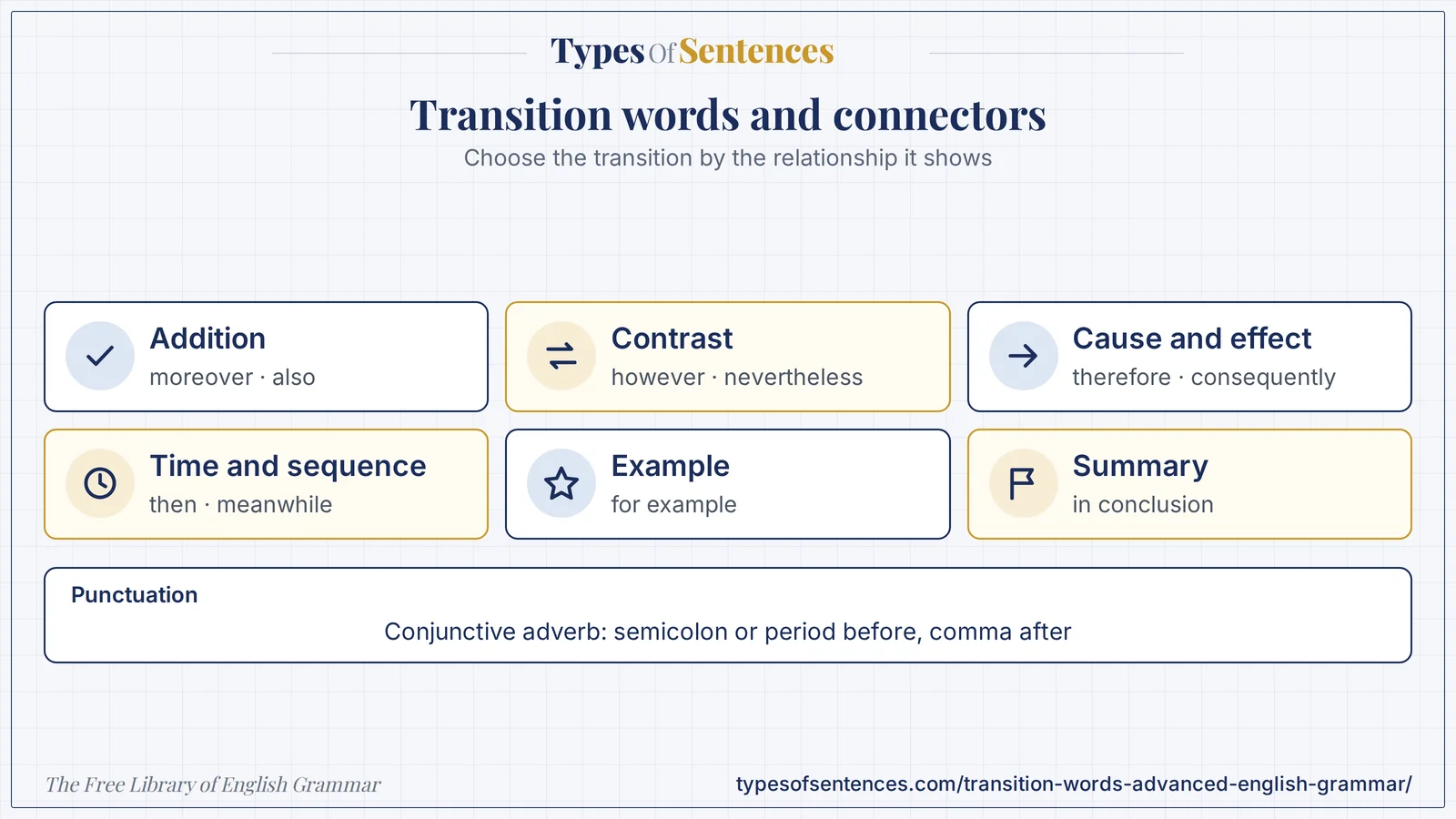
A transition tells the reader what the next idea does in relation to the last one. However says “contrast”, therefore says “result”, for example says “illustration”, finally says “last in the series”.
Why it matters: Use a transition when the relationship is not obvious and the reader needs it. Do not add one to every sentence: if the order of ideas makes the link clear, no word is needed.
Summary: Transitions express relations of addition, contrast, cause and effect, time and sequence, example, emphasis, clarification, concession, condition, comparison, and summary. They are conjunctive adverbs (however, therefore), coordinating conjunctions (but, so), subordinating conjunctions (although, because), and phrases (as a result, on the other hand). Conjunctive adverbs joining two independent clauses need a semicolon or a period before them, not a comma. Paragraphs are linked by topic sentences, repeated key terms, and bridging sentences. Too many transitions make text mechanical; the choice of formal or informal transitions must fit the register, and the meaning must match the logic.
- Choose the transition by the relationship it shows.
- Conjunctive adverb: semicolon or period before, comma after.
- Link paragraphs with topic sentences and bridging sentences.
- Do not overuse; match the register.
What You’ll Learn
- 1. Transition Words: Types of Transitions by Function
- 2. Sentence-Level Transitions: Grammar and Punctuation
- 3. Paragraph-Level Transitions: Between Paragraphs and Sections
- 4. Transitional Sentences: Bridging Ideas
- 5. Overusing Transitions: Natural Flow and When to Omit
- 6. Formal and Informal Transitions
- 7. Choosing the Right Transition: Easily Confused Connectors
- 8. Transitions in Different Kinds of Writing
- 9. Common Errors with Transitions
- 10. Exercises
- 11. Test Your Knowledge
- 12. Frequently Asked Questions
- 13. Conclusion
1. Transition Words: Types of Transitions by Function
| Relation | Transitions | Example |
|---|---|---|
| addition | moreover, furthermore, in addition, additionally, also, besides, what is more, as well as, not only that, too, equally important, plus (informal) | The plan is cheap. Moreover, it is fast. |
| contrast (opposition) | however, nevertheless, nonetheless, yet, still, on the other hand, in contrast, conversely, whereas, while, by contrast, on the contrary, instead, rather, even so, despite this, in spite of this, but | The plan is cheap; however, it is risky. |
| cause and effect (result) | therefore, thus, hence, consequently, as a result, accordingly, so, for this reason, because of this, as a consequence, thereby, it follows that, that is why | The road was flooded; therefore, the bus did not run. |
| reason (cause) | because, since, as, for, owing to, due to, given that, in view of the fact that, on account of, now that | Because the road was flooded, the bus did not run. |
| time (and sequence in time) | meanwhile, subsequently, later, afterward, then, next, previously, earlier, formerly, simultaneously, at the same time, eventually, in the meantime, before long, soon, immediately, thereafter, once, as soon as, until then, at that point | Meanwhile, the rescue team arrived. |
| order (sequence in a list) | first, second, third, firstly, secondly, finally, lastly, to begin with, in the first place, next, then, to conclude | First, define the term; second, give an example. |
| example (illustration) | for example, for instance, such as, namely, specifically, in particular, to illustrate, including, especially, notably, say, as an illustration | Several cities, for example, have banned plastic bags. |
| emphasis | indeed, in fact, above all, certainly, clearly, undoubtedly, in particular, most importantly, of course, obviously, especially, without doubt, truly | Indeed, the results were striking. |
| clarification (restatement) | in other words, that is, that is to say, to put it differently, to put it another way, namely, i.e., simply put | The policy is regressive; in other words, it hurts the poor more. |
| concession | admittedly, granted, of course, naturally, it is true that, although, even though, though, albeit, notwithstanding, after all, to be sure, true | Admittedly, the plan is costly. |
| condition | if, unless, provided that, as long as, otherwise, in that case, if so, if not, on condition that, whether, in the event that, supposing | Submit by Friday; otherwise, you will lose the place. |
| comparison (similarity) | similarly, likewise, in the same way, equally, just as, in comparison, compared with, by the same token, correspondingly, in a like manner | Similarly, the second study found a decline. |
| purpose | so that, in order that, so as to, to this end, for this purpose, with this in mind, with this aim, in order to | Prices were cut so that more people could buy. |
| summary and conclusion | in conclusion, to conclude, in summary, to sum up, in short, in brief, overall, all in all, on the whole, in sum, ultimately, in the end, therefore, thus, to summarize | Overall, the plan succeeded. |
| generalization | in general, generally, as a rule, on the whole, typically, usually, by and large, for the most part, in most cases | In general, prices rose. |
| exception | except, apart from, but for, with the exception of, other than, save for, otherwise | Apart from the first test, all results were positive. |
| place or position | here, there, nearby, above, below, beyond, opposite, adjacent to, in the background, in the distance, behind, further along | Beyond the village lay a river. |
| reference to the previous | as mentioned, as noted above, in this respect, in this case, in that sense, to this extent | In this respect, the plan is a success. |
| repetition and return | as I said; to return to; coming back to; turning to; as for; regarding | Turning to cost, the plan is cheap. |
| Grammatical class | Examples | Position and punctuation |
|---|---|---|
| conjunctive adverbs (sentence adverbs) | however, therefore, moreover, nevertheless, consequently, furthermore, thus, otherwise, meanwhile, instead | between independent clauses: ; however, or . However,; can move within the clause with commas |
| coordinating conjunctions (FANBOYS) | for, and, nor, but, or, yet, so | joins clauses: , and; a comma before it when it joins two independent clauses |
| subordinating conjunctions | although, because, since, while, whereas, if, unless, when, after, before, until, as | a subordinate clause before the main clause takes a comma; after it, usually none |
| correlative conjunctions | both … and, not only … but also, either … or, neither … nor, whether … or | parallel structure (see the chapter on parallel structure) |
| transitional phrases | as a result, in addition, for example, on the other hand, in other words, in contrast | a comma after, when they open a sentence |
| prepositions with the same relation | despite, in spite of, because of, due to, owing to, in addition to, instead of | followed by a noun phrase or a gerund, not a clause |
| relative and other linkers | which, whereby, wherein, in which | introduce a clause that adds information |
The count in the table is above 150 items. The relations come from the logical connections discussed in the chapter on cohesion and coherence: the writer chooses the relation first, then the word.
2. Sentence-Level Transitions: Grammar and Punctuation
| Pattern | Example | Punctuation |
|---|---|---|
| independent clause. Conjunctive adverb, independent clause. | The plan is cheap. However, it is risky. | a period, then the adverb with a comma |
| independent clause; conjunctive adverb, independent clause. | The plan is cheap; however, it is risky. | a semicolon, then the adverb with a comma |
| independent clause, coordinating conjunction independent clause. | The plan is cheap, but it is risky. | a comma before the conjunction |
| subordinate clause, independent clause. | Although the plan is cheap, it is risky. | a comma after the subordinate clause |
| independent clause subordinate clause. | The plan is risky although it is cheap. | usually no comma |
| independent clause, nonessential clause. | The plan, which is cheap, is risky. | commas for the nonessential clause |
| conjunctive adverb in the middle | The plan is cheap. It is, however, risky. | commas on both sides |
| conjunctive adverb at the end | The plan is cheap. It is risky, however. | a comma before |
| transitional phrase + comma | In addition, the plan is fast. | a comma after an opener |
| introductory word that is closely linked (no comma) | Thus the plan was approved. (short, formal) | the comma is optional with thus, hence, also, then |
| Comma splice trap | Incorrect | Correct |
|---|---|---|
| conjunctive adverb after a comma | The plan is cheap, however, it is risky. | The plan is cheap; however, it is risky. / The plan is cheap, but it is risky. |
| therefore after a comma | He was ill, therefore he stayed home. | He was ill; therefore, he stayed home. / He was ill, so he stayed home. |
| then after a comma | She finished, then she left. | She finished, and then she left. / She finished; then she left. |
| moreover after a comma | It is cheap, moreover it is fast. | It is cheap; moreover, it is fast. |
| also after a comma | He sings, also he dances. | He sings, and he also dances. |
| otherwise after a comma | Hurry, otherwise you will miss it. | Hurry; otherwise, you will miss it. / Hurry, or you will miss it. |
| Easily confused structures | Pattern | Example |
|---|---|---|
| although / though / even though + clause | a conjunction | Although it was cheap, it was risky. |
| despite / in spite of + noun or gerund | a preposition | Despite the cost, he bought it. / Despite being expensive, … |
| however + comma (adverb) | a conjunctive adverb | It was cheap; however, it was risky. |
| because + clause | a conjunction | Because it rained, we stayed. |
| because of / due to / owing to + noun phrase | prepositions | Because of the rain, we stayed. |
| therefore / consequently + comma (adverb) | conjunctive adverbs | It rained; therefore, we stayed. |
| so + clause (coordinating) | a conjunction | It rained, so we stayed. |
| as a result of + noun phrase | a preposition phrase | As a result of the rain, we stayed. |
| as a result, + clause | an adverbial | It rained. As a result, we stayed. |
| whereas / while + clause (contrast) | conjunctions | Whereas the first plan was cheap, the second was costly. |
| in contrast to + noun phrase | a preposition phrase | In contrast to the first plan, the second was costly. |
| in addition to + noun phrase or gerund | a preposition phrase | In addition to being cheap, it was fast. |
| in addition, + clause | an adverbial | It was cheap. In addition, it was fast. |
- Identify the grammatical class before you punctuate: a conjunctive adverb cannot join two independent clauses with only a comma.
- Do not confuse a conjunction and a preposition with the same meaning: although takes a clause, despite takes a noun phrase.
- Place a conjunctive adverb where it reads best: at the start for a strong signal, in the middle to avoid a heavy opening, at the end for a light touch.
- Put a comma after most sentence-initial transitions (However,, For example,); short ones (Thus, Then, Also) may omit it.
- Use a semicolon to join two closely related independent clauses with a conjunctive adverb, as in ; however,.
The grammar of the coordinate and subordinate links is discussed in the chapters on advanced conjunction concepts and coordination and subordination; the choice of connectors in speech is one of the topics of the chapter on discourse analysis.
3. Paragraph-Level Transitions: Between Paragraphs and Sections
| Technique | How it works | Example |
|---|---|---|
| transition word or phrase at the start of the paragraph | signals the relation to the previous paragraph | In contrast, the second study found … |
| repeating a key term from the end of the previous paragraph | links by lexical repetition | … the problem of cost. Cost is also the first concern of the council … |
| “this” + noun | summarizes the previous point and builds on it | This lack of funding led to … |
| numbered or ordinal signposts | shows the sequence of the argument | A second reason is …; The third factor … |
| a topic sentence that points back and forward | connects to the previous and introduces the new | Although cost matters, a more serious obstacle is time. |
| a question | a turn of the argument | Why did the plan fail? |
| a short bridging sentence at the end of a paragraph | prepares for the next | These costs, however, are only part of the story. |
| headings and subheadings | mark the structure in long texts | — |
| a summary and a preview sentence at a section boundary | reviews and previews | Having examined the causes, we turn to the effects. |
| a transitional paragraph | a short paragraph that moves between sections | — |
| Relation between paragraphs | Opening words (examples) |
|---|---|
| addition | Another reason is …; In addition to cost, …; A further problem … |
| contrast | In contrast, …; By contrast, …; On the other hand, …; Yet this view overlooks … |
| cause and effect | As a result, …; This led to …; Consequently, … |
| example | A good example is …; Consider the case of …; To illustrate, … |
| sequence | The first step …; Next, …; Finally, … |
| concession and refutation | Some may object that …; Admittedly, …; Even so, … |
| conclusion | In conclusion, …; Overall, …; Taken together, … |
Transitions between paragraphs are of two kinds: logical (a word that says what the relation is) and thematic (a repeated term or a pointing phrase that makes the topics connect). The best paragraph openings combine both. The structure of an essay and the logic of its paragraphs are discussed in the chapter on advanced essay structure.
4. Transitional Sentences: Bridging Ideas
| Function | Transitional sentence (examples) |
|---|---|
| summarize and move on | So far, this chapter has shown how the plan was made. The next question is how it was carried out. |
| concede and turn | These arguments are persuasive; yet they leave one question unanswered. |
| raise a question | This raises a question: who pays? |
| signal a contrast of view | Not everyone agrees. |
| signal a deeper point | The problem is more serious than it first appears. |
| introduce an example | Consider a recent case. |
| move to a new topic | Turning from cost to benefits, we find a more mixed picture. |
| return to a theme | This brings us back to the question of trust. |
| signal a shift in time | Ten years later, the picture had changed. |
| prepare a conclusion | All of this points in one direction. |
| signal a limit | But the story does not end there. |
| link cause and effect | What followed was predictable. |
| introduce a counterexample | There is, however, one exception. |
| mark importance | Most important of all, … |
| bridge two sections | Having considered the causes, we can now examine the consequences. |
A good transitional sentence is short and has a clear job: it closes one point, opens the next, or does both. It should not repeat what has just been said at length (a transition is not a summary) or announce the next section in a stiff formula (In the next section, I will discuss …) when a natural phrase would do.
5. Overusing Transitions: Natural Flow and When to Omit
| Overuse | Example | Revision |
|---|---|---|
| a transition in every sentence | Moreover, … Furthermore, … In addition, … Also, … | Join the ideas, or let the order show the link. |
| the same transition repeatedly | However, … However, … However, … | Vary, or restructure. |
| a transition that does not match the logic | The plan is cheap. However, it is fast. (no contrast) | The plan is cheap. It is also fast. / The plan is cheap and fast. |
| a stiff transition in an informal text | Furthermore, I would like some coffee. | Also, could I have some coffee? |
| a “list” transition without a list | First, … (with no second) | Delete. |
| heavy transitions in a short text | a 100-word paragraph with five connectors | Cut to one or two. |
| transitions where repetition or pronouns suffice | He wrote a book. Moreover, the book sold well. | He wrote a book. It sold well. |
| emphatic words used as filler | Indeed, in fact, of course, clearly in every paragraph | Keep for real emphasis. |
| Other ways to link ideas | Example |
|---|---|
| repetition of key words | The council voted on the budget. The budget was approved by one vote. |
| pronouns and “this” + noun | The plan failed. This failure … |
| given–new order | the end of one sentence becomes the start of the next |
| parallel structure | — |
| synonyms and related terms | plan … scheme … proposal |
| an implied relation from the order of events | He opened the door. The room was empty. |
| punctuation (colon, dash, semicolon) | The plan failed: nobody had read it. |
- Ask what relation you want to show, and whether the reader will see it without a word.
- Use a transition where the reader could take the logic in more than one way.
- Keep transitions short and natural. But is often better than nevertheless.
- Vary the position of the transition (start, middle, end of the sentence).
- Read aloud. A heavy, “listy” rhythm marks overuse.
- Check the logic. A wrong transition is worse than none.
6. Formal and Informal Transitions
| Informal | Neutral | Formal |
|---|---|---|
| but | however | nevertheless; nonetheless |
| so | therefore; as a result | consequently; accordingly; hence; thus |
| also; plus | in addition; also | moreover; furthermore |
| anyway; still | even so | notwithstanding this |
| though | although | albeit |
| and then | then; next | subsequently; thereafter |
| for example | for example; for instance | to illustrate; by way of illustration |
| I mean; like | in other words | that is to say; namely |
| in the end | finally | ultimately; in conclusion |
| if not | otherwise | failing that |
| because | because; since | owing to the fact that (avoid); in view of |
| all in all | overall | in sum; on balance |
| by the way | incidentally | — |
| on top of that | besides | what is more |
| Spoken discourse markers | Function |
|---|---|
| well | a response, a hedge, or a pause |
| so | a topic shift or a result |
| anyway | a return to the main point; a closing |
| actually | a correction or a surprise |
| you know; I mean | shared knowledge; reformulation |
| right; okay | a topic boundary; agreement |
| by the way | a digression |
Spoken English uses discourse markers (well, so, anyway) that do the job of transitions; written formal English prefers the conjunctive adverbs and phrases listed above. Choose by register: academic and legal writing prefer therefore, moreover, nevertheless; business writing prefers also, however, as a result; informal writing is comfortable with but, so, and plus. See the chapter on register and style. Some formal transitions (moreover, furthermore, notwithstanding) sound stiff outside formal texts, and an overly formal connector can seem pompous.
7. Choosing the Right Transition: Easily Confused Connectors
| Words | Difference | Example |
|---|---|---|
| however / nevertheless | however: contrast; nevertheless: contrast that persists despite what was said (concession) | The plan was risky; nevertheless, they went ahead. |
| therefore / thus / hence | all mean “as a result”; hence is often followed by a noun phrase; thus may also mean “in this way” | Costs rose; hence the delay. |
| while / whereas | while: time or contrast; whereas: contrast only (clearer) | Whereas the first plan was cheap, the second was costly. |
| since / as | since, as: time or reason; check ambiguity | Since you left, nothing has changed. (time) / Since you left, I locked the door. (ambiguous) |
| moreover / furthermore / in addition | add information; moreover and furthermore add a stronger or further point | — |
| on the other hand / in contrast | on the other hand: another side of the same issue; in contrast: a sharp difference between two things | — |
| on the contrary | denies the previous statement | The plan was not a failure. On the contrary, it succeeded. |
| besides / beside | besides: in addition; beside: next to | Besides, it was cheap. / beside the river |
| in fact / actually | in fact: emphasis or correction; actually: a contrast with expectation | — |
| otherwise | if not; or else | Hurry; otherwise, you will be late. |
| so / so that | so: result; so that: purpose | It rained, so we stayed. / We left early so that we could avoid the rain. |
| then / thus / therefore | then: next in time; thus/therefore: logical result | — |
| accordingly | as a consequence, in a fitting way | — |
| meanwhile | at the same time (elsewhere) | Meanwhile, the team arrived. |
| instead / rather | instead: in place of; rather: more accurately | He did not stay; instead, he left. |
| although / though / even though | though may be placed at the end in informal speech | It was cheap. It was risky, though. |
- Pick by meaning, not by sound. A long word is not a better word.
- Check for ambiguity: since, while, and as can mean time or reason/contrast; use because, although, or whereas if there is a risk.
- Use on the other hand for a counter-view, not for any contrast; in contrast for two different things.
- Check the logic. Therefore requires a real consequence.
8. Transitions in Different Kinds of Writing
| Genre | Typical transitions | Notes |
|---|---|---|
| academic essay and paper | moreover, however, therefore, in contrast, for example, in conclusion | formal; used to show the argument; avoid mechanical repetition |
| research article | as shown in, in contrast to, consistent with, whereas, in addition | relation to previous research |
| business email | also, however, as a result, next steps, in addition | short; direct |
| report | first, second, finally, as a result, in summary | sequence and findings |
| technical instructions | first, then, next, after that, once, finally | sequence |
| news | meanwhile, however, according to, earlier, later | short; few connectors |
| fiction | then, later, meanwhile, suddenly, but | plain; avoid heavy logical connectors |
| speech | first, next, so, but, finally | signposting for listeners |
| digital writing | headings and short links; plain connectors | — |
| legal drafting | provided that, subject to, notwithstanding, without prejudice to | fixed formulas |
The best transitions are invisible: they carry the reader from one idea to the next so smoothly that the reader notices only the ideas. Revise your transitions by reading your text as a reader who does not know the connection, and mark each place where you had to guess.
9. Common Errors with Transitions
| Error | Example | Fix |
|---|---|---|
| comma splice with a conjunctive adverb | The test was long, however, we finished. | The test was long; however, we finished. |
| wrong logic | He studied hard. However, he passed. | He studied hard. As a result, he passed. |
| conjunction and preposition confused | Despite it was cheap, … | Although it was cheap, … / Despite being cheap, … |
| “although … but” together | Although it was cheap, but it was risky. | Although it was cheap, it was risky. / It was cheap, but it was risky. |
| “because … so” together | Because it rained, so we stayed. | Because it rained, we stayed. / It rained, so we stayed. |
| overuse | Moreover … Furthermore … In addition … | vary or omit |
| too formal for the text | Notwithstanding the foregoing, I like pizza. | Even so, I like pizza. |
| wrong word | On the contrary (for any contrast) | In contrast; on the other hand |
| missing comma after an opener | However the plan failed. | However, the plan failed. |
| “Firstly … Secondly …” with no end | First, … (no second) | delete |
| ambiguous since or while | While he was reading, she was writing (time or contrast?) | Whereas / As he was reading, … |
| also in the wrong place | He also is tall. / He is also tall. | He is also tall. |
| therefore with no result | Therefore, the sky is blue. | — |
| starting every sentence with a transition | — | make some links by repetition and pronouns |
| on the other hand without a first hand | — | use only when two sides are set against each other |
Edit: The plan is cheap, however, it is risky, moreover it is also fast, in addition it is simple, furthermore it is popular. Although it was cheap, but nobody trusted it. Despite it was popular. Therefore, the sky is blue. Moreover, the council approved it, furthermore the mayor signed it.
- cheap, however, it is risky: a comma splice: The plan is cheap; however, it is risky.
- moreover it is also fast, in addition it is simple, furthermore it is popular: overuse and splices: It is also fast, simple, and popular.
- Although … but …: double conjunction: Although it was cheap, nobody trusted it.
- Despite it was popular: a conjunction needed: Although it was popular, …
- Therefore, the sky is blue.: no logical result: delete.
- Moreover, the council approved it, furthermore the mayor signed it.: overuse and splice: The council approved it, and the mayor signed it.
- Result: The plan is cheap; however, it is risky. It is also fast, simple, and popular. Although it was cheap, nobody trusted it. The council approved it, and the mayor signed it. (the plan is invented)
Recap in 12 seconds
Watch the lesson build itself: Transitions express relations such as addition, contrast, cause, time, example, and summary. The video has no sound.
Exercises
Part A: Types (Exercises 1–7)
Exercise 1: Name a transition of addition.
Show Answer
Answer: moreover, furthermore, in addition, besides.
Exercise 2: Name a transition of contrast.
Show Answer
Answer: however, nevertheless, in contrast, whereas.
Exercise 3: Name a transition of result.
Show Answer
Answer: therefore, consequently, as a result, thus.
Exercise 4: Name a transition of example.
Show Answer
Answer: for example, for instance, such as, namely.
Exercise 5: Name a transition of time.
Show Answer
Answer: meanwhile, subsequently, afterward, later.
Exercise 6: Name a transition of concession.
Show Answer
Answer: admittedly, granted, although, albeit.
Exercise 7: Name a transition of summary.
Show Answer
Answer: in conclusion, in short, overall, to sum up.
Part B: Grammar and Punctuation (Exercises 8–14)
Exercise 8: Correct: The plan is cheap, however, it is risky.
Show Answer
Answer: The plan is cheap; however, it is risky.
Exercise 9: Correct: He was ill, therefore he stayed home.
Show Answer
Answer: He was ill; therefore, he stayed home. / He was ill, so he stayed home.
Exercise 10: Correct: She finished, then she left.
Show Answer
Answer: She finished, and then she left.
Exercise 11: Correct: Despite it was cheap, he bought it.
Show Answer
Answer: Although it was cheap, he bought it.
Exercise 12: Correct: Although it was cheap, but it was risky.
Show Answer
Answer: Although it was cheap, it was risky.
Exercise 13: Correct: Because it rained, so we stayed.
Show Answer
Answer: Because it rained, we stayed.
Exercise 14: Which takes a noun phrase: although or despite?
Show Answer
Answer: despite.
Part C: Paragraphs and Bridging (Exercises 15–19)
Exercise 15: Name a way to link paragraphs.
Show Answer
Answer: A transition word, repetition of a key term, “this” + noun, a topic sentence that points back and forward.
Exercise 16: Write a bridging sentence from causes to effects.
Show Answer
Answer: Having considered the causes, we can now examine the consequences.
Exercise 17: Write a transitional question.
Show Answer
Answer: This raises a question: who pays?
Exercise 18: What is a signpost?
Show Answer
Answer: A word or phrase that shows where the text is going.
Exercise 19: What should a transitional sentence not do?
Show Answer
Answer: Repeat a long summary or announce the next section stiffly.
Part D: Overuse and Register (Exercises 20–26)
Exercise 20: Fix the overuse: He wrote a book. Moreover, the book sold well.
Show Answer
Answer: He wrote a book. It sold well.
Exercise 21: Name another way to link ideas.
Show Answer
Answer: Repetition, pronouns, given–new order, parallelism.
Exercise 22: Informal for nevertheless:
Show Answer
Answer: but; still; even so.
Exercise 23: Formal for so (result):
Show Answer
Answer: consequently; accordingly; hence; thus.
Exercise 24: Informal for in addition:
Show Answer
Answer: also; plus.
Exercise 25: Name a spoken discourse marker.
Show Answer
Answer: well, so, anyway, actually.
Exercise 26: Why avoid a transition in every sentence?
Show Answer
Answer: It sounds mechanical.
Part E: Choosing and Errors (Exercises 27–30)
Exercise 27: Choose: It rained, ___ we stayed. (so / so that)
Show Answer
Answer: so.
Exercise 28: Choose: We left early ___ we could avoid the rain. (so / so that)
Show Answer
Answer: so that.
Exercise 29: Fix the logic: He studied hard. However, he passed.
Show Answer
Answer: He studied hard. As a result, he passed.
Exercise 30: Fix: However the plan failed.
Show Answer
Answer: However, the plan failed.
Test Your Knowledge
Ready to check what you learned? Answer all 10 questions, then submit. You need 80% (8 of 10) to pass. Your answers are not stored.
View correct answers and explanations
Question 1: Which is a transition of contrast?
✓ Correct Answer: A – however
However.
Question 2: Which is a transition of result?
✓ Correct Answer: B – therefore
Therefore.
Question 3: Which is a transition of example?
✓ Correct Answer: C – for instance
For instance.
Question 4: Which is correct?
✓ Correct Answer: D – The plan is cheap; however, it is risky.
A semicolon before the adverb.
Question 5: Which is correct?
✓ Correct Answer: C – Despite the cost, he bought it.
Despite + noun phrase.
Question 6: Which is correct?
✓ Correct Answer: A – Although it was cheap, it was risky.
One connector.
Question 7: Which means “as a result”?
✓ Correct Answer: D – consequently
Consequently.
Question 8: Which is a bridging sentence?
✓ Correct Answer: C – Having considered the causes, we can now examine the consequences.
It closes and opens.
Question 9: Which is a sign of overuse?
✓ Correct Answer: B – Moreover, … Furthermore, … In addition, … in every sentence
Mechanical.
Question 10: Which expresses purpose?
✓ Correct Answer: B – so that
So that.
Frequently Asked Questions
What are transition words?
Transition words are words and phrases that show the relationship between ideas, sentences, or paragraphs: addition, contrast, cause and effect, time, example, emphasis, and summary. Transition words guide the reader.
What are transitions and connectors?
Transitions and connectors are the words and phrases that link ideas: conjunctive adverbs, conjunctions, and transitional phrases. Transitions and connectors work at the level of the sentence, the paragraph, and the whole text.
What are conjunctive adverbs and connectors?
Conjunctive adverbs, such as however and therefore, join the meaning of two clauses without joining them grammatically; they need a semicolon or a period before them. Other connectors are conjunctions and phrases.
What is connectors grammar?
Connectors grammar is the set of rules for the grammatical class, position, and punctuation of linking words: for example, although takes a clause, despite takes a noun phrase, and however needs a semicolon or period.
What are logical connectors?
Logical connectors are linking words that express logical relations such as addition, contrast, cause, result, condition, and concession. Logical connectors should match the logic of the ideas.
How many transitions should I use?
Use a transition where the relationship is not obvious, and not in every sentence. Many relationships are clear from the order of ideas, repetition, and pronouns.
How do I avoid comma splices with transitions?
Do not join two independent clauses with only a comma and a conjunctive adverb. Use a semicolon or a period before the adverb, or use a coordinating conjunction.
Conclusion
You now have a deep study of transition words and connectors: the types by function, their grammar and punctuation, sentence-level and paragraph-level transitions, bridging sentences, overuse, formal and informal registers, easily confused connectors, and the common errors. You can link ideas so that the reader follows the logic without effort.
When you write, choose the relation first and the word second. Next, you will study tone and voice in writing.
- Halliday, M. A. K., and Ruqaiya Hasan. Cohesion in English. Longman, 1976.: conjunction as a cohesive relation.
- Quirk, Randolph, Sidney Greenbaum, Geoffrey Leech, and Jan Svartvik. A Comprehensive Grammar of the English Language. Longman, 1985.: conjuncts and linking adverbials.
- Biber, Douglas, et al. Longman Grammar of Spoken and Written English. Longman, 1999.: linking adverbials in registers.
- Swales, John M., and Christine B. Feak. Academic Writing for Graduate Students. 3rd ed. University of Michigan Press, 2012.: signposting and linking in academic prose.
- Merriam-Webster Dictionary: transition: the dictionary entry.
Last reviewed: October 29, 2026. How it was made: drafted with AI assistance, then checked with automated tests (structure, links, answer keys, spelling) and against the sources above. A person has not yet read this chapter line by line. Found a mistake? Report it.