Cohesion and coherence are the two properties that make a group of sentences a text and not a list. Cohesion is the set of visible links between sentences: pronouns that refer back, conjunctions that connect, repeated or related words. Coherence is the sense that the sentences belong together and make a whole: that the ideas follow logically, that the reader can see where the text is going. A text can have plenty of cohesive ties and still not make sense, and it can make perfect sense with almost no visible ties at all.
You will study text cohesion and its five types (reference, substitution, ellipsis, conjunction, and lexical cohesion), the coherence relations that readers infer, the devices that create cohesive ties, thematic progression (how topics develop from sentence to sentence), the known-new contract that connects the grammar of sentences to the shape of a text, and practical methods for creating and revising coherent texts. The result is control of text connectivity and of the coherence grammar of whole paragraphs. Thirty editing exercises and a quiz follow.
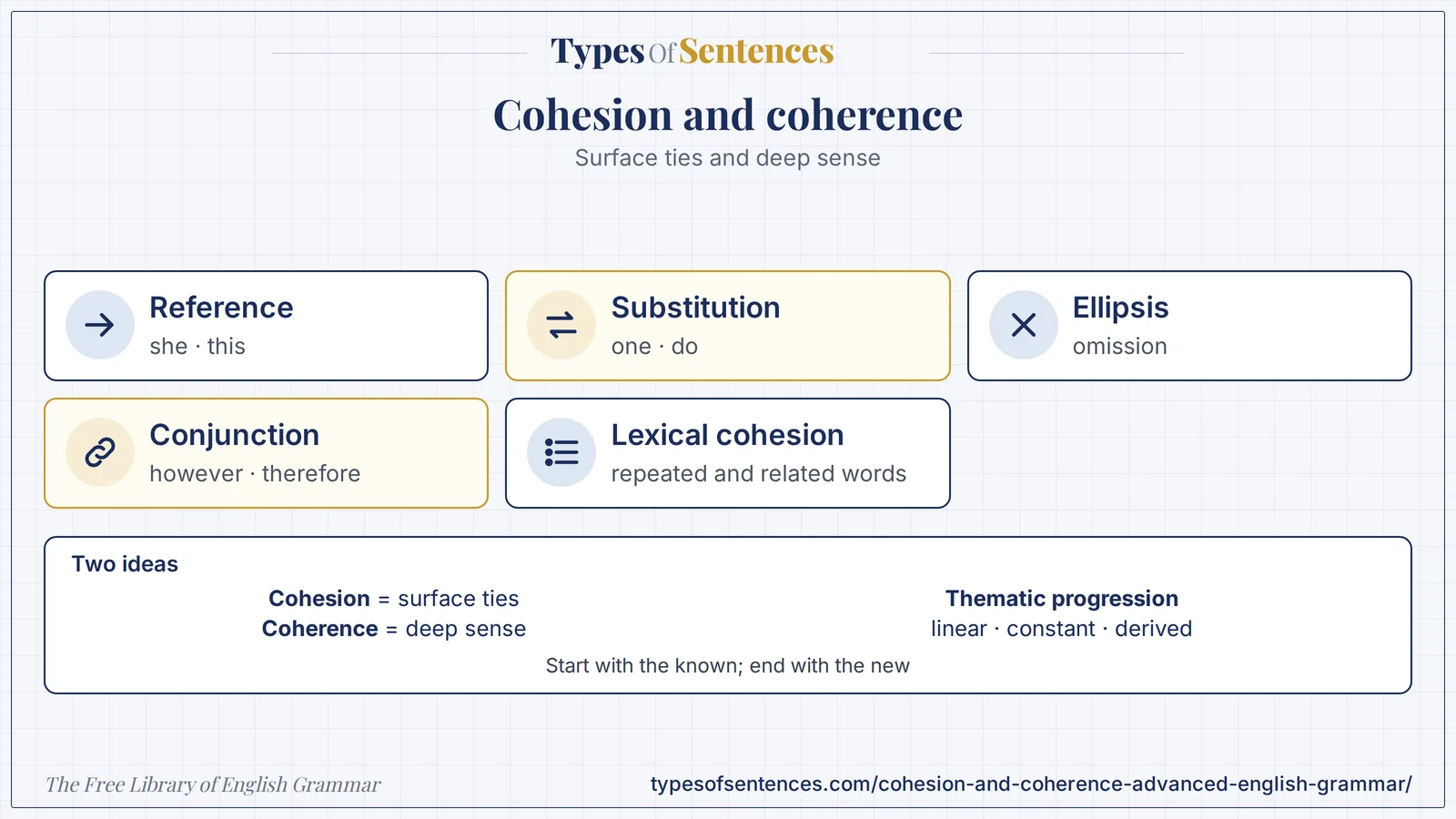
A paragraph holds together for two reasons. One is that its sentences are tied to each other by words: she points back to Maria, however signals a contrast, the project repeats a project. This is cohesion. The other is that the ideas follow a plan: a cause is followed by an effect, a claim by its evidence. This is coherence.
Why it matters: Good writers manage both. They tie their sentences with the right devices, and they plan the ideas so that the ties have something to link. The ties alone cannot rescue a disorganized text.
Summary: Cohesion is the network of linguistic ties between sentences, and Halliday and Hasan identify five types: reference (she, this), substitution (one, do), ellipsis (omission), conjunction (however, therefore), and lexical cohesion (repetition, synonyms, related words). Coherence is the underlying sense of the text: the logical relations among ideas, which the reader infers from the text and from world knowledge. Thematic progression (simple linear, constant theme, derived themes) shows how topics develop. The known-new contract says that each sentence starts with what the reader knows and ends with what is new.
- Cohesion = surface ties; coherence = deep sense.
- Five types: reference, substitution, ellipsis, conjunction, lexical.
- Thematic progression: linear, constant, derived.
- Start with the known; end with the new.
What You’ll Learn
- 1. Cohesion and Coherence: Surface Ties and Deep Sense
- 2. Types of Cohesion
- 3. Conjunction as a Cohesive Device
- 4. Lexical Cohesion
- 5. Coherence: Logical Connections and Inference
- 6. Cohesive Devices in Practice
- 7. Thematic Progression: How Topics Develop
- 8. The Known-New Contract
- 9. Creating Coherent Texts
- 10. Common Problems with Cohesion and Coherence
- 11. Exercises
- 12. Test Your Knowledge
- 13. Frequently Asked Questions
- 14. Conclusion
1. Cohesion and Coherence: Surface Ties and Deep Sense
| Cohesion | Coherence | |
|---|---|---|
| what it is | the linguistic links between sentences | the logical sense of the text as a whole |
| where it lies | in the words and the grammar (surface) | in the ideas and the reader’s understanding (deep) |
| signals | pronouns, conjunctions, repetition | relations among ideas, organization, world knowledge |
| who creates it | the writer, by choice of words | the writer and the reader, who infers the relations |
| can it be absent? | a text can lack cohesive ties and still be coherent | a text can have many ties and be incoherent |
- Maria bought a book. The book was about birds. Birds migrate in autumn. cohesive (repetition) and coherent (a chain of related ideas)
- Maria bought a book. She is tall. Tall buildings are costly. Costs rise in spring. cohesive (reference, repetition) but not coherent: the ideas drift
- A: There’s the phone. B: I’m in the bath. A: OK. coherent but with no cohesive ties; the reader infers: B cannot answer; A will answer
The distinction was made in the work of Halliday and Hasan, who described cohesion, and of linguists such as Widdowson and de Beaugrande and Dressler, who showed that coherence depends on the reader’s inferences. A text is coherent when a reader can construct a sensible interpretation of it; it is cohesive when the words point to each other. Both are properties of a whole text, not of single sentences. The study of language beyond the sentence is described in a later chapter, on discourse analysis.
2. Types of Cohesion
| Type | Device | Example |
|---|---|---|
| reference | personal pronouns, demonstratives, comparatives | Maria called. She left a message. This surprised us. |
| substitution | one, do, so, not | I need a pen; do you have one? I think so. |
| ellipsis | omission of recoverable words | Tom came and [Tom] left. Who called? — Tom [called]. |
| conjunction | additive, adversative, causal, temporal links | It was late. However, we stayed. Therefore, … |
| lexical cohesion | repetition, synonymy, hyponymy, collocation | a project … the project … the plan … the scheme |
| Grammatical cohesion | Lexical cohesion |
|---|---|
| reference, substitution, ellipsis, conjunction | repetition, synonym, superordinate, general word, collocation |
| uses closed-class words (pronouns, conjunctions) | uses open-class words (nouns, verbs, adjectives) |
| marks the relation between sentences | builds the topic through the vocabulary |
Reference is treated in the previous chapter, substitution and ellipsis in the chapter on ellipsis and substitution, and conjunction in the chapter on advanced conjunction concepts. The remaining sections look at conjunction and lexical cohesion, then turn to coherence.
3. Conjunction as a Cohesive Device
| Relation | Examples | Sentence |
|---|---|---|
| additive | and, also, moreover, furthermore, in addition, similarly, for example, in other words | The plan is cheap. Moreover, it is fast. |
| adversative | but, however, yet, nevertheless, on the other hand, in contrast, instead, although | It was hard. However, we finished. |
| causal | so, therefore, thus, consequently, as a result, because, for this reason | It rained. Therefore, we stayed. |
| temporal | then, next, afterward, meanwhile, finally, first, second, at the same time | She finished. Then she left. |
| continuative | now, well, of course, anyway, after all | Anyway, let’s continue. |
Cohesive conjunctions join sentences, not clauses; they are adverbial linkers such as however and therefore, and not the coordinators in a single sentence. The punctuation of these links (the semicolon or full stop before, the comma after) is described in the chapter on conjunctions, and the full range of transitions in the chapter on transition words and connectors. Each link should express a relation that is really there: a connective that does not fit (However where no contrast exists) damages coherence.
4. Lexical Cohesion
| Device | Example | Effect |
|---|---|---|
| repetition | The project began in May. The project ended in June. | clear and emphatic; avoids ambiguity |
| synonym or near-synonym | a car … the vehicle | variety; risk of confusion if the words differ in meaning |
| superordinate (hypernym) | an apple … the fruit | moves to a general term |
| subordinate (hyponym) | fruit … apples, pears | moves to specific |
| part-whole (meronymy) | the house … the roof | — |
| antonym | success … failure | contrast |
| general word | the thing, the problem, the idea, the matter | summarizes |
| signaling (summary) noun | This decision … This approach … This finding | packages the previous idea as a noun |
| collocation (words of the same field) | hospital, doctor, nurse, patient | builds a topic by vocabulary |
5. Coherence: Logical Connections and Inference
Coherence comes from the relations that hold between the ideas of a text. The reader infers these relations from the content, from knowledge of the world, and from expectations about the genre. A writer helps by organizing the text and by signaling the relations.
| Relation | Example | Typical signals |
|---|---|---|
| elaboration (specific after general) | The city has problems. Traffic is the worst. | for example, in particular |
| cause and effect | He slipped on ice. He broke his arm. | so, therefore, because |
| explanation (effect then cause) | He broke his arm. He slipped on ice. | because, for |
| contrast | Prices rose. Wages stayed the same. | but, however, whereas |
| concession | The plan is costly. It will work. | although, nevertheless |
| sequence | She opened the door. She went in. | then, next |
| problem and solution | Traffic is heavy. A tram line would help. | to solve this |
| condition | If prices rise, demand falls. | if, unless |
| comparison | Tom is tall. Maria is taller. | similarly, than |
| summary or conclusion | The evidence is clear. The policy failed. | in short, thus |
Readers often supply the relation themselves: He broke his arm. He slipped on ice is understood as an explanation although there is no connective. This inference is the core of coherence. If the relation cannot be inferred, the text is incoherent: He broke his arm. The bus was late. The relations are also described in the theory of rhetorical structure (Mann and Thompson), in which a main part (the nucleus) is supported by other parts (satellites).
6. Cohesive Devices in Practice
| Device | Example | Caution |
|---|---|---|
| personal pronoun | Maria called. She left a message. | ambiguity when two antecedents exist |
| demonstrative | The plan failed. This surprised us. | keep a noun: This failure |
| definite noun phrase | A man arrived. The man wanted a room. | — |
| conjunction | It was late. Therefore, we left. | do not overuse |
| lexical repetition | The report … the report … | vary only if the meaning is the same |
| parallel structure | She came, she saw, she conquered. | — |
| consistent tense and person | — | avoid unmotivated shifts |
| thematic progression | — | see below |
| punctuation (semicolon, colon, dash) | The plan has one flaw: the cost. | — |
| Too few ties | Too many ties |
|---|---|
| Maria bought a book. It rained. The train was late. | Moreover, Maria bought a book. Furthermore, it rained. In addition, the train was late. Therefore, … |
| The reader cannot see how the sentences relate. | The text sounds mechanical and heavy; connectives replace thought. |
Dense cohesion is not the same as good writing. A text that strings together moreover, furthermore, and in addition may still lack a clear argument. The best cohesion is the natural link that arises from the ideas themselves: the end of one sentence supplies the start of the next.
7. Thematic Progression: How Topics Develop
Every sentence has a theme (the starting point, what the sentence is about) and a rheme (what is said about it). The way that the themes of successive sentences relate to each other is called thematic progression, a notion developed by the Czech linguist František Daneš.
| Pattern | Structure | Example |
|---|---|---|
| simple linear | the rheme of one sentence becomes the theme of the next | The company launched a product. The product sold well. Its success surprised everyone. |
| constant theme | the same theme begins each sentence | Maria woke early. She made coffee. She read the news. |
| derived themes (hypertheme) | a general theme splits into parts | The city has three parks. The first is old. The second is new. The third is large. |
| split rheme | the rheme contains two items, taken up in turn | She bought a book and a pen. The book was cheap. The pen was costly. |
| jumpy themes (weak) | each theme is new | Maria woke early. The coffee was cold. Birds sang. The news was bad. |
| Marked and unmarked themes | Example | Effect |
|---|---|---|
| unmarked theme (the subject) | Maria called me. | neutral |
| marked theme (adverbial) | Yesterday, Maria called me. | a time frame |
| marked theme (object) | That book I enjoyed. | contrast; see the chapter on fronting |
| marked theme (clause) | Because it rained, we stayed. | a reason frame |
Thematic progression is a practical tool for revision: list the first few words of each sentence in a paragraph. If the themes repeat or link to the previous rheme, the paragraph is cohesive; if each theme is new and unconnected, it is jumpy. The theme and the rheme are treated in the chapter on fronting and postponement and in the next chapter, on information structure.
8. The Known-New Contract
| Principle | Meaning | Example |
|---|---|---|
| known before new | each sentence begins with information the reader already has | A study was published. The study found a link. |
| end focus | the most important new information comes at the end | The study found a link between sleep and memory. |
| end weight | long phrases come late | — |
| topic continuity | the topic stays recognizable across sentences | — |
| Before (new first) | After (known first) |
|---|---|
| A link between sleep and memory was found by the study. | The study found a link between sleep and memory. |
| A risk is carried by the drug. | The drug carries a risk. |
| Prices rose. A cause was the shortage of grain. | Prices rose. The shortage of grain was the cause. |
The known-new contract connects grammar to cohesion. The choice of active or passive, of a fronted adverbial or a cleft, can all be understood as a way of making each sentence start with what is known. These devices are treated in the chapters on voice and on cleft sentences.
9. Creating Coherent Texts
- Decide the point. A coherent text has a main idea that every paragraph serves.
- Choose an organization: chronological, spatial, general to specific, problem and solution, comparison, cause and effect, or order of importance.
- Write topic sentences that state the point of each paragraph, and check that each sentence supports it.
- Link the sentences through the known-new contract and thematic progression.
- Signal the relations with connectives only where they are needed.
- Keep terms, tense, and person consistent.
- Revise with a reverse outline: write the point of each paragraph beside it, and check that the points form a sequence.
| Disconnected | Coherent |
|---|---|
| Maria is a teacher. The school is large. Many students like sports. Football is popular. The weather was cold. | Maria teaches at a large school where sports are popular. Football is the favorite, even in cold weather. |
| The company grew. Its profits rose. We bought shares. They fell later. | The company grew, and its profits rose, so we bought shares. Later, however, the shares fell. |
A coherent text also uses signposting: previews (This section has three parts) and reviews (These three factors explain …). They are discussed in a later chapter, on readability.
10. Common Problems with Cohesion and Coherence
| Problem | Example | Fix |
|---|---|---|
| unclear pronoun reference | Maria told Anna she was late. | Maria told Anna, “You are late.” |
| vague this | The prices rose. This surprised us. | This rise surprised us. |
| missing connection | The company grew. We bought shares. | The company grew, so we bought shares. |
| wrong connective | The plan was cheap. However, it was fast. | The plan was cheap. Moreover, it was fast. |
| on the other hand without a first hand | On the other hand, it failed. | On the one hand, it was cheap; on the other hand, it failed. |
| abrupt topic shift | The report was long. Football is popular in India. | Add a link or a new paragraph. |
| inconsistent terminology | the policy … the scheme … the plan (the same thing) | the policy … the policy … |
| tense shift without reason | She walks in and sat down. | She walked in and sat down. |
| overuse of connectives | Moreover … Furthermore … In addition … | Remove some; let the ideas link. |
| a list with no logic | A, B, C, D, E | group and order the points |
Edit: The company grew. It rained. Moreover, Maria told Anna she was late. This surprised us. On the other hand, the plan was cheap. The policy was good. The scheme failed. She walks in and sat down.
- It rained has no link: delete or connect.
- Moreover adds nothing: delete.
- she was late: unclear: Maria told Anna, “You are late.”
- This surprised us: vague: The announcement surprised us.
- On the other hand has no first hand: On the one hand, the plan was cheap; on the other hand, it failed.
- the policy … the scheme: the plan … the plan.
- walks … sat: walked … sat.
- Result: The company grew. Maria told Anna, “You are late.” The announcement surprised us. On the one hand, the plan was cheap; on the other hand, it failed. She walked in and sat down. (Better to rewrite the whole paragraph around one point.)
Recap in 12 seconds
Watch the lesson build itself: Five types of cohesion tie sentences together; coherence is the deeper sense of the whole. The video has no sound.
Exercises
Part A: Cohesion and Coherence (Exercises 1–6)
Exercise 1: Cohesion or coherence: the links between sentences made by words
Show Answer
Answer: Cohesion.
Exercise 2: Cohesion or coherence: the logical sense of the whole text
Show Answer
Answer: Coherence.
Exercise 3: Can a text have cohesion without coherence?
Show Answer
Answer: Yes.
Exercise 4: Can a text have coherence without cohesive ties?
Show Answer
Answer: Yes (the reader infers the relations).
Exercise 5: Name the five types of cohesion.
Show Answer
Answer: Reference, substitution, ellipsis, conjunction, lexical cohesion.
Exercise 6: Who described the five types?
Show Answer
Answer: Halliday and Hasan (1976).
Part B: Types and Devices (Exercises 7–13)
Exercise 7: Name the type: Maria called. She left a message. (She)
Show Answer
Answer: Reference.
Exercise 8: Name the type: I need a pen; do you have one?
Show Answer
Answer: Substitution.
Exercise 9: Name the type: It rained. Therefore, we stayed. (Therefore)
Show Answer
Answer: Conjunction (causal).
Exercise 10: Name the type: an apple … the fruit
Show Answer
Answer: Lexical cohesion (superordinate).
Exercise 11: Name the relation of however.
Show Answer
Answer: Adversative.
Exercise 12: Name the relation of moreover.
Show Answer
Answer: Additive.
Exercise 13: Replace the vague This: The prices rose. This surprised us.
Show Answer
Answer: This rise surprised us.
Part C: Coherence Relations (Exercises 14–19)
Exercise 14: Name the relation: He slipped on ice. He broke his arm.
Show Answer
Answer: Cause and effect.
Exercise 15: Name the relation: He broke his arm. He slipped on ice.
Show Answer
Answer: Explanation (effect then cause).
Exercise 16: Name the relation: Prices rose. Wages stayed the same.
Show Answer
Answer: Contrast.
Exercise 17: Name the relation: Traffic is heavy. A tram line would help.
Show Answer
Answer: Problem and solution.
Exercise 18: Is this coherent: He broke his arm. The bus was late.?
Show Answer
Answer: No (the relation cannot be inferred).
Exercise 19: What is a nucleus in rhetorical structure theory?
Show Answer
Answer: The main part, supported by satellites.
Part D: Thematic Progression (Exercises 20–25)
Exercise 20: Name the pattern: Maria woke early. She made coffee. She read the news.
Show Answer
Answer: Constant theme.
Exercise 21: Name the pattern: The company launched a product. The product sold well.
Show Answer
Answer: Simple linear progression.
Exercise 22: Name the pattern: The city has three parks. The first is old. The second is new.
Show Answer
Answer: Derived themes (hypertheme).
Exercise 23: Which is the theme of The study found a link?
Show Answer
Answer: The study.
Exercise 24: What is the known-new contract?
Show Answer
Answer: Begin with what the reader knows; end with what is new.
Exercise 25: Revise: A risk is carried by the drug.
Show Answer
Answer: The drug carries a risk.
Part E: Revision (Exercises 26–30)
Exercise 26: Fix: Maria told Anna she was late.
Show Answer
Answer: Maria told Anna, “You are late.”
Exercise 27: Fix: On the other hand, it failed. (no first hand)
Show Answer
Answer: On the one hand, it was cheap; on the other hand, it failed.
Exercise 28: Fix: the policy … the scheme … the plan (same thing)
Show Answer
Answer: the policy … the policy … the policy.
Exercise 29: Fix: She walks in and sat down.
Show Answer
Answer: She walked in and sat down.
Exercise 30: What is a reverse outline?
Show Answer
Answer: Writing the point of each paragraph beside it to check the sequence.
Test Your Knowledge
Ready to check what you learned? Answer all 10 questions, then submit. You need 80% (8 of 10) to pass. Your answers are not stored.
View correct answers and explanations
Question 1: What is cohesion?
✓ Correct Answer: A – links between sentences made by words
Cohesion is the surface ties.
Question 2: What is coherence?
✓ Correct Answer: B – the logical sense of the text
Coherence is the deep sense.
Question 3: How many types of cohesion do Halliday and Hasan identify?
✓ Correct Answer: C – five
Reference, substitution, ellipsis, conjunction, lexical.
Question 4: Which is substitution?
✓ Correct Answer: D – I need a pen; do you have one?
One replaces a noun.
Question 5: Which is a causal conjunction?
✓ Correct Answer: B – therefore
Therefore shows a result.
Question 6: Which is constant theme?
✓ Correct Answer: A – Maria woke. She made coffee. She read.
The same theme starts each sentence.
Question 7: Which is derived themes?
✓ Correct Answer: C – The city has three parks. The first is old. The second is new.
A general theme splits into parts.
Question 8: What is the known-new contract?
✓ Correct Answer: C – begin with the known; end with the new
Known before new.
Question 9: Which is vague?
✓ Correct Answer: B – The prices rose. This surprised us.
This has no noun.
Question 10: Which has no first hand?
✓ Correct Answer: D – On the other hand, it failed.
On the other hand needs a first hand.
Frequently Asked Questions
What are cohesion and coherence?
Cohesion is the network of linguistic ties between sentences (pronouns, conjunctions, repetition); coherence is the logical sense of the text as a whole, which the reader infers.
What is text cohesion?
Text cohesion is the set of grammatical and lexical links that connect the sentences of a text: reference, substitution, ellipsis, conjunction, and lexical cohesion.
What is coherence grammar?
Coherence grammar is the study of the structures that help a text make sense as a whole: the order of information, thematic progression, and the choice of structures that put known information first.
What are cohesive ties?
Cohesive ties are the individual links between two items in a text, such as a pronoun and its antecedent or a conjunction and the relation it signals. Cohesive ties can be grammatical or lexical.
What is text connectivity?
Text connectivity is the degree to which the parts of a text are linked, by cohesive ties and by coherence relations. Good text connectivity helps the reader follow the argument.
What is thematic progression?
Thematic progression is the way the themes of successive sentences relate: the rheme of one becomes the theme of the next (linear), the same theme repeats (constant), or a general theme splits into parts (derived).
How can I make my writing more coherent?
Decide the main point, organize the ideas, write topic sentences, put known information first, use connectives where the relation needs signaling, keep terms consistent, and revise with a reverse outline.
Conclusion
You now have a deep study of cohesion and coherence: the difference between surface ties and deep sense, the five types of cohesion, conjunction and lexical cohesion, coherence relations, thematic progression, the known-new contract, and methods of creating coherent texts. You can build and revise texts with expert control.
When you revise, check both the ties and the sense. Next, you will study information structure.
- Halliday, M. A. K., and Ruqaiya Hasan. Cohesion in English. Longman, 1976.: the classic account of the five types of cohesion.
- de Beaugrande, Robert, and Wolfgang Dressler. Introduction to Text Linguistics. Longman, 1981.: the standards of textuality, including cohesion and coherence.
- Mann, William C., and Sandra A. Thompson. “Rhetorical Structure Theory.” Text 8 (1988): 243–281.: the theory of coherence relations.
- Daneš, František. “Functional Sentence Perspective and the Organization of the Text.” In Papers on Functional Sentence Perspective. Academia, 1974.: thematic progression.
- Merriam-Webster Dictionary: cohesion: the dictionary entry.
Last reviewed: October 29, 2026. How it was made: drafted with AI assistance, then checked with automated tests (structure, links, answer keys, spelling) and against the sources above. A person has not yet read this chapter line by line. Found a mistake? Report it.