Ellipsis grammar studies how English leaves words out when they can be recovered from the context. In I can swim and she can too, the verb swim is omitted after the second can; in Want some coffee?, the words Do you are omitted at the beginning. Substitution is the related process of replacing a repeated word or phrase with a short pro-form: I need a pen; do you have one?, I think so, She works hard and so does he. Both are ways of avoiding repetition.
You will study the types of ellipsis (initial, medial, and final; situational, structural, and textual), ellipsis in coordination and comparison, the main named types (verb phrase ellipsis, gapping, stripping, sluicing), substitution with one/ones, do/do so, and so/not, the difference between ellipsis and substitution, the idea of recoverability that governs both, and the errors that result from omitting too much or replacing the wrong word. This is the basis of ellipsis and substitution as a part of cohesion and grammatical omission. Thirty editing exercises and a quiz follow.
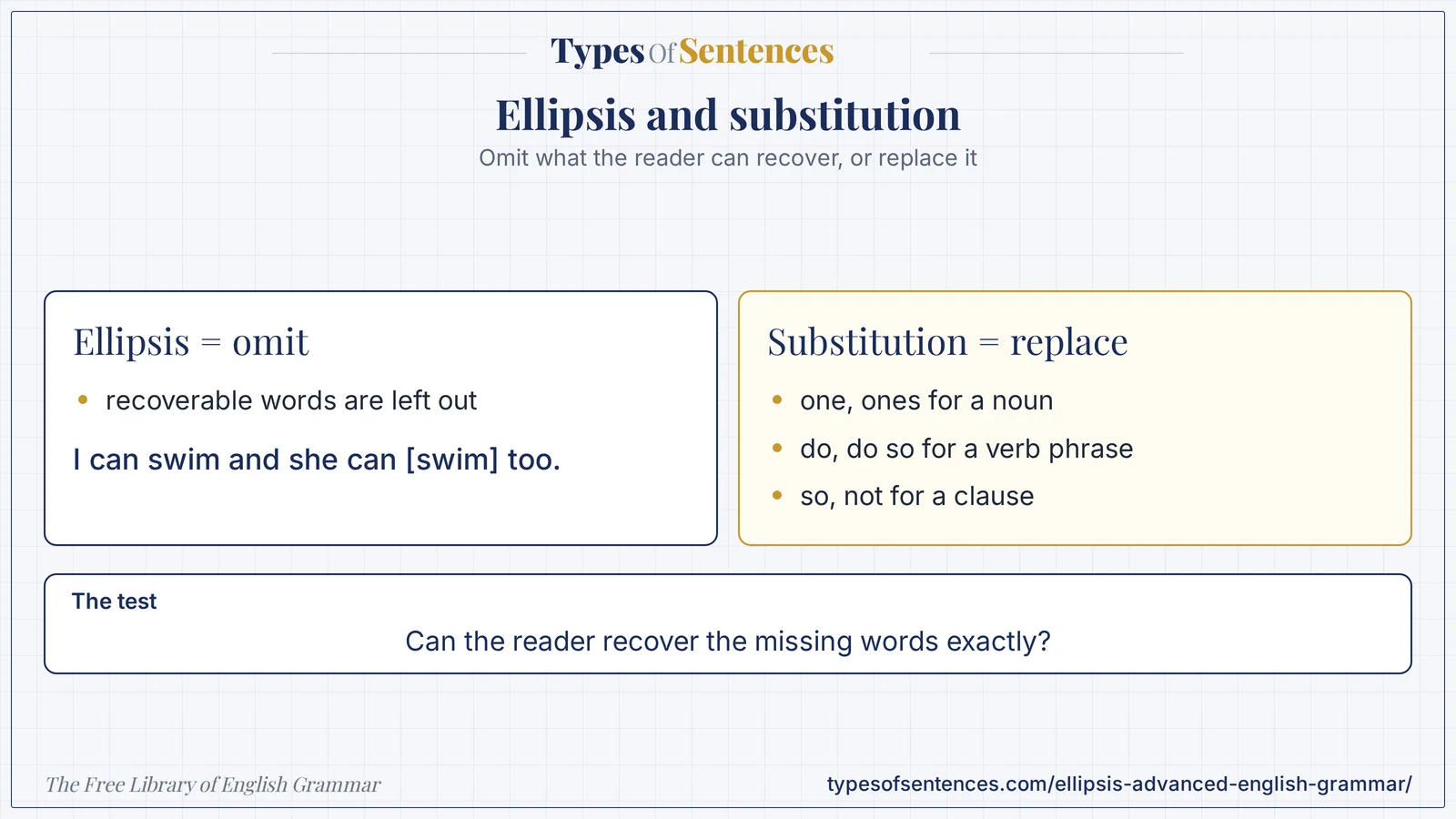
A language that repeated every word would be tedious. English avoids repetition in two ways: it leaves out words that the listener can supply (ellipsis), or it uses a short word that stands for the repeated material (substitution).
Why it matters: The rule is recoverability. You may omit or replace only what the reader or listener can reconstruct without effort. If the omitted words could be understood in two ways, the sentence is unclear.
Summary: Ellipsis omits recoverable words (I can swim and she can [swim] too). Substitution replaces them with a pro-form: one/ones for a noun, do/do so for a verb phrase, so/not for a clause. Ellipsis can be situational ([Do you] want some coffee?), structural (Tom came and [Tom] left), or textual (Who called? — Tom [called].). The omitted or replaced words must be recoverable and the remaining forms must match them.
- Ellipsis = omit; substitution = replace.
- Pro-forms: one/ones (noun), do/do so (verb phrase), so/not (clause).
- Named types: verb phrase ellipsis, gapping, stripping, sluicing.
- The test: can the reader recover the missing words exactly?
What You’ll Learn
- 1. Ellipsis Grammar: What Are Ellipsis and Substitution?
- 2. Types of Ellipsis: Initial, Medial, and Final
- 3. Ellipsis in Coordinated Structures
- 4. Ellipsis in Comparisons
- 5. Substitution: One, Do, So, and Not
- 6. Verbal Substitution: Do and Do So
- 7. Clausal Substitution: So and Not
- 8. Named Types of Ellipsis for Advanced Study
- 9. Ellipsis or Substitution? Choosing and Combining
- 10. Limits: Recoverability and Ambiguity
- 11. Common Errors with Ellipsis and Substitution
- 12. Exercises
- 13. Test Your Knowledge
- 14. Frequently Asked Questions
- 15. Conclusion
1. Ellipsis Grammar: What Are Ellipsis and Substitution?
Both processes reduce repetition. Ellipsis omits words that are understood; substitution puts a pro-form in the place of the repeated words. The two are sometimes combined in one sentence.
| Ellipsis | Substitution | |
|---|---|---|
| what happens | words are left out | words are replaced by a pro-form |
| example | I can swim and she can [swim] too. | I need a pen. Do you have one? |
| what remains | the structure, with a gap | a pro-form (one, do, so) |
| the omitted or replaced material | recoverable from the context | recoverable from the context |
| typical use | coordination, answers, comparisons | repeated nouns, verb phrases, and clauses |
| Source of recovery | Name | Example |
|---|---|---|
| the situation of speaking | situational (exophoric) ellipsis | [Do you] want some coffee? [It’s] Cold today. |
| a previous clause in the same sentence | structural ellipsis | Tom came and [Tom] left. Tom ate fish, and Mary [ate] rice. |
| a previous sentence or turn | textual (anaphoric) ellipsis | Who called? — Tom [called]. Are you coming? — [I’m] Not sure. |
Halliday and Hasan treated ellipsis and substitution as cohesive devices, along with reference and conjunction. The chapter on cohesion and coherence places them in the system of text connection, and the chapter on reference and deixis covers reference. At the Intermediate level, they were introduced in the chapter on cohesion in writing.
2. Types of Ellipsis: Initial, Medial, and Final
| Position of the omission | Example | Typical context |
|---|---|---|
| initial (the beginning of a clause) | [Do you] want some coffee? [I] Can’t say. [It’s] Nice to see you. | conversation; informal |
| medial (the middle) | She can swim and [she can] dive. Tom wanted to go but Maria [wanted] not [to]. | coordinated clauses |
| final (the end) | I can swim and she can [swim] too. I’d like to [go]. He said he would [come]. | verb phrase ellipsis |
| of a noun (head) | I’ll take the red [one]. She has two [cats] and he has three [cats]. | noun phrases |
| of a whole clause | I don’t know [what to do]. Maria said she would [come]. | null complements |
Initial ellipsis is characteristic of speech and of notes, diaries, and informal messages, where the subject and an auxiliary are dropped (Hope to see you soon, Sorry I missed you). Medial and final ellipsis work in speech and in all kinds of writing, wherever the omitted words are present in the context.
3. Ellipsis in Coordinated Structures
| Type | Example | Omitted words |
|---|---|---|
| subject ellipsis | Tom came and [Tom] left. | the subject of the second clause |
| verb phrase ellipsis (VP ellipsis) | Tom can swim and Maria can [swim] too. I haven’t finished, but she has [finished]. | the main verb and its complements |
| gapping | Tom ate fish, and Maria [ate] rice. Some like tea, and others [like] coffee. | the verb in the second clause |
| stripping | Tom came, but not Maria [came]. I like tea, and coffee too. | everything except one constituent and a word such as not or too |
| right-node raising | Tom likes, and Maria hates, jazz. | a shared object at the end |
| shared auxiliary | She has written and [has] sent the letters. He might be working and [might be] studying. | an auxiliary shared by two main verbs |
| shared determiner or preposition | the red and [the] blue cars (ambiguous); in the house and [in the] garden | a shared determiner or preposition |
The omitted material must match the form of what remains. A shared auxiliary must be in the right form for both verbs: She has written and sent the letters (both past participles), but not *She has written and sending the letters. The sharing of auxiliaries is covered in the chapter on complex verb phrases, and coordination in the chapter on advanced conjunction concepts.
| Constraint | Example |
|---|---|
| parallel forms | She has written and sent the letters. (not *written and sending) |
| matching auxiliaries | She is working and he is studying. / She is working and he studying. (gapping: is omitted) |
| one gap only in gapping | Tom ate fish, and Maria rice. (not *and Maria, rice, at lunch) |
| recoverability | Tom likes jazz and Maria [likes] blues. |
| no ellipsis in a subordinate clause when a conjunction intervenes (usually) | Tom came because Maria asked him. (not *because [Maria] asked) |
4. Ellipsis in Comparisons
| Sentence | Full form | Notes |
|---|---|---|
| She is taller than I [am]. | She is taller than I am tall. | the subject form with a deleted verb phrase (formal) |
| She is taller than me. | (informal) | the object form after than |
| He runs as fast as she [does]. | He runs as fast as she runs fast. | do substitutes for the verb |
| She likes jazz more than [she likes] blues. | — | the verb is recovered |
| She likes him more than [she likes] me. / She likes him more than I [do]. | — | ambiguous without the full form |
| Nobody knows him better than she [does]. / than her. | — | she (formal) or her (informal) |
| It is more expensive than [it was] last year. | — | the verb is recovered |
5. Substitution: One, Do, So, and Not
| Type | Pro-form | Replaces | Example |
|---|---|---|---|
| nominal | one, ones | a countable noun (with its modifiers) | I need a pen. Do you have one? Which shoes? The red ones. |
| nominal (possession) | that of, those of | a noun with its complement | The population of London is larger than that of Paris. |
| verbal | do, do so, do it, do that, do the same | a verb phrase | I asked him to leave, and he did (so). She works hard, and so does he. |
| clausal | so, not | a clause (after verbs of thinking and saying) | Will it rain? I think so. I hope not. |
| adverbial | there, then | a place or time | She lives in Paris, and I work there. We met in 2010, and then we moved. |
| of the same kind | the same, such | a previous item | I’ll have the same. Such things happen. |
| Rule for one | Example |
|---|---|
| replaces a countable noun with or without modifiers | I like the blue shirt more than the green one. |
| can take a, the, this, that, which, another, each | Which one? This one. Another one. |
| not after a possessive or a number alone (use mine, two) | Mine is better. (not *my one) I have two. (not *two ones) |
| not for uncountable nouns | I prefer white wine. (not *the white one, unless a bottle) |
| plural indefinite: use some | I need pens. Do you have some? |
| not after a noun with a complement of of (use that of) | the temperature of Delhi and that of Mumbai (not *the one of) |
6. Verbal Substitution: Do and Do So
| Pattern | Example | Notes |
|---|---|---|
| do as auxiliary (VP ellipsis) | Do you like tea? — I do. She runs faster than he does. | the main verb is omitted; do carries tense |
| so do/does/did + subject | She works hard, and so does he. He plays golf, and so do I. | inversion; see the chapter on inversion |
| do so | I asked him to leave, and he did so. Anyone who wishes to do so may leave. | formal; replaces an action verb phrase |
| do it, do that | He said he would help, and he did it. Don’t do that! | informal; replaces an action |
| do the same | She left early, and I did the same. | — |
| stative verbs: no do so | He knows French, and so do I. (not *and I do so) | do so needs a controlled action |
| Original | Substitution | Ellipsis |
|---|---|---|
| I can swim, and she can swim. | I can swim, and so can she. | I can swim, and she can [swim] too. |
| She works hard, and he works hard. | She works hard, and so does he. | She works hard, and he [works hard] too. |
| He said he would help, and he helped. | He said he would help, and he did so. | He said he would help, and he did [help]. |
7. Clausal Substitution: So and Not
| Pattern | Example | Notes |
|---|---|---|
| verb + so | I think so. I believe so. I suppose so. I expect so. I guess so. It appears so. | replaces a that-clause |
| verb + not | I hope not. I’m afraid not. I suspect not. I guess not. | the negative clause |
| negative with so | I don’t think so. I don’t believe so. | the usual negative (negative raising) |
| negative with not (formal) | I think not. I believe not. | formal and slightly old-fashioned |
| if so and if not | If so, call me. If not, we’ll wait. | replaces a conditional clause |
| say so, tell … so | You told me so. She said so. | replaces what was said |
| so in short answers | Is it true? — It seems so. | — |
| so as emphasis | I told you so. Why do you say so? | — |
Verbs that take so and not are verbs of thinking, saying, and appearance: think, believe, suppose, expect, hope, suspect, guess, say, tell, seem, appear, and the phrase I’m afraid. The pro-form stands for the whole clause: I think so = I think that it will rain. A clause that is understood can also be omitted entirely: I don’t know [whether it will rain].
| Verb | With so | With not |
|---|---|---|
| think | I think so. I don’t think so. | I think not. (formal) |
| hope | I hope so. | I hope not. |
| be afraid | I’m afraid so. | I’m afraid not. |
| suppose | I suppose so. | I suppose not. |
| believe | I believe so. | I believe not. (formal) |
| expect | I expect so. | I expect not. |
8. Named Types of Ellipsis for Advanced Study
| Type | Example | What is omitted |
|---|---|---|
| verb phrase ellipsis | Tom can swim, and Maria can [swim] too. | the verb phrase after an auxiliary |
| gapping | Tom ate fish, and Maria [ate] rice. | the verb in the second coordinated clause |
| stripping | Tom came, but not Maria [came]. | everything but one element and not/too |
| sluicing | Someone called, but I don’t know who [called]. | the clause after a wh-word |
| pseudogapping | Maria likes jazz more than she does [like] blues. | the main verb, with do remaining |
| comparative ellipsis | She is taller than I am [tall]. | the predicate after than or as |
| null complement | She asked me to come, but I couldn’t [come]. | a complement after an auxiliary or to |
| noun phrase ellipsis | Two [cats] are sleeping. Mine [is] the red one. | the head noun |
| fragments and short answers | Who called? — Tom. Where? — In Paris. | the rest of the clause |
These names come from linguistic analysis. The practical point for writers is the same for all: the omitted material must be recoverable from the context, and the remaining words must be in a form that fits the missing material. For example, in sluicing, the wh-word must correspond to the missing element: She bought something, but I don’t know what [she bought].
9. Ellipsis or Substitution? Choosing and Combining
| Meaning | Ellipsis | Substitution | Notes |
|---|---|---|---|
| two people can swim | I can swim, and she can [swim] too. | I can swim, and so can she. | both are natural; the second is slightly more formal |
| I need a pen | I need a pen. Do you have [a pen]? (not usual) | Do you have one? | nouns are usually replaced, not omitted |
| a repeated action | He said he would help, and he did [help]. | …, and he did so. | do so is more formal |
| a repeated clause | Will it rain? — I think [it will]. | I think so. | so is the norm |
| the same noun after an adjective | I prefer the red [one]. | I prefer the red one. | the noun is replaced by one, or omitted after a determiner and adjective in some cases |
| number words | I have two [cats]. | I have two. | ellipsis, not one |
- Substitute a noun, and omit a verb. Nouns are normally replaced by one or a pronoun; verbs are normally omitted (after an auxiliary) or replaced by do.
- Ellipsis is more economical, and substitution is more explicit. A formal writer may prefer the substitution (did so) to the bare ellipsis.
- Combine the two with care. She can’t swim, and neither can he uses both: neither and an elliptical swim.
10. Limits: Recoverability and Ambiguity
| Problem | Example | Fix |
|---|---|---|
| ambiguity | She likes him more than I. (than I like him, or than I am?) | She likes him more than I do. / more than I like him. |
| mismatched form | *She has gone and seeing him. | She has gone and seen him. |
| unrecoverable | *Tom likes jazz and Maria. | Tom likes jazz and Maria [does too] / Tom and Maria like jazz. |
| too much omitted in formal writing | Hope to see you soon. | I hope to see you soon. |
| wrong pro-form | *I need a pen; do you have it? | I need a pen; do you have one? |
| stative with do so | *He knows French and she does so too. | He knows French, and so does she. |
| double ellipsis | *I can and she can swim. | I can swim, and she can too. |
Context supplies the missing words. In a long sentence or after a change of topic, recovery may be hard, and then the full form is better. This is a matter of cohesion and clarity, discussed in the chapters on cohesion and on conciseness. Notes, messages, and headlines allow heavy ellipsis, but formal prose requires a fuller form.
11. Common Errors with Ellipsis and Substitution
| Error | Correction | Rule |
|---|---|---|
| I need a pen; do you have it? | I need a pen; do you have one? | one for an indefinite noun |
| She can swim and I can too swim. | She can swim and I can too. | no repeated verb after ellipsis |
| He knows French and she does so too. | He knows French and so does she. | no do so with a stative verb |
| He told me to go and I did it. | He told me to go and I did so. | do so for the action (formal) |
| I think that so. | I think so. | so replaces the clause |
| I hope it not. | I hope not. | not alone |
| She doesn’t like tea, and so don’t I. | She doesn’t like tea, and neither do I. | neither after a negative |
| I prefer my one. | I prefer mine. | one not after a possessive |
| Two ones are here. | Two are here. | one not after a number |
| The temperature of Delhi and the one of Mumbai | the temperature of Delhi and that of Mumbai | that of |
| I can’t swim, but she can swim. | I can’t swim, but she can. | omit the repeated verb |
| She likes him more than I. (unclear) | She likes him more than I do. | add the pro-form to avoid ambiguity |
Edit: I need a pen and Maria needs it too, so I asked her to give me one but she did it, and I think that so, but he knows French and she does so too, and I can’t swim, and so can’t she, and she likes me more than he.
- needs it too: needs one too.
- she did it: she did so (or she did).
- I think that so: I think so.
- she does so too: stative: so does she.
- and so can’t she: and neither can she.
- than he: ambiguous: than he does (or than he likes me).
- Result: I need a pen and Maria needs one too, so I asked her to give me one but she did so, and I think so, but he knows French and so does she, and I can’t swim, and neither can she, and she likes me more than he does. (A better edit would split this into several sentences.)
Recap in 12 seconds
Watch the lesson build itself: Ellipsis omits recoverable words; substitution replaces them with a pro-form such as one, do so, or so. The video has no sound.
Exercises
Part A: Recognizing Ellipsis (Exercises 1–6)
Exercise 1: Name the type: Want some coffee? (omission of Do you)
Show Answer
Answer: Situational (initial) ellipsis.
Exercise 2: Name the type: Tom came and left.
Show Answer
Answer: Structural ellipsis (subject).
Exercise 3: Name the type: Tom ate fish, and Maria rice.
Show Answer
Answer: Gapping.
Exercise 4: Name the type: Tom came, but not Maria.
Show Answer
Answer: Stripping.
Exercise 5: Name the type: Someone called, but I don’t know who.
Show Answer
Answer: Sluicing.
Exercise 6: Name the type: I can swim and she can too.
Show Answer
Answer: Verb phrase ellipsis.
Part B: Nominal Substitution (Exercises 7–12)
Exercise 7: Edit: I need a pen; do you have it?
Show Answer
Answer: …do you have one?
Exercise 8: Complete: I like the blue shirt more than the green ___.
Show Answer
Answer: one.
Exercise 9: Edit: I prefer my one.
Show Answer
Answer: I prefer mine.
Exercise 10: Edit: Two ones are here.
Show Answer
Answer: Two are here.
Exercise 11: Complete: The population of London is larger than ___ of Paris.
Show Answer
Answer: that.
Exercise 12: Plural indefinite: I need pens. Do you have ___?
Show Answer
Answer: some.
Part C: Verbal Substitution (Exercises 13–19)
Exercise 13: Complete: She works hard, and so ___ he.
Show Answer
Answer: does.
Exercise 14: Complete: I asked him to leave, and he did ___.
Show Answer
Answer: so.
Exercise 15: Edit: He knows French and she does so too.
Show Answer
Answer: He knows French, and so does she.
Exercise 16: Edit: I can swim and she can swim too.
Show Answer
Answer: I can swim and she can too.
Exercise 17: Complete: She left early, and I did the ___.
Show Answer
Answer: same.
Exercise 18: Edit: She doesn’t like tea, and so don’t I.
Show Answer
Answer: …and neither do I.
Exercise 19: Name the register of do so.
Show Answer
Answer: Formal.
Part D: Clausal Substitution (Exercises 20–24)
Exercise 20: Replace the clause: Will it rain? — I think that it will rain.
Show Answer
Answer: I think so.
Exercise 21: Replace the clause (negative): I hope that it won’t rain.
Show Answer
Answer: I hope not.
Exercise 22: Edit: I think that so.
Show Answer
Answer: I think so.
Exercise 23: Give the usual negative of I think so.
Show Answer
Answer: I don’t think so.
Exercise 24: Complete: If ___, call me. (if it is true)
Show Answer
Answer: so.
Part E: Comparisons, Limits, Choosing (Exercises 25–30)
Exercise 25: Complete: She is taller than I ___. (formal)
Show Answer
Answer: am.
Exercise 26: Disambiguate: She likes him more than I.
Show Answer
Answer: She likes him more than I do. (or than I like him)
Exercise 27: Which is more explicit: ellipsis or substitution?
Show Answer
Answer: Substitution.
Exercise 28: Fix the mismatched form: She has gone and seeing him.
Show Answer
Answer: She has gone and seen him.
Exercise 29: Fix: The temperature of Delhi and the one of Mumbai
Show Answer
Answer: …and that of Mumbai.
Exercise 30: Why is formal writing careful about ellipsis?
Show Answer
Answer: The omitted material must be recoverable and unambiguous.
Test Your Knowledge
Ready to check what you learned? Answer all 10 questions, then submit. You need 80% (8 of 10) to pass. Your answers are not stored.
View correct answers and explanations
Question 1: What is ellipsis?
✓ Correct Answer: A – omitting recoverable words
Ellipsis omits words that can be recovered.
Question 2: What is substitution?
✓ Correct Answer: B – replacing words with a pro-form
Substitution uses a pro-form.
Question 3: Which is correct?
✓ Correct Answer: C – I need a pen; do you have one?
One replaces a countable noun.
Question 4: Which is correct?
✓ Correct Answer: D – I think so.
So replaces the clause.
Question 5: Which is gapping?
✓ Correct Answer: A – Tom ate fish, and Maria rice.
The verb is omitted in the second clause.
Question 6: Which is sluicing?
✓ Correct Answer: C – Someone called, but I don’t know who.
The clause after the wh-word is omitted.
Question 7: Which is correct?
✓ Correct Answer: D – I prefer mine.
Use the possessive pronoun.
Question 8: Which is correct?
✓ Correct Answer: C – He knows French, and so does she.
No do so with a stative verb.
Question 9: Which is the usual negative of I think so?
✓ Correct Answer: B – I don’t think so.
Negative raising.
Question 10: Which makes the comparison unambiguous?
✓ Correct Answer: B – She likes him more than I do.
Add the pro-form do.
Frequently Asked Questions
What is ellipsis grammar?
Ellipsis grammar is the study of how English omits words that are understood from the context, as in I can swim and she can too, where the verb swim is left out after the second can.
What are ellipsis and substitution?
Ellipsis omits recoverable words; substitution replaces them with a pro-form such as one, do, so, or not. Both are ways of avoiding repetition and linking a text together.
What is substitution grammar?
Substitution grammar is the study of pro-forms: one/ones for nouns, do/do so for verb phrases, so/not for clauses, and there/then for place and time.
How do I use avoiding repetition techniques?
For avoiding repetition, omit a verb after an auxiliary (she can too), replace a noun with one, replace a verb phrase with do so, and replace a clause with so or not.
What is grammatical omission?
Grammatical omission is the leaving out of words that the grammar allows when they can be recovered: the subject in a coordinated clause, a verb after an auxiliary, or a noun after a determiner and adjective.
When can I not use ellipsis?
When the omitted words cannot be recovered with certainty, or when the remaining forms do not match the omitted words. In ambiguous comparisons such as She likes him more than I, add the pro-form.
What is the difference between do so and do it?
Do so replaces a voluntary action in a more formal style (He said he would leave, and he did so); do it or do that is informal.
Conclusion
You now have a deep study of ellipsis and substitution: types of ellipsis, ellipsis in coordination and comparison, nominal, verbal, and clausal substitution, the named types such as gapping and sluicing, how to choose between ellipsis and substitution, and the limits of recoverability. You can use these devices with expert control and avoid the usual errors.
When you edit, ask whether each repeated word is needed, and whether each omission can be recovered. Next, you will study fronting and postponement.
- Halliday, M. A. K., and Ruqaiya Hasan. Cohesion in English. Longman, 1976.: the classic account of ellipsis and substitution as cohesive devices.
- Huddleston, Rodney, and Geoffrey K. Pullum. The Cambridge Grammar of the English Language. Cambridge University Press, 2002.: the reference analysis of ellipsis (gapping, stripping, sluicing, and verb phrase ellipsis).
- Quirk, Randolph, et al. A Comprehensive Grammar of the English Language. Longman, 1985.: the classic treatment of ellipsis and substitution.
- Biber, Douglas, et al. Longman Grammar of Spoken and Written English. Longman, 1999.: corpus evidence on ellipsis in conversation.
- Merriam-Webster Dictionary: ellipsis: the dictionary entry.
Last reviewed: October 29, 2026. How it was made: drafted with AI assistance, then checked with automated tests (structure, links, answer keys, spelling) and against the sources above. A person has not yet read this chapter line by line. Found a mistake? Report it.