Expository writing explains. Its purpose is to inform the reader about a topic clearly, accurately, and in an order that makes sense. Textbooks, encyclopedia entries, news reports, manuals, and most school reports are examples. Unlike persuasive writing, which argues for a position, expository writing does not try to win the reader over; it tries to make the reader understand.
This chapter is a guide to informative writing. You will learn what expository writing is, its main types, how to organize it, how to write a thesis for expository essays, how to use evidence and examples, how to use transitions, and how to keep an objective tone. You will also see the expository techniques for explaining topics: processes, comparison and contrast, and cause and effect. Thirty exercises and a quiz follow.
If someone asks, “How does a vaccine work?” and you answer with the facts in a clear order, you are doing expository writing. You are not telling the person what to think, only helping them to understand.
Why it matters: The key habits are to define your terms, to use accurate evidence, to organize in a logical pattern, and to keep your own opinions out of the explanation.
Summary: Expository writing informs or explains. It has a clear thesis that states what the writing will explain, organized body paragraphs with evidence and examples, transitions that show relationships, and an objective tone. Common patterns are definition, process, comparison and contrast, cause and effect, classification, and problem and solution. The test of good expository writing is whether the reader understands.
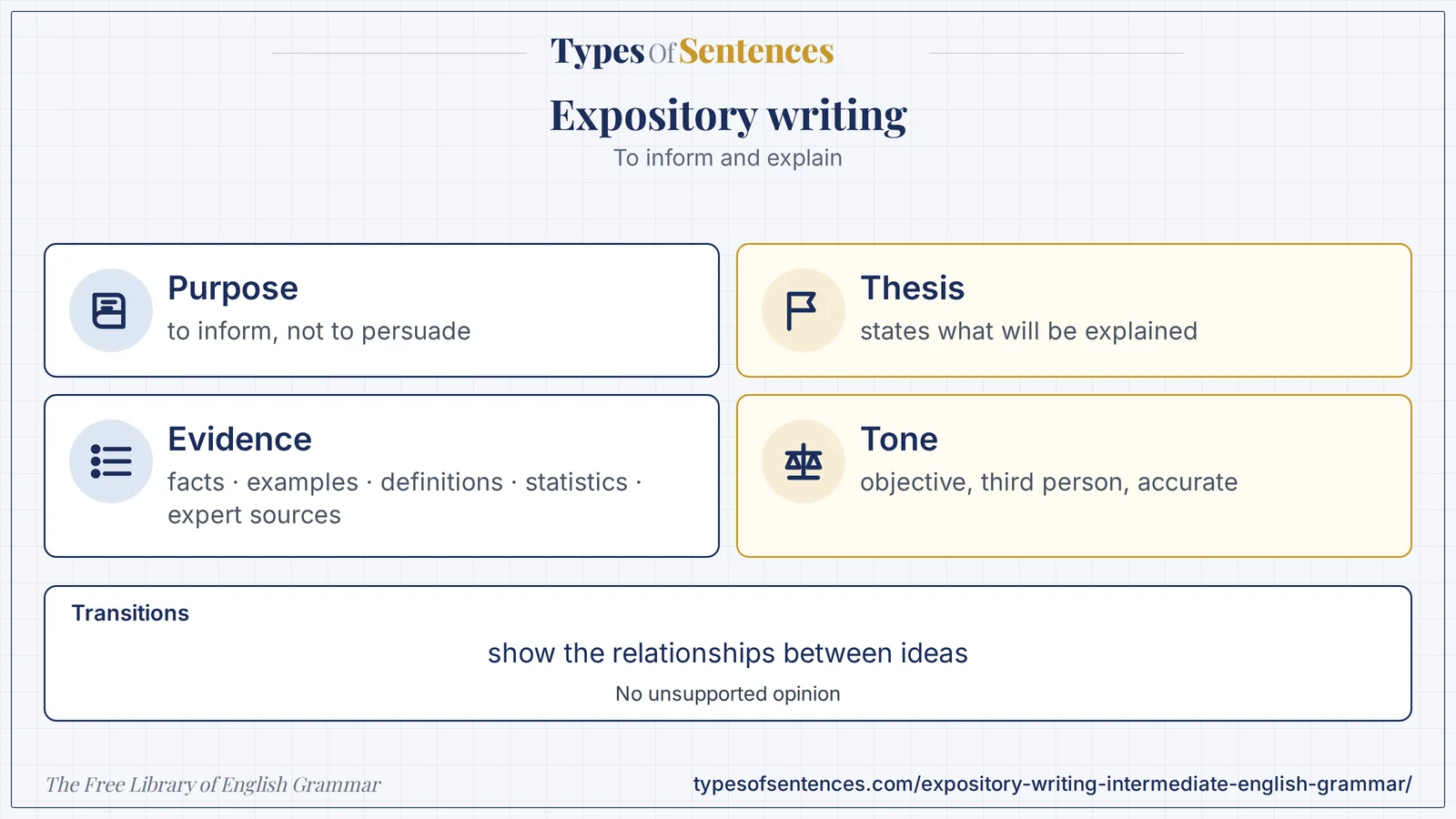
- Purpose: to inform, not to persuade.
- Thesis: states what will be explained (a focus), not a debatable claim.
- Evidence: facts, examples, definitions, statistics, expert sources.
- Tone: objective; third person; accurate; no unsupported opinion.
What You’ll Learn
- 1. Expository Writing: What Is Expository Writing?
- 2. Types of Expository Writing
- 3. Clear Organization
- 4. Thesis Statement in Expository Writing
- 5. Using Evidence and Examples
- 6. Transitions in Expository Writing
- 7. Objective Tone
- 8. Explaining Processes
- 9. Comparing and Contrasting
- 10. Cause and Effect
- 11. Common Errors in Expository Writing
- 12. Exercises
- 13. Test Your Knowledge
- 14. Frequently Asked Questions
- 15. Conclusion
1. Expository Writing: What Is Expository Writing?
The word expository comes from expose, to set out. Expository writing sets out information and ideas so that readers can understand them. It answers questions such as What is it?, How does it work?, Why does it happen?, and How are these different?
| Kind of writing | Main purpose | Example |
|---|---|---|
| expository | to inform or explain | An article on how vaccines work |
| persuasive | to convince the reader to agree or act | An essay arguing that vaccines should be required |
| descriptive | to create a picture in the reader’s mind | A description of a vaccination clinic |
| narrative | to tell a story | A story about a child’s first vaccination |
The kinds often mix. A persuasive essay uses expository passages to explain the facts, and a narrative may explain how something works. Nevertheless, the dominant purpose of expository writing is to explain. The structure follows the outline in the chapter on essay structure.
2. Types of Expository Writing
| Type | Question it answers | Example topic |
|---|---|---|
| definition | What is it? | What is inflation? |
| process (how-to) | How does it work? How is it done? | How a bill becomes a law |
| compare and contrast | How are they alike and different? | Solar and wind power |
| cause and effect | Why did it happen? What happens as a result? | Causes of the French Revolution |
| classification | What kinds are there? | Types of volcanoes |
| problem and solution | What is wrong, and how can it be fixed? | Reducing food waste in schools |
| informative report | What are the facts about this topic? | A report on the Nile |
Each type has a natural structure, which is described in the sections below. A single piece can use several: an essay on climate change may define it, explain its causes, and classify its effects.
3. Clear Organization
Readers can follow an explanation only if the parts come in a logical order. Choose the pattern that fits the content.
| Pattern | Use | Signal words |
|---|---|---|
| chronological | processes, histories | first, then, next, finally, afterward |
| order of importance | reasons, features | most important, equally important, above all |
| spatial | describing a layout | above, below, to the left, nearby |
| general to specific | definitions, overviews | in general, for example, specifically |
| compare and contrast | two or more subjects | similarly, likewise, however, in contrast |
| cause and effect | explanations of reasons | because, therefore, as a result, consequently |
| problem and solution | proposals | the problem is, one solution is |
A short outline helps: write the thesis, list the main points in order, and add the evidence for each. Each point becomes one paragraph, built as in the chapter on paragraph writing.
4. Thesis Statement in Expository Writing
The thesis in expository writing states the focus: what the writing will explain and, often, its main parts. It is not a debatable opinion but a clear statement of the topic and the point of view from which you explain it.
| Weak | Better (expository thesis) |
|---|---|
| This essay is about volcanoes. | Volcanoes form in three main ways: at plate boundaries, over hot spots, and along rifts. |
| Recycling is good. (an opinion) | Recycling involves four stages: collection, sorting, processing, and manufacturing. |
| The Internet is important. | The Internet works by breaking messages into packets that travel separately and are reassembled at the destination. |
| Many things caused the war. | The war began because of three factors: rivalry between empires, a system of alliances, and a single assassination. |
- Make the thesis specific, so the reader knows what will be explained.
- State the organizing idea (three ways, four stages, two causes) so that the body paragraphs follow naturally.
- A thesis that only announces a topic (This essay is about …) is not a thesis.
5. Using Evidence and Examples
| Kind | What it does | Example |
|---|---|---|
| facts | state what is known to be true | Water boils at 100 degrees Celsius at sea level. |
| statistics | give numbers | About 71 percent of the Earth’s surface is covered by water. |
| examples | illustrate a general point | For instance, a thermometer is a device that measures temperature. |
| definitions | explain a term | Evaporation is the change of a liquid into a gas. |
| quotations from experts | give authority | As one geologist explained, “A volcano is a vent in the Earth’s crust.” |
| analogies | compare to something familiar | The heart works like a pump. |
| descriptions and details | add concrete information | The cell membrane has two layers of fat molecules. |
- Use accurate information from reliable sources, and cite them when you write for school or publication.
- Explain each piece of evidence: say what it shows and why it matters.
- Choose specific evidence rather than vague statements (many people versus about 3 million people).
- Define technical terms the first time you use them.
The examples and figures in this chapter are illustrations of the writing patterns. In your own expository writing, use real, checkable sources, and never invent facts or statistics.
6. Transitions in Expository Writing
| Purpose | Transition words | Example |
|---|---|---|
| to add | also, in addition, moreover, furthermore | In addition, the skin protects against infection. |
| to give an example | for example, for instance, such as | Some metals, such as copper, conduct electricity well. |
| to show sequence | first, second, next, then, finally | Next, the water is filtered. |
| to compare | similarly, likewise, in the same way | Likewise, wind power produces no emissions. |
| to contrast | however, on the other hand, in contrast, whereas | Solar panels need sunlight; wind turbines, in contrast, need wind. |
| to show cause and effect | therefore, as a result, consequently, because | As a result, the ice melted. |
| to summarize | in short, in conclusion, overall | Overall, the system has three stages. |
Transitions are part of cohesion; see the chapter on cohesion in writing. Use them to show how one idea relates to the next, and do not add them where the relationship is already clear.
7. Objective Tone
Expository writing uses an objective tone: it states information without showing the writer’s personal feelings or opinions. The aim is for the reader to trust the explanation.
| Feature | Objective | Subjective (avoid in expository writing) |
|---|---|---|
| point of view | third person: The process has three stages. | first person opinion: I think the process is amazing. |
| word choice | neutral: The method is widely used. | loaded: The terrible method is used by fools. |
| claims | supported: The study found a 20 percent increase. | unsupported: Everyone knows it is huge. |
| qualifiers | accurate: often, usually, in most cases | absolute: always, never, everyone |
| emotion | calm and clear | exclamations and exaggeration |
- Use precise verbs and exact figures.
- Use hedging words (may, often, suggests) when the facts are uncertain. The modal verbs of possibility are in the chapter on modals of possibility.
- Use the present tense for facts and general truths (Water boils at 100 degrees) and the past tense for historical events.
- Avoid slang and keep contractions rare in formal reports.
8. Explaining Processes
A process explanation tells how something happens or is done. It has two forms: instructions (how to do it, in the imperative) and a description (how it happens, in the present tense).
| Type | Example |
|---|---|
| instructions (imperative) | First, wash the rice. Then add two cups of water for every cup of rice. Cover the pot and cook for fifteen minutes. |
| description (present tense, third person) | First, water evaporates from the sea. Then the vapor rises and cools, forming clouds. Finally, the water falls as rain. |
- Say what the process is and why it matters (a short introduction).
- List what is needed (materials, conditions, or actors).
- Give the steps in order, with one main action per step.
- Explain the reasons for steps that are not obvious.
- Warn about common mistakes.
- End with the result or a summary.
Explain a process: How a seed becomes a plant.
- Thesis: A seed becomes a plant in three stages: germination, seedling growth, and maturity.
- Stage 1: With water and warmth, the seed absorbs water and swells; the root emerges first.
- Stage 2: The shoot pushes up through the soil and unfolds its first leaves, which begin to make food from sunlight.
- Stage 3: The plant grows taller, develops flowers, and produces new seeds.
- Transitions: first, then, finally, as a result.
9. Comparing and Contrasting
A comparison shows similarities, and a contrast shows differences. Choose a limited number of points that matter, and treat each subject in the same order.
| Arrangement | How it works | Example outline (Solar and wind power) |
|---|---|---|
| block (subject by subject) | all about A, then all about B | Paragraph 1: solar (source, cost, drawbacks). Paragraph 2: wind (source, cost, drawbacks). |
| point by point | each point for A and B in turn | Paragraph 1: source (solar, wind). Paragraph 2: cost (solar, wind). Paragraph 3: drawbacks (solar, wind). |
| Signal | Words |
|---|---|
| similarity | both, similarly, likewise, also, in the same way, like |
| difference | however, but, whereas, while, in contrast, on the other hand, unlike |
- Both solar and wind power produce electricity without burning fuel. similarity
- Solar panels need sunlight; wind turbines, in contrast, need steady wind. difference
- Solar power is useful in sunny regions, whereas wind power suits coasts and plains. difference
10. Cause and Effect
| Pattern | Example |
|---|---|
| one cause, several effects | Heavy rain caused floods, damaged roads, and closed schools. |
| several causes, one effect | Rising costs, low demand, and strong competition led the company to close. |
| a chain of causes and effects | The drought reduced the harvest, which raised food prices, which caused hardship for poor families. |
| Signal words for causes | Signal words for effects |
|---|---|
| because, since, due to, owing to, as a result of, the reason for | therefore, as a result, consequently, thus, so, this led to, this caused |
Do not use because and therefore in the same clause. One word shows the relationship.
11. Common Errors in Expository Writing
| Error | Fix |
|---|---|
| no clear thesis | write one sentence that says what you will explain |
| mixing in opinion | state facts; save opinion for persuasive writing |
| unexplained jargon | define technical terms |
| facts without sources | use reliable sources and cite them |
| no logical order | choose chronological, comparison, or cause-and-effect order |
| missing transitions | use them where relationships are not obvious |
| too much detail | include only what supports the thesis |
| vague words (things, stuff) | use precise nouns and exact figures |
| shifting between tenses | use the present for facts, the past for history |
| a conclusion that adds a new topic | summarize the main points and restate the thesis |
Recap in 12 seconds
Watch the lesson build itself: Expository writing has a clear thesis, evidence, transitions, and an objective tone. The video has no sound.
Exercises
Part A: Purpose and Types (Exercises 1–6)
Exercise 1: What is the main purpose of expository writing?
Show Answer
Answer: To inform or explain.
Exercise 2: Which is expository: How vaccines work or Why vaccines must be required?
Show Answer
Answer: How vaccines work.
Exercise 3: Name three types of expository writing.
Show Answer
Answer: Definition, process, compare and contrast (also cause and effect, classification).
Exercise 4: Which type answers “What is it?”
Show Answer
Answer: Definition.
Exercise 5: Which type answers “Why did it happen?”
Show Answer
Answer: Cause and effect.
Exercise 6: How does expository differ from persuasive writing?
Show Answer
Answer: It explains; it does not argue for a position.
Part B: Thesis and Organization (Exercises 7–12)
Exercise 7: Weak or strong: This essay is about volcanoes.
Show Answer
Answer: Weak (it only announces).
Exercise 8: Improve: Recycling is good.
Show Answer
Answer: Sample: Recycling involves four stages: collection, sorting, processing, and manufacturing.
Exercise 9: Which pattern for a process?
Show Answer
Answer: Chronological.
Exercise 10: Which pattern for two subjects?
Show Answer
Answer: Compare and contrast.
Exercise 11: Name a signal word for sequence.
Show Answer
Answer: first (or then, next, finally).
Exercise 12: What does a short outline list?
Show Answer
Answer: The thesis, the main points in order, and the evidence for each.
Part C: Evidence and Transitions (Exercises 13–18)
Exercise 13: Name three kinds of evidence.
Show Answer
Answer: Facts, statistics, examples (also definitions, quotations, analogies).
Exercise 14: Which is more specific: many people or about 3 million people?
Show Answer
Answer: The second.
Exercise 15: Choose a transition for contrast: Solar needs sunlight; wind, ___, needs wind.
Show Answer
Answer: in contrast.
Exercise 16: Choose a transition for a result: The ice melted. ___, the river rose.
Show Answer
Answer: As a result.
Exercise 17: Choose a transition for an example: Some metals, ___ copper, conduct electricity well.
Show Answer
Answer: such as.
Exercise 18: Should you define technical terms?
Show Answer
Answer: Yes, the first time you use them.
Part D: Tone (Exercises 19–23)
Exercise 19: Objective or subjective: The method is widely used.
Show Answer
Answer: Objective.
Exercise 20: Objective or subjective: I think the method is amazing.
Show Answer
Answer: Subjective.
Exercise 21: Which person is usual in expository writing: first or third?
Show Answer
Answer: Third.
Exercise 22: Which tense for general facts?
Show Answer
Answer: Present.
Exercise 23: Name a hedging word.
Show Answer
Answer: may (or often, suggests).
Part E: Processes, Comparisons, Causes (Exercises 24–30)
Exercise 24: Which form uses the imperative: instructions or a process description?
Show Answer
Answer: Instructions.
Exercise 25: Name two ways to arrange a comparison.
Show Answer
Answer: Block and point by point.
Exercise 26: Signal word for similarity:
Show Answer
Answer: both (or similarly, likewise).
Exercise 27: Signal word for difference:
Show Answer
Answer: whereas (or however, in contrast).
Exercise 28: Name a cause-and-effect pattern.
Show Answer
Answer: One cause with several effects (or several causes, or a chain).
Exercise 29: What is the difference between correlation and causation?
Show Answer
Answer: Two things occur together versus one causes the other.
Exercise 30: Fix it: Because he studied, therefore he passed.
Show Answer
Answer: Because he studied, he passed.
Test Your Knowledge
Ready to check what you learned? Answer all 10 questions, then submit. You need 80% (8 of 10) to pass. Your answers are not stored.
View correct answers and explanations
Question 1: What is the purpose of expository writing?
✓ Correct Answer: D – To inform or explain
Expository writing explains.
Question 2: Which is an expository thesis?
✓ Correct Answer: C – Recycling involves four stages: collection, sorting, processing, and manufacturing.
It states what will be explained.
Question 3: Which tone is used in expository writing?
✓ Correct Answer: A – Objective
Expository tone is objective.
Question 4: Which point of view is usual?
✓ Correct Answer: C – Third person
Third person keeps the tone objective.
Question 5: Which tense states general facts?
✓ Correct Answer: D – Present
Use the present for facts.
Question 6: Which pattern fits a process?
✓ Correct Answer: A – Chronological
A process is in time order.
Question 7: Which signals a contrast?
✓ Correct Answer: C – whereas
Whereas shows contrast.
Question 8: Which is a cause-and-effect signal?
✓ Correct Answer: B – as a result
As a result shows an effect.
Question 9: Which is specific evidence?
✓ Correct Answer: B – About 3 million people use the service.
A number is specific.
Question 10: Which should an expository writer avoid?
✓ Correct Answer: B – Unsupported opinion
Opinion without support does not belong.
Frequently Asked Questions
What is expository writing?
Expository writing is writing that informs or explains. It presents facts and ideas clearly and in a logical order, with an objective tone, and does not try to persuade.
What is informative writing?
Informative writing is another name for expository writing: writing whose purpose is to inform the reader about a topic, such as a report, a textbook chapter, or an encyclopedia entry.
What are expository techniques?
Expository techniques include a clear thesis, logical organization, evidence and examples, definitions, transitions, an objective tone, and patterns such as process, comparison and contrast, and cause and effect.
How do I start explaining topics?
For explaining topics, decide your focus, write an informative thesis, outline the main points in order, add evidence and examples to each, define technical terms, and keep an objective tone.
What are expository essays?
Expository essays are essays that explain a topic. Types include definition, process, comparison and contrast, cause and effect, classification, and problem and solution essays.
What is the difference between expository and persuasive writing?
Expository writing explains a topic without taking a side. Persuasive writing argues for a position and tries to convince the reader.
Can I use “I” in expository writing?
Most expository writing uses the third person to keep the tone objective. Some informal or personal expository pieces use “I”, but opinion should still be separated from fact.
Conclusion
You now know how expository writing works: its purpose and types, clear organization, an informative thesis, evidence and examples, transitions, an objective tone, and the patterns for explaining processes, comparing and contrasting, and showing causes and effects.
Write a short explanation of something you know well, and check that a reader who knows nothing about it could follow it. Next, you will study persuasive writing.
- Purdue Online Writing Lab: Expository Essays: reference page on expository writing.
- Purdue Online Writing Lab: General Writing: reference pages on writing processes.
- Strunk, William, Jr., and E. B. White. The Elements of Style. 4th ed. Longman, 2000.: principles of clear, concise exposition.
- Quirk, Randolph, et al. A Comprehensive Grammar of the English Language. Longman, 1985.: modality and tense in discourse.
Last reviewed: October 29, 2026. How it was made: drafted with AI assistance, then checked with automated tests (structure, links, answer keys, spelling) and against the sources above. A person has not yet read this chapter line by line. Found a mistake? Report it.