Persuasive writing tries to convince the reader to accept a position or take an action. A good persuasive piece does not simply state an opinion; it proves it with reasons and evidence, answers the other side, and speaks to the reader’s values. Editorials, speeches, reviews, advertisements, and many school essays are persuasive. Persuasive writing and argumentative writing overlap, and the second stresses logic and evidence more.
This chapter is a guide to writing arguments. You will learn what persuasive writing is, how to write a clear thesis, how to build supporting arguments and use strong evidence, how to address counterarguments, which persuasive techniques to use (and which fallacies to avoid), how to organize persuasive essays, how to choose persuasive language, and how to end with a call to action. Thirty exercises and a quiz follow.
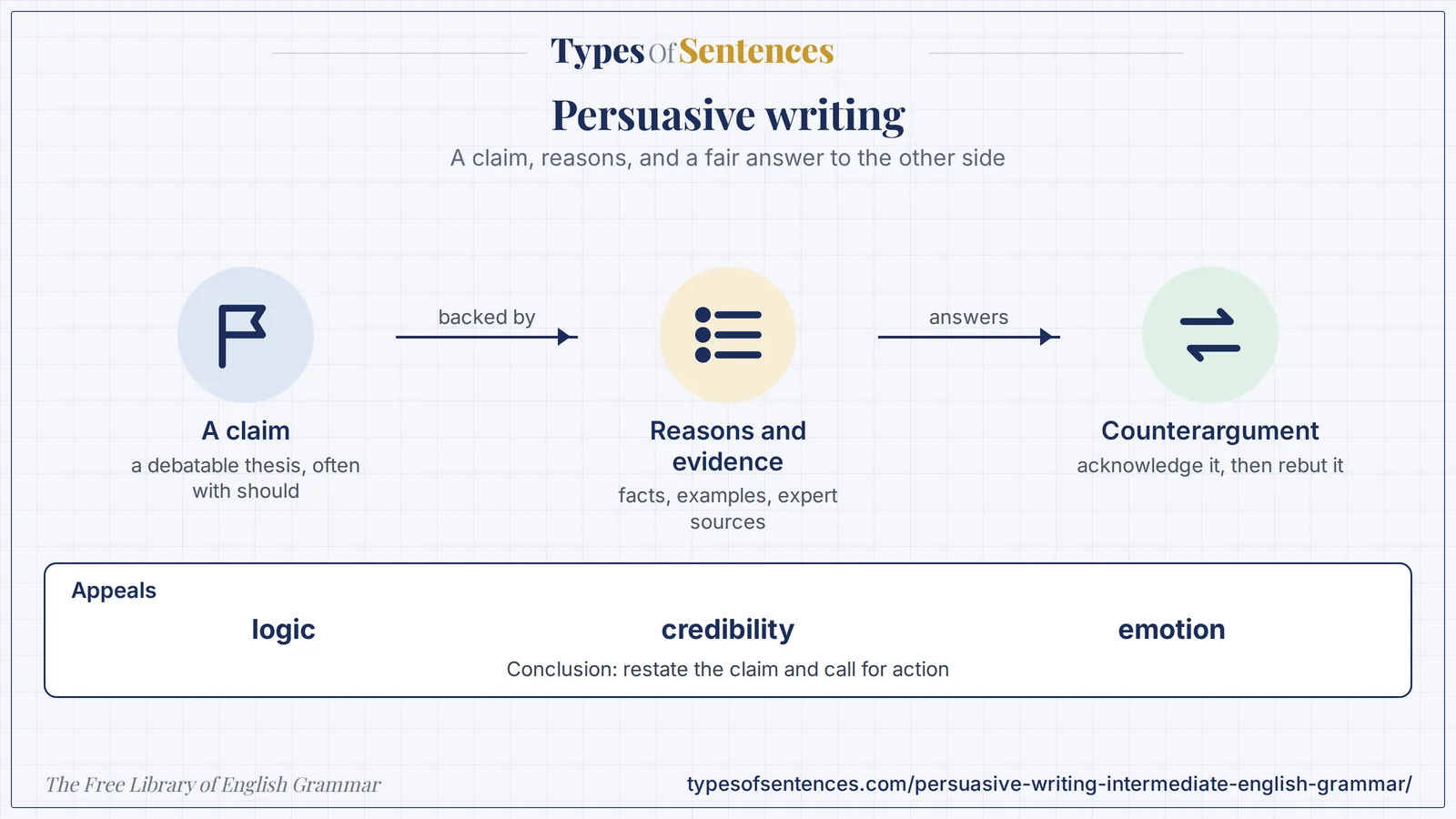
To persuade is to prove your point. You state what you believe, give the best reasons for it, show that you have considered the other side, and ask the reader to agree or act.
Why it matters: The strongest persuasion is honest: it relies on true facts, sound reasoning, and respect for the reader. Tricks and exaggeration may work once, but they cost you trust.
Summary: A persuasive piece has a clear claim (the thesis), several supporting reasons backed by evidence, a fair treatment of opposing views (a counterargument and a rebuttal), persuasive appeals (logic, credibility, emotion), a logical organization, and a conclusion with a call to action. Avoid logical fallacies and loaded, unsupported statements.
- Thesis: a debatable claim, often with should.
- Reasons + evidence (facts, examples, expert sources).
- Counterargument: acknowledge it, then rebut it.
- Conclusion: restate the claim and call for action.
What You’ll Learn
- 1. Persuasive Writing: What Is Persuasive Writing?
- 2. Thesis Statement in Persuasive Writing
- 3. Supporting Arguments
- 4. Addressing Counterarguments
- 5. Persuasive Techniques
- 6. Organization of a Persuasive Essay
- 7. Strong Evidence
- 8. Persuasive Language
- 9. Logical Fallacies to Avoid
- 10. Call to Action
- 11. Common Errors in Persuasive Writing
- 12. Exercises
- 13. Test Your Knowledge
- 14. Frequently Asked Questions
- 15. Conclusion
1. Persuasive Writing: What Is Persuasive Writing?
Persuasive writing aims to change the reader’s mind or move the reader to act. It takes a position on an issue that reasonable people can disagree about: Schools should start later, Cities should ban cars from their centers.
| Expository | Persuasive | |
|---|---|---|
| purpose | to explain | to convince |
| thesis | states what will be explained | states a debatable claim |
| view of the writer | neutral | takes a side |
| evidence | supports an explanation | proves the claim |
| other views | not needed | acknowledged and answered |
| ending | summary | call to action |
The chapter on essay structure gives the general frame. In persuasive writing, the body paragraphs are arguments, and the structure includes a place for the opposing view.
2. Thesis Statement in Persuasive Writing
The thesis in persuasive writing is a claim: a clear statement of your position that someone could disagree with. It often uses a modal such as should or must; the modals of obligation are in the chapter on modals of obligation.
| Weak | Strong (persuasive thesis) |
|---|---|
| Schools have start times. (a fact) | Schools should start after 8:30 a.m. because later start times improve sleep, attendance, and grades. |
| Homework is a topic many discuss. (an announcement) | Homework should be limited to one hour a night because more than that harms sleep and family life. |
| I think zoos are bad. (a feeling) | Zoos should be phased out because they cannot provide the space that wild animals need. |
| Cars are bad. | Cities should ban private cars from their centers because cars cause most urban air pollution, noise, and traffic deaths. |
- A good claim is debatable, specific, and focused.
- The formula is: Position + because + two or three reasons. The because clause is a complex-sentence pattern; see the chapter on complex sentences.
- Avoid “I think” and “In my opinion” in formal writing; the claim itself shows that it is your position.
3. Supporting Arguments
Each body paragraph makes one argument for the thesis. A strong argument has four parts, called the claim–reason–evidence–explanation pattern.
| Part | Job | Example (thesis: schools should start later) |
|---|---|---|
| claim (topic sentence) | states the reason | Later start times improve students’ sleep. |
| reason | says why | Teenagers’ body clocks shift later during adolescence. |
| evidence | a fact, statistic, example, or expert | A study of several schools found that students slept 30 to 60 minutes more after the start time moved. |
| explanation | links the evidence to the claim | More sleep makes students more alert, which supports learning. |
- Arrange arguments in order of importance, usually saving the strongest for last (or opening with it).
- Make each argument different. Do not repeat the same reason in new words.
- Check that each argument supports the thesis and not a different idea.
4. Addressing Counterarguments
A counterargument is a reason that someone on the other side would give. A persuasive writer states it fairly and then answers it. This shows that you have considered the issue, and it makes your own position more credible.
| Step | Language | Example |
|---|---|---|
| 1. state the opposing view fairly | Some people argue that … / Critics claim that … / It may be objected that … | Some people argue that later start times would disrupt after-school sports. |
| 2. concede what is true | It is true that … / Admittedly, … / Although … | It is true that schedules would need to change. |
| 3. rebut (answer it) | However, … / Nevertheless, … / Yet … | However, many schools have adjusted their schedules successfully, and the benefits to health outweigh the inconvenience. |
- Although some argue that school uniforms limit self-expression, students can still express themselves through hobbies, speech, and friendships.
- Admittedly, a ban on cars would inconvenience some drivers; nevertheless, cleaner air would benefit everyone.
5. Persuasive Techniques
Aristotle named three kinds of appeal that persuade: ethos, pathos, and logos. Good persuasive writing uses all three, with logic as the base.
| Appeal | Meaning | Example |
|---|---|---|
| logos (logic) | reason, facts, statistics, cause and effect | Studies show that students who sleep eight hours score higher on tests. |
| ethos (credibility) | the trustworthiness of the writer or source | As a teacher with twenty years of experience, I have seen the effects of tired students. |
| pathos (emotion) | feelings and values | Imagine a child dozing at her desk before the day has begun. |
| Technique | What it does | Example |
|---|---|---|
| rhetorical question | makes the reader think | Can we really ask teenagers to learn when they are half asleep? |
| repetition | adds emphasis | We need rest. We need time. We need change. |
| rule of three | a rhythmic list of three | safer, cleaner, and quieter |
| anecdote or example | makes the issue personal | Last year, one student fell asleep during an exam. |
| analogy | explains by comparison | Asking a tired student to learn is like asking a car with no fuel to run. |
| expert authority | adds credibility | According to the American Academy of Pediatrics, … |
| statistics | gives weight | Eighty percent of students said they were tired. |
Persuasive techniques are tools, not tricks. Use emotional appeals to make a true point vivid, not to replace evidence. Appeals that are false or manipulative can mislead readers, and many teachers treat them as weaknesses in an argument.
6. Organization of a Persuasive Essay
| Part | Content |
|---|---|
| introduction | a hook, background on the issue, and the thesis (claim with reasons) |
| body paragraph 1 | the strongest (or a key) argument with evidence |
| body paragraph 2 | a second argument with evidence |
| body paragraph 3 | a third argument with evidence |
| counterargument paragraph | the opposing view and the rebuttal (may come before or after the arguments) |
| conclusion | restated claim, summary of the strongest reasons, and a call to action |
| Pattern | How it works |
|---|---|
| classical | introduction, background, claim, proof, refutation, conclusion |
| order of importance | arguments from the strongest to the weakest, or the reverse |
| problem and solution | describe the problem, then argue for your solution |
| Rogerian | state the other side fairly first, find common ground, then present your view |
Link the paragraphs with transitions: First, In addition, Most important, On the other hand, For these reasons; see the earlier chapter on cohesion in writing.
7. Strong Evidence
| Test | Question to ask |
|---|---|
| relevant | Does it actually support this claim? |
| accurate | Is it true and up to date? |
| sufficient | Is there enough of it to convince? |
| credible | Does it come from a reliable, qualified source? |
| representative | Does it reflect the whole picture, not a single case? |
| Kind of evidence | Strength | Caution |
|---|---|---|
| statistics from reliable studies | strong | check the source, the date, and the sample |
| expert testimony | strong | the expert must be qualified in this field |
| examples | moderate | a single example may be unusual |
| anecdotes | weak to moderate | vivid but not proof |
| common sense or tradition | weak | may be wrong, and varies by reader |
| personal opinion | weakest | not evidence by itself |
The examples and statistics in this chapter are invented to illustrate the patterns. When you write a real argument, use sources that you can name and check, and never make up or distort evidence.
8. Persuasive Language
| Feature | Example |
|---|---|
| strong, confident verbs | demand, prove, require, ensure, improve |
| modals of strong recommendation (should, must, need to) | Schools should start later. We must act now. |
| precise, positive words | a fair, practical solution |
| connotation (loaded words) used with care | freedom fighter versus rebel show different attitudes |
| inclusive pronouns | we, our, us: We all want safe streets. |
| conditionals that show consequences | If we do nothing, the problem will worsen. (see the chapter on other conditional patterns) |
| imperatives in the call to action | Join us. Sign the petition. Vote on Tuesday. |
- Be confident without being rude. Anyone who disagrees is stupid insults the reader; The evidence strongly suggests invites agreement.
- Avoid absolute words (always, never, everyone, nobody) unless they are true. One counterexample can destroy the claim.
- Balance hedging (may, might) with firmness. A claim that is too hedged sounds weak.
9. Logical Fallacies to Avoid
A logical fallacy is an error in reasoning that makes an argument unsound, even when it sounds convincing. Knowing the common fallacies helps you to avoid them and to spot them in other writing.
| Fallacy | What it is | Example |
|---|---|---|
| ad hominem | attacking the person, not the argument | You cannot trust her view on schools; she is not a parent. |
| straw man | distorting the opposing view to attack it | Opponents of homework want students to learn nothing. |
| false dilemma | offering only two choices when there are more | Either we ban all cars or the city will choke. |
| slippery slope | claiming that one step will lead to a chain of extreme results without proof | If we allow one late start, soon school will never begin. |
| hasty generalization | a broad claim from too little evidence | My cousin hated the program, so it is a failure. |
| bandwagon | claiming that something is right because many do it | Everyone is using it, so it must be good. |
| appeal to authority (false) | citing someone not qualified in the field | A famous actor says the medicine works. |
| circular reasoning | the conclusion repeats the premise | It is wrong because it is not right. |
| red herring | introducing an irrelevant point | Why worry about air quality when taxes are so high? |
10. Call to Action
A persuasive conclusion often ends with a call to action: what you want the reader to think, feel, or do.
| Type | Example |
|---|---|
| a direct request | Sign the petition today. |
| a recommendation | Every school board should adopt a later start time. |
| a vision of the future | Imagine a city where children breathe clean air. |
| a challenge | The question is not whether we can afford to change, but whether we can afford not to. |
| a warning | If we wait, the damage will be harder to undo. |
Write a conclusion for: Schools should start later.
- Restate the claim in new words: The evidence is clear that later start times help students.
- Summarize the strongest reasons: Better sleep, better attendance, and better grades.
- Call to action: School boards should move the first bell to 8:30 a.m. this year.
- Result: The evidence is clear that later start times help students: better sleep, better attendance, and better grades. School boards should move the first bell to 8:30 a.m. this year.
11. Common Errors in Persuasive Writing
| Error | Fix |
|---|---|
| no clear claim | write a debatable thesis with reasons |
| stating opinion without evidence | support each reason with facts, examples, or experts |
| ignoring the other side | state and rebut at least one counterargument |
| a weak, silly version of the opposition | represent the other side fairly |
| logical fallacies | check each argument against the list |
| over-emotional or insulting language | keep a firm, respectful tone |
| absolute claims (always, everyone) | qualify the claim and use precise numbers |
| repeating the same reason | make each argument different |
| no call to action | end with what you want the reader to do |
| invented or unchecked facts | use reliable, named sources |
Recap in 12 seconds
Watch the lesson build itself: Persuasive writing makes a debatable claim, backs it with reasons and evidence, and answers the opposing view. The video has no sound.
Exercises
Part A: Purpose and Thesis (Exercises 1–7)
Exercise 1: What is the purpose of persuasive writing?
Show Answer
Answer: To convince the reader to accept a position or act.
Exercise 2: Which is a persuasive thesis: Schools have start times or Schools should start later?
Show Answer
Answer: The second.
Exercise 3: Improve: I think zoos are bad.
Show Answer
Answer: Sample: Zoos should be phased out because they cannot provide the space that wild animals need.
Exercise 4: Name two qualities of a good claim.
Show Answer
Answer: Debatable and specific (also focused).
Exercise 5: Which modal often appears in a claim: should or might?
Show Answer
Answer: should.
Exercise 6: Give the thesis formula.
Show Answer
Answer: Position + because + two or three reasons.
Exercise 7: How does persuasive differ from expository writing?
Show Answer
Answer: It argues a position; expository writing explains.
Part B: Arguments and Evidence (Exercises 8–14)
Exercise 8: Name the parts of a supporting argument.
Show Answer
Answer: Claim, reason, evidence, explanation.
Exercise 9: Which order for arguments is common?
Show Answer
Answer: Order of importance.
Exercise 10: Name three kinds of evidence.
Show Answer
Answer: Facts, statistics, expert testimony (also examples).
Exercise 11: Which is weaker: statistics from a reliable study or personal opinion?
Show Answer
Answer: Personal opinion.
Exercise 12: Name a test for evidence.
Show Answer
Answer: Relevant (also accurate, sufficient, credible, representative).
Exercise 13: Should you invent statistics?
Show Answer
Answer: No. Use real, checkable sources.
Exercise 14: Should each argument repeat the same reason?
Show Answer
Answer: No. Each should be different.
Part C: Counterarguments (Exercises 15–19)
Exercise 15: Name the three steps for a counterargument.
Show Answer
Answer: State it fairly, concede what is true, rebut it.
Exercise 16: Choose a concession word: ___, the plan has costs.
Show Answer
Answer: Admittedly (or It is true that).
Exercise 17: Choose a rebuttal word: ___, the benefits outweigh them.
Show Answer
Answer: However (or Nevertheless).
Exercise 18: What is the straw man fallacy?
Show Answer
Answer: Distorting the opposing view to attack it.
Exercise 19: Why include a counterargument?
Show Answer
Answer: It shows you considered the issue and builds credibility.
Part D: Techniques and Language (Exercises 20–25)
Exercise 20: Name the three appeals.
Show Answer
Answer: Logos, ethos, pathos.
Exercise 21: Which appeal is logic?
Show Answer
Answer: Logos.
Exercise 22: Which appeal is credibility?
Show Answer
Answer: Ethos.
Exercise 23: Name a rhetorical technique that uses a question.
Show Answer
Answer: A rhetorical question.
Exercise 24: Name an inclusive pronoun.
Show Answer
Answer: we (or our, us).
Exercise 25: Which is better: Anyone who disagrees is stupid or The evidence strongly suggests …?
Show Answer
Answer: The second.
Part E: Fallacies and Call to Action (Exercises 26–30)
Exercise 26: Name the fallacy: You cannot trust her; she is not a parent.
Show Answer
Answer: Ad hominem.
Exercise 27: Name the fallacy: Either we ban all cars or the city will choke.
Show Answer
Answer: False dilemma.
Exercise 28: Name the fallacy: Everyone is using it, so it must be good.
Show Answer
Answer: Bandwagon.
Exercise 29: Name the fallacy: My cousin hated it, so it is a failure.
Show Answer
Answer: Hasty generalization.
Exercise 30: Write a call to action about voting.
Show Answer
Answer: Sample: Vote on Tuesday.
Test Your Knowledge
Ready to check what you learned? Answer all 10 questions, then submit. You need 80% (8 of 10) to pass. Your answers are not stored.
View correct answers and explanations
Question 1: What is the purpose of persuasive writing?
✓ Correct Answer: D – To convince the reader
Persuasive writing convinces.
Question 2: Which is a persuasive thesis?
✓ Correct Answer: C – Schools should start after 8:30 a.m. because later start times improve sleep, attendance, and grades.
It states a debatable claim with reasons.
Question 3: What is a counterargument?
✓ Correct Answer: A – An opposing view
A counterargument is the other side’s reason.
Question 4: Which appeal is logic?
✓ Correct Answer: C – Logos
Logos is logic.
Question 5: Which appeal is credibility?
✓ Correct Answer: D – Ethos
Ethos is credibility.
Question 6: Which is the straw man fallacy?
✓ Correct Answer: B – Distorting the other view to attack it
A straw man distorts the opposing view.
Question 7: Which is a false dilemma?
✓ Correct Answer: A – Either we ban all cars or the city will choke.
Only two choices are offered.
Question 8: Which is strongest evidence?
✓ Correct Answer: C – Statistics from a reliable study
Reliable statistics are strong.
Question 9: Which belongs in a conclusion?
✓ Correct Answer: B – A call to action
Persuasive conclusions often include a call to action.
Question 10: Which is better tone?
✓ Correct Answer: B – The evidence strongly suggests that later start times help.
Firm but respectful.
Frequently Asked Questions
What is persuasive writing?
Persuasive writing is writing that tries to convince the reader to accept a position or take an action. It uses a clear claim, reasons, evidence, a response to opposing views, and a call to action.
What is argumentative writing?
Argumentative writing is a form of persuasive writing that stresses logic and evidence. It presents a claim, proves it with reasons and sources, and answers counterarguments.
What are persuasive techniques?
Persuasive techniques include the appeals of logic (logos), credibility (ethos), and emotion (pathos), and tools such as rhetorical questions, repetition, the rule of three, anecdotes, analogies, and statistics.
How do I start writing arguments?
For writing arguments, choose a debatable issue, state a claim with reasons, collect reliable evidence, plan the arguments in order of importance, answer a counterargument, and end with a call to action.
What are persuasive essays?
Persuasive essays are essays that argue for a position. They have an introduction with a thesis, body paragraphs with arguments and evidence, a counterargument, and a conclusion with a call to action.
What is a counterargument and rebuttal?
A counterargument is the opposing view; a rebuttal is your answer to it. State the opposing view fairly, concede what is true, and then explain why your position is still stronger.
What are logical fallacies?
Logical fallacies are errors in reasoning, such as ad hominem attacks, straw men, false dilemmas, and hasty generalizations. They weaken an argument, so a persuasive writer avoids them.
Conclusion
You now know how to write persuasively: a clear claim, supporting arguments with strong evidence, a fair counterargument and rebuttal, the appeals of logos, ethos, and pathos, an effective organization, confident language, and a call to action. You can also spot and avoid logical fallacies.
Pick an issue you care about and write a thesis with two or three reasons. Next, you will study functional grammar.
- Purdue Online Writing Lab: Argumentative Essays: reference page on argument and thesis.
- Purdue Online Writing Lab: Fallacies: reference page on logical fallacies.
- Aristotle. Rhetoric.: the classic account of ethos, pathos, and logos.
- Quirk, Randolph, et al. A Comprehensive Grammar of the English Language. Longman, 1985.: modality and conditionals in argument.
Last reviewed: October 29, 2026. How it was made: drafted with AI assistance, then checked with automated tests (structure, links, answer keys, spelling) and against the sources above. A person has not yet read this chapter line by line. Found a mistake? Report it.