Grammar for academic success is not about being perfect; it is about meeting the expectations of readers who grade, review, and decide. A professor reading forty essays notices quickly whether an argument is clear, whether claims are supported, whether sources are used correctly, and whether the writing is controlled: grammar is the part of that control that is easiest to see. Errors that obscure meaning cost marks; errors that merely distract can cost credibility; and a controlled, appropriately formal style helps the reader to take the argument seriously. Students at university also meet new genres (the research paper, the lab report, the literature review, the thesis) with their own grammatical conventions.
This chapter is for students at every stage. It explains what academic writing grammar expects, the grammar needed in exams (including grammar skills for exams and timed essays), in research papers, in presentations, and in dissertations, how to meet professors’ expectations, and how to give and receive peer review. It also treats the grammar of citing and paraphrasing, the use of writing tools and AI in coursework, and the common errors of student writing. It is a chapter of university grammar in practice, and a companion to the earlier chapters on academic writing, citing sources, and research writing. Thirty exercises and a quiz follow.
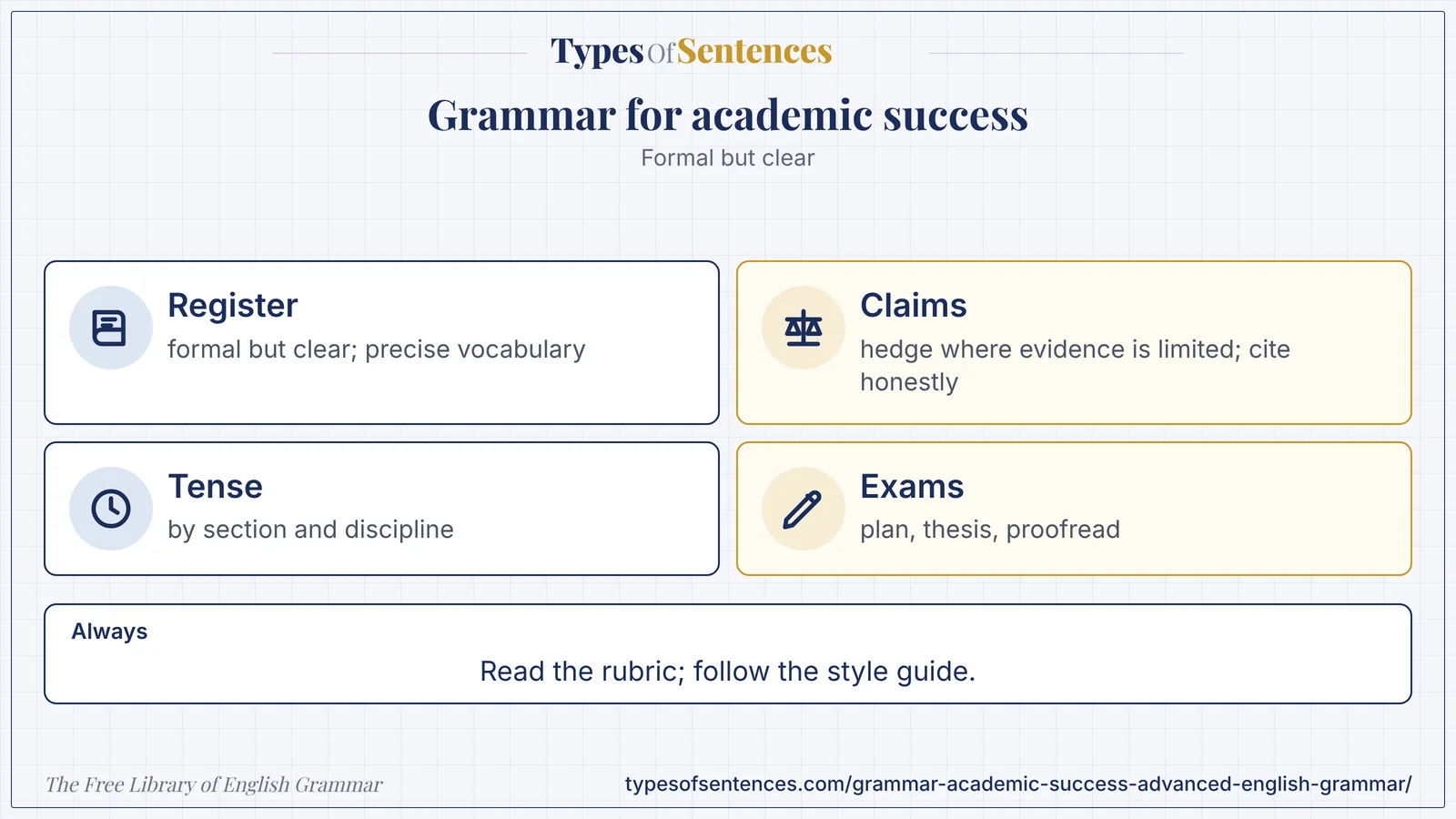
In academic writing, grammar supports your argument. Aim for clear sentences, a suitably formal tone, correct punctuation and agreement, careful verb tenses, and honest use of sources. Read the instructions and the grading rubric, and follow the style guide your course uses.
Why it matters: Do not try to sound impressive with long words and long sentences. Professors read for clarity and evidence. Write plainly, hedge claims that need it, and proofread.
Summary: Academic writing expects a formal but clear register, precise vocabulary, hedged claims where evidence is limited, nominalization used judiciously, correct citation and paraphrase, consistent tense by section and by discipline (present for established knowledge and humanities argument; past for specific studies, methods, and results; present perfect for the state of research), and avoidance of slang, contractions, and vague references. In exams, plan quickly, state a thesis, use topic sentences, and proofread for errors that obscure meaning; in grammar tests, know the commonly tested conventions. Presentations use spoken academic grammar. Theses require consistency across a long document. Students should read rubrics, follow the required style guide, and ask when expectations are unclear. Peer review should be specific, kind, and focused first on higher-order issues. Academic integrity requires honest paraphrase and attribution and compliance with the course policy on writing tools.
- Formal but clear; hedge claims; cite honestly.
- Tense by section and discipline.
- Exams: plan, thesis, proofread.
- Read the rubric; follow the style guide.
What You’ll Learn
- 1. Grammar for Academic Success: Grammar in Academic Writing
- 2. Grammar in Exams: Common Requirements and Tips
- 3. Grammar in Research Papers: Academic Conventions
- 4. Grammar in Presentations: Spoken Academic Grammar
- 5. Grammar in Dissertations: Thesis Writing
- 6. Meeting Professor Expectations: Standards and Rubrics
- 7. Peer Review: Giving and Receiving Feedback
- 8. Academic Integrity, Writing Tools, and Common Student Errors
- 9. A Worked Example: Revising a Student Paragraph
- 10. Exercises
- 11. Test Your Knowledge
- 12. Frequently Asked Questions
- 13. Conclusion
1. Grammar for Academic Success: Grammar in Academic Writing
| Expectation | What it means | Example |
|---|---|---|
| formal register | avoid slang, contractions, and chatty phrases in most academic writing | do not, not don’t; a large number of, not loads of |
| precision | exact words and numbers | increased by 12 percent, not increased a lot |
| clarity | sentences that the reader can follow | one main idea per sentence; subjects near verbs |
| hedging | match certainty to evidence | suggests, may, appears to |
| objectivity | focus on evidence, not on opinion words | avoid obviously unless justified |
| nominalization (used with care) | abstract nouns for concepts | the expansion of trade |
| third person (in many fields) | but first person is now accepted in many fields for the writer’s own actions | I argue / This paper argues (check your discipline) |
| consistent tense | by section and genre | see below |
| cohesion | connectors and reference that link ideas | however, therefore, this finding |
| signposting | tell the reader the structure | This section examines … |
| paragraph unity | a topic sentence and support | — |
| parallel structure | in lists, headings, and comparisons | — |
| correct punctuation | commas, semicolons, colons, apostrophes | — |
| agreement | subject-verb and pronoun | — |
| citation grammar | signal phrases and parenthetical citations | According to Smith (2019), … |
| avoid vague words | thing, stuff, a lot | — |
| the thesis statement | a clear claim in a complete sentence | This essay argues that rural migration has reshaped urban housing. |
| topic sentences | state the point of each paragraph | — |
| transitions | between paragraphs | — |
| conclusion language | restate and extend, not repeat | — |
| abstract | self-contained; past and present tenses; no citations in most styles | — |
| headings | parallel; informative | — |
| captions and labels | consistent | — |
| numbers and units | consistent; according to the style guide | — |
| abbreviations | spelled out at first use | — |
| avoid sweeping generalizations | Throughout history, … | — |
| avoid reliance on AI-generated text without checking | — | see below |
| format according to the required style | APA, MLA, Chicago, and others | — |
| ethical writing | honest attribution | — |
| Disciplinary variation | Typical features |
|---|---|
| humanities | argument-driven; present tense for discussing texts; first person is increasingly accepted; MLA or Chicago style |
| social sciences | evidence and theory; past tense for studies; APA style; hedged claims |
| natural sciences | objective; passives in methods; past tense for methods and results; numerical precision |
| engineering and technology | procedures; precise terms; imperatives in instructions; numbered references |
| law | precise; long sentences; citations to cases and statutes; formal register |
| medicine and health | structured abstracts; precise reporting; hedging; numbered references |
| business and management | report structure; evidence; recommendations; plain style |
| education | mix of theory and practice; APA style |
| computer science | technical terms; algorithms; conference-style papers |
| arts and design | reflective writing; description; critique |
The grammar of academic writing is treated in depth in the chapters on academic writing and on research writing; this chapter focuses on what students need to do in practice. The conventions vary by discipline, so check the guidance of your department and the style guide you are required to use.
2. Grammar in Exams: Common Requirements and Tips
| Kind of exam | Grammar demand | Tips |
|---|---|---|
| essay exam (timed) | a clear thesis; organized paragraphs; correct sentences | spend the first minutes planning; write a thesis; use topic sentences; leave time to proofread |
| short-answer exam | concise, complete sentences; precise terms | answer the question asked; define terms; avoid padding |
| multiple-choice grammar section | recognition of conventions (agreement, punctuation, parallelism, modifiers, pronouns, verb forms, word choice) | read the whole sentence; eliminate wrong options; check what the question tests; avoid overthinking |
| grammar and usage tests in admission exams | standard written English conventions | know the commonly tested points (below); practice timed sets; check the current format of the test |
| English language proficiency exams (for example IELTS and TOEFL) | range and accuracy of grammar are assessed in writing and speaking | practice varied structures; avoid memorized formulas that do not fit; check the official criteria |
| English literature exam | analysis; quotation integration; present tense for discussing texts | use signal phrases; cite correctly |
| science exam | precise terms; units; explanations | use correct tense for methods and results |
| viva or oral exam | spoken academic grammar; clear answers | use short sentences and signposts |
| take-home exam | academic writing standards; citation | follow the required style; observe integrity rules |
| open-book exam | — | organize references; paraphrase; do not copy |
| dissertation or thesis defense | spoken explanation of written work | prepare clear explanations |
| entrance exams for professional programs | varied | check the syllabus |
| Frequently tested grammar points (in standard written English tests; check the current specification) | Example |
|---|---|
| subject-verb agreement | The cost of the repairs is high. |
| pronoun-antecedent agreement and clarity | Each student must bring their book. (check the test’s expectations) |
| verb tense and form | had gone, has been |
| parallel structure | reading, writing, and speaking |
| modifier placement and dangling modifiers | Walking home, I saw the rain start. |
| sentence boundaries (fragments, run-ons, comma splices) | — |
| punctuation (commas, semicolons, colons, apostrophes) | — |
| possessive and plural forms | its/it’s, students’ |
| word choice and idiom | depend on, affect/effect |
| logical comparison | The price of this car is lower than that of the other. |
| conciseness | removing redundancy |
| transitions and logical connections | however, therefore |
| relevance and organization | sentence order in a paragraph |
| formal register | — |
| verbs of attribution | argues, suggests |
| correct use of who, whom, that, which | — |
| correct use of articles and prepositions (especially for learners) | — |
| conditional and subjunctive forms | If I were … |
| quantifiers | fewer, less, many, much |
| idioms and word forms | — |
| Exam writing routine (timed essay of 40 minutes; invented) | Minutes |
|---|---|
| read the question twice; underline the task words (discuss, compare, evaluate) | 2 |
| plan: thesis, three points, examples | 5 |
| write the introduction with a thesis | 4 |
| write the body paragraphs with topic sentences | 23 |
| write the conclusion | 3 |
| proofread: agreement, tense, punctuation, spelling, missing words | 3 |
| Tip | Why |
|---|---|
| write in complete sentences | fragments cost marks unless clearly stylistic |
| use simple, correct structures rather than risky complex ones | accuracy matters |
| use topic sentences | organization |
| avoid long, tangled sentences | clarity |
| use connectors sparingly and correctly | — |
| write legibly | markers must read it |
| do not pad | — |
| correct errors neatly | — |
| keep to the time plan | — |
| answer all parts of the question | — |
| reread the question at the end | — |
| for grammar tests, answer easy items first | — |
| do not change answers without reason | — |
| for multiple choice, check each option against the rule | — |
| use the process of elimination | — |
| practice under timed conditions | — |
| review your own typical errors before the exam | your error log |
| practice with past papers | — |
| sleep and eat well | — |
| stay calm | — |
The design and interpretation of grammar tests is described in the chapter on grammar testing and assessment; for students, the useful lesson is that tests sample a limited set of conventions, so a log of your own typical errors is the best preparation.
3. Grammar in Research Papers: Academic Conventions
| Section | Tense convention (varies by discipline and style guide) | Example |
|---|---|---|
| abstract | past for what was done and found; present for conclusions | This study examined … and found … The results suggest … |
| introduction | present for established knowledge and the paper’s aim; past or present perfect for earlier studies | Housing costs affect health (Smith, 2019). This paper examines … |
| literature review | past (APA, social sciences) or present perfect for earlier studies; present (humanities) for what authors argue | Smith (2019) found … / Smith argues … |
| methods | past (often passive) | Participants were recruited through … |
| results | past for what was found; present for referring to tables | Scores increased (see Table 2). |
| discussion | present for interpretation; past for the study’s results | These results suggest that … |
| conclusion | present for the main claim; future or modal for implications | Further research should examine … |
| limitations | past and hedged | The sample was small. |
| recommendations | modal verbs | Policy makers should … |
| figure and table captions | present for describing what they show | Figure 2 shows … |
| Feature | Guidance | Example |
|---|---|---|
| hedging | match certainty to evidence | suggests, may, is likely to |
| boosters (use sparingly) | — | clearly, demonstrates (when the evidence is strong) |
| nominalization | compress and abstract, but avoid heavy noun strings | the expansion of trade |
| passives | methods and objective description | Samples were analyzed. |
| first person | follow the discipline | I argue, we found |
| signal phrases (verbs of attribution) | choose accurate verbs | argues, claims, demonstrates, suggests, notes, concedes |
| citation grammar | integrate sources into your sentences | Smith (2019) argues that … |
| quotations | short, integrated, with a signal phrase and a page number | Smith describes the policy as “narrowly designed” (2019, p. 14). |
| paraphrase | restate in your own words and structure, with a citation | — |
| summaries | shorter than the original; neutral | — |
| transitions | link ideas | In contrast, Similarly, As a result |
| definitions | at first use | — |
| abbreviations | spell out at first use | — |
| numbers | follow the style guide | — |
| statistics | report precisely | t(58) = 2.31, p = .02 (APA conventions) |
| comparisons | logical and complete | higher than in the control group |
| causal language | be careful: correlation is not causation | was associated with, not caused, unless shown |
| generalization | qualify | in this sample |
| avoid vague references | this without a noun | this result |
| punctuation of citations | follow the style guide | — |
| Paraphrase example (invented source) | Version |
|---|---|
| source (invented) | “The rapid growth of private tuition has widened educational inequality in urban areas, because families with fewer resources cannot afford the extra instruction that others buy.” (Author, 2021, p. 8) |
| patchwriting (too close; unacceptable) | The quick growth of private tutoring has widened educational inequality in cities, because poorer families cannot afford the extra teaching that others pay for. (Author, 2021) |
| acceptable paraphrase (new structure and wording, with citation) | Author (2021) argues that inequality in urban education has increased as private tuition has spread, since only better-off families can pay for it. |
| acceptable summary | Author (2021) links the spread of private tuition to greater inequality in urban schooling. |
| acceptable quotation (short, integrated) | Author (2021) notes that tuition has “widened educational inequality” (p. 8). |
The grammar of citation (signal phrases, verbs of attribution, and the integration of quotations) is part of the chapter on citing sources; the structure of papers is in the chapter on research writing; the conventions of scientific papers are in the chapter on scientific writing. Academic integrity requires that paraphrase be genuine: changing a few words is not enough, and a citation is required even when the wording is your own.
4. Grammar in Presentations: Spoken Academic Grammar
| Feature | Guidance | Example |
|---|---|---|
| signposting | tell the audience the structure | I will make three points. First, … |
| short sentences | listeners cannot reread | — |
| formal but conversational | full sentences; few contractions | — |
| direct address | we and you are acceptable | Let us consider the data. |
| hedging in speech | seems, may | — |
| numbers spoken clearly | round and repeat | — |
| definitions | at first use | — |
| transitions | Now let us turn to … | — |
| answering questions | repeat the question; answer directly | — |
| handling disagreement politely | That is a fair point; however, … | — |
| slides | parallel bullets; short phrases | — |
| acknowledge sources aloud | According to Smith (2019) | — |
| poster presentations | brief, parallel text | — |
| conference talks in a second language | prepare key phrases | — |
| group presentations | consistent terms and style across speakers | — |
5. Grammar in Dissertations: Thesis Writing
| Feature | Guidance | Example |
|---|---|---|
| consistency across chapters | one variety of English; one citation style; consistent terms and tense conventions | — |
| abstract | a concise summary; self-contained | — |
| chapter introductions and conclusions | signposting and summary | This chapter reviews … |
| literature review grammar | present perfect or past for earlier studies; careful attribution; synthesis, not a list | Several studies have found … (A, 2018; B, 2020). |
| methods chapter | past tense; precise detail; passive where appropriate | — |
| results chapter | past for findings; present for tables | — |
| discussion chapter | present for interpretation; hedging | — |
| conclusion chapter | present for claims; modal verbs for implications | — |
| cohesion across a long text | references back and forward | As Chapter 3 showed, … |
| terminology | define terms and use them consistently | — |
| long sentences | control and split | — |
| nominalization | use judiciously; avoid heavy noun strings | — |
| hedging | proportional to evidence | — |
| first person | follow the discipline and supervisor | — |
| headings | parallel; informative | — |
| numbering of sections, tables, figures | consistent | — |
| cross-references | accurate | — |
| footnotes and endnotes | consistent form | — |
| quotation and paraphrase | honest and integrated | — |
| acknowledgments | a short, courteous section | — |
| editing | a multi-pass proofread; a style sheet; a second reader | — |
| formatting | follow the university’s template | — |
| dates, numbers, and units | consistent | — |
| abbreviations | a list | — |
| the viva or defense | speak clearly; use plain explanation | — |
| revision after feedback | track changes; respond to each comment | — |
| publication from the thesis | adapt grammar and length to the journal | — |
| working with a supervisor | agree expectations about grammar and editing | — |
| using an editor | follow the university’s rules on editing assistance | — |
| using AI tools | follow the university’s policy; you remain responsible for the text | — |
| Large-document practices | Why |
|---|---|
| keep a style sheet | consistency across hundreds of pages |
| use styles for headings and formats | structure and consistency |
| search for inconsistent terms | find variants |
| proofread in stages | one problem at a time |
| read each chapter aloud | the ear catches problems |
| let the text rest | distance helps |
| ask a reader outside your field | clarity |
| keep a record of changes | — |
| check references against the text | — |
| check numbers and tables against the text | — |
6. Meeting Professor Expectations: Standards and Rubrics
| Practice | Why | Example |
|---|---|---|
| read the assignment and rubric first | they state what is graded | a rubric with a row for grammar and mechanics |
| note the weight of grammar in the grade | to allocate effort | 10 percent for language |
| follow the required style guide | format and citation | APA 7, MLA 9, Chicago |
| check word limits and structure | compliance | — |
| ask about unclear expectations | early | May I use first person? |
| use office hours and the writing center | feedback before submission | — |
| use formal register in emails to professors | Dear Professor Rao, … | — |
| Typical rubric criterion for language (invented) | Strong | Needs work |
|---|---|---|
| clarity | sentences are clear and precise | meaning is sometimes unclear |
| accuracy | few errors; none that obscure meaning | frequent errors that distract |
| register | consistently academic | mixes slang and formal terms |
| sentence variety | varied and controlled | repetitive or tangled |
| cohesion | smooth transitions | abrupt shifts |
| citation grammar | signal phrases used skillfully | quotations dropped in without integration |
| mechanics | correct punctuation and spelling | frequent mistakes |
| formatting | follows the style guide | inconsistent |
7. Peer Review: Giving and Receiving Feedback
| Guideline for giving feedback | Example |
|---|---|
| read for meaning first | What is the main claim? Where is it clear or unclear? |
| start with strengths that are specific | The second paragraph gives a clear example. |
| focus on higher-order issues before sentence-level errors | argument, structure, evidence |
| be specific and show where | In paragraph 3, the link between the two studies is unclear. |
| explain the reader’s experience | I was confused here because … |
| suggest, do not dictate | You might consider adding a sentence that explains … |
| limit the number of comments | prioritize the most important |
| correct grammar patterns, not every instance | You often omit articles before singular nouns; here are three examples. |
| use questions | What do you mean by this here? |
| be kind and professional | — |
| check your own corrections against a reference | do not “correct” myths |
| respect the writer’s voice | — |
| mark what works, not only what does not | — |
| avoid vague comments | Good, unclear without explanation |
| avoid personal remarks | — |
| use the rubric or a checklist | — |
| offer to discuss | — |
| finish with next steps | — |
| keep confidentiality | — |
| follow the instructor’s peer review guidelines | — |
| Guideline for receiving feedback | Why |
|---|---|
| listen without defending | you learn more |
| ask clarifying questions | — |
| look for patterns across reviewers | — |
| decide which comments to act on | you remain the author |
| check rules in a reference | — |
| revise and thank the reviewer | — |
| keep a log of the comments | — |
| do not take it personally | — |
| ask for more detail where needed | — |
| revisit after a break | — |
| Comment bank (examples of helpful comments) | Type |
|---|---|
| Your thesis appears in the last sentence of the introduction; could it come earlier? | structure |
| This paragraph makes two points. Would two paragraphs be clearer? | paragraphing |
| I cannot tell what this refers to in the second sentence. | reference |
| The evidence supports the first claim but not the second. | argument |
| Consider adding a transition between these paragraphs. | cohesion |
| The tense changes from past to present here; was that intended? | tense |
| This sentence is 52 words long; could you divide it? | sentence length |
| The quotation is not introduced; add a signal phrase. | integration |
| The paraphrase is very close to the original; consider restructuring it. | integrity |
| You hedge well in paragraph 4; the claim in paragraph 6 seems stronger than the evidence. | hedging |
| There are three comma splices (lines 4, 9, and 15). | punctuation |
| Subject and verb do not agree in the sentence beginning “The cost …”. | agreement |
| The conclusion repeats the introduction; could it add implications? | conclusion |
| This term is not defined for a general reader. | audience |
| The reference to Smith (2019) is missing from the list. | citation |
Peer review is a skill that improves one’s own writing: explaining why a sentence does not work trains the same judgment that revising requires, as the chapter on grammar mastery describes for learning by teaching.
8. Academic Integrity, Writing Tools, and Common Student Errors
| Issue | Guidance |
|---|---|
| plagiarism | presenting others’ words or ideas as your own; cite every source and mark quotations |
| patchwriting | changing a few words of a source; restructure and use your own words, and still cite |
| self-plagiarism | reusing your own earlier work without permission |
| collusion | unauthorized collaboration |
| fabrication | inventing data or sources |
| use of writing tools | spelling and grammar checkers are generally allowed as aids, but follow the course policy |
| use of AI writing tools | policies differ by course and institution; follow them; disclose use if required; you remain responsible for the accuracy and originality of your work; AI tools can generate false statements and false references |
| use of translation tools | policies differ; follow them; translated text must still be your own work where required |
| editing help | follow the rules on how much help from editors is allowed |
| sharing work | follow the rules |
| citation of sources of ideas | even without direct quotation |
| common knowledge | no citation, but when in doubt, cite |
| quotations | exact words in quotation marks with a citation |
| data and figures | source them |
| images | permission and credit |
| paraphrase tools | may produce text too close to the source; check |
| check your work with the institution’s tools if offered | — |
| when in doubt, ask | — |
| Common student error | Example | Fix |
|---|---|---|
| comma splice | The study was small, the results are unclear. | The study was small; the results are unclear. |
| fragment | Although the sample was small. | Although the sample was small, the results were clear. |
| run-on | The study was small the results were unclear. | add a period or a conjunction |
| vague this | This shows … | This result shows … |
| informal register | kids, a lot of | children, many |
| contractions | doesn’t | does not |
| rhetorical question as an opener | Have you ever wondered …? | a statement of the problem |
| overgeneralization | Throughout history, people have … | a specific claim |
| unsupported claim | It is obvious that … | evidence |
| wordy phrases | due to the fact that | because |
| nominalization overload | The implementation of the utilization of … | verbs |
| tense shifts | Smith argued … and concludes | consistent tense |
| agreement errors | The results was … | were |
| pronoun errors | Each student should bring their book. (check the style guide) | — |
| dangling modifiers | Using this method, the data were collected. | Using this method, we collected the data. |
| misused semicolon | Although it rained; we went. | comma |
| apostrophe errors | the studies’s results | the studies’ results |
| wrong word | effect/affect | — |
| inconsistent citation style | — | follow one style |
| inaccurate verbs of attribution | proves for suggests | suggests |
| dropped quotations | a quotation with no introduction | add a signal phrase |
| long, tangled sentences | — | split |
| missing articles (for learners) | The study used survey. | a survey |
| preposition errors | depend of | depend on |
| word choice from a thesaurus | utilize for use without need | plain words |
| overuse of passive | It was found that it was shown that … | active where clearer |
| inconsistent terminology | — | one term |
| no topic sentences | — | add |
| listing without synthesis | — | link ideas |
| too many quotations | — | paraphrase |
| conclusion repeats introduction | — | add implications |
9. A Worked Example: Revising a Student Paragraph
Revise this paragraph from a student essay (invented) for an academic audience: Have you ever wondered why kids dont learn good in big classes? Smith (2019) proved that big classes are bad, he says that there was less attention for each student, this is a big problem. Its obvious that schools should reduce class sizes, due to the fact that students learn more better in small classes. The results was very clear and everybody agrees.
- Have you ever wondered why kids dont learn good in big classes?: a rhetorical question, informal word, missing apostrophe, and good for well: Research suggests that students learn less effectively in large classes. (a claim, not a question).
- Smith (2019) proved that big classes are bad: overstated verb and informal wording: Smith (2019) found that large classes were associated with less individual attention for each student.
- he says that there was less attention for each student: a comma splice, inconsistent tense, and repetition: merged into the previous sentence.
- this is a big problem: vague this and informal wording: This reduction in attention may limit learning.
- Its obvious that schools should reduce class sizes: apostrophe, an unsupported claim: These findings suggest that schools should consider reducing class sizes.
- due to the fact that students learn more better in small classes: wordy and a double comparative: because students appear to learn more in small classes.
- The results was very clear and everybody agrees.: agreement, overgeneralization: The results were consistent across the studies reviewed, although some researchers question the size of the effect. (only if the sources support it).
- Result: Research suggests that students learn less effectively in large classes. Smith (2019) found that large classes were associated with less individual attention for each student. This reduction in attention may limit learning, and these findings suggest that schools should consider reducing class sizes, because students appear to learn more in small classes. The results were consistent across the studies reviewed, although some researchers question the size of the effect. (the essay and the claims are invented; a real paper must cite sources that support each claim)
- Notes: the revision is more formal, hedged, and precise; it replaces opinion with evidence; and it keeps the tense of attribution consistent.
| Checklist before submitting academic work | Item |
|---|---|
| Does the thesis answer the question? | — |
| Does every paragraph have a clear point? | — |
| Are claims hedged in proportion to the evidence? | — |
| Is the tense consistent by section? | — |
| Are sources cited and paraphrases genuine? | — |
| Are quotations introduced and cited? | — |
| Is the register formal and consistent? | — |
| Are sentences clear (no run-ons, fragments, or tangles)? | — |
| Do subjects and verbs agree? | — |
| Are punctuation and spelling correct? | — |
| Are abbreviations defined and numbers consistent? | — |
| Does the format follow the required style guide? | — |
| Have I met the word limit and the rubric? | — |
| Have I followed the policy on writing tools? | — |
| Have I proofread aloud? | — |
Recap in 12 seconds
Watch the lesson build itself: Academic success needs a formal but clear register, hedged claims, honest citation, and the right tense for each section. The video has no sound.
Exercises
Part A: Academic Writing (Exercises 1–7)
Exercise 1: Name three expectations of academic writing grammar.
Show Answer
Answer: Formal register, precision, clarity, hedging, citation.
Exercise 2: What does hedging do?
Show Answer
Answer: It matches certainty to evidence.
Exercise 3: Rewrite: kids don’t learn good.
Show Answer
Answer: children do not learn well.
Exercise 4: Rewrite: a lot of (formal).
Show Answer
Answer: many / a large number of.
Exercise 5: Rewrite: due to the fact that.
Show Answer
Answer: because.
Exercise 6: Why check the rubric?
Show Answer
Answer: It states what is graded.
Exercise 7: Why follow the required style guide?
Show Answer
Answer: Format and citation are part of the assessment.
Part B: Exams (Exercises 8–13)
Exercise 8: What should you do first in a timed essay?
Show Answer
Answer: Read the question and plan (thesis and points).
Exercise 9: How long should proofreading take in a 40-minute essay?
Show Answer
Answer: About three minutes.
Exercise 10: Name a commonly tested grammar point.
Show Answer
Answer: Subject-verb agreement, parallelism, modifiers, punctuation, pronouns.
Exercise 11: Why practice under timed conditions?
Show Answer
Answer: To build speed and accuracy.
Exercise 12: Why review your own error log before an exam?
Show Answer
Answer: It targets your typical errors.
Exercise 13: Name a strategy for multiple-choice grammar items.
Show Answer
Answer: Read the whole sentence; eliminate options; check the rule.
Part C: Research Papers (Exercises 14–20)
Exercise 14: Tense for the methods section.
Show Answer
Answer: Past (often passive).
Exercise 15: Tense for the discussion of results.
Show Answer
Answer: Present for interpretation; past for the study’s results.
Exercise 16: Name two verbs of attribution.
Show Answer
Answer: argues, suggests, notes, claims.
Exercise 17: What is patchwriting?
Show Answer
Answer: Changing a few words of a source while keeping its structure.
Exercise 18: Rewrite with a signal phrase: “narrowly designed” (Smith 2019).
Show Answer
Answer: Smith (2019) describes the policy as “narrowly designed.”
Exercise 19: Why avoid proves for most research claims?
Show Answer
Answer: Evidence usually suggests or supports; it rarely proves.
Exercise 20: What does a paraphrase need?
Show Answer
Answer: New wording and structure, plus a citation.
Part D: Presentations, Dissertations, and Professors (Exercises 21–26)
Exercise 21: Name a feature of spoken academic grammar.
Show Answer
Answer: Signposting, short sentences, definitions at first use.
Exercise 22: Why keep a style sheet for a thesis?
Show Answer
Answer: Consistency across a long document.
Exercise 23: Name a way to meet professor expectations.
Show Answer
Answer: Read the rubric; follow the style guide; ask early; use feedback.
Exercise 24: Where should you check the policy on AI writing tools?
Show Answer
Answer: In the course and institutional policies.
Exercise 25: What does a rubric criterion on citation grammar look for?
Show Answer
Answer: Quotations integrated with signal phrases.
Exercise 26: Why use office hours or a writing center?
Show Answer
Answer: To get feedback before submission.
Part E: Peer Review and Editing (Exercises 27–30)
Exercise 27: Name a guideline for giving feedback.
Show Answer
Answer: Be specific; start with strengths; focus on higher-order issues first.
Exercise 28: Name a guideline for receiving feedback.
Show Answer
Answer: Listen; look for patterns; decide which comments to act on.
Exercise 29: Correct: *The study was small, the results are unclear.
Show Answer
Answer: The study was small; the results are unclear.
Exercise 30: Correct: *The results was clear.
Show Answer
Answer: The results were clear.
Test Your Knowledge
Ready to check what you learned? Answer all 10 questions, then submit. You need 80% (8 of 10) to pass. Your answers are not stored.
View correct answers and explanations
Question 1: Which tense is typical for describing a specific past study in a literature review (APA)?
✓ Correct Answer: A – past
Past (or present perfect).
Question 2: What does hedging do?
✓ Correct Answer: B – matches certainty to evidence
Matches certainty to evidence.
Question 3: Where should you check the grammar expectations of an assignment?
✓ Correct Answer: C – the rubric and instructions
The rubric and instructions.
Question 4: A good paraphrase
✓ Correct Answer: D – restates the idea in your own words and structure, with a citation
New wording, new structure, citation.
Question 5: Which is a signal phrase?
✓ Correct Answer: C – According to Smith (2019),
A phrase that introduces a source.
Question 6: In peer review, useful feedback is
✓ Correct Answer: A – specific and focused on the text
Specific and text-focused.
Question 7: Which is typical of academic register?
✓ Correct Answer: D – precise vocabulary and hedging
Precision and hedging.
Question 8: Why proofread an exam answer?
✓ Correct Answer: C – to catch errors that obscure meaning
To catch errors.
Question 9: A comma splice is
✓ Correct Answer: B – two independent clauses joined by only a comma
Two sentences joined by a comma.
Question 10: AI tools in coursework should be used
✓ Correct Answer: B – only as your course policy allows, with your own checking
Follow the policy and check.
Frequently Asked Questions
What is grammar for academic success?
Grammar for academic success is the use of clear, accurate, appropriately formal grammar in coursework, exams, papers, and presentations, together with the conventions of citation and attribution. Grammar for academic success supports argument and credibility.
What are grammar skills for exams?
Grammar skills for exams include planning quickly, writing complete and correct sentences, using topic sentences, and recognizing commonly tested conventions such as agreement, parallelism, modifiers, and punctuation. Grammar skills for exams are built by timed practice and an error log.
What grammar do students need?
Grammar for students includes formal register, correct sentence boundaries, agreement, consistent tense, hedging, citation grammar, and the conventions of the discipline. Grammar for students is learned by writing and feedback.
What is university grammar?
University grammar is a loose term for the grammar expected in higher education: academic register, precise and hedged claims, and the genres of the essay, the paper, and the thesis. University grammar varies by discipline.
What is academic writing grammar?
Academic writing grammar is the set of conventions of grammar and style in scholarly writing: formality, nominalization, hedging, tense by section, and citation. Academic writing grammar should serve clarity.
Can I use first person in academic writing?
In many fields, yes, for the writer’s own actions and arguments (I argue, we found); some instructors and fields still prefer the third person, so check the guidance.
Can I use AI tools for my coursework?
Only as your course and institution allow; you remain responsible for accuracy and originality, and AI tools can produce false statements and references, so check everything and follow disclosure rules.
Conclusion
You now have a guide to grammar for academic success: the expectations of academic writing, exams, research papers, presentations, dissertations, professors’ expectations, peer review, and academic integrity. You can meet the standards of your readers and keep improving.
Before you submit, read the rubric and proofread aloud. Next, you will review the whole course in the comprehensive review.
- Publication Manual of the American Psychological Association. 7th ed. American Psychological Association, 2020.: writing style, tense, and citation in APA.
- MLA Handbook. 9th ed. Modern Language Association, 2021.: writing and citation in MLA.
- Swales, John M., and Christine B. Feak. Academic Writing for Graduate Students. 3rd ed. University of Michigan Press, 2012.: the language of academic genres.
- Hyland, Ken. Metadiscourse: Exploring Interaction in Writing. Continuum, 2005.: hedges, boosters, and signposting.
- Purdue Online Writing Lab: General Writing: reference pages on academic writing.
Last reviewed: October 29, 2026. How it was made: drafted with AI assistance, then checked with automated tests (structure, links, answer keys, spelling) and against the sources above. A person has not yet read this chapter line by line. Found a mistake? Report it.