Advanced essay structure begins where the five-paragraph model ends. At the Intermediate level, an essay has an introduction with a thesis, three body paragraphs, and a conclusion. At the advanced level, the writer must organize a longer argument, with a thesis that makes a real claim, paragraphs that develop ideas and not just list them, transitions that carry the reader from one point to the next, and a conclusion that adds something. The structure is not a mold into which ideas are poured; it is the shape of the argument, and a strong structure makes a strong essay.
You will study how to analyze an essay question, advanced introductions (hook strategies, context building, thesis types and placement), body paragraphs (topic sentences, development strategies, and transitions), advanced conclusions (synthesis, implications, and avoiding repetition), the structures of the main essay types (argumentative, analytical, expository, and compare and contrast), cohesion in essays, the organization of long and complex essays, and ways of revising structure. These are the skills of advanced essay writing and academic essay structure, with argument organization in essays as the central concern. Thirty editing exercises and a quiz follow.
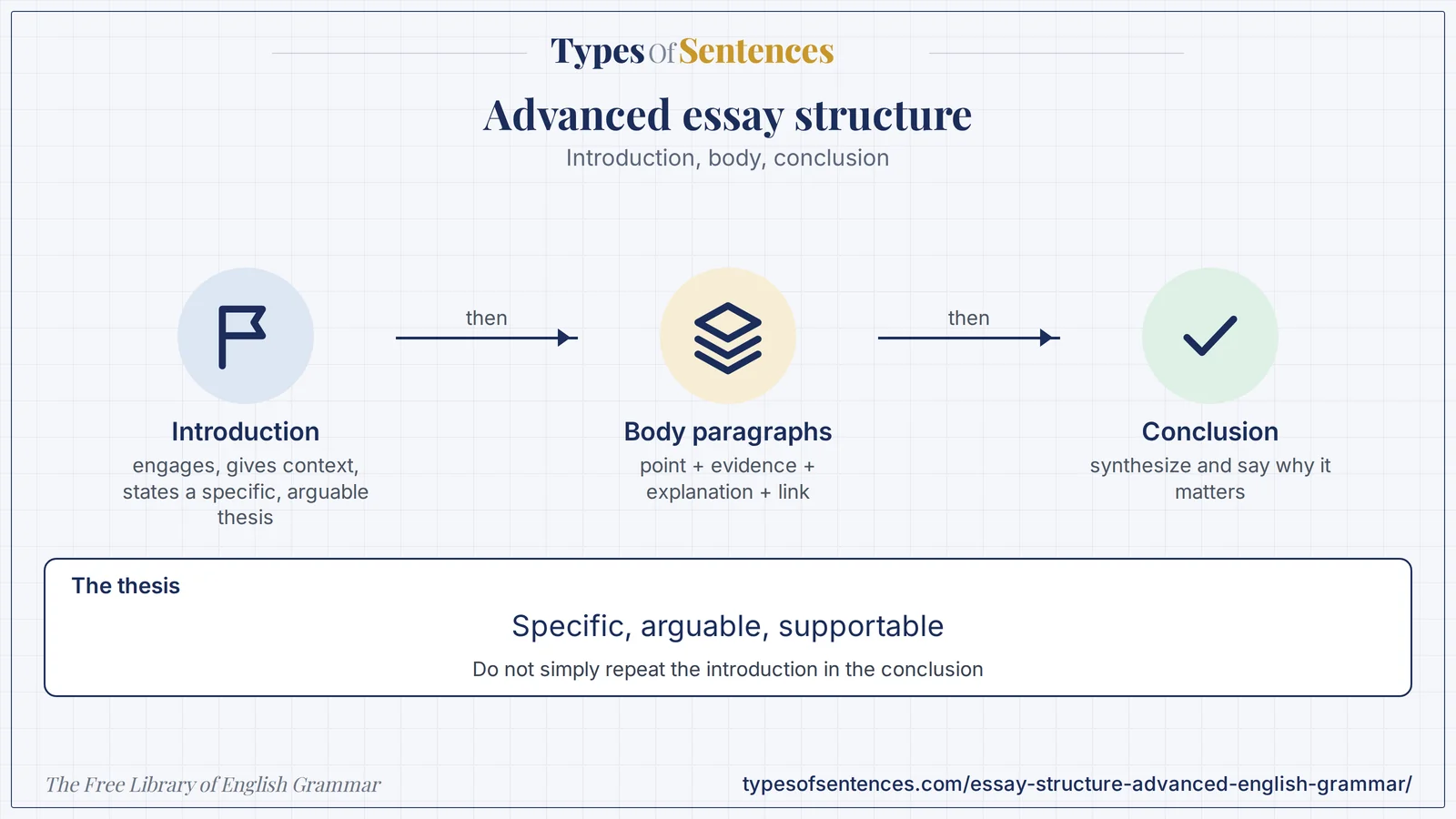
An essay is an argument in prose. It begins by telling the reader what it will claim and why the claim matters; it goes on to support the claim step by step; and it ends by saying what the argument has shown. The structure is the order in which these steps come.
Why it matters: Each paragraph has a job within the whole. If you can say what each paragraph does for the thesis, the essay is probably well built; if you cannot, the structure needs work.
Summary: An advanced essay has an introduction that engages the reader, supplies context, and states a specific, arguable thesis; body paragraphs, each with a topic sentence that makes a claim, evidence, explanation, and a link; and a conclusion that synthesizes the argument and states its significance. The question (and its command words, such as evaluate and discuss) decides the type of essay: argumentative, analytical, expository, or comparative. Cohesion comes from thematic progression, transitions, and signposting. Long essays use sections and sub-claims. Revision uses a reverse outline.
- Thesis: specific, arguable, supportable.
- Paragraph = point + evidence + explanation + link.
- Conclusion: synthesize and say why it matters; do not repeat.
- Types: argumentative, analytical, expository, compare and contrast.
What You’ll Learn
- 1. Advanced Essay Structure: Starting with the Question
- 2. Introductions: Hooks, Context, and Thesis
- 3. Body Paragraphs: Topic Sentences, Development, and Order
- 4. Conclusions: Synthesis, Implications, and Avoiding Repetition
- 5. Essay Types and Their Structures
- 6. Cohesion in Essays: Linking Devices and Logical Flow
- 7. Long and Complex Essays
- 8. The Language of Essay Structure
- 9. Revising the Structure
- 10. Common Errors in Essay Structure
- 11. Exercises
- 12. Test Your Knowledge
- 13. Frequently Asked Questions
- 14. Conclusion
1. Advanced Essay Structure: Starting with the Question
An essay answers a question, and the first step in structure is to analyze it. The command words (also called directive words) tell you what kind of thinking and what structure the question requires.
| Command word | Meaning | Typical structure |
|---|---|---|
| analyze | break into parts and show how they relate | parts → relations → significance |
| assess; evaluate | judge the value or success, with criteria and evidence | criteria → evidence → judgment |
| discuss | examine the issue from several sides | several views → a reasoned position |
| compare; contrast | show similarities; show differences | point-by-point or block |
| critically assess; critically evaluate | judge, with attention to strengths and weaknesses | claims → strengths → weaknesses → verdict |
| to what extent | judge how far a statement is true | partly true; conditions; qualified conclusion |
| explain; account for | show how or why | causes or process |
| justify; argue | defend a position with reasons and evidence | claim → reasons → counterargument → refutation |
| outline; describe | give the main points | sequence of points |
| examine; explore; investigate | look closely at an issue | question → evidence → findings |
| Step | Task | Example |
|---|---|---|
| 1 | underline the command word and the topic words | Evaluate the effect of social media on political participation. |
| 2 | identify the limits (period, place, group) | in the last decade; in India |
| 3 | turn the question into a research question | Does social media increase political participation? |
| 4 | draft a working thesis | Social media increases some forms of participation but not others. |
| 5 | list the parts of the argument | forms of participation; evidence; counterarguments |
| 6 | outline the order | — |
The planning of a long argument benefits from a model. The philosopher Stephen Toulmin described an argument as a claim supported by grounds (evidence), connected by a warrant (the reasoning that links them), with a backing for the warrant, a qualifier (usually, in most cases), and a rebuttal (conditions under which the claim fails). The structure of argument is treated in the next chapter, on rhetorical strategies.
2. Introductions: Hooks, Context, and Thesis
| Function | What it does | Example (an essay on urban green space) |
|---|---|---|
| engage (hook) | gets the reader’s interest | When a city loses one park, it loses more than trees. |
| context | gives the background, scope, and definitions | Over the past 20 years, many Indian cities have lost green space to roads and buildings. |
| narrowing | moves from the general to the specific topic | Studies of the effects on health have increased. |
| thesis | states the claim and the plan | Green space should be treated as health infrastructure because it reduces disease, lowers heat, and improves mental health. |
| Hook strategy | Example | Caution |
|---|---|---|
| a striking fact or statistic | Almost half of the world’s population lives in cities. | must be accurate and cited |
| a question | What is a park worth? | do not overuse; avoid yes/no questions |
| a short anecdote or scenario | On a hot afternoon in May, the temperature under a tree is five degrees lower. | keep it brief and relevant |
| a quotation | A line from a relevant source. | avoid hackneyed quotations |
| a bold claim | Cities cannot be healthy without trees. | be ready to support it |
| a contrast or paradox | Cities grow denser; their people need more space, not less. | — |
| a definition (only if useful) | “Green infrastructure” means … | avoid “Webster’s defines …” |
| a problem statement | Heat waves are killing more people each year. | — |
| Type of thesis | Form | Example |
|---|---|---|
| claim thesis | a clear, arguable claim | Green space should be treated as health infrastructure. |
| claim with reasons (roadmap) | claim + because + reasons | … because it reduces disease, lowers heat, and improves mental health. |
| concessive thesis | although + opposing view, claim | Although parks cost money, they save more in health costs. |
| analytical thesis | what a text or case shows, and how | The report presents green space as a luxury, but its own data show otherwise. |
| exploratory (delayed) thesis | the question first; the thesis emerges later | used in some humanities essays |
| comparative thesis | the point of a comparison | Both cities lost green space, but only one planned for it. |
| Weak thesis | Why weak | Stronger thesis |
|---|---|---|
| This essay is about parks. | a topic, not a claim | Urban parks are health infrastructure. |
| Parks are good. | vague and obvious | Parks reduce urban heat more cost-effectively than other measures. |
| Some people like parks and some do not. | no position | Parks deserve priority in city budgets because … |
| Is green space important? | a question | Green space is important because … |
| In this essay I will discuss parks. | an announcement | (state the claim directly) |
| Parks have trees. | a fact; not arguable | — |
- A good thesis is arguable, specific, focused, and supportable within the length of the essay, and it answers the question.
- Place the thesis at the end of the introduction in most academic essays; in long essays a problem statement may come first, and in exploratory essays the thesis may come later.
- Use grammar to make a thesis tight: subordination for concession (Although …), parallel structure for reasons (because A, B, and C); see the chapter on coordination and subordination.
- Keep the introduction short: about 10 percent of the essay is a common guide.
- Avoid clichés (Since the dawn of time, In today’s society) and long announcements (In this essay I will first discuss …), though a short roadmap is accepted in many fields.
3. Body Paragraphs: Topic Sentences, Development, and Order
| Part | Function | Example |
|---|---|---|
| topic sentence (point) | states the claim of the paragraph and links to the thesis | Parks lower urban temperatures. |
| evidence | a fact, statistic, quotation, or example | In Pune, areas with tree cover were up to 4 degrees cooler (Rao, 2021). (a sample citation) |
| explanation (analysis) | shows how the evidence supports the point | Shade and evaporation from leaves reduce heat, so … |
| link (concluding or transition sentence) | connects to the thesis or the next point | This cooling effect has direct consequences for health. |
This structure is known by several acronyms (PEEL: point, evidence, explanation, link; TEEL; PIE: point, illustration, explanation). The weakest paragraphs state a point and give evidence but do not explain; the strongest spend as much space on analysis as on evidence.
| Type of topic sentence | Example | Note |
|---|---|---|
| claim | Public parks reduce health inequality. | arguable and specific |
| link to the previous paragraph | A second benefit of parks is economic. | uses a transition |
| contrast | However, the cost of land is a real obstacle. | introduces a counterargument |
| question | Why do some cities succeed? | answered in the paragraph |
| fact only (weak) | There are 40 parks in the city. | not a claim |
| too broad (weak) | Parks have many advantages. | vague |
| Development strategy | Use | Example |
|---|---|---|
| example or illustration | makes a point concrete | a named park |
| statistics and data | quantify the point | 12 percent fewer clinic visits |
| expert testimony or quotation | cite authority | a public health researcher |
| comparison and contrast | show differences | two cities |
| cause and effect | explain why | shade → lower temperature → fewer heat illnesses |
| definition | clarify a term | what “green infrastructure” covers |
| classification | organize types | pocket parks; large parks; green roofs |
| process | explain a sequence | how a park is planned and funded |
| analogy | explain by comparison | a park as a public clinic |
| concession and refutation | answer an objection | Parks cost money, but … |
| Order of paragraphs | Description | Best for |
|---|---|---|
| strongest last (climactic) | end with the most important point | persuasion |
| strongest first | lead with the best argument | short essays; reader has little time |
| chronological | events in time | history; process |
| thematic | group by theme | analysis |
| problem then solution | — | policy essays |
| concession first | deal with the opposing view, then argue | argumentative essays |
| simple to complex | — | expository essays |
A paragraph should have one main idea (unity) and should be developed enough to support it (development), usually five to ten sentences in academic writing. A very short paragraph can signal an undeveloped idea; a very long one may contain several ideas that need separate paragraphs. The links between paragraphs are part of cohesion, treated below and in the chapter on transition words and connectors.
4. Conclusions: Synthesis, Implications, and Avoiding Repetition
| Move | What it does | Example |
|---|---|---|
| restate the thesis in new words | reminds the reader of the main claim | Green space is best understood as health infrastructure. |
| synthesize the main points | shows how the points fit together | Cooling, disease prevention, and mental health together … |
| state the significance (“so what”) | says why the argument matters | If this is correct, city budgets must change. |
| draw implications | what follows for policy, practice, or theory | Cities should reserve land before it is built on. |
| acknowledge limits | shows the scope of the claim | This essay considered only large cities. |
| suggest further questions | opens the topic | How do small towns compare? |
| link back to the hook | gives closure | The tree’s shade is a small thing; the city’s health depends on it. |
| call to action (persuasive essays) | asks the reader to act | Citizens should ask their councils to protect parks. |
| Weak conclusion | Problem | Stronger |
|---|---|---|
| In conclusion, parks are good for many reasons. | repeats the topic and adds nothing | Because parks reduce heat, disease, and stress, they should be funded as health infrastructure. |
| New evidence: Another study shows … | new evidence belongs in the body | — |
| I hope you liked this essay. | apology or filler | — |
| In conclusion, I have shown that … (a long restatement of all points) | mechanical summary | Synthesize in two or three sentences. |
| This essay is only my opinion. | undermines the argument | State the limits precisely. |
| It is clear that all cities must … | overclaiming | Cities with high heat risk should … |
- Do not simply repeat. A conclusion should give the reader something more than a summary: a synthesis, an implication, or a broader view.
- Do not introduce new evidence or a new argument.
- Avoid mechanical openers such as In conclusion in every essay; start with a statement of the main point.
- Match the strength of the conclusion to the evidence (hedge where needed).
- Keep it proportionate: about 10 percent of the essay.
5. Essay Types and Their Structures
| Type | Purpose | Typical structure |
|---|---|---|
| argumentative | persuade the reader of a claim | introduction with thesis → reasons with evidence → counterargument and refutation → conclusion |
| analytical | explain how a text, event, or case works | introduction with an interpretive thesis → analysis of parts (with evidence) → synthesis |
| expository | explain a subject objectively | introduction → defined parts, classification, process, or cause and effect → conclusion |
| compare and contrast | show similarities and differences | introduction with the point of the comparison → block or point-by-point → conclusion |
| problem and solution | define a problem and propose a solution | problem → causes → solutions → evaluation → recommendation |
| cause and effect | show why something happens or its results | causes (or effects) in order of importance → conclusion |
| discussion | examine several views and reach a position | issue → views for → views against → reasoned position |
| reflective | analyze one’s own experience | experience → analysis → learning |
| Argument model | Structure | Note |
|---|---|---|
| classical (Aristotelian) | introduction → statement of the case → proof → refutation → conclusion | the traditional form |
| Toulmin | claim → grounds → warrant → backing → qualifier → rebuttal | useful for analyzing reasoning |
| Rogerian | state the other side fairly → find common ground → present your position | for contested topics and conciliatory tone |
| problem–solution | — | policy and business |
| Compare and contrast pattern | Structure | Example |
|---|---|---|
| block (subject by subject) | all of A, then all of B | City A: parks, transport; then City B: parks, transport |
| point-by-point (criterion by criterion) | each criterion for both | Parks: A and B; transport: A and B |
| similarities then differences | — | — |
The choice of pattern follows the purpose. A block structure suits short comparisons; point-by-point suits long ones, because it keeps the comparison in view. In an argumentative essay, the counterargument can go before the refutation (Opponents argue that … but …), or each reason can be followed by its own objection. The persuasive appeals and the handling of counterarguments are in the next chapter, and the analysis of arguments in the chapter on critical analysis.
6. Cohesion in Essays: Linking Devices and Logical Flow
| Relation | Linking devices | Example |
|---|---|---|
| addition | moreover, furthermore, in addition, also, similarly | Moreover, parks reduce noise. |
| contrast | however, in contrast, on the other hand, nevertheless, whereas | However, cost remains an obstacle. |
| cause and result | therefore, thus, consequently, as a result, for this reason | Consequently, cities lose revenue. |
| example | for example, for instance, such as, in particular | For instance, in Pune … |
| sequence | first, second, next, finally, subsequently | First, parks cool the air. |
| concession | although, even though, admittedly, granted | Admittedly, parks are costly. |
| emphasis | indeed, in fact, above all | In fact, the evidence is strong. |
| conclusion | therefore, in short, overall, ultimately | Overall, the case is clear. |
| Device | How it creates flow | Example |
|---|---|---|
| thematic progression | the end of one sentence becomes the start of the next | Parks cool the air. This cooling reduces … |
| repetition of key terms | keeps the topic visible | green space … green space |
| pronouns and “this” + noun | point back | This finding … |
| topic sentences that echo the thesis | link the paragraph to the whole | — |
| signposting | tells the reader where the essay is going | This section has three parts. First, … |
| parallel structure | shows equal ideas | not only … but also … |
| transitional paragraphs or sentences | move between sections | Having considered the costs, we turn to the benefits. |
The theory of cohesion and coherence is in the chapter on cohesion and coherence, and the theory of how the sentence organizes information in the chapter on information structure. For essays, the practical points are that each sentence should begin with something the reader knows, that connectives should express a relation that is really there, and that a text should not be cluttered with a transition in every sentence. Variation in sentence structure helps: see the chapter on sentence variety.
7. Long and Complex Essays
| Challenge | Strategy | Example |
|---|---|---|
| sustaining an argument over many pages | sub-claims that support the main thesis; a running link to the thesis | Each section ends with a sentence that links to the thesis. |
| organizing many sources | group by theme or position, not by source | a paragraph on supporters, one on critics |
| keeping the reader oriented | headings, signposts, and a roadmap | Section 3 considers cost. |
| managing counterarguments | a separate section or a paragraph after each reason | — |
| avoiding summary | ask “so what?” after each piece of evidence | analysis after every quotation |
| balancing length | plan the proportions: introduction 10%, body 80%, conclusion 10% (a common guide) | — |
| cross-reference | refer back and forward | As shown in section 2, … |
| linking sections | a summary and a preview sentence at the boundaries | This section showed X; the next considers Y. |
- State the overall argument in a paragraph before you write.
- Divide it into sections, each with its own sub-claim.
- Plan the order so that each section builds on the previous.
- Plan the evidence for each sub-claim.
- Write signposts at the start and end of each section.
- Check that the conclusion answers the introduction.
8. The Language of Essay Structure
| Function | Language | Example |
|---|---|---|
| stating the thesis | argue, contend, maintain, propose, demonstrate, show | This essay argues that … |
| concession | although, while, admittedly, granted, it is true that | Although the plan has costs, … |
| refutation | however, yet, but, nevertheless, this overlooks | This view overlooks … |
| stating a point | a second consideration is; furthermore; turning to | A second consideration is cost. |
| evidence | according to, as shown by, the data suggest | According to Rao (2021), … |
| explaining | this suggests; this means that; as a result | This suggests that … |
| summarizing | in short; overall; taken together | Taken together, these points show … |
| limiting | in most cases; to some extent; at least in … | — |
| Grammar for essays | Example | Note |
|---|---|---|
| subordination for concession | Although X, Y. | a tight thesis |
| parallelism for reasons and lists | because A, B, and C | — |
| nominalization for “this” + noun | This decision … | summary noun |
| hedged verbs for claims | suggests; may | — |
| present tense for arguments | Rao argues; the data show | — |
| past tense for specific studies | Rao found that … | — |
| agreement and reference | each pronoun has a clear antecedent | — |
9. Revising the Structure
- Reverse outline. After drafting, write the main point of each paragraph in a margin and read the list: does it form an argument?
- Check the thesis against the conclusion. Do they say the same thing, in different words?
- Check each topic sentence. Does it make a claim and link to the thesis?
- Check unity. Does every sentence in the paragraph support its point?
- Check development. Is there evidence and explanation, or only assertion?
- Check order. Could the paragraphs be rearranged for a better flow?
- Check transitions between paragraphs.
- Cut repetition and digressions.
- Read aloud to hear gaps.
| Before (structure problem) | After |
|---|---|
| Parks have many benefits. They are green. Many cities have parks. Some parks are big. | Parks lower urban temperatures. In Pune, areas with tree cover were up to 4 degrees cooler (Rao, 2021), because shade and evaporation reduce heat. |
| Paragraph 2: heat. Paragraph 3: cost. Paragraph 4: more about heat. | Paragraph 2: heat. Paragraph 3: heat and health. Paragraph 4: cost. |
| Conclusion: Parks are good. In conclusion, parks are good. | Conclusion: Because parks reduce heat, disease, and stress, they should be funded as health infrastructure; cities should reserve land before it is built on. |
10. Common Errors in Essay Structure
| Problem | Example | Fix |
|---|---|---|
| topic as a thesis | This essay is about parks. | Parks are health infrastructure. |
| thesis as a fact | Parks have trees. | a claim that can be argued |
| thesis as a question | Are parks important? | a claim with reasons |
| no topic sentence | a paragraph that begins with a quotation | begin with a claim |
| two ideas in one paragraph | heat and cost together | separate paragraphs |
| orphan quotation | a quotation with no comment | add explanation |
| summary instead of analysis | retelling a text | state what the evidence shows |
| abrupt transition | Parks cool the air. Football is popular. | add a link or begin a new section |
| new evidence in the conclusion | Another study shows … | move to the body |
| mechanical “in conclusion” | In conclusion, in conclusion … | state the point directly |
| repetitive conclusion | copies the introduction | synthesize and extend |
| overlong introduction | three pages of background | keep to about 10% |
| no counterargument | one-sided essay | address a serious objection |
| inconsistent terms | policy … scheme … plan | one term |
| overuse of connectives | Moreover … Furthermore … In addition … | vary and link by ideas |
Edit: This essay is about parks, and parks are good, and trees are green, and the city has parks, and in conclusion parks are good and another study shows that they cool the air and I hope you liked this essay.
- This essay is about parks: a topic, not a thesis: Parks should be funded as health infrastructure because they reduce heat, disease, and stress.
- trees are green, and the city has parks: no claim: delete or develop with evidence.
- in conclusion parks are good: mechanical repetition: Because parks cool the air and improve health, cities should reserve land for them.
- another study shows: new evidence in the conclusion: move to the body.
- I hope you liked this essay: filler: delete.
- Result: Parks should be funded as health infrastructure because they reduce heat, disease, and stress. In Pune, tree-covered areas were up to 4 degrees cooler (Rao, 2021). Because parks cool the air and improve health, cities should reserve land for them. (the citation is a sample)
Recap in 12 seconds
Watch the lesson build itself: An advanced essay has an engaging introduction with an arguable thesis, body paragraphs with point, evidence, explanation, and link, and a conclusion that synthesizes. The video has no sound.
Exercises
Part A: The Question and the Introduction (Exercises 1–7)
Exercise 1: Name three command words.
Show Answer
Answer: analyze, evaluate, discuss, compare, assess, argue.
Exercise 2: What does evaluate require?
Show Answer
Answer: A judgment with criteria and evidence.
Exercise 3: Name the parts of an introduction.
Show Answer
Answer: Hook, context, narrowing, thesis.
Exercise 4: Name a hook strategy.
Show Answer
Answer: A fact, a question, an anecdote, a quotation, or a bold claim.
Exercise 5: Weak or strong thesis: This essay is about parks.
Show Answer
Answer: Weak (a topic).
Exercise 6: Weak or strong thesis: Parks are health infrastructure because they reduce heat, disease, and stress.
Show Answer
Answer: Strong.
Exercise 7: Where is the thesis usually placed?
Show Answer
Answer: At the end of the introduction.
Part B: Body Paragraphs (Exercises 8–14)
Exercise 8: Name the parts of a PEEL paragraph.
Show Answer
Answer: Point, evidence, explanation, link.
Exercise 9: Fact or claim: There are 40 parks in the city.
Show Answer
Answer: A fact (weak topic sentence).
Exercise 10: Give a claim topic sentence about parks and heat.
Show Answer
Answer: Parks lower urban temperatures.
Exercise 11: Name a development strategy.
Show Answer
Answer: Example, statistics, comparison, cause and effect, definition, analogy.
Exercise 12: Name an order of paragraphs for persuasion.
Show Answer
Answer: Strongest last (climactic).
Exercise 13: What is unity?
Show Answer
Answer: One main idea per paragraph.
Exercise 14: What is an orphan quotation?
Show Answer
Answer: A quotation with no comment or explanation.
Part C: Conclusions (Exercises 15–19)
Exercise 15: Name two moves of a conclusion.
Show Answer
Answer: Synthesize, state significance, draw implications.
Exercise 16: Should a conclusion contain new evidence?
Show Answer
Answer: No.
Exercise 17: Fix: In conclusion, parks are good.
Show Answer
Answer: Because parks reduce heat, disease, and stress, they should be funded as health infrastructure.
Exercise 18: How long is a typical conclusion (guide)?
Show Answer
Answer: About 10 percent of the essay.
Exercise 19: Name a way to give closure.
Show Answer
Answer: Link back to the hook.
Part D: Types and Cohesion (Exercises 20–26)
Exercise 20: Name the pattern: all of A, then all of B
Show Answer
Answer: Block.
Exercise 21: Name the pattern: each criterion for both
Show Answer
Answer: Point-by-point.
Exercise 22: Name the Toulmin elements.
Show Answer
Answer: Claim, grounds, warrant, backing, qualifier, rebuttal.
Exercise 23: Name a connective of contrast.
Show Answer
Answer: however, in contrast, whereas.
Exercise 24: Name a connective of cause and result.
Show Answer
Answer: therefore, consequently, as a result.
Exercise 25: Name a way to create flow.
Show Answer
Answer: Thematic progression, repetition of key terms, “this” + noun, signposting.
Exercise 26: Why avoid a transition in every sentence?
Show Answer
Answer: It becomes mechanical and heavy.
Part E: Revision (Exercises 27–30)
Exercise 27: What is a reverse outline?
Show Answer
Answer: Writing the main point of each paragraph beside it to check the argument.
Exercise 28: Fix: This essay is about parks.
Show Answer
Answer: Parks are health infrastructure because …
Exercise 29: Fix: a paragraph with heat and cost
Show Answer
Answer: Separate them into two paragraphs.
Exercise 30: Name a way to avoid summary.
Show Answer
Answer: Ask “so what?” after each piece of evidence.
Test Your Knowledge
Ready to check what you learned? Answer all 10 questions, then submit. You need 80% (8 of 10) to pass. Your answers are not stored.
View correct answers and explanations
Question 1: Which is a strong thesis?
✓ Correct Answer: A – Parks are health infrastructure because they reduce heat, disease, and stress.
Arguable and specific.
Question 2: What does evaluate require?
✓ Correct Answer: B – a judgment
A judgment with evidence.
Question 3: Which is a weak topic sentence?
✓ Correct Answer: C – There are 40 parks in the city.
A fact, not a claim.
Question 4: Which is not a hook strategy?
✓ Correct Answer: D – a long list of sources
A list is not a hook.
Question 5: What does PEEL stand for?
✓ Correct Answer: C – Point, Evidence, Explanation, Link
The paragraph model.
Question 6: Which belongs in the conclusion?
✓ Correct Answer: A – synthesis and significance
Synthesize and extend.
Question 7: Which is a block structure?
✓ Correct Answer: D – all of A, then all of B
Subject by subject.
Question 8: Which links a paragraph to the next?
✓ Correct Answer: C – a transition sentence
A link or transition.
Question 9: Which is a mechanical conclusion?
✓ Correct Answer: B – In conclusion, parks are good.
It repeats without adding.
Question 10: What is a reverse outline?
✓ Correct Answer: B – writing the main point of each paragraph after drafting
A revision tool.
Frequently Asked Questions
What is advanced essay structure?
Advanced essay structure is the organization of a longer, more complex essay: a specific thesis, developed paragraphs with clear topic sentences, transitions, and a conclusion that synthesizes and extends the argument.
What is advanced essay writing?
Advanced essay writing is the skill of building a sustained argument or analysis: analyzing the question, planning the structure, developing paragraphs with evidence and explanation, and revising for coherence.
What is argument organization in essays?
Argument organization in essays is the ordering of claims, evidence, and counterarguments so that the argument builds toward its conclusion: for example, concession first, strongest point last, or a Toulmin sequence.
What are complex essays?
Complex essays are longer or multi-part essays that need sections, sub-claims, signposting, and the management of many sources and counterarguments.
What is academic essay structure?
Academic essay structure is the conventional organization of an academic essay: an introduction with a thesis, body paragraphs each with a topic sentence and evidence, and a conclusion, adapted to the type of essay.
How do I write a good thesis?
Make it a claim that can be argued, specific, focused, and supportable in the space you have, and place it at the end of the introduction.
How do I avoid a repetitive conclusion?
Synthesize the main points, state why the argument matters, draw implications, and acknowledge limits, instead of restating each point.
Conclusion
You now have a deep study of essay structure: analyzing the question, advanced introductions, body paragraphs and development, advanced conclusions, the essay types, cohesion, long and complex essays, and revision. You can plan and revise an essay so that its structure carries its argument.
When you plan an essay, ask what each paragraph does for the thesis. Next, you will study rhetorical strategies in argument and persuasion.
- Toulmin, Stephen E. The Uses of Argument. Updated ed. Cambridge University Press, 2003.: the model of claim, grounds, and warrant.
- Swales, John M., and Christine B. Feak. Academic Writing for Graduate Students. 3rd ed. University of Michigan Press, 2012.: moves in academic genres.
- Hyland, Ken. Academic Discourse: English in a Global Context. Continuum, 2009.: academic discourse and its structures.
- Williams, Joseph M., and Joseph Bizup. Style: Lessons in Clarity and Grace. 12th ed. Pearson, 2017.: clarity and cohesion in extended writing.
- Merriam-Webster Dictionary: essay: the dictionary entry.
Last reviewed: October 29, 2026. How it was made: drafted with AI assistance, then checked with automated tests (structure, links, answer keys, spelling) and against the sources above. A person has not yet read this chapter line by line. Found a mistake? Report it.