Inversion is the reversal of the normal subject-verb order. In She has seen it the subject comes first. In Has she seen it? and Never has she seen it the auxiliary comes before the subject. Inverted word order appears in questions, after certain adverbials, in conditional clauses without if, and in literary descriptions such as On the hill stood a castle. These inversion examples are formal and often literary, and they are a mark of advanced control of English.
You will study subject-auxiliary inversion (the rule behind questions), negative inversion after words such as never, rarely, hardly, and no sooner, inversion after only, in conditionals (Had I known), after so, neither, and nor, subject verb inversion in locative sentences (Here comes the bus), inversion for emphasis and in exclamations, the register of each type, and the errors that learners make. Thirty editing exercises and a quiz follow.
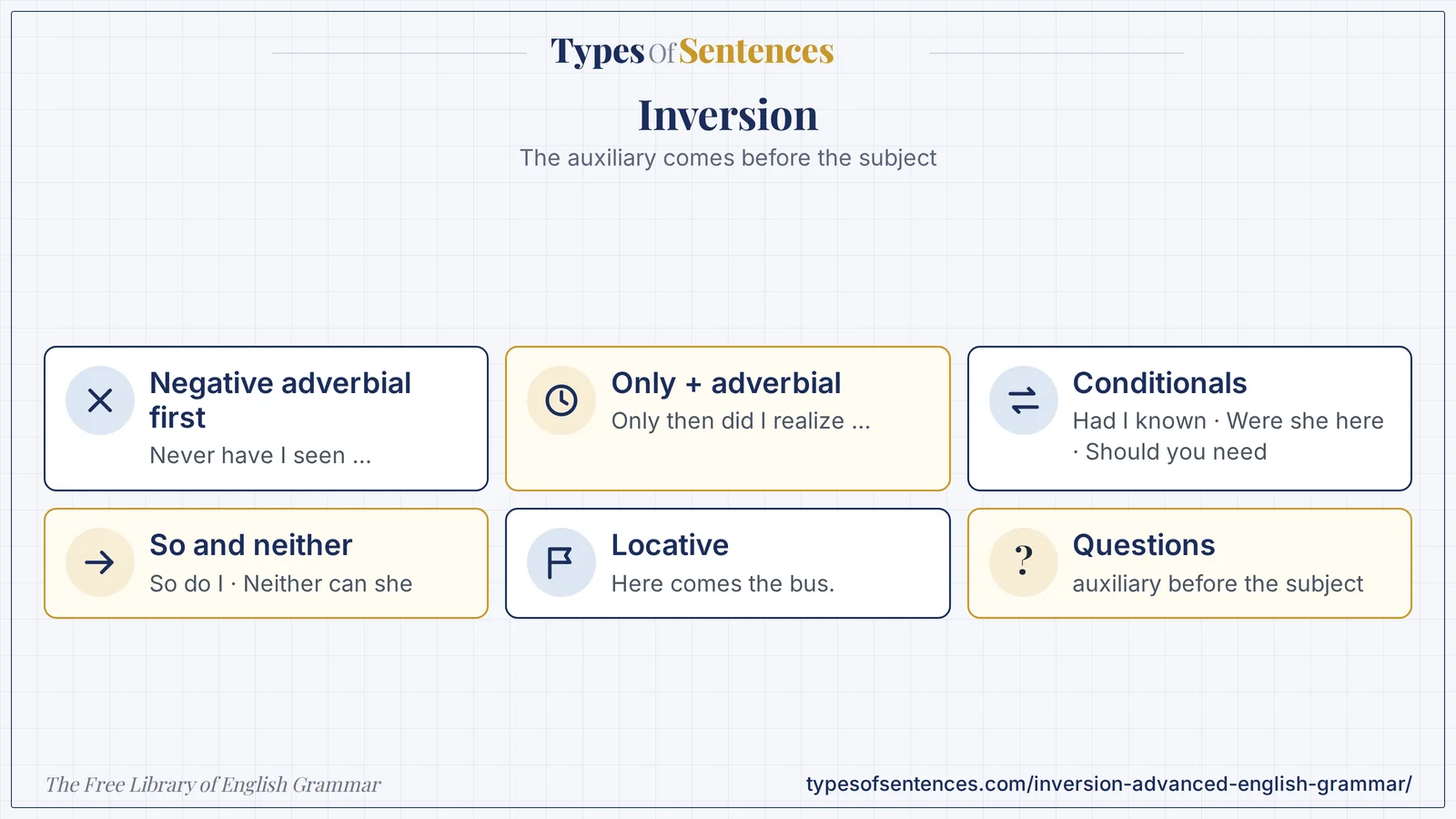
Normally English puts the subject before the verb. Inversion moves an auxiliary (or, in some cases, the main verb) in front of the subject. In questions this is routine. In statements it is a deliberate choice that gives a formal or dramatic tone.
Why it matters: The key rule for statements: when a negative or restrictive adverbial comes first, the auxiliary comes before the subject. Never have I seen such a sight.
Summary: There are two kinds of inversion. In subject-auxiliary inversion, the first auxiliary (or do) precedes the subject: questions, negative and restrictive adverbials at the start (Never have I seen, Only then did I realize), conditional clauses (Had I known), and clauses with so, neither, and nor. In full subject-verb inversion, the whole verb precedes a noun-phrase subject after a fronted locative (On the hill stood a castle, Here comes the bus).
- Negative adverbial first → auxiliary before subject.
- Only + adverbial first → inversion.
- Conditionals: Had I known, Were she here, Should you need.
- So do I, Neither can she; locative: Here comes the bus.
What You’ll Learn
- 1. Inversion in English: What Is Inversion?
- 2. Inversion in Questions (Review)
- 3. Inversion After Negative and Restrictive Adverbials
- 4. Inversion After Only
- 5. Inversion in Conditional Clauses
- 6. Inversion After So, Neither, and Nor
- 7. Locative and Full Subject-Verb Inversion
- 8. Inversion for Emphasis and in Comparisons
- 9. Inversion in Exclamations
- 10. Style, Register, and Use
- 11. Common Errors with Inversion
- 12. Exercises
- 13. Test Your Knowledge
- 14. Frequently Asked Questions
- 15. Conclusion
1. Inversion in English: What Is Inversion?
In a normal English statement, the subject comes before the verb: She has seen it. Inversion puts an auxiliary (the operator) before the subject: Has she seen it? If the sentence has no auxiliary, do is added (Does she see it?). The rule is the same as for the NICE properties in the chapter on advanced verb concepts.
| Type | Pattern | Example | Where used |
|---|---|---|---|
| subject-auxiliary inversion | auxiliary + subject + main verb | Has she seen it? Never have I seen it. | questions; negative adverbials; conditionals; so/neither |
| do-support inversion | do + subject + base verb | Does she see it? Rarely does she complain. | verbs without an auxiliary |
| full subject-verb inversion | verb + subject (noun phrase) | On the hill stood a castle. Here comes the bus. | locative and presentational sentences |
| quotative inversion | quote + verb + subject | “Come in,” said the old man. | fiction and reporting |
Inversion has two sources: it is required in questions, and it is a stylistic choice after fronted adverbials. In formal and literary writing it gives emphasis and a formal tone; in conversation it occurs in a small number of fixed patterns. The chapter on fronting and postponement treats the fronting that usually triggers it.
2. Inversion in Questions (Review)
| Question type | Example | Rule |
|---|---|---|
| yes/no with auxiliary | Is she coming? Can you help? Has he gone? | the first auxiliary before the subject |
| yes/no with do | Do you like it? Did she call? | do added when there is no auxiliary |
| wh-question (object or adverbial) | Where is she? What did you buy? Why are they late? | wh-word + inverted auxiliary |
| wh-question (subject) | Who called? What happened? | no inversion: the wh-word is the subject |
| negative question | Isn’t she coming? Is she not coming? (formal) | n’t moves with the auxiliary |
| tag question | She is coming, isn’t she? | inverted tag |
| embedded question | I wonder where she is. (no inversion) | statement order in a nominal clause |
| echo question | You did WHAT? | no inversion |
Questions and their word order are treated in the chapter on advanced question formation. Note that embedded questions do not invert (I wonder where she is), a point that is treated in the chapter on nominal clauses.
3. Inversion After Negative and Restrictive Adverbials
When a negative or restrictive adverbial is placed at the beginning of a clause, the auxiliary comes before the subject. This is the main stylistic use of inversion.
| Adverbial | Example | Notes |
|---|---|---|
| never | Never have I seen such a sight. Never did she lie. | very common in formal writing |
| rarely, seldom | Rarely does he come. Seldom had she felt so happy. | near-negatives |
| hardly … when, scarcely … when, barely … when | Hardly had he left when it started to rain. | when after hardly |
| no sooner … than | No sooner had he left than it rained. | than after no sooner |
| not only … but also | Not only did she win, but she also set a record. | inversion in the first clause only |
| not until … | Not until noon did she leave. | the main clause inverts |
| nowhere, nothing, no one | Nowhere have I seen such beauty. Nothing did he say. | negative pronouns and adverbs |
| little (= not at all) | Little did he know that she was watching. | a verb of knowing |
| under no circumstances, on no account, in no way, at no time, by no means | Under no circumstances should you open it. At no time was she in danger. | prepositional negative phrases |
| not a word, not once, not a single | Not a word did she say. Not once did he apologize. | negative object or adverbial |
| no longer | No longer can we ignore the problem. | — |
| neither, nor | He did not call; nor did he write. | after a negative clause |
| Fronted | Not fronted (no inversion) |
|---|---|
| Rarely does she complain. | She rarely complains. |
| Seldom had they met. | They had seldom met. |
| Under no circumstances should you go. | You should not go under any circumstances. |
| Not until noon did she leave. | She did not leave until noon. |
| Little did he know … | He knew little. (a different meaning) |
Native speakers use these patterns mostly in writing, speeches, and formal narration. In casual conversation they sound stiff, though a few (Never have I …, Not only … but also) are heard in speeches and public talks. The correlative not only … but also is treated in the chapter on advanced conjunction concepts; note that only the first clause inverts, not the second.
4. Inversion After Only
Only followed by an adverbial at the beginning of a clause triggers inversion. It acts as a restrictive adverb, equivalent to a negative (not until, no other time).
| Pattern | Example | Notes |
|---|---|---|
| only + time | Only then did I realize. Only recently have I understood. Only once has she been late. | — |
| only after/before + phrase | Only after dinner can we discuss it. Only after she left did he speak. | — |
| only when/if + clause | Only when you finish may you leave. Only if you agree will we begin. | inversion in the main clause, not the only clause |
| only by/in + phrase | Only by working hard can you succeed. Only in this way will it work. | — |
| only + noun phrase (subject) | Only Maria knew. (no inversion) | only modifies the subject |
| only not at the start | She could only wait. | no inversion |
Only with an adverbial at the start requires inversion in the main clause.
The test is the position of only: when it begins an adverbial that is fronted (Only then, Only after dinner), the main clause is inverted; when only modifies the subject (Only Maria knew) or comes later in the sentence, it is not.
5. Inversion in Conditional Clauses
| With if | Inverted | Meaning |
|---|---|---|
| If I had known, I would have come. | Had I known, I would have come. | unreal past |
| If she were here, she would help. | Were she here, she would help. | unreal present |
| If you should need help, call me. | Should you need help, call me. | unlikely future |
| If it were not for your help, I would fail. | Were it not for your help, I would fail. | “but for” |
| If it had not been for you, we would have lost. | Had it not been for you, we would have lost. | “but for” (past) |
| If she had not left, she would have seen it. | Had she not left, she would have seen it. | negative: not follows the subject |
Only three auxiliaries can open an inverted conditional: had, were, and should. No other verb is used (*Did I know). The negative form is Had she not left, never Hadn’t she left. The conditional clauses are described in the chapters on advanced adverbial clauses and in the Intermediate chapter on other conditional patterns.
6. Inversion After So, Neither, and Nor
| Pattern | Example | Meaning |
|---|---|---|
| so + auxiliary + subject | She likes tea, and so do I. I am tired, and so is he. | agreement with a positive statement |
| neither + auxiliary + subject | He doesn’t smoke, and neither do we. She can’t swim; neither can I. | agreement with a negative statement |
| nor + auxiliary + subject | He did not call; nor did he write. | a second negative |
| so + subject + auxiliary (no inversion) | It was cold. — So it was. They said she was late, and so she was. | confirmation: “that is true” |
| informal short forms | Me too. Neither do I. (or Me neither.) | conversational |
| Meaning | With inversion | Without inversion |
|---|---|---|
| agree (me too) | So do I. | — |
| confirm (it is true) | — | So I did. So it is. |
| agree (negative) | Neither do I. | — |
| correct or contradict | — | I did not! — Yes, you did. |
7. Locative and Full Subject-Verb Inversion
In full inversion, a fronted locative or directional expression is followed by the verb and then the subject. It is used in descriptions and narrative to introduce a new entity into the scene. The verb is usually intransitive and the subject is a noun phrase with new information.
| Pattern | Example | Notes |
|---|---|---|
| place PP + verb + subject | On the hill stood a castle. In the corner sat an old man. Next to the table lay a letter. | verbs of position: stand, sit, lie, hang |
| direction + verb + subject | Down the street ran the children. Out came the sun. Away went the horse. | verbs of motion |
| here/there + verb + subject | Here comes the bus. There goes my chance. Here is your coffee. | a deictic construction |
| pronoun subject (no inversion) | Here it comes. There he goes. Away they went. | pronouns do not invert |
| predicate adjective + be + subject | Happy are those who help. Blessed are the meek. Gone are the days when … | literary or biblical |
| such + be + subject | Such is life. Such was his anger that he left. | — |
| so + adjective + be + subject | So great was her fear that she could not move. | result clause follows |
8. Inversion for Emphasis and in Comparisons
| Context | Example | Register |
|---|---|---|
| result with so or such at the start | So tired was she that she fell asleep. Such was the noise that nobody could sleep. | formal |
| comparison with than/as | She earns more than does her brother. He studied law, as did his father. | formal |
| fronted object (negative) | Not a word did she say. Nothing did he say. | literary |
| after a fronted complement | Great was his surprise. Strange it was. | literary |
| quotative inversion | “Come in,” said the old man. “I am ready,” said Maria. | fiction |
| after a fronted participle | Standing at the door was a stranger. Attached is the report. | formal, business |
| fronted adverbial of manner | Slowly and carefully did she open the door. | literary |
Inversion is a tool of emphasis. It puts the fronted element in focus and delays the subject, which creates suspense. It should be used selectively, since a text full of inversions sounds artificial. Related emphasis structures are cleft sentences (the previous chapter) and the other devices in the chapter on emphasis and focus.
9. Inversion in Exclamations
| Pattern | Example | Notes |
|---|---|---|
| how + adjective + inversion (formal or literary) | How beautiful is the sunset! | the usual form has no inversion: How beautiful the sunset is! |
| what + noun phrase + subject + verb | What a mess he is in! What a lovely day it is! | no inversion |
| informal exclamatory inversion | Boy, was I tired! Man, is it hot! Was it ever cold! | a rhetorical use |
| do I ever, did he ever | Do I ever! (= Yes, very much) Did he ever! | emphatic agreement |
| am I not as a rhetorical question | Am I not right? Isn’t it obvious? | rhetorical question |
The informal exclamatory inversion (Boy, was I tired!) is common in American speech and is not a formal pattern. Do not confuse it with the standard exclamation without inversion: How tired I was!
10. Style, Register, and Use
| Use inversion when | Avoid it when |
|---|---|
| you want a formal, literary, or rhetorical effect | the context is casual conversation or informal writing |
| you introduce a new entity in a description (On the hill stood a castle) | the subject is a pronoun (Here it comes) |
| you want to emphasize a negative or restrictive adverbial (Never have I …) | you use many such sentences in a row |
| you write a conditional in a formal style (Had I known) | the plain if form is clearer to the audience |
| you give a speech or an argument that needs rhythm | a plain sentence says it more simply |
- Check the scope of the adverbial. The inversion applies to the clause in which the adverbial is fronted.
- Match the auxiliary. The first auxiliary moves; the others stay: Never has she been able to explain it.
- Do not mix registers. A single formal inversion in a chatty email may look odd.
- Read the sentence aloud. If it sounds stilted, use the normal order.
11. Common Errors with Inversion
| Error | Correction | Rule |
|---|---|---|
| Never I have seen such a sight. | Never have I seen such a sight. | invert after a fronted negative |
| Rarely he comes. | Rarely does he come. | do and the base form |
| Only then I realized. | Only then did I realize. | only + adverbial |
| Not only she won, but she also set a record. | Not only did she win, but she also set a record. | invert the first clause |
| Not only did she won. | Not only did she win. | base form after did |
| Hardly had he left than it rained. | Hardly had he left when it rained. | hardly … when |
| No sooner had he left when it rained. | No sooner had he left than it rained. | no sooner … than |
| Here comes it. | Here it comes. | a pronoun subject does not invert |
| On the table put she the book. | On the table she put the book. | no inversion with a transitive verb |
| I wonder where is she. | I wonder where she is. | no inversion in embedded questions |
| He doesn’t smoke, and so don’t we. | He doesn’t smoke, and neither do we. | neither after a negative |
| Had she not known. | Had she not known, … | a conditional needs a main clause |
| Hadn’t she left, she would have seen it. | Had she not left, she would have seen it. | not follows the subject |
Edit: Never I have seen such a sight, and not only the river was frozen but also the road, and only then I realized that on the hill put a castle, so was great my surprise that hadn’t I left, I would have stayed, and neither can I explain it, nor did I wanted to.
- Never I have seen: Never have I seen.
- not only the river was frozen: not only was the river frozen.
- only then I realized: only then did I realize.
- on the hill put a castle: on the hill stood a castle (intransitive verb).
- so was great my surprise: so great was my surprise.
- hadn’t I left: had I not left.
- nor did I wanted: nor did I want.
- Result: Never have I seen such a sight, and not only was the river frozen but also the road. Only then did I realize that on the hill stood a castle. So great was my surprise that, had I not left, I would have stayed, and I cannot explain it, nor did I want to. (A better edit would rewrite it in the normal order.)
Recap in 12 seconds
Watch the lesson build itself: Inversion follows negative and restrictive adverbials, appears in conditionals, so and neither clauses, and locative openings, and in questions. The video has no sound.
Exercises
Part A: Questions and Basic Inversion (Exercises 1–6)
Exercise 1: Invert: She has seen it. (question)
Show Answer
Answer: Has she seen it?
Exercise 2: Add do: She likes tea. (question)
Show Answer
Answer: Does she like tea?
Exercise 3: Which needs no inversion: Who called? or Where is she?
Show Answer
Answer: Who called?
Exercise 4: Edit: I wonder where is she.
Show Answer
Answer: I wonder where she is.
Exercise 5: Make the negative question formal: Isn’t she coming?
Show Answer
Answer: Is she not coming?
Exercise 6: Name the operator in Has she gone?
Show Answer
Answer: has.
Part B: Negative Adverbials (Exercises 7–14)
Exercise 7: Invert: I have never seen such a sight. (Never …)
Show Answer
Answer: Never have I seen such a sight.
Exercise 8: Invert: He rarely comes. (Rarely …)
Show Answer
Answer: Rarely does he come.
Exercise 9: Invert: She had hardly left when it rained.
Show Answer
Answer: Hardly had she left when it rained.
Exercise 10: Invert: He had no sooner left than it rained.
Show Answer
Answer: No sooner had he left than it rained.
Exercise 11: Invert: She not only won but also set a record.
Show Answer
Answer: Not only did she win, but she also set a record.
Exercise 12: Invert: She did not leave until noon. (Not until …)
Show Answer
Answer: Not until noon did she leave.
Exercise 13: Invert: You should not open it under any circumstances. (Under no circumstances …)
Show Answer
Answer: Under no circumstances should you open it.
Exercise 14: Edit: Little he knew.
Show Answer
Answer: Little did he know.
Part C: Only and Conditionals (Exercises 15–21)
Exercise 15: Invert: I realized the truth only then. (Only then …)
Show Answer
Answer: Only then did I realize the truth.
Exercise 16: Invert: We can discuss it only after dinner.
Show Answer
Answer: Only after dinner can we discuss it.
Exercise 17: Is there inversion in Only Maria knew.?
Show Answer
Answer: No (only modifies the subject).
Exercise 18: Invert: If I had known, I would have come.
Show Answer
Answer: Had I known, I would have come.
Exercise 19: Invert: If she were here, she would help.
Show Answer
Answer: Were she here, she would help.
Exercise 20: Invert: If you should need help, call me.
Show Answer
Answer: Should you need help, call me.
Exercise 21: Edit: Hadn’t she left, she would have seen it.
Show Answer
Answer: Had she not left, she would have seen it.
Part D: So, Neither, Locative (Exercises 22–27)
Exercise 22: Complete: She likes tea, and so ___ I.
Show Answer
Answer: do.
Exercise 23: Complete: He can’t swim, and neither ___ she.
Show Answer
Answer: can.
Exercise 24: Complete: I am tired, and so ___ he.
Show Answer
Answer: is.
Exercise 25: Invert: A castle stood on the hill. (On the hill …)
Show Answer
Answer: On the hill stood a castle.
Exercise 26: Edit: Here comes it.
Show Answer
Answer: Here it comes.
Exercise 27: Edit: On the table put she the book.
Show Answer
Answer: On the table she put the book.
Part E: Emphasis and Errors (Exercises 28–30)
Exercise 28: Invert: She was so tired that she fell asleep. (So …)
Show Answer
Answer: So tired was she that she fell asleep.
Exercise 29: Edit: Hardly had he left than it rained.
Show Answer
Answer: Hardly had he left when it rained.
Exercise 30: Edit: Only then I realized.
Show Answer
Answer: Only then did I realize.
Test Your Knowledge
Ready to check what you learned? Answer all 10 questions, then submit. You need 80% (8 of 10) to pass. Your answers are not stored.
View correct answers and explanations
Question 1: What is inversion?
✓ Correct Answer: A – placing an auxiliary before the subject
Inversion reverses subject and auxiliary.
Question 2: Which is correct?
✓ Correct Answer: C – Never have I seen such a sight.
Invert after a fronted negative.
Question 3: Which is correct?
✓ Correct Answer: D – Rarely does he come.
Do and the base form.
Question 4: Which is correct?
✓ Correct Answer: B – Only then did I realize.
Only + adverbial triggers inversion.
Question 5: Which is correct?
✓ Correct Answer: C – Hardly had he left when it rained.
Hardly … when.
Question 6: Which is the inverted conditional?
✓ Correct Answer: B – Had I known
Had + subject.
Question 7: Which is correct?
✓ Correct Answer: C – He doesn’t smoke, and neither do we.
Neither after a negative.
Question 8: Which uses full inversion?
✓ Correct Answer: A – On the hill stood a castle.
Verb before the subject.
Question 9: Which is correct?
✓ Correct Answer: D – Here it comes.
A pronoun subject does not invert.
Question 10: Which is correct?
✓ Correct Answer: B – Not only did she win, but …
Invert the first clause.
Frequently Asked Questions
What is inversion in English?
Inversion in English is the reversal of the normal subject-verb order: an auxiliary goes before the subject (Has she seen it?, Never have I seen it) or, in some descriptions, the whole verb goes before the subject (On the hill stood a castle).
What is inverted word order?
Inverted word order is any order in which the verb or auxiliary comes before the subject. It is required in questions and used for emphasis after negative adverbials, only, and in conditionals without if.
What is negative inversion?
Negative inversion is the inversion that follows a fronted negative or restrictive adverbial: Never have I seen, Rarely does he come, Not only did she win, Hardly had he left.
What is subject verb inversion?
Subject verb inversion places the main verb before the subject, after a fronted locative: Here comes the bus, On the hill stood a castle. It is used in descriptions and with intransitive verbs.
What are some inversion examples in conditionals?
Had I known, I would have come. Were she here, she would help. Should you need help, call me. These are inversion examples for the unreal past, the unreal present, and the unlikely future.
When should I use inversion?
Use it in formal or literary writing, speeches, and for emphasis, and avoid it in casual conversation or when it makes the text sound stiff.
Why doesn’t “Here it comes” invert?
Because a pronoun subject does not invert after here or there. Only a noun-phrase subject does: Here comes the bus.
Conclusion
You now have a deep study of inversion: subject-auxiliary inversion in questions, inversion after negative and restrictive adverbials, after only, in conditionals, after so, neither, and nor, full subject-verb inversion, inversion for emphasis and in exclamations, and the common errors. You can use inversion with expert control.
When you want a formal or dramatic effect, front the adverbial and invert, and check that the auxiliary and the verb forms are correct. Next, you will study ellipsis and substitution.
- Huddleston, Rodney, and Geoffrey K. Pullum. The Cambridge Grammar of the English Language. Cambridge University Press, 2002.: the reference analysis of subject-auxiliary and subject-dependent inversion.
- Quirk, Randolph, et al. A Comprehensive Grammar of the English Language. Longman, 1985.: the classic treatment of inversion.
- Biber, Douglas, et al. Longman Grammar of Spoken and Written English. Longman, 1999.: corpus evidence on the frequency of inversion.
- Garner, Bryan A. Garner’s Modern English Usage, 5th ed. Oxford University Press, 2022.: usage guidance on hardly … when and no sooner … than.
- Merriam-Webster Dictionary: inversion: the dictionary entry.
Last reviewed: October 29, 2026. How it was made: drafted with AI assistance, then checked with automated tests (structure, links, answer keys, spelling) and against the sources above. A person has not yet read this chapter line by line. Found a mistake? Report it.