Advanced article usage deals with the smallest and most frequent words in English: a, an, and the. They are also among the hardest to master, because the choice depends not on grammar alone but on what the speaker assumes that the listener already knows. These complex articles also include the “zero article”, the choice to use no article at all, which is as meaningful as the other two.
This chapter studies the system in depth. You will learn the idea of definiteness, the detailed uses of the indefinite article, the definite article, and the zero article, the way articles work with countable and uncountable nouns, the rules for proper nouns and geographic names, and the fixed phrases that must simply be learned. These article complexities are summarized in a decision procedure that applies to any noun phrase and leads to expert articles. Thirty editing exercises and a quiz follow.
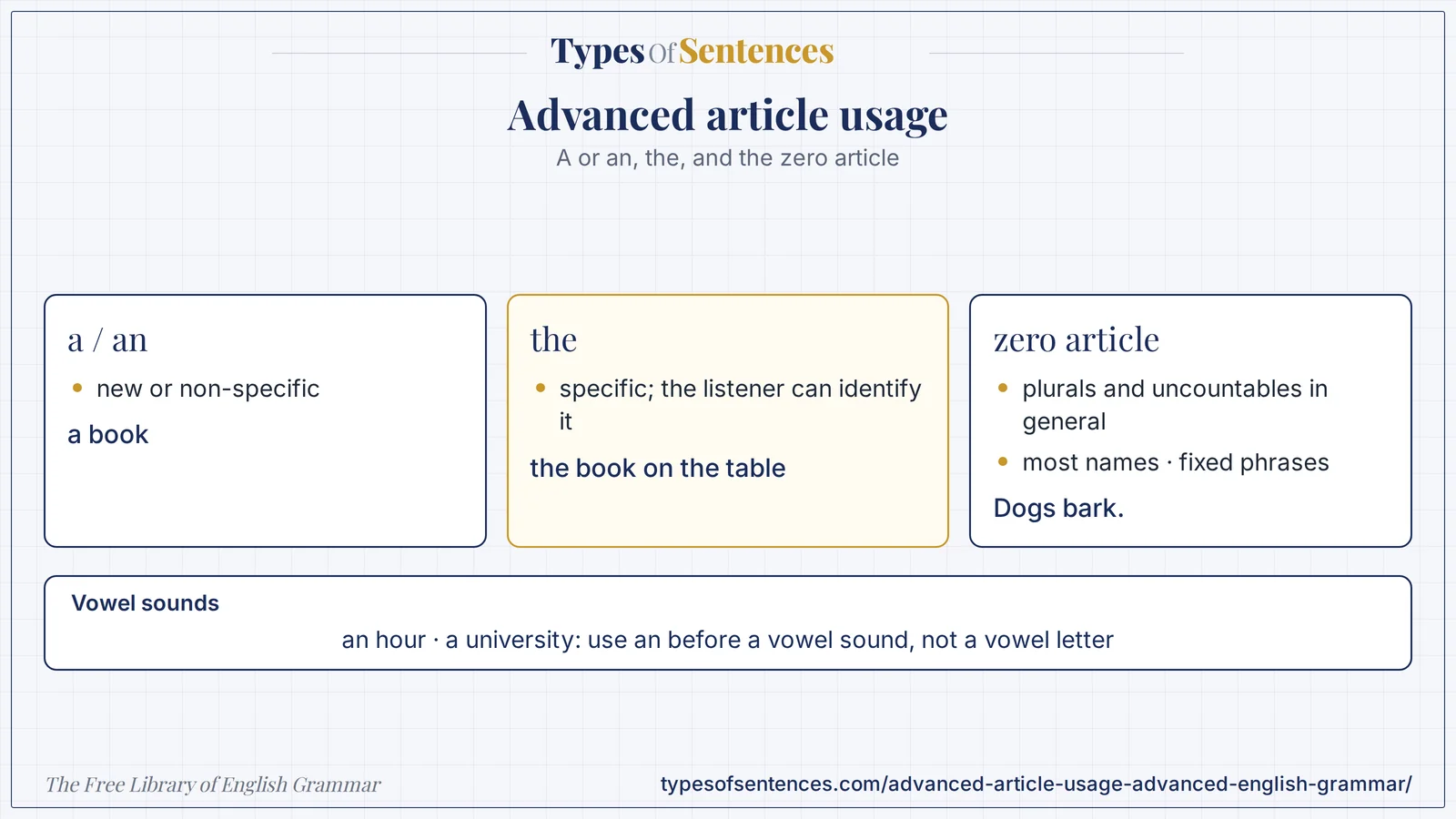
An article tells the listener whether you mean one particular thing that both of you can identify (the book), one example of a type (a book), or the kind in general (books).
Why it matters: Speakers of languages without articles find this hard because the choice is not about the noun but about the situation. The way to get it right is to ask the same few questions every time.
Summary: The definite article the marks a noun phrase that the listener can identify. The indefinite articles a/an introduce a singular countable noun that is new or not specific. The zero article is used with plural and uncountable nouns in a general sense, with names, and in many fixed phrases. The decision depends on four things: whether the noun is countable, whether it is singular, whether it is specific, and whether the listener can identify it.
- a/an: one of many, new or non-specific.
- the: a specific one that the listener can identify.
- zero: plural or uncountable in general; most names; fixed phrases.
- Use an before a vowel sound, not a vowel letter.
What You’ll Learn
- 1. Advanced Article Usage: Definiteness and the Article System
- 2. Indefinite Articles (a, an) in Detail
- 3. The Definite Article (the) in Detail
- 4. The Zero Article
- 5. Articles with Countable and Uncountable Nouns
- 6. Articles with Proper Nouns
- 7. Articles with Geographic Names
- 8. Fixed Phrases With and Without Articles
- 9. Articles in Discourse: Given, New, and Headlines
- 10. A Procedure for Choosing an Article
- 11. Common Errors with Articles
- 12. Exercises
- 13. Test Your Knowledge
- 14. Frequently Asked Questions
- 15. Conclusion
1. Advanced Article Usage: Definiteness and the Article System
Articles are determiners that mark whether a noun phrase is definite (the listener can identify what is meant) or indefinite (the listener cannot, or it does not matter which). The two ideas of definiteness and specificity are related but not the same.
| Idea | Question | Example |
|---|---|---|
| definite | Can the listener identify it? | The book on the table is mine. |
| indefinite | Is it new, or any member of a class? | I bought a book. |
| specific | Does the speaker have one in mind? | I’m looking for a book that I lost. (a particular book) |
| non-specific | Is any member acceptable? | I’m looking for a book to read on the trip. (any book) |
| generic | Does it refer to the class as a whole? | A dog is loyal. The dog is loyal. Dogs are loyal. |
| Noun type | Indefinite | Definite | Generic or zero |
|---|---|---|---|
| singular countable | a book / an idea | the book | a book / the book (generic) |
| plural countable | some books | the books | books |
| uncountable | some water | the water | water |
The singular countable noun cannot stand without a determiner in English: *I bought book is wrong. Plural and uncountable nouns can, and then the zero article gives a general or unspecified meaning. For the countability of nouns, see the chapter on advanced noun concepts.
2. Indefinite Articles (a, an) in Detail
The choice between a and an depends on the sound of the next word, not its spelling.
| Rule | Examples |
|---|---|
| an before a vowel sound | an apple, an egg, an hour, an honest man, an MBA, an FBI agent, an X-ray, an 8-year-old |
| a before a consonant sound | a university, a one-time offer, a European, a unit, a historic event (American), a U.N. official, a 1980s song |
| words beginning with h | an hour, an honor; a house, a horse; historic and hotel usually take a in American English |
| acronyms and initialisms | by the sound of the first letter: an SOS, an LCD screen, a NASA scientist |
| SQL, URL, FAQ | varies with pronunciation (a SQL if pronounced “sequel”, an SQL if letter by letter) |
| Use | Example | Notes |
|---|---|---|
| introduces something new | I saw a man. The man was tall. | first mention |
| one example of a type (non-specific) | I need a pen. | any pen will do |
| class membership or profession | She is a doctor. He became a father. | after be, become |
| generic (a type) | A cat is a mammal. | definition style |
| rate or frequency (per) | twice a day; $5 a pound | means per |
| exclamations | What a day! Such a pity! | what and such take a |
| quantity phrases | a few, a little, a lot, a couple, a bit, a number of | a few and a little are positive; few and little are negative |
| a proper name used as common noun | a Kennedy (a member of that family), a Picasso (a work) | see below |
| a certain, a + unnamed person | a certain Mr. Smith | someone I don’t know |
| in fixed phrases | once upon a time, as a rule, in a hurry | learn as units |
Note the contrast in meaning: I have a few friends (some, enough) and I have few friends (hardly any). The article changes the attitude from positive to negative, a favorite point in advanced usage. The quantifiers are in the chapter on quantifiers at the Intermediate level.
3. The Definite Article (the) in Detail
The definite article is pronounced thuh before a consonant sound and thee before a vowel sound (the apple), and with stress for emphasis (the man I mentioned). It signals that the noun phrase is identifiable. The identification can come from several sources.
| Source of identifiability | Example | Notes |
|---|---|---|
| previous mention (anaphoric) | I bought a car. The car is red. | the noun was introduced earlier |
| shared knowledge or situation | Pass the salt. Close the door. | both people can see it |
| unique in the world or context | the sun, the moon, the sky, the president, the internet | only one |
| modification that identifies | the book that I read, the end of the road, the girl in red | the modifier makes it identifiable |
| superlatives and ordinals | the best, the first, the last, the next, the only, the same, the other | they imply uniqueness |
| associated with something mentioned (bridging) | I rented a house. The kitchen was small. | a house has a kitchen |
| generic with a singular count noun | The whale is a mammal. The computer has changed life. | formal or scientific; a type |
| adjectives used as nouns | the rich, the poor, the unexpected | plural meaning |
| nationalities (plural) | the French, the Dutch, the Japanese | plural |
| musical instruments | play the piano, the guitar | in American usage also with no article in some styles |
| decades and centuries | the 1990s, the nineteenth century | a period |
| comparatives (correlative) | The sooner, the better. | a special use of the |
| body parts after a verb + preposition | She hit him on the head. He grabbed me by the arm. | instead of a possessive |
Some uses vary between American and British English, or between registers. For example, go to the hospital (American) versus go to hospital (British) when the sense is “as a patient”. For a musical instrument, play the guitar is standard in American English, while British English sometimes drops the (play guitar), and both occur in informal American English.
| Contrast | Meaning |
|---|---|
| the with a unique noun versus a | the moon (ours) versus a moon (of another planet) |
| the other versus another | the other: the remaining one; another: one more |
| the same versus a similar | the same: identical; a similar: like it |
| the + adjective | the old (all old people), versus an old man (one man) |
4. The Zero Article
The zero article is not an omission; it is a meaningful choice that marks a general or unspecified reference.
| Use | Example | Notes |
|---|---|---|
| plural countable nouns in general | Books are expensive. Children need sleep. | the generic plural |
| uncountable nouns in general | Water is essential. Information is power. | substances and abstractions |
| abstract nouns | Freedom matters. Love is blind. | general concepts |
| languages and school subjects | She speaks French. He studies physics. | but the French language |
| meals | Let’s have lunch. Breakfast is ready. | unless specified: the lunch we had |
| sports and games | He plays tennis and chess. | no article |
| institutions used for their purpose | go to school, go to church, in bed, at work, in prison | the building as a place: the school on Main Street |
| transport by means | by car, by bus, by train, on foot | means of transport |
| times and days | at night, on Monday, in winter, last week, next year | no article |
| personal names and titles | Maria; President Lincoln; Dr. Rao; Mother (as a name) | titles used as names |
| places: most countries, cities | India, Paris, Texas | exceptions below |
| fixed phrases | at home, in town, by chance, on purpose, in fact | learn as units |
| With the article | Without (a different meaning) |
|---|---|
| She is at the school. (the building) | She is at school. (as a student) |
| He went to the church. (the building) | He went to church. (to worship) |
| The hospital is near. (the building) | He is in hospital. (British: as a patient) |
| the prison on the hill | He is in prison. (as an inmate) |
| the bed in the corner | She is in bed. (sleeping or resting) |
5. Articles with Countable and Uncountable Nouns
| Noun | Singular countable | Plural countable | Uncountable |
|---|---|---|---|
| a / an | a book | — | — |
| the | the book | the books | the information |
| zero | — | books (in general) | information (in general) |
| some / any | — | some books | some information |
Uncountable nouns never take a or an in their ordinary use: *an information, *an advice. Use some or a partitive: some information, a piece of advice. But many nouns are used both ways with a difference in meaning: coffee (the substance) and a coffee (a cup), wine and a wine (a kind), paper and a paper (an essay or newspaper). Here, the article signals the countable sense.
| Noun | Uncountable (zero article) | Countable (article) |
|---|---|---|
| coffee | I like coffee. | Two coffees, please. |
| experience | She has experience. | It was an experience. |
| room | There is no room. | We have a room. |
| time | Time flies. | a good time; three times |
| chicken | We ate chicken. | a chicken in the yard |
The definite article can go with an uncountable noun to make it specific: The information that you gave me was useful (a particular body of information), and with a plural noun: The books on the shelf are mine.
6. Articles with Proper Nouns
| Type | Rule | Examples |
|---|---|---|
| personal names | no article | Maria, Mr. Smith, Dr. Rao |
| families and plural names | the + plural | the Smiths, the Kennedys, the Joneses |
| identifying a person among others of the same name | the + stress | the Mr. Smith who called yesterday (not the one you know) |
| a name used as a common noun | a or the | a Kennedy (a member), a Picasso (a work by him), the Beethoven of our age |
| a name with a modifier | the often | the London of the 1960s, the young Mozart, the real Maria |
| organizations and institutions | often the | the United Nations, the BBC, the FBI, the Supreme Court; but NATO, UNESCO, Microsoft |
| acronyms pronounced as letters | the | the FBI, the CIA, the UN |
| acronyms pronounced as words | no article | NASA, NATO, UNESCO |
| newspapers | the | the New York Times, the Guardian |
| ships, trains, planes | the | the Titanic, the Orient Express |
| hotels, theaters, museums | often the | the Hilton, the Globe, the Louvre; but Harvard University, Madison Square Garden |
| holidays and days | no article, except a few | Christmas, Diwali, Easter; the Fourth of July |
| titles of works | depend on the title | the Odyssey, Hamlet, the Bible, Time (the magazine) |
The rules for names are conventions, and a few are surprising: the Netherlands, the Philippines, the United States, and the Hague take the, while Ukraine and Sudan are now usually written without it. A current style guide or atlas is the reliable reference, and the guide to capitalization and the chapter on capitalization treat the writing of names.
7. Articles with Geographic Names
| No article (singular names) | Examples |
|---|---|
| continents | Asia, Europe, Africa, North America |
| most countries | India, France, Brazil, Japan, Nigeria |
| cities and towns | Paris, Mumbai, Austin |
| states, provinces, counties | Texas, Kerala, Yorkshire |
| single lakes | Lake Superior, Lake Victoria |
| single mountains | Mount Everest, Mount Fuji, Everest |
| islands (single) | Hawaii, Sicily, Madagascar, Bali |
| streets, squares, parks | Oak Street, Times Square, Central Park |
| airports, stations, bridges named for places | Heathrow, Grand Central Station, Brooklyn Bridge |
| the (names that are plural, or types) | Examples |
|---|---|
| plural names (mountain ranges, islands, countries) | the Alps, the Rockies, the Himalayas, the Bahamas, the Philippines, the Netherlands |
| rivers | the Nile, the Ganges, the Mississippi, the Thames |
| oceans and seas | the Pacific, the Atlantic, the Mediterranean, the Arabian Sea |
| deserts | the Sahara, the Gobi, the Thar |
| canals, straits, gulfs | the Suez Canal, the Strait of Gibraltar, the Persian Gulf |
| peninsulas and regions | the Iberian Peninsula, the Midwest, the Middle East, the Arctic |
| countries with Republic, Kingdom, Union, States, Emirates | the United Kingdom, the Czech Republic, the United States, the United Arab Emirates |
| groups of lakes | the Great Lakes |
| names with of | the Gulf of Mexico, the Cape of Good Hope, the Bay of Bengal |
A useful pattern: a single named feature (one mountain, one lake, one island) takes no article, and a group or a type of feature (a range, a river, an ocean, a desert) takes the. Mount Everest is a single mountain, and the Himalayas is a range. There are exceptions; consult a reference for names that you do not know.
8. Fixed Phrases With and Without Articles
| Without an article | With an article |
|---|---|
| at home, at work, at night, at first, at last, at once | at the moment, at the end, at the beginning, at the same time |
| by chance, by mistake, by hand, by car | by the way, by the end of the day, by the hour |
| in fact, in time, in touch, in love, in danger, in public | in the end, in the morning, in the middle, in the future, in the world |
| on foot, on purpose, on time, on holiday (British), on average | on the other hand, on the whole, on the way, on the radio |
| out of date, out of order, out of control | out of the way, out of the question |
| go to bed, go to school, go to sea, go home, go abroad | go to the cinema, go to the bank, go to the doctor (the person) |
| play football, listen to music, watch television | listen to the radio, watch the news, read the paper |
| take place, take care, take part | take a look, take the bus, take the opportunity |
Pairs differ in meaning: at last (finally) and at the last (formal: at the final moment); in time (soon enough) and in the time of (during the age of); in front of (before) and in the front of (in the forward part of): in the front of the car. Collocations like these must be learned as units; see the chapter on collocation.
9. Articles in Discourse: Given, New, and Headlines
In a text, articles manage the flow of information. A noun phrase with a introduces something new, and later mentions with the refer back to it. This is the basis of cohesion, treated in the chapter on reference and deixis.
- I rented a house. The house had a garden. The garden was overgrown. new, then given
- We saw a film last night. The director is Indian. a film has a director (bridging)
- A man and a woman entered. The man sat down; the woman stood. introduction and tracking
| Context | Practice | Example |
|---|---|---|
| headlines | articles omitted for space | Police Arrest Suspect; Government Plans New Tax |
| notes and telegraphic style | articles omitted | Arrive Monday. Need tickets. |
| instructions | articles often kept | Press the button. Insert a coin. |
| labels and signs | articles omitted | Exit; Danger; Out of order |
| academic writing | the generic plural is usual | Researchers have shown that … |
| definitions | a/an + noun | A noun is a word that names a person, place, thing, or idea. |
10. A Procedure for Choosing an Article
- Is the noun a proper name? Use the conventions for names (usually none, but the for plural and many institutional names).
- Is it uncountable or plural? If you mean the kind in general, use no article. If you mean particular ones that the listener can identify, use the.
- Is it singular and countable? You must have a determiner: a/an, the, this, my, and so on.
- Can the listener identify it? (Mentioned before, unique, shared, or identified by a modifier?) If yes, use the.
- If not, use a/an (one of many, or new).
- Is it a fixed phrase? Check whether the phrase needs a particular article.
| Sentence | Decision |
|---|---|
| I need ___ pen. | singular, countable, new, non-specific: a pen |
| ___ pen on the desk is mine. | specific, identified: The pen |
| ___ pens are cheap. | plural, general: zero: Pens are cheap |
| She has ___ experience. | uncountable, general: zero |
| He is ___ honest man. | vowel sound: an honest man |
| We stayed in ___ Hilton. | a hotel name: the Hilton |
11. Common Errors with Articles
| Error | Correction | Rule |
|---|---|---|
| I bought book. | I bought a book. | singular countable needs a determiner |
| She gave me an advice. | She gave me some advice. / a piece of advice. | uncountable |
| an university | a university | sound, not spelling |
| a hour | an hour | silent h |
| The life is short. | Life is short. | general abstract noun |
| I like the music. (in general) | I like music. | general |
| He plays the football. | He plays football. | sports take no article |
| She is at the school. (as a student) | She is at school. | institution used for its purpose |
| I went to the bed. | I went to bed. | fixed phrase |
| I live in the India. | I live in India. | most countries take no article |
| They visited Netherlands. | They visited the Netherlands. | a plural name takes the |
| What the nice day! | What a nice day! | what + a |
| such nice a day | such a nice day | such + a |
Edit: I have bought book about the history, and she gave me an advice that the life is short, but I live in the United Kingdom and we like the music, so we play the tennis at the school in a hour, by the car.
- bought book: bought a book.
- about the history: general: about history.
- an advice: some advice (or a piece of advice).
- the life is short: life is short.
- the music (in general): music; the tennis: tennis.
- at the school (as a student): at school.
- in a hour: in an hour; by the car: by car.
- Result: I have bought a book about history, and she gave me some advice that life is short, but I live in the United Kingdom and we like music, so we play tennis at school in an hour, by car. (The sentence is still awkward; a better edit would split it.)
Recap in 12 seconds
Watch the lesson build itself: The definite article marks a noun phrase the listener can identify, a or an introduces a new one, and the zero article goes with general plurals and uncountables. The video has no sound.
Exercises
Part A: A or An (Exercises 1–6)
Exercise 1: Choose: ___ university
Show Answer
Answer: a.
Exercise 2: Choose: ___ hour
Show Answer
Answer: an.
Exercise 3: Choose: ___ honest man
Show Answer
Answer: an.
Exercise 4: Choose: ___ FBI agent
Show Answer
Answer: an.
Exercise 5: Choose: ___ one-time offer
Show Answer
Answer: a.
Exercise 6: Explain the difference: a few friends and few friends.
Show Answer
Answer: A few is positive (some); few is negative (hardly any).
Part B: The, A, or Zero (Exercises 7–14)
Exercise 7: Edit: I bought book.
Show Answer
Answer: I bought a book.
Exercise 8: Edit: The life is short.
Show Answer
Answer: Life is short.
Exercise 9: Edit: He plays the football.
Show Answer
Answer: He plays football.
Exercise 10: Edit: She gave me an advice.
Show Answer
Answer: She gave me some advice.
Exercise 11: Choose: I saw ___ man. ___ man was tall.
Show Answer
Answer: a … The.
Exercise 12: Choose: Pass ___ salt, please.
Show Answer
Answer: the.
Exercise 13: Choose: ___ sun is a star.
Show Answer
Answer: The.
Exercise 14: Choose: She is ___ doctor.
Show Answer
Answer: a.
Part C: Institutions and Fixed Phrases (Exercises 15–20)
Exercise 15: Choose: He is at (school/the school). (as a student)
Show Answer
Answer: school.
Exercise 16: Choose: The meeting is at (school/the school) on Main Street. (the building)
Show Answer
Answer: the school.
Exercise 17: Edit: I went to the bed.
Show Answer
Answer: I went to bed.
Exercise 18: Choose: She travels (by car/by the car).
Show Answer
Answer: by car.
Exercise 19: Choose: ___ moment (at)
Show Answer
Answer: at the moment.
Exercise 20: Choose: by (chance/the chance)
Show Answer
Answer: by chance.
Part D: Names and Geography (Exercises 21–27)
Exercise 21: Choose: I live in (India/the India).
Show Answer
Answer: India.
Exercise 22: Choose: They visited (Netherlands/the Netherlands).
Show Answer
Answer: the Netherlands.
Exercise 23: Choose: ___ Alps
Show Answer
Answer: The Alps.
Exercise 24: Choose: ___ Mount Everest
Show Answer
Answer: Mount Everest (no article).
Exercise 25: Choose: ___ Nile
Show Answer
Answer: The Nile.
Exercise 26: Choose: ___ Smiths are here.
Show Answer
Answer: The Smiths.
Exercise 27: Choose: He is ___ Picasso. (a work)
Show Answer
Answer: a Picasso (I bought a Picasso).
Part E: Errors and Procedure (Exercises 28–30)
Exercise 28: Edit: What the nice day!
Show Answer
Answer: What a nice day!
Exercise 29: Edit: such nice a day
Show Answer
Answer: such a nice day.
Exercise 30: What is the first question in the decision procedure?
Show Answer
Answer: Is the noun a proper name?
Test Your Knowledge
Ready to check what you learned? Answer all 10 questions, then submit. You need 80% (8 of 10) to pass. Your answers are not stored.
View correct answers and explanations
Question 1: Which is correct?
✓ Correct Answer: A – a university
University begins with a consonant sound.
Question 2: Which is correct?
✓ Correct Answer: B – She gave me some advice.
Advice is uncountable.
Question 3: Which is correct?
✓ Correct Answer: C – I like music.
General reference takes the zero article.
Question 4: Which is correct?
✓ Correct Answer: D – He plays football.
Sports take no article.
Question 5: Which is correct?
✓ Correct Answer: C – She is at school.
Institutions used for their purpose take no article.
Question 6: Which takes the?
✓ Correct Answer: B – the Nile
Rivers take the.
Question 7: Which takes the?
✓ Correct Answer: D – the Netherlands
A plural name takes the.
Question 8: Which is correct?
✓ Correct Answer: A – What a nice day!
What + a + adjective + noun.
Question 9: What does a few mean?
✓ Correct Answer: C – some, enough
A few is positive.
Question 10: Which is the first step in the decision procedure?
✓ Correct Answer: B – Check whether the noun is a proper name
Start with proper names.
Frequently Asked Questions
What is advanced article usage?
Advanced article usage is the detailed use of a, an, the, and the zero article: definiteness and specificity, generic reference, countable and uncountable nouns, proper and geographic names, and fixed phrases.
What are complex articles?
Complex articles are the cases where the choice of article is not simple: the zero article, generic reference, names and geographic nouns, fixed phrases, and nouns that are both countable and uncountable.
What are article complexities that cause errors?
The main article complexities are articles with uncountable nouns (an advice), general nouns (The life is short), institutions (at the school), and names (in the India).
What are the advanced article rules for geographic names?
The advanced article rules for geographic names are that single features (one mountain, lake, island) take no article, while plural names, rivers, oceans, deserts, and countries with Republic or Kingdom take the.
What are expert articles?
Expert articles are articles used with full control: the right article for definiteness, the right sound for a and an, and a sure grasp of the zero article and fixed phrases.
Why do I say a university but an hour?
The choice depends on sound. University begins with a y sound (a consonant sound), so a. Hour begins with a vowel sound because the h is silent, so an.
How can I improve my use of articles?
Read and listen widely, learn fixed phrases and names as units, and apply the decision procedure: proper name, countable or not, singular or plural, specific and identifiable or not.
Conclusion
You now have a deep study of the articles: definiteness and specificity, the detailed uses of a/an, the, and the zero article, countable and uncountable nouns, proper nouns, geographic names, fixed phrases, articles in discourse, and a decision procedure. You can use articles with expert control and avoid the usual errors.
When you edit, check every noun phrase with the procedure above. Next, you begin the study of advanced clause structures with nominal clauses.
- Huddleston, Rodney, and Geoffrey K. Pullum. The Cambridge Grammar of the English Language. Cambridge University Press, 2002.: the reference analysis of determination and definiteness.
- Quirk, Randolph, et al. A Comprehensive Grammar of the English Language. Longman, 1985.: the classic treatment of the articles and generic reference.
- Biber, Douglas, et al. Longman Grammar of Spoken and Written English. Longman, 1999.: corpus evidence on article use.
- Garner, Bryan A. Garner’s Modern English Usage, 5th ed. Oxford University Press, 2022.: usage guidance on a and an before h and on place names.
- Purdue Online Writing Lab: Articles: reference pages on articles.
Last reviewed: October 29, 2026. How it was made: drafted with AI assistance, then checked with automated tests (structure, links, answer keys, spelling) and against the sources above. A person has not yet read this chapter line by line. Found a mistake? Report it.