Advanced adverbial clauses answer the questions when?, where?, why?, how?, under what condition?, in spite of what?, for what purpose?, and with what result? At the Intermediate level you learned the common subordinators. At this level the focus shifts to formal alternatives (inasmuch as, lest), to clauses that are reduced to a participle or a verbless phrase (While walking home, I met Tom), to inversion (Had I known, I would have come), and to the way that position, punctuation, and scope change meaning.
You will study the complex adverb clauses of time, reason, condition, concession, purpose, result, manner, and comparison, the reduced and verbless forms, inversion in conditional clauses, the rules of position and punctuation, and comment clauses such as as you know. Together they lead to adverb clause mastery and expert adverbial clauses, which give a writer precise control over how ideas are related. Thirty editing exercises and a quiz follow.
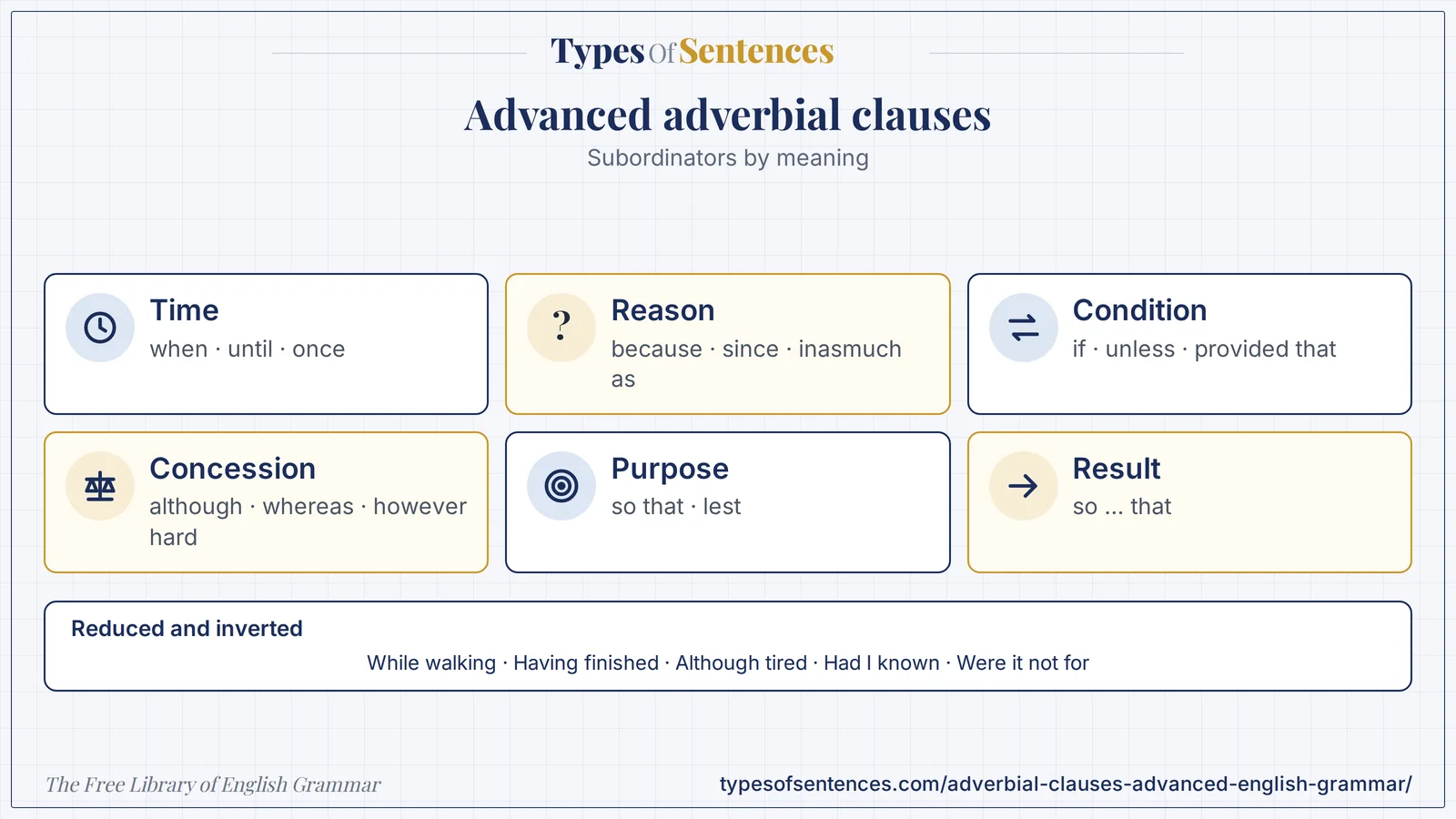
An adverbial clause is a dependent clause that works like an adverb: it tells when, where, why, how, or under what condition the main clause is true. It begins with a subordinating conjunction and has its own subject and verb.
Why it matters: The advanced questions are about choice and form: which subordinator fits the meaning and the register, when the clause can be shortened, and how its position and punctuation affect the sentence.
Summary: Adverbial clauses are introduced by subordinators that show time (when, until, once), reason (because, since, inasmuch as), condition (if, unless, provided that), concession (although, whereas, however hard), purpose (so that, lest), result (so … that), and manner (as if). They can be reduced to participial or verbless clauses when the subject is shared, and conditional clauses can be formed by inversion (Had I known). A clause before the main clause takes a comma; one after it usually does not.
- Present tense for future time and condition: when she arrives, if it rains.
- Formal reason and concession: inasmuch as, insofar as, much as.
- Reduced: While walking, Having finished, Although tired.
- Inverted conditionals: Had I known, Were it not for, Should you need.
What You’ll Learn
- 1. Advanced Adverbial Clauses: Functions and Subordinators
- 2. Adverbial Clauses of Time
- 3. Adverbial Clauses of Reason, Including Inasmuch As and Insofar As
- 4. Adverbial Clauses of Condition
- 5. Adverbial Clauses of Concession and Contrast
- 6. Adverbial Clauses of Purpose
- 7. Adverbial Clauses of Result
- 8. Manner, Comparison, and Proportion Clauses
- 9. Reduced and Verbless Adverbial Clauses
- 10. Inversion in Conditional and Other Adverbial Clauses
- 11. Position, Punctuation, and Emphasis
- 12. Comment and Disjunct Clauses
- 13. Common Errors with Adverbial Clauses
- 14. Exercises
- 15. Test Your Knowledge
- 16. Frequently Asked Questions
- 17. Conclusion
1. Advanced Adverbial Clauses: Functions and Subordinators
An adverbial clause is a dependent clause that functions as an adjunct (or a comment) in the main clause. It can be moved around the main clause, and it is introduced by a subordinating conjunction. The conjunctions are surveyed in the chapter on advanced conjunction concepts.
| Meaning | Question | Subordinators | Example |
|---|---|---|---|
| time | when? | when, whenever, while, as, before, after, since, until, till, once, as soon as, by the time, every time, the moment | Call me when you arrive. |
| place | where? | where, wherever, anywhere, everywhere | Sit where you like. |
| reason | why? | because, since, as, now that, given that, seeing that, inasmuch as, insofar as | Because it rained, we stayed. |
| condition | under what condition? | if, unless, provided that, as long as, in case, supposing, assuming (that), on condition that, even if, only if | We go if it stops. |
| concession and contrast | in spite of what? | although, though, even though, even if, while, whereas, much as, however, no matter how | Although it rained, we went. |
| purpose | for what purpose? | so that, in order that, lest, for fear that | She left early so that she could rest. |
| result | with what result? | so … that, such … that, so that | It was so cold that the lake froze. |
| manner and comparison | how? how much? | as, as if, as though, like (informal), the way, than, as … as, the more … the more | He acts as if he owns it. |
Two tests identify an adverbial clause: it can usually be moved (We stayed because it rained / Because it rained, we stayed), and it answers a question such as when? or why?. The dependent clauses that are not adverbial (noun clauses and relative clauses) cannot move in this way. Some adverbial clauses are disjuncts, which comment on the main clause and are set off by commas: As you know, the plan has failed.
2. Adverbial Clauses of Time
| Subordinator | Meaning | Example | Notes |
|---|---|---|---|
| when | at the time that; after | When she arrived, we left. | ambiguous between sequence and simultaneity |
| whenever, every time | on any occasion | Whenever it rains, the roof leaks. | repeated events |
| while, as | during the time that | While we were eating, he called. As she walked, she sang. | while for duration; as for simultaneity or change |
| before, after | earlier or later than | Before you go, lock the door. | also prepositions |
| since | from the time that | I have lived here since I was ten. | perfect tense in the main clause |
| until, till | up to the time that | Wait until I call. | with a negative: not … until |
| once, as soon as, the moment | immediately after | Once you finish, call me. | — |
| by the time | no later than | By the time you arrive, we will have left. | future perfect or past perfect in the main clause |
| Sentence | Meaning |
|---|---|
| When she was a student, she worked. | the whole period |
| When she called, I was sleeping. | a point within the sleeping |
| As the sun rose, the birds sang. | at the same time |
| As she grew older, she grew wiser. | gradual change together |
| Since she left, I have been happy. | from that time to now (or: because she left) |
3. Adverbial Clauses of Reason, Including Inasmuch As and Insofar As
| Subordinator | Use | Example | Register |
|---|---|---|---|
| because | the usual reason; may carry the new information | We stayed because it rained. | all registers |
| since, as | a reason already known to the reader; usually before the main clause | Since you are here, you can help. As it was late, we left. | neutral to formal |
| now that | a reason that has recently become true | Now that you have arrived, we can start. | neutral |
| given that, seeing that, considering that | taking a fact into account | Given that it is late, we should go. | formal |
| inasmuch as | since (formal); also to the extent that | The plan is sound inasmuch as it saves money. | formal, legal |
| insofar as | to the extent that (a limit) | Insofar as I know, it is true. | formal |
| in that | in the respect that | It is unusual in that it has no windows. | formal |
| for | reason; after the main clause (coordinator) | She wept, for she was alone. | literary |
Because is used when the reason is the point of the sentence. Since and as are better when the reason is already known and the main clause carries the new information. Note that since and as can also mean time (Since you left, …), so choose because when meaning must be clear.
| Sentence | Meaning | Why it matters |
|---|---|---|
| He didn’t leave because he was afraid. | the reason for not leaving is not fear | scope of negation: because clause is within it |
| He didn’t leave, because he was afraid. | he stayed; the reason is fear | the comma makes the clause independent of the negation |
| He left not because he was afraid but because he was bored. | correction | not because … but because |
| Just because he is rich doesn’t mean he is happy. | a common construction | informal |
| Because he was rich, he was happy. (faulty logic) | reason ≠ effect | check that the reason is really a reason |
4. Adverbial Clauses of Condition
The conditionals are treated in full in the chapter on advanced conditionals. Here are the forms of the clause itself.
| Subordinator | Meaning | Example |
|---|---|---|
| if | condition | If it rains, we stay. |
| unless | if … not | Unless it rains, we go. |
| provided / providing (that), as long as, so long as, on condition that | only if | You may go provided that you finish. |
| in case | as a precaution | Take an umbrella in case it rains. |
| supposing, assuming (that) | hypothetical | Assuming that it rains, what will we do? |
| even if | whether or not | I will go even if it rains. |
| only if | and no other condition | You may go only if you finish. |
| whether … or (not) | in either case | Whether it rains or not, we go. |
The verb in the condition clause follows the rules of the conditional type: present simple for a real future (if it rains), past for unreal present (if it rained), past perfect for unreal past (if it had rained). Will and would are not used in the clause, with one exception: willingness in a polite request (If you will wait here, I’ll call him).
5. Adverbial Clauses of Concession and Contrast
| Subordinator | Meaning | Example | Notes |
|---|---|---|---|
| although, though | in spite of the fact that | Although it rained, we went. | though is slightly less formal |
| even though | a stronger concession (a fact) | Even though it rained, we went. | the fact is true |
| even if | a hypothetical concession | Even if it rains, we will go. | the fact may not be true |
| while, whereas | contrast between two facts | Whereas he is tall, she is short. While he likes tea, she prefers coffee. | whereas is unambiguous |
| much as | though strongly | Much as I like her, I disagree. | formal |
| however + adjective/adverb | no matter how | However hard she tried, she failed. | formal; no matter how is neutral |
| whatever, whoever, whichever | no matter what, who, which | Whatever you say, I disagree. | nominal-relative concessive |
| adjective/participle + as/though | inverted concession | Tired though she was, she worked on. Young as he was, he understood. | formal, literary |
| despite the fact that, in spite of the fact that | in spite of | Despite the fact that it rained, we went. | wordy; although is shorter |
| for all that | nevertheless | For all that he tried, he failed. | formal |
6. Adverbial Clauses of Purpose
| Subordinator | Example | Notes |
|---|---|---|
| so that | She left early so that she could rest. | a modal (can, could, will, would) is usual |
| in order that (formal) | The rules were changed in order that all might benefit. | formal |
| lest (formal, literary) | He locked the door lest anyone enter. / lest anyone should enter. | negative purpose; subjunctive or should |
| for fear that | She whispered for fear that someone might hear. | negative purpose |
| in case | Take a coat in case it gets cold. | precaution |
| (that) in informal speech | Speak up so (that) we can hear. | that is often omitted |
| Purpose clause | Purpose infinitive | Comment |
|---|---|---|
| She left early so that she could rest. | She left early to rest. | same subject: the infinitive is shorter |
| She left early so that he could rest. | (not possible) | different subjects need a clause |
| She spoke softly so that she would not wake the baby. | She spoke softly so as not to wake the baby. | in order not to and so as not to for negatives |
Compare so that of purpose (She spoke clearly so that everyone could understand, with a modal and no comma) and so that of result (She spoke clearly, so that everyone understood, with a comma and no modal). The infinitive of purpose is described in the chapter on infinitives.
7. Adverbial Clauses of Result
| Pattern | Example | Notes |
|---|---|---|
| so + adjective/adverb + that | It was so cold that the lake froze. She ran so fast that she won. | intensity with result |
| such + (a/an) + adjective + noun + that | It was such a cold day that the lake froze. | such with a noun phrase |
| so much / so many + noun + that | There were so many people that we left. | — |
| so that (result, with comma) | The road was closed, so that we had to turn back. | formal |
| with the result that | The road was closed, with the result that we turned back. | formal |
| to the extent that, to such a degree that | He was tired to the extent that he fell asleep standing. | formal |
| inverted, literary | So cold was the day that the lake froze. Such was her anger that she left. | emphatic |
| that omitted (informal) | It was so cold I could hardly move. | speech |
| Clause | Alternative |
|---|---|
| The tea was so hot that I could not drink it. | The tea was too hot to drink. |
| She is so old that she can vote. | She is old enough to vote. |
| It was such a good book that I read it twice. | It was so good a book that I read it twice. (formal) |
8. Manner, Comparison, and Proportion Clauses
| Type | Subordinators | Example |
|---|---|---|
| manner | as, the way, (just) as, like (informal) | Do as I say. Cook it the way my mother does. |
| unreal manner | as if, as though | He talks as if he knew everything. She looks as though she has seen a ghost. |
| comparison | than, as … as, the same as | She is taller than he is. He runs as fast as she does. |
| proportion | the more … the more, as … so | The more she practiced, the better she became. As the day grew hotter, so the crowd thinned. |
| place | where, wherever | Put it where you can find it. |
After as if or as though, the past (or were) marks a situation that is unreal at the time of speaking: He talks as if he knew everything (he does not); the present (as if she has seen a ghost) is used when the situation may be true. Like as a conjunction (like I said) is common in speech, but formal usage prefers as.
9. Reduced and Verbless Adverbial Clauses
When the subject of the adverbial clause is the same as the subject of the main clause, the clause can often be reduced by dropping the subject and the verb be, or by changing the verb to a participle.
| Full clause | Reduced clause | Type |
|---|---|---|
| While I was walking home, I met Tom. | While walking home, I met Tom. | -ing participle |
| After she had finished the report, she left. | Having finished the report, she left. | perfect participle |
| After she finished the report, she left. | After finishing the report, she left. | -ing after a subordinator |
| Because she was tired, she slept. | Being tired, she slept. / Tired, she slept. | participle or adjective |
| Although she was tired, she worked. | Although tired, she worked. | verbless clause |
| If it is possible, call me. | If possible, call me. | verbless clause |
| When you are in doubt, ask. | When in doubt, ask. | verbless clause |
| Once it has been opened, it must be eaten. | Once opened, it must be eaten. | past participle |
| Because he was born in 1990, he is thirty-five. | Born in 1990, he is thirty-five. | past participle |
10. Inversion in Conditional and Other Adverbial Clauses
Conditional clauses can be formed without if by moving an auxiliary in front of the subject. This is formal or literary, and common in written English. Inversion in general is treated in the chapter on inversion.
| With if | Inverted | Type |
|---|---|---|
| If I had known, I would have come. | Had I known, I would have come. | unreal past (third conditional) |
| If I were you, I would go. | Were I you, I would go. | unreal present |
| If it were not for your help, I would fail. | Were it not for your help, I would fail. | “but for” |
| If you should need help, call me. | Should you need help, call me. | unlikely future, polite |
| If she had not left, she would have seen it. | Had she not left, she would have seen it. | negative: not follows the subject |
| Other inverted adverbial constructions | Example |
|---|---|
| comparison after than and as (formal) | She earns more than does her brother. He, as did his father, studied law. |
| result with so or such at the start | So tired was she that she slept. Such was his anger that he left. |
| concession with an adjective | Tired though she was, she worked on. |
| negative adverbial at the start (main clause) | Hardly had he left when it rained. Not until noon did she leave. |
11. Position, Punctuation, and Emphasis
| Position | Punctuation | Example | Effect |
|---|---|---|---|
| before the main clause | comma after the clause | When the bell rang, we left. | sets the scene or the condition; gives the main clause the end position |
| after the main clause | usually no comma | We left when the bell rang. | the main idea first |
| after the main clause (contrast or afterthought) | comma | We left, although we wanted to stay. | a clause set apart |
| inside the main clause | commas around | We, when the bell rang, left. | rare; interrupting |
| because after the main clause (restrictive) | no comma | We left because it was late. | the reason is essential |
| so that of purpose | no comma | She left early so that she could rest. | — |
| so that of result | comma | The road was closed, so that we turned back. | — |
- Front a clause for emphasis and cohesion. A clause at the start links to the previous sentence and puts new information at the end; see the chapter on fronting and postponement.
- Put the longer clause last (end weight): They left because the road, which had been closed for weeks, was still flooded.
- Avoid a series of three or more dependent clauses before the main clause. The reader has to wait too long.
12. Comment and Disjunct Clauses
| Clause | Function | Example |
|---|---|---|
| as you know, as I said, as we have seen | refers back to shared information | As you know, the plan failed. |
| if I may say so, if you like, if necessary | politeness or condition on the speech act | If I may say so, you are wrong. |
| since you ask, now that you mention it | response to the conversation | Since you ask, I think it is a mistake. |
| as far as I know, as far as I can tell | limits the claim | As far as I know, she left. |
| to be honest, to tell the truth, to put it simply | the way the speaker is speaking | To be honest, I disagree. |
| so to speak, what is more, to make matters worse | comment on the statement | He is, so to speak, the boss. |
These clauses are disjuncts. They are set off by commas and can appear at the start, in the middle, or at the end. They are part of the system of hedging and stance, treated in the chapter on hedging.
13. Common Errors with Adverbial Clauses
| Error | Correction | Rule |
|---|---|---|
| When she will arrive, I will call. | When she arrives, I will call. | present tense for future time |
| If it will rain, we will stay. | If it rains, we will stay. | present tense for future condition |
| Although it rained, but we went. | Although it rained, we went. | double conjunction |
| Because it rained, so we stayed. | Because it rained, we stayed. | double conjunction |
| Walking home, the rain started. | Walking home, I felt the rain start. | dangling reduced clause |
| Despite of the rain, we went. | Despite the rain, we went. | despite takes no of |
| He talks as if he knows everything. (unreal) | He talks as if he knew everything. | unreal manner takes the past |
| She left early so that to rest. | She left early so that she could rest. / She left early to rest. | a clause or an infinitive, not both |
| It was so cold the lake froze. (formal) | It was so cold that the lake froze. | keep that in formal writing |
| Since the road was closed. We turned back. | Since the road was closed, we turned back. | fragment |
| We left, because it was late. | We left because it was late. | no comma before an essential because |
| Even if it rained, we went. (real fact) | Even though it rained, we went. | even though for a fact |
Edit: When she will finish the report, we will leave, although it rained, but she insists that we go because the road is closed, so that she hopes to leave lest she is late, and walking to the car, the rain started.
- When she will finish: When she finishes.
- although it rained, but: although it rained, we … (one conjunction).
- because … so that: the logic needs a fix: because the road is closed, she hopes to leave early.
- lest she is late: lest she be late (formal) or so that she is not late.
- walking to the car, the rain started: dangling: As we walked to the car, the rain started.
- Result: When she finishes the report, we will leave, although it is raining, because she hopes to leave early lest she be late. As we walked to the car, the rain started. (A better edit would split this into several sentences.)
Recap in 12 seconds
Watch the lesson build itself: Adverbial clauses show time, reason, condition, concession, purpose, and result, and can be reduced or inverted. The video has no sound.
Exercises
Part A: Time and Reason (Exercises 1–8)
Exercise 1: Edit: When she will arrive, I will call.
Show Answer
Answer: When she arrives, I will call.
Exercise 2: Edit: After she finishes, we will leave. (completion)
Show Answer
Answer: After she has finished, we will leave.
Exercise 3: Choose: She did not leave (until/by) noon.
Show Answer
Answer: until.
Exercise 4: Name the meaning of by the time.
Show Answer
Answer: No later than.
Exercise 5: Choose: (Since/Because) you are here, you can help. (a known reason)
Show Answer
Answer: Since (known reason, fronted).
Exercise 6: Explain the difference: He didn’t leave because he was afraid. and He didn’t leave, because he was afraid.
Show Answer
Answer: The first: fear was not the reason for leaving; the second: he stayed because of fear.
Exercise 7: Name the register of inasmuch as.
Show Answer
Answer: Formal.
Exercise 8: Replace: due to the fact that
Show Answer
Answer: because.
Part B: Condition and Concession (Exercises 9–15)
Exercise 9: Edit: If it will rain, we will stay.
Show Answer
Answer: If it rains, we will stay.
Exercise 10: Edit: Although it rained, but we went.
Show Answer
Answer: Although it rained, we went.
Exercise 11: Choose: (Even if/Even though) it was raining, we went. (a fact)
Show Answer
Answer: Even though.
Exercise 12: Choose: (Even if/Even though) it rains tomorrow, we will go.
Show Answer
Answer: Even if.
Exercise 13: Rewrite: However hard she tried, she failed. (use no matter how)
Show Answer
Answer: No matter how hard she tried, she failed.
Exercise 14: Rewrite with inverted concession: Although she was tired, she worked on.
Show Answer
Answer: Tired though she was, she worked on.
Exercise 15: Name the clause type: Whereas he is tall, she is short.
Show Answer
Answer: Concession (contrast).
Part C: Purpose and Result (Exercises 16–21)
Exercise 16: Edit: She left early so that to rest.
Show Answer
Answer: She left early so that she could rest.
Exercise 17: Rewrite as a purpose infinitive: She left early so that she could rest.
Show Answer
Answer: She left early to rest.
Exercise 18: Complete (formal): He locked the door lest anyone ___ enter.
Show Answer
Answer: (should) enter (or enter, subjunctive).
Exercise 19: Complete: It was ___ a cold day that the lake froze.
Show Answer
Answer: such.
Exercise 20: Rewrite with too: The tea was so hot that I could not drink it.
Show Answer
Answer: The tea was too hot to drink.
Exercise 21: Invert: The day was so cold that the lake froze.
Show Answer
Answer: So cold was the day that the lake froze.
Part D: Reduced Clauses and Inversion (Exercises 22–27)
Exercise 22: Reduce: While I was walking home, I met Tom.
Show Answer
Answer: While walking home, I met Tom.
Exercise 23: Reduce: After she had finished, she left.
Show Answer
Answer: Having finished, she left.
Exercise 24: Reduce: Although she was tired, she worked.
Show Answer
Answer: Although tired, she worked.
Exercise 25: Fix the dangling clause: Walking home, the rain started.
Show Answer
Answer: Walking home, I felt the rain start.
Exercise 26: Invert: If I had known, I would have come.
Show Answer
Answer: Had I known, I would have come.
Exercise 27: Invert: If you should need help, call me.
Show Answer
Answer: Should you need help, call me.
Part E: Punctuation and Style (Exercises 28–30)
Exercise 28: Punctuate: When the bell rang we left
Show Answer
Answer: When the bell rang, we left.
Exercise 29: Punctuate: We left because it was late
Show Answer
Answer: No comma.
Exercise 30: Name a comment clause.
Show Answer
Answer: as you know (or to be honest, if I may say so).
Test Your Knowledge
Ready to check what you learned? Answer all 10 questions, then submit. You need 80% (8 of 10) to pass. Your answers are not stored.
View correct answers and explanations
Question 1: Which is correct?
✓ Correct Answer: B – When she arrives, I will call.
The present tense for future time.
Question 2: Which means “no later than”?
✓ Correct Answer: C – by the time
By the time means no later than.
Question 3: Which is more formal?
✓ Correct Answer: D – inasmuch as
Inasmuch as is formal.
Question 4: Which is a fragment?
✓ Correct Answer: C – Since the road was closed.
A dependent clause alone is a fragment.
Question 5: Which is correct?
✓ Correct Answer: B – Although it rained, we went.
One conjunction is enough.
Question 6: Which is a reduced clause?
✓ Correct Answer: C – While walking
The subject and be are dropped.
Question 7: Which is the inverted form of If I had known?
✓ Correct Answer: A – Had I known
Had + subject.
Question 8: Which expresses negative purpose (formal)?
✓ Correct Answer: A – lest
Lest means so that not.
Question 9: Which is correct?
✓ Correct Answer: D – Despite the rain, we went.
Despite takes no of.
Question 10: Which is a dangling modifier?
✓ Correct Answer: B – Walking home, the rain started.
The rain was not walking.
Frequently Asked Questions
What are advanced adverbial clauses?
Advanced adverbial clauses are the finer points of dependent clauses that do an adverb’s job: formal subordinators, reduced and verbless clauses, inversion in conditional clauses, scope and punctuation, and comment clauses.
What are advanced adverb clauses of reason?
Advanced adverb clauses of reason use formal subordinators such as inasmuch as, insofar as, given that, seeing that, and now that, besides because, since, and as.
What are complex adverb clauses?
Complex adverb clauses are adverbial clauses that are reduced to a participle or a verbless phrase, formed by inversion (Had I known), expressed with inverted concession (Tired though she was), or combined with other clauses.
What is adverb clause mastery?
Adverb clause mastery is the ability to choose the right subordinator for each relation, use the correct tense and verb form, reduce clauses safely, and punctuate and position each clause to suit the meaning.
What are expert adverbial clauses?
Expert adverbial clauses are adverbial clauses used with full control: formal and informal alternatives, correct tense, no double conjunctions, no dangling reductions, and clear scope.
When can I reduce an adverbial clause?
When its subject is the same as the main clause’s subject. You can drop the subject and be (While walking, Although tired) or use a perfect participle (Having finished). Otherwise the clause dangles.
Do I put a comma before because?
Not when the reason is essential (We left because it was late). A comma before because makes the clause nonessential and can change the scope of a negation: He didn’t leave, because he was afraid.
Conclusion
You now have a deep study of adverbial clauses: functions and subordinators, time, reason, condition, concession, purpose, result, manner and comparison, reduced and verbless clauses, inversion in conditionals, position and punctuation, and comment clauses. You can use adverbial clauses with expert control and avoid the usual errors.
When you edit, check that each adverbial clause has the right subordinator, the right verb form, and the right position. Next, you will study complex noun phrases.
- Huddleston, Rodney, and Geoffrey K. Pullum. The Cambridge Grammar of the English Language. Cambridge University Press, 2002.: the reference analysis of adjunct clauses, concessive, conditional, and purpose clauses, and non-finite adjuncts.
- Quirk, Randolph, et al. A Comprehensive Grammar of the English Language. Longman, 1985.: the classic treatment of adverbial clauses and disjuncts.
- Biber, Douglas, et al. Longman Grammar of Spoken and Written English. Longman, 1999.: corpus evidence on adverbial clauses.
- Garner, Bryan A. Garner’s Modern English Usage, 5th ed. Oxford University Press, 2022.: usage guidance on since and because, lest, and inasmuch as.
- The Chicago Manual of Style, 17th edition, chapter 5 (Grammar and Usage): American publishing conventions.
Last reviewed: October 29, 2026. How it was made: drafted with AI assistance, then checked with automated tests (structure, links, answer keys, spelling) and against the sources above. A person has not yet read this chapter line by line. Found a mistake? Report it.