Coordination and subordination are the two ways of linking ideas in a sentence. In coordination, the parts have equal rank and are joined by a conjunction (She sang, and he played). In subordination, one part depends on another (She sang because he played). Advanced writers use both, often at several levels in the same sentence, and the choice decides which idea the reader treats as central. The chapters on conjunctions and clauses gave the parts; this chapter is about the techniques of sentence combining advanced writers use and the relationships that complex sentences create.
You will study how to distinguish the two processes with syntactic tests, complex coordination with multiple and nested conjunctions, subordination hierarchies with several levels of embedding, the mixing of the two in compound-complex structures and the ambiguities of scope that they create, the explicit and implicit logical relationships of coordinating subordinating structures, techniques of sentence combining, and stylistic choices such as upside-down subordination. The aim is expert coordination and well-built complex sentence relationships. Thirty editing exercises and a quiz follow.
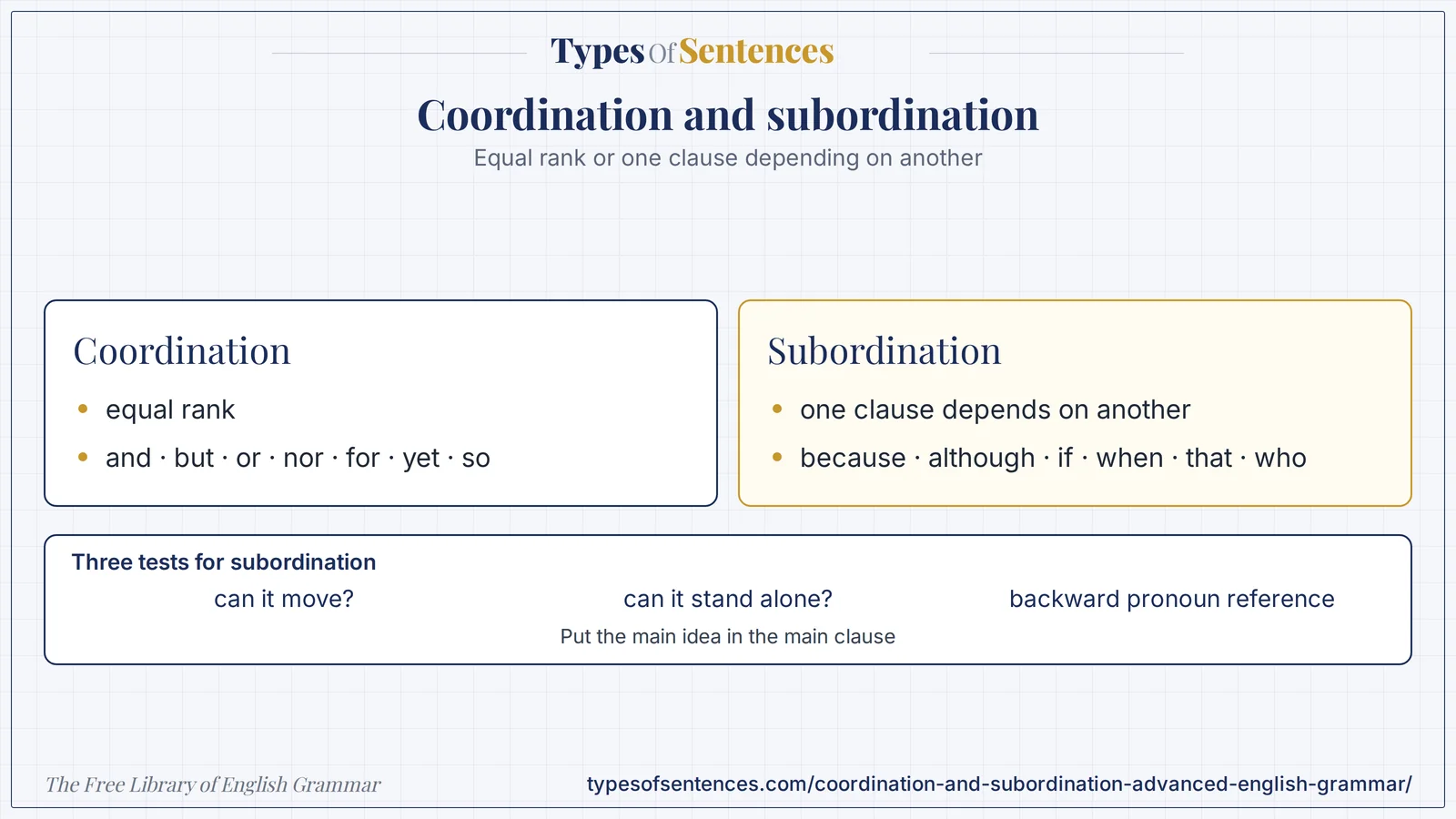
Coordination puts ideas side by side with equal weight: It rained, and we stayed home. Subordination ranks them: Because it rained, we stayed home. The second version tells the reader which idea is the reason and which is the result.
Why it matters: Skilled sentence-building is mostly a matter of choosing the right relationship between ideas and signaling it clearly, so that the reader never has to guess.
Summary: Coordination joins units of equal rank (and, but, or, nor, for, yet, so); subordination makes one clause dependent on another (because, although, if, when, that, who). Tests: a subordinate clause can usually move and cannot stand alone; coordinated clauses keep their order. Complex sentences can have several levels (a subordinate clause inside a subordinate clause) and can mix both processes, so the scope of each conjunction matters. A writer chooses coordination for ideas of equal importance and subordination to rank them.
- Coordination = equal rank; subordination = one clause depends on another.
- Tests: movement, stand-alone, backward pronoun reference.
- Mixed structures need clear scope: [A and B] because C vs A and [B because C].
- Put the main idea in the main clause (avoid upside-down subordination).
What You’ll Learn
- 1. Coordination and Subordination: Equal and Unequal Relationships
- 2. Complex Coordination: Multiple and Nested Conjunctions
- 3. Subordination Hierarchies: Levels and Embedding
- 4. Mixing Coordination and Subordination: Compound-Complex Sentences
- 5. Explicit and Implicit Logical Relationships
- 6. Advanced Sentence Combining
- 7. Stylistic Choices: When to Coordinate and When to Subordinate
- 8. Punctuation Across the Hierarchy
- 9. Common Errors in Coordination and Subordination
- 10. Exercises
- 11. Test Your Knowledge
- 12. Frequently Asked Questions
- 13. Conclusion
1. Coordination and Subordination: Equal and Unequal Relationships
Coordination links units of the same rank and category. Subordination links a dependent unit to a unit on which it depends. The conjunctions are surveyed in the chapter on advanced conjunction concepts.
| Test | Coordination | Subordination |
|---|---|---|
| rank | equal units | a dependent clause and a main clause |
| can the second unit stand alone as a sentence? | yes: She sang. He played. | no: *Because he played. |
| can the units swap places? | usually yes, with a change of meaning in time or sequence | the dependent clause can move: Because he played, she sang / She sang because he played |
| conjunction position | the conjunction stays between the units | the conjunction goes with the dependent clause |
| backward pronoun reference | not allowed: *He came, and Tom left (with he = Tom) | allowed: When he came, Tom left (he = Tom) |
| ellipsis | allowed: Tom came and [Tom] left | restricted |
| punctuation | comma before the conjunction between clauses | comma after an introductory dependent clause |
| adding a second conjunction | and + but in the same position is impossible | a coordinator can precede a subordinator: and because |
The backward-pronoun test is useful: a pronoun may precede its antecedent when the pronoun is in a subordinate clause (Before he left, Tom called) but not when the two clauses are coordinated (He left, and Tom called cannot mean that he is Tom). It shows that subordination creates a structural dependency, while coordination does not.
2. Complex Coordination: Multiple and Nested Conjunctions
| Pattern | Example | Notes |
|---|---|---|
| simple series | red, white, and blue; She came, she saw, she conquered. | a list with a final and (syndeton) |
| no conjunctions (asyndeton) | I came, I saw, I conquered. | quick, dramatic rhythm |
| repeated conjunctions (polysyndeton) | We laughed and cried and sang and danced. | slow, cumulative rhythm |
| mixed conjunctions | She sang, and he played, but nobody listened, so they left. | a chain of clauses with different relations |
| nested coordination | Either (the manager and the staff) or (the owner) must sign. | coordinated units inside coordinated units |
| correlative nesting | Both (young and old) and (rich and poor) came. | — |
| coordination with different categories | She is rich and in love. He is a fool and proud of it. | unlike categories: informal |
| phrasal coordination | the tall man and the short woman; to read and to write | words, phrases, and clauses |
| Ambiguity of scope | Possible meanings | Fix |
|---|---|---|
| old men and women | [old men] and [women] or [old [men and women]] | old men and old women / elderly people |
| the manager or the owner and the staff | (manager or owner) and staff, or manager or (owner and staff) | use brackets in words: either the manager or the owner, together with the staff |
| She plays tennis and golf on Sundays. | tennis (anytime) and golf on Sundays / both on Sundays | On Sundays she plays tennis and golf. |
| bread and butter or jam | (bread and butter) or jam, or bread and (butter or jam) | bread with butter or jam |
3. Subordination Hierarchies: Levels and Embedding
A subordinate clause can contain its own subordinate clause, which can contain another. The levels of embedding make a hierarchy.
| Level | Clause | Type |
|---|---|---|
| 0 | The report is late | main clause |
| 1 | because the manager said | adverbial clause (reason) |
| 2 | that the data were incomplete | noun clause (object of said) |
| 3 | which the team had collected | relative clause (modifies data) |
- The report is late [because the manager said [that the data [which the team had collected] were incomplete]]. three levels of subordination
- I know [that she believes [that he will win]]. two levels
- [Although the plan [that she proposed] was costly], it succeeded. a relative clause inside an adverbial clause
| Branching | Example | Effect on the reader |
|---|---|---|
| right-branching (dependent clause at the end) | She said that he knew that I thought that they left. | easy to read: each clause follows the previous |
| left-branching (dependent clause at the start) | Because he knew that she would come, he waited. | acceptable; a delay before the main clause |
| center-embedding (a clause inside the main clause) | The report that the committee that the manager chose wrote was late. | hard to read beyond one level; avoid more than one center-embedded clause |
| multiple center-embedding | The rat the cat the dog chased killed ate the malt. | grammatical but practically unreadable |
Right-branching sentences are easiest because the reader finishes one clause before starting the next. Center-embedding strains memory because the reader must hold the subject until the verb arrives. A writer should keep the number of levels to about three, and avoid center-embedding of more than one clause. The clause types are treated in the chapters on nominal clauses, relative clauses, and adverbial clauses.
4. Mixing Coordination and Subordination: Compound-Complex Sentences
| Structure | Example | Reading |
|---|---|---|
| [A and B] because C | We left because it was late and the road was closed. | the reason has two parts |
| A and [B because C] | We left, and we stayed away because it was late. | only the second clause has the reason |
| [A because B] and C | We left because it was late, and we did not return. | the first clause has a reason; the second is added |
| [Although A], B and C | Although it rained, we went out and got wet. | one concession; two main clauses |
| A, [which B], and C | The plan, which was costly, succeeded, and she was promoted. | relative clause inside a coordinated sentence |
| A because [B and C] | We left because it was late and the road was closed. | ambiguous with the first reading |
The same words can have different structures, so the scope of the conjunction matters. We left because it was late and the road was closed can mean that two things caused the leaving ([it was late and the road was closed]) or that we left because it was late, and (also) the road was closed. Punctuation can help (We left because it was late, and the road was closed), and so can repeating the subordinator (because it was late and because the road was closed).
| Repeating the subordinator | Example | Effect |
|---|---|---|
| not repeated | because he was tired and hungry | one reason with two parts |
| repeated | because he was tired and because he was hungry | two separate reasons; emphatic |
| that repeated | He said that he was tired and that he was hungry. | keeps the parallel structure; formal |
| if repeated | If it rains and if it is cold, we stay. | emphatic |
| coordinator before subordinator | We stayed home, and because it rained, we read. | — |
5. Explicit and Implicit Logical Relationships
The relationship between two ideas can be stated explicitly by a conjunction or left implicit. Grammar offers three levels of explicitness.
| Level | Example | Relationship |
|---|---|---|
| parataxis (juxtaposition) | It rained. We stayed home. | implied: reason and result |
| coordination | It rained, so we stayed home. | result |
| subordination | Because it rained, we stayed home. | reason |
| parataxis | He tried hard. He failed. | implied: concession |
| coordination | He tried hard, but he failed. | contrast |
| subordination | Although he tried hard, he failed. | concession |
| Relationship | Coordinators and conjuncts | Subordinators |
|---|---|---|
| addition | and, also, moreover | — |
| contrast | but, yet, however | although, though, whereas, while |
| reason | for, since (as) | because, since, as, now that |
| result | so, therefore, thus | so … that, such … that |
| condition | or (otherwise) | if, unless, provided that, as long as |
| time and sequence | then, next, and | when, after, before, while, until |
| purpose | — | so that, in order that, lest |
| alternative | or, either … or | whether … or |
Explicit signals make a text easier to follow, because the reader does not have to infer the relation. But an explicit conjunction can also be wrong: and says only “addition” and may hide a relation of cause or contrast. He worked hard and he failed is less clear than He worked hard but he failed. The role of the relations in the coherence of a text is treated in a later chapter.
6. Advanced Sentence Combining
Take three short sentences: The storm hit the coast. The power failed. The city went dark. There are many ways of combining them, and each version gives the ideas a different weight.
| Version | Technique | Emphasis |
|---|---|---|
| The storm hit the coast, the power failed, and the city went dark. | coordination (equal) | a chain of events |
| When the storm hit the coast, the power failed, and the city went dark. | subordination (time) + coordination | the storm is the time frame |
| The storm that hit the coast caused the power to fail, which left the city dark. | relative clauses | the storm and its consequences |
| When the storm hit the coast and the power failed, the city went dark. | subordination with coordination inside | the darkness is the main result |
| The storm hit the coast, causing the power to fail and the city to go dark. | participial phrase (non-finite) | the storm is the cause of two effects |
| After the storm’s landfall, the failure of the power left the city dark. | nominalization | compressed and formal |
| Technique | Use | Example |
|---|---|---|
| coordinate | ideas of equal importance | The road was closed, and the river was rising. |
| subordinate with a conjunction | rank ideas; show the relation | Because the road was closed, we stayed. |
| relative clause | add identifying or extra information about a noun | The road, which was closed, … |
| participial phrase | reduce a clause when the subject is shared | Seeing the road closed, we stayed. |
| appositive | rename a noun | The road, a narrow lane, … |
| absolute phrase | add circumstance | The road closed, we stayed. |
| nominalization | compress for formal style | The closure of the road kept us home. |
7. Stylistic Choices: When to Coordinate and When to Subordinate
| Coordinate when | Subordinate when |
|---|---|
| two ideas are equally important | one idea is less important or supporting |
| you want a parallel, balanced effect | you want to show a reason, condition, concession, or time |
| the ideas are a sequence of events | one idea sets the background for another |
| you want a quick, rhythmic effect | you want a precise logical relation |
| Fault | Example | Fix |
|---|---|---|
| stringy sentence (excess coordination) | We went to the market, and we bought apples, and then we went home, and it started to rain, and we got wet. | Because it started to rain as we went home from the market, where we had bought apples, we got wet. |
| choppy sequence (no coordination or subordination) | We went to the market. We bought apples. We went home. It rained. | After we bought apples at the market, we went home in the rain. |
| upside-down subordination (the main idea in the dependent clause) | He was driving at 90 miles an hour when he was stopped by the police. | He was stopped by the police when he was driving at 90 miles an hour. / Driving at 90 miles an hour, he was stopped by the police. |
| excessive embedding | The report that the committee that the manager chose wrote was late. | The report written by the committee that the manager chose was late. |
| wrong relation | He is tall and he can’t play basketball. | Although he is tall, he can’t play basketball. |
Upside-down subordination is a term used by writing teachers for a sentence that puts the important information in a dependent clause. Although she won the Nobel Prize, she was born in a small town subordinates the prize; if the prize is the point, make it the main clause: She won the Nobel Prize, although she was born in a small town. The two versions say the same, but they stress different facts.
Spoken English relies on coordination and clause chaining (and … and … so …), while academic writing uses more subordination and embedding. The choice of style depends on genre. Writers also use periodic sentences (the main clause comes late, building suspense) and loose sentences (the main clause comes first, followed by details).
8. Punctuation Across the Hierarchy
| Structure | Punctuation | Example |
|---|---|---|
| coordinated independent clauses | comma + coordinator | It rained, and we stayed. |
| coordinated clauses with internal commas | semicolon (before the coordinator) | Although it rained, we went; and although we were tired, we stayed. |
| introductory dependent clause | comma after it | When it rains, we stay. |
| final dependent clause (essential) | no comma | We stay when it rains. |
| final dependent clause (contrast) | comma | We stayed, although it rained. |
| nonrestrictive relative clause | commas | The plan, which was costly, succeeded. |
| compound predicate | no comma | She opened the door and walked in. |
| correlative pair joining clauses | comma between clauses | Either you leave, or I will. |
| conjunctive adverb joining clauses | semicolon before; comma after | It rained; therefore, we stayed. |
9. Common Errors in Coordination and Subordination
| Error | Correction | Rule |
|---|---|---|
| It rained, we stayed. | It rained, so we stayed. | comma splice |
| Because it rained. We stayed. | Because it rained, we stayed. | fragment |
| Although it rained, but we went. | Although it rained, we went. | double conjunction |
| Because it rained, so we stayed. | Because it rained, we stayed. | double conjunction |
| She is smart and a good teacher and kind. | She is smart, kind, and a good teacher. | parallel forms |
| We went, and it rained, and we got wet, and we went home. | We went out, but it rained and we got wet, so we went home. | stringy coordination; vary the relations |
| He was driving 90 when he was stopped by the police. (upside-down) | He was stopped by the police when he was driving 90. | main idea in the main clause |
| The report that the committee that the manager chose wrote was late. | The report written by the committee that the manager chose was late. | excessive center-embedding |
| While she likes tea, he prefers coffee. (ambiguous) | Whereas she likes tea, he prefers coffee. | while can mean time |
| We left because it was late and the road was closed. (ambiguous) | We left because it was late and because the road was closed. | scope |
| Either he comes, nor I leave. | Either he comes or I leave. | either … or |
| She sang, and he is playing, but they left. | She sang, and he played, but they left. | consistent tense |
Edit: It rained, we stayed, because it rained. So we read, and because it was dark, so we slept, and we went to bed, and although it was late, but we were happy, and she was driving 90 when she was stopped by the police, and the report that the committee that the manager chose wrote was late.
- It rained, we stayed, because it rained: comma splice and repetition: Because it rained, we stayed.
- So we read: starts with a coordinator: We read.
- because it was dark, so we slept: double conjunction: because it was dark, we slept.
- although it was late, but we were happy: although it was late, we were happy.
- she was driving 90 when she was stopped by the police: upside-down: the police stopped her when she was driving 90.
- the report that the committee that the manager chose wrote was late: the report written by the committee that the manager chose was late.
- Result: Because it rained, we stayed and read. Because it was dark, we slept, and although it was late, we were happy. The police stopped her when she was driving 90, and the report written by the committee that the manager chose was late.
Recap in 12 seconds
Watch the lesson build itself: Coordination joins units of equal rank and subordination makes one clause depend on another; three tests tell them apart. The video has no sound.
Exercises
Part A: Telling Them Apart (Exercises 1–6)
Exercise 1: Coordination or subordination: She sang, and he played.
Show Answer
Answer: Coordination.
Exercise 2: Coordination or subordination: She sang because he played.
Show Answer
Answer: Subordination.
Exercise 3: Which clause can stand alone: Because he played or He played?
Show Answer
Answer: He played.
Exercise 4: Can the clauses swap places: Because he played, she sang and She sang because he played?
Show Answer
Answer: Yes (subordination).
Exercise 5: Which allows backward pronoun reference: When he came, Tom left or He came, and Tom left?
Show Answer
Answer: When he came, Tom left.
Exercise 6: Which rank do coordinated units have?
Show Answer
Answer: Equal rank.
Part B: Complex Coordination (Exercises 7–12)
Exercise 7: Name the device: I came, I saw, I conquered.
Show Answer
Answer: Asyndeton.
Exercise 8: Name the device: We laughed and cried and sang and danced.
Show Answer
Answer: Polysyndeton.
Exercise 9: Disambiguate: old men and women
Show Answer
Answer: old men and old women (or elderly people).
Exercise 10: Punctuate the large units: She sang, danced, and juggled and he played the guitar, drums, and piano.
Show Answer
Answer: …juggled; and he played …
Exercise 11: Edit: She is smart and a good teacher and kind.
Show Answer
Answer: She is smart, kind, and a good teacher.
Exercise 12: Edit: Either he comes, nor I leave.
Show Answer
Answer: Either he comes or I leave.
Part C: Subordination Hierarchies (Exercises 13–18)
Exercise 13: Count the levels: I know that she believes that he will win.
Show Answer
Answer: Two levels of subordination.
Exercise 14: Name the branching: She said that he knew that I thought that they left.
Show Answer
Answer: Right-branching.
Exercise 15: Name the problem: The report that the committee that the manager chose wrote was late.
Show Answer
Answer: Center-embedding (hard to read).
Exercise 16: Rewrite: The report that the committee that the manager chose wrote was late.
Show Answer
Answer: The report written by the committee that the manager chose was late.
Exercise 17: Name the clause type: that the data were incomplete in the manager said that the data were incomplete
Show Answer
Answer: A noun clause (object).
Exercise 18: How many levels are advisable at most?
Show Answer
Answer: About three.
Part D: Mixed Structures and Relationships (Exercises 19–24)
Exercise 19: Explain the two readings: We left because it was late and the road was closed.
Show Answer
Answer: One reason with two parts; or the reason is lateness, and the road was also closed.
Exercise 20: Make the reasons separate: because it was late and the road was closed
Show Answer
Answer: because it was late and because the road was closed.
Exercise 21: Name the relationship: Although he tried hard, he failed.
Show Answer
Answer: Concession.
Exercise 22: Name the level: It rained. We stayed.
Show Answer
Answer: Parataxis (implicit relation).
Exercise 23: Make the relation explicit (subordination): He tried hard. He failed.
Show Answer
Answer: Although he tried hard, he failed.
Exercise 24: Choose: He worked hard (and/but) he failed.
Show Answer
Answer: but.
Part E: Style and Errors (Exercises 25–30)
Exercise 25: Fix the upside-down subordination: He was driving at 90 when he was stopped by the police.
Show Answer
Answer: He was stopped by the police when he was driving at 90.
Exercise 26: Fix the stringy sentence: We went to the market, and we bought apples, and then we went home.
Show Answer
Answer: After buying apples at the market, we went home.
Exercise 27: Edit: It rained, we stayed.
Show Answer
Answer: It rained, so we stayed.
Exercise 28: Edit: Although it rained, but we went.
Show Answer
Answer: Although it rained, we went.
Exercise 29: Edit: While she likes tea, he prefers coffee. (to avoid ambiguity)
Show Answer
Answer: Whereas she likes tea, he prefers coffee.
Exercise 30: Define a periodic sentence.
Show Answer
Answer: A sentence whose main clause comes late, building suspense.
Test Your Knowledge
Ready to check what you learned? Answer all 10 questions, then submit. You need 80% (8 of 10) to pass. Your answers are not stored.
View correct answers and explanations
Question 1: What is coordination?
✓ Correct Answer: A – joining units of equal rank
Coordination joins equals.
Question 2: What is subordination?
✓ Correct Answer: B – making one clause depend on another
A subordinate clause depends on another.
Question 3: Which can stand alone?
✓ Correct Answer: C – He played
An independent clause.
Question 4: Which allows he to precede Tom?
✓ Correct Answer: D – When he came, Tom left.
Backward reference works in subordination.
Question 5: Which is upside-down subordination?
✓ Correct Answer: C – He was driving 90 when he was stopped by the police.
The main news is in the dependent clause.
Question 6: Which is right-branching?
✓ Correct Answer: D – She said that he knew that I thought that they left.
Each clause follows the previous.
Question 7: Which is correct?
✓ Correct Answer: B – Because it rained, we stayed.
No double conjunction.
Question 8: Which is a comma splice?
✓ Correct Answer: C – It rained, we stayed.
Two clauses joined only by a comma.
Question 9: Which is stringy?
✓ Correct Answer: A – We went out, and it rained, and we got wet, and we went home.
Excess coordination.
Question 10: Which punctuation separates larger units with internal commas?
✓ Correct Answer: B – semicolon
A semicolon marks the hierarchy.
Frequently Asked Questions
What are coordination and subordination?
Coordination links units of equal rank with a coordinator (and, but, or); subordination links a dependent clause to a main clause with a subordinator (because, although, if) or a relative word.
What is sentence combining advanced?
Advanced sentence combining is joining short sentences into longer ones with coordination, subordination, relative clauses, participial and appositive phrases, and nominalizations, choosing the structure that gives the ideas the right weight.
What are coordinating subordinating structures?
Coordinating subordinating structures are sentences that use both processes: compound-complex sentences with coordinated clauses, dependent clauses, and relative clauses at several levels.
What are complex sentence relationships?
Complex sentence relationships are the logical links between clauses in a sentence: addition, contrast, reason, result, condition, concession, time, and purpose, signaled by conjunctions and conjuncts, or left implicit.
What is expert coordination?
Expert coordination is the use of coordination with control: parallel forms, clear scope, correct punctuation at each level, and a choice between coordination and subordination that suits the ideas.
What is upside-down subordination?
Upside-down subordination is the placing of the main idea in a dependent clause and a secondary idea in the main clause, as in He was driving at 90 when he was stopped by the police.
When should I coordinate and when subordinate?
Coordinate ideas of equal importance, and subordinate the less important idea or the one that gives a reason, condition, concession, or time.
Conclusion
You now have a deep study of coordination and subordination: the tests that separate them, complex and nested coordination, subordination hierarchies, mixed structures and scope, explicit and implicit relationships, sentence combining, style, and punctuation across the hierarchy. You can build complex sentences with expert control.
When you write a long sentence, ask which ideas are equal and which depend on others, and make the structure show it. This chapter ends Part 2; next, you begin the advanced verb system with tense and aspect.
- Huddleston, Rodney, and Geoffrey K. Pullum. The Cambridge Grammar of the English Language. Cambridge University Press, 2002.: the reference analysis of coordination and subordination.
- Quirk, Randolph, et al. A Comprehensive Grammar of the English Language. Longman, 1985.: the classic treatment of coordination, subordination, and condensed clauses.
- Biber, Douglas, et al. Longman Grammar of Spoken and Written English. Longman, 1999.: corpus evidence on the use of coordination and subordination in speech and writing.
- Christensen, Francis. “A Generative Rhetoric of the Sentence.” College Composition and Communication 14 (1963): 155–161.: the cumulative sentence.
- Merriam-Webster Dictionary: subordination: the dictionary entry.
Last reviewed: October 29, 2026. How it was made: drafted with AI assistance, then checked with automated tests (structure, links, answer keys, spelling) and against the sources above. A person has not yet read this chapter line by line. Found a mistake? Report it.