This advanced grammar overview opens the third level of the course. The Basic level taught you what grammar is and how simple sentences work. The Intermediate level taught you the parts of speech in depth, clauses, phrases, tenses, modals, voice, conditionals, and the writing skills. The Advanced level asks a different question: not only what is the rule? but why does English work this way, and how do skilled writers choose among the possibilities it offers?
This chapter is a map. It explains what expert English grammar means in this course, gives a short review of the foundations so that you can check yourself, lays out the 12 parts and 106 chapters of the Advanced level, introduces the technical vocabulary that the later chapters use, and shows how to study. It closes with 30 review exercises and a quiz. If you can do them comfortably, you are ready for the advanced grammar topics that follow.
Think of the first two levels as learning to drive and then learning to drive in traffic. The Advanced level is learning how the engine works, so that you can handle any road: unusual constructions, formal and informal styles, and the places where careful writers disagree.
Why it matters: In advanced level English you will meet more technical words, more exceptions, and more choices. In return, you will understand sentences that you could previously only imitate.
Summary: Advanced grammar goes beyond rules to explanation and choice. It covers the finer structure of words and phrases, complex clauses, the verb system in full, how sentences connect into texts, vocabulary and meaning, professional and academic writing, style, grammar in real contexts, punctuation and mechanics, and the future of the language. It assumes secure knowledge of the Basic and Intermediate levels.
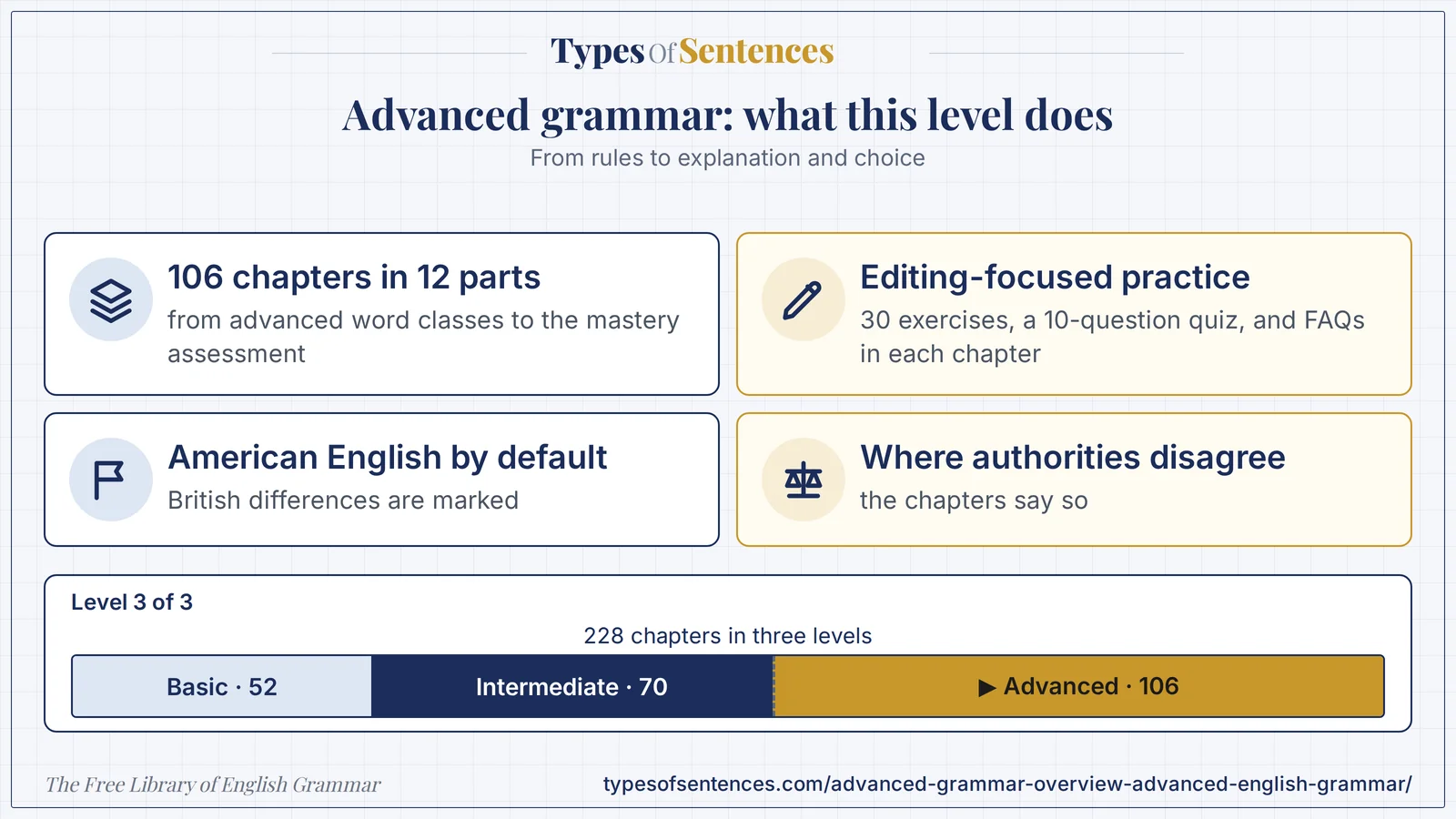
- 106 chapters in 12 parts, from advanced word classes to the mastery chapters.
- Each chapter ends with 30 editing-focused exercises, a 10-question quiz, and 7 FAQs.
- American English is the default; British differences are marked.
- Where careful writers and style guides disagree, the chapters show the options.
What You’ll Learn
- 1. Advanced Grammar Overview: What “Advanced” Means
- 2. Expert English Grammar: A Quick Review of the Foundations
- 3. Advanced Grammar Topics: The 12 Parts and 106 Chapters
- 4. Mastering English Grammar: The Technical Vocabulary
- 5. How to Study the Advanced Chapters
- 6. Are You Ready? A Self-Check
- 7. What You Will Be Able to Do
- 8. Conventions Used in the Advanced Chapters
- 9. Common Obstacles for Advanced Learners
- 10. Exercises
- 11. Test Your Knowledge
- 12. Frequently Asked Questions
- 13. Conclusion
1. Advanced Grammar Overview: What “Advanced” Means
Advanced does not mean harder rules to memorize. It means a different kind of knowledge: explaining why a construction works, recognizing the options that the grammar offers, and choosing among them for a reader, a purpose, and a register. A writer with advanced control can say why Rarely had she seen such a view sounds literary, why It was the budget that failed shifts the focus, and when a long noun phrase helps a reader and when it burdens one.
| Level | Main question | Typical skill |
|---|---|---|
| Basic | What is it called, and how do I build a simple sentence? | Write correct simple and compound sentences |
| Intermediate | How do the parts fit together, and what are the rules? | Control tenses, clauses, phrases, voice, and punctuation |
| Advanced | Why does it work, and what are my choices? | Analyze unusual structures; edit for style, register, and precision |
- Description before prescription. The chapters first describe how English is actually used, and then say what formal writing expects. Many “rules” turn out to be conventions of a particular style guide.
- Structure and meaning together. You will often ask what a form does for the reader, not only whether it is “correct”.
- Awareness of variation. English differs by region, register, and period. The chapters name the differences instead of hiding them.
2. Expert English Grammar: A Quick Review of the Foundations
I. What is grammar? (quick review)
Grammar is the system of patterns that lets speakers combine words into meaningful sentences. It has two main parts: morphology (the forms of words: walk, walks, walked) and syntax (how words and phrases combine into clauses and sentences). A descriptive grammar records how people use the language; a prescriptive grammar recommends how they should. Standard English is a prestige variety, used in formal writing and education, and it is the focus of this course. The first chapter of the course explains what grammar is.
II. The eight parts of speech (quick review)
| Part of speech | Job | Example | Advanced chapter |
|---|---|---|---|
| noun | names a person, place, thing, or idea | teacher, justice | Chapter 2 |
| verb | expresses action, state, or occurrence | run, seem | Chapter 3 |
| pronoun | stands in for a noun phrase | she, whom | Chapter 4 |
| adjective | modifies a noun | rapid progress | Chapter 5 |
| adverb | modifies a verb, adjective, adverb, or clause | quickly, quite | Chapter 6 |
| preposition | links a noun phrase to the rest of the clause | in the box | Chapter 7 |
| conjunction | joins words, phrases, or clauses | and, although | Chapter 8 |
| interjection | expresses a feeling | Wow! | — |
Articles and determiners (a, the, this, some) belong to a closely related class and are treated in the chapter on articles at this level.
III. Simple sentence structure (quick review)
A clause has a subject and a predicate. The main patterns are subject–verb (Birds sing), subject–verb–object (She wrote a letter), subject–verb–complement (He is tired), and the patterns with two objects, an object complement, or an adverbial. A simple sentence has one clause; a compound sentence joins independent clauses; a complex sentence has a dependent clause; and a compound-complex sentence has both. The Advanced chapters on clauses (Part 2) and on sentence architecture (Part 8) rest on these.
IV. Basic tenses (quick review)
| Aspect | Present | Past | Future |
|---|---|---|---|
| simple | she writes | she wrote | she will write |
| continuous | she is writing | she was writing | she will be writing |
| perfect | she has written | she had written | she will have written |
| perfect continuous | she has been writing | she had been writing | she will have been writing |
At this level, tense (the form of the verb) and aspect (how the event is viewed) are separated carefully, and will is treated as a modal. See the chapter on tense and aspect.
V. Basic punctuation (quick review)
| Mark | Core use |
|---|---|
| period, question mark, exclamation mark | end a sentence |
| comma | separate list items, set off introductory and nonessential elements, join clauses with a conjunction |
| semicolon | join closely related independent clauses |
| colon | introduce what follows a complete clause |
| apostrophe | possession and contraction |
| quotation marks | speech, quotations, short titles |
| hyphen and dash | join words; interrupt |
3. Advanced Grammar Topics: The 12 Parts and 106 Chapters
The Advanced level is organized in twelve parts. Each part has its own theme, and the chapters in each part build on those before.
| Part | Chapters | Theme | What you will study |
|---|---|---|---|
| 1. Advanced syntax and structure | 1 to 9 | word classes at depth | nouns, verbs, pronouns, adjectives, adverbs, prepositions, conjunctions, articles |
| 2. Advanced clause structures | 10 to 21 | how clauses are built | nominal, relative, and adverbial clauses; complex phrases; complement clauses; existential there; clefts; inversion; ellipsis; fronting; coordination and subordination |
| 3. Advanced verb system | 22 to 30 | the verb in full | tense and aspect; modality; voice; reported speech; conditionals; non-finite verbs; complementation; negation; questions |
| 4. Discourse and cohesion | 31 to 35 | sentences into texts | reference and deixis; cohesion and coherence; information structure; discourse analysis; register and style |
| 5. Lexical sophistication | 36 to 43 | words and meaning | collocation; idioms; morphology; lexical relations; pragmatics; hedging; emphasis; vagueness and precision |
| 6. Professional and academic writing | 44 to 56 | writing in domains | academic, research, business, technical, legal, scientific, journalistic, creative, and digital writing |
| 7. Stylistic grammar | 57 to 66 | style choices | editing; conciseness; diction; parallelism; sentence variety; transitions; tone; readability; myths; British and American English |
| 8. Grammar in context | 67 to 80 | grammar in the world | history; change; corpora; contrastive analysis; grammar and meaning; sentence processing; ambiguity; rhetoric; literature; poetry; error analysis |
| 9. Pedagogy and learning | 81 to 84 | teaching and learning | methods; strategies; assessment; resources |
| 10. Advanced punctuation and mechanics | 85 to 89 | mechanics | punctuation; typography; abbreviations; numbers; title capitalization |
| 11. Grammar and modern communication | 90 to 97 | current practice | email; technology; global Englishes; inclusive language; advertising; social media; plain language; translation |
| 12. Future and mastery | 98 to 106 | integration | myths; the future of grammar; mastery; professional communication; troubleshooting; self-study; academic success; review; assessment |
Part 2 begins with nominal clauses, Part 3 with tense and aspect, and Part 4 with reference and deixis. Part 5 starts with collocation, Part 6 with academic writing, and Part 7 with editing and proofreading. Part 8 begins with the history of English grammar.
4. Mastering English Grammar: The Technical Vocabulary
The Advanced chapters use more precise terms. Here are the main ones; each is explained again when it first matters.
| Term | Meaning | Example |
|---|---|---|
| head | the main word of a phrase | teacher in the tired teacher |
| modifier | a word or phrase that adds to the head | tired in the tired teacher |
| determiner | a word that specifies a noun | the, my, some |
| complement | an element required by a head to complete its meaning | She became a doctor. |
| adjunct | an optional element, often adverbial | She left early. |
| finite / non-finite | a verb form with tense and a subject / one without | writes / to write, writing |
| clause | a unit with a subject and a predicate | because she left |
| phrase | a group of words built around a head | in the garden |
| mood | the grammatical expression of reality, command, or hypothesis | indicative, imperative, subjunctive |
| aspect | how the time of an event is viewed | simple, continuous, perfect |
| voice | the relation of subject to action | active, passive |
| polarity | positive or negative | She came / She did not come. |
| anaphora / cataphora | reference backward / forward | Maria came. She sat. |
| deixis | reference tied to the situation of speaking | here, now, I |
| register | the variety of language suited to a situation | formal, neutral, informal |
| corpus | a large body of real text used to study usage | a collection of newspapers |
Different grammars use different terms. This course follows the common terms of the major reference grammars (Quirk et al. and Huddleston and Pullum) and notes where a term differs. For instance, many traditional grammars call a wh-word an “interrogative pronoun,” while Huddleston and Pullum treat many such words as determinatives or other classes.
5. How to Study the Advanced Chapters
- Read for the idea first. Each chapter opens with a plain-language summary and a short brief. Read these before the tables.
- Study the tables, then test yourself. Cover the right-hand column and predict it.
- Do the exercises as editing. The 30 exercises ask you to correct, rewrite, and choose, as an editor would, not only to label.
- Notice grammar in real texts. Read newspapers, academic articles, and novels, and look for the structures you have studied.
- Keep a notebook of choices. Where two forms are possible, write both and note which suits which register.
- Check the references. Each chapter lists sources: reference grammars, usage guides, and style manuals. Use them when you want detail.
- Revisit. Advanced chapters reward a second reading after you have met related topics.
6. Are You Ready? A Self-Check
| Check | If not, review |
|---|---|
| I can name the parts of speech and give two types of each. | Intermediate Chapters 2 to 11 |
| I can find independent and dependent clauses and name the dependent type. | Intermediate Chapters 12 to 15 |
| I can identify the main phrase types. | Intermediate Chapters 16 to 24 |
| I can use the twelve tenses and the main modals. | Intermediate Chapters 35 to 46 |
| I can change a sentence into the passive and report speech. | Intermediate Chapters 47 to 48 |
| I can use the four conditionals. | Intermediate Chapters 49 to 53 |
| I can punctuate a paragraph and write a clear essay. | Intermediate Chapters 57 to 60 |
| I can spot my own frequent errors. | Intermediate Chapter 68 |
The 30 exercises at the end of this chapter are a check on the foundations. If you answer most of them without hesitation, go on to Chapter 2. If not, use the references in the table.
7. What You Will Be Able to Do
- Analyze any English sentence, including long, formal, and literary ones, into clauses and phrases.
- Explain why a construction is grammatical or not, with the terms of a reference grammar.
- Choose among alternatives (active or passive, that or which, a clause or a noun phrase) for a given reader and register.
- Edit your own and others’ writing for precision, concision, and tone.
- Adapt your English to academic, professional, technical, creative, and digital contexts.
- Recognize regional variation and language change without treating every difference as an error.
- Use corpora, dictionaries, and reference grammars to settle questions of usage yourself.
8. Conventions Used in the Advanced Chapters
| Convention | Meaning |
|---|---|
| italics | words and sentences discussed as examples |
| * (asterisk) before a sentence | an ungrammatical or unacceptable form, in linguistic style |
| ? before a sentence | a doubtful or marginal form |
| [brackets] | an omitted or understood word |
| American spelling and punctuation | the default; British practice is marked as such |
| boxes | tips, “common mistakes”, and “where guides differ” notes |
Where careful writers and style guides disagree (the serial comma, whom, the singular they, split infinitives), the chapters show the options and the reasoning. Chapter 65 is devoted to grammar myths and controversies, and Chapter 98 to advanced myths.
9. Common Obstacles for Advanced Learners
| Obstacle | What happens | Remedy |
|---|---|---|
| over-correction | treating every deviation from a rule as an error | learn which rules are conventions and which are core grammar |
| hypercorrection | using a “correct” form where it is wrong (between you and I) | learn the principle, not just the rule |
| terminology overload | memorizing terms without using them | apply each term to a real sentence |
| reading without analysis | understanding a sentence but not its structure | parse one sentence a day |
| ignoring register | using formal forms in casual contexts, or the reverse | ask who the reader is |
| relying on rules of thumb | “never end a sentence with a preposition” | check the evidence in a reference grammar |
Recap in 12 seconds
Watch the lesson build itself: The Advanced level has 106 chapters in 12 parts, uses American English by default, and says where style guides disagree. The video has no sound.
Exercises
Part A: Parts of Speech (Exercises 1–6)
Exercise 1: Name the part of speech of quickly in She spoke quickly.
Show Answer
Answer: Adverb.
Exercise 2: Name the part of speech of although.
Show Answer
Answer: Conjunction (subordinating).
Exercise 3: Name the part of speech of whom in the man whom I met.
Show Answer
Answer: Pronoun (relative).
Exercise 4: Name the part of speech of justice.
Show Answer
Answer: Noun (abstract).
Exercise 5: Is the a preposition? Explain.
Show Answer
Answer: No. It is an article (a determiner).
Exercise 6: Find the preposition: The book is on the table.
Show Answer
Answer: on.
Part B: Sentence Structure (Exercises 7–13)
Exercise 7: Identify the subject: The tired teacher left early.
Show Answer
Answer: The tired teacher.
Exercise 8: Identify the head noun in the tired teacher.
Show Answer
Answer: teacher.
Exercise 9: Identify the complement: She became a doctor.
Show Answer
Answer: a doctor.
Exercise 10: Identify the adjunct: She left early.
Show Answer
Answer: early.
Exercise 11: Simple, compound, complex, or compound-complex: She left because it was late.
Show Answer
Answer: Complex.
Exercise 12: Simple, compound, complex, or compound-complex: She left, and he stayed.
Show Answer
Answer: Compound.
Exercise 13: Name the clause type: because she left
Show Answer
Answer: Dependent (adverbial) clause.
Part C: Tense and Aspect (Exercises 14–19)
Exercise 14: Name the tense and aspect: she has written
Show Answer
Answer: Present perfect.
Exercise 15: Name the tense and aspect: she was writing
Show Answer
Answer: Past continuous.
Exercise 16: Name the tense and aspect: she will have written
Show Answer
Answer: Future perfect.
Exercise 17: Which is a finite verb: writes or to write?
Show Answer
Answer: writes.
Exercise 18: Which is non-finite: writing or wrote?
Show Answer
Answer: writing (a participle or gerund) in a non-finite use.
Exercise 19: Which word in She will write is a modal?
Show Answer
Answer: will.
Part D: Punctuation and Style (Exercises 20–25)
Exercise 20: Fix the comma splice: It was late, we left.
Show Answer
Answer: It was late, so we left. (or use a semicolon)
Exercise 21: Add the colon: You need three things a pen, paper, and time.
Show Answer
Answer: You need three things: a pen, paper, and time.
Exercise 22: Choose: The dog wagged (its/it’s) tail.
Show Answer
Answer: its.
Exercise 23: Descriptive or prescriptive: “People say ‘between you and I’ in speech.”
Show Answer
Answer: Descriptive.
Exercise 24: Descriptive or prescriptive: “Use ‘me’ after a preposition.”
Show Answer
Answer: Prescriptive.
Exercise 25: Name the register: Hey, wanna grab lunch?
Show Answer
Answer: Informal.
Part E: Terms and Map (Exercises 26–30)
Exercise 26: Define head in a phrase.
Show Answer
Answer: The main word that the phrase is built around.
Exercise 27: Define deixis with an example.
Show Answer
Answer: Reference tied to the situation of speaking: here, now, I.
Exercise 28: Which part of the course covers tense and aspect?
Show Answer
Answer: Part 3 (Chapter 22).
Exercise 29: Which part covers academic and business writing?
Show Answer
Answer: Part 6 (Chapters 44 to 56).
Exercise 30: What does an asterisk before a sentence mean?
Show Answer
Answer: The sentence is ungrammatical or unacceptable.
Test Your Knowledge
Ready to check what you learned? Answer all 10 questions, then submit. You need 80% (8 of 10) to pass. Your answers are not stored.
View correct answers and explanations
Question 1: What is the focus of the Advanced level?
✓ Correct Answer: B – Explaining why constructions work and choosing among options
Advanced grammar is about explanation and choice.
Question 2: How many chapters does the Advanced level have?
✓ Correct Answer: C – 106
There are 106 chapters in 12 parts.
Question 3: What is a descriptive grammar?
✓ Correct Answer: A – One that records how people use the language
Descriptive grammars record actual usage.
Question 4: What is the head of the tired teacher?
✓ Correct Answer: C – teacher
Teacher is the main word.
Question 5: What does an asterisk before a sentence mean?
✓ Correct Answer: C – It is ungrammatical
The asterisk marks an unacceptable form.
Question 6: Which is a finite verb form?
✓ Correct Answer: D – writes
Writes has tense and a subject.
Question 7: Which part covers tense, modality, and voice?
✓ Correct Answer: B – Part 3
Part 3 is the advanced verb system.
Question 8: What is register?
✓ Correct Answer: A – The variety of language suited to a situation
Register is formal, neutral, or informal use.
Question 9: What is hypercorrection?
✓ Correct Answer: A – Using a “correct” form where it is wrong
For example, between you and I.
Question 10: Which is the best way to study the exercises?
✓ Correct Answer: D – As editing: correct, rewrite, and choose
The exercises are editing-focused.
Frequently Asked Questions
What is advanced grammar?
Advanced grammar is the study of English beyond the basic rules: why constructions work, how the grammar of words, phrases, clauses, and texts is organized, and how to choose among forms for a reader, a purpose, and a register.
What is the advanced grammar overview?
The advanced grammar overview is this chapter. It reviews the foundations, maps the 12 parts and 106 chapters of the Advanced level, introduces the technical terms, and explains how to study.
What are the advanced grammar topics?
The advanced grammar topics are word classes at depth, complex clauses and phrases, the full verb system, cohesion and discourse, vocabulary and meaning, academic and professional writing, style, grammar in context, teaching and learning, mechanics, modern communication, and mastery.
What does expert English grammar mean?
Expert English grammar means the ability to analyze any sentence, to explain why a form is acceptable or not, to choose among alternatives for a context, and to edit writing for precision and style.
What is mastering English grammar like at this level?
Mastering English grammar at this level means moving from applying rules to understanding principles, recognizing variation, and using reference works and real texts to settle questions yourself.
Do I need to finish the Intermediate level first?
It is strongly recommended. The Advanced chapters assume that you can handle the parts of speech, clauses, phrases, tenses, modals, and punctuation of the Intermediate level.
Is advanced level English the same as academic English?
No. Academic English is one register, covered in Part 6. Advanced-level grammar also covers literary, professional, technical, digital, and everyday styles, and the language itself.
Conclusion
You now have the map of the Advanced level: what advanced grammar means, a quick review of the foundations, the 12 parts and 106 chapters, the technical vocabulary, a study method, a readiness check, the outcomes, and the conventions used. You are ready to study the word classes in depth.
Begin with the noun, the word class that is both the simplest and the richest. Next, you will study advanced noun concepts.
- Huddleston, Rodney, and Geoffrey K. Pullum. The Cambridge Grammar of the English Language. Cambridge University Press, 2002.: the main reference grammar for the terms and analyses used in this level.
- Quirk, Randolph, et al. A Comprehensive Grammar of the English Language. Longman, 1985.: the classic comprehensive grammar.
- Biber, Douglas, et al. Longman Grammar of Spoken and Written English. Longman, 1999.: a corpus-based grammar.
- Garner, Bryan A. Garner’s Modern English Usage, 5th ed. Oxford University Press, 2022.: usage guidance.
- The Chicago Manual of Style, 17th edition, chapter 5 (Grammar and Usage): American publishing conventions.
Last reviewed: October 29, 2026. How it was made: drafted with AI assistance, then checked with automated tests (structure, links, answer keys, spelling) and against the sources above. A person has not yet read this chapter line by line. Found a mistake? Report it.