Collocation is the tendency of words to occur together. English speakers say strong tea and heavy rain, not powerful tea or strong rain; they make a decision but do homework; they pay attention and not give attention. There is rarely a rule that explains these choices. They are conventions, and they make the difference between language that is merely grammatical and language that sounds natural. Word collocations are one of the last things that learners master and the first thing that native speakers notice when they are wrong.
This chapter studies collocation patterns in depth: what collocation is and how it differs from idioms and free combinations; the main types (verb + noun, adjective + noun, adverb + adjective, verb + adverb, noun + verb); strong and weak collocations; the common errors, especially with make and do and with say and tell; why collocation matters for fluency; how to learn it with dictionaries and corpora; collocations in different registers and in British and American English; fixed expressions and word combinations; and semantic prosody. Thirty editing exercises and a quiz follow.
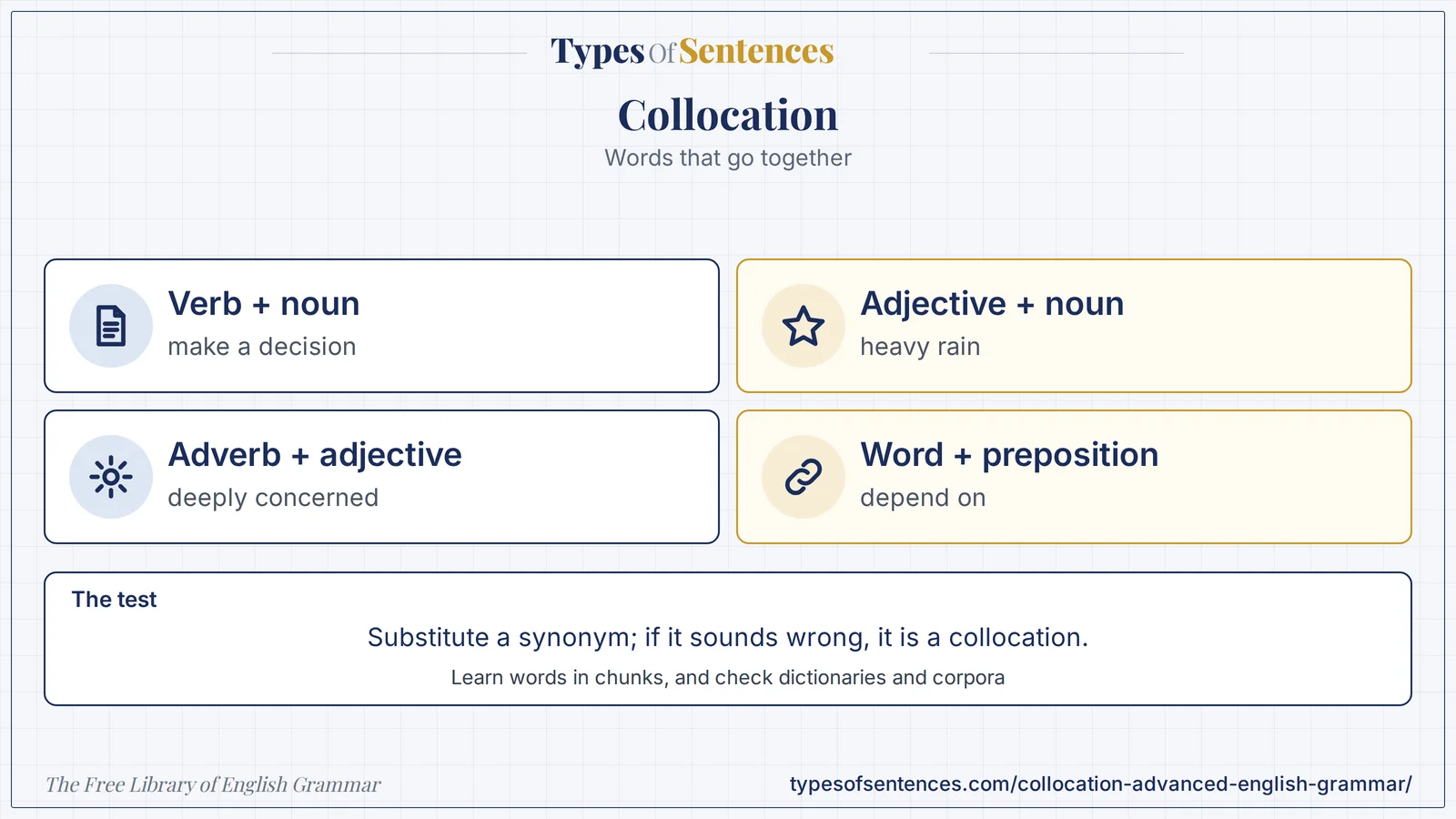
Words have favorite partners. In English, rain is heavy, traffic is heavy, and a smoker is heavy, but tea is strong and not heavy. The reasons are historical and arbitrary, but the habits are firm, and a speaker who ignores them sounds foreign even when the grammar is perfect.
Why it matters: The only way to master collocation is to learn words in company: not decision alone, but make a decision, reach a decision, and a tough decision.
Summary: A collocation is a combination of words that co-occur more often than chance would predict, and that native speakers accept as natural. Grammatical collocations combine a word with a preposition or a grammatical pattern (depend on, interested in); lexical collocations combine content words (make a decision, heavy rain, highly unlikely, smile broadly). Collocations range from free combinations (read a book) through restricted ones (commit a crime) to idioms (kick the bucket). They are arbitrary, but they can be learned from dictionaries and corpora. Delexical verbs (make, do, take, have, give) are especially prone to error.
- Collocation = words that go together; arbitrary but firm.
- Types: verb + noun, adjective + noun, adverb + adjective, verb + adverb.
- Tests: substitute a synonym; if it sounds wrong, it is a collocation.
- Learn words in chunks, and check dictionaries and corpora.
What You’ll Learn
- 1. Collocation: What Is Collocation?
- 2. Types of Collocation
- 3. Strong vs. Weak Collocations: Fixed and Free Combinations
- 4. Common Collocation Errors: Make vs. Do, Say vs. Tell, and More
- 5. Learning Collocations: Why They Matter and How to Learn Them
- 6. Collocations in Different Registers and Varieties
- 7. Fixed Expressions, Idioms, and Word Combinations
- 8. Collocation, Colligation, and Semantic Prosody
- 9. Using Collocation to Write Precisely
- 10. Common Errors with Collocation
- 11. Exercises
- 12. Test Your Knowledge
- 13. Frequently Asked Questions
- 14. Conclusion
1. Collocation: What Is Collocation?
The term collocation was made central to linguistics by J. R. Firth, who argued that part of the meaning of a word is shown by the words that habitually accompany it. A node is the word under study, and its collocates are the words that occur near it, within a span of a few words. Modern corpus linguistics measures collocation statistically, using scores such as mutual information and the t-score, to find the words that appear together more often than chance.
| Term | Meaning | Example |
|---|---|---|
| collocation | a habitual combination of words | heavy rain; make a decision |
| free combination | words combined by general grammar and meaning, with many alternatives | read a book; buy a ticket |
| restricted collocation | a combination in which the choice of partner is limited | commit a crime; pay attention; catch a cold |
| idiom | a fixed expression whose meaning is not the sum of its parts | kick the bucket; spill the beans |
| colligation | the grammatical company that a word keeps | suggest + that-clause or -ing |
| lexical bundle | a frequent multi-word sequence in a register | in the case of; as a result of; on the other hand |
| delexical verb | a verb with little meaning of its own, used with a noun | take a look; have a drink; give a sigh |
| Test | Result | Meaning |
|---|---|---|
| substitute a synonym | strong tea → powerful tea (odd) | a collocation: synonyms are not interchangeable |
| substitute a different verb | make a mistake → do a mistake (wrong) | a collocation |
| ask a native speaker or a corpus | heavy rain is common; strong rain is not found | confirmation |
| translate word for word | often gives an error | collocations differ across languages |
Collocations are not predictable from grammar or meaning: fast food and quick meal are normal, but quick food and fast meal are not. Yet they are not random: they are the conventions of a speech community, which is why writing guides treat them under diction; see the chapter on diction.
2. Types of Collocation
| Type | Pattern | Examples |
|---|---|---|
| verb + noun | verb + object | make a decision, take a break, catch a cold, pay attention, give a speech, run a business, keep a secret, break a promise, hold a meeting, meet a deadline, reach a conclusion, draw a conclusion, tell a lie, raise a question, cast doubt, set an example, take a chance, lose weight |
| adjective + noun | adjective + noun | strong tea, heavy rain, heavy traffic, bitter disappointment, fierce competition, sound advice, deep sleep, high hopes, major problem, vast majority, slim chance, bright idea, tight schedule, cold feet, rough estimate |
| noun + noun | noun + of + noun, or compound | a piece of advice, a pang of guilt, a round of applause, a bar of soap, a stroke of luck, a gust of wind, a fit of rage, a pack of lies, a flock of birds, a bunch of keys |
| adverb + adjective | intensifier + adjective | highly unlikely, deeply concerned, fully aware, utterly ridiculous, perfectly clear, bitterly cold, painfully slow, strictly forbidden, widely known, blindingly obvious |
| verb + adverb | verb + manner | smile broadly, apologize profusely, strongly recommend, deeply regret, fully understand, sleep soundly, breathe deeply, argue heatedly, fail miserably, win narrowly |
| noun + verb | subject + verb | dogs bark, a bomb explodes, prices rise, the sun sets, a phone rings, thunder rumbles, a baby cries, a crowd gathers |
| verb + preposition (grammatical) | verb + preposition | depend on, rely on, consist of, apply for, look at, believe in, deal with |
| adjective + preposition (grammatical) | adjective + preposition | interested in, afraid of, good at, responsible for, aware of, keen on, proud of |
| preposition + noun (grammatical) | preposition + noun | in advance, on purpose, by mistake, in charge of, at risk, out of order, under pressure |
| adverb + verb | adverb + verb | completely agree, seriously consider, thoroughly enjoy, firmly believe |
The grammatical collocations are the concern of the chapter on complementation patterns, since each verb, adjective, and noun selects its prepositions. The lexical collocations, in which two content words combine, are the subject of the rest of this chapter. The Benson, Benson, and Ilson BBI Dictionary of English Word Combinations divides collocations into these two groups.
3. Strong vs. Weak Collocations: Fixed and Free Combinations
| Strength | Description | Examples | Substitution |
|---|---|---|---|
| free combination | any suitable word can fill the slot | read a book / a letter / a report | many alternatives |
| weak collocation | a preferred partner, but alternatives exist | a high price / a steep price; a big mistake / a major mistake | some alternatives |
| strong collocation | a very close partnership | heavy rain; pay attention; commit a crime; break a promise | few or no alternatives |
| fixed collocation (binomial) | a fixed pair in a fixed order | salt and pepper; black and white; ladies and gentlemen; by and large; rise and fall | none; order is fixed |
| idiom | a non-literal, fixed expression | kick the bucket; spill the beans; under the weather | none; meaning is not literal |
| Collocation | Possible variants | Impossible variants |
|---|---|---|
| make a mistake | commit an error, make an error | *do a mistake |
| heavy rain | torrential rain, light rain | *strong rain, *big rain |
| strong tea | weak tea, black tea | *powerful tea, *heavy tea |
| pay attention | give attention, draw attention | *do attention, *make attention |
| bitterly cold | freezing cold, icy cold | *bitterly hot |
| commit a crime | commit murder, commit suicide | *make a crime, *do a crime |
| break a promise | keep a promise, make a promise | *destroy a promise |
| catch a cold | catch a bus, catch a ball | *grab a cold |
The more restricted a collocation, the more important it is to learn it as a unit. Lexical bundles, such as in the case of, as a result of, and on the other hand, are frequent in particular registers, and Biber and others have shown that they are a main feature of academic prose. Irreversible binomials (salt and pepper, by and large, odds and ends) must be kept in order: pepper and salt sounds wrong in English.
4. Common Collocation Errors: Make vs. Do, Say vs. Tell, and More
| Use make with | Use do with |
|---|---|
| a decision, a mistake, progress, an effort, a noise, money, a plan, a promise, a suggestion, a speech, a phone call, an attempt, a choice, a profit, friends, a difference, a living, a point | homework, the dishes, the laundry, housework, business, research, damage, harm, good, a favor, your best, exercise, a job, an exam (British: take), the shopping, nothing, something, a course |
| Use say with | Use tell with |
|---|---|
| hello, goodbye, yes, no, a word, a prayer, sorry, thanks, something, nothing, what you think | the truth, a lie, a story, a joke, the time, a secret, the difference, the way, someone (an object is required), someone off |
| Wrong | Right | Note |
|---|---|---|
| do a mistake | make a mistake | make with mistake, decision |
| make homework | do homework | do with homework |
| make a research | do research (or conduct research) | research is uncountable |
| say a lie | tell a lie | tell with lie, truth, story |
| tell hello | say hello | say with greetings |
| open the light | turn on the light | — |
| close the light | turn off the light | — |
| make an exam | take (or sit) an exam | — |
| do a decision | make a decision | — |
| do a noise | make a noise | — |
| make damage | do damage | — |
| strong rain | heavy rain | — |
| powerful tea | strong tea | — |
| do an effort | make an effort | — |
| take a decision (American) | make a decision | take a decision is British |
| give an exam | give (set) a test / take (sit) an exam | — |
| take attention | pay attention | — |
| make business | do business | — |
| Other confusing sets | Examples |
|---|---|
| big, large, great | a big mistake; a large number; a great deal; a great success |
| high, tall | high mountain, high price; tall building, tall man |
| fast, quick | fast food, a fast car; a quick meal, a quick look |
| rise, raise | prices rise; raise a question, raise prices |
| receive, get, take | receive a message; get a cold; take advice (not receive) |
| look, see, watch | look at a picture; see a film; watch television |
| bring, take | bring it here; take it there |
| lend, borrow | lend money to someone; borrow money from someone |
| hear, listen | hear a noise; listen to music |
Many collocation errors come from first-language transfer: a learner translates a collocation word for word, and the result is wrong. The only cure is to learn collocations in their English form. The choice between make, do, take, have, and get is especially troublesome because these delexical verbs carry little meaning, and the noun decides which verb to use.
5. Learning Collocations: Why They Matter and How to Learn Them
Collocation is a foundation of fluency. Speakers store common sequences as chunks and retrieve them whole, which speeds speech and makes it natural. A learner who knows only single words must build every sentence from scratch and is likely to produce unnatural combinations. A learner who knows collocations gains speed, accuracy, and a native-like style.
- Notice collocations when you read. Underline verb + noun and adjective + noun pairs in texts.
- Record phrases, not words. Write reach a decision and tough decision, not just decision.
- Use a collocations dictionary: the Oxford Collocations Dictionary, the Macmillan Collocations Dictionary, or the BBI.
- Use a corpus such as the Corpus of Contemporary American English (COCA), the British National Corpus (BNC), or a concordancer, to see how a word is really used and which partners are common.
- Check a doubtful combination by searching for the phrase in quotation marks, and compare the number of results.
- Learn by topic: collocations for business, health, weather, and academic writing.
- Learn in sentences and review them with spaced repetition.
- Avoid word-for-word translation. Think in English chunks.
| Tool | What it gives | Use |
|---|---|---|
| collocations dictionary | lists of common partners for each word | writing and revision |
| learner’s dictionary | example sentences with collocates | everyday reference |
| COCA / BNC | frequency and examples from real texts | checking a doubtful phrase |
| concordancer | lines showing a word in context | seeing patterns |
| thesaurus (with caution) | synonyms, but they may not share collocations | — |
| n-gram viewer | frequency of phrases over time | comparing variants |
6. Collocations in Different Registers and Varieties
| Informal / general | Formal / academic | Comment |
|---|---|---|
| do research | conduct research, carry out research | conduct and carry out are formal |
| make a decision | reach a decision, come to a decision | — |
| look into a problem | investigate a problem | — |
| have a go | make an attempt | — |
| a lot of evidence | substantial evidence, compelling evidence | — |
| get an idea | gain an insight | — |
| a big problem | a significant problem, a major concern | — |
| say what you think | express an opinion, voice a concern | — |
| do damage | cause damage, inflict damage | — |
| think about | give consideration to, take into account | — |
| very important | of great importance, crucial, vital | — |
| show that | demonstrate that, indicate that | — |
| Academic collocations | Example |
|---|---|
| play a role / an important role | Education plays a key role in development. |
| pose a threat / a problem | Climate change poses a serious threat. |
| draw attention to | The study draws attention to the gap. |
| shed light on | The results shed light on the process. |
| give rise to | The policy gave rise to unintended effects. |
| take into account | We took costs into account. |
| bear in mind | Bear in mind that the sample is small. |
| raise concerns | The data raise concerns about quality. |
| gain access to | Students gain access to resources. |
| reach a consensus | Experts reached a consensus. |
| conduct an experiment / a survey | We conducted a survey. |
| undertake a study | They undertook a major study. |
| British | American | Note |
|---|---|---|
| have a shower | take a shower | — |
| take a decision | make a decision | — |
| go to hospital | go to the hospital | — |
| make a speech | give a speech | both are used |
| at the weekend | on the weekend | — |
| have a look | take a look | — |
| do a degree | get a degree / earn a degree | — |
| fill in a form | fill out a form | — |
| holiday | vacation | — |
| tick (a box) | check (a box) | — |
The collocations of a variety of English are part of its identity, and each national variety has its own, including Indian, Australian, and Irish English. For the wider contrast, see the chapter on British and American English; the contrast of formal and informal words is also in the previous chapter.
7. Fixed Expressions, Idioms, and Word Combinations
| Type | Example | Features |
|---|---|---|
| idiom | spill the beans; under the weather; a piece of cake | non-literal; mostly fixed |
| proverb | A stitch in time saves nine. | a complete saying |
| simile | as busy as a bee; as cold as ice | a fixed comparison |
| binomial | salt and pepper; black and white; trial and error | a fixed pair in a fixed order |
| phrasal verb | give up; carry out; look after | verb + particle |
| collocational framework | a ___ of (a bit of, a piece of) | a frame with variable fillers |
| sentence stem | I was wondering if …; It goes without saying that … | a fixed beginning |
| discourse formula | by the way; for example; in other words; as a matter of fact | a connector |
| cliché | at the end of the day; think outside the box | overused; avoid in formal writing |
| routine formula | how do you do; nice to meet you; thank you | social ritual |
| Idiom | Syntactic flexibility | Example |
|---|---|---|
| kick the bucket | frozen: no passive, no change | *The bucket was kicked by him. |
| spill the beans | flexible: passive possible | The beans were spilled. |
| break the ice | semi-flexible | He broke the ice. The ice was broken. |
| hit the nail on the head | modifiable | She hit the nail squarely on the head. |
Idioms can be opaque (kick the bucket) or partly transparent (spill the beans), and vary in how much grammatical change they allow. They are often informal and, when overused, become clichés. Learners should learn the common ones as units, and use them sparingly: a text full of idioms can sound artificial. The morphology of fixed compounds and word-formation is treated in the chapter on morphology.
8. Collocation, Colligation, and Semantic Prosody
| Concept | Meaning | Example |
|---|---|---|
| colligation | the grammatical patterns that a word prefers | responsible for + noun or -ing; suggest that; in charge of |
| semantic preference | the semantic field of the typical collocates | cause is followed by words for problems, damage, and delays |
| semantic prosody | the positive or negative “aura” that a word takes from its collocates | cause (negative: cause a problem); provide (positive: provide support); happen (often negative events); utterly (negative: utterly ridiculous) |
| delexical (light verb) construction | a verb with little meaning + a noun that carries it | take a bath; have a look; give a sigh; make a start |
| Word | Typical collocates | Prosody |
|---|---|---|
| cause | problems, damage, delay, concern, harm | negative |
| provide | support, information, opportunities, access | positive |
| commit | crime, murder, suicide, fraud, adultery | negative |
| achieve | success, goals, results, aims | positive |
| sheer | luck, size, nonsense, force | intensifying |
| rife | corruption, rumors, speculation | negative |
Semantic prosody is a subtle point that corpus studies have revealed: a word can carry a positive or negative evaluation from its habitual company, even when its dictionary meaning does not. Cause is usually followed by something bad, and provide by something good; a writer who says The study caused a breakthrough sounds slightly odd, because the usual partners of cause are unwelcome. Knowing this helps in choosing the right verb: The study led to a breakthrough.
9. Using Collocation to Write Precisely
| Weak (vague or overused) | Stronger collocation | Why |
|---|---|---|
| very important | crucial, vital, of great importance | a precise collocation replaces very + weak adjective |
| a big problem | a major problem, a serious problem | — |
| do a study | conduct a study, undertake a study | formal |
| get better | improve, make progress | — |
| a lot of evidence | strong evidence, substantial evidence | — |
| very tired | exhausted, utterly exhausted | — |
| show a result | yield a result, produce a result | — |
| say a conclusion | draw a conclusion, reach a conclusion | — |
| strong argument | a compelling argument, a convincing argument | — |
| a heavy burden | a heavy burden (keep) | a strong collocation |
| a nice person | a kind person, a generous person | — |
- Replace vague intensifiers (very, really) with a precise adjective or a strong collocation. The chapter on conciseness and wordiness makes the same point.
- Choose the verb that fits the noun: draw a conclusion, pose a question, meet a deadline.
- Do not pile up collocations or idioms; one apt phrase is better than three.
- Check a collocation when in doubt, with a dictionary or a corpus.
- Keep the register consistent: do not mix carry out research with a bunch of stuff.
10. Common Errors with Collocation
| Error | Correction | Rule |
|---|---|---|
| She did a mistake. | She made a mistake. | make + mistake |
| He made his homework. | He did his homework. | do + homework |
| I said him the truth. | I told him the truth. | tell + truth |
| She told hello. | She said hello. | say + hello |
| strong rain | heavy rain | adjective + noun |
| powerful tea | strong tea | adjective + noun |
| I will give an exam. | I will take (sit) an exam. | — |
| She made a research. | She did (conducted) research. | uncountable |
| He opened the light. | He turned on the light. | — |
| They took a decision. (American) | They made a decision. | regional |
| pepper and salt | salt and pepper | fixed order |
| She did an effort. | She made an effort. | make + effort |
| They were very tired. (weak) | They were exhausted. | precision |
| The study caused a breakthrough. (odd) | The study led to a breakthrough. | semantic prosody |
| We discussed about the plan. | We discussed the plan. | no preposition |
| deeply hot | extremely hot, scorching | adverb + adjective |
| She smiled loudly. | She smiled broadly. | verb + adverb |
| a pack of lie | a pack of lies | noun + noun |
Edit: She did a mistake, and he made his homework, and I said him the truth, and strong rain fell, and she drank powerful tea, and she made a research, and he opened the light, and they discussed about the plan, and the study caused a breakthrough, and she smiled loudly.
- did a mistake: made a mistake.
- made his homework: did his homework.
- said him the truth: told him the truth.
- strong rain: heavy rain.
- powerful tea: strong tea.
- made a research: did research (or conducted research).
- opened the light: turned on the light.
- discussed about: discussed.
- caused a breakthrough: led to a breakthrough.
- smiled loudly: smiled broadly.
- Result: She made a mistake, and he did his homework, and I told him the truth, and heavy rain fell, and she drank strong tea, and she conducted research, and he turned on the light, and they discussed the plan, and the study led to a breakthrough, and she smiled broadly.
Recap in 12 seconds
Watch the lesson build itself: Collocations are word combinations that native speakers accept as natural; test them by substituting a synonym. The video has no sound.
Exercises
Part A: Make vs. Do, Say vs. Tell (Exercises 1–8)
Exercise 1: Choose: She (made/did) a mistake.
Show Answer
Answer: made.
Exercise 2: Choose: He (made/did) his homework.
Show Answer
Answer: did.
Exercise 3: Choose: I (said/told) him the truth.
Show Answer
Answer: told.
Exercise 4: Choose: She (said/told) hello.
Show Answer
Answer: said.
Exercise 5: Choose: He (made/did) an effort.
Show Answer
Answer: made.
Exercise 6: Choose: They (made/did) business.
Show Answer
Answer: did.
Exercise 7: Edit: She made a research.
Show Answer
Answer: She did (conducted) research.
Exercise 8: Edit: He said a lie.
Show Answer
Answer: He told a lie.
Part B: Adjective + Noun, Adverb + Adjective (Exercises 9–14)
Exercise 9: Choose: (strong/heavy) rain
Show Answer
Answer: heavy.
Exercise 10: Choose: (strong/powerful) tea
Show Answer
Answer: strong.
Exercise 11: Choose: (highly/deeply) unlikely
Show Answer
Answer: highly.
Exercise 12: Choose: (deeply/highly) concerned
Show Answer
Answer: deeply.
Exercise 13: Choose: (fast/quick) food
Show Answer
Answer: fast.
Exercise 14: Edit: deeply hot
Show Answer
Answer: extremely hot (or scorching).
Part C: Verb Collocations (Exercises 15–20)
Exercise 15: Choose: (pay/give) attention
Show Answer
Answer: pay.
Exercise 16: Choose: (commit/make) a crime
Show Answer
Answer: commit.
Exercise 17: Choose: (catch/take) a cold
Show Answer
Answer: catch.
Exercise 18: Choose: (break/destroy) a promise
Show Answer
Answer: break.
Exercise 19: Choose: (meet/reach) a deadline
Show Answer
Answer: meet.
Exercise 20: Choose: (draw/make) a conclusion
Show Answer
Answer: draw.
Part D: Registers and Varieties (Exercises 21–25)
Exercise 21: Formal for do research:
Show Answer
Answer: conduct research.
Exercise 22: Formal for look into a problem:
Show Answer
Answer: investigate a problem.
Exercise 23: Stronger for very important:
Show Answer
Answer: crucial (vital).
Exercise 24: American for have a shower:
Show Answer
Answer: take a shower.
Exercise 25: American for fill in a form:
Show Answer
Answer: fill out a form.
Part E: Fixed Expressions and Prosody (Exercises 26–30)
Exercise 26: Edit: pepper and salt
Show Answer
Answer: salt and pepper.
Exercise 27: Name the type: spill the beans
Show Answer
Answer: An idiom.
Exercise 28: Name the type: as busy as a bee
Show Answer
Answer: A simile.
Exercise 29: Which has negative prosody: cause or provide?
Show Answer
Answer: cause.
Exercise 30: Edit: The study caused a breakthrough.
Show Answer
Answer: The study led to a breakthrough.
Test Your Knowledge
Ready to check what you learned? Answer all 10 questions, then submit. You need 80% (8 of 10) to pass. Your answers are not stored.
View correct answers and explanations
Question 1: What is collocation?
✓ Correct Answer: A – words that habitually go together
Collocation is habitual co-occurrence.
Question 2: Which is correct?
✓ Correct Answer: B – make a mistake
Make a mistake.
Question 3: Which is correct?
✓ Correct Answer: C – do homework
Do homework.
Question 4: Which is correct?
✓ Correct Answer: D – tell a lie
Tell a lie.
Question 5: Which is correct?
✓ Correct Answer: B – heavy rain
Heavy rain.
Question 6: Which is correct?
✓ Correct Answer: C – strong tea
Strong tea.
Question 7: Which is correct?
✓ Correct Answer: D – highly unlikely
Highly unlikely.
Question 8: Which is correct?
✓ Correct Answer: C – pay attention
Pay attention.
Question 9: Which is a fixed binomial?
✓ Correct Answer: A – salt and pepper
The order is fixed.
Question 10: Which has negative semantic prosody?
✓ Correct Answer: B – cause
Cause usually takes bad things.
Frequently Asked Questions
What is collocation?
Collocation is the tendency of words to occur together, such as heavy rain, make a decision, and highly unlikely. The combinations are conventional and mostly arbitrary.
What are word collocations?
Word collocations are pairs or groups of words that habitually occur together, whether lexical (verb + noun, adjective + noun) or grammatical (verb + preposition).
What are collocation patterns?
Collocation patterns are the typical structures of word combinations: verb + noun, adjective + noun, noun + noun, adverb + adjective, verb + adverb, and noun + verb.
What are fixed expressions?
Fixed expressions are combinations of words that are stored and used as units: idioms, proverbs, similes, binomials, and discourse formulas. They are fixed expressions because their wording cannot be freely changed.
What are word combinations?
Word combinations are sequences of words that go together, ranging from free combinations (read a book) through collocations (pay attention) to idioms (kick the bucket).
Why do collocations matter?
They make language natural and fluent. Speakers store common combinations as chunks, so knowing them is faster than building each sentence from single words, and wrong collocations are quickly noticed.
How can I learn collocations?
Notice them when you read, record phrases and not single words, use a collocations dictionary and a corpus, learn by topic, avoid word-for-word translation, and review them in sentences.
Conclusion
You now have a deep study of collocation: what it is, its types, strong and weak combinations, the common errors with make and do and with say and tell, learning methods, collocations in different registers and varieties, fixed expressions, and semantic prosody. You can choose word combinations with the confidence of a fluent speaker.
When you write, ask whether each word combination sounds natural, and check the doubtful ones. Next, you will study idiomatic expressions.
- Benson, Morton, Evelyn Benson, and Robert Ilson. The BBI Dictionary of English Word Combinations. Rev. ed. John Benjamins, 1997.: the classification of grammatical and lexical collocations.
- Sinclair, John. Corpus, Concordance, Collocation. Oxford University Press, 1991.: the corpus approach to collocation and semantic prosody.
- Firth, J. R. “A Synopsis of Linguistic Theory, 1930–1955.” In Studies in Linguistic Analysis. Blackwell, 1957.: the origin of the term.
- Biber, Douglas, et al. Longman Grammar of Spoken and Written English. Longman, 1999.: lexical bundles in registers.
- Merriam-Webster Dictionary: collocation: the dictionary entry.
Last reviewed: October 29, 2026. How it was made: drafted with AI assistance, then checked with automated tests (structure, links, answer keys, spelling) and against the sources above. A person has not yet read this chapter line by line. Found a mistake? Report it.