Reference and deixis are the two systems by which language connects to something outside itself. John came. He was happy. The pronoun he refers back to John: that is reference. I am here now can only be interpreted if you know who is speaking, where, and when: that is deixis. Both are examples of context-dependent meaning, because the words do not carry their meaning alone but point to something else, in the text or in the situation.
You will study the grammar of reference (anaphoric, cataphoric, and exophoric), the notion of the deictic center, and the types of deixis: person (I, you, we, with the difference between inclusive and exclusive we), place (here, there, this, that, come, go), time (now, then, yesterday, tense), discourse (as mentioned above), and social deixis. You will also see how deixis shifts in narrative and in reported speech, and why unclear reference is one of the most common weaknesses in writing. Thirty editing exercises and a quiz follow.
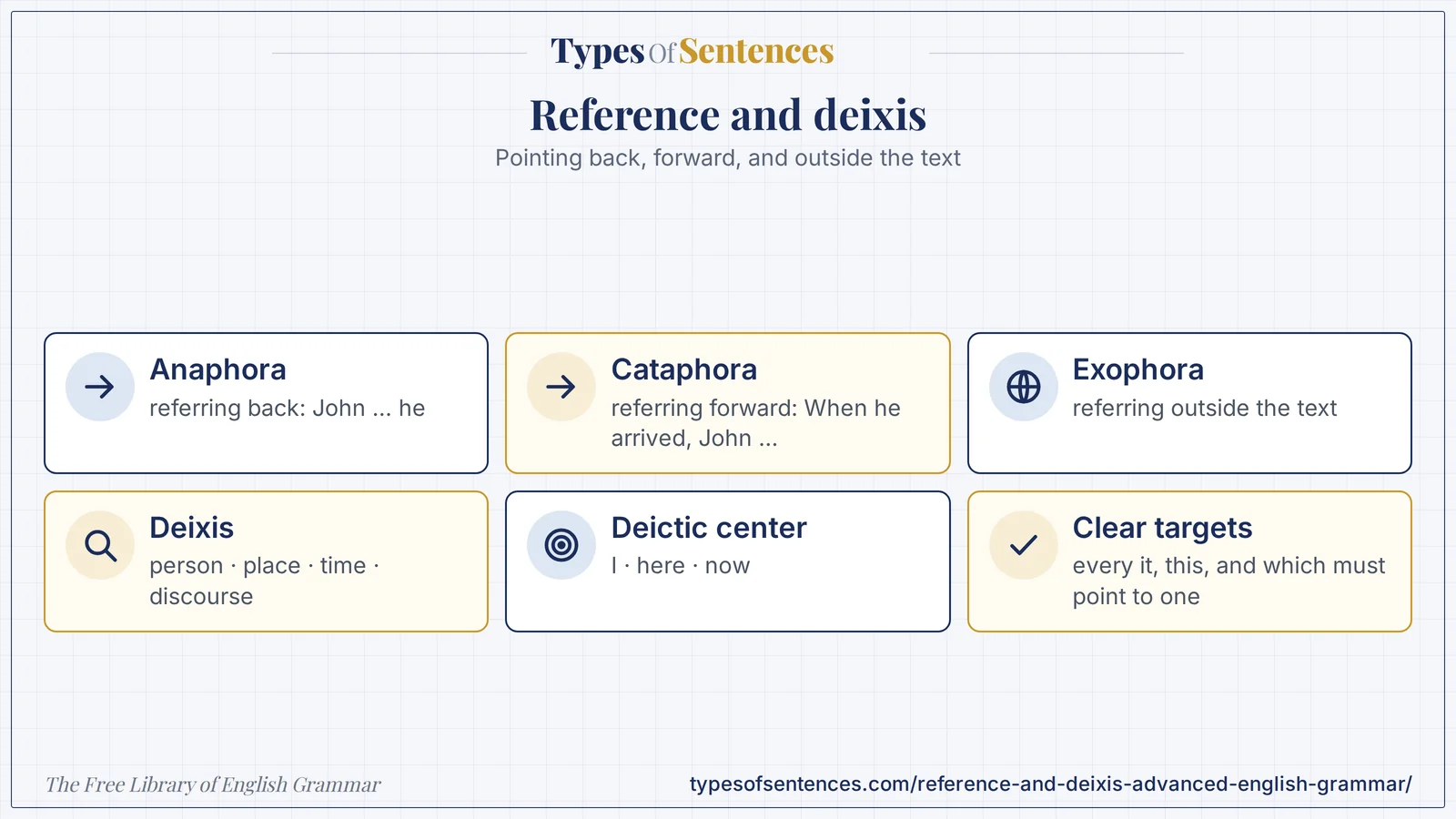
Some words do not have a fixed meaning. I means the speaker, whoever that is; here means the place of speaking; that means something the speaker points to or has just mentioned. Such words are “pointing words”, and understanding them means knowing the context.
Why it matters: In writing, the context is the text itself and the situation of reading. A writer must make sure that every pointing word has a clear target, because the reader cannot ask what it or this refers to.
Summary: Reference is the relation between an expression and what it refers to. When the referent is in the text, reference is endophoric: anaphoric (referring back: John … he) or cataphoric (referring forward: When he arrived, John was happy). When the referent is in the situation, it is exophoric (Look at that!). Deixis is the use of expressions whose reference depends on the speaker, the addressee, the time, and the place of the utterance: person (I, you, we), place (here, there), time (now, then), discourse (the following), and social deixis (titles). Reported speech shifts the deictic center.
- Anaphora = back; cataphora = forward; exophora = outside the text.
- Deixis = pointing with words: person, place, time, discourse, social.
- The deictic center: I, here, now.
- Make every it, this, and which point to a clear target.
What You’ll Learn
- 1. Reference and Deixis: What Is Reference?
- 2. Anaphoric Reference: Referring Back
- 3. Cataphoric Reference: Referring Forward
- 4. Exophoric Reference: Referring to the Situation
- 5. What Is Deixis? The Deictic Center
- 6. Person Deixis: I, You, We
- 7. Place Deixis: Here, There, This, That, Come, Go
- 8. Time Deixis: Now, Then, Yesterday, Tomorrow
- 9. Discourse Deixis and Social Deixis
- 10. Tracking Reference in Writing
- 11. Common Errors with Reference and Deixis
- 12. Exercises
- 13. Test Your Knowledge
- 14. Frequently Asked Questions
- 15. Conclusion
1. Reference and Deixis: What Is Reference?
Reference is the way in which an expression picks out an entity (a person, thing, place, event, or idea). The entity that it picks out is the referent. Referring expressions include proper names (Maria), definite noun phrases (the manager), pronouns (she, it), demonstratives (this, that), and indefinite noun phrases when they introduce a new entity (a man).
| Type of reference | Where the referent is | Example | Name |
|---|---|---|---|
| anaphoric | earlier in the text | John came. He was happy. | endophoric (inside the text) |
| cataphoric | later in the text | When he arrived, John was happy. | endophoric |
| exophoric (situational) | in the situation of speaking | Look at that! Pass the salt. | exophoric (outside the text) |
| homophoric (shared knowledge) | in the common culture | The sun is shining. The president spoke. | exophoric, shared |
| generic | a whole class | You can’t win them all. A dog is loyal. | — |
| Referring expression | Identifiability | Example |
|---|---|---|
| proper name | identifies a known individual | Maria, Delhi, Microsoft |
| definite noun phrase | the hearer can identify it | the report, the man in the hat |
| pronoun | recoverable from context | she, it, they |
| demonstrative | pointed to or just mentioned | this, that, these, those |
| indefinite noun phrase | introduces a new entity | a man, some books |
| possessive | identified through the owner | my sister, her car |
The grammar of the articles that signal identifiability is treated in the chapter on advanced article usage. The cohesive role of reference in a text is treated in the next chapter, on cohesion and coherence.
2. Anaphoric Reference: Referring Back
| Device | Example | Notes |
|---|---|---|
| personal pronoun | Maria called. She left a message. | agrees with the antecedent in person, number, and gender |
| demonstrative (this, that) | The plan failed. That surprised everyone. | refers to a clause or an idea |
| definite noun phrase | A man arrived. The man wanted a room. | repeats or renames |
| superordinate or synonym | I bought a Ford. The car is red. | renaming |
| such, so, the same, another | She wore a red hat; another was blue. I hope so. | substitution and comparison |
| it for a clause | He lied. It upset me. | sentential it |
| relative which | He was late, which annoyed me. | a clause as antecedent |
| bridging (associative) anaphora | I bought a car. The engine is noisy. | the engine is part of the car |
| reflexive | Maria hurt herself. | the antecedent is in the same clause |
| zero (ellipsis) | Maria came and [she] left. | omitted subject |
| Problem | Example | Fix |
|---|---|---|
| ambiguous pronoun | John told Bill that he was late. (who was late?) | John told Bill, “You are late.” / John told Bill that John was late. |
| vague this/it/which | The prices rose. This surprised us. (the rise? the fact?) | The price rise surprised us. |
| remote antecedent | Maria spoke to the manager, who works in finance and who said that the plan was costly. She left. (who left?) | repeat the noun |
| number disagreement | Each student brought their book. (formal: his or her) | singular they is now accepted |
| no antecedent | In the report, they say that … (who?) | The authors of the report say that … |
Pronouns normally refer to the nearest preceding noun phrase that agrees with them, and to the subject in case of doubt, but these are tendencies and not rules. A reader resolves a pronoun by agreement, nearness, and sense. The pronoun system and agreement with indefinite antecedents are treated in the chapter on advanced pronoun concepts. The relation between anaphora and ellipsis and substitution is treated in the chapter on ellipsis and substitution.
3. Cataphoric Reference: Referring Forward
| Pattern | Example | Notes |
|---|---|---|
| pronoun before a noun (subordinate clause first) | When he arrived, John was happy. Before she left, Maria called. | the pronoun precedes the noun in a fronted subordinate clause |
| pronoun in a postposed clause | Although he was tired, Tom worked. | — |
| this introducing what follows | Here is what I mean: …. This is the problem: nobody knows. | a colon or dash follows |
| the following, as follows | The steps are as follows: … | a text marker |
| such + that | Such was his anger that he left. | — |
| it anticipating a clause | It is clear that she left. | extraposition |
| narrative opening | He was a tall man, Mr. Smith. She stood at the door, the old teacher. | a pronoun introduces the character |
| both, all, each before the list | Both of them, Maria and Tom, agreed. | — |
4. Exophoric Reference: Referring to the Situation
| Type | Example | Notes |
|---|---|---|
| pointing at an object | Give me that. I’ll take this one. | requires a gesture or shared attention |
| pronoun without antecedent (situational) | Look out! It’s coming! | the referent is perceived |
| definite noun phrase from the situation | Pass the salt. Close the door. | known in the situation |
| homophoric (unique in the culture) | The sun, the moon, the president, the Internet | one possible referent |
| generic you, they, one | You never know. They say it’s going to rain. | vague people |
| written text addressing the reader | This paper argues that … Here we show … In the present study … | the text and the writer are the referents (partly discourse deixis) |
Exophoric reference is the usual kind in face-to-face conversation, and it is the reason why a transcript of a conversation can be hard to understand: the gestures and the objects are not in the transcript. Written texts try to avoid it, and must make the reference explicit, because the reader does not share the writer’s situation.
5. What Is Deixis? The Deictic Center
Deixis (from a Greek word for “pointing”) is the use of expressions whose reference depends on the context of the utterance. A deictic expression is interpreted relative to a deictic center (the origin), which is by default the speaker at the time and place of speaking: “I, here, now”.
| Type | Examples | Reference point |
|---|---|---|
| person deixis | I, you, we, my, your, yours, this writer | the speaker and the addressee |
| place deixis | here, there, this, that, these, those, left, right, in front of, come, go, bring, take, up, down | the location of the speaker |
| time deixis | now, then, today, yesterday, tomorrow, last week, next year, ago, soon, recently, tense | the time of speaking |
| discourse deixis | the following, as mentioned above, this chapter, the latter, the former, in the next section, this point, that is a good question | the text itself |
| social deixis | Sir, Madam, Dr., Your Honor, T/V pronouns in other languages | the social relationship |
| Proximal | Distal |
|---|---|
| this, these | that, those |
| here | there |
| now | then |
| today, this week | that day, that week |
| come | go |
| bring | take |
The distinction between proximal (near) and distal (far) is the core of English deixis. Note that “near” may refer to space, time, or the speaker’s feelings: this film (the one I am talking about, and care about) versus that film (distant, or disliked). Tense is also deictic: the present locates the event at the time of speaking and the past before it; see the chapter on tense and aspect.
6. Person Deixis: I, You, We
| Form | Reference | Example |
|---|---|---|
| I, me, my | the speaker | I think so. |
| you | the addressee (singular or plural) | You are late. |
| inclusive we | speaker and addressee | Let’s go. We should leave. (you and I) |
| exclusive we | speaker and others, not the addressee | We are going to Paris. (you are not coming) |
| royal we | one person (a monarch) | We are not amused. |
| editorial we | the writer (and the reader) | We can see that the results are significant. |
| generic you | people in general | You can’t trust everyone. |
| generic they | unspecified people | They say it will rain. (they = the weather forecasters) |
| one | impersonal; formal | One must be careful. |
| third person (he, she, it, they) | others (not deictic by themselves) | She called. |
| plural you forms (dialect) | you all | you guys, y’all, youse, yous |
| Contrast | Example | Meaning |
|---|---|---|
| Let’s go versus Let us go | Let’s go. / Let us go! | let’s includes the addressee; let us asks permission (excluding the addressee) |
| we in academic writing | We argue that … / The author argues … / I argue … | editorial we is a style choice |
| you in instructions | You should press the button. | generic or addressee |
| this writer, yours truly | This writer disagrees. | indirect self-reference |
Person deixis shifts in reported speech: “I will help you,” she said becomes She said that she would help me (if I am the one addressed). The shift of person, time, and place in reported speech is treated in the chapter on advanced reported speech. Many languages mark politeness and social distance with the choice of pronoun (such as the T/V distinction); English lost this in the case of thou and you, and uses titles and names instead.
7. Place Deixis: Here, There, This, That, Come, Go
| Expression | Use | Example |
|---|---|---|
| here | the place of the speaker (a room, a town, a planet) | I live here. Come here! |
| there | a place away from the speaker; or near the addressee | I will meet you there. Is she there? |
| this, these | near or relevant | This book is mine. Look at these. |
| that, those | far, or the hearer’s side | That house is old. Those are mine. |
| come | movement toward the speaker (or the addressee) | Come here! I’ll come to your party. |
| go | movement away from the speaker | Go there! I’m going to Paris. |
| bring | toward the speaker or addressee | Bring me the book. |
| take | away from the speaker | Take it to her. |
| left, right, in front of, behind | relative to the viewpoint | The pen is on my left. The car is in front of the house. |
| up, down, upstairs | relative to the speaker’s location | Come up. She’s downstairs. |
| this/that + place noun | — | this city (here), that city (there) |
| Frame of reference | Example | Meaning |
|---|---|---|
| deictic (speaker’s viewpoint) | The ball is in front of the tree. | between me and the tree |
| intrinsic (the object’s own front) | The ball is in front of the car. | the front of the car |
| absolute (compass) | The shop is north of the river. | independent of the viewpoint |
Place deixis shifts in narrative and in telephone conversations. When the speaker takes the addressee’s point of view, come is used for movement toward the addressee: I’ll come to your house (not go). In narrative, the deictic center can move to a character: She looked up; a man was coming toward her, where coming is from the point of view of the character. These shifts are treated in the discussion of free indirect speech in the chapter on reported speech.
8. Time Deixis: Now, Then, Yesterday, Tomorrow
| Deictic (relative to now) | Non-deictic (relative to another time) | Notes |
|---|---|---|
| now | then, at that time | proximal and distal |
| today | that day | — |
| yesterday | the day before, the previous day | reported speech |
| tomorrow | the next day, the following day | — |
| last week, last year | the week before, the previous year | — |
| next week, next year | the week after, the following week | — |
| ago | before | two years ago (from now) versus two years before (from then) |
| this morning, this week | that morning, that week | — |
| soon, recently, lately | later, earlier | — |
| Expression | Interpretation | Notes |
|---|---|---|
| next Friday | ambiguous: the first Friday after now, or the Friday of next week | specify the date to avoid confusion |
| this Tuesday | the nearest Tuesday (past or future depending on the tense) | — |
| on Tuesday | a calendar day, interpreted by tense | — |
| in two weeks | two weeks from now | — |
| I am writing this now | at the time of writing, not of reading | coding time versus receiving time |
| by the time you read this | deixis of the reader’s time | letters and emails |
Time deixis is interpreted relative to the time of speaking. In a letter or an email, the time of writing and the time of reading differ, and writers sometimes adjust: By the time you read this, I will be in Delhi. In reported speech, deictic time words are replaced by non-deictic ones: “I will come tomorrow” becomes She said she would come the next day. The sequence of tenses is covered in the chapter on tense and aspect.
9. Discourse Deixis and Social Deixis
| Discourse deixis | Example | Notes |
|---|---|---|
| above, below, earlier, later | As mentioned above, … See below. | points to a part of the text |
| this, that + text noun | This chapter … In that section … | — |
| the former, the latter | Maria and Tom came; the former left early. | refers to two items in order |
| this, that + proposition | That is a good point. This shows that … | the proposition is pointed to |
| the following, as follows | The steps are as follows: | cataphoric |
| legal formulas | herein, hereby, aforementioned, thereof, hereinafter | formal and legal |
| here in a text | Here we show … Here the author argues … | — |
| Social deixis | Example | Notes |
|---|---|---|
| titles and forms of address | Sir, Madam, Dr. Rao, Professor, Your Honor, Your Majesty | mark status and respect |
| first names vs titles | Maria / Ms. Rao | degree of familiarity |
| T/V pronouns (other languages) | tu/vous (French), du/Sie (German) | English lost thou |
| honorifics | Mr., Mrs., Ms., Mx. | — |
| inclusive vs exclusive address | Dear colleagues, Dear all, To whom it may concern | letters |
The difference between anaphora and discourse deixis is subtle: anaphora refers to the same entity as an earlier expression (The plan failed; it was costly), while discourse deixis refers to the text or an expression (As mentioned above, That is a good point). Both are devices of cohesion. The use of the former and the latter is discouraged by many style guides, because the reader must look back; it is clearer to repeat the noun.
10. Tracking Reference in Writing
| Stage | Device | Example |
|---|---|---|
| introduce a participant | indefinite noun phrase or name | A man arrived. Maria called. |
| maintain | pronoun | He wanted a room. She said no. |
| re-introduce after a gap | definite noun phrase or name | The man returned the next day. |
| shift | new subject or topic | Meanwhile, Maria was at home. |
| clarify | repeat the noun | When Maria met the manager, the manager said that Maria should wait. |
| summarize | this + noun | This approach has two advantages. |
- Check every pronoun for a clear antecedent: if two nouns could be the antecedent, repeat the noun.
- Avoid this, that, it, and which with no noun when the antecedent is a whole clause or an idea: This shows is vague; This result shows is clear.
- Use this + noun (this approach, this finding) to summarize the preceding idea.
- Keep the person consistent: do not shift between you, one, and we without a reason.
- Check deictic time words in emails and letters: tomorrow and next week may be misread by a later reader.
11. Common Errors with Reference and Deixis
| Error | Correction | Rule |
|---|---|---|
| John told Bill he was late. (unclear) | John told Bill, “You are late.” / John said that Bill was late. | ambiguous pronoun |
| The prices rose. This surprised us. (vague) | The price rise surprised us. | vague this |
| In the article, they say that … | The authors of the article say that … | no antecedent |
| Each student brought their books. (formal) | Each student brought his or her book. / The students brought their books. | agreement (or singular they) |
| She said that she will come tomorrow. (reported, past) | She said that she would come the next day. | shift of time and tense |
| Take it here. (toward the speaker) | Bring it here. | bring vs take |
| I’ll go to your party. (from the addressee’s view) | I’ll come to your party. | come toward the addressee |
| This paper, we show that … | In this paper, we show that … | — |
| The former and the latter are confusing. (in a long text) | Repeat the nouns. | discourse deixis |
| You can’t trust anyone, one should be careful. | One can’t trust anyone; one should be careful. / You can’t trust anyone; you should be careful. | consistent person |
| Next Friday I will arrive. (ambiguous) | On Friday, 12 November, I will arrive. | time deixis |
| We are not amused. (in an ordinary essay) | I am not amused. | the royal we |
Edit: John told Bill he was late, and the prices rose, this surprised us, and in the article they say that each student brought their books, and she said that she will come tomorrow, and take it here, and next Friday I will arrive.
- John told Bill he was late: John told Bill, “You are late.”
- this surprised us: the price rise surprised us.
- they say: the authors say.
- each student … their: the students brought their books.
- she will come tomorrow: she would come the next day.
- take it here: bring it here.
- next Friday: on Friday, 12 November.
- Result: John told Bill, “You are late.” The prices rose, and the price rise surprised us. In the article the authors say that the students brought their books. She said that she would come the next day. Bring it here. On Friday, 12 November, I will arrive.
Recap in 12 seconds
Watch the lesson build itself: Reference can be anaphoric, cataphoric, or exophoric, and deixis points with words from the deictic center. The video has no sound.
Exercises
Part A: Types of Reference (Exercises 1–7)
Exercise 1: Name the type: John came. He was happy. (He)
Show Answer
Answer: Anaphoric.
Exercise 2: Name the type: When he arrived, John was happy. (he)
Show Answer
Answer: Cataphoric.
Exercise 3: Name the type: Look at that!
Show Answer
Answer: Exophoric.
Exercise 4: Name the type: The sun is shining.
Show Answer
Answer: Homophoric (shared knowledge).
Exercise 5: Name the type: The steps are as follows:
Show Answer
Answer: Cataphoric (discourse deixis).
Exercise 6: Name the device: I bought a car. The engine is noisy.
Show Answer
Answer: Bridging (associative) anaphora.
Exercise 7: Name the device: He lied. It upset me. (It)
Show Answer
Answer: A sentential pronoun referring to a clause.
Part B: Fixing Unclear Reference (Exercises 8–13)
Exercise 8: Fix: John told Bill he was late.
Show Answer
Answer: John told Bill, “You are late.”
Exercise 9: Fix: The prices rose. This surprised us.
Show Answer
Answer: The price rise surprised us.
Exercise 10: Fix: In the article, they say …
Show Answer
Answer: The authors of the article say …
Exercise 11: Name the problem: Each student brought their books. (formal view)
Show Answer
Answer: Pronoun-antecedent agreement (or accepted singular they).
Exercise 12: Replace for clarity: This shows that …
Show Answer
Answer: This result shows that …
Exercise 13: Replace the former and the latter in a long text:
Show Answer
Answer: Repeat the nouns.
Part C: Person and Place Deixis (Exercises 14–20)
Exercise 14: Inclusive or exclusive we: Let’s go.
Show Answer
Answer: Inclusive.
Exercise 15: Inclusive or exclusive we: We are going to Paris. (to a friend who is not coming)
Show Answer
Answer: Exclusive.
Exercise 16: Name the use: We can see that the results are significant.
Show Answer
Answer: Editorial we.
Exercise 17: Choose: (Come/Go) here!
Show Answer
Answer: Come.
Exercise 18: Choose: (Bring/Take) it to her.
Show Answer
Answer: Take.
Exercise 19: Choose from the addressee’s view: I’ll (come/go) to your party.
Show Answer
Answer: come.
Exercise 20: Name the pair: here / there
Show Answer
Answer: Proximal and distal.
Part D: Time and Discourse Deixis (Exercises 21–26)
Exercise 21: Reported speech: “I will come tomorrow,” she said.
Show Answer
Answer: She said she would come the next day.
Exercise 22: Reported speech: “It happened yesterday.”
Show Answer
Answer: …it had happened the day before.
Exercise 23: Name the problem: Next Friday I will arrive.
Show Answer
Answer: Ambiguity of next.
Exercise 24: Name the type: as mentioned above
Show Answer
Answer: Discourse deixis.
Exercise 25: Name the type: That is a good point. (That)
Show Answer
Answer: Discourse deixis (a proposition).
Exercise 26: Name the type: Sir, Madam
Show Answer
Answer: Social deixis.
Part E: Tracking (Exercises 27–30)
Exercise 27: Which device introduces a new participant?
Show Answer
Answer: An indefinite noun phrase or a name.
Exercise 28: Which device maintains a participant?
Show Answer
Answer: A pronoun.
Exercise 29: Fix: This paper, we show that …
Show Answer
Answer: In this paper, we show that …
Exercise 30: Why are letters tricky for time deixis?
Show Answer
Answer: The time of writing and the time of reading differ.
Test Your Knowledge
Ready to check what you learned? Answer all 10 questions, then submit. You need 80% (8 of 10) to pass. Your answers are not stored.
View correct answers and explanations
Question 1: What is anaphora?
✓ Correct Answer: A – reference back
Anaphora refers back.
Question 2: What is cataphora?
✓ Correct Answer: B – reference forward
Cataphora refers forward.
Question 3: Which is exophoric?
✓ Correct Answer: C – Look at that!
The referent is in the situation.
Question 4: Which is deixis?
✓ Correct Answer: D – here
Here depends on the speaker’s place.
Question 5: Which is inclusive we?
✓ Correct Answer: C – Let’s go.
Includes the addressee.
Question 6: Which is correct?
✓ Correct Answer: B – John told Bill, “You are late.”
Removes the ambiguity.
Question 7: Which is vague?
✓ Correct Answer: D – The prices rose. This surprised us.
This has no clear antecedent.
Question 8: Which verb moves toward the speaker?
✓ Correct Answer: C – come
Come.
Question 9: Which is a discourse deictic?
✓ Correct Answer: A – as mentioned above
It points to the text.
Question 10: Which is the reported form of tomorrow?
✓ Correct Answer: B – the next day
Tomorrow becomes the next day.
Frequently Asked Questions
What are reference and deixis?
Reference is the relation between an expression and what it refers to; deixis is the use of expressions (I, here, now) whose reference depends on the speaker, place, and time of the utterance. The study covers anaphora, cataphora, and exophora, and the types of deixis.
What is deixis grammar?
Deixis grammar is the study of the pointing words of a language: person (I, you), place (here, there), time (now, then), discourse (above), and social deixis (titles).
What is reference grammar?
Reference grammar is the study of how expressions refer: pronouns, demonstratives, definite noun phrases, and names, and the relations of anaphora, cataphora, and exophora.
What is the difference between anaphora and cataphora?
Anaphora refers back to something already mentioned (John came. He was happy); cataphora refers forward to something that comes later (When he arrived, John was happy). The terms anaphora cataphora cover both directions of endophoric reference.
What is context-dependent meaning?
Context-dependent meaning is meaning that cannot be fixed without the context of the utterance: the meaning of I, here, that, and yesterday depends on who speaks, where, and when.
What is the difference between inclusive and exclusive we?
Inclusive we includes the person addressed (Let’s go); exclusive we excludes them (We are going to Paris, said to someone who is not going).
How can I avoid unclear reference?
Check every pronoun and demonstrative for a clear antecedent, repeat the noun when two nouns could be meant, and add a noun after this (this result).
Conclusion
You now have a deep study of reference and deixis: anaphoric, cataphoric, and exophoric reference, the deictic center, person, place, time, discourse, and social deixis, the shifts in narrative and reported speech, and the habits that keep reference clear. You can handle pointing words with expert control.
When you write, ask where each pronoun and demonstrative points. Next, you will study cohesion and coherence.
- Huddleston, Rodney, and Geoffrey K. Pullum. The Cambridge Grammar of the English Language. Cambridge University Press, 2002.: the reference analysis of pronouns, anaphora, and deixis.
- Halliday, M. A. K., and Ruqaiya Hasan. Cohesion in English. Longman, 1976.: the classic account of reference as a cohesive device.
- Levinson, Stephen C. Pragmatics. Cambridge University Press, 1983.: the standard account of deixis.
- Quirk, Randolph, et al. A Comprehensive Grammar of the English Language. Longman, 1985.: the classic treatment of pronouns and reference.
- Merriam-Webster Dictionary: deixis: the dictionary entry.
Last reviewed: October 29, 2026. How it was made: drafted with AI assistance, then checked with automated tests (structure, links, answer keys, spelling) and against the sources above. A person has not yet read this chapter line by line. Found a mistake? Report it.